Four spans for serious hope that does not overload a new chapter
Start Serious Long-Distance Dating at a Low-Pressure Pace
Build serious long-distance dating after a new beginning with a low-pressure rhythm, clear structure, privacy, money safeguards and a safe visit plan.

Build direction, rhythm, evidence and crossing as separate spans.
Written and edited by Jean-Claude Mukendi · Relationship Guides Editor
Build four separate spans. State serious direction without guaranteeing an outcome. Design a low-pressure rhythm both adults can initiate, repair and review. Let repeated conduct—consistent facts, kept plans, respected limits and financial independence—create evidence. Keep past records, accounts and live location outside readiness proof. Discuss exclusivity directly. Send no fare, visa, medical, device or investment money. Before any crossing, independently check necessary facts and preserve a public first meeting, controlled lodging, documents, funds, consent and return. Continue with one proportionate span, revise a specific strain, or close when the bridge stays vague, one-sided or pressured.
Relationship intent · New Relationship Starters
How can serious direction stay credible across distance without making a new journey rush into exclusivity, disclosure, money, travel or future promises?
Serious low-pressure long-distance dating on a new journey is adult connection oriented toward lasting partnership while communication, disclosure and access grow at a deliberately modest, mutually understood pace. The four-span bridge separates direction, rhythm, evidence and crossing so hope cannot silently create structure, dependence or travel obligations.
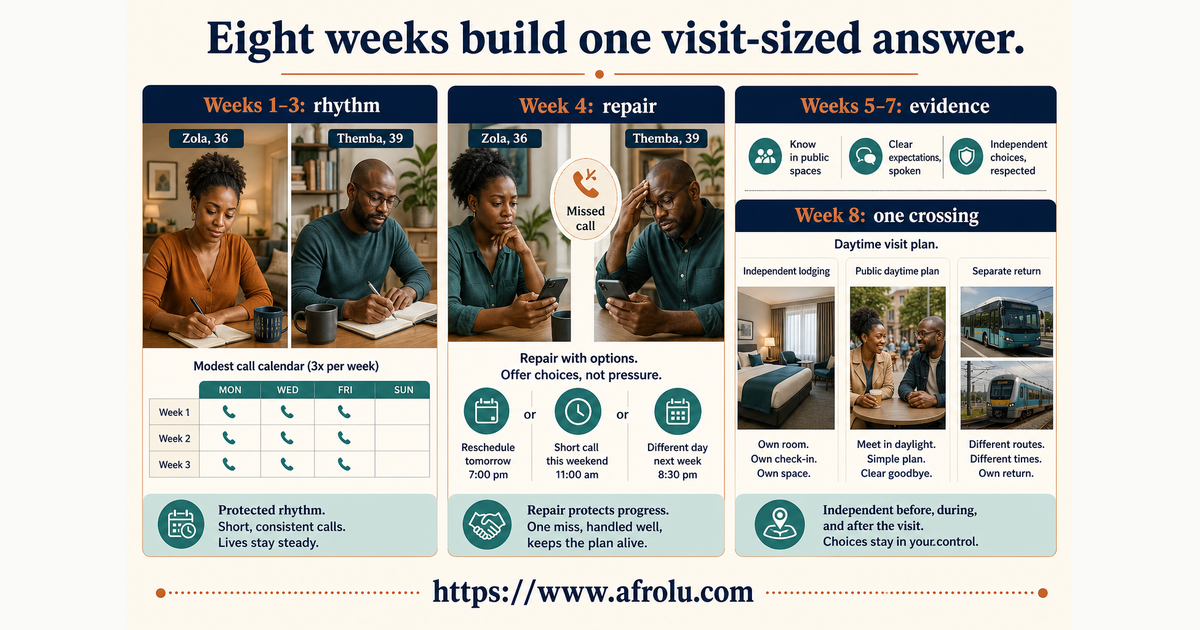
Zola and Themba are fictional adults, 36 and 39, dating across cities after different life transitions. They choose a light eight-week rhythm, remain non-exclusive and protect private histories. A missed call receives a practical repair. Repeated conduct then supports one public visit with independently controlled lodging, money and return—not an automatic promise of exclusivity or relocation.
The four-span distance bridge
Give serious hope structure without turning it into urgency
Jean-Claude separates future direction, a light rhythm, repeated evidence and one complete crossing for adults beginning again.
The bridge uses four independent spans, an eight-week evidence cycle and a six-anchor visit check without treating past disclosure or sunk cost as commitment.
Serious direction
Name lasting-partnership intent while leaving the outcome open.
Low-pressure rhythm
Choose sustainable contact, repair and a review point.
Repeated evidence
Use conduct, limits and financial independence rather than intensity.
Complete crossing
Anchor identity, place, lodging, funds, consent and return.
Keep hope larger than urgency
Serious dating names a future direction, not a speed or guarantee
A new journey may follow relocation, bereavement, divorce, career change, recovery from burnout, a long single period or an ordinary decision to date differently. The phrase does not identify a diagnosis or make every past detail relevant. You can describe present capacity without producing a history dossier. Serious intention means you are open to exploring lasting partnership; it does not promise that this particular connection will become one.
Low pressure describes speed. It can mean modest calls, gradual disclosure, affordable visits and permission to preserve work, friendships, rest and private reflection. It should reduce performance, not accountability. A light rhythm still needs a reason, mutual understanding, reciprocal initiative, repair and a review point. Long-distance geography makes those elements more important because ordinary gaps can otherwise be filled by hope or fear.
Structure answers whether either adult dates or has sex with other people under the current agreement. Serious direction does not make exclusivity automatic. Neither do daily messages, a disclosed past, a costly visit or a future plan. Ask directly and discuss relevant sexual-health expectations before intimacy. Every digital and physical consent choice remains specific, current and reversible.
This guide offers a decision framework, not therapy, legal advice, immigration advice or a prediction about long-distance success. Relationship research can challenge simple assumptions, but cannot forecast an individual pair. The practical task is smaller: build a serious bridge from present conduct, protect both complete lives, and cross only when identity, place, money, consent and return work independently.
Build the four spans in order
Direction, rhythm, evidence and crossing carry different loads
The direction span records what each adult is genuinely open to: lasting partnership, a lighter connection or uncertainty. Serious adults can still discover incompatibility. Discuss broad future questions—location, work, family, faith, finances—without treating early answers as contracts. If one adult needs certainty immediately, the honest response may be that the bridge is not ready, not an inflated promise offered to prevent disappointment.
The rhythm span protects real life. Choose contact both can initiate and sustain, a method for missed plans and a date to review. Time zones, work cycles and care duties can make unequal availability normal; they do not justify one-sided labour. Share broad capacity rather than employer systems, calendars, medical records or live location. A low-pressure bridge needs enough structure to distinguish flexibility from disappearance.
The evidence span is built from repeated small actions: consistent identity details, kept calls, realistic alternatives, respected limits, financial independence and repair that changes later conduct. Emotional intensity and disclosure volume are not stronger materials. Someone can share a painful history and still be unreliable; someone can preserve privacy and behave with care. Ask what the pattern supports, not how dramatic it feels.
The crossing span is travel or a future-location decision. It begins only after the earlier spans can carry it and the plan itself is complete. Independently check necessary facts and bookings. Keep public first meeting, suitable lodging, documents, money, communication, consent and return under the traveller's control. One visit is a bounded event, not an obligation to move, cohabit, combine finances or stay after new evidence appears.
Zola and Themba use an eight-week bridge cycle
A repaired small plan supports one visit-sized next step
Zola, 36, and Themba, 39, are fictional adults in different cities. Both describe themselves as starting a new chapter and dating toward lasting partnership. They choose two brief midweek check-ins and one longer call every second weekend. Neither requests constant location, work calendars or a detailed account of past relationships. They remain non-exclusive while discussing what a future structure conversation would require.
In week four, Themba misses their longer call because a family obligation changes unexpectedly. He sends an apology the next morning, explains only what he chooses and offers two alternatives. Zola says the miss was disappointing but does not demand evidence. They reschedule. The repair matters because it restores the plan without making privacy the price of reassurance.
Over the next three weeks, both initiate, details remain consistent and limits receive respect. They talk about the possibility of one visit but send no fare or booking money to each other. Zola independently checks transport and reserves cancellable lodging under her control. Themba confirms a public daytime plan. Both retain documents, phones, money and separate routes. No visit depends on staying at a private home.
At week eight, they agree to the visit and set a review afterward. They do not become exclusive because a ticket was purchased. They do not promise relocation because the remote rhythm felt caring. The next step matches the evidence: one bounded crossing supported by direction, rhythm and conduct. If in-person information changes the picture, either adult remains free to revise or end.
Inspect the bridge without diagnosing the builders
Serious and light, temporarily strained, vague and rushed are different patterns
Serious and light means both adults can name a lasting-partnership direction while maintaining modest, mutually designed contact. A next step exists and both contribute. Low pressure protects capacity rather than insulating the relationship from all questions. The pattern can remain serious even when a week is quiet, provided changes are communicated and a route back to the ordinary rhythm exists.
Temporary strain has a reason, a bounded effect and a return or review point. Work deadlines, illness or care responsibilities may reduce contact. Nobody owes protected documents to prove the context. Each adult still decides whether the temporary arrangement meets their needs. If the end date keeps moving, rename the actual pattern and make a new decision rather than living under an expired exception.
Vagueness avoids present structure, future direction and concrete plans while continuing to collect attention. One adult may be warm whenever available but never initiate, repair or define. Ask once for a decision-sized answer and observe. Serious words that cannot produce one modest repeatable plan are not yet serious evidence.
Rushed access uses the language of a new beginning or destiny to accelerate exclusivity, intimate disclosure, money, private images, travel, home or relocation. Slow the specific step. A respectful partner can tolerate verification and independent arrangements. Threats, surveillance, extortion, account intrusion or stalking require system protection and qualified support, not another attempt to prove romantic intent.

Judge the span by clarity, reciprocity, repair and preserved choice.
Use present-tense span language
A serious answer can be warm without promising access it cannot support
State direction plainly: ‘I am dating toward a lasting partnership and want to discover fit slowly.’ This communicates purpose without guaranteeing the other person an outcome. Ask their direction and accept uncertainty if it is honest. If you need a firm answer sooner, that is also valid. Compatibility includes whether the decision timelines themselves can coexist.
Turn low pressure into a rhythm: ‘I can offer one longer call every second weekend and two flexible check-ins.’ Add a repair method and review date. Broad capacity is sufficient; neither adult needs screenshots, work contacts, account access or continuous location. If fewer calls feel inadequate, say so as a need rather than accusing the other adult of failing a universal rule.
Protect the new journey: ‘I will share previous experiences when they are relevant and I choose to; they are not verification material.’ You can discuss present health, consent, finances and practical constraints directly without recounting every past relationship. A partner may need information for their own decision, but cannot demand confidential records or a complete narrative as the price of continuing.
Keep travel language complete: ‘I will book only after I verify the plan, and I will control my lodging, documents, money and return.’ Refuse fare, visa, emergency or investment transfers. A serious partner can support independent planning. If they call independence disloyal or insist that private accommodation proves trust, do not cross. The bridge is missing a safety span.

Say the present agreement before hopeful distance fills the gap.
Anchor the first visit
Verification, public meeting, lodging, money, consent and return must all work
Check the identity and booking facts necessary for the visit through sources you can access independently. An ordinary video call may help, but it is not complete verification. Do not send document copies or use a verification service selected by the match. Compare information proportionately and stop if contradictions affect safety or feasibility. Curiosity does not authorise intrusive investigation.
Plan a staffed public first meeting and suitable lodging controlled by the traveller. Know how to reach both without dependence on the match. Keep documents, phone, medication and payment accessible. Share selected trip information with a trusted person if useful, but do not broadcast live location. Check current destination, health, insurance and entry guidance from official sources; this page cannot keep those requirements current for every traveller.
Protect the whole budget, including a change of plan and return. Do not send fare, visa, customs, medical, device or emergency money to a remote match. Romance scams may build daily trust before an urgent request. If money was sent suspiciously, contact the bank, transfer service or platform promptly, secure connected accounts and report through suitable local channels.
Consent is not purchased by travel cost and does not continue automatically from remote conversation. Each physical act, image and recording needs a current answer. Either adult can change the itinerary or leave. A traveller should not be trapped by lodging, documents or lack of fare. Immediate danger needs local emergency help; non-urgent concerns may require provider, legal, medical or safeguarding support.

Travel is one bounded meeting, not proof that the entire future has arrived.
Choose the next span, not the whole destination
Continue, revise or close while both complete lives remain standing
Continue when serious direction is mutual, the light rhythm remains visible, both adults initiate and repair, private systems stay private and the next plan is complete. Choose one step: another remote cycle, a structure conversation or one public visit. Keep exclusivity, home access, money, sex, family involvement and relocation behind different agreements. Hope does not need all doors open at once.
Revise when the direction fits but a cadence, expectation or logistical plan strains. Change one observable feature and name the next review. Perhaps calls become less frequent but more reliable, planning becomes reciprocal or a visit is postponed until the budget works. Revision without changed behaviour simply gives the old ambiguity a kinder name.
Close when serious direction is one-sided, lightness becomes indefinite vagueness, one adult carries the bridge or money and access pressure persists. A concise ending is enough. Do not travel for closure or debate your history to prove the decision. Remove permissions, secure accounts and return items through a safe method. The relationship can end without making the new journey a mistake.
If threats, violence, stalking, extortion, workplace intrusion or account compromise occurs, protect the affected system first. Preserve useful evidence and use qualified local support. Relationship research reviewed here describes group patterns and aspects of commitment; it cannot certify a partner. Your final evidence is conduct: does the connection increase clarity and choice while both adults remain able to live, work, move and seek help independently?
Eight serious distance moments where one bridge span needs inspection
Present capacity is named without a history dossier
An adult says they are beginning again and describes a modest rhythm rather than recounting every past event.
Proceed because the current offer is specific.Future direction is shared without an outcome guarantee
Both adults date toward partnership and acknowledge that fit still needs evidence.
Build one small span instead of promising the destination.A temporary reduction has an end point
Work strain changes contact for ten days and the ordinary rhythm resumes afterward.
Read bounded context and repair together.A match demands records to prove readiness
Serious intent is made conditional on private documents and detailed relationship history.
Decline access and assess the response to the boundary.A first visit is pushed before the plan is complete
A discount deadline is used to bypass lodging, verification and return questions.
Let the fare expire; incomplete travel is not ready.Remote affection is followed by a money story
A sudden visa or medical problem supposedly blocks the long-awaited meeting.
Send nothing and contact providers if any transfer occurred.Serious does not mean the same present agreement
One adult wants exclusivity now and the other needs another month of non-exclusive dating.
Negotiate freely or accept incompatibility without inference.Six independent anchors support one visit
Identity, public plan, lodging, money, consent and return all work separately.
Travel for the bounded meeting, then review from in-person evidence.Evidence that low pressure still carries a serious direction
{'label': 'Direction', 'title': 'Serious intent is specific but not guaranteed', 'detail': 'Both can name the future being explored and the uncertainty that remains.', 'reading': 'Honest purpose'}
{'label': 'Rhythm', 'title': 'Low pressure has a repeatable shape', 'detail': 'Contact is modest, mutual and reviewed rather than demanded continuously.', 'reading': 'Sustainable movement'}
{'label': 'Initiative', 'title': 'Both adults carry bridge material', 'detail': 'Each sometimes asks, plans, confirms and repairs.', 'reading': 'Reciprocal effort'}
{'label': 'Privacy', 'title': 'A new journey is not an open archive', 'detail': 'Present decisions receive relevant information without forced history disclosure.', 'reading': 'Proportionate trust'}
{'label': 'Structure', 'title': 'Exclusivity is discussed directly', 'detail': 'Serious language and distance do not manufacture agreement.', 'reading': 'Present clarity'}
{'label': 'Money', 'title': 'Every adult retains financial control', 'detail': 'No fare, visa, device or emergency transfer becomes proof of care.', 'reading': 'Independent systems'}
{'label': 'Travel', 'title': 'The crossing is complete before booking', 'detail': 'Verification, place, lodging, funds and return remain usable.', 'reading': 'Practical readiness'}
{'label': 'Consent', 'title': 'Every remote and physical permission stays current', 'detail': 'Cost, exclusivity and history grant no intimate access.', 'reading': 'Free choice'}
{'label': 'Repair', 'title': 'A miss creates a changed next action', 'detail': 'The explanation is paired with alternatives and later reliability.', 'reading': 'Accountable conduct'}
{'label': 'Impact', 'title': 'Both complete lives remain functional', 'detail': 'The connection leaves room for work, friends, rest, money and reflection.', 'reading': 'Serious fit'}
Choose the next step from the four-span bridge
| Situation | What it may mean | What to do next |
|---|---|---|
Scripts for direction, rhythm, history, structure, money and travel
“I am dating toward a lasting partnership and still need time to discover our fit.”
“I can offer two check-ins and one longer call every second weekend.”
“After eight weeks, can we decide whether to visit or continue remotely?”
“I will share past experiences when relevant and by choice, not as a readiness test.”
“Serious does not tell me whether we are exclusive; what agreement do you want now?”
“I do not send fare, visa, medical or investment money to a remote match.”
“For a first visit, I will keep accommodation under my own control.”
“Travel and serious intent do not decide physical contact or images for me.”
“This rhythm is too thin for me; I need one reliable weekly plan or I will step back.”
“The bridge has stayed one-sided, so I am ending the connection.”
Know the difference
The five-card serious distance bridge register

Register each bridge decision separately.
Compare serious direction, pace, structure, distance and crossing
| Type or dimension | What it describes | Best next question |
|---|---|---|
| Serious intention | ||
| Low-pressure pace | ||
| Exclusive structure | ||
| Long-distance context | ||
| Temporary strain | ||
| First visit | ||
| Relocation discussion | ||
| Clean ending |
Build a serious new-journey distance bridge in six moves
Name serious direction
Design a light rhythm
Protect the new chapter
Observe bridge evidence
Anchor one crossing
Choose one span next
Questions organised by direction, rhythm, evidence and travel
Choose a few prompts that fit the moment. This is a reference library, not a list to complete.
Direction questions
Keep serious hope precise and non-guaranteed.
- What future are we exploring?
- What remains uncertain?
- Are we exclusive now?
- Which decision is too early?
- When will we choose again?
Rhythm questions
Fit contact around two complete lives.
- What cadence is sustainable?
- Can both adults initiate?
- How do we repair a miss?
- What does low pressure protect?
- When does a pause end?
Evidence questions
Use conduct rather than disclosure volume.
- Are details consistent?
- Are limits respected?
- Does effort travel both ways?
- Does repair change behaviour?
- Are money and systems independent?
Crossing questions
Complete every visit anchor before movement.
- What has been checked?
- Is the first plan public?
- Who controls lodging?
- Are consent and funds independent?
- Does return still work?
What relationship research and official guidance can support
Distance alone does not decide relationship quality or stability
A nationally representative U.S. study compared long-distance and close-proximity relationships and reported a more complex pattern than simple distance pessimism. Afrolu uses only the narrow lesson to inspect actual agreement and behaviour.
Evidence limit: The 2013 sample cannot forecast an individual pair or represent every African and cross-border context.
Dedication and constraint are not the same aspect of commitment
A U.S. study of unmarried adults examined dedication alongside perceived, material and felt constraints. The practical caution here is not to confuse sunk costs, tickets or social pressure with freely chosen dedication.
Evidence limit: Associations in one study do not diagnose a relationship or supply a decision rule for an individual.
Purpose and necessity offer a useful limit for data requests
Kenya's Data Protection Act includes principles related to lawful, purpose-specific and necessary processing. In personal dating, the cautious parallel is to share only what the present decision needs.
Evidence limit: The Act has defined scope and exemptions; this guide does not determine legal coverage.
Long-distance trust can be followed by travel or emergency requests
The U.S. Federal Trade Commission describes romance scams involving tickets, medical expenses, visas and investments. Protect essential funds and contact the provider quickly after suspected loss.
Evidence limit: U.S. reporting routes are jurisdiction-specific; use suitable local and provider channels.
A current answer is not replaced by travel, exclusivity or history
NHS public-health guidance explains active consent and withdrawal. Afrolu applies that principle to touch, sex, images and recording throughout remote connection and visits.
Evidence limit: The source explains UK context; laws and support services vary by location.
Official requirements and independent backups belong in the crossing
The UK Foreign, Commonwealth & Development Office checklist covers destination requirements, insurance, health, documents and backups. Use current official sources suited to your own citizenship and destination.
Evidence limit: The checklist is designed for British travellers and does not provide immigration or personalised travel advice.
Six shortcuts that overload a serious new beginning
Use a reviewed resource that matches the decision
This guide focuses on the relationship decision, so it does not rank dating apps. Check current prices, safety tools, and local availability before choosing a service.
Explore the guide library
Show more related guides
Continue with Afrolu
Show more Afrolu guides
Research and official guidance used for this distance bridge
Afrolu reviewed these health, research, safety, or public guidance resources while editing this page. They support the behaviour and safety guidance; they do not diagnose any individual described by a reader.
Serious low-pressure long-distance questions for a new journey
Can serious long-distance dating be low pressure?
Yes. Serious describes future direction; low pressure describes speed. Two adults can explore lasting partnership with modest, mutually understood contact. The rhythm still needs reciprocity, repair and a review point. Present exclusivity, travel, money and private access require separate agreements.
How much of my past must I disclose when starting again?
Share information relevant to the current adult decision, health, consent or practical safety, and do so truthfully. You do not owe a complete relationship history, records, passwords or private documents as proof of readiness. A match may decide they need more information, but cannot compel access.
Does serious intention mean we should become exclusive quickly?
No. Intention and structure answer different questions. Ask whether either adult dates or has sex with others and which health expectations matter. Exclusivity starts only through mutual agreement and never grants location tracking, passwords, money, sex or travel.
What makes low-pressure distance different from vague dating?
Deliberate low pressure has a reason, sustainable rhythm, reciprocal initiative, repair and a named review. Vagueness keeps direction, structure and next steps unavailable while collecting attention. Ask for one decision-sized plan, then judge the response and later conduct.
How long should we talk before a first visit?
No universal number of weeks establishes readiness. This guide's eight-week story is an example, not a rule. Travel is ready when necessary identity and booking facts are checked and public meeting, lodging, funds, consent and return work independently. Wait if any anchor is missing.
Should I pay a remote partner's fare, visa or emergency cost?
Do not use a transfer to prove serious intent. Romance scams may use tickets, visas, medical problems, devices or investments after sustained contact. Keep bookings and funds under your control. If money was sent suspiciously, contact the provider promptly, secure accounts and report through suitable channels.
Can a ticket make us committed or create consent?
No. A ticket is a travel purchase, not exclusivity, permanence or permission for touch, sex, images or recording. Each adult can change the plan. The traveller should retain lodging, documents, communication, money and a usable return so refusal does not create entrapment.
How do we handle a quiet period caused by work or family?
Name what changes, what contact remains possible and the return or review date. Nobody needs to submit records to prove capacity. Either adult can accept, renegotiate or decline. If the quiet period keeps extending, reassess the actual pattern instead of relying on the old explanation.
When should we discuss relocation?
You may discuss broad future possibilities early, but do not make job, visa, housing or financial promises before stronger evidence and qualified advice. Complete bounded visits and observe in-person conduct first. Any later move needs its own legal, financial, career and support planning outside romantic pressure.
How do I close a serious long-distance connection safely?
Use a brief present-tense message and do not travel for closure. Remove account, location and shared-plan access; handle belongings through safe methods. If there are threats, stalking, extortion or account compromise, preserve useful evidence and seek qualified local support rather than debating intent.
One thing to do now
Let the next span carry only the decision it has earned
Build direction, rhythm and evidence before crossing. Continue when serious intent is mutual, light contact is reciprocal and limits hold. Revise one observable cadence or plan when the direction still fits. Close when future language hides vagueness, one adult carries the bridge or disclosure, money, travel and access are pressured. Every visit and future-location choice remains a separate decision.