One weekend, five present checkpoints
Start Long-Distance Dating With a Clear Weekend Plan
A first-weekend runway for new long-distance dating: verify proportionately, set bounded calls, protect privacy and clear a safe visit gate.

Clear five checkpoints: verify the person, name the direction, plan contact, protect money and debrief before the next promise.
Written and edited by Tariro Ncube · Diaspora Dating Editor
Use a five-checkpoint runway. First, build proportionate identity confidence through consistent basic facts and normal live interaction without collecting private documents. Second, name present direction and ask separately about other dating. Third, plan two or three bounded weekend contact moments with clear endings and offline life between them. Fourth, protect home, precise location, work, family, documents, accounts, codes, intimate images and money. Fifth, debrief on Sunday before increasing call time or discussing travel. Do not book a visit until time, budget, public meeting, independent accommodation, transport and return are complete. Weekend intensity can be real without being an agreement.
Distance and diaspora · New Relationship Starters
Can this new distance connection complete one bounded weekend with consistent facts, free answers and protected systems before future plans gather speed?
A first-weekend long-distance plan is a short operating agreement for adults who are beginning a connection while living apart. It names proportionate identity checks, present direction, current relationship structure, contact anchors, privacy and the next review. Long-distance describes geography. Weekend rhythm describes timing. Emotional intensity describes felt experience. Exclusivity describes a mutual present agreement. A visit is a separate practical plan. Keeping these dimensions apart lets a fresh start remain warm without requiring fantasy, surveillance, financial urgency or immediate dependence.
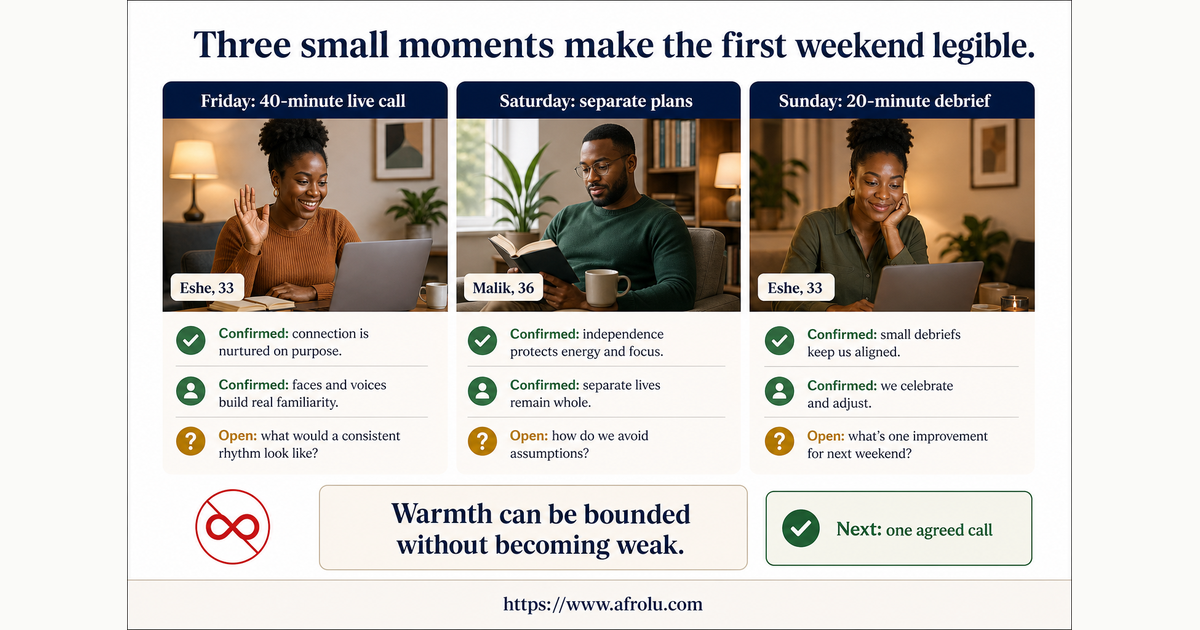
Eshe and Malik are made-up adults. Eshe is 33 and works in communications in Harare; Malik is 36 and works in quantity surveying in Lusaka. Eshe is dating again after a long break and wants to avoid mistaking constant contact for safety. Malik suggests remaining on a live call throughout their first free weekend. Eshe offers a forty-minute Friday call, separate Saturday plans and a Sunday debrief. Malik accepts. They discover that both are open to serious partnership but have not agreed to exclusivity. They keep home, work, documents, intimate images and money private. On Sunday they choose a one-hour call next weekend and list the facts a future public visit would require. No ticket is purchased. The relationship gains clarity because their ordinary lives remain visible.
The first-weekend distance runway
Let the beginning generate evidence before it generates momentum
A new connection can feel expansive while its first useful plan remains deliberately small.
Tariro checks identity confidence, direction, contact rhythm, protected systems and the Sunday debrief before any visit idea advances.
Person and direction
Use proportionate live interaction and direct present questions without treating one call as complete proof.
Bounded rhythm
Choose Friday and Sunday anchors while Saturday remains ordinary enough to test balance.
Protected perimeter
Keep location, home, work, family, images, documents, accounts, codes and money outside urgency.
Debrief and visit gate
Review what happened, then plan travel only after every independent-control fact is complete.
A short runway
Clear five checkpoints before a new distance connection gathers speed
Checkpoint one is proportionate identity confidence. Move from profile claims to a normal live personal interaction when comfortable. Look for consistent basic facts across time without demanding passports, employer files, home tours or account access. A live call can reduce one kind of uncertainty, but it cannot prove character, financial honesty or future fit. Verification should remain limited to the decision in front of you.
Checkpoint two is present direction. Ask whether the other adult seeks casual conversation, open exploration, exclusive dating, serious partnership or remains unsure. A fresh start may include uncertainty; honesty about it is more useful than premature certainty. Direction does not create exclusivity. If the present structure matters, ask whether either adult dates or seeks others and what disclosures support consent.
Checkpoint three is a bounded Friday-to-Sunday rhythm. Name when you will connect, for how long and what remains separate. Do not promise an entire weekend online to prove interest. The first test should survive sleep, work, friends, family, exercise, faith, rest and ordinary offline life. A pattern that requires abandoning a life on weekend one is unlikely to become easier when distance becomes more demanding.
Checkpoints four and five protect systems and review evidence. Keep precise location, home, intimate images, documents, money and codes private. Do not book travel because weekend warmth creates urgency. On Sunday, compare what happened with the agreement and choose one small next step. A new call, clearer question, more time or ending may be appropriate. A visit enters the runway only after its facts can be independently checked.
A fresh start with edges
Eshe and Malik keep Saturday ordinary enough to learn something
Eshe and Malik are fictional adults. Eshe is 33 and works in communications in Harare. She is returning to dating after a long break and wants to avoid mistaking intensity for safety. Malik is 36 and works in quantity surveying in Lusaka. They meet online and exchange messages for ten days. Malik proposes keeping a live call open across their entire first free weekend. Eshe likes him and notices the proposal feels too large for what they know.
Eshe offers three bounded moments: a forty-minute Friday live call, an optional Saturday note and a twenty-minute Sunday debrief. Malik accepts. On Friday, their basic stories remain consistent and they discuss present direction. Both are open to serious partnership, but neither agrees to exclusivity. They do not exchange home addresses, identity documents or intimate images. The call ends on time even though the conversation is warm.
On Saturday, Eshe visits a friend and Malik handles errands and rest. Neither requests live location or a running account of the day. Malik sends one photo of a neutral public object, not a workplace, home or third person. Eshe replies later. The gap gives each adult useful evidence: interest can tolerate an ordinary life. It also prevents a weekend bubble from producing closeness that has not yet been tested against boundaries.
On Sunday, they review. Malik enjoyed the rhythm and wants a longer call next weekend. Eshe agrees to one hour. He mentions a future visit, and they list the facts that would need checking before any booking: identity confidence, time, budget, public first meeting, independent lodging, transport and return. No ticket is purchased. Their new journey advances because the next step remains clear and reversible.
Contact architecture
Build a weekend rhythm that leaves both lives visible
Start with two anchors rather than permanent access. An anchor may be one live call and one debrief. Between them, messaging can remain optional or loosely defined. Say what reply gaps mean: often they mean someone is living, resting or concentrating. If urgent contact has not been agreed and there is no established relationship role, a new match should not become the primary emergency system. Ordinary support should remain distributed across an existing life.
Time zones, work patterns and communication preferences can shape the rhythm, but avoid pretending one schedule is universal. Use local clock times for both adults when arranging calls. Confirm the day and duration. If one person repeatedly carries inconvenient hours, redesign the pattern. Fairness does not require exact equality every weekend; it requires that burden can be discussed, alternatives appear and no adult is permanently expected to sacrifice rest.
Include an end. A planned call can finish while interest is high. Ending on time tests whether boundaries survive positive emotion. It also gives each adult space to notice how they feel after contact without immediately returning for reassurance. The next call should come from a present choice, not an exhausted promise made because silence feels threatening.
When a plan fails, use a small repair. Share the personal fact that matters, such as being delayed or unavailable, and offer a new time when possible. Do not submit work screenshots, medical records or family explanations. Repeated unexplained absence is different from one repaired disruption. Review the pattern and choose from its effect on your needs rather than trying to prove motive from a distance.
Present evidence
Look for green lights before money, images or a journey enter the connection
Green lights include basic stories that remain reasonably consistent, a willingness to speak live without coercion, respect for limited disclosure and contact that occurs when promised. The person can answer present relationship questions without flooding the conversation with a guaranteed future. They allow independent checking and do not rush you off a platform solely to avoid moderation. These are useful observations, not a certificate of safety.
Watch the response to ordinary limits. Can the other adult accept that you are unavailable Saturday? Can a call end on time? Can you decline an image, private topic or video without punishment? A respected no gives more relevant evidence than perfect compliments. Repeated bargaining, sexual pressure, threats, isolation from trusted people or demands for proof should reduce access rather than trigger a better explanation.
Digital monitoring is not maintenance. Sharing every location, password, contact list or social account does not create trust; it reduces privacy and can enable control. Public social information can also be incomplete or manipulated. Use proportionality: check the fact required for the next decision and stop there. Do not collect intimate material or documents as insurance against uncertainty.
Money is a firm runway light. Fare, visa, customs, device, medical, family, investment, account-release or business stories require independent verification. Do not send transfers, gift cards, cryptocurrency, codes or account access to someone you have not met. A genuine problem can still use an official provider or existing support network. Contact a financial institution promptly after suspected loss and use relevant reporting help.

Look for proportionate verification, kept plans, free answers and repair. Pause at avoided live contact, tracking or money.
Present-tense scripts
Name the direction, rhythm and boundaries without writing the ending
For direction, say what you are open to while acknowledging the connection is new. You may want a lasting partnership and still be evaluating this person. Ask whether the other adult is casually connecting, exploring, seeking exclusivity or pursuing serious partnership. If the answers differ, do not assume chemistry will convert them. A clear early mismatch can prevent a much more expensive later one.
For rhythm, make a specific offer rather than asking for maximum availability. Name the call, duration and what Saturday will look like. Let either adult counter. The person who wants more contact is not automatically needy, and the person who wants less is not automatically avoidant. The question is whether a mutually understood pattern fits both lives without pressure or deception.
For privacy, name categories rather than defending each item. You can keep home, precise location, workplace, family, documents, intimate images and account information private. You may share more later through separate choices. If image exchange becomes relevant, remember that consent to receive or send one image does not permit saving, forwarding, threatening or requesting more. Avoid sharing material you would not want outside your control.
For travel, use a gate: no booking until identity confidence, time, budget, public meeting, independent accommodation, transport, communication, consent and return are clear. Each adult controls documents and essential funds. The conversation can occur without buying a ticket. If the other person treats caution as betrayal or introduces urgent money, step back and involve trusted or specialist support as appropriate.

Ask one present question at a time and let either adult choose yes, no, not yet or another offer.
A logbook, not a countdown
Use three ordinary weekends to decide whether another small step is justified
In weekend one, observe whether basic facts stay consistent and the bounded plan is respected. In weekend two, notice initiation and reciprocity: does each adult sometimes propose, listen and adapt? In weekend three, watch repair if an ordinary disruption occurs. Do not manufacture tests or deception. Use naturally occurring life and direct questions. The logbook belongs to your decision, not to scoring the other person.
Record only adult relationship facts: planned time, whether it happened, how a change was communicated and which important answer remains open. Do not save private messages unnecessarily, track location or catalogue third-party information. Emotional notes can be useful: did the rhythm leave you grounded, pressured, confused or free? Feelings are data about your experience, not proof of the other adult's intention.
Choose from four outcomes. Continue calls under the same rhythm. Ask one clarity question. Begin an independently checked public-visit plan. Or stop. A travel plan is appropriate only when it answers a real next question and both adults can maintain control. Booking is not a reward for completing three weekends, and declining travel does not erase a genuine connection.
If the connection ends, remove access that no longer has a purpose. Review shared photos, location settings, linked calendars and accounts. Block when appropriate. If there are threats, intimate-image abuse, stalking, financial deception or repeated unwanted contact, preserve relevant evidence when safe and use platform, financial, legal or local specialist support. Do not keep negotiating because the beginning once felt hopeful.

Review identity consistency, bounded contact, repair and reciprocity; then choose another call, more time, a safe visit plan or an ending.
Five moving dimensions
Separate distance, weekend rhythm, intensity, agreement and a future visit
Distance describes geography. Weekend rhythm describes when contact happens. Neither tells you whether the relationship is casual, exclusive or serious. Two adults may speak every weekend and remain in open exploration. Another pair may have fewer calls and a clear exclusive agreement. Contact frequency can help show effort relative to capacity, but only direct words define the structure.
Intensity describes the felt concentration of attention, disclosure or hope. It can be sincere and still outrun knowledge. An entire weekend of calls may create a powerful sense of closeness because ordinary interruptions disappear. Do not shame the feeling; place it beside facts. Can the connection tolerate sleep, friends, work, a boundary, disagreement and a call ending?
A relationship agreement describes present choices, including other dating and relevant disclosures. A visit plan is practical: time, identity, money, accommodation, transport, consent, safety and return. Agreement does not make every visit safe. A visit does not create exclusivity. Keep both decisions explicit so travel costs do not become leverage for a status or activity nobody freely chose.
A new journey may eventually become a committed long-distance relationship, close the distance or end after honest evaluation. Do not select the final outcome during the first weekend. The mature beginning is not the one with the biggest promise. It is the one in which both adults retain an ordinary life, ask present questions and make the next step from enough evidence rather than fear of losing momentum.
Eight new-distance moments before the first visit
Eshe chooses three anchors instead of permanent access
Eshe is 33 and likes Malik's enthusiasm but does not want to remain on video from Friday to Sunday. She proposes a Friday call, separate Saturday and Sunday debrief. Malik accepts. The bounded rhythm lets them observe whether warmth can coexist with ordinary lives.
Offer specific contact moments and judge whether the other adult can accept time outside the connection.Tariro pauses marriage and relocation language on day eight
Tariro is 35. A new match describes a shared home and future travel before they have spoken live. Tariro says she is open to serious partnership and is evaluating this connection one step at a time. She requests a normal live conversation and does not debate the imagined future.
Return to the present direction and next proportionate verification step.Jonas treats avoided live contact as a reason to pause, not accuse
Jonas is 38 and his match repeatedly agrees to a call, then sends explanations and requests money instead. He does not demand documents or declare a crime. He sends nothing, ends the interaction and reports relevant conduct to the platform. A camera alone would not prove safety, but repeated avoidance plus money changes the decision.
Respond to observable inconsistency and financial pressure without collecting unnecessary identity data.Mpho does not turn six quiet hours into a loyalty investigation
Mpho is 31 and becomes uneasy when a new match goes offline during their loosely planned Saturday. They had not agreed on continuous contact. She waits for the Sunday call and asks what rhythm they both expect. The match's later answer and future conduct matter more than a location request.
Check the actual contact agreement before interpreting an ordinary gap or seeking surveillance.Kendi declines without offering a safer-looking substitute
Kendi is 34. During a warm late call, her match requests an intimate image and says distance requires extra trust. Kendi says no and ends the call. She does not owe another image, explanation or continued conversation. The response to her no will determine whether access reduces further.
Keep consent specific, protect material that can escape your control and distance yourself from repeated pressure.Samuel refuses to book before leave and lodging are real
Samuel is 40 and discusses meeting a new connection. The other person begins a countdown although neither has confirmed time, budget, public venue or independent accommodation. Samuel pauses the countdown and assigns each fact an owner. No ticket is purchased until the complete plan exists.
Turn romantic travel talk into a checklist of independently verifiable facts before spending.Lerato sends no money when the first meeting becomes urgent
Lerato is 37. A distant match says a ticket price is expiring and asks her to transfer the difference. She declines, avoids the payment link and speaks with a trusted person. If a later visit is genuine, each adult can discuss affordable independent booking without a same-day romantic rescue.
Do not allow urgency to replace independent travel control or financial verification.Amina wants exclusivity while Biko wants open exploration
Amina is 32 and Biko is 36. Both enjoy two weekends of calls, but Amina wants an exclusive serious path and Biko is actively meeting others. Neither is dishonest after the conversation. Amina ends because the present offer does not fit. The warmth was real and still insufficient.
Treat a direct structure mismatch as usable information rather than waiting for intensity to change it.Green and red lights on the first-weekend runway
Basic identity and life facts remain reasonably consistent across time and ordinary live interaction.
The other adult can name a present direction without promising a guaranteed future.
Weekend contact has agreed anchors, clear endings and room for sleep, work, friends, family and rest.
A reply gap or changed plan receives direct discussion and repair rather than tracking or punishment.
Each adult sometimes initiates, asks, listens and adapts without auditing exact equality.
Home, precise location, workplace, family, documents, accounts and intimate images remain protected.
A no about calls, camera, disclosure, images, sex, money or travel remains intact after it is heard.
Serious direction and exclusivity receive separate present answers before assumptions influence choices.
Visit talk becomes a complete independently controlled plan before any ticket is bought.
Urgent fare, visa, health, business, investment, device or account requests trigger a pause and verification.
The connection tolerates ordinary low-contact periods without requiring one adult to abandon an existing support network.
Either adult can choose more time or an ending without threats, shame, intimate-image misuse or repeated unwanted contact.
Route each early-distance moment to the right checkpoint
| Situation | What it may mean | What to do next |
|---|---|---|
| A new match proposes being on video all weekend. | Excitement is expanding contact before capacity and boundaries are known. | Offer two or three bounded moments and keep ordinary offline plans. |
| Marriage or relocation language appears before a live call. | A future story is outrunning basic identity and present-direction evidence. | Return to a proportionate live interaction and one present-tense question. |
| Live contact is repeatedly avoided while money is requested. | Inconsistency and financial pressure make further access inappropriate. | Send nothing, end contact and use relevant platform or financial reporting support. |
| Several quiet hours trigger anxiety. | The assumed rhythm may be larger than the agreement. | Review what was actually planned and ask what contact pattern each adult can sustain. |
| An intimate image is framed as proof of distance trust. | Sexual or privacy pressure is being disguised as reassurance. | Decline, protect material that can escape control and reduce access if pressure continues. |
| A visit countdown starts before logistics are complete. | Emotional momentum is creating booking pressure. | Stop the countdown and verify time, cost, lodging, public meeting, transport and return first. |
| Urgent fare or visa money is requested. | Romantic urgency is replacing independent financial and provider verification. | Send nothing, avoid supplied links and verify any institution through an official channel. |
| Both adults seek serious partners but disagree on exclusivity. | Direction matches while the available present structure does not. | Choose whether the stated structure fits; do not let intensity write a hidden agreement. |
| A planned call is missed with a specific repair. | An ordinary disruption may be handled responsibly. | Consider the replacement and observe the pattern without requesting confidential proof. |
| One person initiates every weekend plan. | Warm responses may coexist with one-sided operating effort. | Pause initiation once, request one concrete offer and choose from the response. |
| A first visit would require dependence on the match. | The plan lacks independent accommodation, transport, money or return. | Do not travel until personal control and a complete safe plan exist. |
| An ending triggers threats or image misuse. | The task is now safety, evidence preservation and access control. | Stop negotiating, preserve useful evidence when safe and use suitable platform, legal or local support. |
Scripts for direction, rhythm, privacy, money and travel
“I am open to a serious relationship and still evaluating this new connection. What are you seeking now?”
“Are either of us dating or actively seeking others? Weekend closeness does not answer that for me.”
“I can do a forty-minute live call Friday and want to end on time. Does that work for you?”
“I have offline plans Saturday. We can exchange one note and reconnect Sunday without live-location updates.”
“I do not share my address, precise routine, workplace, documents, accounts or family details in a new connection.”
“I am not sending that image. My no does not require another photo or explanation.”
“I cannot speak privately tonight. I can offer Sunday at ten; it is fine if that does not fit.”
“I do not send travel, medical, business or emergency money in dating. Any real provider can be checked independently.”
“I will not book until time, budget, public meeting, accommodation, transport and return are complete.”
“Did this rhythm leave enough room for both lives, and what one change would make next weekend clearer?”
“I want an exclusive path and your open exploration does not fit me. I am ending this respectfully.”
“I will not send money or more information. I am ending contact and reviewing my privacy and account security.”
Know the difference
Weekend emotional intensity versus a workable new distance agreement
Long calls, rapid disclosure and a vivid future create real feeling but may leave identity, direction, exclusivity, privacy, money and travel unanswered.
Both adults use bounded contact, present answers, proportionate verification, protected systems, repair and an independently checked visit gate.
Keep the warmth. Reduce the number of decisions the warmth is allowed to make by itself.

Name each dimension before allowing concentrated weekend attention to write an agreement or ticket.
Separate geography, intensity, agreement and a visit plan
| Type or dimension | What it describes | Best next question |
|---|---|---|
| Long-distance condition | Geography limits ordinary in-person contact and makes calls and visits more consequential. | What operating rhythm and safe meeting path fit the real distance? |
| Weekend rhythm | The agreed timing and duration of contact across Friday, Saturday and Sunday. | Which anchors leave both adults enough ordinary life? |
| Emotional intensity | The felt concentration of attention, disclosure or future hope; it can outrun knowledge. | Which present fact still needs to be tested outside the weekend bubble? |
| Serious direction | An intention to evaluate a connection for lasting partnership without guaranteeing this match. | Which present choices express that direction honestly? |
| Exclusivity | A current mutual agreement regarding other romantic or sexual connections. | What is included, disclosed and reviewable? |
| Identity confidence | Proportionate evidence that the person and basic story are consistent; never absolute proof of character. | Which limited check supports the next decision without exposing private systems? |
| Digital privacy | Boundaries around precise location, devices, accounts, images, documents and third-party information. | What remains private until a legitimate purpose and free consent exist? |
| Visit idea | A romantic possibility that has not yet cleared time, cost, safety and independent-control gates. | Which facts are still missing before anyone books? |
| Complete visit plan | Verified time, budget, public meeting, accommodation, transport, communication and return. | Can each adult remain independent and change consent throughout? |
| Closing distance | A much later practical transition involving ordinary compatibility, work, home, family, health, law and downside. | What substantial in-person evidence and reversible stages would be required? |
Clear the first-weekend runway in six moves
Clear one identity checkpoint
Move to a normal live personal interaction when comfortable and check only the facts needed for the next decision.
Name direction and structure
Ask what each adult seeks and whether either dates others; do not let weekend attention answer silently.
Build three anchors
Choose a Friday call, separate Saturday and Sunday debrief with clear duration and endings.
Close the private perimeter
Protect home, precise location, workplace, family, documents, accounts, codes and intimate images.
Use a visit gate
Require independent time, cost, public meeting, lodging, transport and return before booking.
Review three weekends
Compare consistent facts, bounded contact, reciprocity and repair, then select one optional next step.
Questions for identity, contact, privacy and the first visit
Choose a few prompts that fit the moment. This is a reference library, not a list to complete.
Identity and direction
Keep checks proportionate and questions in the present tense.
- Which basic facts have remained consistent?
- What are you seeking now?
- Are either of us dating others?
- Which disclosure matters before the next choice?
- What remains honestly uncertain?
The bounded weekend
Build contact that leaves both adults with an ordinary life.
- Which Friday call and duration work?
- What does separate Saturday time look like?
- What reply gaps should mean?
- How do we repair a missed plan?
- When will we debrief?
Privacy and money
Name protected categories before excitement makes each request feel exceptional.
- Which location and home details stay private?
- Which images will I not send?
- Which documents and accounts stay closed?
- How will I respond to money urgency?
- Who is my independent trusted support?
The first visit gate
Use these before spending, not after the ticket creates pressure.
- Is time confirmed by both adults?
- Can each person afford the plan independently?
- Where is the public first meeting?
- Who controls lodging, transport and return?
- Which new fact would make us cancel?
What long-distance research and public safety guidance can support
Distance alone does not determine relationship quality
Comparative long-distance research has reported several favourable self-reported quality measures and no simple universal deficit. Afrolu uses that evidence to reject distance fatalism, not to promise success. The people, agreement, resources, trust, communication and practical future still need individual examination.
Evidence limit: Group comparisons cannot predict one connection's quality, safety or stability.
Individual and relationship factors matter more than mileage slogans
Research comparing distant and geographically close relationships has often found few broad differences and highlighted individual or relationship characteristics. That supports assessing the bond rather than treating kilometres as the diagnosis. It does not identify one correct rhythm or remove the need for safe visits and future-location decisions.
Evidence limit: Samples, measures and study designs limit transfer to every age, country and relationship structure.
Channel effects do not create a universal contact quota
Research with emerging adults has examined texting, voice, video, responsiveness and satisfaction. Associations can differ by channel and relationship context. A result in one sample cannot prescribe daily video or message counts. Use shared preference, sustainable capacity and repair to design the rhythm.
Evidence limit: Young-adult samples and correlational measures do not establish causation or a global schedule.
Online maintenance and surveillance are not the same
Research on social networking in distant relationships has considered both maintenance and partner surveillance. Seeing a public update may support connection; demanding passwords, continuous location or account control crosses a different boundary. Trust should be built through voluntary communication and observed conduct rather than monitoring access.
Evidence limit: Study associations do not diagnose jealousy, abuse or an individual relationship.
Closing distance is a life-course decision
Longitudinal population work has examined moves and breakups in relation to geographic distance. It supports treating location change as a major practical transition, not the automatic ending of a romance story. Work, housing, family, health, money, law, ordinary compatibility and downside require independent attention.
Evidence limit: Population patterns cannot determine whether, when or where a particular pair should move.
Distance and urgent money create known scam risk
Public anti-scam and law-enforcement guidance describes relationship scams involving fake profiles, grooming, avoided live contact, isolation, money or investment requests and image misuse. Do not send urgent travel or emergency funds. Preserve relevant evidence when safe, contact a financial institution promptly after loss and use suitable reporting support.
Evidence limit: A warning pattern does not prove a crime. Respond to observed risk and local options.
Six ways early distance excitement outruns evidence
Promising permanent weekend access
An excitement-only contact level can crowd out sleep, work, friends and judgment before capacity is known.
Treating a camera as complete verification
Live contact can support identity confidence but cannot prove character, money claims, safety or compatibility.
Using disclosure as a closeness race
Rapid sharing can create intensity while exposing home, work, family, documents or images before a legitimate need.
Interpreting silence through location tracking
Check the actual rhythm and ask directly; monitoring reduces privacy and does not establish intent.
Booking to preserve momentum
A ticket purchased before a complete independent plan turns hope and sunk cost into pressure.
Funding the imagined visit
Urgent fare, visa, health, device, business or investment requests need independent verification, not romantic rescue.
Use a reviewed resource that matches the decision
This guide focuses on the relationship decision, so it does not rank dating apps. Check current prices, safety tools, and local availability before choosing a service.
Explore the guide library
Show more related guides
Continue with Afrolu
Show more Afrolu guides
Research and public guidance reviewed for this runway
Afrolu reviewed these health, research, safety, or public guidance resources while editing this page. They support the behaviour and safety guidance; they do not diagnose any individual described by a reader.
New long-distance weekend dating questions
How should I start a new long-distance dating journey?
Begin with proportionate identity confidence, a present direction question and bounded contact. Protect home, location, work, family, documents, images, money and codes. Debrief after an ordinary weekend and choose one reversible next step. Do not book travel or promise exclusivity from intensity alone.
Should we talk all weekend in a new long-distance connection?
Only if both adults freely want that and can sustain it. A smaller rhythm often gives better evidence: one planned live call, separate offline time and a short debrief. Preserve sleep, work, friends, family and rest. Ending a warm call on time can be a useful boundary test.
Does a live video call prove someone is genuine?
No. Live interaction can support identity confidence and expose inconsistency, but it cannot prove character, financial claims, safety or compatibility. Use multiple proportionate checks, protect private information and judge conduct across time. Do not collect identity documents unnecessarily.
When should a new long-distance couple become exclusive?
No universal week count applies. Ask whether the present structure fits both adults and which disclosures are needed. Weekend attention, deleted profiles, sexual conversation or future plans do not create exclusivity. Define the agreement directly and allow either adult to decline or request change.
How do we handle different time zones and work schedules?
Use local times for both people, agree on duration and alternate inconvenience where practical. Plan a lighter busy-period option and a repair for missed calls. Fairness does not require exact equality every week; it requires that burden can be discussed and revised.
Should I share my live location with a distant match?
Not as a trust test. Precise location can create privacy and safety risk. Share only what supports a legitimate plan, and use trusted support proportionately for an in-person meeting. Continuous tracking, passwords and account access are not required for relationship maintenance.
When is it safe to plan the first visit?
Move to planning only after proportionate identity checks and direct relationship answers. Before booking, confirm time, budget, public first meeting, independent accommodation, transport, communication, consent and return. Keep documents, devices and essential funds under your control throughout.
What if a distant match asks for fare or emergency money?
Do not send transfers, gift cards, cryptocurrency, codes, documents or account access because the story feels urgent. Verify claimed providers independently, speak with someone you trust and contact a financial institution promptly after suspected loss. Romance is not verification.
How do I distinguish excitement from love bombing?
Do not diagnose from one enthusiastic weekend. Look at whether the person tolerates pacing, boundaries, independent relationships and direct questions. Pressure, grand certainty, isolation, gifts tied to access, threats or punishment matter more than affectionate volume alone. Reduce access when the observable pattern is unsafe.
What if our first few weekends feel good but our goals differ?
Treat the goal or structure mismatch as decision-ready information. Warmth can be real while the available relationship remains wrong for you. State the difference, choose whether a defined evaluation period fits and end respectfully when it does not. Do not book a visit to postpone the answer.
One thing to do now
Clear one more present checkpoint, not the whole imagined future
Clear one present checkpoint at a time. Use bounded contact, direct relationship questions, proportionate verification, protected digital and financial systems, and a Sunday review. Increase evidence before cost, access or dependence. If the person, structure, rhythm or visit plan does not fit, choose more time or an ending instead of using intensity to make the question disappear.