Later entrants · safe long-distance dating
Dating Red Flags for Later Entrants in Safe Long-Distance Dating
Dating red flags for later entrants in long-distance dating: verify proportionately, protect travel, privacy and money, and keep every next step reversible.
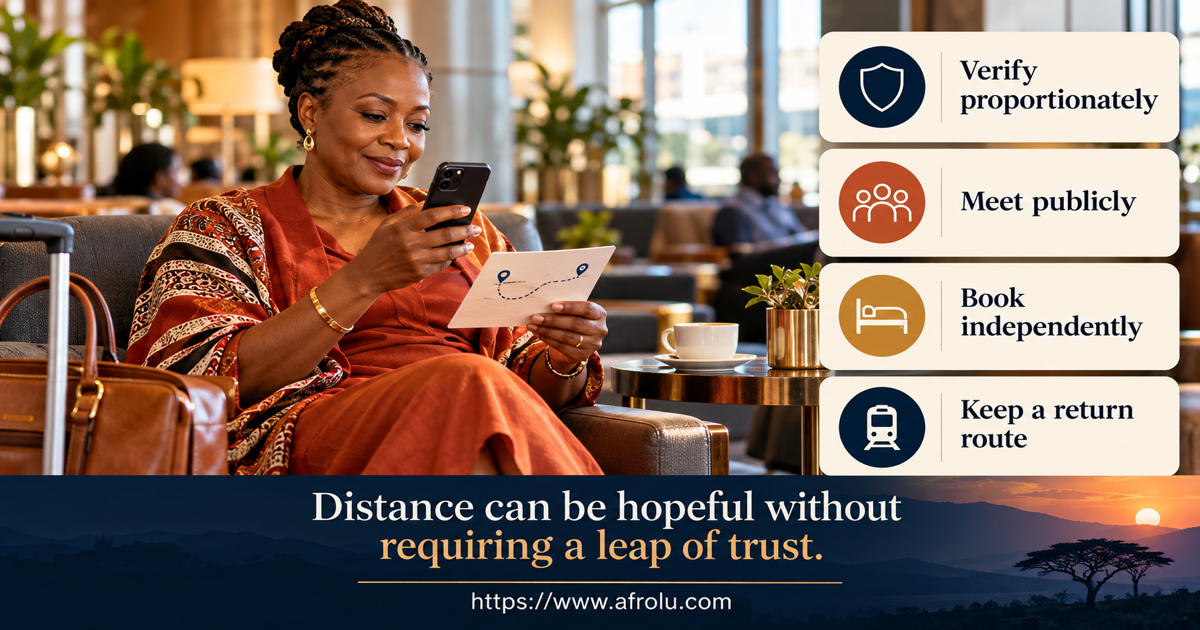
A later start does not make your next decision overdue.
Written and edited by Nia Kato · Profile Advice Editor
Build distance trust by sequence, not leap. Use proportionate verification, public meetings, independent travel and lodging, a firm money rule, layered digital privacy, and a pace that keeps major choices reversible. Repeated verification evasion, funded-travel urgency, demanded documents or images, monitoring, boundary bargaining, threats, unwanted contact, coercion, financial exploitation, or fear deserves less access and a support-led safety response.
Dating safety · Late Entrants
Is this distance connection building practical trust, or is it using urgency, evidence gaps, travel, money, private data, future promises, monitoring, pressure, or fear to reduce your choices?
Dating red flags for later entrants in long-distance dating are observable behaviours that make verification, travel, money, privacy, digital access, consent, future pace, or an exit less voluntary. They include recurring evidence gaps, financial urgency, document or image pressure, monitoring, unwanted contact, coercion, threats, or fear. The phrase describes conduct, not a diagnosis or a verdict on every distant connection.
Nia begins a promising long-distance conversation after years away from dating. A video call keeps being postponed, a future visit becomes an urgent transfer request, and a private stay is presented as proof of trust. She stops treating later entry as a deadline, makes one modest verification request, protects her travel and financial independence, and lets the response guide her toward a public plan, a pause, or an ending.
later entrants · safe long-distance dating
Nia builds a distance connection by sequence without letting a future promise claim her travel, money, data, or choices
This guide separates ordinary distance logistics from conduct that makes a later entrant’s privacy, travel, finances, body, future, or exit less freely chosen.
Make trust incremental, verify proportionately, plan travel independently, protect digital access, keep future talk reversible, end without solving every inconsistency, and review evidence before expanding access.
Build trust by sequence
A workable call and public plan can say more than a distant promise.
Keep a route home
Independent transport and lodging make a first visit easier to leave.
Keep money and data private
Documents, codes, transfers, images, and location are not proof of trust.
Let the future remain possible
A hope does not require an irreversible present choice.
distance does not make trust a leap
Date across places without letting optimism replace practical evidence
An adult who begins dating later may meet someone who feels unusually attentive across a screen. The conversation can offer relief from loneliness, a sense of being understood, and a future that appears before ordinary life has caught up. Those feelings are not foolish. They are also not evidence that a person should receive your address, money, identity documents, private history, travel commitment, or access to your routines before trust has been tested in workable ways.
Distance can create a false choice between total belief and total suspicion. You do not need either. Start with observable facts: Can the person communicate consistently enough to make a plan? Can they tolerate a video call or another proportionate way to confirm identity? Do their stated place, work, relationship status, availability, and plans fit together over time? Do they honour a no without turning it into a challenge?
Long-distance dating also needs realistic scope. A daily message may be welcome, but it is not the same as shared responsibility. A planned visit may be meaningful, but it is not a contract for sex, money, a home stay, or a future move. Let each new level of access have its own conversation. A person who can handle that separation gives more useful information than someone who offers grand certainty while asking you to bypass practical safeguards.
Safety does not require you to become detached. You can enjoy a call, share a broad story, plan a public visit, and remain curious. The point is to keep your decision-making in the present: what have I freely chosen today, what do I still need to know, and what route remains open if the connection changes shape? That is a steadier basis for hope than a deadline imposed by distance or by feeling late to dating.
verify without trying to investigate a life
Use proportionate checks that protect you without turning dating into surveillance
Before committing to a long trip or sharing more private information, look for low-drama ways to establish consistency. A live video call at a reasonable time, a conversation that fits the claimed location, or an independently chosen public first meeting can be enough to answer practical questions. You do not need access to someone’s documents, contacts, or devices; you do need enough clarity to avoid asking your safety to depend entirely on a stranger’s story.
Be cautious when verification is endlessly postponed through a new crisis. A camera is broken, a work rule prevents calls, travel is suddenly impossible, a relative needs money, a bank has frozen access, or an urgent ticket must be purchased today. Each explanation could be true. The issue is whether the pattern always moves the cost, risk, or proof burden onto you while the promised next step remains just out of reach.
Keep verification separate from private exposure. Do not send an identity document, a banking screen, a code, your full address, work itinerary, child or family details, intimate images, or account access in order to prove that you are genuine. A person who insists that you must disclose more than they do is not offering a balanced path to trust. You can give a broad answer and allow time to do some of the work.
If something does not add up, pause rather than rush to prove deception. Ask one concrete question, choose a smaller plan, decline the transfer or trip, and seek an outside perspective from someone who is not invested in the romance. You are allowed to decide that the available evidence is not enough for more access without calling the other person a scammer or waiting for a perfect confession.

Look at the pattern and the freedom it leaves you.
plan a visit as a meeting, not a surrender of options
A first trip can preserve independent transport, lodging, money, location privacy, and an easy way to leave
If you travel, keep the booking, payment, documents, luggage, phone, and return route under your control. Choose lodging and transport you can access without the date’s permission, tell a trusted person a broad itinerary when useful, and avoid making your first arrival depend on being collected at an unfamiliar address. These are practical choices, not signs that you expect the worst.
Agree on the visible part of the plan first: public venue, meeting time, how each person arrives, approximate end time, and what happens if the plan changes. You do not need to share a live location throughout the trip or accept a last-minute move to a private home, remote venue, car ride, or overnight stay because someone calls independence unromantic. A changed plan requires a fresh yes.
Money can become a pressure point around distance. A date may want you to fund a ticket, reimburse a delay, book accommodation in your name, lend money for a passport or emergency, receive a transfer, or join an investment that will supposedly make a visit possible. Keep financial decisions separate from affection. Use your own payment channels, do not move money for another person, and verify any travel or emergency claim independently.
If a visit feels wrong after you arrive, choose departure over politeness. You can leave a venue, change lodging, contact your travel provider, tell someone trusted, and use local emergency or specialist support if you are in immediate danger. You do not owe a host, a paid ticket, a previous video call, or a future promise a private meeting or a second chance to persuade you.
treat digital intimacy as real access
A screen can carry pressure, monitoring, image abuse, financial loss, and a sense of obligation long before people meet
Long-distance conversations can become intense because calls and messages fill quiet parts of the day. Intensity is not automatically danger, but notice when a person needs constant proof that you are present, asks you to stay on a call while sleeping, demands your location, wants access to a phone, insists on moving to disappearing messages, or criticises you for keeping normal work, sleep, friends, and family time. Closeness that requires surveillance is not mutual closeness.
Be careful with private images and recordings. A person may ask for a photograph, video, or sexual call and promise that it is only for them. You can decline without an explanation. Never allow a date to frame a refusal as evidence of distrust, a lack of maturity, or a failure to compensate for distance. If images are already shared and pressure begins, avoid sending more, preserve relevant material if safe, use platform tools, and seek specialist support where appropriate.
Keep account access outside romance. Do not share passwords, one-time codes, recovery details, device screens, bank messages, immigration documents, medical records, airline confirmations, or a live itinerary to satisfy a demand for proof. If you choose to share a travel detail with a trusted person, do so because it supports your own plan, not because a date says privacy makes a relationship impossible.
If monitoring, threats, blackmail, image pressure, impersonation, repeated contact from new accounts, or fear enters, move from relationship analysis to safety planning. Use a safer device if needed, document what is safe to preserve, seek help from a platform, trusted person, local specialist, legal, health, security, advocacy, or emergency service, and avoid a confrontation that could increase risk.

A future hope does not make a present risk yours to take.
let future talk remain a possibility, not collateral
A promise to close the distance does not require an early merger of money, home, immigration, work, family, or body
Distance often invites future language because it makes uncertainty visible. Someone may talk about moving, marriage, a shared business, a home, a visa, meeting family, or permanent travel after a brief intense connection. Future hopes are not automatically a red flag. The question is whether the hope stays separate from pressure to make a present decision you cannot safely reverse.
Watch for deadlines that appear to have only one solution: send the money now, quit the job, host the visit, marry quickly, reveal documents, join an account, stop seeing friends, or commit before you have met. A person may call reluctance fear, ask you to rescue the relationship from distance, or make a practical pause sound like betrayal. You can refuse a deadline without deciding that their feelings are fake.
Pace matters particularly for a later entrant because people sometimes use age or inexperience to create urgency. They may say that mature adults should know immediately, that you have already waited too long, or that a cautious person will miss their chance. Your history does not make anyone else’s timetable binding. A slower route can be evidence of capacity, not a lack of courage.
Use a sequence instead of a leap: a call, a verified public meeting, several consistent interactions, a discussion of what each person offers, and only then a next decision that both can freely reverse. If the relationship cannot tolerate that sequence, the problem is not that you failed to trust hard enough. It is that the proposed arrangement needs you to give up too much uncertainty too soon.
end distance contact without trying to solve every inconsistency
A concise boundary can be enough when the connection no longer feels safe, workable, or voluntary
For an ordinary mismatch, use a brief direct message: 'I do not want to continue this connection. I wish you well.' You can decline a final video call, stop trying to obtain answers, and let the person disagree without reopening the relationship. Distance can make people feel that an explanation is owed because so much was said online; your time and privacy remain yours.
For recurring pressure, make communication smaller. Do not accept a rushed trip designed to change your mind, do not share your current location, avoid moving a discussion to a private platform, and consider blocking or reporting accounts if someone repeatedly returns after you asked them not to. Preserve messages or transaction records only where doing so is safe and useful.
For threats, blackmail, image abuse, stalking, financial exploitation, coercion, unwanted travel contact, or fear, use a protected exit. Tell a trusted person, contact relevant providers or platforms, use a safer device if needed, and seek local emergency or specialist support that fits the situation. General advice cannot assess a particular danger, so urgent help matters when you are in immediate risk.
After you end it, bring attention back to the life that existed before the future story. Sleep, work, food, movement, friends, family, hobbies, study, and practical tasks can steady a mind that has been living in messages and imagined plans. You can grieve a connection and still decide that protecting your money, privacy, home, body, and future choices was the right call.

Choose the move that keeps your travel, data, money, and exit yours.
review the evidence before the next level of access
A long-distance connection should make practical choice easier, not make every decision feel urgent
Use a short review before sharing more. Can I keep independent transport, lodging, money, identity details, digital access, location, work routine, and private history under my control? Has the person been consistent enough to make a modest plan? Can I say no to a call, image, transfer, trip, home stay, or future commitment without fear, guilt, or a campaign to change my mind?
A steady pattern includes someone who accepts a proportionate check, plans publicly, communicates a change, respects a slower pace, keeps finances separate, and makes repair visible. A caution pattern may be a time-zone difference, delayed trip, or differing future hope. A serious pattern includes repeated verification evasion, financial urgency, privacy demands, monitoring, boundary bargaining, threats, unwanted contact, coercion, or fear.
Choose the action that fits the fact: another call, a public meeting, a slower pace, less sharing, a separately booked visit, no transfer, a pause, a concise ending, account protections, documentation, or a support-led exit. You do not need to decide whether every word was true before choosing the path that keeps your next day and future decisions yours.
Long-distance dating can invite patience, imagination, and care. It is healthiest when those qualities do not require self-erasure. A connection worth learning about can survive a public plan, a firm money rule, a delayed decision, a private detail kept private, and a no. If it cannot, the distance is not the only thing making the relationship hard.
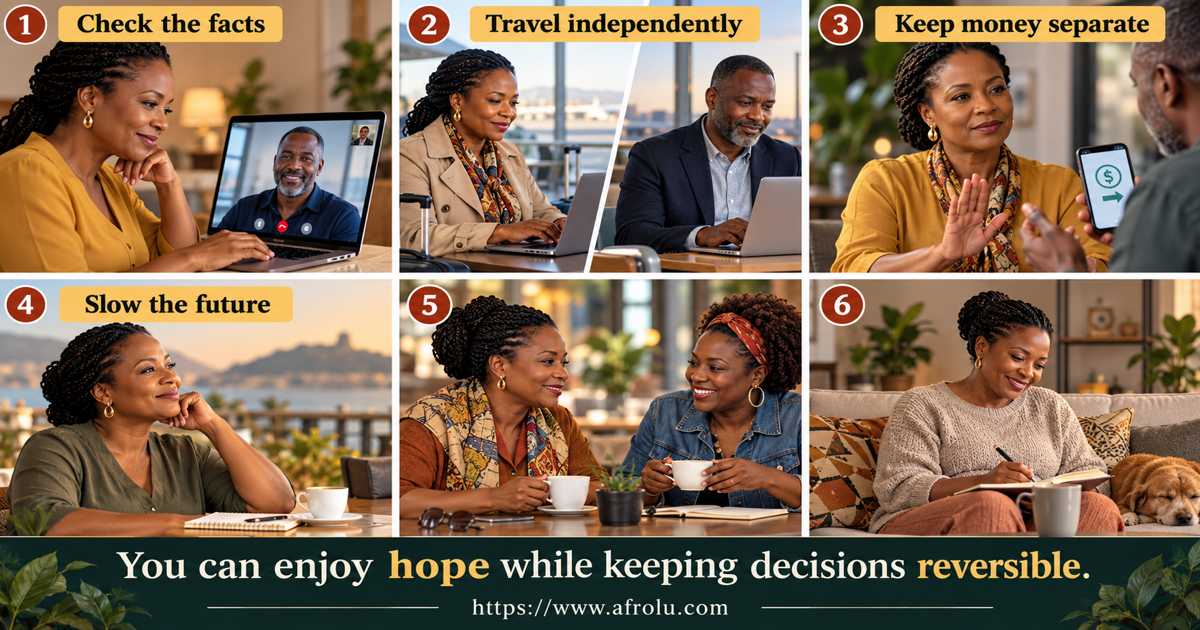
Eight later-entrant long-distance dating moments
A simple verification step is always postponed
A match says their camera, work rules, travel, and connection prevent every reasonable live call but asks for more personal details.
Keep information layered, ask one concrete question, and do not escalate access without workable evidence.A future visit becomes an urgent transfer
A person says a ticket is nearly paid but a bank delay means the dater must send funds today to save the relationship.
Send no money, do not use a link or account, and verify any travel story independently.A first meeting has an independent plan
Two adults meet at a public venue after each booked their own travel and lodging, with a clear end time and no shared address.
Treat the structure as a good sign while continuing to observe respect and consistency.A separately booked stay becomes pressure
After arriving, a date says it is insulting not to stay at their home and claims the booking proves distrust.
Keep the lodging you chose, meet publicly if you wish, or leave the plan entirely.Identity proof becomes private exposure
A match asks for a passport image and banking screen to prove the dater is serious about visiting.
Do not send documents or financial data; an early relationship does not need them.Age is used to rush a life change
A person says later entrants cannot afford to wait and should discuss moving, marriage, or a joint business after a few calls.
Keep future hopes separate from present commitments and slow the sequence.A disruption is handled with respect
A scheduled call is missed because of a genuine work emergency, followed by a clear apology and a practical reschedule that is kept.
Treat it as a repair while looking at the longer pattern.An ending is bypassed online
After a clear ending, a person contacts the dater from several new accounts and mentions details from a past travel plan.
Do not negotiate; preserve information if safe, block or report, tell someone trusted, and seek support if fear enters.Signals about verification, travel, data, money, future pace, and exits
They can tolerate a proportionate live call or public meeting plan without treating basic consistency as an insult.
They let identity, location, work, and relationship information become clearer through time rather than demanding your documents first.
They accept separately booked travel, public venues, independent lodging, and a clear return route.
They do not turn a ticket, travel cost, visit, gift, or future promise into a claim on sex, home access, money, or a life change.
They do not ask for passwords, codes, banking screens, passport images, device access, live location, or account recovery details.
They can name a future hope without making it a deadline you must meet now.
They communicate a delay or changed plan instead of repeatedly creating urgency at your expense.
They do not use loneliness, age, inexperience, distance, or a lost chance to hurry your decision.
They respect a no to images, sexual calls, a private stay, a trip, money, or a move without bargaining.
They keep your private disclosures out of family, work, travel, social, or online spaces.
They make a specific repair after a missed commitment instead of asking you to ignore the pattern.
They do not use new accounts, mutual contacts, travel details, or local routines to bypass an ending.
They do not make you responsible for solving a financial, immigration, medical, work, or family crisis to prove care.
They do not leave you afraid to ask a question, slow a visit, protect data, or stop contact.
Choose a proportionate next move
| Situation | What it may mean | What to do next |
|---|---|---|
| They avoid every live verification | Privacy or access issues can be real, but indefinite avoidance is a pattern to assess. | Do not escalate travel, money, documents, or intimacy; ask one concrete question or step back. |
| They ask you to fund a visit | Urgency may be a scam, a leverage test, or a risk you do not want. | Do not send, receive, lend, or move funds; verify independently. |
| They want you to stay at their home | Hospitality can be genuine, but lodging needs its own freely given yes. | Book independently or choose a public meeting without explaining away the boundary. |
| They request travel documents | A request for proof can become identity exposure or fraud risk. | Keep documents, codes, screens, and account access private. |
| They promise a future move quickly | Hope can be sincere; a deadline can create irreversible pressure. | Discuss the present step and keep major decisions separate. |
| They miss a call | A disruption may be ordinary; follow-through reveals whether there is a repair. | Look for a clear apology and a realistic reschedule instead of a dramatic excuse. |
| They want private images or constant location | Distance can make reassurance tempting, but consent and privacy remain current. | Keep digital access small and reduce contact if no is negotiated. |
| They ask you to hide the connection | Privacy can be valid; secrecy that isolates or restricts your support is different. | Keep trusted support and do not surrender normal relationships to protect a secret. |
| They return after an ending | Repeated new-account or indirect contact can be harassment or stalking. | Stop negotiating, preserve records if safe, block or report, and seek support. |
| You feel fear or cannot leave a travel plan | Fear changes the task from dating clarity to safety planning. | Use a protected exit and urgent local or specialist support. |
Twelve lines for verification, travel, money, digital privacy, and ending
“Before we plan travel, I need a live call and a public first-meeting plan that works for both of us.”
“I do not send identity documents, banking screens, codes, or account details to someone I am dating.”
“If we meet, I will book my own transport and place to stay.”
“I am keeping the public plan and my own accommodation. That is what works for me.”
“I do not send, receive, lend, or move money for a dating connection.”
“I can discuss hopes, but I am not making a move, marriage, visa, or money decision from this stage.”
“I do not share live location, passwords, private images, or constant call access.”
“When the call changed without notice, I needed a clear update. Can you make a practical plan now?”
“I am not comfortable with that. I am ending the call and will decide later whether I want more contact.”
“This plan no longer feels workable, so I am not travelling or hosting.”
“I do not want to continue this connection. Do not contact me through new accounts or people around me.”
“I am not discussing this further. I am taking steps to protect myself and need no more contact.”
Know the difference
A practical distance delay, an evidence gap, a future hope, and access pressure need different responses
A person can accept modest verification, public meetings, independent bookings, a slower future pace, digital privacy, separate money, and a clear no while letting trust grow through consistent action.
Endless evasion, funded-travel urgency, document or image requests, demanded constant access, future deadlines, financial leverage, new-account contact, coercion, threats, or fear turn a distant connection into a claim on your safety.
Distance and a future promise do not decide the risk. The observed pattern and your freedom to choose do.

The pattern and your freedom decide the next move, not a future promise.
Separate a distance delay, evidence gap, future hope, and access pressure
| Type or dimension | What it describes | Best next question |
|---|---|---|
| A proportionate check | Both people can choose a workable live call or public plan before travel and greater sharing. | Use the evidence to decide whether a modest next step fits. |
| Endless evasion | Every verification step becomes a fresh crisis while requests for access increase. | Keep data, money, travel, and intimacy separate and step back. |
| A delayed visit | A real constraint is explained and a new plan can be made without financial urgency. | See whether the revised plan is practical and respectful. |
| Financial urgency | A crisis, ticket, passport, investment, or account story makes you responsible for solving the cost now. | Do not transfer or receive funds; verify independently. |
| Future hope | A possibility is discussed without requiring a present move, merger, or sacrifice. | Keep major decisions reversible and slow. |
| Future pressure | Distance, age, or romance is used to make caution look like a failure of commitment. | State your pace and reduce access if it is not respected. |
| A repair | A missed call or plan is acknowledged and the next commitment changes visibly. | Watch for consistency before increasing trust. |
| Digital intimacy | Messages or calls feel warm while each person can still retain privacy and end contact. | Keep current boundaries around images, location, and availability. |
| A safety concern | Threats, blackmail, stalking, coercion, unwanted travel contact, financial exploitation, or fear appear. | Use a protected exit and appropriate local support. |
Start with the distance plan and access you freely choose
Trust can be incremental
A call, a public plan, and consistent follow-through can provide more useful evidence than a grand promise.
Keep verification proportionate
You need enough consistency to make a choice, not access to another person’s private life.
Book your own route
Independent transport, lodging, payment, documents, and return options make a visit easier to leave.
Treat digital access as real access
Images, location, devices, accounts, and constant availability can create vulnerability before anyone meets.
Separate hope from collateral
A future move, marriage, visa, home, or business plan can remain a possibility until evidence supports a choice.
Let silence be data
You can end contact from the observable pattern without obtaining proof of every hidden motive.
Questions organised by purpose and depth
Choose a few prompts that fit the moment. This is a reference library, not a list to complete.
Before more sharing
Use before sending a private detail or document.
- Does this person need this information today?
- Can I verify the relevant fact without exposing myself?
- Would sharing make an exit harder?
Before travel
Use before booking or accepting a visit.
- Do I control transport, lodging, payment, documents, and the return route?
- Is the first meeting public?
- Who can I tell a broad itinerary?
Before money
Use when urgency enters the story.
- Am I being asked to solve a crisis to prove care?
- Can I verify this independently?
- What changes if I say no?
Before a future commitment
Use when a move, marriage, visa, home, or business plan appears.
- What evidence exists now?
- Which decision is irreversible?
- Can I slow down without a penalty?
Look more closely at verification, travel, digital safety, money, future talk, and endings
Enough consistency is different from an investigation
Use modest, mutual checks before travel or greater exposure and pause when the burden of proof keeps shifting onto you.
Evidence limit: No check can guarantee another person’s intentions or safety.
A first visit needs an independent route
Keep transport, lodging, documents, money, phone, itinerary, and a way out under your own control, with public meeting plans.
Evidence limit: A public plan is not a guarantee of safety in every situation.
Intimacy can be pressure at a distance
Set boundaries around images, recordings, location, accounts, devices, disappearing messages, and constant contact before expectations quietly form.
Evidence limit: Change settings carefully if someone could notice and escalate.
Romance should not choose your financial risk
Pause ticket, passport, visa, emergency, travel, investment, transfer, document, and account requests and verify independently.
Evidence limit: A concerning request does not prove every person is committing fraud.
Hope does not need an irreversible decision
Discuss possibilities without combining money, housing, work, immigration, family, or body access before a relationship has earned that level of trust.
Evidence limit: A guide cannot decide the future for two adults.
Risk changes the communication route
Use a concise ending for mismatch and a more protected support plan when unwanted contact, threats, coercion, stalking, blackmail, or fear appears.
Evidence limit: Blocking alone may not resolve every safety concern.
Shortcuts that make a later entrant’s distance dating less safe
Treating late entry as a deadline
Beginning later does not oblige you to turn a future promise into a present commitment.
Confusing intense messaging with verified trust
Frequency can feel intimate while still revealing little about practical reliability.
Letting a visit remove every exit
Shared lodging, dependent transport, and someone else’s payment can make a changed mind harder to act on.
Sharing documents to prove you are genuine
Identity, financial, travel, and account records can create risk without building real trust.
Using money to rescue a future story
Urgency and compassion do not make a transfer, loan, ticket, or investment safe.
Seeking a final explanation from a fearful situation
A protected exit matters more than resolving every inconsistency with someone who is pressuring you.
Choose one resource that fits the fact in front of you
Use a distance-boundary guide for a clear limit, a long-distance guide for practical planning, or a slower return-to-dating guide when you want more evidence before offering more access.
Explore the guide library
Show more related guides
Continue with Afrolu
Show more Afrolu guides
Sources used for this guide
Afrolu reviewed these health, research, safety, or public guidance resources while editing this page. They support the behaviour and safety guidance; they do not diagnose any individual described by a reader.
Questions about dating red flags in long-distance dating
Is long-distance dating riskier by definition?
Not by definition. Distance adds logistics and uncertainty, so practical plans, proportionate verification, independent travel, privacy, and a free exit matter more.
Do I need a video call before meeting?
There is no universal rule, but a reasonable live call or other proportionate consistency check can help before committing to travel or greater sharing.
Should I pay for someone’s ticket to visit?
Do not send, receive, lend, transfer, or fund travel to create trust in a new online love interest. Pause and verify independently.
Is it rude to book my own hotel?
No. Independent lodging and transport preserve a practical exit. A considerate person can understand that a first visit needs its own boundaries.
What if a date says caution means I do not trust them?
A present boundary is not a verdict about another person. State the pace you can freely choose and see whether it is respected.
Can someone be genuine but unable to video call?
Possibly. The key is whether the connection can offer another proportionate, non-pressuring way to build consistency rather than always shifting more risk to you.
Should I share my passport or travel details to prove seriousness?
No. Keep documents, codes, account data, live location, and detailed itinerary private unless sharing serves your own safety plan with a trusted person.
What if I already sent an intimate image?
Do not send more because you feel embarrassed. Preserve relevant information if safe, use platform tools, and seek specialist support if pressure, threats, or image abuse develops.
Can I end a long-distance relationship by message?
Yes. A concise message is enough for an ordinary mismatch. Use a more protected format if a call, visit, or explanation could increase pressure or risk.
How can I stay open without ignoring warning signs?
Use facts. Separate a repairable delay, a practical incompatibility, recurring evidence gaps, and conduct that makes money, privacy, consent, or an exit less voluntary.
One thing to do now
Let every next distance step leave your travel, future, and exit under your control
Choose the smallest next action that protects verification, independent travel and lodging, money, documents, digital privacy, current consent, trusted support, and a genuine ability to slow down or leave.