Seven platforms · serious direction, present choice
Return to Serious Dating Later Without a Recovery Clock
A later-life guide to serious dating after heartbreak: test capacity, name intent, protect memories and money, plan one weekend date, and keep exits open.
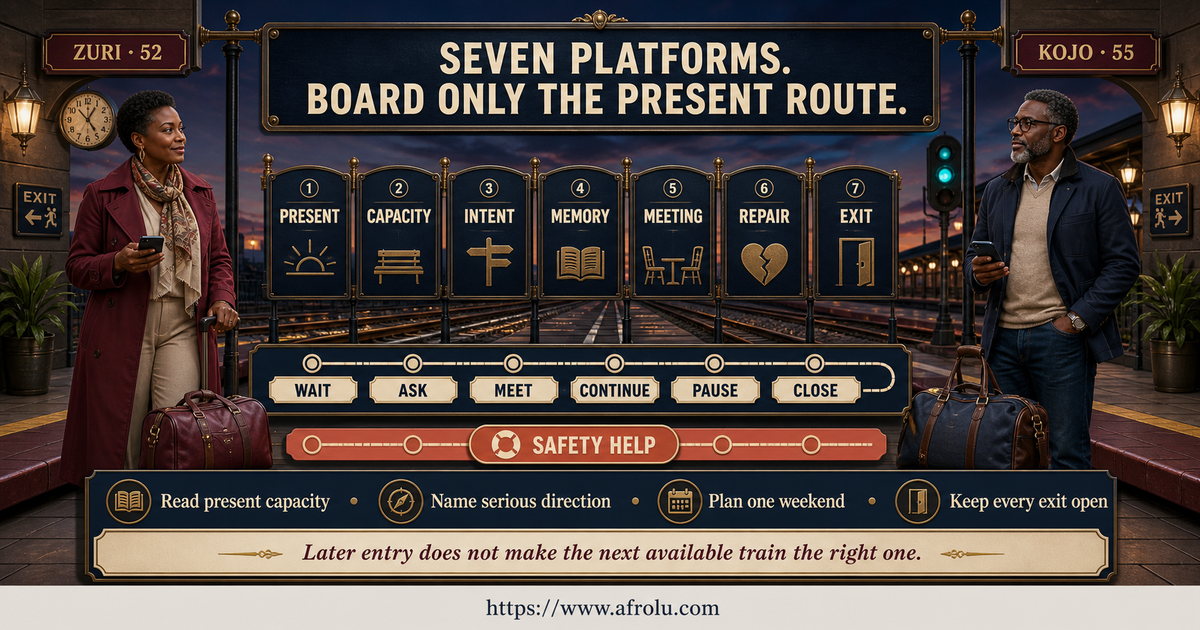
Serious intention is a destination board, not a command to board today.
Written and edited by Jean-Claude Mukendi · Relationship Guides Editor
Use seven independent platforms: PRESENT, CAPACITY, INTENT, MEMORY, MEETING, REPAIR and EXIT. Name serious partnership as a direction, not immediate status. Offer the smallest meeting your present capacity supports, keep former-relationship detail voluntary and preserve independent money, home, transport, consent and reflection. Observe how a boundary is received and how one public plan is delivered. Then WAIT, ASK ONE QUESTION, MEET ONCE, CONTINUE, PAUSE, CLOSE, SEEK CARE or SEEK SAFETY HELP. No age, number of dates or recovery interval sets departure.
Starting over · Late Entrants
How can a later-life dater name serious intent, test one weekend connection and respect memories after heartbreak without rushing commitment, exposing assets or turning the date into a healing verdict?
Dating after heartbreak means exploring new adult connection while past loss, adjustment or memory may still matter. Serious re-entry can coexist with grief waves or cautious pacing and should be distinguished from rebound function, intent mismatch, persistent impairment, romance fraud and unsafe control. The seven-platform station organises present evidence; it cannot certify readiness, diagnose distress, predict partnership or prescribe treatment.
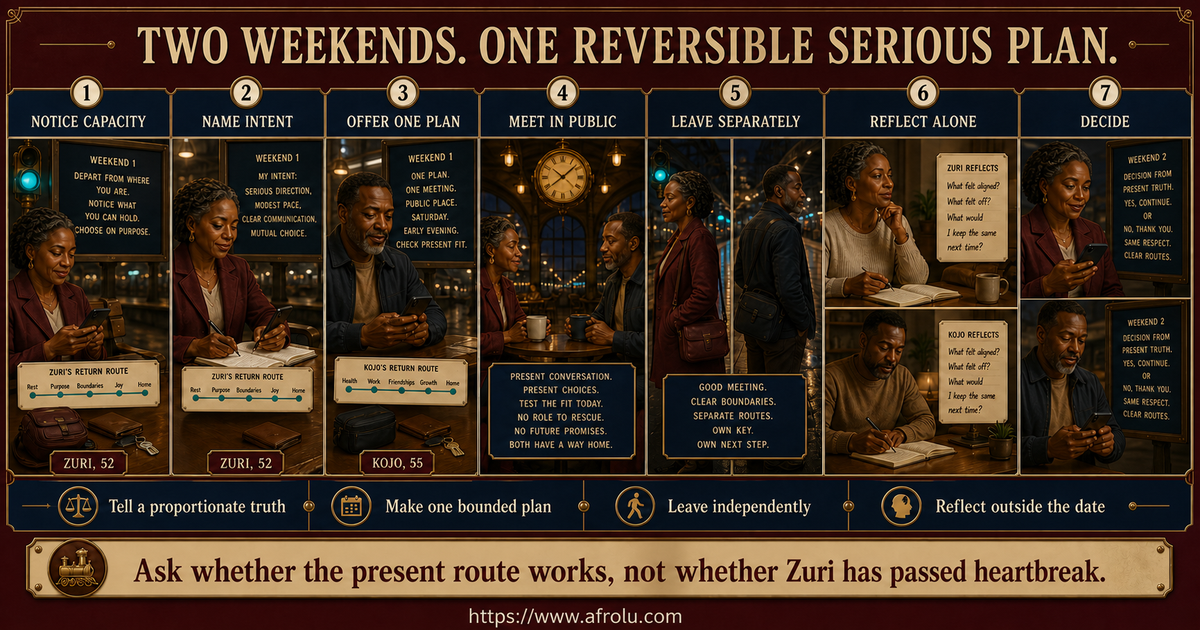
Zuri, a fictional 52-year-old returning after heartbreak, tells Kojo, 55, that she wants a serious direction at a gradual pace. Across two fictional weekends she counters a long dinner with one bounded public coffee, keeps the former relationship's details private, notices a memory without making Kojo responsible for it, leaves independently and reflects before choosing another short meeting. The story contains no recovery score, age deadline, ex-partner depiction or marriage promise.
The late-entry seven-platform serious-weekend station
Choose one present train without obeying an age or recovery timetable
Jean-Claude separates long-term direction from current capacity, private memory, one meeting, repair and exit for adults returning in their fifties.
Name today's offer, keep serious intent provisional, disclose only useful present impact, meet once and reflect outside the date.
Read the present
Choose what fits today rather than proving the final relationship is possible.
Name the destination
Serious intent guides direction while status and exclusivity remain explicit agreements.
Carry only your history
A present boundary can be complete without a former relationship dossier.
Keep a return ticket
Separate money, home, transport, consent and closure preserve adult choice.
Read the destination board slowly
Let serious intention describe direction without forcing immediate departure
Returning to dating at 52 or 55 can feel unusually visible. Friends may call the first new invitation overdue; relatives may treat serious intent as an express route; an app may make every pause look like lost opportunity. None of those pressures establishes capacity. Zuri is allowed to want a committed future while deciding that she can only offer one short public meeting this weekend.
Serious intent answers a direction question: if a connection fits over time, is a committed partnership a welcome possibility? It does not establish exclusivity, emotional readiness, home access, financial entanglement, sexual consent or a schedule. Kojo can share the same direction while preferring a different pace. The adults still need present agreements rather than a destination printed on imagination.
Heartbreak does not disappear on a timetable. Memories may arise during a good date, a quiet Sunday or a familiar song without proving that dating is harmful or that a new person is a replacement. The useful evidence is functional: can Zuri notice the memory, make a current choice, stay truthful with Kojo and leave the meeting without asking him to repair history he did not create?
The seven-platform station keeps these questions apart. PRESENT describes what is happening now; CAPACITY describes the smallest honest offer; INTENT names direction; MEMORY observes past material without making it Kojo's job; MEETING and REPAIR show conduct; EXIT protects choice. None of the platforms produces a healed-or-unhealed total, and danger bypasses the ordinary timetable.
Check each platform independently
Review present capacity, serious intent, memory, one meeting, repair and exit
PRESENT asks what Zuri wants from today's invitation rather than from a hypothetical final relationship. CAPACITY asks what time, attention and disclosure she can freely offer without cancelling rest, care, work or existing commitments. A small answer is complete. 'One daytime coffee, then I want the evening alone' is clearer than agreeing to an open-ended weekend because serious dating feels scarce.
INTENT distinguishes a serious direction from an immediate status. Zuri and Kojo can say they are exploring long-term partnership while remaining non-exclusive until they agree otherwise. MEMORY records how past experience affects the present—perhaps a venue feels difficult or a rapid question feels intrusive—without demanding the former relationship's full story. A boundary can be valid before its history is narrated.
MEETING checks identity proportionately, uses a public staffed place, keeps ordinary money separate and gives both adults independent departure. The date can be warm, awkward, brief or unexpectedly emotional without becoming a referendum on readiness. The relevant questions are whether choice remained free, current scope was honest and the experience left enough capacity for ordinary life afterward.
REPAIR observes what happens after a missed cue, cancellation or boundary crossing. A useful repair names impact, avoids pressure and changes conduct. EXIT asks whether a pause, no or ending is accepted. Threats, tracking, impersonation, financial exploitation, image abuse or blocked movement are not repair exercises; they belong on a direct protective track.
One meeting, then a separate room for reflection
A fictional later-life story keeps curiosity, memory and decision from becoming one event
On the first weekend, Kojo asks Zuri to a long dinner and says he is dating with serious intent. Zuri appreciates the direction but notices that a full evening feels too large. She does not say she is unavailable for love. She counters with a daytime coffee for seventy-five minutes in a public place she can reach and leave independently.
Before the meeting, Zuri says she is returning after a painful relationship and prefers not to discuss the detailed history yet. Kojo can accept that boundary or decide he needs a different style of openness. He accepts. During coffee, a question about holidays brings a strong memory. Zuri names that she needs a short pause, drinks water and decides to continue; Kojo does not demand an explanation.
They leave separately at the planned time. Zuri does not rate the date while travelling home. She gives herself the rest of the day, notices both interest and fatigue, and speaks to a trusted friend without sharing Kojo's private details. Kojo sends one message saying he enjoyed meeting and would welcome another conversation, with no deadline attached.
On the second weekend, Zuri chooses a short walk and tells Kojo she still wants a serious direction at a gradual pace. She may continue, pause or close after that meeting. Kojo may also decline the pace. The successful part of the story is not a relationship outcome; it is that both adults can see and leave the present route without becoming evidence in someone else's recovery trial.
Use destination cards, not confessions
Say enough about pace, intent and impact while keeping private history optional
Zuri can say, 'I am interested in a serious relationship, and I want to learn this connection one meeting at a time.' That sentence holds direction and pace together. If she is not ready to discuss her former relationship, she can add, 'Some history still affects me, but I am not sharing the details today. I can tell you what I need in this meeting.'
When a memory appears, present language is more useful than comparison. 'I need ten minutes,' 'I do not want to visit that place,' or 'That question is more private than I can answer now' gives Kojo an action. It avoids making him compete with a former partner or prove he is different. Kojo can respect the limit and still decide whether the available connection fits him.
Serious intent also needs ordinary questions: Are either of us dating other people? How often do we want contact? What does privacy mean? Are home visits offered? How will money remain separate? Before sex, what conversations about partners, testing, prevention and contraception are needed? One label cannot answer these operational details.
Closure can be direct and proportionate: 'I appreciate meeting you, but I do not want to continue this connection.' Zuri does not owe a verdict about healing, age or Kojo's character. If a boundary or ending leads to punishment, threats or persistent contact, stop refining the wording and move to protective platform, legal, health or emergency support appropriate to the facts.

Present truth is enough; disclosure can grow only with freely chosen trust.
Keep the serious route independently leaveable
Use proportionate identity checks, separate funds, public plans and reversible consent
Later-life daters may control homes, savings, businesses, benefits or family responsibilities that a new contact does not need to inspect. Keep identity and address data limited. Use proportionate calls and public meetings, verify financial or professional claims through independently found channels and never share passwords, codes, banking access or identity documents to prove trust.
Romance fraud can use serious language, bereavement stories, urgency or future planning before requesting fees, emergencies, travel money or investments. Refuse transfers and do not rely on a link supplied by the contact for verification or recovery. Contact the platform, bank or relevant authority through details you locate independently. Affection and age do not make a financial request safe.
Home access is its own platform. A good public date, a long conversation or serious intent does not create permission to visit, store belongings, collect keys or manage transport. Each adult should keep a complete return route. Consent to touch, intimacy, images or sex remains specific and reversible; changing one's mind is not evidence of failed healing.
If there are threats, stalking, non-consensual tracking, coercive control, impersonation, image abuse or blocked movement, another date is not a safe clarification tool. Protect accounts and devices, preserve relevant evidence where safe, tell trusted people as appropriate and use current local support. The protective choice should match the person's location, accessibility and immediate circumstances.

No promising platform cancels coercion, fraud or a blocked exit.
Read eight destination boards without ranking them
Separate serious re-entry, rebound function, grief waves, cautious pacing, mismatch, impairment, fraud and control
Serious re-entry combines a welcome long-term direction with present consent, enough ordinary functioning and an independently leaveable pace. Cautious pacing may look similar but says less about destination; it simply protects the size of the next step. Both can be healthy or unworkable depending on fit. Intent mismatch occurs when Kojo wants rapid exclusivity and Zuri wants gradual exploration, even if both behave respectfully.
Rebound function describes dating being used mainly to numb, replace, provoke or restore a lost role. That function may change, and an article cannot infer it from timing alone. A grief wave is a temporary surge of sadness, anger or memory that may happen inside an otherwise chosen life. Neither state means a person is permanently unavailable or owes a new date a complete history.
Persistent impairment is different when sleep, appetite, concentration, enjoyment or ordinary functioning changes severely or across settings. Qualified local care can assess cause and options. A date can be kind but should not become an assigned therapist, emergency service or proof that support is unnecessary. Pausing dating may be useful, but it is not treatment by itself.
Romance fraud and unsafe control require factual routes rather than recovery interpretation. Money requests, fake verification, threats, surveillance, isolation, coercion or blocked movement should not be averaged against serious promises. Reduce exposure and use the relevant platform, financial, legal, health or emergency channel. One safety fact can override every attractive destination board.
Finish with one reversible route
Wait, ask, meet, continue, pause, close, seek care or seek safety help
WAIT when no action is wanted and waiting does not become a promise to anyone. ASK ONE QUESTION when a missing fact—scope, exclusivity, schedule or venue—would change the decision. MEET ONCE when identity checks, public logistics, money, health boundaries and independent return are sufficient for one bounded encounter. Every option remains a present choice rather than a stage to complete.
CONTINUE when the pace, serious direction and delivered conduct fit both adults. PAUSE when dating displaces rest, care or ordinary functioning, or when Zuri simply wants space. CLOSE when the connection is unwanted or mismatched. No option requires comparing Kojo with the former partner, proving that heartbreak is finished or promising to restart before an imagined deadline.
SEEK CARE when distress or impairment is severe, persistent or spreads across settings. A qualified local professional can offer assessment and support. SEEK SAFETY HELP when fraud, threats, coercion, tracking, impersonation, image abuse or blocked movement is present. Keep those tracks direct; another romantic conversation should not be used to investigate or repair danger.
After choosing, let the station quiet. Keep only information needed for a safe and legitimate process, stop monitoring the other person's activity and return attention to ordinary life. A later proposal can be reviewed as new evidence, but it does not own Zuri's place in the timetable. Entering dating later means the route can be deliberate, not rushed.

Waiting, pausing and closing are destinations, not evidence that love has been missed.
Eight later-life dating moments where one platform changes the route
The long first-date proposal
The familiar venue
The recovery interview
The rapid exclusivity request
The quiet day after
The money emergency
The respected pause
The ending that becomes pursuit
Fourteen signals across present capacity, intent, memory, meeting, repair and exit
{'label': 'Present supports', 'description': 'The adult can name what is wanted today without promising the final relationship.'}
{'label': 'Present pulls', 'description': 'Every decision is framed as proof that the past has been defeated.'}
{'label': 'Capacity supports', 'description': 'The offered time and disclosure leave room for rest and ordinary commitments.'}
{'label': 'Capacity pulls', 'description': 'Scarcity or age pressure expands the date beyond what is freely wanted.'}
{'label': 'Intent supports', 'description': 'A serious direction is named while status and exclusivity remain explicit choices.'}
{'label': 'Intent pulls', 'description': 'Long-term language is used to bypass present agreement.'}
{'label': 'Memory supports', 'description': 'A memory can be named or kept private and the current boundary is respected.'}
{'label': 'Memory pulls', 'description': 'The new adult is required to compete, rescue or hear a complete history.'}
{'label': 'Meeting supports', 'description': 'Public logistics, money, consent and separate departure remain controlled.'}
{'label': 'Meeting pulls', 'description': 'Home, funds or movement expand because the date felt meaningful.'}
{'label': 'Repair supports', 'description': 'Impact is heard and conduct changes without making vulnerability a debt.'}
{'label': 'Repair pulls', 'description': 'Apology demands faster trust or more disclosure.'}
{'label': 'Exit supports', 'description': 'A pause, no or ending is accepted without age-based pressure.'}
{'label': 'Exit pulls', 'description': 'Contact, threats or surveillance continue after access is withdrawn.'}
Read the serious weekend through ten independent questions
| Situation | What it may mean | What to do next |
|---|---|---|
| Can I name what I want today? | Fits: One present action is welcome. Needs review: Direction is clearer than capacity. Stop: Dating is treated as an emergency cure. | Reduce the decision to wait, one question or one bounded meeting. |
| Does serious intent remain provisional? | Fits: Direction is shared without assumed status. Needs review: Exclusivity still needs discussion. Stop: Future promises demand present access. | Separate direction, status, exclusivity and access. |
| Can memory stay private? | Fits: Present impact is enough. Needs review: One context detail may help voluntarily. Stop: A full recovery biography is demanded. | State the current boundary and decline interrogation. |
| Is the meeting the right size? | Fits: Duration and setting preserve capacity. Needs review: A smaller plan would fit better. Stop: Age or scarcity pressure creates an unwanted commitment. | Counter with the smallest honest public plan. |
| Are money and home separate? | Fits: Costs and access stay independent. Needs review: One ordinary detail needs agreement. Stop: Funds, keys, documents or housing are requested. | Keep assets closed and verify through independent channels. |
| Is consent still specific? | Fits: Every step can change freely. Needs review: A conversation is needed before intimacy. Stop: Pressure, fear or intoxication removes free choice. | Pause the step and choose health or safety support as needed. |
| Did repair change conduct? | Fits: Impact was heard and behaviour adjusted. Needs review: One observable change is pending. Stop: Vulnerability becomes leverage for more access. | Observe the specific repair or close the route. |
| Does ordinary life still function? | Fits: Dating remains one bounded part of life. Needs review: Rest or concentration needs protection. Stop: Severe or persistent impairment spans settings. | Pause optional dating and seek qualified local assessment. |
| Is money being solicited? | Fits: No transfers or credentials are involved. Needs review: A claim needs independent checking. Stop: Fees, emergencies, investments or verification payments appear. | Stop transactions and use independently found financial or platform contacts. |
| Is exit respected? | Fits: A pause or no ends access. Needs review: One practical exchange remains. Stop: Threats, tracking or blocked movement continue. | Skip another date and use appropriate protective support. |
Twelve lines for pace, serious intent, memories, money, consent and closure
“I am interested, and today I can offer one short public meeting.”
“I want to learn this connection gradually, even though I date with serious intent.”
“A committed partnership is my long-term direction; we have not agreed exclusivity yet.”
“That topic touches difficult history. I can tell you my present boundary, not the full story.”
“A seventy-five-minute daytime meeting fits me better than a full evening.”
“I keep dating costs and accounts separate, and I do not send emergency funds.”
“I am not offering home access; let us choose a public place we can each leave.”
“Interest in a serious relationship does not decide any physical step today.”
“Before sex, I want us to discuss partners, testing, prevention and contraception.”
“When I asked to pause, the questioning continued. I need that limit to be respected.”
“I am taking space from dating and I am not setting a return date.”
“I do not want to continue this connection. Please do not contact me elsewhere.”
Know the difference
Serious re-entry or rebound function?
Long-term direction coexists with present consent, bounded capacity, independent life and freely adjustable pace.
Dating is being used mainly to numb, replace, provoke or restore a lost role, though timing alone cannot prove that function.
Ask what dating is doing now; do not infer readiness or rebound status from age or elapsed time.

Name the current function of dating before judging its speed.
Separate eight nearby re-entry, grief, mismatch, care, fraud and control routes
| Type or dimension | What it describes | Best next question |
|---|---|---|
| Serious re-entry | A long-term direction is welcome while each present agreement remains voluntary and bounded. | Test one honest meeting and review its impact separately. |
| Rebound function | Dating mainly numbs, replaces, provokes or restores a lost role rather than meeting the current person. | Pause and identify the present need without shaming the timing. |
| Grief wave | A temporary surge of memory or emotion can occur within an otherwise chosen life. | Protect capacity, seek support and avoid making the date responsible for removal. |
| Cautious pacing | The adult wants small steps without making a claim about the final destination. | Agree on the next step and allow either person to decline the pace. |
| Intent mismatch | One adult wants rapid exclusivity while the other wants gradual serious exploration or another route. | Name the difference and redesign or close without age pressure. |
| Persistent impairment | Sleep, appetite, concentration, enjoyment or ordinary functioning changes severely or widely. | Seek qualified local assessment rather than using dates as treatment. |
| Romance fraud | Serious promises lead toward money, documents, credentials, travel fees or investments. | Stop transactions and contact legitimate services independently. |
| Unsafe control | Threats, surveillance, coercion, isolation, impersonation or blocked movement are present. | Reduce exposure and use appropriate local safety support. |
Use the seven-platform re-entry station without a recovery clock
Read seven platforms
Keep present, capacity, intent, memory, meeting, repair and exit independently visible.
Remove the age clock
Being 52 or 55 creates no duty to accelerate commitment or disclosure.
Name serious direction
Long-term intention can be clear while status, exclusivity and access remain undecided.
Tell present impact
A boundary can be valid without a complete former-relationship account.
Meet once, reflect twice
Leave space after the date before deciding what its emotional intensity means.
Protect direct tracks
Care, fraud and unsafe conduct require different support routes.
Questions for present capacity, intent, meeting and reflection
Choose a few prompts that fit the moment. This is a reference library, not a list to complete.
Present platform
Separate today's offer from the imagined destination.
- What do I want now?
- What is too large?
- What remains private?
- What ordinary capacity exists?
- Can I change my mind?
Intent platform
Name direction without inventing status.
- Is partnership welcome?
- Is exclusivity agreed?
- Which pace fits?
- What access is not offered?
- Which mismatch matters?
Meeting platform
Build one bounded, leaveable weekend plan.
- Which public place?
- How long?
- Who pays what?
- How does each arrive?
- How does each leave?
Reflection platform
Review impact outside the date.
- What felt nourishing?
- What felt costly?
- Which memory appeared?
- Was the boundary respected?
- Which route now fits?
What breakup research and current safety guidance can and cannot support
Longitudinal research describes average mental-health and life-satisfaction changes after relationship dissolution
The work supports expecting variation and examining functioning rather than imposing one recovery date.
Evidence limit: Group averages cannot determine Zuri's readiness, cause or individual support needs.
Research has examined coping strategies in relation to breakup distress
It supports treating rumination, reflection and support as complex rather than moral evidence.
Evidence limit: Association and mediation findings do not prescribe treatment or a dating timetable.
Studies have examined self-concept recovery following romantic separation
The research supports allowing identity reconstruction outside the new dating connection.
Evidence limit: A young-sample design cannot be transferred directly to every later-life adult.
Official guidance covers privacy, identity, public meetings and abuse response
It supports bounded disclosure, independent travel and use of platform controls.
Evidence limit: Australian guidance does not replace local law, services or emergency advice.
Consumer guidance describes trust-building stories followed by money requests
It supports refusing transfers and using independently found reporting channels.
Evidence limit: U.S. guidance must be adapted to current local financial and legal institutions.
Official consent guidance emphasises voluntary and reversible agreement
It supports keeping serious intent, meetings, images and physical choices separate.
Evidence limit: General guidance cannot assess capacity or replace local clinical and legal advice.
Public-health guidance recommends conversations about partners, testing and prevention
It supports discussing health before intimacy rather than inferring status from age or appearance.
Evidence limit: General information cannot verify a partner or replace individual healthcare.
Six ways a later start can create false urgency
Obeying the age clock
Scarcity turns pace into a test. Repair: choose the smallest present action.
Promoting intent into status
Serious language silently creates exclusivity. Repair: name each agreement separately.
Submitting a recovery biography
Private history is used as proof. Repair: state current impact and boundaries.
Assigning the new person a cure
A date carries treatment work. Repair: keep care on a qualified route.
Opening assets for trust
Money or home access becomes commitment evidence. Repair: keep both independent.
Averaging danger against hope
Future promises excuse control. Repair: take the direct safety track.
Use a reviewed resource that matches the decision
This guide focuses on the relationship decision, so it does not rank dating apps. Check current prices, safety tools, and local availability before choosing a service.
Explore the guide library
Show more related guides
Continue with Afrolu
Show more Afrolu guides
Breakup adjustment research plus current online safety, fraud, consent and health guidance
Afrolu reviewed these health, research, safety, or public guidance resources while editing this page. They support the behaviour and safety guidance; they do not diagnose any individual described by a reader.
Serious dating after heartbreak without an age or recovery deadline
How long should I wait after heartbreak before serious dating?
There is no universal interval. Look at present capacity, ordinary functioning, truthful intent, freely chosen pace and whether one bounded meeting remains independently leaveable. Waiting, trying one date, pausing again or closing are all legitimate. Severe or persistent impairment deserves qualified local assessment rather than a countdown supplied by an article.
Am I too old to date slowly?
No. Zuri is 52 and Kojo is 55, and neither owes faster commitment, disclosure, intimacy or home access because dating began later. A serious direction can be explicit while each meeting remains small. Age pressure is social context, not consent or evidence that a particular connection should continue.
Does wanting a serious relationship mean I am ready?
It names a direction, not a certificate. Readiness is not perfect calm; practically, it means enough present capacity to make an honest, reversible choice while ordinary life and exits remain intact. You can want partnership and still wait, counter with a smaller plan or decide this particular connection does not fit.
How much should I tell a new date about my former relationship?
Share what is freely chosen and useful now. 'That venue is difficult for me,' 'I need a slower pace' or 'I am not discussing those details yet' can be complete. You do not owe names, messages, legal records, medical information or a full recovery biography to make a boundary valid.
What if I become emotional during a good date?
Emotion does not automatically prove unreadiness or compatibility. Pause, leave or continue according to what you want and can safely do. Reflect later when the intensity has settled. If distress is severe, persistent or affects ordinary functioning across settings, seek qualified local support instead of asking the date to assess it.
Should serious daters agree exclusivity immediately?
Not unless both freely want and explicitly agree it. Serious intent, exclusivity, partner count, contact rhythm, home access and sexual-health agreements are separate questions. One adult may want gradual serious exploration while another wants immediate exclusivity; that can be a legitimate mismatch rather than a character flaw.
Is a home date a good low-pressure option?
A home may feel convenient but adds address, property and exit implications. Early meetings are often clearer in a public, staffed place with independent arrival and departure. A good public date does not create home access. Choose the setting based on current trust, desire and safety, not seriousness or age.
What if a match asks for money after promising commitment?
Do not send fees, emergency funds, investments, travel money, gift cards, credentials or account access. Serious language cannot verify a financial story. Pause contact and reach the platform, bank or relevant authority through details you find independently, not links supplied by the person requesting money.
Can a new relationship help me heal?
Supportive connection may coexist with recovery, but a new date should not be assigned as treatment, proof or replacement. Keep friends, community and qualified care available where useful. Judge this connection by present conduct, capacity and consent rather than by whether it removes every memory or difficult feeling.
When should I skip another conversation and seek safety help?
Threats, stalking, coercion, impersonation, non-consensual tracking or image sharing, financial exploitation and blocked movement do not require another date for clarity. Protect devices and accounts, preserve relevant evidence where safe and use current platform, financial, legal, health or emergency support appropriate to your location.
One thing to do now
Choose the present train, not the timetable other people imagined
Continue only while present capacity is honest, serious direction does not invent status, history stays voluntary, meetings are public and independently leaveable, assets remain protected, consent stays specific and a pause or ending is respected. Use qualified local care for severe or persistent impairment. Use appropriate platform, financial, legal, health or emergency support for fraud, coercion, tracking, impersonation, image abuse or blocked movement.