Dating after heartbreak · serious intent · weekends
Want commitment? Talk about today's choices first
Wanting a serious relationship after heartbreak is valid. Define commitment now, plan a weekend you can keep, and let mutual effort build trust over time.
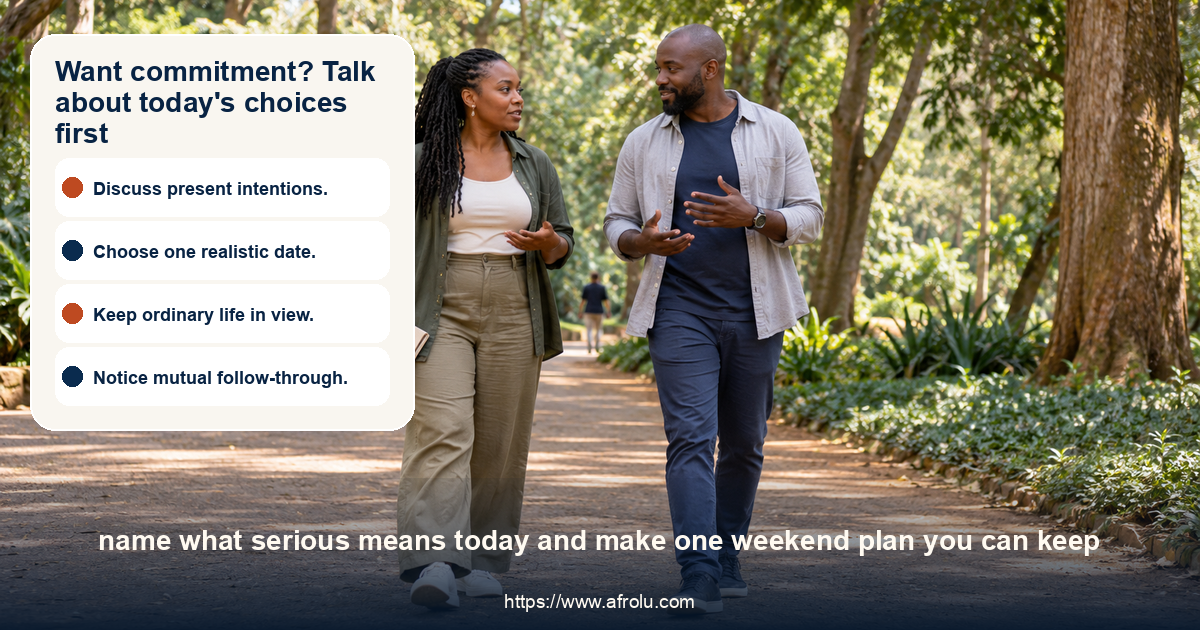
Serious intent can be discussed without making one good weekend a promise.
Written and edited by Jean-Claude Mukendi · Relationship Guides Editor
It is valid to want a serious relationship after a breakup; there is no universal timeline or requirement to be completely unaffected by the past. Decide what serious means in present choices, such as honesty, regular plans or a discussion about exclusivity. Offer a weekend time you can keep, ask what the other person wants now, and look for mutual follow-through over several interactions. You can protect rest and still make room for connection.
Starting over · New Relationship Starters
How can I date with serious intent after heartbreak without rushing commitment or giving up the weekends that help me feel grounded?
Serious dating is not one universal promise. People may mean dating with long-term possibility, exclusivity, a shared life direction or simply intentional effort. After heartbreak, clarify which meaning matters to you now. A weekend date or strong early chemistry cannot establish commitment by itself; current terms and repeated choices need to be discussed by both adults.
At forty-two, Esther wants a committed partnership after her marriage ended. She also values Saturday time with friends and Sunday rest. When a new match suggests “spending every weekend together,” Esther says she is interested in dating intentionally but wants to begin with one plan at a time. They choose a Saturday walk and later talk about exclusivity, rather than treating one good date as a promise.
Keep your own timeline
Wanting commitment does not require rushing to prove you are ready
Some adults want a committed relationship soon after a separation; others need time or prefer a different kind of connection. A wish for commitment is not automatically a rebound, and lingering memories do not automatically make you unavailable. Consider whether you can make choices based on the person in front of you rather than using the relationship to repair your past or meet someone else's deadline.
The American Psychological Association summarizes research on coping after relationship dissolution, including a small writing study with people who had recently experienced a breakup. That evidence concerns one limited task and sample; it cannot define readiness, predict future relationships or prescribe a waiting period. Personal reflection may be helpful, but it is not a test you must pass before dating.
If you notice strong distress, persistent fear or difficulty managing daily life, support from a trusted person or qualified professional may be useful. You can continue dating while seeking support if that is right for you, or pause. A new partner cannot certify your recovery, and you do not owe someone a fixed schedule for becoming interested in commitment.
Define serious in your words
A relationship goal becomes clearer when you name the choices inside it
Write down what serious means to you right now. It might mean dating intentionally with long-term possibility, choosing exclusivity after discussion, or making consistent time to learn about each other. It may include shared values or family plans, but you do not have to decide every future detail on a first date. Your definition can become more specific as trust develops.
Research on relationship talks examines how some couples move from casual dating toward commitment in particular samples. It does not tell every adult when to have the conversation or what answer to expect. The useful practice is mutual clarity: ask what each person means and listen for actual terms. If you want different things, that is compatibility information, not proof that someone is defective.
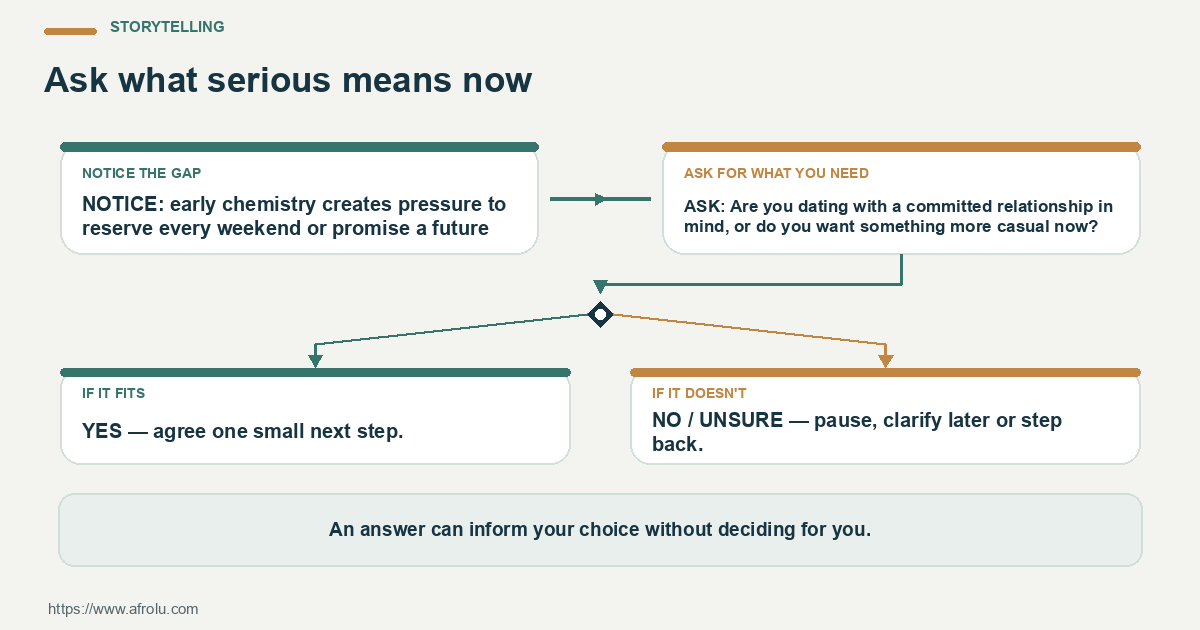
You can ask, “Are you dating with the possibility of a committed relationship, or are you looking for something more casual right now?” This is a present-tense question, not a request for a guarantee. If the answer is unsure, decide whether you want to continue while uncertain and when you would like to revisit it. Your limit belongs to you.
Plan weekends you can keep
A serious intention should fit inside a life, not replace it
Weekends may hold family, faith, rest, community, study or work. Choose a time that you can genuinely keep and offer it as an invitation. A short walk or daytime meeting can make room for conversation without implying that you are ready to share every weekend. Ask what works for the other adult too; a plan is mutual only when both people can choose it.
You might say, “I am free Saturday afternoon and would enjoy a walk. Sunday is for rest, so I will keep that plan.” The boundary is clear without being punitive. If the other person suggests another day, consider it if you want. If neither schedule works, choose a later time or decide the rhythm is not enough for you.
Do not infer serious intent from the amount of weekend time someone offers. A person may have caregiving, shift work, religious commitments or a need for rest. Ask what kind of regular contact is realistic. Then compare the answer with what you actually want. You can appreciate a constraint and still decide that the arrangement does not meet your needs.
Separate intensity from commitment
Strong chemistry is a feeling; commitment is an agreement
Early attraction can feel vivid after a long relationship or a lonely season. Enjoy the feeling without using it as evidence that the future is settled. Commitment usually involves choices that both adults discuss and continue to make, such as how they describe the relationship, whether they date other people and how they handle changes. Ask when a question matters to your next decision.
A person who says they want a future may mean it sincerely, but a future statement does not define what is agreed today. You can respond warmly and ask what the phrase means in practice. Avoid treating repeated promises as proof, but also avoid diagnosing someone from a single mismatch. Look for the pattern across conversations and the actions both adults choose.
A thoughtful pace does not require distrust. It gives each person time to observe whether values, communication and availability fit. If plans change, an update and a realistic alternative may be enough. If one adult repeatedly leaves plans open, you can decide not to keep your weekend reserved. You do not need to label the other person to protect your time.
Look for mutual effort
A relationship direction is built through shared participation
Mutual effort can look different in two people's lives. One may suggest a date while the other chooses the venue; one may be better at planning while the other checks in after a change. Look across several interactions for willingness to contribute, respect limits and talk about what matters. Do not use one person's job, age or family role as a shortcut for deciding what they feel.
When a plan falls through, a repair might include an apology, a practical update and a new option if interest remains. Both adults can do this. You do not need to disclose private work details or make a large gesture to show care. A direct question about present intent is often more useful than leaving your weekend open and waiting for someone to guess what you want.
The NHS guidance on healthy relationships highlights open communication, boundaries, time for oneself and trusted support. It is broad wellbeing guidance rather than a prediction about an individual partner. Use it to keep your own support network and interests in view while you learn whether the actual connection is respectful and workable.

Review observable actions in serious-intent dating after heartbreak while protecting weekends over more than one interaction.
Keep room for yourself
A serious goal can coexist with privacy and independent choices
You can want a long-term partner and still keep your own account, friendships, transport and savings. Do not make a major financial, housing or work decision to reassure a new date. Share personal history gradually and only at a level you choose. A person can learn that you are serious through honest conversation and kept plans; access to every part of your life is not a prerequisite.
Consent and boundaries apply throughout dating, including within an exclusive relationship. Agreeing to one activity does not create permission for another. Either person can pause, decline or reconsider. If a partner responds to a limit with repeated pressure or threats, take the behavior seriously and seek support from people or services you trust.
If you have responsibilities outside dating, say what you can offer without apologizing for having a full life. A useful match will still need to negotiate time and preferences. If the amount of contact available is below what you want, you may decide that it is not enough even when the other person has a valid reason. Compatibility includes whether the arrangement fits both people.

Adapt a question or boundary script to serious-intent dating after heartbreak while protecting weekends; no phrase guarantees a response.
Review the actual fit
Use the relationship you are building, not an imagined deadline
After several dates, ask whether you have discussed the terms that matter, whether both people show up in ways they agreed to, and whether your weekends still feel like your own. You may be ready to talk about exclusivity, or you may want more time. Neither choice is a failure. Keep the question specific to what you know so far.
If your goals differ, state them kindly and decide whether you can accept the current arrangement. Do not stay because a former relationship ended or because friends expect you to find someone soon. Do not rush commitment to prove that heartbreak did not change you. Your choice can be based on the present offer and your own values.
If both adults want a similar direction, agree on one next step and revisit the conversation when circumstances change. Serious dating grows through repeated choices, but no sequence guarantees a lasting partnership. Keep support and interests outside the relationship. You can be hopeful, realistic and self-respecting at the same time.

Take one voluntary step in serious-intent dating after heartbreak while protecting weekends and review how it feels afterward.
Common moments in serious-intent dating after heartbreak while protecting weekends
A clear invitation
For serious-intent dating after heartbreak while protecting weekends: An adult suggests a specific day and activity.
Notice whether you want that plan before accepting; you may offer another option.A busy or difficult day
For serious-intent dating after heartbreak while protecting weekends: A reply arrives later while one person is handling ordinary responsibilities.
Treat timing as context, ask for a workable plan if you want one, and avoid guessing motive.An open-ended promise
For serious-intent dating after heartbreak while protecting weekends: The conversation turns toward a future possibility without a current step.
Ask what each person wants today and keep the future idea separate from an agreement.A changed plan
For serious-intent dating after heartbreak while protecting weekends: A date or call moves after it was discussed.
Notice whether the change is communicated and decide whether the alternative works for you.A boundary is named
For serious-intent dating after heartbreak while protecting weekends: One person asks for less contact, a public venue or more time.
Acknowledge the limit and make the next choice without pressure.Your feelings shift
For serious-intent dating after heartbreak while protecting weekends: The current pace starts to feel different from what you want.
Say what changed and ask whether the other adult wants to revisit the terms.A private detail is requested
For serious-intent dating after heartbreak while protecting weekends: Someone asks for information that is not needed for the next step.
Share only what you are comfortable sharing; a simple no is enough.Two people want different terms
For serious-intent dating after heartbreak while protecting weekends: One adult wants more commitment or contact than the other currently does.
Clarify the difference and decide whether the actual arrangement fits you.Notice choices and actions, not imagined motives
You can name what you want from the next interaction.
The invitation has a detail you can accept, decline or change.
The pace fits your work, sleep, care and other commitments.
You can ask a question without demanding a particular answer.
Either person can say no without guilt or punishment.
A change is communicated when reasonably possible.
A new plan is chosen by both adults rather than assumed.
Your privacy boundary is heard without repeated pressure.
You can keep your own friends, money and transport choices.
The connection leaves room for interests outside dating.
You distinguish a feeling from an agreement.
A mismatch can be named without a diagnosis or label.
The next step for serious-intent dating after heartbreak while protecting weekends remains voluntary.
You can pause or leave without proving that the other person is wrong.
Choose a response that fits the moment
| Situation | What it may mean | What to do next |
|---|---|---|
| A clear invitation | For serious-intent dating after heartbreak while protecting weekends: An adult suggests a specific day and activity. | Notice whether you want that plan before accepting; you may offer another option. |
| A busy or difficult day | For serious-intent dating after heartbreak while protecting weekends: A reply arrives later while one person is handling ordinary responsibilities. | Treat timing as context, ask for a workable plan if you want one, and avoid guessing motive. |
| An open-ended promise | For serious-intent dating after heartbreak while protecting weekends: The conversation turns toward a future possibility without a current step. | Ask what each person wants today and keep the future idea separate from an agreement. |
| A changed plan | For serious-intent dating after heartbreak while protecting weekends: A date or call moves after it was discussed. | Notice whether the change is communicated and decide whether the alternative works for you. |
| A boundary is named | For serious-intent dating after heartbreak while protecting weekends: One person asks for less contact, a public venue or more time. | Acknowledge the limit and make the next choice without pressure. |
| Your feelings shift | For serious-intent dating after heartbreak while protecting weekends: The current pace starts to feel different from what you want. | Say what changed and ask whether the other adult wants to revisit the terms. |
| A private detail is requested | For serious-intent dating after heartbreak while protecting weekends: Someone asks for information that is not needed for the next step. | Share only what you are comfortable sharing; a simple no is enough. |
| Two people want different terms | For serious-intent dating after heartbreak while protecting weekends: One adult wants more commitment or contact than the other currently does. | Clarify the difference and decide whether the actual arrangement fits you. |
| An answer is uncertain | The other adult may be unsure or want different terms; one answer does not establish a motive. | Ask whether a check-in would help, then choose your own limit. |
| Your comfort changes | A changed feeling can be enough reason to revise or stop a plan. | Say what you want now and leave the next choice voluntary. |
Words you can adapt to your own voice
“I am interested in serious-intent dating after heartbreak while protecting weekends, and I want to move at a pace I can sustain.”
“Would you like to plan a Saturday walk and a later conversation about present relationship goals?”
“Are you dating with a committed relationship in mind, or do you want something more casual now?”
“I can share the weekend time you can offer, not a promise of every free day, but I am keeping other details private.”
“Can we agree on one weekend plan that leaves room for rest and other commitments before I change my plans?”
“That time no longer works for me. I can suggest another option if I still want to meet.”
“It sounds as if we want different things right now. Have I understood you correctly?”
“My feelings or availability have changed. Would you like to revisit what we agreed?”
“I am not comfortable with that plan, so I will not go ahead with it.”
“I can meet for about an hour, then I need to head home.”
“I want to think about that before I answer. I will get back to you if I decide to.”
“I have appreciated meeting you, but I do not want to continue dating.”
Know the difference
Compare intentional and gradual with intense but undefined
Both adults discuss present goals, choose a realistic date and keep ordinary life in view.
Strong early feelings are treated as a promise before terms or expectations are discussed.
Use the agreement and what happened next; a label cannot establish another person's motive.

Compare stated terms and actions in serious-intent dating after heartbreak while protecting weekends without diagnosing motive.
Compare intentional and gradual and intense but undefined
| Type or dimension | What it describes | Best next question |
|---|---|---|
| A feeling | Interest, grief or uncertainty describes an experience, not a relationship agreement. | Notice it and choose whether to talk or wait. |
| A stated goal | Each person can explain what they hope for without guaranteeing an outcome. | Ask what the goal means in current choices. |
| A clear plan | A day, activity and practical details have been agreed by both adults. | Confirm the details and keep the choice voluntary. |
| A boundary | A person names what they will or will not do. | Respect it without asking repeatedly. |
| A changed plan | Someone's schedule or comfort has shifted. | Offer or accept an alternative only if it works. |
| An open promise | A future possibility is mentioned but has no present step. | Separate hope from what is agreed today. |
| A mismatch | Two people want different terms, timing or contact. | Decide whether the actual offer suits you. |
| A repeated pattern | Several interactions show how plans or limits are handled. | Describe the observations without diagnosing a motive. |
| A new choice | Either person wants to revise or end the arrangement. | State the change and let both adults respond freely. |
Six practical ideas to keep nearby
No universal timeline
Your history does not set a deadline for meeting someone new.
Feelings are not terms
Interest, grief and hope do not define exclusivity or commitment.
Small steps count
For serious-intent dating after heartbreak while protecting weekends, a modest next action may give you enough information.
Boundaries stay yours
You can protect time, privacy, money and comfort while dating.
Use observable details
Compare what was agreed with what happened without guessing motive.
Choose again
Continue, clarify, pause or stop as your needs change.
Questions for planning and reflection
Choose a few prompts that fit the moment. This is a reference library, not a list to complete.
Before you meet
Choose the conditions that fit your real life.
- What do I want from this interaction?
- What time or boundary matters?
- What is one step I actually want?
During the conversation
Ask the question that affects your next choice.
- What do I mean by this dating term?
- What does the other person want now?
- Can we both say no freely?
Afterward
Notice your experience without grading your recovery.
- Was I able to be myself?
- Did the plan and boundary hold?
- Do I want another step?
If something changes
Revisit the plan without assigning motive.
- What changed?
- What do I want now?
- Would a pause or ending fit better?
What research and practical guidance can—and cannot—tell you
What the writing study examined
The APA summary describes a small study of people who had recently experienced relationship dissolution.
Evidence limit: It does not define readiness or prescribe a universal recovery technique.
Why boundaries and communication matter
NHS guidance discusses open conversation, personal time, boundaries and trusted support.
Evidence limit: General wellbeing guidance cannot predict how one dating relationship will develop.
Why a dating label is not a diagnosis
Terms such as rebound, casual or serious can mean different things to different adults.
Evidence limit: This guide does not diagnose attachment, motive or mental-health conditions.
Agreement applies to each current choice
RAINN and Planned Parenthood describe direct communication and respect for boundaries.
Evidence limit: These educational sources do not replace local legal or clinical advice.
Share personal information deliberately
Kenya's ODPC explains rights and consent in personal-data processing.
Evidence limit: Data-protection guidance does not authenticate a profile or guarantee confidentiality.
When a guide is not enough
A trusted person or qualified professional may help when distress affects daily life or safety.
Evidence limit: This article cannot assess mental health, risk or the need for treatment.
Common assumptions that add pressure
Waiting until you feel nothing
A universal finish line does not exist and may not fit your experience.
Treating a date as a promise
One good interaction does not establish future commitment.
Using a label as a contract
People can mean different things by the same dating term.
Explaining a boundary at length
A respectful no does not need to persuade someone before it counts.
Reading one delay as proof
Timing has many possible explanations; ask for what you need.
Giving up ordinary support
Friends, routine, rest and professional care can remain part of life.
Discuss today's relationship direction
These information links are clearly labelled, non-commercial and do not promise a relationship outcome.
Explore the guide library
Show more related guides
Continue with Afrolu
Show more Afrolu guides
Research and practical guidance used for this guide
Afrolu reviewed these health, research, safety, or public guidance resources while editing this page. They support the behaviour and safety guidance; they do not diagnose any individual described by a reader.
Questions about serious-intent dating after heartbreak while protecting weekends
Is it too soon to want commitment?
Wanting commitment is valid; no universal timeline decides when you may date.
What does serious dating mean?
People use the term differently. Name the present choices that matter to you.
Should we spend every weekend together?
Only if both adults want that. One agreed plan can be enough to continue learning.
Does chemistry prove compatibility?
No. It is one experience, not a shared relationship agreement.
How do I ask about exclusivity?
Ask directly and listen to the answer; do not infer it from time together.
What if they are unsure?
Decide whether you want to continue while uncertain and what limit works for you.
Can I protect time with friends?
Yes. A serious goal can coexist with friendships, rest and other commitments.
What if we have different schedules?
Discuss a realistic rhythm and decide whether the arrangement fits both people.
Does a breakup mean I need therapy before dating?
A guide cannot assess your needs; choose professional support if it would help you.
Can I change my mind after a good date?
Yes. A pleasant meeting does not obligate you to continue.
One thing to do now
Choose the next step that fits your actual needs
Name what serious means to you today, choose a weekend plan that fits your life, and use honest conversation plus follow-through to decide whether to keep building.