Dating after heartbreak · career · low pressure
Let dating fit a full life while you start again
After heartbreak, a demanding job can make dating feel like another task. Choose a pace that protects rest, ask for a simple plan, and review how it feels.

Low-pressure dating can fit a full career and leave rest protected.
Written and edited by Miriam Otieno · Senior Kenya Editor
There is no required timeline for dating again, and a busy career does not prove that you are unavailable. Check your real capacity, offer a short low-pressure date you want to attend, and keep work, rest and friendships in view. Afterward, notice your own experience and whether the other person respects the pace you stated. You can continue, revise the plan or pause without turning it into a verdict on your recovery.
Starting over · New Relationship Starters
How do I make room for dating after heartbreak when work already takes much of my time and energy?
Low-pressure dating after a breakup means choosing a modest pace that leaves room for genuine curiosity, ordinary responsibilities and the option to stop. It does not mean avoiding every serious conversation or accepting a connection that stays vague. A work calendar is one practical constraint among many; it neither explains another person's motives nor defines the amount of care you can offer.
Thirty-five-year-old Amina has returned to dating after a relationship ended. She is leading a busy project and notices that late evening chats leave her tired. She decides that Thursday lunch or a Saturday walk is more realistic than open-ended texting. When someone suggests a date, she offers one option, keeps her weekend plans, and checks afterward whether the pace felt enjoyable rather than obligatory.
Start with capacity
Wanting a date and having limited time can both be true
A breakup can leave a person wanting company while work, family care or ordinary fatigue still needs attention. You do not have to wait until every feeling disappears, and you do not have to fill every free evening to prove you are ready. Check what is realistically available in the next few days: time, attention, travel, money and the energy to be present.
A useful plan may be shorter than the date you imagine a confident person would choose. A twenty-minute call, a daytime coffee or a walk near a familiar route can be enough to learn whether conversation feels comfortable. Keep the rest of your day for what it already holds. Your first step is an invitation you actually want, not a performance of being over the past.
If you are unsure about dating at all, you can try one interaction and reassess or decide to wait. There is no universal emotional threshold. If grief or stress feels difficult to manage in daily life, a trusted person or qualified professional can provide support; a demanding job and a dating choice are not substitutes for mental-health care.
Set a workable window
A clear invitation can protect both work and personal time
Look at the week you actually have, including commute, deadlines, sleep and any responsibilities outside work. Offer a day and a reasonable time window rather than saying “whenever.” A concrete invitation lets the other person accept, decline or suggest an alternative. It also lets you make other plans if neither of you can find a time.
Some work and family research examines competing demands among established couples in particular countries. It cannot prescribe a dating schedule for Kenyan adults or explain whether a person who is busy is interested. Use the practical lesson cautiously: time is finite, so make plans that account for it. Do not treat an employment pattern as evidence that someone is emotionally avoidant or withholding.
If work changes the plan, send an update as soon as it is practical and offer another time only if you still want to meet. The same standard applies to the other person. A change is not automatically a rejection; repeated open-ended rescheduling may show that the current arrangement does not work, whatever the reason. Keep the distinction between what you observe and what you infer.
Keep the first step light
Low pressure works best when the terms remain clear
A first date does not need an expensive booking, a full weekend or a long list of future possibilities. Choose a public activity that leaves both adults free to arrive and leave independently. You might take a short walk, meet for a daytime drink or talk by phone. Let the plan be small enough that you can notice how you feel rather than managing a complicated event.
Low-pressure does not have to mean unclear. If you only want to meet once and see how conversation feels, say that. If you hope to explore a relationship over time, you can state that too without asking for a guarantee. The other adult can want something different. Honest expectations help you decide whether to continue without treating a mismatch as evidence that either person is broken.
Avoid using message volume as your measure of interest. Someone may be occupied; someone else may simply prefer less texting. Ask for the communication rhythm you prefer and notice whether both people can discuss it. A brief check-in after a date—“I enjoyed that; would you like to meet again?”—is more useful than trying to decode every response time.
Keep rest in the plan
Dating should leave room for recovery, friendships and the life you already have
After a breakup, it can be tempting to keep evenings open in case attention arrives. You may feel better if some time remains yours regardless of what a match decides. Maintain routines and relationships that support you. A full life is not a tactic to make someone pursue you; it is a set of commitments and interests you are allowed to keep.
Try a simple limit: no dating messages during meetings, no late call before an early start, or one weekend plan at a time. Choose a boundary that reflects your needs rather than a rule borrowed from a social-media checklist. You can revise it later. If another person responds with pressure, guilt or contempt, you may pause and decide whether that interaction is acceptable to you.
The NHS guidance on healthy relationships highlights boundaries, time for oneself, trusted support and open communication as useful practices. It is general mental-wellbeing guidance rather than a formula for a perfect relationship. You can borrow those ideas without turning them into an obligation to be constantly calm, available or emotionally finished before meeting someone new.
Talk about what you want
A direct question can be brief and still leave room for a real answer
You might say, “I am enjoying meeting people slowly after a recent breakup. What are you looking for at the moment?” This gives the other adult context without requiring you to recount private details. Ask only what matters to your next decision. You can discuss exclusivity, casual dating or the possibility of a relationship when those choices become relevant.
Researchers who study relationship discussions examine specific samples and stages of dating; those studies do not set a deadline for defining a relationship. A clear conversation is useful because both people can say what they mean. It should not be used as a test with a hidden correct answer. If you want something different, decide whether the actual offer is enough for you today.
You do not owe a date your breakup history, workplace details or a polished narrative of what you learned. Share at the level that feels right and answer questions in your own time. A person who respects you can hear “I would rather not discuss that yet.” A relationship that requires disclosure or instant trust before you are comfortable is not a plan you have to accept.

Review observable actions in low-pressure dating after heartbreak during a busy career season over more than one interaction.
Review the experience
Notice how the pace feels after the workday ends
After a date or conversation, ask whether you were interested, whether you felt free to leave and whether you want another step. Notice what happened to sleep, focus and ordinary responsibilities too. You do not need a scorecard. A short private note can help you distinguish the actual experience from a wish to be chosen or a fear that time is running out.
An American Psychological Association summary describes a small writing study with people who had recently experienced a breakup. The task and sample were limited; the findings do not mean journaling is necessary or that you should reframe painful events before you are ready. If private reflection is useful, keep it brief and neutral: what happened, what you felt, and what you want next.
If you repeatedly feel depleted after contact or cannot hold the limits you intended, adjust the pace before deciding that something is wrong with you. You may choose shorter dates, fewer messages or a pause. If dating feels enjoyable and your schedule stays workable, continue at the speed you prefer. Both outcomes are reasonable choices.

Adapt a question or boundary script to low-pressure dating after heartbreak during a busy career season; no phrase guarantees a response.
Choose the next step
Continue, revise or pause without making work the excuse
If the other person suggests a time that fits, confirm the details and enjoy meeting them. If your work changes, offer a specific alternative only if you want to. If neither person has capacity this month, say so plainly. Calling a mismatch a scheduling problem can be kind, but avoid promising a date later if you do not want to make one.
If the connection stays vague, ask once whether they want to choose a day. You can keep your calendar moving while they decide. There is no need to label someone as avoidant or blame your job for wanting more clarity. State the effect: “I prefer making plans rather than leaving a time open, so I am going to step back for now.”
Support after a breakup can come from friends, community, faith, routine or professional care that you choose. A new date may be part of life again; it does not have to become the only source of comfort. Your work matters, your rest matters, and your curiosity matters. Decide how those parts fit together for this week, then make a new choice when circumstances change.

Take one voluntary step in low-pressure dating after heartbreak during a busy career season and review how it feels afterward.
Common moments in low-pressure dating after heartbreak during a busy career season
A clear invitation
For low-pressure dating after heartbreak during a busy career season: An adult suggests a specific day and activity.
Notice whether you want that plan before accepting; you may offer another option.A busy or difficult day
For low-pressure dating after heartbreak during a busy career season: A reply arrives later while one person is handling ordinary responsibilities.
Treat timing as context, ask for a workable plan if you want one, and avoid guessing motive.An open-ended promise
For low-pressure dating after heartbreak during a busy career season: The conversation turns toward a future possibility without a current step.
Ask what each person wants today and keep the future idea separate from an agreement.A changed plan
For low-pressure dating after heartbreak during a busy career season: A date or call moves after it was discussed.
Notice whether the change is communicated and decide whether the alternative works for you.A boundary is named
For low-pressure dating after heartbreak during a busy career season: One person asks for less contact, a public venue or more time.
Acknowledge the limit and make the next choice without pressure.Your feelings shift
For low-pressure dating after heartbreak during a busy career season: The current pace starts to feel different from what you want.
Say what changed and ask whether the other adult wants to revisit the terms.A private detail is requested
For low-pressure dating after heartbreak during a busy career season: Someone asks for information that is not needed for the next step.
Share only what you are comfortable sharing; a simple no is enough.Two people want different terms
For low-pressure dating after heartbreak during a busy career season: One adult wants more commitment or contact than the other currently does.
Clarify the difference and decide whether the actual arrangement fits you.Notice choices and actions, not imagined motives
You can name what you want from the next interaction.
The invitation has a detail you can accept, decline or change.
The pace fits your work, sleep, care and other commitments.
You can ask a question without demanding a particular answer.
Either person can say no without guilt or punishment.
A change is communicated when reasonably possible.
A new plan is chosen by both adults rather than assumed.
Your privacy boundary is heard without repeated pressure.
You can keep your own friends, money and transport choices.
The connection leaves room for interests outside dating.
You distinguish a feeling from an agreement.
A mismatch can be named without a diagnosis or label.
The next step for low-pressure dating after heartbreak during a busy career season remains voluntary.
You can pause or leave without proving that the other person is wrong.
Choose a response that fits the moment
| Situation | What it may mean | What to do next |
|---|---|---|
| A clear invitation | For low-pressure dating after heartbreak during a busy career season: An adult suggests a specific day and activity. | Notice whether you want that plan before accepting; you may offer another option. |
| A busy or difficult day | For low-pressure dating after heartbreak during a busy career season: A reply arrives later while one person is handling ordinary responsibilities. | Treat timing as context, ask for a workable plan if you want one, and avoid guessing motive. |
| An open-ended promise | For low-pressure dating after heartbreak during a busy career season: The conversation turns toward a future possibility without a current step. | Ask what each person wants today and keep the future idea separate from an agreement. |
| A changed plan | For low-pressure dating after heartbreak during a busy career season: A date or call moves after it was discussed. | Notice whether the change is communicated and decide whether the alternative works for you. |
| A boundary is named | For low-pressure dating after heartbreak during a busy career season: One person asks for less contact, a public venue or more time. | Acknowledge the limit and make the next choice without pressure. |
| Your feelings shift | For low-pressure dating after heartbreak during a busy career season: The current pace starts to feel different from what you want. | Say what changed and ask whether the other adult wants to revisit the terms. |
| A private detail is requested | For low-pressure dating after heartbreak during a busy career season: Someone asks for information that is not needed for the next step. | Share only what you are comfortable sharing; a simple no is enough. |
| Two people want different terms | For low-pressure dating after heartbreak during a busy career season: One adult wants more commitment or contact than the other currently does. | Clarify the difference and decide whether the actual arrangement fits you. |
| An answer is uncertain | The other adult may be unsure or want different terms; one answer does not establish a motive. | Ask whether a check-in would help, then choose your own limit. |
| Your comfort changes | A changed feeling can be enough reason to revise or stop a plan. | Say what you want now and leave the next choice voluntary. |
Words you can adapt to your own voice
“I am interested in low-pressure dating after heartbreak during a busy career season, and I want to move at a pace I can sustain.”
“Would you like to plan a brief daytime walk or call after your workday?”
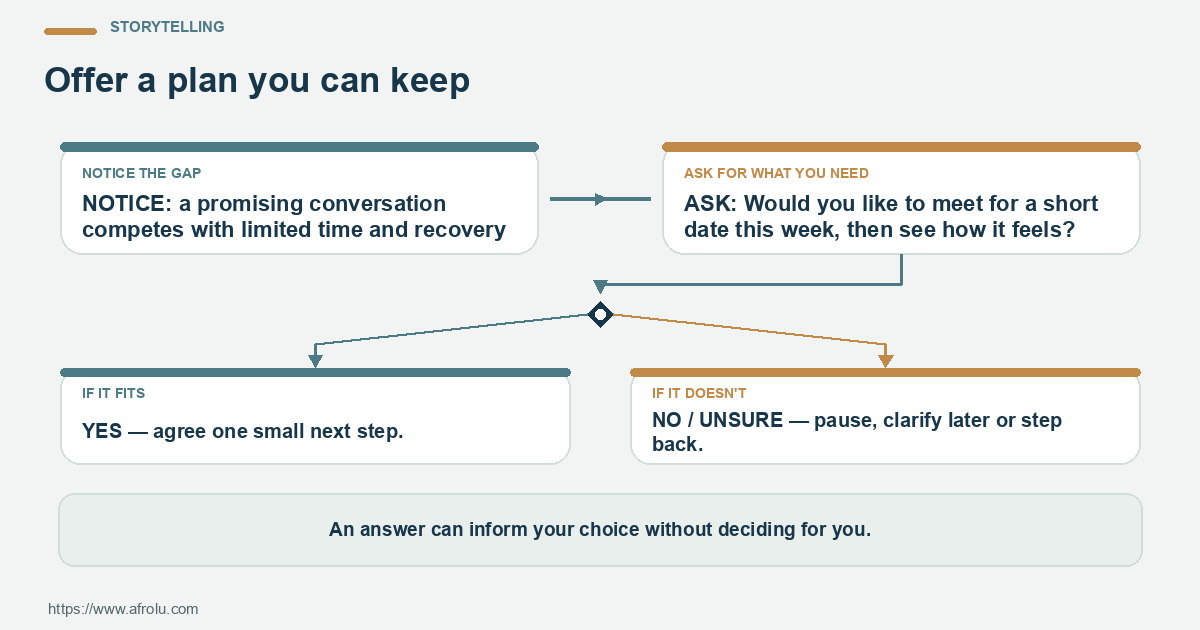
“Would you like to meet for a short date this week, then see how it feels?”
“I can share a time option, not confidential work or calendar details, but I am keeping other details private.”
“Can we agree on one short evening or weekend activity you can keep before I change my plans?”
“That time no longer works for me. I can suggest another option if I still want to meet.”
“It sounds as if we want different things right now. Have I understood you correctly?”
“My feelings or availability have changed. Would you like to revisit what we agreed?”
“I am not comfortable with that plan, so I will not go ahead with it.”
“I can meet for about an hour, then I need to head home.”
“I want to think about that before I answer. I will get back to you if I decide to.”
“I have appreciated meeting you, but I do not want to continue dating.”
Know the difference
Compare slow and specific with warm but open-ended
A small invitation fits both schedules, can be accepted or declined, and leaves room for rest.
Messages continue without a chosen day, so one person keeps moving work or personal plans around.
Use the agreement and what happened next; a label cannot establish another person's motive.

Compare stated terms and actions in low-pressure dating after heartbreak during a busy career season without diagnosing motive.
Compare slow and specific and warm but open-ended
| Type or dimension | What it describes | Best next question |
|---|---|---|
| A feeling | Interest, grief or uncertainty describes an experience, not a relationship agreement. | Notice it and choose whether to talk or wait. |
| A stated goal | Each person can explain what they hope for without guaranteeing an outcome. | Ask what the goal means in current choices. |
| A clear plan | A day, activity and practical details have been agreed by both adults. | Confirm the details and keep the choice voluntary. |
| A boundary | A person names what they will or will not do. | Respect it without asking repeatedly. |
| A changed plan | Someone's schedule or comfort has shifted. | Offer or accept an alternative only if it works. |
| An open promise | A future possibility is mentioned but has no present step. | Separate hope from what is agreed today. |
| A mismatch | Two people want different terms, timing or contact. | Decide whether the actual offer suits you. |
| A repeated pattern | Several interactions show how plans or limits are handled. | Describe the observations without diagnosing a motive. |
| A new choice | Either person wants to revise or end the arrangement. | State the change and let both adults respond freely. |
Six practical ideas to keep nearby
No universal timeline
Your history does not set a deadline for meeting someone new.
Feelings are not terms
Interest, grief and hope do not define exclusivity or commitment.
Small steps count
For low-pressure dating after heartbreak during a busy career season, a modest next action may give you enough information.
Boundaries stay yours
You can protect time, privacy, money and comfort while dating.
Use observable details
Compare what was agreed with what happened without guessing motive.
Choose again
Continue, clarify, pause or stop as your needs change.
Questions for planning and reflection
Choose a few prompts that fit the moment. This is a reference library, not a list to complete.
Before you meet
Choose the conditions that fit your real life.
- What do I want from this interaction?
- What time or boundary matters?
- What is one step I actually want?
During the conversation
Ask the question that affects your next choice.
- What do I mean by this dating term?
- What does the other person want now?
- Can we both say no freely?
Afterward
Notice your experience without grading your recovery.
- Was I able to be myself?
- Did the plan and boundary hold?
- Do I want another step?
If something changes
Revisit the plan without assigning motive.
- What changed?
- What do I want now?
- Would a pause or ending fit better?
What research and practical guidance can—and cannot—tell you
What the writing study examined
The APA summary describes a small study of people who had recently experienced relationship dissolution.
Evidence limit: It does not define readiness or prescribe a universal recovery technique.
Why boundaries and communication matter
NHS guidance discusses open conversation, personal time, boundaries and trusted support.
Evidence limit: General wellbeing guidance cannot predict how one dating relationship will develop.
Why a dating label is not a diagnosis
Terms such as rebound, casual or serious can mean different things to different adults.
Evidence limit: This guide does not diagnose attachment, motive or mental-health conditions.
Agreement applies to each current choice
RAINN and Planned Parenthood describe direct communication and respect for boundaries.
Evidence limit: These educational sources do not replace local legal or clinical advice.
Share personal information deliberately
Kenya's ODPC explains rights and consent in personal-data processing.
Evidence limit: Data-protection guidance does not authenticate a profile or guarantee confidentiality.
When a guide is not enough
A trusted person or qualified professional may help when distress affects daily life or safety.
Evidence limit: This article cannot assess mental health, risk or the need for treatment.
Common assumptions that add pressure
Waiting until you feel nothing
A universal finish line does not exist and may not fit your experience.
Treating a date as a promise
One good interaction does not establish future commitment.
Using a label as a contract
People can mean different things by the same dating term.
Explaining a boundary at length
A respectful no does not need to persuade someone before it counts.
Reading one delay as proof
Timing has many possible explanations; ask for what you need.
Giving up ordinary support
Friends, routine, rest and professional care can remain part of life.
Make room for one manageable date
These information links are clearly labelled, non-commercial and do not promise a relationship outcome.
Explore the guide library
Show more related guides
Continue with Afrolu
Show more Afrolu guides
Research and practical guidance used for this guide
Afrolu reviewed these health, research, safety, or public guidance resources while editing this page. They support the behaviour and safety guidance; they do not diagnose any individual described by a reader.
Questions about low-pressure dating after heartbreak during a busy career season
Do I need to be completely healed first?
There is no universal readiness deadline; notice what you want and what you can offer now.
How much time should I reserve?
Choose an amount that fits your actual week; no guide can prescribe a correct cadence.
Is slow dating the same as avoiding commitment?
Not automatically. You can set a modest pace and still be clear about your longer-term hopes.
Should I move a deadline for a date?
Only if that is your choice; you do not need to sacrifice work or rest to prove interest.
What if work keeps changing my plans?
Offer alternatives you genuinely want and be honest if you do not have capacity right now.
Does a late reply mean disinterest?
Reply timing alone does not establish intent; ask for a plan if you want one.
Can a short date be enough?
Yes. A brief public meeting may help you decide whether you want another step.
What if I need more time?
Say so and choose a check-in only if you want one.
Should I explain my breakup?
Share only the context you are comfortable discussing.
Can I stop after one date?
Yes. Meeting once does not create an obligation to continue.
One thing to do now
Choose the next step that fits your actual needs
Offer one small plan that fits your actual week, then decide from your energy, comfort and mutual follow-through whether to repeat it.