Six slots · parent casual-dating calendar
Parents: Keep Breadcrumbing Off the Family Calendar
A clear breadcrumbing guide for parents dating casually: protect family time and child privacy, confirm real plans, repair missed steps and exit safely.
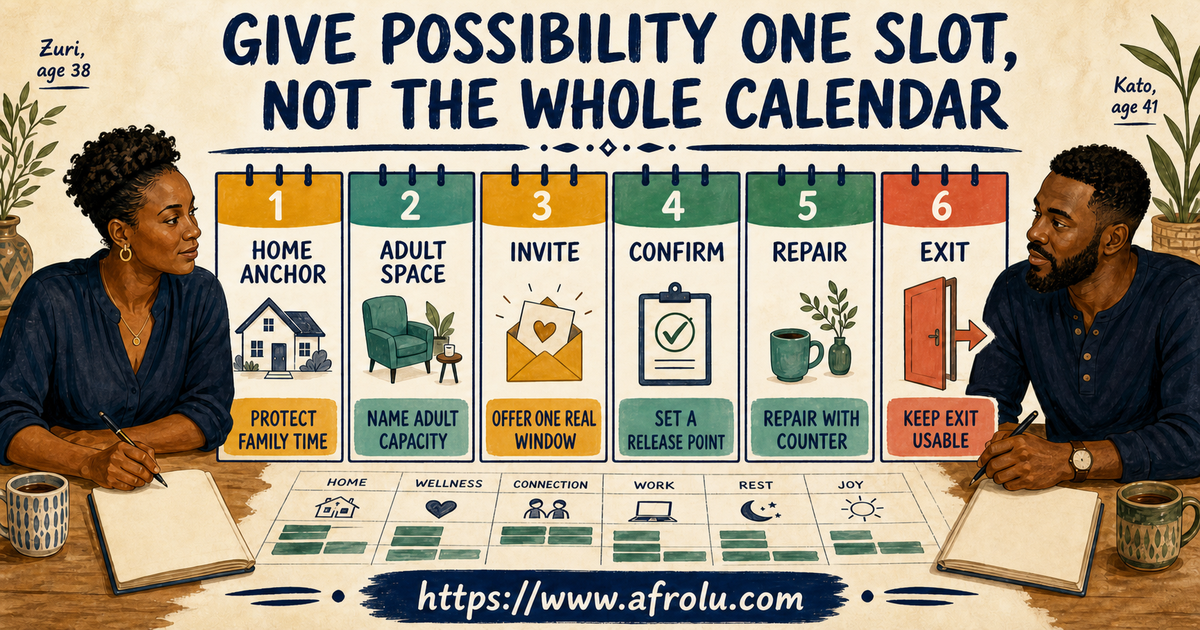
A casual connection may use a small slot; it does not get the whole family calendar.
Written and edited by Grace Mutiso · Kenya Guides Editor
Use six separate slots: HOME ANCHOR, ADULT SPACE, INVITE, CONFIRM, REPAIR and EXIT. Offer only real adult capacity, ask once about an unfinished step and release unconfirmed time. Casual scope may stay light while plans, child privacy, money, consent and closure remain explicit. Continue, counter, reschedule, pause or close without proving motive. Use qualified care for lasting daily-life distress and direct local help for fraud, threats, stalking or child-targeted access.
Mixed signals · Parents Returning To Dating
How can a parent tell whether intermittent attention is a mutual casual rhythm or an open loop occupying protected family time?
Breadcrumbing is a non-clinical dating term for intermittent attention that keeps romantic possibility alive while clarity, reciprocity or a useful next step repeatedly stays unavailable. It does not diagnose a person or make every slow parent harmful. Mutual casual dating, real parenting delay, uncertainty, mismatch, friendship, closure, distress and danger leave different evidence and require different responses.
Zuri, 38, is a parent dating casually and offers Kato, 41, Saturday coffee. He cannot attend, proposes Wednesday at 18:00, confirms by Tuesday and meets in public for forty-five minutes. Both fictional adults travel separately, handle ordinary costs and keep family data, money, consent and exit controlled. They review only the present casual plan, never a child's place in it.
The six-slot parent dating calendar
Keep family anchors steady while adult possibility stays answerable
Zuri separates protected family blocks from the small adult plan that a casual connection must actually carry.
Name the open slot, request one useful handoff, release unconfirmed time and keep children outside the evidence trail.
Anchor family time
Existing responsibilities do not need a match's approval.
Name the real slot
Availability can be clear without exposing a child.
Read the counteroffer
A real constraint carries another usable plan.
Return the time
Pause and closure protect a life already in motion.
The family calendar is not a waiting room
Give intermittent attention one answerable adult slot
Breadcrumbing is a popular, non-clinical term for intermittent attention that keeps romantic possibility alive while a useful next step repeatedly stays unfinished. One delayed reply or cancelled plan does not establish a pattern. The label cannot reveal motive, diagnose attachment or prove manipulation. It can help a parent describe what adult contact delivers and whether that rhythm fits.
Parenthood already contains commitments that do not need to audition for importance. Meals, rest, caregiving, co-parent communication and a child's private life remain separate from a new dating contact. A casual connection may receive chosen adult time, but it does not acquire a child's name, images, school, routine, home access or emotional role because messages feel warm.
Casual dating is an adult agreement about present scope, not permission for vague behaviour. It may mean no exclusivity or long-term promise. It still needs honest availability, current consent and a plan that can be accepted, changed or declined. When both adults choose a light rhythm, they can identify the next modest step and let a no finish the question.
Start with one open slot. Perhaps a conversation needs an invitation, a date needs confirmation or a cancellation needs a counteroffer. Ask once, keep family information outside the question and read the action that follows. Fraud, threats, stalking, child-targeted access or blocked movement bypass ordinary dating review and call for local protection suited to the facts.
The six-slot family calendar
Keep home anchors, adult capacity and dating effort in separate boxes
HOME ANCHOR contains the routines and responsibilities the parent has chosen to protect. ADULT SPACE is the time genuinely available for dating, rest or friends. These blocks are not excuses that a match must inspect. A parent can say when they are free without handing over a full calendar, a child's details or a co-parenting history.
INVITE turns interest into an answerable adult activity, place and window. CONFIRM sets the point when both people know the plan stands. Casual scope does not require daily texting or elaborate dates. It does require enough definition that nobody holds an evening indefinitely. Unconfirmed time returns to family life, work, rest or another plan without punishment.
REPAIR follows a missed action. A brief apology, realistic counteroffer and later follow-through provide useful evidence. A warm message that avoids the cancelled plan leaves the slot open. Parents do not need to publish their constraints to deserve respect. The question is whether the other adult can work with the capacity actually offered, not whether they approve its cause.
EXIT keeps pause, closure and access usable. Either adult may decide the offered casual rhythm does not fit. A respectful ending is a complete answer, not an invitation to reach through another account, workplace, relative or child. Review observable conduct only. Do not monitor online status, recruit a co-parent or ask children to notice or report an adult's behaviour.
Zuri and Kato complete one small plan
A fictional coffee shows how a real counteroffer protects family time
Zuri is 38, a parent and open to casual adult company without a commitment promise. Kato is 41 and wants the same present scope. Both are fictional Black African adults. Zuri keeps family identities, home routines and co-parent communication private. Each person controls money, devices, travel, physical affection and the right to leave at every stage.
After several friendly messages, Zuri offers coffee on Saturday afternoon. Kato says the window does not work and proposes Wednesday at 18:00 near a public transport stop. The counteroffer is useful because it can be accepted or declined. Zuri checks only the adult slot she controls and agrees to hold it until confirmation on Tuesday evening.
Kato confirms by the agreed point without asking why Saturday mattered or requesting Zuri's home address. They travel separately, meet in a staffed public cafe and each handles ordinary personal costs. The coffee lasts forty-five minutes because that is what they chose. Time spent does not purchase another meeting, affection, private history or access to family life.
Afterward, Zuri says the light scope still fits and offers to review another plan later. Kato agrees without promoting the connection into exclusivity. If either had wanted a different route, they could have closed kindly. The story proves no future compatibility or safety; it simply shows six current adult moves completed without turning a family calendar into romantic evidence.
Fourteen signals around protected time
Pair the adult effort that arrived with the loop it answers
The fourteen signals form seven pairs across home anchor, adult space, invitation, confirmation, repair, privacy and exit. Each pair contrasts protected effort with an open loop. They are prompts for observation, not points toward a verdict. Mixed evidence is normal, circumstances change and no reassuring response certifies future safety or compatibility.
A protected HOME ANCHOR is accepted without interrogation; its open loop treats family time as competition. Protected ADULT SPACE works with the window offered; the loop demands proof, full schedules or constant access. Parenting limits can be real while a connection still does not fit. Respecting capacity and choosing compatibility are separate adult decisions.
A protected INVITE is specific enough to answer, and protected CONFIRMATION arrives by the chosen point. Their open forms keep someday language active or repeatedly hold time until the last moment. Protected REPAIR addresses the missed plan with accountability and a usable alternative. The loop returns warmth while leaving the same calendar problem untouched.
Protected PRIVACY keeps children, home, school, co-parenting, money and accounts outside romantic proof. Protected EXIT accepts no across every channel. Their open forms seek family access or reopen contact after closure. Fraud, threats, stalking, unwanted image sharing, workplace approaches and child-targeted contact are not weak dating signals; they require direct safety choices and fitting local support.

Observe the slot that was carried; do not turn a parenting schedule into a motive test.
Twelve lines for a light and honest lane
Name casual scope without handing over the family timetable
Parents can over-explain because they fear a boundary will sound like disinterest. Shorter language protects everyone. Name the present fact, offer one adult option and allow yes, a workable alternative or no. You do not need to call someone a breadcrumber. A motive argument can consume the same space that a simple planning question would release.
For scope, try: ‘I am dating casually and I still plan real dates.’ For rhythm: ‘I can message some evenings, not throughout family time.’ For an invitation: ‘Would Wednesday coffee or a short Sunday walk work?’ These lines make a modest offer visible. The other adult remains free to want more contact, another structure or no connection.
For privacy, say: ‘I do not share a child's images, school, routine or live location.’ For home: ‘Early dates stay in public; my address is private.’ For money: ‘We each cover our own ordinary costs, and I do not send dating contacts funds or codes.’ None of these boundaries needs a parenting story as evidence.
For consent, say: ‘This date does not decide touch, images, sex or another meeting.’ For pause: ‘This rhythm is taking more space than I want, so I am stepping back.’ For closure: ‘The contact is not becoming a plan I want, so I am ending it.’ If a boundary brings pursuit or threats, protect access instead of continuing the script.

You can be warm, casual and clear without making family privacy the price of interest.
Keep children outside the dating evidence trail
Separate adult romance from child privacy and co-parent communication
A profile can say that you are a parent without displaying a child's face, name, school, routine or location. The eSafety Commissioner advises care with information and images about children in dating profiles. That guidance is Australian, so reporting routes differ elsewhere, but the privacy principle travels well: share the minimum needed for the adult choice in front of you.
Co-parent communication belongs in its own lane. Cafcass guidance encourages separated parents to keep communication focused on the child's needs and not use the child as messenger. A new date does not need to read those exchanges or negotiate existing arrangements. If schedules change, state the adult availability that results without turning private family material into a test of patience.
Introducing a partner to children is a separate family decision, not the automatic next step after a pleasant date. This article sets no timetable. Consider the child's situation, existing responsibilities, safety, local professional advice and any binding arrangements. A casual match may never enter that part of life, and declining an introduction does not make the adult connection dishonest.
Watch for access pressure: demands for child images, attempts to learn school or home locations, contact through relatives, threats involving parenting, monitoring, financial requests or arrival after a no. Legal meanings vary. Use the strongest concrete fact, preserve evidence when safe and seek jurisdiction-appropriate platform, family, workplace, legal, safeguarding or emergency help rather than staging another private meeting.
Release the slot or carry one next move
Let effort, family capacity, wellbeing and safety lead to different choices
CONTINUE fits when casual scope is wanted and both adults complete modest plans. ASK ONCE fits one genuine ambiguity. COUNTER fits a clear invitation that collides with available adult time. RESCHEDULE fits a real shared constraint. These doors stay equal because the correct move depends on current capacity and evidence, not a cultural rule about how available a parent should be.
PAUSE fits when dating consumes attention needed for rest, work or family stability. CLOSE fits when the rhythm or scope does not fit, even if nobody behaved badly. Neither choice requires a case against the other adult. A parent may leave apps, date through another route or stop dating entirely. Openness is not measured by keeping every intermittent contact alive.
SEEK CARE fits when distress is severe, worsening or persistently affects sleep, concentration, appetite, work, caregiving or ordinary tasks. Dating language cannot diagnose a cause, and a match cannot provide treatment. Qualified local support may help a person assess what is happening. Care can support any dating choice, including continuing, redesigning, pausing or closing.
SEEK SAFETY HELP fits fraud, threats, stalking, coercive control, child-targeted access, image abuse or blocked movement. Do not average danger against kind messages. Secure accounts, money, devices, home, work and family information in a way suited to the situation. Local definitions and services differ; use relevant professional or emergency channels and avoid contact that increases access.

Review today's evidence; no choice has to decide the whole family future.
Eight adult dating moments where a family calendar needs a firm edge

Family time fills the available window
The parent states limited adult capacity without supplying a child's schedule or asking the match to approve it.
Offer one real alternative or release the plan.A friendly message arrives after another missed invitation
Attention resumes, but the same adult planning question remains unanswered.
Ask once about the plan, then read action.A cancelled coffee receives a specific replacement
The constraint becomes workable because another activity, day and confirmation point are offered.
Accept, counter again or decline.Both adults want company without exclusivity
A light scope is mutual and still includes consent, privacy, confirmation and closure.
Write down the agreements that matter.A match asks for school and routine details
The information is not needed to decide an adult public date and could expose a child.
Decline the disclosure and reduce access.A date wants to inspect parenting messages
Private co-parent communication is being treated as romantic proof instead of a separate responsibility.
Share availability, not the thread.Pleasant coffee is promoted into family access
A completed meeting provides information about two adults, not permission to meet children or enter a home.
Return to the scope actually agreed.Contact reaches a relative after a clear ending
Bypassing closure through family creates a concrete access concern rather than a planning misunderstanding.
Protect the channel and seek fitting help.Fourteen signals across time, casual scope, privacy, repair and exit
Protected family blocks are accepted without interrogation or competition.
Adult availability is stated without sharing a child's routine or location.
A casual connection has an explicit present scope rather than assumed access.
Invitations name a usable activity, place and window.
A conflict carries a realistic counteroffer instead of another vague maybe.
Confirmation arrives by the point both adults chose.
Unconfirmed time returns to family life, work, rest or another plan.
Repair addresses the missed action rather than covering it with affection.
Children, co-parent messages, home and school remain outside romantic proof.
Each adult controls money, accounts, transport and ordinary date costs.
Disclosure, images, touch, sex and future dates each keep a separate answer.
A no or pause is respected across apps, relatives, work and physical access.
Persistent daily-life impairment is routed to qualified local care.
Fraud, threats, stalking or child-targeted access bypass dating review.
Review the family-calendar route through ten independent questions
| Situation | What it may mean | What to do next |
|---|---|---|
| What adult slot is actually open? | Fits: A real window is available. Needs review: Capacity needs a smaller option. Stop: Family obligations are being displaced. | Offer only the usable slot. |
| Is casual scope explicit? | Fits: Both adults name the present lane. Needs review: One assumption needs wording. Stop: Warmth is treated as commitment. | Define the current agreement. |
| Did attention become an invitation? | Fits: A place and window can be answered. Needs review: One detail remains open. Stop: Someday language keeps returning. | Ask once or release it. |
| Did a conflict carry a counteroffer? | Fits: Another realistic option arrived. Needs review: The alternative needs narrowing. Stop: Only an excuse repeats. | Read the delivered alternative. |
| Was confirmation mutual? | Fits: Both know the plan stands. Needs review: One deadline needs agreement. Stop: One person waits indefinitely. | Set and honour a release point. |
| Is child privacy intact? | Fits: No child data supports the date. Needs review: One disclosure needs limiting. Stop: School, images or location are sought. | Remove unnecessary access. |
| Is co-parenting kept separate? | Fits: Only adult availability is shared. Needs review: One boundary needs restating. Stop: Private messages become proof. | Return to the adult plan. |
| Are money and consent independent? | Fits: Every choice stays freely controlled. Needs review: An assumption needs correction. Stop: Spending or effort is treated as access. | Separate each agreement. |
| Does exit work everywhere? | Fits: Pause and closure are respected. Needs review: One channel needs securing. Stop: Family or work is used to bypass no. | Protect access proportionately. |
| What is the strongest current fact? | Fits: An ordinary dating choice remains. Needs review: Lasting distress may need care. Stop: Fraud or danger needs protection. | Lead with that fact. |
Twelve lines for adult time, child privacy, money, consent and closure
“I am dating casually, and I still make real plans.”
“I can message some evenings, not throughout family time.”
“Would Wednesday coffee or a short Sunday walk work?”
“Saturday is closed; I can offer Wednesday at 18:00.”
“Let us confirm by Tuesday evening or release the plan.”
“That block is unavailable; I do not need to explain the child detail.”
“I do not share a child's images, school, routine or location.”
“Early dates stay public, and my home address is private.”
“We cover our own costs; I send no funds, codes or investments.”
“This date decides no image, touch, sex or later meeting.”
“This rhythm is taking too much space, so I am stepping back.”
“This contact is not becoming a plan I want, so I am ending it.”
Know the difference
Breadcrumbing and mutual casual dating use a parent's calendar differently
Warm attention repeatedly occupies possibility while the same answerable adult plan remains open.
Both adults choose light scope and still complete modest plans, privacy boundaries, repair and closure.
Keep the relationship light if you want; keep the calendar honest.

Use the narrowest description supported by the adult actions you can see.
Separate nine calendar routes without judging parenthood or motive
| Type or dimension | What it describes | Best next question |
|---|---|---|
| Breadcrumbing pattern | Attention returns while the useful adult step remains unfinished. | Ask once, then read effort. |
| Mutual casual dating | Light scope is explicit and modest plans still happen. | Keep the chosen agreement. |
| Real parenting delay | A family responsibility changes capacity and receives an honest option. | Use the counteroffer or pause. |
| New-connection uncertainty | An adult has not yet named interest or scope. | Ask one narrow question. |
| Pace mismatch | Two honest preferences for contact or progress differ. | Redesign or close without blame. |
| Friendship | Warm contact exists without an agreed romantic lane. | Name and accept the scope. |
| Respectful closure | One adult ends contact and access stays closed. | Let the answer complete the route. |
| Daily-life distress | Sleep, focus, caregiving or work stays badly affected. | Seek qualified local care. |
| Fraud or danger | Money deception, threats, stalking or child-targeted access appears. | Protect access and use fitting help. |
Use six calendar slots without placing children inside the dating test
Anchor the family block
Protect existing routines without turning them into a story a match must judge.
Name the adult slot
Offer only the time and access genuinely available for dating.
Make casual answerable
Keep light scope while using real invitations, confirmation and consent.
Read the counteroffer
A constraint becomes useful when it carries a realistic alternative.
Keep children offstage
Do not use child images, schedules or messages as evidence of trust.
Choose the fitting door
Separate ordinary mismatch, care needs and concrete danger.
Questions for family anchors, adult scope, repair and safe exit
Choose a few prompts that fit the moment. This is a reference library, not a list to complete.
Protect the anchor
Separate family routine from adult dating capacity.
- What stays closed?
- What adult slot is real?
- What information is unnecessary?
- When is time released?
Make casual clear
Name the light agreement without leaving the plan vague.
- What is offered now?
- Is exclusivity discussed?
- Which plan is answerable?
- How can either adult leave?
Read the repair
Look for the action that follows a conflict.
- Was there notice?
- Did a counter arrive?
- Was confirmation mutual?
- Did later action change?
Choose the right lane
Separate fit, care and safety before responding.
- Continue or counter?
- Pause or close?
- Does care fit?
- Does danger bypass review?
What current parenting, privacy, fraud and safety guidance can support
Cafcass keeps child-focused communication in its own lane
The official guidance supports separating child updates from other disputes and not using children as messengers.
Evidence limit: It applies in England and cannot decide a reader's private arrangements or local duties.
Cafcass youth guidance protects children from loyalty pressure
The official tips stress respectful parent communication and allow a child to relate to a parent's new partner without divided loyalty.
Evidence limit: The page does not set a timetable for introductions or assess any family.
CDC explains consistency, predictability and follow-through
The official parenting resource supports the value of clear routines and rules in family life.
Evidence limit: Its examples focus on younger children and must not be stretched into universal dating rules.
eSafety advises care with child information on dating profiles
The official guidance supports limiting child images, names, locations and linked social data while using platform controls.
Evidence limit: Australian services and legal context need local adaptation.
FTC guidance separates affection from money requests
The official consumer resource supports refusing transfers, codes, gifts and investments and checking claims independently.
Evidence limit: U.S. reporting routes do not verify a specific person and differ elsewhere.
UK statutory guidance includes post-separation and child-related tactics
The official framework supports treating threats, monitoring and child-related control as safety facts rather than dating ambiguity.
Evidence limit: Its legal definitions apply to England and Wales; readers need jurisdiction-specific advice.
Six ways a light connection can occupy too much family space
Treating every free block as dating time
Possibility crowds family or rest. Repair: name one adult slot.
Explaining a child schedule to prove interest
Private data becomes romantic evidence. Repair: share availability only.
Calling vague contact casual
Light scope hides missing agreements. Repair: define the plan and exit.
Holding an unconfirmed evening
One maybe consumes real capacity. Repair: set a release point.
Letting a good date promote access
Warmth becomes home or child permission. Repair: keep each gate separate.
Seeking closure through family
An ending creates unsafe access. Repair: use the safest channel and protect it.
Choose the resource that protects family time from vague attention
Casual dating can be honest and light without borrowing childcare, home access or family privacy. Ask for one usable adult plan or closure, then use one published guide instead of maintaining an open placeholder.
Explore the guide library
Show more related guides
Continue with Afrolu
Show more Afrolu guides
Reviewed official family, online-safety, fraud and coercion guidance
Afrolu reviewed these health, research, safety, or public guidance resources while editing this page. They support the behaviour and safety guidance; they do not diagnose any individual described by a reader.
Parent questions about breadcrumbing, casual dating and family privacy
What does breadcrumbing mean for a parent dating casually?
It is a non-clinical term for intermittent attention that keeps romantic possibility open while a useful adult step repeatedly remains unfinished. Casual scope can include fewer messages or no commitment promise, but it does not require a parent to keep time open indefinitely or disclose family details. Ask once, observe action and choose fit.
Is every slow reply breadcrumbing when someone has children?
No. Parenting, work, care, health and ordinary life affect response time. Look at the rhythm both adults named, whether an invitation becomes usable and how a missed step is repaired. Do not demand a child's schedule as proof. One delay cannot reveal motive, capacity or future interest.
Can casual dating still have clear plans?
Yes. Casual describes present relationship scope, not the absence of courtesy, consent or logistics. Two adults can choose light contact and still name a public activity, time, confirmation point, cost boundary and exit. If one wants more contact or commitment, that may be an ordinary mismatch rather than wrongdoing.
Should I put photos of my children on a dating profile?
The eSafety Commissioner advises care with information and images about children because profiles can expose identity and location clues. A safer editorial rule is to state parenthood without displaying a child's face, name, school, routine or live location. Adapt platform and reporting choices to your local context.
When should a casual date meet my child?
This guide sets no timetable. An introduction is a separate family decision shaped by the child's situation, the adults' actual relationship, safety, existing parenting arrangements and suitable local advice. A pleasant date creates no entitlement to family access, and some casual connections may never enter that part of life.
Do I need to explain my co-parenting arrangement to prove interest?
No. Share the adult availability and boundaries needed for the date, not private messages, legal documents or a child's history. A match may decide the available schedule does not fit. That is different from demanding evidence, trying to negotiate another household's arrangement or using a child as messenger.
How many cancelled plans prove breadcrumbing?
No universal count proves a pattern. Review notice, accountability, a realistic counteroffer and later follow-through. You may accept one repair or close after one mismatch. You do not need repeated cancellations or certainty about motive before returning unconfirmed time to family life, work, rest or another plan.
What if an online match asks for money for a family emergency?
Do not send cash, codes, gift cards, cryptocurrency, fees or investments. A moving family story does not verify identity or need. Check any institution through an official route you find yourself, secure affected accounts and contact relevant platform, bank and local reporting support. Do not involve a child in the request.
Can I block someone after a clear ending?
Yes. When safe, one clear closure is enough. Archive, mute or block according to the facts. If the person reaches a relative, workplace, school or home, treat that bypass as an access and safety concern rather than another invitation to explain. Preserve evidence when safe and seek fitting local help.
When might qualified care help?
Qualified local care may fit when distress is severe, worsening or persistently disrupts sleep, concentration, appetite, work, caregiving or ordinary tasks. Breadcrumbing language cannot diagnose a condition or establish cause. Immediate danger, self-harm risk or threats to a child need urgent local professional or emergency support.
One thing to do now
Carry one adult plan—or return the slot to family life
Continue when the casual scope is wanted and both adults complete modest plans, confirmation, repair, privacy boundaries and closure. Ask once about one real gap, counter or reschedule around genuine adult capacity and release unconfirmed time. Pause or close without diagnosing motive. Seek qualified local care for severe or persistent impairment and direct platform, family, workplace, legal, safeguarding or emergency help for fraud or danger.