Five load zones for one adult-only first date
Reduce First-Date Anxiety and Get Casual Clarity as a Parent
A parent-first guide to ordinary date nerves, casual clarity, child privacy, public logistics, sexual health, consent, boundaries and recovery.
Reduce the load; do not diagnose the feeling.
Written and edited by Adwoa Boateng · Dating Safety Editor
Ordinary nerves are not a diagnosis; persistent overwhelming impairment deserves qualified support. Use five load zones: RESET notices thoughts and sensations, LOGISTICS confirms a short staffed plan and independent return, CONVERSATION names casual scope, BOUNDARY protects children, money, substances, health and consent, and RECOVERY separates body state, observed conduct, practical fit and pressure. A casual first date makes no family promise, and cancellation remains available.
First dates · Parents Returning To Dating
How can a parent make a casual first date clearer and more manageable without diagnosing ordinary nerves, exposing a child or minimising observable pressure?
A clear casual first-date plan for a parent is a bounded adult-only meeting that reduces reset, logistics, conversation, boundary and recovery load while keeping child data, transport, money, sexual health, consent and the exit independently controlled.
Mumbi and Kamau are fictional Kenyan parents, 35 and 38. A ninety-minute Saturday lunch, private care plan, manageable pre-date activation, respected child-information boundary and honest planning mismatch show how a first date can provide clarity without a second date or family promise.
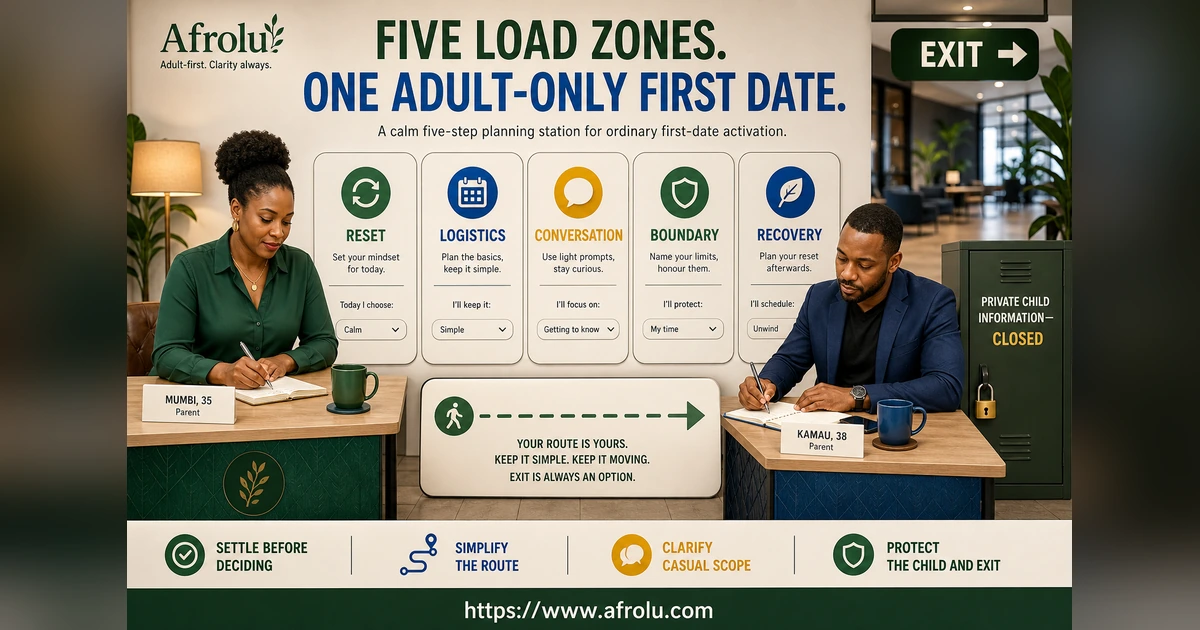
The five-load-zone parent first-date station
Make one adult meeting smaller without asking the feeling to disappear
Adwoa separates body activation, observed conduct, practical fit and pressure across five manageable first-date zones.
Each zone gets a bounded action, keeping anxiety language cautious and family privacy outside the dating plan.
Reset
Notice thoughts and sensations, orient gently and retain every choice.
Logistics
Confirm a staffed venue, short duration, affordable cost and independent return.
Conversation and boundary
Name casual scope and protect child, money, health, consent and time.
Recovery
Separate body, conduct, fit and pressure before the next decision.
Start with a careful distinction
First-date nerves, incompatibility and observable danger are not the same category
A parent may feel a fast heartbeat, tense shoulders, nausea, busy thoughts, guilt or an urge to cancel before an unfamiliar date. Ordinary first-date activation is not a diagnosis and does not automatically prove the plan is unsafe. It can coexist with a well-designed meeting. It can also coexist with genuine risk, so feelings and external facts should be considered without collapsing them.
Incompatibility is a respectful difference about casual scope, availability, attraction, communication, other dating or future direction. It may lead to no second date without anyone being dangerous. Observable safety concerns include deception, threats, monitoring, intoxication pressure, child-access pursuit, transport control, sexual coercion, financial demands or refusal to accept a boundary. Those facts deserve protective action even if the body feels calm.
Parents may carry extra anticipatory load: arranging care, protecting a child, wondering whether adult desire is selfish, or fearing that a short date makes a family promise. One adult-only meeting makes no promise. Confirm care privately and disclose only the availability the date needs. The match does not need a child's name, image, school, location, caregiver, routine or home address.
Casual describes the adult date's current relationship scope. It never lowers the standard for honesty, public-meeting logistics, sexual health, consent, privacy, money or kindness. If ordinary nerves remain persistent, overwhelming or interfere with daily life, a qualified health professional can help assess them. A dating guide and a new date cannot provide that diagnosis or treatment.
Reduce five kinds of load
Reset, logistics, conversation, boundary and recovery can each be made smaller
RESET happens before the decision. Notice thoughts and sensations, place feet on the floor, orient to the room, slow down in a comfortable way and ask what matters. WHO stress guidance includes grounding practices, but any exercise may be skipped if uncomfortable. Use familiar food, medication and health routines according to qualified advice rather than experimenting for a date.
LOGISTICS covers a confirmed staffed venue, short duration, independent transport, affordable cost, charged phone and a chosen check-in if useful. Do not disclose the childcare system or precise home route. A clear end time reduces ambiguity. If the venue changes unexpectedly, assess the new facts and freely decline rather than treating sunk effort as a reason to continue.
CONVERSATION names casual scope and a few useful topics without rehearsing a performance. Ask what casual means, whether other dating matters and what each person wants from the ninety minutes. Silence, awkwardness or lack of chemistry may be ordinary. Contempt, interrogation, sexual bargaining, repeated child questions or evasion of basic identity context are different observations.
BOUNDARY keeps no practical around child information, home, money, substances, touch and time. RECOVERY begins with an independent return, basic care and separation of body state, conduct, fit and pressure. If immediate safety is involved, leave or seek suitable help first; reflection can wait. Otherwise, let activation settle before deciding whether curiosity supports another adult-only meeting.
Walk through one Saturday plan
Mumbi and Kamau use casual clarity without turning a first date into family access
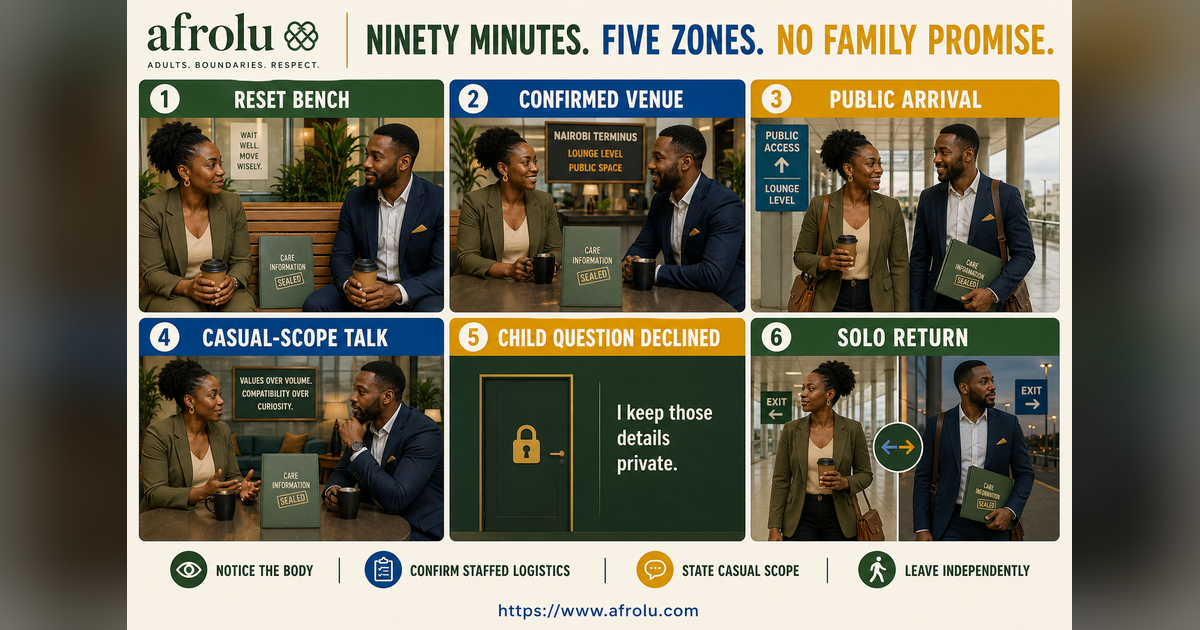
Mumbi, 35, arranged private care and chose a ninety-minute Saturday lunch at a staffed public venue. She told Kamau, 38, only that she was free from one until three. They agreed it was an adult-only casual first date with no exclusivity assumption. Each would arrive and leave independently, pay an affordable share and confirm the venue that morning.
Before leaving, Mumbi noticed guilt, a fast pulse and the thought that a parent should not spend time this way. She placed both feet on the floor, named three visible objects, checked the actual plan and texted a trusted adult the bounded venue and end time. She did not send the child's location, caregiver details or household routine.
At lunch, Kamau said he wanted spontaneous casual dates. Mumbi explained that parenting required advance plans. The difference might have made them incompatible, but he did not ridicule it. When he later asked which school her child attended, she declined. He apologised once and moved on. His response was relevant conduct; it was not proof of permanent safety.
Mumbi returned on her own at the planned time. After food and rest, she separated the evidence: her activation had eased, Kamau had respected one no, their planning preferences differed and no pressure remained. She chose not to schedule a second date because the spontaneous rhythm did not fit. The first date was still successful as a bounded clarity event.
Use four lenses across five zones
Body state, observed conduct, practical fit and pressure should never be averaged into one verdict
In RESET, continue means feelings can be noticed while choice remains available. Review means distress is high enough to shorten, reschedule or seek support. Stop means an urgent health or safety concern needs appropriate help. Do not ask the match to diagnose, medicate or become the only regulator of the parent's emotional state.
In LOGISTICS, continue means venue, time, transport and cost are confirmed. Review means one feature changed and can be reassessed. Stop means a private relocation, ride control, hidden destination, financial demand or blocked exit appears. Leave when possible and use relevant local emergency, venue, transport or trusted-person support for the actual situation.
In CONVERSATION, continue means casual scope and differences can be discussed respectfully. Review means awkwardness, low chemistry or a planning mismatch needs a simple decision. Stop means deception, humiliation, sexual pressure, child interrogation or threats. A poor fit can be declined politely; pressure does not require more conversation before access is reduced.
In BOUNDARY and RECOVERY, continue means no holds and the parent returns independently. Review means rumination or activation suggests waiting before deciding. Stop means stalking, repeated accounts, image abuse, child contact or retaliation follows the date. Preserve relevant evidence securely and use appropriate platform, Kenyan legal, child-protection, health or emergency support.

Use body state, observed conduct, practical fit and pressure as different evidence.
Prepare twelve short sentences
Useful scripts lower decision load without turning a first date into an interview
Before the date: 'This is an adult-only casual first meeting, not a family introduction.' 'I am available from one until three.' 'Let's confirm the staffed venue in the morning.' Those statements clarify scope, end time and place while keeping child care, home and later plans private.
At arrival: 'I arranged my own return.' 'I am comfortable with one drink or meal within this budget.' 'I do not share my live location with dates.' Independence does not accuse the other adult. It gives both people a clear plan and prevents transport, money or tracking from becoming a test of interest.
During conversation: 'I plan dates ahead because I parent; I do not share child details.' 'What does casual mean to you today?' 'Before relevant intimacy, I discuss other dating, health and boundaries.' 'This physical answer can change.' Casual clarity separates compatibility, health information and each present consent decision.
At the exit: 'I am leaving at the time I planned.' 'I do not want another date, and I wish you well.' 'You repeated this after my no, so I am ending contact.' Use the version that fits. In immediate danger, prioritise leaving and suitable help rather than a polished closing sentence.

Use one clear sentence, then watch whether the adult response stays respectful.
Review after the independent return
Separate body, conduct, fit and pressure before deciding what the first date means
BODY asks what sensations and emotions occurred before, during and after. Activation may rise and fall for many reasons. Note it without converting it into a universal verdict. If symptoms are persistent, overwhelming, unexplained or impair daily life, contact a qualified local health professional; urgent or severe symptoms require appropriate urgent care.
CONDUCT records observable actions: Was the venue honoured? Did the date accept the end time, answer proportionately, handle difference and respect no? Avoid rewriting the evening from message tone alone. One respectful date is limited evidence, yet it is still useful. One pressured act may be enough to stop the route without waiting for a pattern.
FIT covers attraction, conversational ease, casual meaning, planning style, availability and desired future. A mismatch may disappoint without becoming a red flag. PRESSURE covers demands, bargaining, threats, monitoring, child access, transport control, money or sexual coercion. The distinction keeps an ordinary no-match from becoming a character accusation and keeps danger from being minimised as nerves.
Choose SECOND DATE when curiosity, logistics and conduct support another bounded meeting. REDESIGN one feature such as venue or duration. Choose NO MATCH for incompatibility or lack of desire. Take SAFETY ACTION when observable pressure or risk requires blocking, account protection, evidence preservation or suitable support. Every outcome can coexist with kindness toward the nervous body.

Recover first; decide after the body settles when safety allows.
Compare eight first-date plans
Smaller, remote, rescheduled and declined plans belong beside an in-person date
A short audio check can clarify voice, casual scope and logistics without creating a date. A daytime drink offers a staffed venue and defined duration. A short public walk may reduce face-to-face intensity but needs weather, route and public visibility considered. Lunch can provide structure while retaining an explicit end time.
An activity date gives conversation a shared focus but should remain public, affordable and easy to leave. A video date may reduce travel while requiring neutral backgrounds, no recording and protected family information. Neither remote option proves identity or safety; it simply changes the immediate load and the evidence available.
Rescheduling is suitable when care, health, work or emotional capacity prevents a freely chosen meeting. Offer a bounded alternative only if desired. Declining is suitable when desire is absent, casual scope does not fit or the plan remains unsafe. A parent never owes attendance because care was arranged, money was spent or someone has waited.
Compare each option through load, privacy, duration and exit. Keep independent transport or a clear end control. Reveal no child or home information beyond the plan's purpose. After any option, use body, conduct, fit and pressure as separate notes. The smallest viable plan often produces clearer evidence than an elaborate performance.
Eight parent first-date moments where feelings and facts can be confused
A fast pulse begins before leaving
Activation is present, but the confirmed plan has not changed.
Ground gently, reassess choice and shorten or cancel if needed.Adult time feels like a family betrayal
A thought is being treated as proof that the date is wrong.
Check values and the private care plan without exposing it.The staffed café changes to a private apartment
The logistics now require different access and exit.
Decline the move and leave or cancel.One adult expects spontaneity and the parent cannot
A planning mismatch may make the route unsuitable.
Name the difference without labelling it danger.School and caregiver details are requested
The information is unnecessary for an adult first date.
Decline and read whether the boundary holds.A date asks for transport funds before arrival
Financial access is being added to an untested meeting.
Do not transfer; keep plans independently affordable.A casual label is used after physical refusal
Relationship scope is replacing current consent.
Stop, leave when possible and seek suitable support.The date was respectful but planning styles differ
Body activation eased while practical incompatibility remained.
Decline another date without inventing a safety claim.Signals across reset, logistics, conversation, boundary and recovery
Ordinary activation is named without treating it as diagnosis, danger proof or a command to attend.
Persistent or overwhelming impairment is directed toward qualified support rather than a date's judgment.
Childcare is confirmed privately while child, caregiver, school, route and home details remain undisclosed.
The venue is staffed and confirmed, duration is bounded and each adult controls transport and cost.
Casual scope, outside dating and relevant sexual-health disclosure can be discussed without shame.
Awkwardness, low attraction and planning mismatch remain compatibility evidence rather than danger labels.
A no around child information, money, substances, touch, time or another date is respected once.
Every physical answer is voluntary, specific, current and changeable despite the casual arrangement.
The parent can leave independently and does not owe an explanation because care or money was invested.
Post-date review separates body state, observed conduct, practical fit and pressure before the next choice.
Choose the next first-date action through ten separate questions
| Situation | What it may mean | What to do next |
|---|---|---|
| Can body activation be noticed without a verdict? | Fits: Choice remains available alongside nerves. Needs review: Distress supports shortening, rescheduling or qualified help. Stop: An urgent health or safety concern requires immediate support. | Ground gently and choose care appropriate to the facts. |
| Is childcare information private? | Fits: Only adult availability is shared. Needs review: An overshare needs containment. Stop: A child, school or caregiver is pursued. | Stop disclosure and protect the family system. |
| Are venue and end time confirmed? | Fits: A staffed place and bounded duration are clear. Needs review: One logistical detail needs confirmation. Stop: A hidden or private relocation is pressured. | Decline the change and leave or cancel. |
| Is transport independently controlled? | Fits: Each adult can arrive and leave. Needs review: A backup route is needed. Stop: Keys, phone, route or movement are controlled. | Prioritise exit and suitable immediate help. |
| Does casual mean the same thing? | Fits: Scope and other dating are understood. Needs review: A respectful mismatch needs a decision. Stop: The label is used to deny honesty or consent. | Clarify once or end the route. |
| Are money and substances bounded? | Fits: Cost and consumption remain freely controlled. Needs review: The plan needs a smaller budget or change. Stop: Payment, intoxication or debt is pressured. | Refuse, leave and use suitable support. |
| Are health facts timely? | Fits: Relevant information precedes intimacy. Needs review: A conversation or care step remains. Stop: Material facts are concealed or mocked. | Pause intimacy until informed choice is possible. |
| Can no end the request? | Fits: The boundary is accepted without bargaining. Needs review: One misunderstanding needs a reset. Stop: Pressure, threats or retaliation follow refusal. | Stop access and prioritise safety. |
| Is the issue fit or pressure? | Fits: Differences can be named respectfully. Needs review: More reflection is needed after activation settles. Stop: Observable coercion or child access appears. | Choose a no-match or safety response accurately. |
| What does recovery support? | Fits: Curiosity and conduct support another bounded date. Needs review: One feature can be redesigned. Stop: Desire, fit or safety does not support continuation. | Choose second date, redesign, no match or safety action. |
Twelve lines for casual clarity, child privacy, consent and exit
“This is an adult-only casual first meeting, not a family introduction.”
“I am available from one until three.”
“Let's confirm the staffed public venue in the morning.”
“I arranged my own return and will leave at the planned time.”
“I am comfortable with this affordable plan and keep my money separate.”
“I do not share continuous live location with dates.”
“I plan ahead because I parent; I do not share child details.”
“What does casual mean to you today, including other dating?”
“Before relevant intimacy, I discuss current partners, health and boundaries.”
“This physical answer applies now and can change.”
“I do not want another date, and I wish you well.”
“You repeated this after my no, so I am ending contact.”
Know the difference
First-date load, family privacy, duration and exit can be adjusted independently
Reduces avoidable load, keeps the child outside, states casual scope and preserves an independent return and post-date review.
Uses elaborate venues, private access, long duration, money or disclosure to prove confidence, availability or romantic worth.
Choose the smallest plan that supports curiosity while a practical cancel, no and exit remain available.

Choose the smallest plan that leaves curiosity and a practical no available.
Compare eight first-date options without a bravery ladder
| Type or dimension | What it describes | Best next question |
|---|---|---|
| Audio check | A brief voice conversation clarifies scope and logistics without becoming an in-person date. | A confirmed public plan or respectful decline |
| Daytime drink | A staffed familiar venue offers structure, affordability and a short natural end. | Enough curiosity for another bounded meeting |
| Short public walk | Side-by-side movement may ease conversation but needs a visible route and weather plan. | Return to a staffed point or independent exit |
| Lunch | A defined meal supplies conversational structure with a stated budget and end time. | A post-date body, conduct, fit and pressure review |
| Public activity | A shared focus reduces interview load while transport and participation stay independent. | Decide whether the activity revealed useful fit |
| Video date | Travel load is lower while backgrounds, recording and family privacy need explicit limits. | Independent identity context before any meeting |
| Reschedule | The date moves because care, health, work or emotional capacity does not support it now. | One bounded alternative only when freely desired |
| Decline | No meeting occurs because desire, scope, logistics or safety does not fit. | A clear boundary and suitable support if needed |
Reduce first-date load in five parent-conscious moves
Name activation carefully
Notice thoughts and sensations without using them as diagnosis or complete safety evidence.
Keep care arrangements private
Offer an adult availability window instead of child, caregiver, school or home details.
Simplify logistics
Confirm a staffed venue, short duration, affordable plan and independent return.
Clarify casual scope
Discuss other dating, present expectations and what intimacy does not change.
Make no practical
Protect child information, money, substances, touch, time and future contact.
Review four evidence lenses
Separate body state, observed conduct, practical fit and pressure after return.
Questions for reset, logistics, conversation and recovery
Choose a few prompts that fit the moment. This is a reference library, not a list to complete.
Reset questions
Notice without diagnosing.
- What do I feel in my body?
- Which thought is present?
- What facts have changed?
- What choice remains available?
- Would qualified support help?
Logistics questions
Make the date small and leaveable.
- Is the venue confirmed and staffed?
- What is the end time?
- How will I return?
- Is the cost comfortable?
- Which child details stay private?
Conversation questions
Clarify adult scope without interviewing.
- What does casual mean now?
- May either person date others?
- Which health facts matter?
- What remains undecided?
- Can difference be a no-match?
Recovery questions
Separate four evidence lenses.
- What did the body do?
- What conduct occurred?
- What fit or did not?
- Where was pressure present?
- Which next step is proportional?
What anxiety, grounding, child, sexual-health and consent sources support
NHS guidance separates common anxious feelings from situations needing help
The NHS notes that most people feel anxious or scared sometimes, describes possible physical, mental and behavioural symptoms, and advises medical help when someone is struggling to cope. That supports non-diagnostic first-date language.
Evidence limit: This page and source cannot identify the cause of a symptom; urgent or persistent concerns need appropriate local care.
Clinical diagnosis requires more than one nervous date
The U.S. National Institute of Mental Health describes social anxiety disorder as strong fear in scrutinised situations that persists and interferes with daily life, with diagnosis and treatment handled by qualified providers.
Evidence limit: The U.S. material is educational and cannot diagnose a reader or determine whether attending a date is appropriate.
WHO stress tools offer optional ways to reconnect with the present
WHO's Doing What Matters in Times of Stress includes noticing thoughts and feelings, slowing down, connecting with the body and refocusing on the present. A reader may use a comfortable part voluntarily.
Evidence limit: Grounding is not a safety detector, treatment plan or requirement; skip practices that feel unsuitable and seek qualified care when needed.
Kenyan child-rights context supports withholding identifying information
Kenya's Children Act protects a child's privacy, family, private affairs and correspondence and centres best interests. That context supports keeping first dates adult-only and child details undisclosed.
Evidence limit: This general legal context is not child-protection, custody or family-law advice about a specific situation.
Casual first dates still require informed adult choices
CDC guidance recommends partner conversations before sex. Discussing current partners, testing, prevention, health and boundaries can occur before relevant intimacy without turning a first date into a medical interrogation.
Evidence limit: The source provides general public-health information, not individual diagnosis, testing or treatment advice.
Every physical decision remains voluntary and current
NSW Government guidance describes consent as free, voluntary, communicated, specific, ongoing and withdrawable. Casual scope, arranged care, date cost, alcohol or a previous yes cannot supply the present answer.
Evidence limit: Consent law and services vary; use appropriate Kenyan health, legal or emergency support for actual events.
Six ways feelings, incompatibility and danger become confused
Diagnosing ordinary nerves
One activated evening becomes a disorder claim. Repair: notice, plan and seek qualified help if impairment persists.
Using the child as reassurance
Photos or details prove parenthood. Repair: keep the first date fully adult-only.
Spending because care was arranged
Sunk effort forces attendance. Repair: cancellation remains available until and during the date.
Calling incompatibility danger
A respectful mismatch gets moralised. Repair: distinguish practical fit from observable pressure.
Calling pressure anxiety
Coercion is blamed on the nervous body. Repair: act on the external conduct.
Letting casual erase consent
The label implies touch or sex. Repair: require a current specific answer every time.
Use a reviewed resource that matches the decision
This guide focuses on the relationship decision, so it does not rank dating apps. Check current prices, safety tools, and local availability before choosing a service.
Explore the guide library
Show more related guides
Continue with Afrolu
Show more Afrolu guides
Official anxiety, stress, Kenyan child, sexual-health and consent guidance
Afrolu reviewed these health, research, safety, or public guidance resources while editing this page. They support the behaviour and safety guidance; they do not diagnose any individual described by a reader.
Casual first-date anxiety and clarity questions for parents
Are first-date nerves normal for a parent?
Many people feel anxious or activated before unfamiliar social situations, and parents may also carry care, privacy and guilt concerns. One nervous date does not establish a diagnosis. Notice the feeling, assess actual logistics and choose freely. If anxiety is persistent, overwhelming or interfering with daily life, seek assessment and support from a qualified local professional.
How can I calm down before a first date?
Reduce avoidable load: eat and use prescribed care normally, confirm a short public plan, arrange an independent return and try an optional grounding practice that feels comfortable. Do not force deep breathing or any exercise that feels wrong. You may shorten, reschedule or cancel. Self-help does not replace qualified care for persistent or urgent symptoms.
How much should I reveal about childcare?
Only say what adult planning requires, such as being available between set times. Do not reveal the child's name, image, school, caregiver, location, routine, health or home address. A match does not need proof of the arrangement. If someone pursues child information after a clear boundary, stop disclosure and respond to the actual risk.
What should casual mean on a first date?
Treat casual as the present adult relationship scope, not automatic sex, low honesty or disrespect. Ask whether the meeting is simple exploration, whether either person dates others and what each wants next. A first date can end with another casual date, a different status question later, a respectful no-match or immediate closure.
Should I share my live location with the date?
No. If you want a trusted person to know a bounded venue and end time, share that separately by choice. Continuous tracking by the date is unnecessary. Keep account credentials and phone control personal. A temporary journey share has a defined purpose and end and can still be declined or stopped.
What if the date changes the venue at the last minute?
Reassess rather than following automatically. A nearby staffed alternative may be acceptable if you freely choose it; a private or hidden location is a material change. Decline, cancel or leave when the new plan reduces independent movement or safety. Arranged care, travel time and politeness do not require attendance.
How do I tell anxiety from a red flag?
Separate four lenses: body state, observed conduct, practical fit and pressure. Activation may occur in a respectful plan; calm may occur while external pressure is present. Record what the person did, whether your logistics work and whether no held. A guide cannot diagnose symptoms or certify another adult's safety.
When should we discuss sexual health?
Before any intimacy where current partners, testing, prevention, health or boundaries affect informed choice. The conversation need not happen if intimacy is not under consideration, and it should not demand unrelated records. Casual dating does not remove the need for relevant truth. Every physical act still needs a current voluntary answer.
What if I do not want a second date?
Decline simply: you do not want another meeting. You do not need to prove danger, diagnose incompatibility or debate your attraction. Block if the boundary is ignored. If there are threats, stalking, image abuse, child contact or other safety concerns, preserve useful evidence and seek appropriate platform, legal or emergency support.
How should I review the date afterward?
Return independently, meet basic needs and separate body, conduct, fit and pressure. Choose another bounded date when curiosity and conduct support it; redesign venue or duration; choose no match for lack of desire or incompatibility; or take safety action for coercion and risk. Wait for activation to settle when safe, but do not postpone urgent protection.
One thing to do now
Protect the child, reduce the load and let the adult date answer only for itself
Attend or continue when logistics, scope and boundaries remain chosen despite manageable nerves. Redesign venue, duration or timing when load is the issue. Choose no match when desire or practical fit is absent. Leave, close access and seek suitable support when deception, child pursuit, transport control, money pressure, stalking, threats, intoxication pressure or sexual coercion appears.