Six keys · adult curiosity with the family folder closed
Date Casually After Heartbreak Without Opening Your Child's World Too Soon
A parent-safe guide to casual dating after heartbreak: protect child privacy, keep meetings adult-only, name scope, and preserve home and exit.
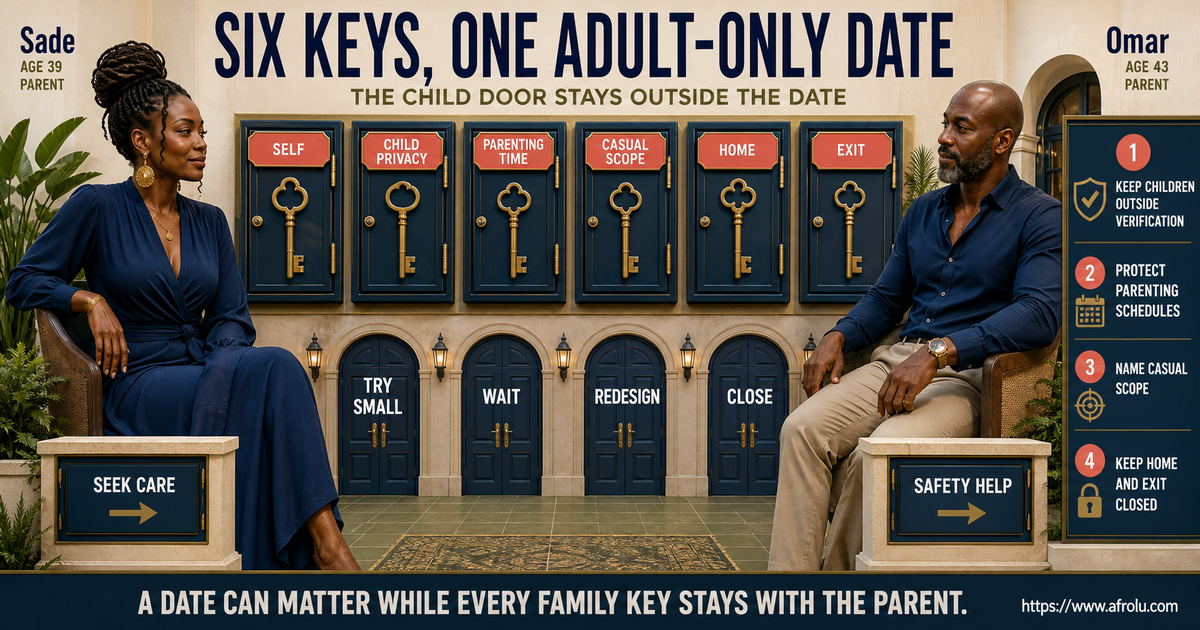
A parent can explore one adult connection without opening the family world.
Written and edited by Adwoa Boateng · Dating Safety Editor
Keep six keys independent: SELF, CHILD PRIVACY, PARENTING TIME, CASUAL SCOPE, HOME and EXIT. Share adult availability without names, images, schools, routines, custody records or family locations. Name casual scope, other dating and health implications. Make meetings adult-only, public, separately funded and independently leaveable; a good date grants no home or child access. Then choose TRY SMALL, WAIT, REDESIGN, CLOSE, SEEK CARE or SEEK SAFETY HELP. No date count certifies readiness or introductions. Privacy breaches, threats, tracking, coercion or blocked movement bypass the ordinary review.
Starting over · Parents Returning To Dating
How can a parent explore one casual adult connection after heartbreak without turning a child, co-parent, home or family schedule into dating evidence or an automatic next stage?
Dating after heartbreak is a present-choice question, not a timed recovery stage. Parent-safe casual re-entry means one limited adult connection while child information, parenting schedules, home access, family relationships and support retain separate decision gates. The six-key house cannot assess custody, diagnose grief, certify another adult or provide a universal introduction timeline.
Sade, a fictional 39-year-old parent, tells Omar, 43, that she is dating casually after an ending while keeping all child details private. Across four public dates they discuss scope, money, health and contact rhythm; she declines home transport and shares only adult availability when a plan changes. They continue occasional adult-only meetings with no home, child or family access.
The parent-safe six-key adult re-entry house
Keep curiosity, child privacy, parenting time, casual scope, home and exit separate
Adwoa designs an adult-only dating route where a new connection never treats the child as verifier, witness or milestone.
Share adult availability, protect the family folder, complete one public plan and choose the smallest supported adult door.
Date by purpose
Share only the heartbreak context that serves a current adult choice.
Abstract the calendar
Offer windows without names, images, schools, routines or records.
Keep the route adult-only
Casual contact grants no family, address or overnight access.
Keep every key controlled
Privacy breaches and danger bypass ordinary dating review.
Keep the first question adult-sized
Explore casual dating after heartbreak without recruiting a child into the new connection
A parent returning to dating after heartbreak may feel that every adult choice carries family consequences. That is partly why the first decision should be deliberately small. A profile, call or public coffee can remain an adult interaction. It does not need to answer whether a new person could fit the family, meet a child or repair the loss that preceded the date.
Casual scope can be honest and caring. Sade may want companionship, affection or occasional dates without exclusivity or a family pathway. Omar may want more. Both should name the present scope, other dating and sexual-health implications rather than allowing 'casual' to mean secrecy, inconsistent consent or hidden possession. A mismatch is enough to close without making heartbreak the culprit.
Child privacy is not a test the new adult can pass. Names, images, ages, schools, activities, health information, custody arrangements, routines, live location and the other parent's details should stay outside early dating unless a clear later purpose and appropriate consent justify sharing. An adult can explain limited availability without providing the family schedule that proves it.
Heartbreak also has no universal completion date. A parent may feel grief and still choose a modest date, or feel calm and decline dating entirely. Readiness belongs to the specific action: a yes to coffee can coexist with no home access, no child discussion and uncertainty about a second meeting. The right to reverse course remains available at every point.
The six-key adult re-entry house
Keep self, child privacy, parenting time, casual scope, home and exit independently locked
SELF covers the parent's own curiosity, grief, health, identity and capacity. It does not require a complete breakup account. Share only what serves the present decision, such as moving slowly or not seeking exclusivity. A new date is not a therapist, witness, investigator or messenger to the former partner, and personal disclosure never buys access to another key.
CHILD PRIVACY covers every identifying and routine detail. PARENTING TIME covers only the availability needed for a plan. Instead of sharing school pickup times or a custody calendar, Sade can say that certain evenings are unavailable and changes need notice. If legal or co-parenting questions affect dating decisions, use qualified local advice rather than asking a new match to interpret them.
CASUAL SCOPE covers what the adults are and are not doing: other dating, affection, contact rhythm, sexual-health conversations, exclusivity and future review. HOME stays separate. A public date, accepted ride or sexual choice does not grant the home address, keys, overnight access or contact with children. Every move from public to private needs a fresh adult decision.
EXIT remains powered. Either adult can shorten the meeting, use independent transport, decline another venue, end the casual route or stop responding to unsafe contact. A former heartbreak story cannot be used to shame caution, and parenting responsibilities cannot be used to demand surveillance. The key remains with the person whose access it controls.
Four dates with the family folder closed
Watch Sade and Omar build adult evidence without making a child the next milestone
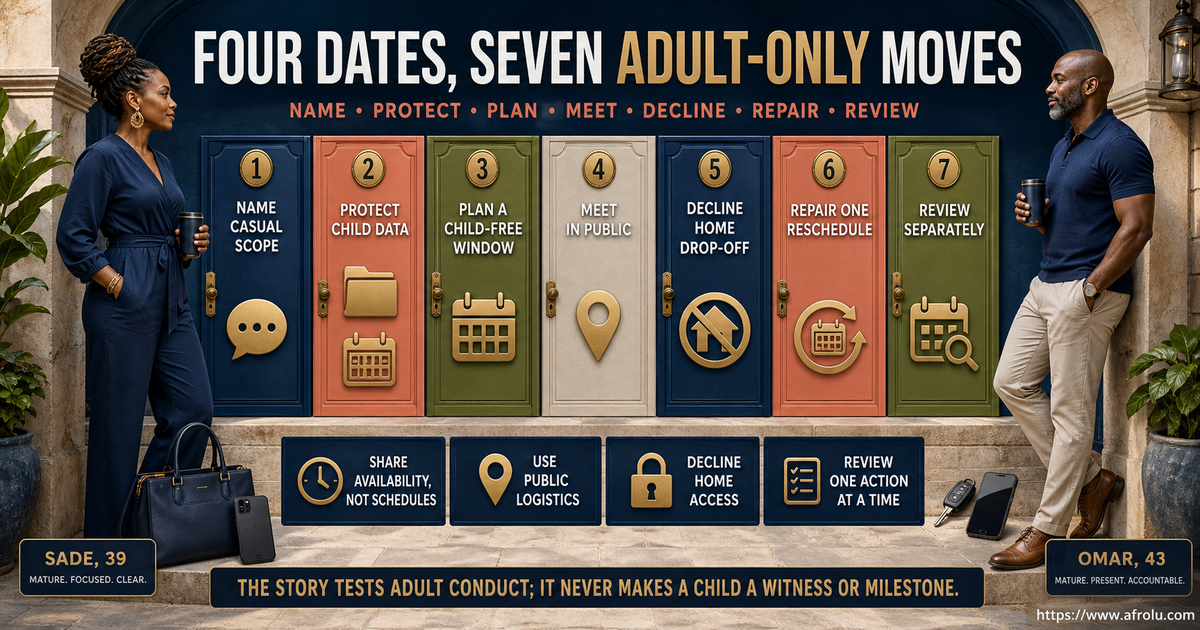
Before their first coffee, Sade says that she is dating casually after a difficult ending and keeps all child information private. She offers a daytime public meeting during an adult-only window and arranges her own transport. Omar says he also has parenting responsibilities and does not ask for names, photos, schools or custody details to prove her schedule.
Across two more dates, they discuss contact rhythm, other dating, money, affection and sexual health. Omar offers to drop Sade home after one evening. She declines and leaves independently. He accepts the no without asking for her address or framing the boundary as evidence that she is not over the former relationship. The respected ending is one useful action, not a safety certificate.
A fourth plan must move because Sade's availability changes. She shares no child or co-parent detail, only that she cannot attend and can offer one alternative. Omar is disappointed but accepts the new time. When they meet, he asks whether their casual scope still fits. They agree that neither wants exclusivity or family involvement now.
Sade reviews the connection separately from grief. The dates felt welcome, her parenting routine remained protected and casual scope stayed honest. She continues occasional public meetings with no home or child access. This outcome is not a recommendation; another parent could wait or close. Persistent impairment would use qualified care, while any privacy breach or coercion would use a direct safety route.
Read six keys without creating a healing score
Separate available-now choices, needs-another-route concerns and conduct that bypasses review
SELF is available now when curiosity is person-specific and the parent can keep the date modest. It needs another route when every interaction becomes a test of being lovable, healed or ready for family life. The repair is not a performance for the new adult. Reduce the step, use independent support and allow the date to remain a date.
CHILD PRIVACY is protected when availability is clear without identifiers, images or routines. A breach can be subtle: asking children to verify the parent, requesting school information, contacting a co-parent or appearing at a family location. Do not keep negotiating those acts as dating misunderstandings. Protect networks, devices and physical access according to the facts.
CASUAL SCOPE is workable when both adults can name frequency, other dating, affection, health conversations and closure. It needs review when one assumes secrecy, exclusivity or family progression. Casual does not cancel consent, and parenting does not turn every connection serious. The relevant issue is whether the agreement is visible and freely changeable.
Danger bypasses every key count. Threats, stalking, impersonation, financial exploitation, image abuse, non-consensual tracking, coercion, retaliation through family networks or blocked movement require a safety response. Where safe, preserve useful evidence and use appropriate platform, workplace, financial, legal, health or emergency support for the reader's location.

Danger and child privacy breaches bypass every ordinary dating review.
Boundaries that do not expose a child
Use ten complete lines for heartbreak, privacy, time, casual scope, home, consent and closure
Heartbreak disclosure should have a purpose. Sade can say that she is moving slowly or is not seeking exclusivity without describing allegations, legal documents or intimate history. Omar can decide whether the available scope fits. Neither becomes responsible for healing the other, gathering evidence about a former partner or validating the parent's family decisions.
Time language should be complete but private. 'I can meet Saturday afternoon and need two days' notice for changes' is enough. There is no need to share custody rotations, school events, childcare providers or the child's live location. If a plan changes, provide only the information needed to accept, counter or decline the new adult arrangement.
Home, transport, money and consent require separate sentences. Each adult can pay ordinary costs, arrive independently and keep the home address private. A casual label, emotional disclosure, gift or ride does not authorise another venue, sexual contact, images or an overnight stay. Before sex, discuss partners, testing and prevention relevant to the adults involved.
Closure need not litigate parenting or heartbreak. A short sentence can say that the route no longer fits. If contact crosses channels, reaches children, relatives, co-parents, workplaces or home locations, another explanation may increase exposure. Protect accounts and networks, preserve useful evidence where safe and use the relevant local safety authority.

A parent boundary shares the adult decision, not the child's private file.
Choose one adult door
Try small, wait, redesign, close, seek care or seek safety help without ranking them
TRY SMALL fits when curiosity is wanted, the family folder remains private and one public adult-only date can be completed. Define small: a chosen window, public place, ordinary cost, independent transport and no home or child access. The date is not probation for Omar and does not require Sade to prove she has recovered.
WAIT fits when dating is unwanted or capacity is unclear. REDESIGN fits when the adult wants connection but needs a different frequency, venue, childcare-independent window or scope. CLOSE fits whenever the match or format does not serve the parent. No option requires a date count, introduction deadline or promise to return.
SEEK CARE belongs to severe or persistent grief, distress or impairment that needs qualified assessment. SEEK SAFETY HELP belongs to threats, privacy breaches, stalking, coercion, fraud or blocked movement and may involve platform, workplace, financial, legal, health or emergency routes. Child-related legal issues need qualified local advice, not editorial inference.
After the choice, make the boundary operational. Remove saved family details from the thread, release held calendar space, confirm any changed adult agreement and update trusted support only as wanted. A later decision can differ, but a previous date never creates automatic access to the child, home, former partner or future family role.

Waiting or closing is a complete adult choice, not proof that heartbreak won.
Use the authority that fits
Keep breakup research, privacy, sexual health, legal questions and urgent safety distinct
Longitudinal breakup research reports average changes in distress and life satisfaction while retaining individual variation and contextual limits. It supports expecting diverse paths, not a countdown to readiness. Samples cannot determine Sade's grief, parenting capacity, treatment or date choice, and a new relationship should not be prescribed as recovery.
Online-dating safety guidance supports limiting personal information, keeping early meetings public, using platform controls and telling a trusted person about plans. For a parent, personal information includes child and family identifiers, routines and locations. No verification method or public date certifies future safety, so access should expand only through specific later choices.
Privacy guidance helps readers recognise identity, contact, location and online identifiers as information that deserves a clear purpose. Avoid sending custody papers, school records, child images, identity documents, passwords or codes. If legal arrangements affect dating or disclosure, obtain qualified local advice rather than relying on a new date's opinion or this guide.
Consent and sexual-health conversations remain adult, specific and reversible. Discuss partners, testing and prevention before sex and use qualified local care for personal recommendations. If a person ignores a no, contacts a child or co-parent, threatens disclosure, tracks movement or blocks exit, prioritise safety and the appropriate current local route over completing the relationship explanation.
Eight parent dating moments where adult curiosity and family access diverge
The child-photo request
The schedule proof
The honest casual conversation
The home drop-off
The missed plan repair
The healing accusation
The network bypass
The grief that impairs life
Twelve signals across self, child privacy, parenting time, casual scope, home and exit
{'signal': 'Curiosity is adult-specific', 'meaning': 'Interest concerns this person, not filling a family role.', 'next_step': 'Keep the next action modest and reversible.'}
{'signal': 'Child data stays closed', 'meaning': 'No names, images, schools, routines or locations are needed.', 'next_step': 'Share adult availability only.'}
{'signal': 'Parenting time is abstracted', 'meaning': 'The plan uses available windows without exposing the family calendar.', 'next_step': 'Give notice requirements rather than evidence.'}
{'signal': 'Casual scope is explicit', 'meaning': 'Frequency, other dating and affection have present meaning.', 'next_step': 'Clarify health and consent implications separately.'}
{'signal': 'Home remains private', 'meaning': 'A public date does not create address, key or overnight access.', 'next_step': 'Use independent transport and venues.'}
{'signal': 'Exit remains usable', 'meaning': 'Either adult can leave or close without parenting criticism.', 'next_step': 'Credit respect without treating it as a guarantee.'}
{'signal': 'Grief can coexist', 'meaning': 'A difficult feeling does not automatically cancel a chosen date.', 'next_step': 'Name the trigger and resize the next action.'}
{'signal': 'A mismatch stays ordinary', 'meaning': 'Different pace or scope needs do not become accusations.', 'next_step': 'Counter once or close cleanly.'}
{'signal': 'Family proof is requested', 'meaning': 'A child or co-parent is being recruited to validate the adult.', 'next_step': 'Decline and reassess access.'}
{'signal': 'Home access accelerates', 'meaning': 'Transport, childcare or convenience becomes a reason for private entry.', 'next_step': 'Return to public independent logistics.'}
{'signal': 'Contact reaches family networks', 'meaning': 'Closure or privacy is being bypassed.', 'next_step': 'Protect accounts and involve appropriate safety routes.'}
{'signal': 'Movement or disclosure is threatened', 'meaning': 'A no creates retaliation, tracking or blocked exit.', 'next_step': 'Prioritise immediate safety and relevant local help.'}
Read the six keys through ten independent questions
| Situation | What it may mean | What to do next |
|---|---|---|
| Is curiosity about this adult rather than a family role? | Fits: One modest date is wanted. Needs review: The connection is used to prove recovery. Stop: A child is recruited to validate it. | Shrink the step and keep the family folder closed. |
| Does child information stay private? | Fits: Adult availability is enough. Needs review: Names or routines keep entering conversation. Stop: Photos, schools or locations are demanded or obtained. | Withhold data and protect networks or safety as needed. |
| Can parenting time be stated abstractly? | Fits: Available windows and notice are clear. Needs review: Repeated proof is requested. Stop: Schedules are monitored or used for pressure. | Share the boundary, not the family evidence. |
| Is casual scope mutual? | Fits: Frequency, other dating and expectations are named. Needs review: One adult assumes progression. Stop: Possessiveness appears without agreement. | Clarify once, redesign or close. |
| Can a date stay public and independent? | Fits: Place, cost, transport and ending are clear. Needs review: Home or ride access is proposed late. Stop: Movement becomes controlled. | Return to public logistics or prioritise safety. |
| Can heartbreak be discussed by purpose? | Fits: Only current decision-relevant context is shared. Needs review: The date becomes a recovery hearing. Stop: Disclosure is coerced or threatened. | Limit the story and close unsafe pressure. |
| Does a no change behaviour? | Fits: The declined request stops. Needs review: Persuasion returns through concern. Stop: Retaliation or network bypass follows. | Restate once if useful, then protect access. |
| Do money and childcare remain separate? | Fits: Each adult funds ordinary dating and care arrangements. Needs review: Help creates implied debt. Stop: Funds, credentials or child access are requested. | Decline dependency and use independent support routes. |
| Does dating leave ordinary function intact? | Fits: The small route fits work, parenting and rest. Needs review: Capacity is unclear. Stop: Serious impairment persists across settings. | Try small, wait or seek qualified care. |
| Can closure remain closed? | Fits: The ending changes access. Needs review: Courtesy keeps the route open. Stop: Family, work or home channels are bypassed. | Disengage and use appropriate safety protection. |
Ten adult lines for heartbreak, child privacy, time, scope, home, consent and closure
“I am dating casually after an ending and will share only what serves our present choices.”
“I do not share my child's name, photos, school, routine or location in early dating.”
“I can offer Saturday afternoon and need two days' notice for changes.”
“I am not exclusive and I am not planning family introductions.”
“I meet in public and do not bring dates into parenting spaces.”
“I will arrive and leave independently, including after a good date.”
“I am not sharing my address or offering home access.”
“A yes to this meeting is not a yes to another venue, images or physical contact.”
“Before sex, I want to discuss partners, testing and prevention relevant to us.”
“This route no longer fits me, so I am ending our contact here.”
Know the difference
Parent dating after heartbreak and seven nearby states
A parent freely chooses one bounded adult interaction while family keys remain closed.
Grief, mismatch, impairment, child privacy breaches or unsafe control requires another route.
A yes or no belongs to the current action; no date count transfers family access.

A cautious parent is not automatically unready, and a new date is not a recovery certificate.
Separate eight nearby grief, caution, curiosity, privacy, care and control states
| Type or dimension | What it describes | Best next question |
|---|---|---|
| Ordinary heartbreak | Sadness, memories and mixed feelings coexist with ordinary functioning. | Allow support and choose or decline dates without a deadline. |
| Memory trigger | A specific moment activates comparison or grief during a new interaction. | Pause, name the trigger privately and resize the next step. |
| Parental caution | The adult intentionally protects child, schedule and home information. | Respect the boundary rather than treating it as unavailability. |
| Casual curiosity | A bounded adult connection is wanted without exclusivity or family progression. | Name scope and keep every key separate. |
| Scope mismatch | The adults want different frequency, exclusivity or future family involvement. | Clarify once and allow a clean no. |
| Persistent impairment | Sleep, focus, appetite, enjoyment or basic tasks remain seriously affected. | Seek qualified local assessment rather than using dating as treatment. |
| Child privacy breach | Identifying details, routines or networks are obtained or used without permission. | Protect data and use appropriate legal, platform or safeguarding advice. |
| Unsafe control | Threats, tracking, coercion, fraud, retaliation or blocked movement changes the problem. | Prioritise safety and current local platform, legal, financial, health or emergency help. |
Use the parent-safe re-entry key house in six deliberate moves
Keep six keys
Separate self, child privacy, parenting time, casual scope, home and exit.
Date the adult only
A first connection is not an audition for a family role.
Abstract the calendar
Share availability and notice without exposing child routines.
Name casual scope
Other dating, affection, sexual health and closure stay explicit.
Keep home and transport private
Use public venues and independent arrival and departure.
Route privacy and danger precisely
Child data breaches, care needs and control require different authority.
Questions for self, child privacy, time, scope, home and exit keys
Choose a few prompts that fit the moment. This is a reference library, not a list to complete.
Self key
Keep the date adult-sized.
- Do I want this person?
- What can I disclose by purpose?
- What belongs to support?
- Which feeling needs no action?
- Can I stop freely?
Child + time keys
Share availability, not the family file.
- Which details stay private?
- What window exists?
- What notice is needed?
- Who needs no explanation?
- Which legal question needs an expert?
Scope + home keys
Name the adult route and its limits.
- Is this casual?
- What about other dating?
- Where do we meet?
- How does each leave?
- What home access is unavailable?
Exit + safety
Keep every close operational.
- What ends the date?
- Which channels remain?
- Has family access been bypassed?
- What evidence is useful?
- Which help route fits?
What breakup research and current privacy, safety and consent guidance can support
Longitudinal research examines mental-health and life-satisfaction changes after unmarried relationship dissolution
The work supports acknowledging average distress and varied recovery paths rather than assuming one response.
Evidence limit: A population sample cannot determine Sade's readiness, parenting or treatment.
Research reviews predictors and diverse outcomes after relationship dissolution
The literature supports retaining variation and examining support, context and functioning.
Evidence limit: Group associations cannot create a date, introduction or recovery deadline.
eSafety guidance covers privacy, platform controls, first meetings and abuse
The resource supports limiting personal information and keeping early meetings public and leaveable.
Evidence limit: No safety practice certifies another adult or replaces local services.
Kenya ODPC material identifies identity, contact, location and online identifiers as personal data
The context supports protecting child and family information unless a clear purpose justifies disclosure.
Evidence limit: An official FAQ is not custody, safeguarding or personalised legal advice.
FTC guidance describes trust-building and money requests
The resource supports refusing transfers, tickets and investments and contacting providers independently.
Evidence limit: The U.S. source cannot verify a profile or replace local reporting.
eSafety guidance emphasises free, voluntary, informed and reversible consent
The material supports unbundling dates, rides, disclosure, images and physical contact.
Evidence limit: General education does not replace local law, emergency help or health advice.
CDC guidance supports partner conversation before sex
The resource supports discussing partners, testing and prevention before urgency.
Evidence limit: It is general U.S. information, not personal clinical advice or proof of status.
Six ways adult dating can open a family door without consent
Making the child a verifier
Family details prove availability or trust. Repair: share the adult boundary only.
Using dates as recovery treatment
A new adult must erase heartbreak. Repair: keep support independent.
Treating casual as secret
Scope hides other dating or health implications. Repair: make the agreement explicit.
Trading convenience for home access
Transport or childcare opens private space. Repair: use public independent logistics.
Counting dates toward introduction
A number becomes a safety certificate. Repair: assess every later purpose separately.
Debating danger as caution
Privacy breaches or control are treated as ordinary nerves. Repair: route concrete harm directly.
Use a reviewed resource that matches the decision
This guide focuses on the relationship decision, so it does not rank dating apps. Check current prices, safety tools, and local availability before choosing a service.
Explore the guide library
Show more related guides
Continue with Afrolu
Show more Afrolu guides
Breakup research and current privacy, online-dating, fraud, consent and health guidance
Afrolu reviewed these health, research, safety, or public guidance resources while editing this page. They support the behaviour and safety guidance; they do not diagnose any individual described by a reader.
Parent-safe casual dating after heartbreak questions
How soon can a parent date after heartbreak?
There is no universal recovery or parenting timetable. Review present functioning, person-specific curiosity and whether one adult-only date can remain public, affordable and freely chosen. Research samples report varied paths and cannot certify readiness by elapsed time. Persistent overwhelming impairment deserves qualified care; dating should not be prescribed as treatment.
Should I tell a casual date that I have children?
Share only what serves the current adult decision and your safety. You may disclose that you are a parent and that availability is limited without giving names, images, ages, schools, routines, health information or locations. The timing of disclosure depends on context; this guide cannot provide personalised legal or safeguarding advice.
What child information should stay private?
Protect identifying details, photographs, school and activity locations, care providers, custody or co-parenting documents, health information, routines, live location, access codes and home details. A new match does not need a child's data to verify the parent's schedule. Use qualified local advice if a legal arrangement affects disclosure.
Can casual dating be responsible for parents?
Yes. Name frequency, other dating, affection, sexual-health expectations, exclusivity and the absence of a family-introduction plan. Casual scope does not cancel consent, honesty or child privacy. Either adult can decide the available arrangement does not fit and close without portraying the parent as damaged or the other adult as unserious.
When should a date meet my child?
No date count or editorial rule can answer that safely for every family. A meeting, if ever considered, requires a separate purpose, age-appropriate context, family circumstances and relevant professional or legal guidance. A pleasant relationship, background check or respected boundary cannot certify the timing. It is valid to keep dating and family worlds separate indefinitely.
Should I share my custody or parenting schedule?
Usually the dating plan needs only available windows and notice requirements, not the evidence behind them. Do not send orders, messages, school calendars or live routines to prove why you are unavailable. If legal terms affect dating, travel or home access, consult a qualified local professional rather than a new match or general web guide.
What if someone says my boundaries prove I am not healed?
A current boundary does not need their psychological approval. Restate the practical offer or close the route. A person may respectfully decide the available pace is too small, but repeated persuasion, humiliation or retaliation is different conduct. Use appropriate safety support if contact enters family, work or home networks.
Can a date give me a ride home?
You may accept or decline, but early independent transport protects the home address and keeps exit under your control. A good date or offered ride does not create access to another venue, home, child or physical contact. If transport dependence would make leaving difficult, change the plan, use an independent route or decline the meeting.
What if the other parent or relatives become involved?
Adult dating should not recruit co-parents or relatives to investigate, persuade, announce or monitor without consent. Share information with trusted support only as you choose. Unexpected contact through family networks after a boundary is a privacy and access issue; preserve useful evidence where safe and use qualified legal or safety support if needed.
When should I seek care or urgent safety help?
Seek qualified care for severe or persistent grief, distress or impairment affecting ordinary function. Use a direct safety route for threats, stalking, fraud, image abuse, child-data breaches, non-consensual tracking, coercion, family-network retaliation or blocked movement. Choose current local platform, workplace, financial, legal, health or emergency help according to facts and urgency.
One thing to do now
Let one adult date remain one adult date
Continue only while curiosity is person-specific, child and co-parent information remains private, parenting time can be stated abstractly, casual scope is explicit, meetings stay public and independent, and every exit remains usable. Wait, redesign or close whenever wanted. Use qualified care for persistent impairment and appropriate platform, legal, financial, health, workplace or emergency authority for privacy breaches or unsafe conduct.