Benching in dating · Nairobi · first-date safety
Set a clear, public first-date plan in Nairobi
For first dates in Nairobi, confirm a public venue and time before going, keep your own way home, protect personal details, and choose again if a plan changes.
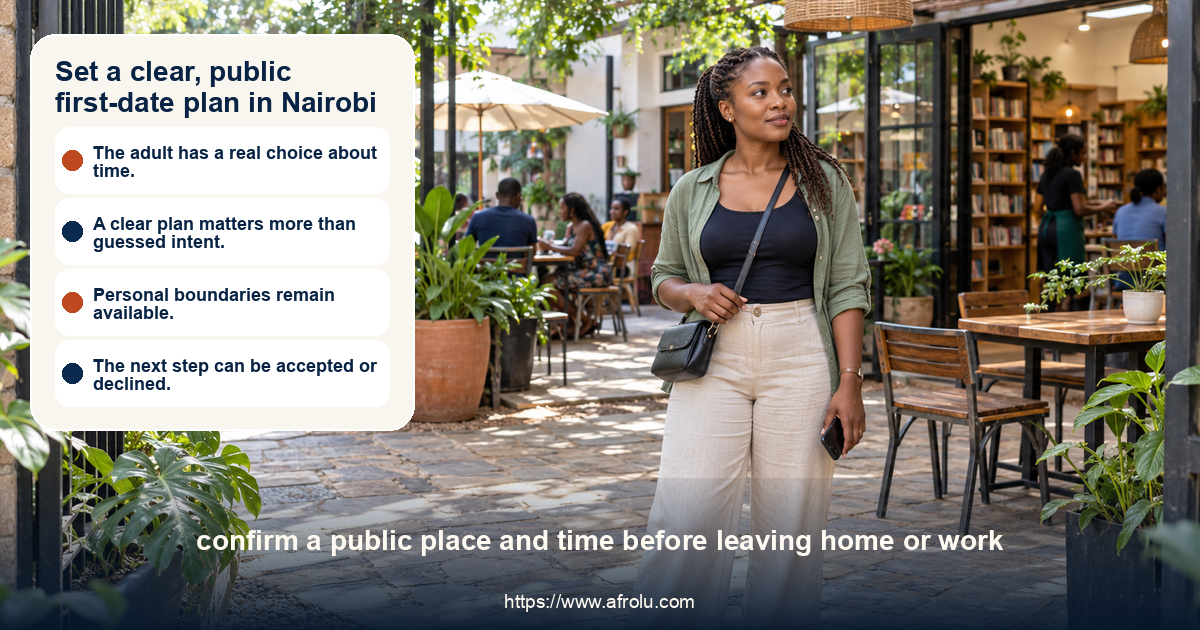
A public first-date plan supports choice but cannot guarantee another person's behavior.
Written and edited by Chipo Banda · Editorial Researcher
Treat a suggestion as unconfirmed until both adults agree on a public venue, a time and a way to leave that works for you. Share only the information needed to meet. If the plan becomes private, pressured or unclear, you can change your mind without proving the other person intended harm.
Modern dating terms · New Relationship Starters
How can I respond to intermittent dating messages while keeping a first Nairobi meeting clear and within my comfort?
Benching is a colloquial label some daters use for intermittent attention with little shared progress. It cannot establish motive or predict safety. For a first Nairobi date, focus on the observable plan, your comfort, a public meeting place, independent transport and whether the other adult respects a change or a no.
Twenty-nine-year-old Amina is new to dating after concentrating on her studies and work. A match sends late messages about meeting “somewhere in town” but does not name a place. Amina asks for a daytime public venue near a route she knows, keeps her own way home and lets the invitation pass when no details arrive.
Do not let the label decide safety
Intermittent contact and personal safety are separate questions
A late “are you free now?” message may leave you with a scheduling choice: ask for details, suggest another day or decline. The benching term cannot tell you whether the person is careless, busy, uncertain or manipulative. Likewise, one vague invitation does not show that a meeting would be dangerous. Use the practical facts available to decide whether you want to proceed.
Your comfort is enough reason to request a public place, more notice or a shorter first meeting. You do not need to accuse anyone to set those terms. If the other adult accepts, you can decide whether the plan works. If they dismiss the boundary, change the venue or apply pressure, you can cancel without conducting an investigation into their character.
Research about breadcrumbing and ghosting is limited and relies on defined survey samples; it does not validate benching as a safety assessment. Safety planning is about options you choose, not a prediction of another person’s intent. Keep the two questions separate: what pattern is occurring, and what conditions make an in-person meeting acceptable to you?
Make the first plan concrete
“Somewhere in town” is not enough detail to plan around
Nairobi is large and a meeting may involve traffic, a matatu, walking or a ride-hailing option. Choose a familiar public area that suits your route and budget. Confirm the venue and time before leaving. You can suggest a daytime café or another staffed public place; the important detail is that you feel able to arrive and leave by choice.
Set a clear confirmation point if you need to arrange transport or move another commitment. If the other person has not confirmed by then, keep the rest of your day. A last-minute invitation can be sincere and still not fit. You do not need to leave work, spend money or travel across town on an open-ended “maybe.”
If the location changes, pause and decide again. A new address, private home or isolated venue is a new plan, not a small detail you have to accept because you already said yes. You can offer a public alternative or cancel. A date should remain voluntary from the first message through the moment you arrive.
Keep your exit yours
Independent transport is a choice that preserves flexibility
Choose a route you can afford and understand, whether that is public transport, a ride-hailing service, a taxi or a trusted person dropping you nearby. Keep enough control to leave when you want. Avoid sharing a home address or getting into a date’s vehicle if that does not feel right to you. A public meeting and independent ride are options, not guarantees.
Tell a trusted person the broad location and expected end time if that is useful for you. You can arrange a check-in without making the friend responsible for judging your date. Keep your phone charged and your own fare available when possible. If the venue feels uncomfortable or the person ignores your limit, leave toward a staffed public area or people you trust.
Do not let a person turn a ride into leverage: “I brought you, so you owe me more time” is not an agreement you made. You can end the meeting and leave. RAINN offers practical online and in-person dating suggestions, but its emergency contacts and service details are U.S.-specific. Use local services in Kenya for local support.
Protect identifying details
You can plan a date without exposing your home or daily routine
Keep your home address, commute routine, workplace access, personal identification numbers and private family details to yourself until you choose to share them. Use the public venue as the meeting point rather than inviting a new date to collect you. If someone asks for details that feel unnecessary, ask why or decline to provide them.
Kenya’s Office of the Data Protection Commissioner describes rights such as being informed about personal-data use, accessing data and objecting to processing. That public guidance concerns data protection; it does not verify a dating profile or guarantee that an app will remove every copy of information. Think before connecting social accounts or sharing location-linked photos.
Never share a one-time login code or financial access because someone says it will prove you are genuine. A request for urgent travel money or an investment is different from an ordinary date invitation. Pause, verify through independent channels and seek a second opinion from someone you trust. You can also keep the conversation on the dating platform while you decide.

Repeat the checks for a first in-person meeting in Nairobi across more than one plan; a single delay does not explain intent.
Notice pressure and choose again
Consent and comfort are current choices, not a reward for showing up
You can agree to meet and later decide you want only a short conversation. You can decline alcohol, a ride, a second location or physical contact without explaining a history. A relationship label, earlier messages or the time someone spent travelling does not create an obligation. Each choice should remain freely made and specific to what is happening now.
If an adult pressures you to move somewhere private, becomes angry when you keep your transport or repeatedly ignores a clear no, you can leave. You do not have to debate the meaning of “benching” or prove danger before ending the date. Move toward a public, staffed place and contact a trusted person or local support if you need help.
A respectful response to a boundary is useful information, but it does not guarantee future behavior. Keep the practical options that suit you: a public setting, a short first meeting and a way home you control. Your safety decisions belong to you; responsibility for harmful conduct belongs to the person who chooses it.
Ask what the contact means
You can check dating intent without turning a first date into an interview
If messages return intermittently, you might ask, “Would you like to make a real plan to meet, or are you looking for occasional chat?” That helps decide whether to keep talking. You can ask about exclusivity later if the relationship develops. A first meeting does not need to resolve long-term commitment, but you can still be honest about what you are seeking.
An adult may want casual dates, a serious relationship, friendship or no meeting at all. None of those answers is a verdict on your worth. If you want something different, you can say so and step away. Avoid treating a confident answer as proof; notice whether later plans continue to match what both people agreed.
Give the person room to decline the proposed time and venue. If they offer another public option that works for you, choose it freely. If they keep sending late messages without details, you may stop replying or mute the conversation. Your choice does not require labelling the other adult as unsafe or manipulative.

Adapt these scripts to a question or limit about a first in-person meeting in Nairobi; no phrase obligates you.
Choose what happens next
A clear plan is an invitation, not an obligation
If both adults confirm a public meeting and you still want to go, keep the plan short and maintain your own route home. If the other person cannot agree to a venue or time, you can reschedule or let the invitation pass. If the connection is enjoyable online but you do not want to meet, say so or stop replying when that feels appropriate.
You might write, “I’m not available for an unconfirmed last-minute plan. If you want to meet, suggest a public place and time with a little notice.” If that does not happen, make your own plans. The message is clear without accusing the other person or inviting an argument about a label.
If someone makes you feel unsafe, prioritize moving toward people and contacting support you trust. No article, public venue or checklist can prevent every harmful action. Keep control of the choices available to you, and remember that you may stop a conversation or date at any point. You do not owe a debate.

For a first in-person meeting in Nairobi, choose one bounded step and reassess what happens next.
How a first in-person meeting in Nairobi can show up in real plans
Warm check-in
For a first in-person meeting in Nairobi: A friendly message arrives, but the next plan is still open.
Reply only if you want to; ask for one concrete option before reserving time.Busy-week delay
For a first in-person meeting in Nairobi: A response arrives later during a week with known responsibilities.
Treat the delay as context, then ask whether a specific time works.Unconfirmed invitation
For a first in-person meeting in Nairobi: The invitation has no agreed day, place or call window.
Ask for the missing detail and keep other plans until both adults confirm.Changed plan
For a first in-person meeting in Nairobi: A date or call moves after one adult's schedule changes.
Notice whether an update and a workable alternative are offered.Different relationship terms
For a first in-person meeting in Nairobi: One adult expects more commitment than the other has chosen.
Ask what each person wants now and decide whether the answer suits you.Future promise
For a first in-person meeting in Nairobi: A possible move, promotion or visit is discussed without a present action.
Separate hope from the step both people can choose today.Private information request
For a first in-person meeting in Nairobi: Someone asks for details beyond what is needed to make the plan.
Share only what you are comfortable sharing; a boundary is enough.Your preference changes
For a first in-person meeting in Nairobi: The current rhythm no longer fits your schedule or goals.
Say what changed and offer a limit or next step you can genuinely keep.What to notice before deciding what a message means
The next step is concrete for a first in-person meeting in Nairobi.
Both adults sometimes propose the plan rather than one person carrying all coordination.
The other adult respects the the meeting point, not your home address or daily route boundary you named.
A change is communicated when reasonably possible.
A cancelled date or call is followed by a usable alternative when interest remains.
The relationship label is discussed rather than treated as a complete agreement.
Either person can decline a time without punishment or guilt.
Your other plans remain intact until a date is confirmed.
The pace leaves space for sleep, work and friendships.
Money and sensitive information are not requested under urgency.
The person answers a present-tense question without turning it into a test of loyalty.
The plan works for both budgets, routes or time zones.
Repeated interactions match the stated terms more often than they contradict them.
You can choose another step or stop without having to prove motive.
Choose a response that matches the moment
| Situation | What it may mean | What to do next |
|---|---|---|
| Warm check-in | For a first in-person meeting in Nairobi: A friendly message arrives, but the next plan is still open. | Reply only if you want to; ask for one concrete option before reserving time. |
| Busy-week delay | For a first in-person meeting in Nairobi: A response arrives later during a week with known responsibilities. | Treat the delay as context, then ask whether a specific time works. |
| Unconfirmed invitation | For a first in-person meeting in Nairobi: The invitation has no agreed day, place or call window. | Ask for the missing detail and keep other plans until both adults confirm. |
| Changed plan | For a first in-person meeting in Nairobi: A date or call moves after one adult's schedule changes. | Notice whether an update and a workable alternative are offered. |
| Different relationship terms | For a first in-person meeting in Nairobi: One adult expects more commitment than the other has chosen. | Ask what each person wants now and decide whether the answer suits you. |
| Future promise | For a first in-person meeting in Nairobi: A possible move, promotion or visit is discussed without a present action. | Separate hope from the step both people can choose today. |
| Private information request | For a first in-person meeting in Nairobi: Someone asks for details beyond what is needed to make the plan. | Share only what you are comfortable sharing; a boundary is enough. |
| Your preference changes | For a first in-person meeting in Nairobi: The current rhythm no longer fits your schedule or goals. | Say what changed and offer a limit or next step you can genuinely keep. |
| An answer stays undecided | A person may be unsure or may prefer different terms; the reason is not settled by one reply. | Ask when, if ever, a check-in would help, then set your own limit. |
| A plan becomes uncomfortable | Your comfort can change even after both adults confirmed the details. | Pause, change the plan or leave; consent and agreement remain current choices. |
Words you can adapt to your own voice
“I can do a daytime meeting near a route you already know. Would either option work for you?”
“Would you like to plan a short first date at a public venue?”
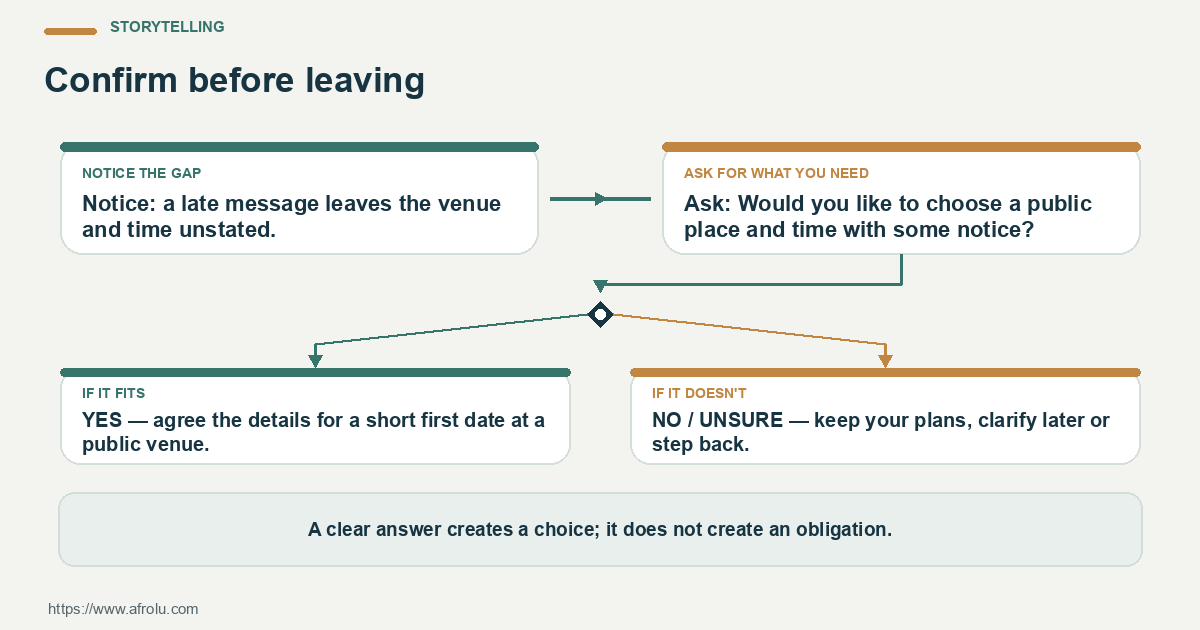
“Would you like to choose a public place and time with some notice?”
“Are we both dating other people, or have we chosen exclusivity?”
“I have not seen a time for a short first date at a public venue; do you want to choose one now?”
“That time no longer works for me. I can offer one alternative if you still want to meet.”
“I can share the meeting point, not your home address or daily route, but I keep other details private.”
“I am comfortable with a public first meeting. Would you choose a place and time with me?”
“I have filled that time, so I will not hold it without details. We can choose another day if we both want.”
“It sounds as if we want different things right now. Have I understood you correctly?”
“I want to keep this relaxed and can offer a daytime meeting near a route you already know.”
“I have enjoyed talking, but this arrangement does not fit what I want, so I am going to step back.”
Know the difference
A workable constraint and an unresolved pattern are different things
A public venue and time are confirmed, and each adult keeps a comfortable way to arrive and leave.
The place or time is missing, so you can ask for detail, suggest another day or decline.
Use what both adults agree and do; the label cannot establish motive.

Compare what was agreed about a first in-person meeting in Nairobi with the actions; avoid diagnosing motive.
Compare a real constraint with unresolved waiting
| Type or dimension | What it describes | Best next question |
|---|---|---|
| A real limit | The constraint is named in practical terms. | Ask what option remains possible now. |
| A shared plan | Both adults contribute a day, place or call window. | Confirm the details before changing your schedule. |
| A warm message | It may show interest but does not settle relationship terms. | Ask what the person wants at present. |
| A future possibility | A move or visit is discussed without a chosen action. | Separate hope from the next feasible step. |
| A reschedule | The original time changes, which can happen for ordinary reasons. | Notice whether an update and alternative follow. |
| Repeated open plans | The invitation returns while no details are agreed. | Choose a confirmation point and keep other plans. |
| A direct no | The person does not want the proposed time or relationship. | Respect it and decide whether another arrangement suits you. |
| A changed preference | Your needs or capacity have shifted since the last discussion. | Say what changed and ask whether the terms can change too. |
| A safety boundary | You want different logistics or information to remain private. | Keep the boundary; an acceptable plan must remain voluntary. |
Six practical ideas to keep nearby
Fact before interpretation
Record what happened in a first in-person meeting in Nairobi before using a popular label.
Present terms
Ask what both adults want now; do not substitute a hopeful future phrase for an agreement.
One usable step
Turn the open question into confirm a public place and time before leaving home or work.
Mutual logistics
Check time, place, cost and capacity before one adult makes a sacrifice.
Independent choices
Keep work, privacy, money and transport decisions available to yourself.
Review and decide
Notice follow-through over several interactions, then choose what you want to do.
Questions for planning, clarity and review
Choose a few prompts that fit the moment. This is a reference library, not a list to complete.
Before the next invitation
Decide what fits a first in-person meeting in Nairobi.
- What day is genuinely available?
- What detail must be confirmed?
- When will I make other plans?
Ask about present intent
Keep the question focused on a current choice.
- What do I want now?
- Which agreement is undecided?
- Can I accept an honest no?
Protect practical options
Choose privacy, money and travel boundaries before they are tested.
- What information is necessary?
- Which costs can I afford?
- How will I leave or reschedule?
Review the arrangement
Look at actions across more than one memorable message.
- Who helped plan?
- What happened after a change?
- Does the present offer fit me?
What research and safety guidance can—and cannot—tell you
What studies of breadcrumbing can tell us
Surveys can describe associations in the people sampled and help define questions for future research.
Evidence limit: They cannot identify the motive behind a message or validate every use of “benching.”
Why a label is not a contract
Adults may attach different meanings to serious, casual, exclusive and low pressure.
Evidence limit: Ask about the decisions each person actually wants to make.
Why reply frequency needs context
Work hours, sleep, time zones and communication preference shape when a person can respond.
Evidence limit: No universal message quota predicts compatibility.
What to notice after a change
An update, another proposed time and shared coordination can make a disruption easier to interpret.
Evidence limit: One repair does not guarantee a future pattern.
Practical choices support autonomy
Public settings, independent transport and privacy limits can help a person retain options.
Evidence limit: No venue or checklist guarantees another person's behavior.
When the current fit is enough information
You can leave an arrangement that does not match your needs without deciding whether it was intentional.
Evidence limit: A reader's decision is personal, not a diagnosis of the other adult.
Common misreads that add more uncertainty
Treating a term as proof
A popular label can describe frustration, but it does not establish intent.
Keeping every slot open
An unconfirmed invitation cannot coordinate your week for you.
Demanding constant access
More messages do not replace a conversation about availability and terms.
Reading one delay as a verdict
A single busy period is weak evidence about a person's overall interest.
Over-investing before agreement
Travel, money or work changes deserve a mutual plan first.
Hiding your own preference
The other adult cannot consent to terms you have not described.
Confirm a public venue before travelling to meet
These information links are clearly labelled, non-commercial and do not promise a match or relationship outcome.
Explore the guide library
Show more related guides
Continue with Afrolu
Show more Afrolu guides
Research and practical guidance used for this guide
Afrolu reviewed these health, research, safety, or public guidance resources while editing this page. They support the behaviour and safety guidance; they do not diagnose any individual described by a reader.
Questions about a first in-person meeting in Nairobi
Does benching prove a date is unsafe?
No. It is an informal label, not a safety assessment. Decide from the plan and your comfort.
Should I meet if the place is not confirmed?
You can ask for a public venue and time or decline to travel before details are agreed.
Is a public venue guaranteed to be safe?
No. It may support your options, but no place or checklist guarantees another person's behavior.
Should I share my home address?
You do not need to. Use a public meeting point and share only information you are comfortable providing.
What if the date changes the venue?
Treat it as a new plan. Accept the change only if it still feels workable, or cancel.
Do I need to explain why I want my own transport?
No. You may state that preference without sharing your full history or route.
Can I leave after I arrive?
Yes. You may end a date or any activity at any time.
Does one missed message mean disinterest?
Not by itself. Consider whether details, updates and follow-through appear across several interactions.
Should I send travel money to a new match?
Do not transfer money under pressure. Verify claims independently and use local reporting channels if needed.
Can I cancel without proof of harm?
Yes. Discomfort or a changed preference is enough reason to change or cancel a plan.
One thing to do now
Choose the next step that fits the agreement you have
Confirm the public place and time, keep your transport and personal details under your control, and decide again whenever the plan changes.