Benching in dating · long distance · low pressure
Make a small next step in low-pressure long-distance dating
A relaxed long-distance connection still needs a next step. Agree on a workable call or visit, discuss the present terms, and review whether it fits both lives.

One agreed call can test whether a relaxed pace works across two routines.
Written and edited by Miriam Otieno · Senior Kenya Editor
Agree on one small next step that both people can actually keep, such as a call window or a conversation about visit feasibility. Ask what is current and what is undecided. Low pressure should leave room for a no, while a clear plan protects both people from treating a hopeful message as a commitment.
Modern dating terms · New Relationship Starters
How do I keep long-distance dating relaxed while still knowing what our next step is?
Benching is a popular, non-clinical term for intermittent contact with little shared progress. It does not prove motive. In long-distance dating, distinguish a genuine limit from indefinite waiting by asking whether both adults can name one realistic action and whether the current arrangement meets their needs.
Thirty-five-year-old Lindiwe has been exchanging voice notes with someone in another time zone. The conversation is warm, but no call or visit has been chosen. She suggests a 30-minute call on Sunday and asks what each of them wants from dating. They keep the pace relaxed and decide separately whether another step fits.
Slow can still be specific
A relaxed pace does not require an undefined future
You may enjoy a few voice notes a week, prefer a short call before discussing travel, or want to meet only when a visit already fits your life. Those are different preferences, and none needs to be disguised as a test. Tell the other adult what you are open to now and leave room for them to choose differently.
An occasional “thinking of you” message can feel close when you live in different countries, but it does not settle whether you are dating exclusively or planning a visit. The word low pressure can hide a mismatch if one person expects a future relationship while the other expects only intermittent contact. Ask about the present terms before building an expectation around a label.
You do not need to decide whether the connection will last before you accept a call. Pick one modest next step with a clear time and purpose. After it happens, decide whether you want another. That makes room for curiosity without creating a promise neither person has made.
Plan across real time zones
Find one overlap instead of negotiating every notification
Write down the time difference and the hours each person can usually step away from work, study, family or sleep. A simple window may be enough: a short call on one weekend afternoon, with asynchronous notes when schedules do not overlap. If a shift or time change disrupts it, revisit the arrangement rather than assuming the old plan still applies.
Research with 647 emerging adults in Canada found an association between frequent, responsive texting and relationship satisfaction among long-distance participants, but the sample was young, student-heavy and measured at one point in time. It does not establish a rule for people of different ages, cultures or work patterns. Do not turn the study into a required reply schedule.
Ask what kind of contact feels connecting rather than monitoring. You might agree that a late reply needs no explanation unless a call was scheduled, or that each adult will suggest another time after a cancellation. You can appreciate a message while still protecting sleep and focus. No one needs to stay on call to keep a dating connection alive.
Choose one next step
Replace “sometime” with an action that is easy to accept or decline
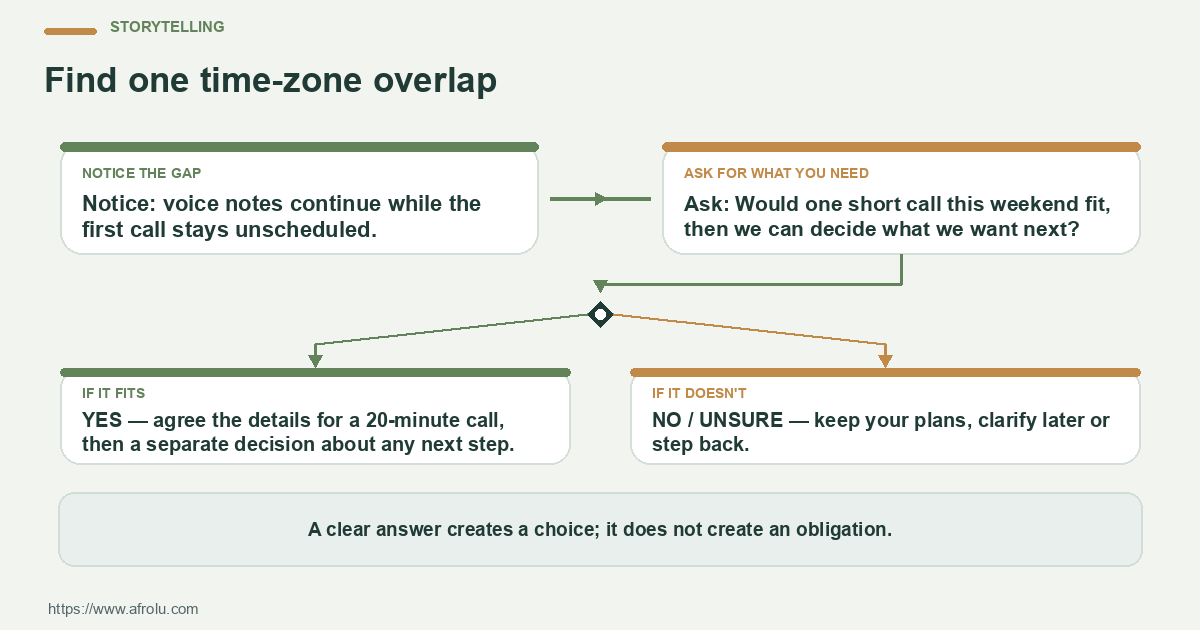
Choose a call, an agreed check-in about exclusivity, or a conversation about whether visiting is feasible. Keep the request proportionate to the stage of the relationship. A 20-minute call is not a promise to meet, and discussing the possibility of travel is not a commitment to buy a ticket. Make each step its own choice.
A clear suggestion sounds like, “Would Sunday at five your time work for a short call? If not, send a window you prefer.” If the answer is no, accept it. If there is no answer, continue your life rather than treating that opening as a reserved time. If the call occurs, decide together whether you want another step.
If both adults want to meet, discuss dates, costs and accommodation before either takes leave or spends money. If no period is possible, agree on what you are doing in the meantime and when you will reassess. That is not a contract for the future; it is a way to keep the present honest.
Keep travel independent
Do not use a ticket or transfer as proof of interest
A long-distance visit can be expensive even when both people are sincere. Decide what you can afford, who is travelling and where each person will stay. Do not assume one adult must pay because they earn more, live closer to an airport or proposed the meeting. A public first outing and separate accommodation may be the more comfortable choice.
Never send funds, verification codes or account access under urgent pressure from someone you have not met. The U.S. Federal Trade Commission describes romance scams that use travel, visa or emergency stories to request money; its local reporting advice is U.S.-specific. Pause, verify independently, keep control of your accounts and speak to someone you trust before any transfer.
If the other adult cannot travel now, ask whether there is another affordable action you both want, or whether the distance makes dating impractical for the moment. You can decide that a connection is enjoyable online but not enough for your relationship goals. That conclusion does not require calling the person dishonest or demanding that they overcome a constraint.

Repeat the checks for low-pressure dating across a time-zone gap across more than one plan; a single delay does not explain intent.
Clarify the terms
Frequent calls, chemistry and distance do not establish exclusivity
People can feel close through remote conversations while holding different assumptions about commitment. Ask whether either person is dating others and whether you are both exploring a relationship or simply enjoying contact. Do not treat video calls, overnight messages or travel talk as an agreement unless you both have chosen the terms.
You can keep the topic light: “I’m enjoying getting to know you. Are you dating other people, and do you want to keep this casual for now?” You can answer the same question honestly. If your preference changes, return to the conversation rather than expecting a gradual increase in messages to communicate it.
If one person wants a committed partnership and the other wants an unlabelled connection, decide whether that difference is comfortable for you. You are not obligated to move faster, and the other person is not obligated to want more. A respectful no can be kinder than letting a hopeful phrase substitute for a present agreement.
Notice repair without scorekeeping
A cancelled call can be a normal disruption; never-ending rescheduling is a different arrangement
Work, travel, illness and family needs can change a call plan. If you need to cancel, send a short message when possible and offer another time if you still want to connect. Notice whether the other adult responds with similar consideration. The useful question is not who missed once; it is whether the plan remains mutual and workable over time.
Avoid checking online status, demanding screenshots or comparing read receipts across time zones. Those signals cannot tell you the full context. Ask directly whether the person wants to keep the current rhythm. If they answer yes but repeatedly make no space for it, you can decide from the mismatch between the words and the arrangement.
A review can be simple: after two calls, ask what felt easy and what needs adjusting. If neither person wants another call, that is also an answer. The goal is not to secure a particular outcome; it is to avoid carrying an imagined commitment that has not been mutually discussed.

Adapt these scripts to a question or limit about low-pressure dating across a time-zone gap; no phrase obligates you.
Keep your wider life active
Dating across distance should not become a second unpaid shift
Set notifications aside during rest and work, and avoid scheduling calls at times that repeatedly leave one person exhausted. Make room for the people and activities already supporting you. If you find yourself rearranging travel, spending more than planned or waiting through every weekend for a conversation, pause and ask whether the current arrangement still feels freely chosen.
You can ask for a different rhythm without demanding that someone be available whenever you feel uncertain. State the need and offer an option, then listen to their capacity. A boundary might be “I can call twice a month, but I cannot stay awake past midnight each week.” It keeps the choice clear for both adults.
If the arrangement no longer fits, you can reduce contact or end the dating part kindly. A short note can say that you value the conversations but want a relationship with more in-person possibility. You do not have to prove that the other adult used distance as an excuse. Your own needs are enough reason to choose differently.

For low-pressure dating across a time-zone gap, choose one bounded step and reassess what happens next.
How low-pressure dating across a time-zone gap can show up in real plans
Warm check-in
For low-pressure dating across a time-zone gap: A friendly message arrives, but the next plan is still open.
Reply only if you want to; ask for one concrete option before reserving time.Busy-week delay
For low-pressure dating across a time-zone gap: A response arrives later during a week with known responsibilities.
Treat the delay as context, then ask whether a specific time works.Unconfirmed invitation
For low-pressure dating across a time-zone gap: The invitation has no agreed day, place or call window.
Ask for the missing detail and keep other plans until both adults confirm.Changed plan
For low-pressure dating across a time-zone gap: A date or call moves after one adult's schedule changes.
Notice whether an update and a workable alternative are offered.Different relationship terms
For low-pressure dating across a time-zone gap: One adult expects more commitment than the other has chosen.
Ask what each person wants now and decide whether the answer suits you.Future promise
For low-pressure dating across a time-zone gap: A possible move, promotion or visit is discussed without a present action.
Separate hope from the step both people can choose today.Private information request
For low-pressure dating across a time-zone gap: Someone asks for details beyond what is needed to make the plan.
Share only what you are comfortable sharing; a boundary is enough.Your preference changes
For low-pressure dating across a time-zone gap: The current rhythm no longer fits your schedule or goals.
Say what changed and offer a limit or next step you can genuinely keep.What to notice before deciding what a message means
The next step is concrete for low-pressure dating across a time-zone gap.
Both adults sometimes propose the plan rather than one person carrying all coordination.
The other adult respects the an agreed overlap, not all-day availability boundary you named.
A change is communicated when reasonably possible.
A cancelled date or call is followed by a usable alternative when interest remains.
The relationship label is discussed rather than treated as a complete agreement.
Either person can decline a time without punishment or guilt.
Your other plans remain intact until a date is confirmed.
The pace leaves space for sleep, work and friendships.
Money and sensitive information are not requested under urgency.
The person answers a present-tense question without turning it into a test of loyalty.
The plan works for both budgets, routes or time zones.
Repeated interactions match the stated terms more often than they contradict them.
You can choose another step or stop without having to prove motive.
Choose a response that matches the moment
| Situation | What it may mean | What to do next |
|---|---|---|
| Warm check-in | For low-pressure dating across a time-zone gap: A friendly message arrives, but the next plan is still open. | Reply only if you want to; ask for one concrete option before reserving time. |
| Busy-week delay | For low-pressure dating across a time-zone gap: A response arrives later during a week with known responsibilities. | Treat the delay as context, then ask whether a specific time works. |
| Unconfirmed invitation | For low-pressure dating across a time-zone gap: The invitation has no agreed day, place or call window. | Ask for the missing detail and keep other plans until both adults confirm. |
| Changed plan | For low-pressure dating across a time-zone gap: A date or call moves after one adult's schedule changes. | Notice whether an update and a workable alternative are offered. |
| Different relationship terms | For low-pressure dating across a time-zone gap: One adult expects more commitment than the other has chosen. | Ask what each person wants now and decide whether the answer suits you. |
| Future promise | For low-pressure dating across a time-zone gap: A possible move, promotion or visit is discussed without a present action. | Separate hope from the step both people can choose today. |
| Private information request | For low-pressure dating across a time-zone gap: Someone asks for details beyond what is needed to make the plan. | Share only what you are comfortable sharing; a boundary is enough. |
| Your preference changes | For low-pressure dating across a time-zone gap: The current rhythm no longer fits your schedule or goals. | Say what changed and offer a limit or next step you can genuinely keep. |
| An answer stays undecided | A person may be unsure or may prefer different terms; the reason is not settled by one reply. | Ask when, if ever, a check-in would help, then set your own limit. |
| A plan becomes uncomfortable | Your comfort can change even after both adults confirmed the details. | Pause, change the plan or leave; consent and agreement remain current choices. |
Words you can adapt to your own voice
“I can do one agreed weekend call window that does not cut into sleep. Would either option work for you?”
“Would you like to plan a 20-minute call, then a separate decision about any next step?”
“Would one short call this weekend fit, then we can decide what we want next?”
“Are we both dating other people, or have we chosen exclusivity?”
“I have not seen a time for a 20-minute call, then a separate decision about any next step; do you want to choose one now?”
“That time no longer works for me. I can offer one alternative if you still want to meet.”
“I can share an agreed overlap, not all-day availability, but I keep other details private.”
“I am comfortable with a public first meeting. Would you choose a place and time with me?”
“I have filled that time, so I will not hold it without details. We can choose another day if we both want.”
“It sounds as if we want different things right now. Have I understood you correctly?”
“I want to keep this relaxed and can offer one agreed weekend call window that does not cut into sleep.”
“I have enjoyed talking, but this arrangement does not fit what I want, so I am going to step back.”
Know the difference
A workable constraint and an unresolved pattern are different things
A small call is agreed freely, both people can reschedule, and no future promise is assumed.
Contact continues without a time to talk, while one person treats each warm note as a future commitment.
Use what both adults agree and do; the label cannot establish motive.

Compare what was agreed about low-pressure dating across a time-zone gap with the actions; avoid diagnosing motive.
Compare a real constraint with unresolved waiting
| Type or dimension | What it describes | Best next question |
|---|---|---|
| A real limit | The constraint is named in practical terms. | Ask what option remains possible now. |
| A shared plan | Both adults contribute a day, place or call window. | Confirm the details before changing your schedule. |
| A warm message | It may show interest but does not settle relationship terms. | Ask what the person wants at present. |
| A future possibility | A move or visit is discussed without a chosen action. | Separate hope from the next feasible step. |
| A reschedule | The original time changes, which can happen for ordinary reasons. | Notice whether an update and alternative follow. |
| Repeated open plans | The invitation returns while no details are agreed. | Choose a confirmation point and keep other plans. |
| A direct no | The person does not want the proposed time or relationship. | Respect it and decide whether another arrangement suits you. |
| A changed preference | Your needs or capacity have shifted since the last discussion. | Say what changed and ask whether the terms can change too. |
| A safety boundary | You want different logistics or information to remain private. | Keep the boundary; an acceptable plan must remain voluntary. |
Six practical ideas to keep nearby
Fact before interpretation
Record what happened in low-pressure dating across a time-zone gap before using a popular label.
Present terms
Ask what both adults want now; do not substitute a hopeful future phrase for an agreement.
One usable step
Turn the open question into choose one low-cost call and review whether another step fits both lives.
Mutual logistics
Check time, place, cost and capacity before one adult makes a sacrifice.
Independent choices
Keep work, privacy, money and transport decisions available to yourself.
Review and decide
Notice follow-through over several interactions, then choose what you want to do.
Questions for planning, clarity and review
Choose a few prompts that fit the moment. This is a reference library, not a list to complete.
Before the next invitation
Decide what fits low-pressure dating across a time-zone gap.
- What day is genuinely available?
- What detail must be confirmed?
- When will I make other plans?
Ask about present intent
Keep the question focused on a current choice.
- What do I want now?
- Which agreement is undecided?
- Can I accept an honest no?
Protect practical options
Choose privacy, money and travel boundaries before they are tested.
- What information is necessary?
- Which costs can I afford?
- How will I leave or reschedule?
Review the arrangement
Look at actions across more than one memorable message.
- Who helped plan?
- What happened after a change?
- Does the present offer fit me?
What research and safety guidance can—and cannot—tell you
What studies of breadcrumbing can tell us
Surveys can describe associations in the people sampled and help define questions for future research.
Evidence limit: They cannot identify the motive behind a message or validate every use of “benching.”
Why a label is not a contract
Adults may attach different meanings to serious, casual, exclusive and low pressure.
Evidence limit: Ask about the decisions each person actually wants to make.
Why reply frequency needs context
Work hours, sleep, time zones and communication preference shape when a person can respond.
Evidence limit: No universal message quota predicts compatibility.
What to notice after a change
An update, another proposed time and shared coordination can make a disruption easier to interpret.
Evidence limit: One repair does not guarantee a future pattern.
Practical choices support autonomy
Public settings, independent transport and privacy limits can help a person retain options.
Evidence limit: No venue or checklist guarantees another person's behavior.
When the current fit is enough information
You can leave an arrangement that does not match your needs without deciding whether it was intentional.
Evidence limit: A reader's decision is personal, not a diagnosis of the other adult.
Common misreads that add more uncertainty
Treating a term as proof
A popular label can describe frustration, but it does not establish intent.
Keeping every slot open
An unconfirmed invitation cannot coordinate your week for you.
Demanding constant access
More messages do not replace a conversation about availability and terms.
Reading one delay as a verdict
A single busy period is weak evidence about a person's overall interest.
Over-investing before agreement
Travel, money or work changes deserve a mutual plan first.
Hiding your own preference
The other adult cannot consent to terms you have not described.
Agree on one small contact step across time zones
These information links are clearly labelled, non-commercial and do not promise a match or relationship outcome.
Explore the guide library
Show more related guides
Continue with Afrolu
Show more Afrolu guides
Research and practical guidance used for this guide
Afrolu reviewed these health, research, safety, or public guidance resources while editing this page. They support the behaviour and safety guidance; they do not diagnose any individual described by a reader.
Questions about low-pressure dating across a time-zone gap
Can long-distance dating stay low pressure?
Yes. Choose a small next step and leave future commitment undecided until both adults discuss it.
What is a useful first step across time zones?
A short call during overlapping awake hours can help both people decide whether they want another step.
Does texting more prove commitment?
No. Contact frequency does not establish exclusivity or predict the future.
Should I book travel after a warm call?
Discuss dates, costs, lodging and expectations first. A call is not an agreement to travel.
What if our schedules never overlap?
Consider whether another format works, or whether the connection is impractical in its current form.
Should I stay up late to show interest?
No. Offer a window that protects sleep and ask whether it works for both people.
Is a voice note a relationship plan?
It can be a useful message, but it does not answer what each adult wants or when to meet.
What if the other person is unsure?
You can ask whether they want to revisit the question later, then set your own limit for waiting.
Does distance explain every missed call?
It may explain a scheduling issue; it does not require you to keep an arrangement that fails to fit.
Can I stop even if the connection is kind?
Yes. Warmth and compatibility are different questions, and your needs are a valid part of the decision.
One thing to do now
Choose the next step that fits the agreement you have
Choose one low-cost, feasible next step, clarify the current terms and review the arrangement after you see how it works.