Benching in dating · long distance · intent
Ask what a distant connection is choosing now
Distance can make check-ins feel meaningful. Ask what they want now, agree on a realistic call or visit, and keep money and travel choices independent.

A current call plan and stated intent matter more than an open-ended visit promise.
Written and edited by Grace Mutiso · Kenya Guides Editor
Agree on one realistic next step, such as a call window or a conversation about a visit. Ask about present intent and exclusivity directly. Distance can explain logistics, but it cannot settle what each person wants; decide whether the current arrangement works before spending money or waiting for a future move.
Modern dating terms · Late Entrants
How can I tell whether a long-distance connection has present intent when contact is warm but visits remain hypothetical?
Benching is an informal term for intermittent contact that appears to keep a dating connection available without much shared progress. It cannot prove motive. In a long-distance relationship, distinguish genuine constraints such as time zones, cost and travel eligibility from repeated promises that never become a mutually chosen next step.
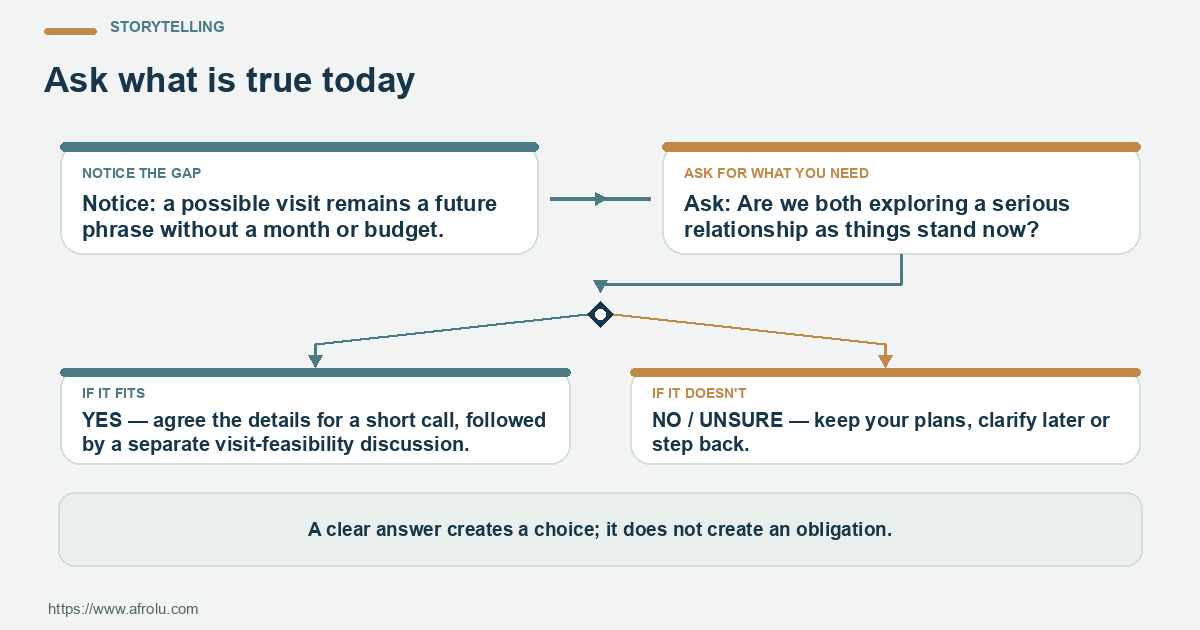
At 49, Daniel reconnects with an adult he met while working abroad. They have warm calls when schedules align, but each possible visit becomes “later this year.” Daniel asks whether both want to explore a committed relationship, then discusses a feasible month and each person’s budget before either books travel.
Separate term from evidence
A benching label does not explain why an international plan is stalled
A person may have meaningful constraints: different work hours, travel costs, family responsibilities, documentation, caregiving or a changing residence. A message that returns after a quiet week does not tell you which constraint applies. Record what each adult said about a call, a visit or relationship direction, and whether the next action was chosen together.
Studies about breadcrumbing and ghosting examine related digital behaviors, not a reliable benching diagnosis. A cross-sectional study of young adults in India and Spain reported associations involving attachment insecurity and breadcrumbing engagement; the authors note that findings differ between samples. It cannot explain a particular person’s messages or establish what cross-border daters in Kenya experience.
Use the label only if it helps you name the frustration, then return to the evidence. Did both people help set a time? Did a cancelled call get rescheduled? Did the proposed visit acquire a period, budget and plan? You can decide that the current pattern is not enough without claiming to know whether the other adult meant to keep you waiting.
Discuss present direction
Future talk is different from a present relationship choice
Long-distance conversations can move quickly into hopes about a reunion, a transfer or living in the same country. Treat those as possibilities until the person has taken a concrete step and both adults understand the conditions. Ask whether you are currently dating exclusively, exploring a committed relationship, or still learning what each of you wants.
The words serious, partner and committed can carry different meanings. Turn them into choices: are you dating other people, how do you handle sexual health, how often can you talk, and what would make an in-person visit realistic? You can discuss one topic at a time. No single answer requires either person to promise a move or a timeline they cannot control.
If one adult wants commitment and the other is content with occasional calls, name the mismatch kindly. A hopeful statement about someday may be sincere, but it still leaves you with a decision about today. You are allowed to continue casually, ask for more clarity, pause or stop. Distance does not obligate you to wait for a future that neither person has scheduled.
Set a contact rhythm
Choose communication that fits two real time zones
List the hours each person is usually awake and available, including work, sleep, prayer, caregiving and quiet time. Suggest a call window that overlaps rather than expecting one person to stay up repeatedly. A voice note or asynchronous message may help with routine updates, while a scheduled call can suit a longer topic. Agree to review the rhythm when a schedule changes.
A study of 647 emerging adults in Canada found that more frequent and responsive texting was associated with relationship satisfaction among its long-distance participants. The participants were 18–25 and mostly students; the survey cannot set a universal message frequency or establish that more texting causes satisfaction. Use it as context, not a target for your relationship.
Make the plan specific enough to use: “Could we call Sunday at your afternoon and my evening, and message if one of us needs to move it?” If the proposed time repeatedly fails, discuss a new option. You do not need to keep a phone open all day or treat an unread message as an answer about commitment.
Make a visit feasible
Talk through travel before either person changes a budget or books leave
A visit may involve leave, lodging, local transport, documentation and time away from family. Discuss those pieces before buying a ticket. Either adult may prefer separate accommodation or a public first meeting. A person can be excited to meet and still need a slower plan; an in-person visit is not proof of exclusivity or future commitment.
Do not send money, gift cards, cryptocurrency or account details to someone you have not met because of an urgent travel, visa or medical story. The U.S. Federal Trade Commission describes those requests as common romance-scam patterns; its reporting system and legal advice are U.S.-specific. The practical lesson is to pause, verify independently and avoid a pressured transfer.
Each person should know what they can pay without resentment and what happens if a flight or schedule changes. Use your own booking and return plan where feasible, keep documents private, and share itinerary details with someone you trust if that helps you. If the logistics remain impossible, decide whether the relationship works in its current form.

Repeat the checks for serious-intent dating across two countries across more than one plan; a single delay does not explain intent.
Notice repair across distance
One missed call is not the same as repeated indefinite rescheduling
A time-zone mistake, illness or work shift can interrupt a call. A caring repair may include a short update and a proposed new time, if the person still wants to talk. Notice whether both adults do this. If one person repeatedly restarts the conversation while the other avoids choosing a date, that tells you about the arrangement’s current capacity even if it does not explain the motive.
Keep the conversation away from surveillance. You do not need screenshots, location tracking or access to someone’s roster to understand their availability. A broad window and an honest explanation are enough. If your schedules cannot overlap often enough for the connection you want, describe that as a real compatibility issue rather than demanding proof of affection through constant access.
Try a review after one agreed month or after the next planned call. Ask what worked, what felt effortful and whether each person wants another step. A review is not a trial. It gives both adults a chance to adjust before one person quietly invests more travel, money or emotional time than the other has chosen.
Protect money and private details
Closeness does not require giving up financial or information boundaries
Keep passport numbers, bank credentials, work credentials, one-time codes and exact home routines private. Kenya’s Office of the Data Protection Commissioner explains data-subject rights such as being informed about use of personal data and objecting to processing. Those rights do not guarantee that a profile is genuine or reverse every disclosure, so choose carefully before sharing.
If a person asks for money or a financial account connection, pause regardless of how affectionate the prior calls felt. Verify a claim through a source you find independently, not a contact or link the person supplies. Tell someone you trust what happened. The FTC’s advice is written for U.S. consumers, so use local reporting channels if you need to report a loss in Kenya.
A boundary can sound simple: “I do not send money to someone I have not met, but I am happy to plan a public visit when we can both cover our own costs.” If that answer is met with anger, urgency or guilt, you may end the conversation. You do not have to decide whether the person is a scammer before protecting your resources.

Adapt these scripts to a question or limit about serious-intent dating across two countries; no phrase obligates you.
Choose from the current agreement
Do not let an imagined reunion make the present decision for you
If the calls are mutual and a realistic next step exists, continue at a pace that fits your life. If you are content with occasional contact, name that honestly and avoid treating it as a promise of commitment. If the gap between your preferred relationship and the current offer is painful, ask once for clarity and then decide what you need.
You might say, “I like our conversations, but I am not comfortable keeping a visit hypothetical for months. Let’s choose a workable period or pause the dating part.” This describes your limit without making a claim about the other person’s character. A direct answer can be no, and you can respect it while choosing a different path.
Keep friendships, finances and personal plans active while you decide. A relationship label cannot predict the future, and a research finding cannot tell you which couple will last. The useful evidence is the agreement you actually have, the steps both adults take and whether that arrangement is a life you want to keep living.

For serious-intent dating across two countries, choose one bounded step and reassess what happens next.
How serious-intent dating across two countries can show up in real plans
Warm check-in
For serious-intent dating across two countries: A friendly message arrives, but the next plan is still open.
Reply only if you want to; ask for one concrete option before reserving time.Busy-week delay
For serious-intent dating across two countries: A response arrives later during a week with known responsibilities.
Treat the delay as context, then ask whether a specific time works.Unconfirmed invitation
For serious-intent dating across two countries: The invitation has no agreed day, place or call window.
Ask for the missing detail and keep other plans until both adults confirm.Changed plan
For serious-intent dating across two countries: A date or call moves after one adult's schedule changes.
Notice whether an update and a workable alternative are offered.Different relationship terms
For serious-intent dating across two countries: One adult expects more commitment than the other has chosen.
Ask what each person wants now and decide whether the answer suits you.Future promise
For serious-intent dating across two countries: A possible move, promotion or visit is discussed without a present action.
Separate hope from the step both people can choose today.Private information request
For serious-intent dating across two countries: Someone asks for details beyond what is needed to make the plan.
Share only what you are comfortable sharing; a boundary is enough.Your preference changes
For serious-intent dating across two countries: The current rhythm no longer fits your schedule or goals.
Say what changed and offer a limit or next step you can genuinely keep.What to notice before deciding what a message means
The next step is concrete for serious-intent dating across two countries.
Both adults sometimes propose the plan rather than one person carrying all coordination.
The other adult respects the a broad call window, not a work roster or identity document boundary you named.
A change is communicated when reasonably possible.
A cancelled date or call is followed by a usable alternative when interest remains.
The relationship label is discussed rather than treated as a complete agreement.
Either person can decline a time without punishment or guilt.
Your other plans remain intact until a date is confirmed.
The pace leaves space for sleep, work and friendships.
Money and sensitive information are not requested under urgency.
The person answers a present-tense question without turning it into a test of loyalty.
The plan works for both budgets, routes or time zones.
Repeated interactions match the stated terms more often than they contradict them.
You can choose another step or stop without having to prove motive.
Choose a response that matches the moment
| Situation | What it may mean | What to do next |
|---|---|---|
| Warm check-in | For serious-intent dating across two countries: A friendly message arrives, but the next plan is still open. | Reply only if you want to; ask for one concrete option before reserving time. |
| Busy-week delay | For serious-intent dating across two countries: A response arrives later during a week with known responsibilities. | Treat the delay as context, then ask whether a specific time works. |
| Unconfirmed invitation | For serious-intent dating across two countries: The invitation has no agreed day, place or call window. | Ask for the missing detail and keep other plans until both adults confirm. |
| Changed plan | For serious-intent dating across two countries: A date or call moves after one adult's schedule changes. | Notice whether an update and a workable alternative are offered. |
| Different relationship terms | For serious-intent dating across two countries: One adult expects more commitment than the other has chosen. | Ask what each person wants now and decide whether the answer suits you. |
| Future promise | For serious-intent dating across two countries: A possible move, promotion or visit is discussed without a present action. | Separate hope from the step both people can choose today. |
| Private information request | For serious-intent dating across two countries: Someone asks for details beyond what is needed to make the plan. | Share only what you are comfortable sharing; a boundary is enough. |
| Your preference changes | For serious-intent dating across two countries: The current rhythm no longer fits your schedule or goals. | Say what changed and offer a limit or next step you can genuinely keep. |
| An answer stays undecided | A person may be unsure or may prefer different terms; the reason is not settled by one reply. | Ask when, if ever, a check-in would help, then set your own limit. |
| A plan becomes uncomfortable | Your comfort can change even after both adults confirmed the details. | Pause, change the plan or leave; consent and agreement remain current choices. |
Words you can adapt to your own voice
“I can do one agreed 30-minute call during overlapping awake hours. Would either option work for you?”
“Would you like to plan a short call, followed by a separate visit-feasibility discussion?”
“Are we both exploring a serious relationship as things stand now?”
“Are we both dating other people, or have we chosen exclusivity?”
“I have not seen a time for a short call, followed by a separate visit-feasibility discussion; do you want to choose one now?”
“That time no longer works for me. I can offer one alternative if you still want to meet.”
“I can share a broad call window, not a work roster or identity document, but I keep other details private.”
“I am comfortable with a public first meeting. Would you choose a place and time with me?”
“I have filled that time, so I will not hold it without details. We can choose another day if we both want.”
“It sounds as if we want different things right now. Have I understood you correctly?”
“I want to keep this relaxed and can offer one agreed 30-minute call during overlapping awake hours.”
“I have enjoyed talking, but this arrangement does not fit what I want, so I am going to step back.”
Know the difference
A workable constraint and an unresolved pattern are different things
A limit is named, a current contact option is chosen and both adults revisit travel when feasible.
The next call or visit stays hypothetical while one person is expected to wait without clear terms.
Use what both adults agree and do; the label cannot establish motive.

Compare what was agreed about serious-intent dating across two countries with the actions; avoid diagnosing motive.
Compare a real constraint with unresolved waiting
| Type or dimension | What it describes | Best next question |
|---|---|---|
| A real limit | The constraint is named in practical terms. | Ask what option remains possible now. |
| A shared plan | Both adults contribute a day, place or call window. | Confirm the details before changing your schedule. |
| A warm message | It may show interest but does not settle relationship terms. | Ask what the person wants at present. |
| A future possibility | A move or visit is discussed without a chosen action. | Separate hope from the next feasible step. |
| A reschedule | The original time changes, which can happen for ordinary reasons. | Notice whether an update and alternative follow. |
| Repeated open plans | The invitation returns while no details are agreed. | Choose a confirmation point and keep other plans. |
| A direct no | The person does not want the proposed time or relationship. | Respect it and decide whether another arrangement suits you. |
| A changed preference | Your needs or capacity have shifted since the last discussion. | Say what changed and ask whether the terms can change too. |
| A safety boundary | You want different logistics or information to remain private. | Keep the boundary; an acceptable plan must remain voluntary. |
Six practical ideas to keep nearby
Fact before interpretation
Record what happened in serious-intent dating across two countries before using a popular label.
Present terms
Ask what both adults want now; do not substitute a hopeful future phrase for an agreement.
One usable step
Turn the open question into choose one call window and ask what relationship direction each person wants now.
Mutual logistics
Check time, place, cost and capacity before one adult makes a sacrifice.
Independent choices
Keep work, privacy, money and transport decisions available to yourself.
Review and decide
Notice follow-through over several interactions, then choose what you want to do.
Questions for planning, clarity and review
Choose a few prompts that fit the moment. This is a reference library, not a list to complete.
Before the next invitation
Decide what fits serious-intent dating across two countries.
- What day is genuinely available?
- What detail must be confirmed?
- When will I make other plans?
Ask about present intent
Keep the question focused on a current choice.
- What do I want now?
- Which agreement is undecided?
- Can I accept an honest no?
Protect practical options
Choose privacy, money and travel boundaries before they are tested.
- What information is necessary?
- Which costs can I afford?
- How will I leave or reschedule?
Review the arrangement
Look at actions across more than one memorable message.
- Who helped plan?
- What happened after a change?
- Does the present offer fit me?
What research and safety guidance can—and cannot—tell you
What studies of breadcrumbing can tell us
Surveys can describe associations in the people sampled and help define questions for future research.
Evidence limit: They cannot identify the motive behind a message or validate every use of “benching.”
Why a label is not a contract
Adults may attach different meanings to serious, casual, exclusive and low pressure.
Evidence limit: Ask about the decisions each person actually wants to make.
Why reply frequency needs context
Work hours, sleep, time zones and communication preference shape when a person can respond.
Evidence limit: No universal message quota predicts compatibility.
What to notice after a change
An update, another proposed time and shared coordination can make a disruption easier to interpret.
Evidence limit: One repair does not guarantee a future pattern.
Practical choices support autonomy
Public settings, independent transport and privacy limits can help a person retain options.
Evidence limit: No venue or checklist guarantees another person's behavior.
When the current fit is enough information
You can leave an arrangement that does not match your needs without deciding whether it was intentional.
Evidence limit: A reader's decision is personal, not a diagnosis of the other adult.
Common misreads that add more uncertainty
Treating a term as proof
A popular label can describe frustration, but it does not establish intent.
Keeping every slot open
An unconfirmed invitation cannot coordinate your week for you.
Demanding constant access
More messages do not replace a conversation about availability and terms.
Reading one delay as a verdict
A single busy period is weak evidence about a person's overall interest.
Over-investing before agreement
Travel, money or work changes deserve a mutual plan first.
Hiding your own preference
The other adult cannot consent to terms you have not described.
Choose a realistic next step before planning a visit
These information links are clearly labelled, non-commercial and do not promise a match or relationship outcome.
Explore the guide library
Show more related guides
Continue with Afrolu
Show more Afrolu guides
Research and practical guidance used for this guide
Afrolu reviewed these health, research, safety, or public guidance resources while editing this page. They support the behaviour and safety guidance; they do not diagnose any individual described by a reader.
Questions about serious-intent dating across two countries
Does a warm call mean we are committed?
No. Ask what each person wants now; calls do not establish exclusivity by themselves.
How often should a long-distance couple text?
There is no universal number. Choose a rhythm that fits both schedules and revisit it when circumstances change.
Should I send money for a ticket or visa?
Do not send funds under pressure to someone you have not met. Verify claims independently and keep your accounts private.
What if the visit is not possible this month?
Ask whether another feasible step exists, then decide whether the current relationship works for you.
Does a move someday count as a plan?
A future possibility is not a present agreement. Discuss what each person is choosing now.
Can a missed call prove low interest?
Not by itself. Notice the update, repair and broader pattern without demanding constant availability.
Should we discuss exclusivity before meeting?
You can ask whenever it matters to your choices; neither frequent calls nor travel talk answers it automatically.
Do study findings predict our relationship?
No. The cited research uses defined samples and cannot predict an individual couple's future.
What details should I share before travel?
Share only what is needed to coordinate. Keep identity documents, account access and home routines private.
Can I stop waiting for a visit?
Yes. You may choose based on the current agreement rather than a hoped-for reunion.
One thing to do now
Choose the next step that fits the agreement you have
Name a next step that is feasible across distance and ask what the relationship means today before investing more time or money.