Professional life · serious hopes · casual terms
Serious Goals and Casual Dating: How to Be Clear
Want a lasting partnership but dating casually today? Separate future hopes from terms, discuss exclusivity, protect work boundaries, and review consent.
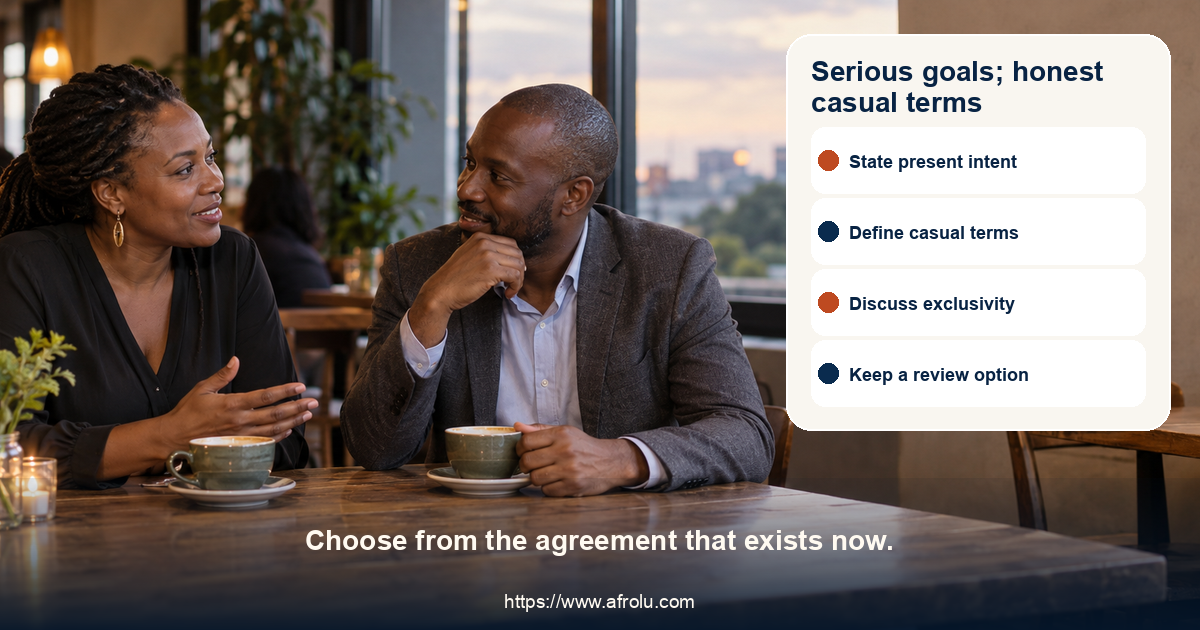
Clarify intent and current status before assuming a future.
Written and edited by Miriam Otieno · Senior Kenya Editor
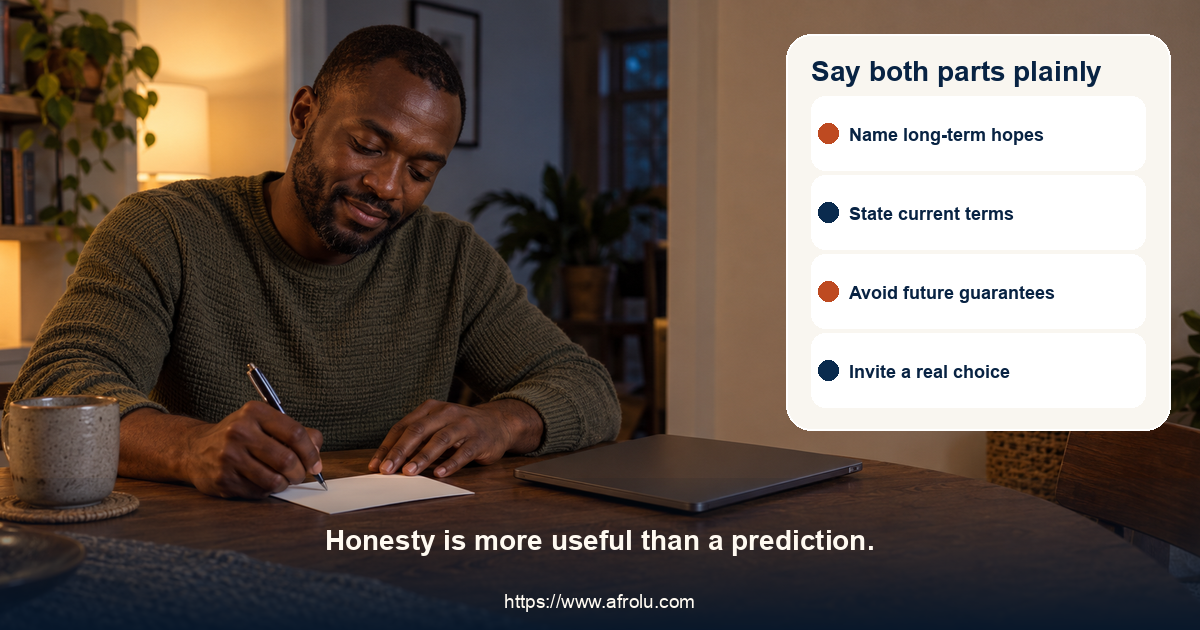
Say what you hope for long term and what you are offering now. Define casual in practical terms such as exclusivity, contact, privacy, sex, and review. Do not imply a particular match will progress. Check workplace policy where a colleague is involved, discuss current consent, and renegotiate or end if the terms stop fitting.
Dating basics · Professionals
How can I be honest about wanting a serious partnership eventually while keeping my current dating arrangement casual?
Serious-goal, casual dating is an arrangement where a person may want a committed relationship in general while choosing a lower-commitment or nonexclusive structure in the present, with honest disclosure and mutual choice.
Dami, 37, works in architecture and wants a lasting partnership eventually. This year, he prefers to date casually and nonexclusively while learning what fits. A match hears the word serious and assumes exclusivity; Dami instead says both parts at the start. They discuss contact, privacy, and when to check in. She can accept the present arrangement or walk away; he cannot promise that this connection will become the future he hopes for.
Professional life · intent · present terms
Let clarity do more work than a label
A serious hope can be genuine while today's arrangement remains casual; each adult needs both facts.
Define the terms, protect work boundaries, and review consent and fit as circumstances change.
What do you hope for?
Describe a future aim without predicting this match.
What is true now?
Discuss exclusivity, contact, privacy, and safer choices.
Is there a professional tie?
Check policy and power before acting on attraction.
Do the terms still fit?
Ask freely, accept a no, or end the arrangement.
intent · present status · meaning
Serious hopes and casual terms can describe different things
Dami hopes to build a committed partnership over time, but right now he wants to date casually and nonexclusively while getting to know people. He says both parts plainly. A match may want the same arrangement, may prefer exclusivity sooner, or may decide the uncertainty does not suit her. Each answer is valid information.
Ask which decisions the label changes: whether either person is dating others, how often they meet, whether sex is part of the arrangement, what privacy means, and what would prompt a review. A person who says serious but avoids these practical questions may not be offering the clarity the word seems to promise.
Do not treat casual as careless or serious as morally better. Adults can want different structures and still act with kindness, safer-sex care, and respect. Compatibility depends on whether the agreement is honest and mutual, not whether the relationship follows one approved ladder from dates to exclusivity to partnership.
A useful check is to describe the arrangement without either label and ask whether the other adult recognizes it: “We meet when schedules allow, we are not exclusive, and we will talk before changing that.” If the description surprises them, slow down. Agreement should be based on shared understanding, not on whichever meaning makes the conversation easiest.
disclosure · choice · timing
Give the other person enough information to decide freely
Dami tells a new match, “I would like a lasting partnership eventually, but I am currently dating casually and seeing other people. I cannot promise that this connection will become exclusive.” She can ask what the other adult wants too. The conversation gives them a real choice before either person plans around an assumption.
You do not need a dramatic confession or a long defense. Use a direct sentence, answer relevant follow-up questions, and let the other person take time. If they need a different arrangement, do not bargain by offering an unearned timeline. A respectful mismatch is better than keeping someone invested in a possibility you cannot guarantee.
If your intent changes, update the agreement before acting as though the status changed automatically. Wanting more does not make the other person owe exclusivity; wanting less does not erase commitments already made. Ask whether both people want to revise the terms and specify when any new boundary begins.
Disclosure can be brief and still leave room for questions. Avoid framing your hope as a test the other person must pass, and do not ask them to prove they are relaxed by accepting terms they dislike. Give them time to think, and treat a decision to leave as a reasonable response rather than a negotiation opening.
frequency · exclusivity · expectations
Casual dating works better when the practical terms are visible
Dami and his match agree they are not exclusive, will share relevant changes that affect safer-sex choices, and will not expect daily messages. They decide to check in after a few more dates. The terms do not guarantee comfort forever; they give each person a starting point and permission to revisit what no longer fits.
Discuss payment and logistics without assuming the person with a more senior job should cover every date. A casual arrangement still benefits from an affordable plan, independent transport, and clarity about cancellations. Do not lend money, share account access, or accept a financial role as proof that the connection is becoming serious.
Privacy also needs a practical definition. Decide whether photos may be shared, what friends or coworkers can be told, and whether either person expects to meet family. A low-commitment arrangement does not authorize public disclosure or secrecy that isolates someone from all support. Make the boundary mutual where possible.
It can help to separate a preference from a promise: “I usually prefer one planned date a week” is different from guaranteeing availability during a busy season. Revisit logistics when travel, deadlines, or caregiving change. A flexible arrangement still needs notice when plans shift; casual is not a reason to leave the other person waiting without an update.

Discuss timing, cost, privacy, and a check-in together.
professional boundaries · time · reputation
Protect work relationships even when attraction starts at the office
If Dami is interested in a colleague, he can make one low-pressure invitation outside a work task and accept a no or nonresponse without repeating the request. If either person supervises the other or controls assignments, pay, or evaluation, pause and check the policy before proceeding. Professional power can make an apparently casual invitation difficult to refuse.
Keep client information, internal documents, work schedules, and private messages out of the dating conversation. Do not use a company directory or calendar to track a person's availability. A relationship ending should not become a reason to affect someone's work, circulate personal details, or pressure colleagues to take sides.
If you choose to date, agree how you will handle shared meetings and personal contact during work hours. Make a plan for changing the arrangement if one person ends it. The goal is not to hide an inappropriate dynamic; it is to preserve agency, confidentiality, and fair treatment for everyone who relies on the professional relationship.
A workplace invitation should also leave a clean path back to ordinary collaboration. Keep it separate from performance conversations, make clear that declining will not affect assignments or access, and do not repeat the invitation after a no. When the power imbalance cannot be removed or policy is unclear, choosing not to pursue the connection may be the safest professional decision.

Check policy and let each person decline freely.
consent · safer sex · privacy
Casual does not mean unclear consent or casual care
Before physical intimacy, Dami asks what feels comfortable and shares his own limits. Either adult can pause, decline, or change their mind. A past date, a casual label, flirtation, payment, or earlier agreement does not decide what someone wants now. A respectful response to a boundary is more useful than a claim that casual means no feelings.
If partners are seeing other people, agree what changes should be shared and when. The purpose is informed choice, not surveillance or a demand for names. Nobody needs to provide screenshots, messages, or a list of partners to prove honesty. Discuss the specific information that affects boundaries, health decisions, or a mutually chosen agreement.
Do not save, forward, or show intimate images without permission. If a partner threatens exposure, keeps contacting you after an ending, or uses workplace power to obtain access, save relevant evidence if safe, stop engaging, use platform or workplace reporting where appropriate, and seek local specialist help. Support routes vary by country.
A health conversation can focus on the choices each person is making now: barriers, testing discussions, and what would change the agreement. Nobody should be pressured to disclose a diagnosis or provide proof as a condition of basic respect. For personal risk questions, a clinician can give guidance suited to a person's circumstances and location.

Ask in the moment and respect a changed answer.
consistency · fairness · boundaries
Measure a casual arrangement by honest conduct, not its label
Dami notices that he is doing all the planning and that his match expects exclusivity while still calling their arrangement casual. He asks whether the terms have changed. They discover they want different things. He can acknowledge the mismatch and end the dating connection without claiming that casual dating itself was the problem.
Pay attention to double standards: one adult expects notice about other dates but refuses to share their own status; one wants privacy while posting the other person publicly; or one expects work favors because the relationship is casual. Clarify the request and decide whether the agreement remains fair to both people.
If you want more commitment, say so without presenting patience as a way to earn it. If you want to continue casually, do not accept exclusivity in practice while denying it in words. Each adult can renegotiate or leave. A clear no protects time and emotional energy better than silently hoping that a label will change itself.
Look at the pattern across ordinary moments, not one polished conversation. Does each person follow through on plans, acknowledge a boundary, and share relevant changes? If an imbalance keeps recurring, name the specific behavior and ask whether it can change. A label cannot compensate for a pattern that leaves one adult carrying the uncertainty alone.
check-in · changing intent · exit
Give a changing connection an honest review, not an implied deadline
Dami says he is beginning to want exclusivity and asks whether his match wants to explore that change. She does not. He can choose to end rather than remain casual while hoping she will change her mind. Her answer is not a failure, and his preference is not a reason to pressure her.
If both people choose to revise the terms, state what changes, when it begins, and how you will handle other dates or communication. Do not use a vague phrase such as “we are basically together” to imply an agreement that has not been made. Specific language makes room for real consent and fewer later disputes.
When ending, keep the message clear and proportionate. You can say the current arrangement no longer fits and that you are ending contact. You do not owe a debate about whether casual dating is good or bad. Protect work, account, and intimate information; block or report if contact becomes threatening or unwanted.
A check-in is most useful when both people can answer honestly without a penalty. Avoid scheduling one as a countdown to commitment or treating continued dates as evidence that the other person has agreed to more. If the answer is uncertain, decide what uncertainty you can freely accept today, then make your own choice instead of assigning a deadline to someone else.
Eight moments where serious hopes and casual terms diverge
A long-term hope is heard as a promise
One adult says they want partnership someday; the other assumes this match will become exclusive.
Name what is hoped for and what is agreed today.Casual terms arrive after attachment
A person waits several dates to mention that they are meeting others.
Share relevant present terms early enough for the other adult to choose.Different contact expectations go unnamed
One person wants daily messages; the other prefers planned calls twice a week.
Describe a workable rhythm and ask if both can accept it.A job title becomes an automatic bill assignment
A match expects the professional with a senior-sounding role to pay for every date.
Agree on costs without guessing anyone's income or obligation.A colleague invitation includes a power imbalance
One adult controls assignments or review for the person they want to date.
Check workplace policy and avoid using professional authority.Casual is used to justify posting a private photo
A person shares an image without asking because they are already dating.
Request removal and set a clear sharing boundary.A prior yes is treated as continuing permission
A partner assumes yesterday's choice applies to today's activity.
Pause and ask what each adult wants now.One person wants exclusivity and the other does not
Both have feelings but prefer different present arrangements.
Renegotiate freely or end instead of bargaining for a future promise.Fourteen signs that the agreement is mutual and current
Serious hopes and present casual terms are described separately.
The adults agree whether they are currently dating other people.
A future partnership is not promised as the likely reward for waiting.
Contact frequency is discussed as a practical preference, not a loyalty test.
Both people can decline exclusivity without being shamed.
Date costs are agreed without assumptions about job title or income.
Employer rules and reporting lines are checked before colleague dating.
No one uses work calendars, directories, or client records to monitor a date.
Sexual-health choices are discussed without demanding private records.
Consent is asked about in the moment and can change.
Photos and intimate information are not shared without permission.
Each adult shares the planning and repair work that the arrangement needs.
A changed feeling is raised before new expectations are acted upon.
Ending remains available when casual or serious terms no longer fit.
A practical map for intent, work, and changing terms
| Situation | What it may mean | What to do next |
|---|---|---|
| They want a serious future | That is an aspiration, not necessarily the current status. | Ask what agreement exists today. |
| They say casual | The word may refer to frequency, exclusivity, or future planning. | Ask which practical terms they mean. |
| They are dating others | The information may affect your own choices or health boundaries. | Decide what you need to know and what you do not. |
| They want daily contact | Their preference may exceed your current capacity. | Offer a sustainable rhythm and ask whether it fits. |
| A colleague asks you out | Power, reporting lines, and policy may affect free choice. | Check the employer's current rules before proceeding. |
| They expect you to pay | A professional label does not reveal income or create a duty. | Agree on each date's cost directly. |
| A prior yes is assumed | Consent may not cover a new moment or activity. | Pause and ask for current agreement. |
| They want an intimate photo | Casual dating does not create image-sharing permission. | Decline or discuss explicit limits; do not forward images. |
| I want exclusivity now | Your feelings may have changed while theirs have not. | Ask once and decide whether the answer fits you. |
| I want to end it | A difference in terms is enough reason. | State the ending clearly and keep work and private details separate. |
Twelve scripts for describing a casual arrangement
“I want a committed partnership eventually, but I am currently dating casually and nonexclusively.”
“When you say casual, do you mean nonexclusive, less frequent, or no long-term plan?”
“Are either of us seeing other people, and what information do we want to share?”
“I can usually plan one evening and a weekend date; daily texting is not realistic for me.”
“Would you be comfortable splitting this date or choosing something lower-cost?”
“Because we work together, I want to check policy and power before we decide anything.”
“Please ask before sharing a photo or telling coworkers that we are dating.”
“I want to pause. Are we both comfortable continuing right now?”
“What safer-sex choices would help each of us make an informed decision?”
“My feelings have changed; would you want to talk about exclusivity, without pressure either way?”
“I want a different arrangement, so I am going to step away rather than ask you to promise it later.”
“This casual arrangement no longer works for me. I am ending our dating connection.”
Know the difference
Honest casual terms versus a serious future implied but never discussed
Both adults know whether they are exclusive, what contact and privacy mean, and that either can ask to renegotiate or leave.
One person uses serious language to keep a match waiting while avoiding present questions about dating others, boundaries, or work.
Choose based on what exists now, not a future someone cannot promise.

Look for clear terms instead of reading a future into a label.
Honest current terms versus an implied future
| Type or dimension | What it describes | Best next question |
|---|---|---|
| Casual, exclusive | The adults have chosen casual goals but agreed not to date others. | State how exclusivity works and when it starts. |
| Casual, nonexclusive | Each may date others under an explicit arrangement. | Discuss relevant disclosure and safer-sex choices. |
| Intentional, not exclusive | The adults are exploring fit with a direction but no exclusivity yet. | Ask whether the current uncertainty suits you. |
| Serious partnership | Both want a committed relationship and define the present status together. | Talk about what each expects before using the label. |
| Low-frequency dating | Contact is less frequent, regardless of future intent. | Agree on a rhythm that works for both people. |
| Situationship | Expectations may be unclear or uneven despite emotional investment. | Ask a direct question and decide what you will accept. |
| Workplace dating | Professional duties may shape whether a personal invitation is appropriate. | Check policy and reporting lines first. |
| Private dating | The adults limit what others know by mutual choice. | Define privacy without accepting harmful isolation. |
| Changing intent | One adult wants new terms after feelings or circumstances change. | Ask freely; accept a no or end the old arrangement. |
A simple plan you can use today
Intent is not status
Long-term hope does not establish exclusivity or a promise with a particular person.
Casual needs nouns
Name frequency, dating others, privacy, costs, sex, and check-ins where they matter.
Professional does not mean wealthy
Do not infer income, schedule, or who pays from a job title.
Power changes a work invitation
Check current employer policy and whether either person controls the other's work.
Consent stays current
A label, payment, or prior agreement never decides what someone wants now.
Leaving is an option
A respectful mismatch does not require either adult to keep waiting.
Questions organised by purpose and depth
Choose a few prompts that fit the moment. This is a reference library, not a list to complete.
Intent
Separate general hopes from today's agreement.
- What do I want eventually?
- What am I offering now?
- What should a match know before deciding?
Terms
Name which parts of casual change a real choice.
- Are we exclusive?
- What contact rhythm fits?
- What privacy is mutual?
Work
Keep professional duties distinct from attraction.
- Do we have a reporting relationship?
- What does current policy say?
- Can either person decline freely?
Review
Make room for feelings or circumstances to change.
- When should we check in?
- What if one person wants more?
- Can either of us end without pressure?
What deserves a closer look
Keep aspiration separate from agreement
An adult may want partnership in general while choosing casual dating today. The other person needs both facts to evaluate the actual offer.
Evidence limit: Do not promise that one match will progress if you cannot know that.
Translate the label into decisions
Frequency, exclusivity, contact, privacy, sexual health, and review points can all differ. Discuss the ones that affect either person's choices.
Evidence limit: No one owes a full history or list of partners as proof.
Account for professional power
Reporting lines, performance review, team trust, and employer rules can make a personal invitation harder to refuse.
Evidence limit: A guide cannot replace current policy or qualified workplace advice.
Notice who carries the arrangement
Planning, spending, rescheduling, and emotional labor should be discussable even when the relationship is casual.
Evidence limit: Do not infer someone's salary or job flexibility from their title.
Use current, specific agreement
A date, payment, label, or previous yes does not settle a new physical decision.
Evidence limit: Consent is not owed because someone has waited or invested.
Let changed needs change the choice
Either adult may want more, want less, pause, or leave. Clear words protect both from an implied future bargain.
Evidence limit: The article is not therapy, legal advice, or medical advice.
Shortcuts that turn hope into an assumed promise
Promising a future to obtain patience
A possibility cannot guarantee a later commitment.
Treating casual as self-explanatory
People attach different meanings to the same word.
Waiting to disclose nonexclusivity
The other person may be choosing under a false assumption.
Using work access to create contact
Professional tools and authority can undermine free choice.
Sharing a photo as proof of closeness
Dating does not grant permission to publish private images.
Staying after terms stop fitting
The wish to appear easygoing can hide a real boundary.
Compare serious intent, casual terms, and a clear ending
This is editorial information, not therapy, legal advice, or medical guidance. Seek qualified support for questions that need it.
Explore the guide library
Show more related guides
Continue with Afrolu
Show more Afrolu guides
Sources used for this guide
Afrolu reviewed these health, research, safety, or public guidance resources while editing this page. They support the behaviour and safety guidance; they do not diagnose any individual described by a reader.
Questions about serious goals and casual dating
Can I want a serious relationship and still date casually?
Yes, if you are clear that a long-term hope is not a promise that this match will become exclusive.
Does casual automatically mean nonexclusive?
No. Ask whether both adults are dating other people and what, if anything, has been agreed.
When should I share my intent?
Early enough for the other person to decide whether the present arrangement suits them; do not wait until an assumption has formed.
What does serious mean?
People use it differently. Ask whether it refers to values, exclusivity, future direction, or a committed relationship today.
Should professionals split date costs?
There is no universal rule. Agree on an affordable plan without guessing income or assigning payment by job title.
Can I date a colleague casually?
Workplace policy, power, and reporting lines matter. Check current rules and avoid using professional access to pressure someone.
Does a casual label change consent?
No. Consent remains specific and can change at any time, whatever the relationship label.
Do I need to share my health records?
No. Discuss the specific information and safer-sex choices that help each person make an informed decision; consult a qualified clinician for medical guidance.
What if my feelings change?
Say so and ask whether the other adult wants to renegotiate. Accept a no and decide whether the old terms still work for you.
Can I end a casual connection without a major reason?
Yes. A mismatch in present goals or comfort is enough; communicate clearly and protect private information.
One thing to do now
Choose terms both adults can freely accept
Separate future aspiration from the agreement that exists today. Define the practical terms that affect either person's choices, share relevant changes promptly, and keep work rules, consent, and privacy intact. If one adult wants exclusivity or a committed relationship and the other does not, renegotiate freely or end rather than using a hoped-for future to keep someone waiting.