Parents · long-distance dating · family privacy
Dating as a Parent Across Distance: Privacy, Visits, and Clarity
Parenting across distance? Protect your child's privacy, plan around care, discuss travel costs and intent, and choose when a family introduction makes sense.
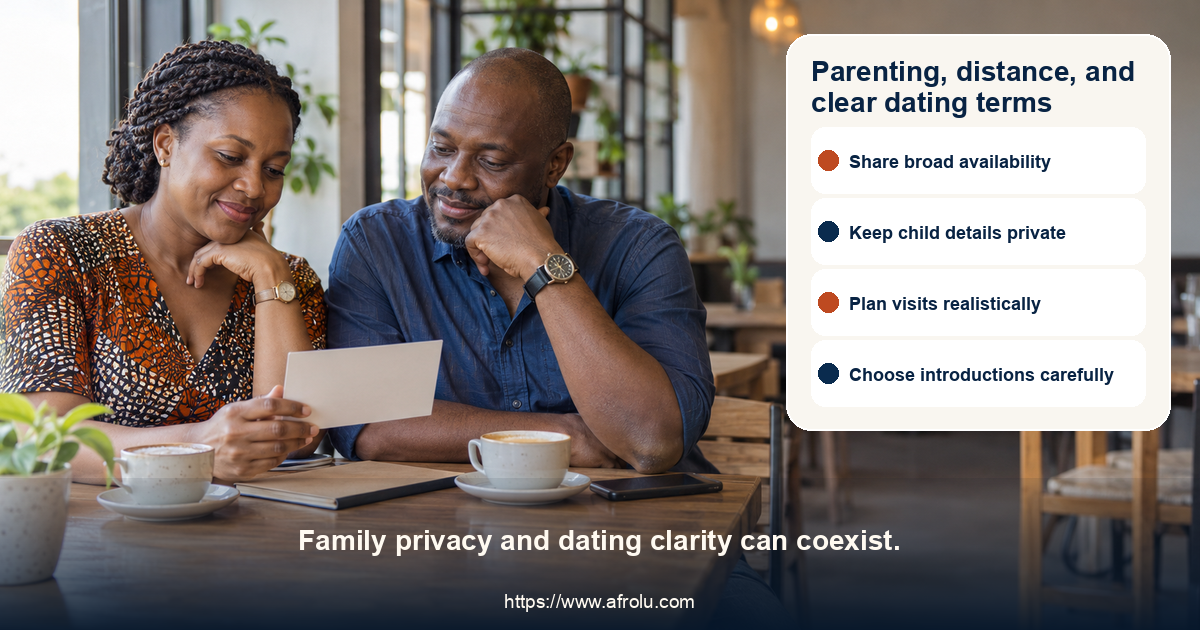
Share practical availability and keep child details private.
Written and edited by Ruth Akinyi · Local Dating Editor
Share the availability and future expectations a match needs to make an informed choice, but keep a child's name, school, images, and detailed calendar private. Plan calls and visits around care with a backup, agree on costs before booking, and keep a partner's role separate from parenting authority. A child introduction is a distinct decision; seek qualified local advice if a legal or safety issue affects it.
Dating basics · Parents Returning To Dating
How can a parent date across distance with clear adult expectations while protecting a child's privacy and care routine?
Long-distance dating as a parent is a relationship arrangement that coordinates adult intent, care responsibilities, privacy, travel, and potential future introductions without treating children as proof of commitment.
Mina, 39, lives in Nairobi and is getting to know Kendi, who works in another city. Mina says she has parenting responsibilities on alternating weekends and can usually call after bedtime on Tuesday, but she keeps her child's name, school, and calendar private. They choose a short public lunch for their first visit and compare costs before booking. When Kendi asks about meeting the child, Mina explains that family introductions are a separate decision she will consider only when the relationship is stable and the child's circumstances support it. Kendi can decide whether that pace fits; Mina does not need to accelerate access or share private information to prove she is serious.
parenting · distance · privacy
Make room for dating without turning a child into the proof
Care schedules and distance can be discussed honestly while a child's identity stays protected.
Clarify adult expectations, plan travel around care, and make family introductions a separate choice.
What does a date need to know?
Share availability, not a child's identifying routine.
What window can you keep?
Choose a dependable call time and backup.
Are care and costs confirmed?
Plan a visit before spending or making promises.
Is a child meeting appropriate now?
Decide separately from exclusivity and pressure.
digital privacy · child identity · consent
A dating profile should not make a child searchable
Mina uses a profile photo of herself at a public garden rather than a family picture. She describes parenting as part of her life but keeps school, pickup times, and her child's face private. If a match asks for photos of the child, she says no and changes the subject; she does not need to prove that parenting is real.
Review privacy settings on the dating service and connected social accounts. A profile may be screenshotted or copied even when the platform offers controls. Avoid linking accounts that expose a child's name or location, and do not share live location, school pickup plans, or a weekly care calendar with a new match.
Do not ask a child to keep a new relationship secret, gather information about a date, or reassure an adult about a developing connection. Those are adult responsibilities. If the relationship becomes stable enough for an introduction, plan it around the child's comfort and family context rather than treating access as a reward for the dating partner.
If private information or an image is shared without permission or used to pressure you, keep evidence if safe and use the platform's reporting controls. Kenya's official digital-support pathways can change, so check current information rather than relying on a copied phone number or an old social post. Seek qualified local help where the situation warrants it.

Let the adult relationship develop without exposing a child's identity.
co-parenting · authority · boundaries
A dating partner does not automatically become a parenting partner
When Mina's date asks when he can meet her child, she says she is not planning an introduction yet. She first wants to understand their compatibility and discuss what a gradual introduction would mean. The answer may disappoint him, but it is a boundary about a child's stability, not a measure of how much Mina likes him.
If another parent or guardian is involved, avoid using a new date to send messages, provoke jealousy, or negotiate care. Keep communication about a child in the appropriate channel and consult a qualified adviser if a legal order or safety concern affects a proposed introduction. This guide cannot interpret a particular custody agreement or family-law question.
Do not make a child responsible for approving, rejecting, or keeping a relationship alive. An age-appropriate introduction, if and when chosen, can be brief and low-pressure, with no demand for affection or an immediate family label. Adults should be ready to explain changes and answer questions without asking the child to protect adult privacy.
A partner who respects the pace may still ask about the eventual role they could have. That conversation belongs between adults and can remain open while the relationship develops. If someone insists on unsupervised access, immediate authority, or secrecy from other trusted caregivers, pause and seek independent advice before proceeding.
care calendar · time zones · contact
Plan calls and visits around dependable windows, not ideal weeks
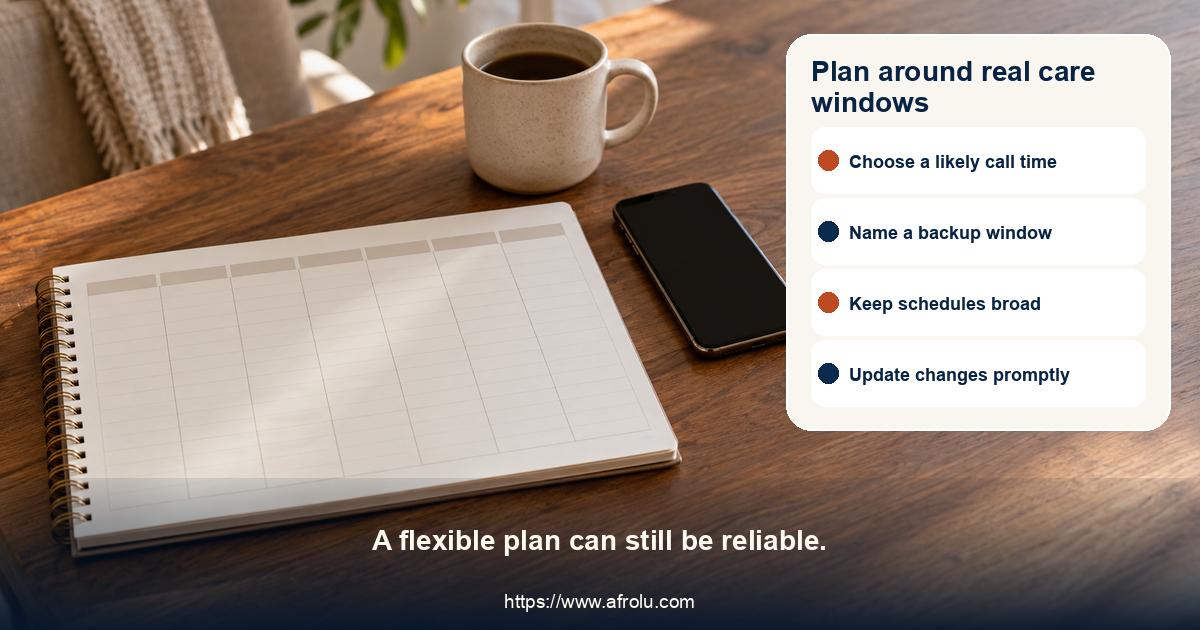
Mina and her match agree to a video call on one weekday after bedtime when circumstances allow, with a message if that evening needs to move. They also name a backup weekend. The arrangement gives both adults a reasonable expectation without suggesting that a parent can guarantee uninterrupted time or should neglect a child's needs to keep a date.
If you live in different time zones, name the local date and time for each adult and confirm who will initiate. A phrase such as “after dinner” may mean different things when one person is managing school routines and another has an evening shift. A calendar invitation can coordinate the date without revealing a child's detailed schedule.
If contact is frequently interrupted, discuss a format that is easier to keep: a shorter call, an occasional voice note, or a check-in after a known busy period. Do not promise constant messages to compensate for distance. A reliable plan respects both the parent's caregiving and the other adult's need to know whether a date is still happening.
Notice whether flexibility is reciprocal. The parent may have less control over exact timing, while the long-distance partner may carry more travel or time-zone adjustment. Acknowledge those differences, plan together, and revisit the balance. Neither person should have to compete with a child for attention or erase their own work and rest to appear committed.
travel · childcare · money
A visit should fit the budget without turning childcare into leverage
Mina and her match compare two possible weekends and find that a short public lunch is more manageable than a full trip. Mina confirms her care arrangements independently before committing; she does not ask the date to pay a caregiver or assume that the child can simply travel too. The plan can change if those arrangements do not hold.
Be clear whether a contribution is a gift, a shared cost, or a loan, and do not let a payment create an expectation of intimacy, access to a home, or influence over parenting. Avoid sending money to someone you have not met or sharing bank access. If a financial commitment is significant, seek independent advice rather than relying on a romantic promise.
A first meeting should leave each adult with an exit. Meet in a public place, keep separate transport or accommodation when possible, and avoid making the trip depend on a new partner's home or car. Tell a trusted person the broad plan if helpful. These steps preserve choice; they do not guarantee safety or replace local support.
Care costs and travel time may not be evenly distributed. The parent may need to arrange cover and the visitor may spend more hours in transit. Discuss what each person can offer without comparing sacrifices as a score. If the only workable plan repeatedly creates stress for one adult, pause or redesign it instead of borrowing or hiding the burden.

Protect essentials and confirm arrangements independently.
introductions · child wellbeing · gradual change
An introduction is a separate decision from becoming exclusive
Mina tells her date that she would consider an introduction only after they have agreed on what it is and how to keep it low-pressure. She does not promise a specific month before she knows how the relationship develops. Her date can decide whether that uncertainty works for him; Mina does not have to accelerate family contact to prevent a mismatch.
If an introduction happens, consider a brief daytime activity in a setting that feels ordinary to the child. Do not expect a child to show affection, use a family title, or keep secrets. Let the child return to their routine and give them a trusted adult to speak with if they feel unsure. The dating partner should respect the parent's boundaries.
Families differ in what introductions mean and what coordination is appropriate. If there are safety concerns, legal orders, or unresolved co-parenting arrangements, seek qualified local advice before changing access. A guide cannot determine what is permitted in a particular family. Keep the child out of adult disagreements and avoid sharing legal papers with a date.
Pay attention after the meeting too. A partner's kindness toward a child does not automatically make them a safe caregiver, and one awkward moment does not require an immediate label. Continue to supervise appropriately, check how the child experienced the interaction, and make later choices based on time and observed conduct rather than pressure.

Discuss timing without treating family access as proof of commitment.
compatibility · review · ending
Choose a relationship plan that respects the parent's whole life
After several months, Mina and her partner review how often they can meet, what travel costs they can share, and whether they want the same future. They still do not agree on when a child introduction would happen. They can set another check-in if both freely prefer that, or acknowledge the gap and end without blaming the child or the distance.
Watch for repeated pressure to cancel care, disclose a child's details, prove affection through money, or provide access before you are ready. Also notice your own limits: perhaps the travel, schedule changes, or distance no longer fits. Describe the specific issue, ask whether a practical adjustment is possible, and give each adult room to answer honestly.
If the relationship ends, keep the message between adults and do not ask a child to carry updates or comfort a former partner. Protect the child's images and routines from public breakup posts. If a former date keeps contacting you or threatens to expose private information, document what is safe to retain and use current local support and platform reporting.
Choose the next step from the arrangement that exists: continue with one clear adjustment, set a review date, pause travel during a demanding care season, or end. Parenting is not a reason to accept poor treatment, and dating is not a reason to neglect a child. A sound decision can respect both realities without promising certainty neither adult has.
Eight moments where dating plans meet parenting and distance
A match reads a care calendar as disinterest
Mina cannot take a call during a school or bedtime routine.
Share a dependable window and agree how to reschedule.A new date requests a child's photograph
The request arrives before trust or a child introduction is appropriate.
Decline and keep the child's image off the dating channel.A partner expects to negotiate directly with the other parent
A new relationship is being treated as authority over an existing care arrangement.
Keep adult roles distinct and seek qualified advice if needed.A visit is booked before care cover is confirmed
The parent may be pressured to improvise childcare or bring the child.
Confirm arrangements independently before committing.A travel contribution becomes leverage
The paying partner expects access, intimacy, or a parenting decision in return.
Clarify gift, shared cost, or loan and reject conditions on consent.Meeting the child is used as proof of commitment
One adult wants a child introduction before the parent feels ready.
Explain that family contact is a separate decision and set a review point.An evening call repeatedly conflicts with care
The adults have not agreed on a workable local-time window.
Name both local times and choose a realistic backup.A breakup message is sent through the child
An adult asks a child to deliver an update or comfort a former partner.
Keep the conversation between adults and protect the child's routine.Fourteen signs that adult expectations respect family privacy
Parenting responsibilities are described truthfully without making a child searchable.
A new date receives schedule context but not a full identifying care calendar.
Children's names, faces, school details, and regular routes stay private early on.
A dating partner is not promised automatic caregiving or decision-making authority.
Any child introduction is a separate choice from exclusivity.
A child is not asked to keep adult secrets or approve a relationship.
Calls and visits have a workable plan plus a way to update changes.
Local dates and times are confirmed when partners live in different time zones.
Travel and care coverage are confirmed before money is spent.
Each adult keeps enough independence to change or leave a first visit.
A financial contribution does not buy access, intimacy, or family authority.
Co-parenting communication stays in the appropriate adult channel.
Both people can discuss the future without using a child as leverage.
A relationship ending is handled by adults without involving the child as messenger.
A map for time, travel, child privacy, and changing expectations
| Situation | What it may mean | What to do next |
|---|---|---|
| I have limited weekends | Care responsibilities shape when a visit is realistic. | Share a broad availability pattern and propose a window. |
| They ask to see my child's photo | They may be curious, but identity sharing is optional. | Decline and explain your privacy boundary. |
| They want to meet my child now | Their preferred timing may differ from your family decision. | Say what would need to be true before an introduction. |
| A care plan changes | The original call or visit may no longer be workable. | Update the date and offer a realistic alternative. |
| Travel feels too expensive | The trip may compete with essentials or care costs. | Choose a smaller plan or wait; do not borrow under pressure. |
| They offer to pay for care | The gift may create expectations unless terms are clear. | Discuss whether it is a gift and keep your decision independent. |
| Time zones keep disrupting calls | The adults may be using vague local-time language. | Confirm both dates and times and name a backup. |
| My co-parent objects | There may be family or legal circumstances the guide cannot assess. | Keep the child out of conflict and seek qualified advice if needed. |
| I want more commitment | A future wish may not match current agreement or readiness. | Discuss adult expectations without promising child access. |
| I want to end the relationship | A mismatch can be sufficient without blaming parenting. | Tell the adult directly and protect the child's privacy. |
Twelve scripts for protecting family boundaries across distance
“My care schedule limits some weekends; I can usually talk on Tuesday after 8 p.m.”
“I am dating intentionally, but I want to let the relationship develop before making family introductions.”
“I do not share my child's name, school, or photos with someone I am newly dating.”
“Tonight's care plan changed, so I need to move our call. Could Thursday work?”
“Could we confirm the date and local time for both of us before we book the call?”
“Meeting my child is a separate decision, and I am not ready to plan that yet.”
“I handle parenting communication directly with the other caregiver; I will not ask you to negotiate it.”
“I need to confirm care coverage and my own transport before I commit to a visit.”
“Let's list the travel and accommodation costs and agree what each of us is choosing to cover.”
“If an introduction happens, I want it to be brief and low-pressure for my child.”
“Can we check in next month about distance, visits, and what each of us wants?”
“This arrangement no longer works for me, so I am ending our dating connection.”
Know the difference
Clear adult dating plans versus a partner being folded into parenting too soon
The parent shares relevant availability, protects the child's identity, confirms care and travel, and chooses separately when an introduction is appropriate.
A date expects a child's photos, immediate introduction, caregiving authority, or influence over co-parenting as evidence of commitment.
A dating agreement can grow without making a child part of the proof.

Notice whether the parent keeps space to decide about introductions.
Clear adult roles versus rushed access to a child
| Type or dimension | What it describes | Best next question |
|---|---|---|
| Weeknight call | Less travel but can conflict with bedtime or shifts. | Choose a backup window and confirm local time. |
| Weekend video date | Keeps distance manageable while care routines remain private. | Share a broad availability window, not a child's calendar. |
| Public day visit | Allows an in-person meeting without a child introduction. | Agree on a short public plan and independent transport. |
| Long weekend | Adds accommodation, care coverage, and missed-work costs. | Confirm every adult's arrangements before booking. |
| Alternating visits | Travel may be uneven because time and budgets differ. | Discuss effort over several visits rather than scoring one trip. |
| Child introduction | Changes the family context and is not just another date. | Wait until the parent decides it is appropriate and plan gently. |
| Shared holiday | Can create pressure to combine households too quickly. | Discuss expectations and separate alternatives before agreeing. |
| Relationship review | Distance and parenting needs may change with time. | Name contact, travel, privacy, and a date to revisit them. |
| Pause or ending | A caring connection may still not fit current family life. | Communicate adult decisions without using the child as messenger. |
A simple plan you can use today
Relevant honesty
Share what changes a partner's choice without exposing a child's identity.
Access is not automatic
Dating, exclusivity, and a child introduction are distinct decisions.
Care changes plans
Build a realistic backup instead of promising uninterrupted availability.
Distance has real costs
Include travel, accommodation, work time, and care coverage.
Money creates no entitlement
A gift or ticket does not purchase intimacy, authority, or access.
Legal details need qualified advice
This guide cannot interpret an individual custody order or family-law situation.
Questions organised by purpose and depth
Choose a few prompts that fit the moment. This is a reference library, not a list to complete.
Disclosure
Share the facts that affect today's dating choice.
- What availability should a match understand?
- Which child details stay private?
- What future expectation needs an honest answer?
Distance
Make contact plans fit care and local time.
- Which call window is dependable?
- What is the backup?
- How will we update a change?
Visits
Protect care, money, and independent options.
- Is care coverage confirmed?
- Can each adult afford the plan?
- How will I arrive and leave?
Introduction
Keep family contact separate from romance labels.
- What would make a meeting appropriate?
- How can it stay low-pressure?
- Do I need qualified advice first?
What deserves a closer look
Share availability, not a child's dossier
A new partner may need to understand when you can meet and what future planning involves, while a child's name, school, images, or routine remain private.
Evidence limit: Do not hide a current commitment that would change the other adult's choice.
Treat family contact as its own decision
A parent can date seriously without arranging immediate access; a gradual meeting should account for the child's comfort and family context.
Evidence limit: There is no universal date count or timeline for introductions.
Keep parenting authority distinct
A romantic partner does not automatically assume a caregiving role or gain authority over an existing arrangement.
Evidence limit: Consult a qualified adviser about a specific legal order or dispute.
Plan for a calendar that can change
Care, work, and travel can shift; a backup call window and honest update can protect both adults from avoidable guessing.
Evidence limit: A parent cannot guarantee uninterrupted access.
Make travel contributions explicit
Define who pays which costs and whether a transfer is a gift, shared cost, or loan before booking.
Evidence limit: Financial support does not create consent or decision-making rights.
Keep the child out of adult relationship repair
A breakup or disagreement should be communicated by the adults, with the child's information and routines kept private.
Evidence limit: Seek current local support if contact becomes threatening.
Shortcuts that make a child carry adult dating pressure
Sharing a child photo as proof
A date does not need an identifying image to believe you are a parent.
Promising a meeting date too early
An introduction depends on a child's context and the relationship's stability.
Sending a full care calendar
Detailed routines can reveal a child's location and predictable schedule.
Letting a ticket create an obligation
Travel spending does not create consent or family authority.
Using the child to test a date
Children should not be asked to validate an adult relationship.
Asking a child to carry a breakup
Adult news and conflict belong in an adult conversation.
Set a call window, agree on travel costs, or clarify a family boundary
This guide is general editorial information and cannot interpret a custody order or replace qualified legal, health, or emergency support.
Explore the guide library
Show more related guides
Continue with Afrolu
Show more Afrolu guides
Sources used for this guide
Afrolu reviewed these health, research, safety, or public guidance resources while editing this page. They support the behaviour and safety guidance; they do not diagnose any individual described by a reader.
Questions about parenting, privacy, and long-distance dating
When should I tell someone I am a parent?
Share enough context for an honest decision about availability and future expectations. You can do that without giving a child's name, school, photos, or detailed care schedule.
Should I put my child in my dating profile?
That is your choice, but consider whether a picture, location tag, or routine could identify the child. A new match does not need a child's image to understand that parenting is part of your life.
When should a date meet my child?
There is no universal timeline. Consider the relationship's consistency, the child's circumstances, and any family or legal context; get qualified local advice if a specific order or safety issue applies.
Does exclusivity mean my child should meet my partner?
No. Exclusivity and a child introduction are separate decisions with different consequences.
How can long-distance parents schedule calls?
Share broad dependable windows, confirm local dates and times, and agree how to reschedule when care or work changes.
Who should pay for visits?
There is no one arrangement for every couple. Discuss travel, accommodation, missed work, and care costs directly, and protect essentials before booking.
Should I let a new partner help with childcare?
Do not assume a dating partner is ready or appropriate for a caregiving role. Keep authority clear and make any later decision based on time, trust, and the child's context.
What if my co-parent disagrees with an introduction?
The facts and any legal arrangement matter. Keep the child out of conflict and consult a qualified local adviser rather than relying on a general dating article.
Can I share my child's routine to explain my schedule?
Usually a broad availability description is enough. Avoid sending identifying calendars, school routes, or location details to a new match.
How do I end a long-distance relationship as a parent?
Communicate with the adult directly, avoid using a child as messenger, and keep the child's photos and routines private during the change.
One thing to do now
Choose a plan that respects the parent's whole life
Be honest about the care constraints that affect dating while limiting details that identify a child. Build a contact rhythm with a realistic backup, confirm care and costs before travel, and keep parenting authority distinct from romance. Decide about introductions separately and based on the family context; use qualified local advice where a legal order or safety concern matters. Review or end the adult relationship without involving a child as messenger.