Six separate doors for adult commitment and protected family life
Build Serious Nairobi Dating Around Family Clarity
A Nairobi parent guide to serious dating intent, exclusivity, childcare, home and child privacy, money, consent, scripts and introduction decisions.

Open the adult relationship door before considering any separate door into family life.
Written and edited by Miriam Otieno · Senior Kenya Editor
Use six separate doors. Define serious direction, agree the present adult relationship, protect realistic time, keep the household operationally independent, choose each form of adult access separately and treat child introduction as a later family decision. Confirm public plans before care costs, share general availability rather than children's routines, retain transport and payment, keep home, child data and money private, and observe what follows a no. Serious words become credible through ordinary reliability, repair and patience—not accelerated access.
Relationship intent · Parents Returning To Dating
How can a parent build a clear serious relationship in Nairobi without treating exclusivity, household access and child introduction as one automatic progression?
Serious parent dating clarity is a mutually understood adult relationship direction and structure that develops through observable conduct while childcare, household privacy, children's information, money, consent and any future introduction retain separate safeguards and decision points.
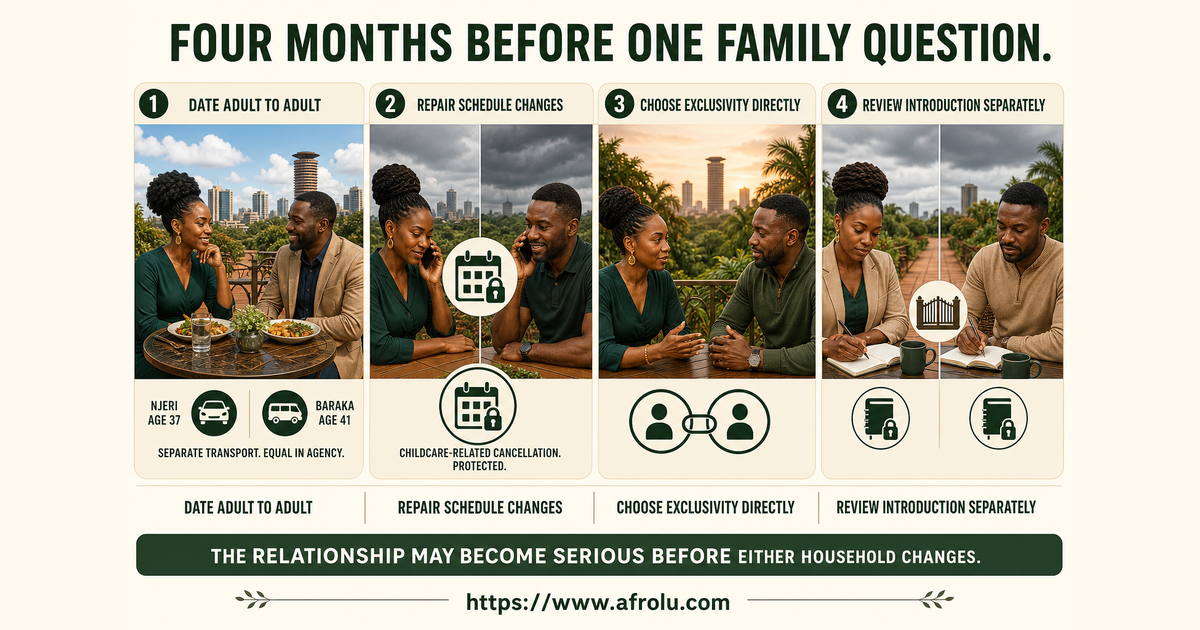
Njeri and Baraka are fictional Nairobi parents, 37 and 41. Over four months of public adult dates, they protect child information and independent care, repair two scheduling disruptions and define exclusivity without sharing devices, money or homes. They later begin a separate introduction review, with no date or outcome promised.
The six-door clarity courtyard
Build adult commitment where family privacy never becomes proof of love
Miriam separates serious relationship direction from every operational and emotional doorway into a parent's household.
The courtyard reviews six doors, follows four months of adult evidence and ends with a seven-ring family protection plan.
Adult direction
Define serious and choose the present relationship structure together.
Time and household
Protect care, schedule, address and child information.
Access and evidence
Keep money, devices, home and consent separately controlled.
Family review
Consider introduction only through a fresh suitability decision.
Begin with the adult relationship
Serious direction can be clear while the household remains protected
A parent in Nairobi may want a lasting partnership and still keep early dates entirely adult, public and separate from family systems. Serious describes direction and, later, a relationship agreement. It does not mean a new person needs the home address, children's names, schools, photographs, care arrangements or financial details. Those disclosures carry different consequences from an adult conversation about partnership and should follow necessity, trust and the parent's safeguarding judgment rather than romantic urgency.
Parenting can make clarity more important, not less. Limited availability, care costs and household responsibilities mean vague plans transfer real consequences. State what serious means to you: exclusivity, a future partnership, marriage, companionship, shared faith or another direction. Ask the other adult for their own definition. Then describe only the present stage. A first month of public dates can be serious-minded without being exclusive or integrated into either home.
Children are not participants in early adult dating. They should not be used to test chemistry, approve a match, carry messages, keep secrets or supply emotional leverage. This guide does not prescribe one introduction timetable for every family. Age, history, support, law, safety and the individual child's needs matter. It does insist on a separate decision: stable adult conduct must exist before a parent considers whether any introduction is suitable.
Clarity also protects the date. A new partner should not be recruited into childcare, transport, school contact or household finance to prove seriousness. They deserve an honest description of availability and direction without being given responsibilities they have not earned or chosen. The adult relationship can grow through plans, repair, conversation and consent while every family system continues to stand on its established support network.
Walk the six-door clarity courtyard
Every door needs its own reason, evidence and two-person decision
The direction door asks what future each adult is willing to explore. The agreement door asks what exists now: dating, exclusivity, partnership or another mutually described structure. Serious future language cannot open exclusivity without two present answers. Exclusivity itself cannot open devices, finances, homes or bodies. Define what the agreement includes and which access decisions remain outside it so that warmth does not silently broaden the contract.
The time door acknowledges real parenting capacity. Share a general window and confirmation deadline rather than a detailed care schedule. If suitable care changes, cancel or offer one alternative without disclosing the child's movements or blaming them for the disruption. A respectful match may have their own limits and may decline. Compatibility includes whether both adults can sustain the rhythm without extracting unpaid planning, care costs or constant apology from one person.
The household and adult-access doors protect address, property, devices, money, work, social networks and physical consent. Meet publicly until the evidence supports a different choice. Keep independent transport and payment. Do not exchange financial records, property documents, passwords or intimate images as proof of serious intention. Consent remains specific and current. A date, gift, exclusivity talk or family hope creates no physical permission.
The introduction door is not the final square on a romance board. It asks a new question: would changing the child's environment serve the family now? Consider the stability and conduct of the adult relationship, the child's needs, co-parenting or legal context and appropriate support. An introduction should not solve adult uncertainty or reward impatience. If the relationship remains healthy while the door stays closed longer, that patience is useful evidence.
Njeri and Baraka date across four months
Ordinary reliability gives serious words somewhere to stand
Njeri, 37, and Baraka, 41, were fictional Nairobi parents seeking long-term partnership. They began with public lunches arranged around broad availability. Neither shared children's names, schools, images or exact routines. They discussed what serious meant: both wanted exclusivity if fit developed and hoped for a committed partnership, while neither promised marriage or family integration at the beginning. Separate transport, payment and homes kept each meeting easy to leave.
In the second month, Njeri cancelled when a trusted care arrangement changed. She informed Baraka early, protected the reason and offered two later dates. Baraka accepted one without asking who provided care or suggesting he could step in. A week later he missed a confirmation deadline and repaired by proposing a complete alternative before Njeri incurred any cost. Their responses to disruption showed whether family realities could be respected without one person disappearing inside them.
They chose exclusivity after a direct adult conversation. They defined it as not dating or having sex with others and agreed to discuss relevant health decisions. It did not include phone inspection, live location, home keys or access to accounts. When Baraka asked about meeting Njeri's child, she said the relationship was not ready for that decision. His willingness to continue building the adult relationship without bargaining became further evidence of patience.
After four months, each parent reviewed the relationship with trusted support. They had seen consistent public conduct, one conflict and repair, compatible direction and respect for household limits. They began a separate conversation about whether any future introduction might be suitable, with no date promised. Another family might wait longer, decline entirely or seek professional guidance. The sequence mattered more than the month count: adult evidence first, family decision later.
Compare words, conduct, patience and pressure
Serious language is one input, not the whole household decision
Serious words can be useful when they are specific. ‘I want a committed partnership’ is clearer than ‘I know you are the one’ after little evidence. Ask what the words mean today, what remains undecided and what behaviour the person expects from themselves. Love-bombing is not diagnosed from enthusiasm alone, but accelerated certainty that repeatedly seeks home, child, financial or physical access deserves a smaller plan and a direct boundary.
Adult reliability appears in mundane conduct: confirming before care costs, keeping public plans, accepting limited availability, paying an agreed share and repairing mistakes without requesting private family detail. It is not perfection. A parent may need to change a date, and a non-parent may have equally real schedule constraints. The question is whether both adults communicate, offer alternatives and carry the consequences fairly instead of making one household absorb every disruption.
Household patience means the relationship can grow without recruiting children or family systems to prove it. A patient adult does not request school pickups, send messages through a child, arrive uninvited at home or pressure the parent to post photographs. They can discuss future hopes while accepting that introductions, caregiving and household access follow a separate suitability decision. Patience is not passive waiting; it is active respect for a boundary that protects other people.
Access pressure changes the task. Urgent money, property questions, password demands, private venue switches, monitoring, threats or punishment after no are not evidence of serious love. Preserve relevant records, restrict affected systems and use platform, financial, legal, advocacy or emergency support appropriate to the facts. Where safe, one concise boundary may clarify a misunderstanding. You do not need to run an experiment after a severe incident to justify protection.

Read the relationship claim, the ordinary evidence and the cost imposed on family life as separate facts.
Speak through one door at a time
Clear adult sentences protect the relationship from family assumptions
For intention, say: ‘I am looking for a committed partnership, and I am still learning whether we fit.’ This communicates direction without pre-assigning a role. Ask: ‘What does serious dating mean in your life now?’ Listen for specifics rather than a performance of certainty. If one adult wants casual dating, that honest answer may reveal incompatibility. It is not automatically deception or danger, and no parent needs to negotiate their core direction into something smaller.
For structure and time, say: ‘We are not exclusive until we both agree what that means.’ Then add: ‘I can offer Saturday afternoon if we confirm by Thursday.’ General availability is enough. You do not owe a new match the child's care provider, school activity or co-parenting arrangement. If care changes, ‘I cannot make Saturday; I can offer next weekend’ protects the family and gives the other adult a usable choice.
For household and money, use complete limits: ‘My home and children's information stay private while dating is new.’ ‘I do not lend, invest, share property records or change beneficiaries as proof of commitment.’ Serious financial conversations may happen as trust grows, but access, transfers and legal changes require time and independent professional advice. A romantic conversation cannot substitute for due diligence.
For consent and introductions, say: ‘I am not choosing physical contact now,’ and ‘A child introduction will be a later family decision, not a date milestone.’ Neither sentence needs apology. If the relationship becomes stable, revisit the introduction door with the relevant family context and support. If the other person responds with guilt, spiritual claims, threats or attempts to contact the child indirectly, close access and prioritise safeguarding.

Clarity names the current adult agreement and keeps every household decision separately voluntary.
Protect the family centre
Seven rings keep adult progress from destabilising essential systems
The adult-relationship ring contains dates, conversations, affection and the agreement the adults have chosen. The care ring remains with established suitable caregivers and support; a new match should not become an early babysitter or school pickup. The schedule ring reveals only what one date needs. This separation prevents the connection from gaining operational power over the household before stable adult conduct exists.
The home and child-data rings protect addresses, access codes, school details, photographs, health information and regular movements. Ask before any photo, introduction or public post. Even proud or affectionate sharing can create a persistent digital record outside the child's control. Use privacy settings, but remember that a platform control cannot guarantee an image will not be copied. Necessary disclosure should be deliberate and minimal.
The money ring covers essential household funds, property, debts, insurance, beneficiaries and business interests. Do not transfer money for a romantic emergency or combine finances to prove seriousness. If the relationship later reaches genuine shared planning, use independent legal and financial advice suited to the jurisdiction and facts. A promise of family future is not verification of an investment, illness, travel need or ownership claim.
The introduction ring opens only through a fresh suitability decision. Review the relationship's duration and stability, how conflict is repaired, the person's respect for boundaries, the child's circumstances and any co-parenting or legal considerations. Plan a limited, age-appropriate context if you decide to proceed, without asking the child to approve the romance. Continue monitoring; one meeting does not permanently open home, care or authority.

Expand only the ring supported by stable conduct; keep all other rings intact.
Use stages without a relationship conveyor belt
Each stage answers a different question and may remain closed
A first public meeting answers whether another conversation feels worthwhile. Regular adult dates show planning, public conduct and capacity. An intention talk reveals future direction. An exclusivity conversation can define present structure. None of these stages proves character or family fit alone, and none grants private access. The value comes from accumulating ordinary evidence while every adult remains able to revise or stop.
Conflict and repair deserve their own stage because early harmony may not show how difference is handled. Observe whether the person acknowledges impact, accepts a limit and changes conduct. Trusted-network contact may offer context, but it is not background verification and should happen with permission. Do not publish the relationship or recruit friends, colleagues or relatives into surveillance. Social approval cannot replace the parent's judgment or the child's interests.
Home access is a high-impact stage. Consider address privacy, belongings, keys, digital systems, routines and whether either adult can end the visit safely. A serious partner may eventually spend time at home, but there is no proof deadline. Home access does not make someone a caregiver, disciplinarian or financial authority. Those roles, if ever appropriate, need further agreements and should not arise from repeated convenience.
Introduction review is not a finish line. The outcome may be ‘not yet’ even inside a healthy committed relationship. It may also be ‘no’ when the adult relationship does not fit the family context. Continue when patience and conduct support the next separate choice. Revise the plan when logistics or timing are the issue. Close when the relationship direction conflicts or when any person's safety, privacy or agency is repeatedly reduced.
Eight Nairobi parent moments where serious direction and family access must stay separate
A match speaks about marriage in week one
The direction may be sincere, but little ordinary conduct has been observed.
Ask what serious means now and keep access unchanged.A trusted childcare plan falls through
The parent cannot complete the date without destabilising family needs.
Cancel early and offer one realistic alternative if desired.A date asks which school the child attends
The detail is unnecessary for the adult plan.
Keep names, locations and routines private.Both adults want to stop dating others
They have not yet defined what exclusivity includes.
Agree scope and keep devices, home and money separate.Private dinner is called easier for a parent
Convenience would reveal the household and weaken the public exit.
Choose another public plan or decline.A business investment is framed as family commitment
Romantic direction is being used to bypass independent checks.
Transfer nothing and seek separate professional advice.A partner says four months should be enough
A calendar claim is replacing the family's separate suitability decision.
Keep the door closed and review evidence, not pressure.Adult conduct remains stable after a boundary
The relationship is committed and the parent wants to consider a next family step.
Begin a separate introduction review without promising an outcome.Signs that serious words are supported by reliability and household patience
{'label': 'Direction', 'title': 'Serious language is specific and conditional', 'detail': 'The future is discussed without assigning ownership.', 'reading': 'Clear'}
{'label': 'Agreement', 'title': 'Exclusivity receives two adult answers', 'detail': 'It is not inferred from time, sex or family hope.', 'reading': 'Mutual'}
{'label': 'Schedule', 'title': 'Parenting capacity is accepted', 'detail': 'A general window is enough to plan the adult date.', 'reading': 'Respectful'}
{'label': 'Care', 'title': 'Childcare remains independently suitable', 'detail': 'The match is not recruited into early family operations.', 'reading': 'Protected'}
{'label': 'Home', 'title': 'Public plans do not become private shortcuts', 'detail': 'Address and household access expand deliberately.', 'reading': 'Bounded'}
{'label': 'Children', 'title': 'Names, images and routines stay limited', 'detail': 'Curiosity never outranks privacy.', 'reading': 'Necessary only'}
{'label': 'Money', 'title': 'Household resources remain separate', 'detail': 'No transfer or property access proves commitment.', 'reading': 'Independent'}
{'label': 'Consent', 'title': 'Every adult no remains complete', 'detail': 'A serious label never becomes physical entitlement.', 'reading': 'Voluntary'}
{'label': 'Repair', 'title': 'Disruptions receive changed conduct', 'detail': 'The next plan carries the apology.', 'reading': 'Observable'}
{'label': 'Introduction', 'title': 'Family timing is not bargained', 'detail': 'Patience continues while the separate decision remains closed.', 'reading': 'Suitable'}
Choose the next step from the six-door clarity courtyard
| Situation | What it may mean | What to do next |
|---|---|---|
| Is serious direction specific? | Fits: Both adults can describe the future they seek. Needs review: One term needs definition. Stop: Certainty is used to claim the person or family. | Ask what serious means today. |
| Is the present agreement mutual? | Fits: Structure and exclusivity have two answers. Needs review: One assumption needs discussion. Stop: Contact or sex is called automatic commitment. | Define the current adult relationship. |
| Does timing fit both lives? | Fits: Plans respect parenting and other adult duties. Needs review: The format needs resizing. Stop: One household absorbs every disruption. | Set a confirmation line and fair alternative. |
| Does care stand alone? | Fits: Established suitable care supports the date. Needs review: The plan must be rescheduled. Stop: The match becomes early childcare or pickup. | Separate dating from care operations. |
| Is household data necessary? | Fits: Only general adult availability is shared. Needs review: One intrusive question needs a limit. Stop: School, address, images or routines are pursued. | Restrict data and affected access. |
| Is home access proportionate? | Fits: Public plans continue until trust supports change. Needs review: Convenience is creating pressure. Stop: Private access is demanded or bypassed. | Keep the home closed and use a public plan. |
| Are money and property independent? | Fits: Household resources remain outside romance. Needs review: A future discussion needs professional advice. Stop: Urgent transfers or ownership access are requested. | Transfer nothing and verify separately. |
| Can consent change? | Fits: A no stops the request without punishment. Needs review: One misunderstanding is repaired. Stop: Serious intent, gifts or faith overrides choice. | End pressure and seek support if needed. |
| Is introduction a separate decision? | Fits: Family suitability is reviewed independently. Needs review: More adult evidence is needed. Stop: Children are used to test or secure the romance. | Close the introduction door. |
| What does the whole pattern support? | Fits: One adult or family step is proportionate. Needs review: Continue adult dating without new access. Stop: Family privacy, stability or agency shrinks. | Continue, hold, revise or close. |
Scripts for intention, exclusivity, care, home, child data, money and consent
“I want a committed partnership, and I am still learning whether we fit.”
“We are not exclusive until we both define and choose it.”
“I can offer Saturday afternoon if we confirm by Thursday.”
“My care arrangement is separate from dating; if it changes, I will reschedule.”
“I do not share children's names, schools, photos or routines while dating is new.”
“My home remains private; we can meet at the confirmed public place.”
“I do not lend, invest or share property records as proof of commitment.”
“I am not choosing that physical step, and I need the request to stop.”
“Meeting a child will be a later family decision, not a dating milestone.”
“Our direction or family boundary does not fit, so I am ending the relationship.”
Know the difference
The Nairobi-parent serious dating access-stage map
Direction, exclusivity and reliability belong to the adults in the relationship. They can deepen through explicit agreement and repeated conduct.
Home entry, child information, money and introductions are separate gated decisions. A relationship label opens none of them automatically.
Commitment can grow while the household stays unchanged; open each family door only on its own evidence and permission.

Relationship depth, exclusivity, home access and child introduction are different decisions.
Compare eight adult and household stages without automatic access
| Type or dimension | What it describes | Best next question |
|---|---|---|
| First public adult date | ||
| Regular public dates | ||
| Serious-intent talk | ||
| Exclusive adult relationship | ||
| Conflict and repair | ||
| Trusted-network contact | ||
| Adult home access | ||
| Child-introduction review |
Build serious parent dating clarity in six moves
Define serious
Choose adult structure
Protect family operations
Keep access granular
Observe repair and patience
Review introduction separately
Questions for adult direction, household systems, evidence and introductions
Choose a few prompts that fit the moment. This is a reference library, not a list to complete.
Adult-direction questions
Define serious before adding family meaning.
- What future am I seeking?
- What does commitment mean now?
- Are we exclusive?
- Which values must align?
- What remains undecided?
Household questions
Keep family systems independently functional.
- Does care stand alone?
- Which details stay private?
- Is the home still protected?
- Does money stay separate?
- Can the date end cleanly?
Evidence questions
Read conduct after ordinary disruption and no.
- Are plans confirmed?
- Does repair change behaviour?
- Is availability respected?
- Does no remain usable?
- Is patience still active?
Introduction questions
Run a separate suitability review.
- Is the adult relationship stable?
- What does this child need?
- Which legal context matters?
- What limited format may fit?
- Is not yet the right answer?
What family, child-data, scam and consent guidance can support
New dating partners should not become early caregivers
American Academy of Pediatrics guidance for single parents cautions against asking new friends or partners to watch children and recommends experienced caregivers. The narrow dating application is to keep childcare independent from a developing romance.
Evidence limit: The source is U.S.-based; family, legal and support circumstances differ, and qualified local guidance may be needed.
Adult dating and child introductions are different stages
AAP guidance after divorce says children do not need to meet every person a parent dates and discusses introductions when a serious relationship develops. Afrolu uses the distinction without imposing one universal month count.
Evidence limit: The source cannot decide what is suitable for a particular child or replace local clinical, safeguarding or legal advice.
Children's information needs deliberate protection
Kenya's Office of the Data Protection Commissioner publishes guidance on processing children's data. In dating, minimise names, images, school details, addresses and regular movements, and do not use disclosure as proof of openness.
Evidence limit: This page is not legal advice and does not determine duties for a particular parent, platform or organisation.
A child's interests remain distinct from adult romance
The UN Convention on the Rights of the Child provides an international child-rights framework, including privacy and best-interests principles. A parent relationship decision should not erase the child's separate interests or turn them into evidence for the adults.
Evidence limit: International principles do not decide an individual family arrangement or replace applicable local law and support.
Family-future stories can be used to press money
The U.S. Federal Trade Commission describes romance scammers who build trust and later request travel, medical or investment money. Keep household funds, property information and credentials outside a new or unverified relationship.
Evidence limit: FTC reporting and remedies are U.S.-specific; use appropriate Kenyan or other local financial, platform and legal channels.
Serious intention never supplies physical permission
Healthdirect explains consent as knowingly and freely agreeing and notes that it can be withdrawn. Exclusivity, gifts, family hopes, care costs or an earlier yes cannot decide another physical or digital act.
Evidence limit: Healthdirect services and legal context are Australia-specific; local health, legal and emergency resources vary.
Six ways serious dating can open family doors too early
Use a reviewed resource that matches the decision
This guide focuses on the relationship decision, so it does not rank dating apps. Check current prices, safety tools, and local availability before choosing a service.
Explore the guide library
Show more related guides
Continue with Afrolu
Show more Afrolu guides
Official family, child-rights, privacy, scam and consent sources
Afrolu reviewed these health, research, safety, or public guidance resources while editing this page. They support the behaviour and safety guidance; they do not diagnose any individual described by a reader.
Serious dating clarity questions for Nairobi parents
What does serious dating mean for a parent in Nairobi?
It means an adult relationship direction or agreement aimed at lasting partnership, as the adults define it. It does not automatically include exclusivity, home access, financial merging or child introduction. Name the future direction, current structure, practical pace and every family boundary separately.
How soon should I tell a serious match that I have children?
Share the fact when it is relevant to availability, values or relationship decisions, but protect names, schools, photographs, health details, addresses and regular movements. A serious adult can understand that parenting shapes capacity without receiving a family map. Timing depends on context; safety and necessary disclosure remain central.
When should a serious partner meet my child?
There is no universal date count. Treat introduction as a separate family decision after stable adult conduct, compatible direction and respect for boundaries are established. Consider the individual child's circumstances, any co-parenting or legal context and qualified local support where appropriate. Do not use an introduction to test the romance.
Should a new partner help with childcare?
Keep early dating and care separate. Use caregivers who already meet the parent's standards; if care is unavailable, reschedule. A long-established relationship may eventually support different choices, but caregiving requires its own suitability, consent and safeguarding judgment rather than serving as proof of romantic commitment.
Does exclusivity make home visits appropriate?
Not automatically. Exclusivity is a relationship agreement about other partners as the adults define it. Home access affects address privacy, belongings, routines and exit. Choose it separately when trust and circumstances support it, and keep keys, devices, child contact and financial authority outside that choice unless independently agreed later.
How can parents handle last-minute schedule changes?
Communicate early, protect the child's private details and offer one realistic alternative if you want to continue. The other adult may decline. Set confirmation deadlines before care costs when possible. A repaired disruption differs from repeated vague planning that leaves one household absorbing all cost and uncertainty.
What family details should stay private while dating is new?
Keep children's names, images, schools, health information, care providers, pickup permissions, home address and regular movements restricted. Share general availability and relevant values instead. If someone repeatedly pursues unnecessary family data or contacts a child, school or caregiver directly, reduce access and seek appropriate support.
Can serious couples discuss money early?
They can discuss values, obligations and broad expectations, but early conversation does not justify transfers, account access, property records, investments, guarantees or beneficiary changes. Keep resources separate and verify claims independently. Use qualified legal or financial advice before consequential decisions.
What if a partner says waiting to meet children proves I am not serious?
Restate that adult commitment and child introduction are separate decisions. A respectful partner may express disappointment but can still accept the boundary. Bargaining, guilt, threats or attempts to bypass you are evidence against expanding access. Protect the child and seek support if intrusion occurs.
How do I end a serious parent-dating mismatch?
Use a concise adult statement that the direction, timing or family boundary does not fit and the romantic relationship is ending. Do not involve children in the explanation or a closure meeting. Remove unnecessary home, digital and financial access; if contact becomes threatening or persistent, preserve evidence and use suitable support.
One thing to do now
Let the adult relationship grow while every family door keeps its own key
Walk six doors in order: adult direction, present agreement, workable time, household protection, specific adult access and separate introduction review. Continue when reliability, repair and patience support one proportional step. Hold or revise when logistics need work. Close when direction conflicts or when child, home, money, consent or safety boundaries are pressured or bypassed.