Parents · household, career and free choice
Dating Red Flags for Parents: Protect Family and Career
Dating red flags for parents: protect children, home, work, money and privacy, spot access pressure, and choose a clear, safe adult-only dating route.
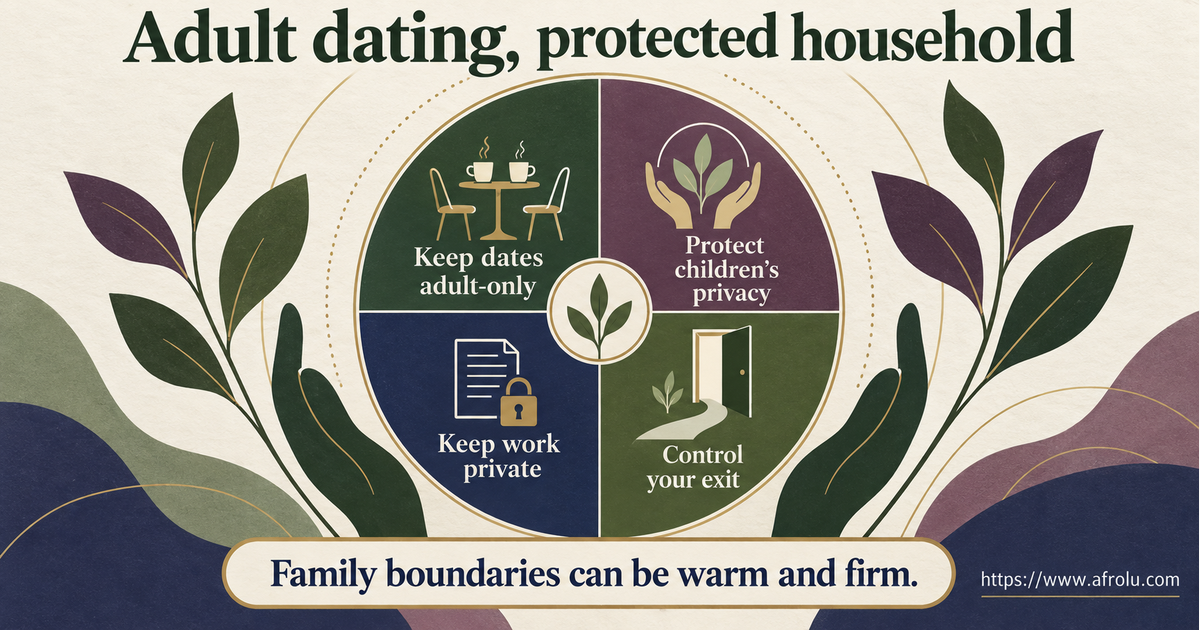
A new date can know you without entering your household.
Written and edited by Miriam Otieno · Senior Kenya Editor
Keep early dating adult-only, public, independently leaveable, and separate from children’s details, home access, work systems, money, accounts, and routine. State one clear boundary and read the response. A repairable question or schedule mismatch may need a conversation; repeated child, household, work, financial, monitoring, indirect-contact, threat, or fear pattern needs reduced access and a safety response.
Dating safety · Parents Returning To Dating
Is this date respecting the adult-only boundaries that protect children, household routines, career, money, privacy, and an independent exit, or is it seeking access that the relationship has not earned?
Dating red flags for parents are observed behaviours that change what access is safe to give while dating, such as repeated pressure for children’s details, home or routine access, workplace information, money, accounts, monitoring, coercion, threats, unwanted contact, or fear. The phrase describes conduct, not a diagnosis of a person or a judgment about all dating after parenthood.
Samira dates as an adult while keeping children, home, work, money, and care routines out of a new connection’s early access. When a date treats those boundaries as a challenge rather than information, she makes the system smaller: public adult-only plans, independent travel, no financial sharing, no work proof, and a clear exit. The response tells her whether the relationship can fit a real household.
parents · household, career and free choice
Samira keeps adult dating separate from the household and career that need her protection
This guide distinguishes respectful curiosity and ordinary mismatch from behaviour that seeks children’s information, home access, professional access, money, routines, or indirect contact before trust exists.
Keep dating adult-only, protect children and work information, read the boundary response, keep money and transport independent, choose a risk-matched ending, and review the stability the relationship leaves around you.
Keep early dating adult-only
Children, routines, home, and family access remain private until trust and a child-centred plan exist.
Keep the firewall intact
Work systems, colleagues, professional contacts, and confidential information stay outside dating.
Keep exits practical
Independent transport, money, accounts, and public plans preserve a parent’s ability to revise a date.
Read the stability left
Continue only where a relationship makes household and career life more workable, not more exposed.
A dating decision can be adult-only and still affect a household
Protect children, routines, work, money, home access, and your own dating choice without making a new relationship answer every family question at once
Dating as a parent does not mean a new person automatically becomes part of family life. Early dates can stay adult-only, public, time-bounded, and separate from children's routines, home access, finances, care arrangements, and private co-parenting information. A warm person may be curious about a parent’s life. A respectful person can accept a broad answer, wait for trust, and understand that a caregiver's availability is not a measure of affection or a promise of future access.
Treat a warning pattern as a concrete act that alters the level of family, work, or personal access you are comfortable offering. One awkward family question or a cancelled date may be repairable. Repeated demands for children's details, pressure to meet them, guilt about care commitments, location or account demands, money requests, workplace intrusion, threats, unwanted contact, or fear are different. They can narrow a parent’s choices and call for a clear limit, less access, or a safety response instead of a more persuasive explanation.
Start with a simple adult-only plan. Samira chooses a public time that does not interrupt her household, keeps her own transport and payment, shares no children’s routine or address, protects work systems, and tells one trusted person a broad plan when helpful. She can say that she is unavailable without disclosing why, and she can leave a connection that treats care or career responsibilities as obstacles to overcome. A relationship worth exploring should make a parent’s life more workable, not ask them to gamble with the people who rely on them.
That approach does not require a parent to hide or apologise for having a full life. It puts the order of access in the parent’s hands: adult conversation first, consistency over time, then only the information or involvement that remains freely chosen and useful. A date who values the person rather than the shortcut can live with that order.
Keep children's lives out of early relationship access
A new date does not need names, images, school routes, custody details, home visits, introductions, or a family role to know whether adult dating has potential
Notice whether a date treats family privacy as a personal rejection. A person may say they would like to understand your life better. That is different from insisting on a video call with children, arriving near a school or home, asking a child to keep a secret, promising a parental role, criticising a co-parent, or using a missed date to compete with care responsibilities. A child is never a relationship test, a route to intimacy, or a source of information for someone still earning trust.
Keep early dating communications separate from household logistics. Do not give a new date access to a shared calendar, door code, childcare provider, family group, school portal, location account, or a person who could be pressured for information. If a date asks you to prove where you are through a child, family member, or home setting, treat the request as an access issue. You can offer a broad return time if you want to coordinate; you do not owe a live view of your household.
If an early connection ends, protect children from adult conflict. Do not ask them to carry messages, monitor social media, deliver belongings, explain a decision, or keep contact secret. If a person continues to contact you through family routes or makes you afraid around a home, school, or routine, reduce access, preserve relevant information when safe, and seek appropriate local, specialist, emergency, legal, health, security, or trusted support. The priority is a stable, safe household, not a perfectly explained ending.
This is also a kindness to children: they do not have to understand an adult’s dating uncertainty in order for you to have a private adult life. Keep the explanation age-appropriate where one is needed, protect familiar routines, and let any future introduction be a deliberate family decision rather than the price of someone else’s impatience.
Build a career firewall alongside a family boundary
Dating does not create permission to enter professional systems, seek information through colleagues, use an employer relationship, or make career access part of intimacy
Do not use work channels to manage dating uncertainty, and do not allow a date to do so. A professional email, LinkedIn message, business number, colleague, workplace event, company car, or office lobby is not a route around silence or a boundary. If a person contacts colleagues, appears at work, threatens reputation, asks for confidential help, or uses a power imbalance to keep access open, treat it as a practical safety concern. The response may need workplace or confidential support, not a private date conversation.
Material power differences deserve an extra pause. A manager, client, supplier, recruiter, direct report, landlord, service provider, school staff member, or anyone who can influence pay, housing, education, childcare, references, visas, assignments, or reputation may create conditions in which a yes is harder to give freely or a no has consequences. A low-pressure dating label cannot remove that imbalance. Seek independent guidance and follow applicable policy rather than hoping personal goodwill makes the situation safe.
Career protection also includes recovery. A parent’s after-work hours may be needed for children, rest, commuting, health, household tasks, or simply quiet. A date who calls these constraints selfish, asks for proof, or expects access during every available minute is not asking for a sustainable connection. You can offer the time you genuinely have. If that does not work for someone, the answer may be a mismatch, not a reason to expose your career or household to more pressure.
If a relationship requires you to be constantly reachable, professionally transparent, or willing to blur policy in order to keep peace, it is already asking too much of a practical life. Sustainable closeness makes room for work boundaries and recovery. It does not turn a parent’s employer, clients, or colleagues into tools for testing affection.

A family boundary should not become another person’s access puzzle.
Read what happens after a family or work boundary
A direct response to a limit often tells you more than early charm, future talk, or a promise to be good with children
Use four questions after a difficult moment. What happened? What did it change for me or my household? What followed my boundary? What action is under my control? For example: 'They asked for my child’s school name; I said I do not share that; they sent three messages saying I was hiding something; I will not answer further questions about the school and will reduce contact.' This gives a parent a clear next step without diagnosing the other person or sharing private family details.
Make room for repair. A date may ask an insensitive question, hear the boundary, apologise, and never ask again. That is different from guilt, repetition, pressure through family or work, financial requests, or a claim that care responsibilities are an obstacle to a relationship. A person can be disappointed by a limited schedule and still respect it. The distinction matters because a parent should not have to turn every ordinary mistake into a crisis, but should not normalise repeated access pressure either.
Avoid becoming an investigator in response. Do not ask children, co-parents, colleagues, neighbours, or friends to monitor a date, and do not use work systems or family networks to bypass their silence. If there is a safety concern, preserve relevant records if safe and seek appropriate support. If the offer simply does not work, choose a short ending. You can leave because the relationship makes household or career life less stable, even before you can explain every motive behind the pattern.
A factual review protects against two unhelpful extremes: treating every uncomfortable moment as a verdict, or explaining away every repeated boundary crossing because the person also has appealing qualities. Focus on the conduct and its effect on access. That keeps a parent’s decision connected to present reality rather than to hope, guilt, or pressure to be endlessly accommodating.

You can protect children and work with one clear sentence.
Keep children, work, and financial resources outside the early bargain
Generosity can be welcome, but it remains free; it cannot buy family access, a home visit, sexual access, care labour, a loan, a work favour, or a future promise
Be cautious with early requests that involve children, work, or a household: a childcare emergency, school fee, rent problem, medical bill, job application, business investment, travel issue, device, verification code, account use, or a request to receive money. A real hardship may be painful, but a new relationship is not a safe reason to merge financial risk. Keep accounts, one-time codes, identity documents, workplace resources, family funds, and children's information private while you decide what is true and what you are willing to do.
A future family conversation should never be used to speed up money. A person can talk about commitment, shared goals, or a blended future without asking you to co-sign, lend, host, transfer, share a lease, reveal an asset, use a professional contact, or make a child’s stability dependent on their promise. The more urgent the request sounds, the more useful it is to pause, verify independently where appropriate, and make no decision while someone is waiting for proof of loyalty.
If you sent money or shared access, focus on restoring control rather than blaming yourself. Contact the relevant bank, provider, platform, account service, or employer support route promptly; secure accounts from a safer device where needed; and ask a trusted or specialist person for help. Do not send more funds, meet privately, or give further household, work, or family details to make pressure stop. A boundary can begin after an error; it does not require you to keep paying for it.
Keeping finances separate is not a statement that every date is dishonest. It is a practical rule that allows generosity, affection, and even disappointment to remain voluntary. The rule becomes especially important when a person points to children, a household need, or a professional opportunity as a reason you should decide more quickly than you otherwise would.
Choose an ending that protects the household and your own adult life
An ordinary mismatch can end with a short message; repeated pressure, threats, unwanted home or workplace contact, stalking, coercion, or fear may need a more protected exit
For repeated pressure, narrow the communication route. If it feels safe, write one boundary, stop sharing availability and household details, review device and location settings, decline a private meeting intended to change your mind, and let one trusted person know the broad situation. You can block a person who continues to call, message, or recruit others. Being a parent does not require you to teach someone else how to respect a no while you manage your household.
For threats, unwanted attendance near home, school, childcare, workplace, or routine places, financial exploitation, coercion, image-based abuse, stalking, retaliation, or fear, move from dating etiquette to safety planning. Preserve relevant information when safe, use account and platform safeguards, and seek appropriate urgent, local, legal, health, specialist, security, workplace, school, or trusted support. A general guide cannot assess immediate danger; seek emergency help if danger is present now.
Afterward, restore the adult-only space of your life as well as family routines. Spend time with people who make you feel grounded, protect sleep and work focus, and resist the pressure to prove that you are still open to dating by reopening a connection that was destabilising. Healthy dating can fit around parenthood and a career, but it does not get to claim the parts of your life that a new date has not earned access to.
A protected ending can be brief and still be fair. Its purpose is not to settle every disagreement or make another person agree with your judgement. Its purpose is to stop access from expanding while you return attention to safety, children’s stability, work, and the people who can support you without crossing your own boundaries.

Choose the next move that keeps household and career access yours.
Review the relationship by the stability it leaves around you
Before offering more time, intimacy, family access, money, or personal information, ask whether the connection supports the routines that make your household and career safe and workable
A steady sign is a date who accepts limited availability, understands why children remain private, leaves professional boundaries intact, makes a public plan, honours an independent exit, and changes conduct after a correction. A caution sign may be a timetable, budget, or hoped-for family pace that does not match yours. A serious sign is repeated pressure, monitoring, money demands, workplace or household intrusion, threats, unwanted contact, or fear. Sorting those levels keeps a practical mismatch from being confused with a safety concern.
Keep any next move proportionate to the life you already steward: perhaps one adult-only daytime meeting, a precise conversation about availability, less frequent contact, no introduction to children, or a firm refusal to mix dating with payroll, accounts, or household resources. You never need to demonstrate commitment by giving a new partner a child’s details, a work route, or access to your home. A compatible relationship can wait while you choose the limits that protect real responsibilities.
Let household, professional, and safety circumstances determine the response. Unwanted sexual contact, stalking, threats, coercion, financial exploitation, workplace retaliation, or fear call for prompt local support rather than more private negotiation. In ordinary uncertainty, continue only where parenthood and work feel more manageable, not more precarious. A worthwhile connection can add care and possibility without recruiting a household into proving that a relationship deserves to continue.
Reviewing this way gives a parent permission to value ordinary stability. You do not have to wait for a dramatic event before deciding a connection costs too much in privacy, time, calm, or safety. A relationship can be unsuitable because it makes your real responsibilities harder to carry, even if its most appealing moments feel intense or promising.
Eight parent-dating moments around family and career boundaries
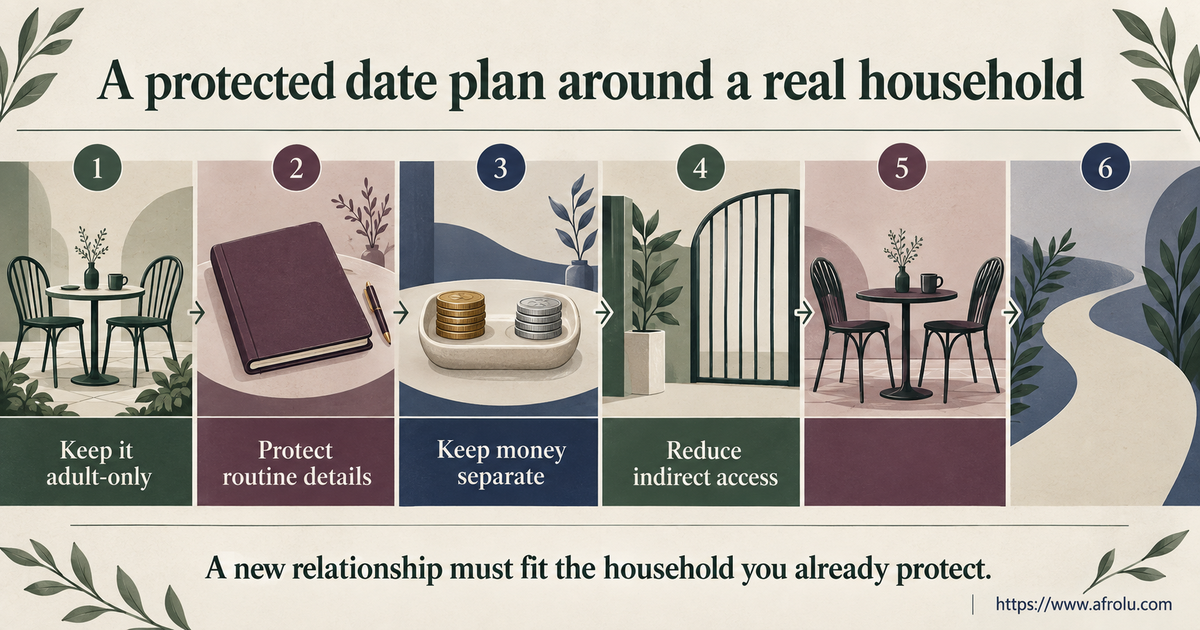
Curiosity becomes a request for child access
A new date asks for school names and pickup times after a parent gives only a broad answer about family life.
The parent says those details are private and watches whether the boundary is accepted without repeat questions.Care responsibilities are treated as a loyalty test
A date demands a same-evening plan and says childcare is an excuse when the parent declines.
The parent keeps the household plan, states the available window, and treats continued guilt as useful information.A family visit is proposed too early
A date says meeting at home is easier because a parent cannot stay out late.
The parent chooses an adult-only public date or no date rather than turning convenience into home access.Professional information becomes relationship access
A date asks for a calendar screenshot and a colleague's contact to prove a work deadline is real.
The parent keeps work systems private and does not use professional channels to soothe dating uncertainty.Urgent money is tied to care
A match asks for a transfer for a childcare emergency and becomes angry when the parent says no.
The parent sends no funds or codes and reduces contact rather than treating urgency as proof of trust.Family and friends are recruited after a boundary
After a slow response, a date contacts a friend to ask why the parent is avoiding them.
The parent asks the friend not to relay information and treats indirect contact as a boundary issue.A clumsy family question receives accountability
A date asks too soon about the children, hears the parent’s limit, apologises, and changes the subject without repeating it.
The parent can treat it as a repairable mistake while continuing adult-only dating.A no is followed by home or workplace contact
After an ending, a date appears near a routine place and sends repeated messages through new accounts.
The parent does not meet privately, preserves relevant records if safe, tells a trusted person, and seeks appropriate support.Signals about children, home, work, money, privacy, indirect contact, and safe exits
They accept adult-only dating and layered family privacy without demanding names, routines, images, or introductions.
They respect a care commitment, work deadline, bedtime, or recovery period without turning availability into a loyalty test.
They make public, bounded plans that preserve independent transport and a way home.
They repeatedly ask for children's school, address, pickup, health, custody, or routine information after a boundary.
They treat a home visit, video call with children, or family introduction as proof that you are serious.
They ask children, co-parents, relatives, friends, colleagues, or neighbours for information about you.
They demand work calendars, employer information, professional access, live location, passwords, or proof of your schedule.
They use a meal, ride, gift, paid activity, or financial help to claim family, sexual, domestic, or emotional access.
They ask for money, codes, documents, workplace resources, housing, or a loan early in the connection.
They can hear a no, apologise for a mistake, and change the pattern rather than finding a new route to the same access.
They contact you through work, school, childcare, family, or new accounts after you ask for space.
They threaten reputation, employment, housing, custody, family relationships, images, or safety to regain access.
They criticise a co-parent, children, career, or support network in ways that isolate you from practical help.
They make you afraid to decline, leave, protect your household, or end the relationship.
Choose a proportionate next move
| Situation | What it may mean | What to do next |
|---|---|---|
| A date asks about your children | Respectful curiosity can receive a broad answer; repeated details requests test family privacy. | Share only what you freely choose and keep children’s identifiers, routines, and access private. |
| A date wants a same-night plan | A request may be ordinary; guilt about care or work responsibilities changes it into pressure. | State the window you genuinely have or decline without a detailed explanation. |
| They offer to pick you up at home | An offer can be kind when declining remains easy and does not require an address. | Meet publicly and arrange independent transport if that preserves choice. |
| They ask for work proof | A broad availability statement should be enough; proof requests can become surveillance or professional access. | Keep systems, colleagues, client information, and calendars private. |
| They mention a family future early | Future interest is not itself unsafe, but it does not decide present family access. | Return to the current adult-only agreement and pace. |
| They request money tied to a household story | Urgency does not make a new relationship a safe financial partnership. | Do not transfer funds, codes, documents, or workplace or family resources under pressure. |
| They contact a friend or relative after a no | Social or family routes are being used to bypass personal consent. | Ask others not to relay information and reduce direct access. |
| They repair a clumsy question | A mistake can be repairable when the boundary is heard, acknowledged, and not repeated. | Choose a modest next step and observe conduct over time. |
| They appear near home, school, childcare, or work | Unwanted attendance near a routine place can be a serious safety concern. | Do not meet privately; preserve relevant information if safe and seek support. |
| You feel fear around family or career access | Fear changes the task from dating clarification to safety planning. | Prioritise a protected exit and appropriate urgent, local, or specialist support. |
Twelve lines for adult-only dating, home, work, money, household privacy, and ending contact
“I do not introduce my children early, and I keep their details private while I am getting to know someone.”
“I am not free tonight. I will make plans only in the time I can genuinely offer.”
“I will meet you there and arrange my own way home.”
“I keep my work calendar, systems, colleagues, and private travel details outside dating.”
“I do not send money, codes, documents, or account access to someone I am dating.”
“Please do not contact my children, family, school, or childcare network about me.”
“I said that information is private. Do not ask again or look for it through someone else.”
“That question was too personal for this stage. Can you respect that and move on?”
“I am slowing this down and will not discuss my family or work details while I think.”
“I am not hosting dates at home. I can choose a public place or leave it for another time.”
“I do not want to continue this connection. Please do not contact me, my family, or my workplace again.”
“I will not meet privately to discuss this. I am getting support and need no further contact.”
Know the difference
Family respect, a real mismatch, and household access pressure are different facts
A date can accept limited availability, adult-only plans, children’s privacy, independent transport, work confidentiality, financial independence, and a clear no.
Repeated details requests, home or school pressure, workplace intrusion, financial leverage, indirect contact, threats, monitoring, or fear make the relationship less free and need a stronger response.
A relationship does not earn family or career access by asking for it more intensely.

Parenthood does not make private access a relationship test.
Separate family respect, mismatch, repair, and access pressure
| Type or dimension | What it describes | Best next question |
|---|---|---|
| Family privacy | A date accepts broad truth and waits for trust before asking for identifiers, routines, or introductions. | Share more only when you freely choose and it serves the household. |
| Family access pressure | A date treats names, routines, home visits, or introductions as proof of seriousness. | Keep dating adult-only and reduce access if a no is not accepted. |
| Care constraint | A parent has limited availability and communicates it plainly. | Offer the time you genuinely have or decline a plan. |
| Loyalty test | A date uses guilt, a surprise, or a last-minute demand to compete with children, work, or rest. | Keep the household plan and treat the response as information. |
| Professional privacy | A date accepts broad work availability without systems, calendars, colleagues, or proof. | Maintain the career firewall. |
| Workplace intrusion | Professional channels, networks, or threats are used to bypass a personal boundary. | Secure access and seek appropriate confidential support. |
| Free generosity | A meal, ride, gift, or paid activity has no later claim on family, home, money, sex, or a future role. | Accept or decline without debt. |
| Financial leverage | Urgent stories or spending are used to obtain money, documents, housing, account access, or loyalty. | Keep finances independent and do not transfer under pressure. |
| Safety concern | Threats, stalking, unwanted routine contact, coercion, or fear need a protected exit rather than another date conversation. | Use appropriate local, urgent, specialist, platform, workplace, school, or trusted support. |
Start with the household and career access you will keep protected
Adult-only early dating is valid
A new connection can grow without access to children, home, routine, or a family role.
Broad truth can be enough
Limited availability and family privacy can be stated honestly without identifiers, schedules, or proof.
Care is not a loyalty test
A partner can be disappointed by a schedule and still respect the people and routines you protect.
Work needs its own firewall
Professional data, colleagues, power, contacts, and channels do not become relationship evidence.
Money needs its own boundary
No gift, emergency, ride, or future family promise creates a debt of access or a reason to share accounts.
Safety can be household-wide
When fear or unwanted contact enters, protect routines and support rather than trying to resolve pressure alone.
Questions organised by purpose and depth
Choose a few prompts that fit the moment. This is a reference library, not a list to complete.
Household audit
Use before giving a new date more access.
- What information protects children and routines?
- What remains adult-only?
- Could I leave the plan independently?
Career audit
Use when a date asks about work.
- What is confidential?
- What broad truth is enough?
- Which professional channel stays unavailable?
Pattern audit
Use after a hard boundary conversation.
- What happened without interpretation?
- What followed my no?
- What action protects stability next?
Exit audit
Use when pressure or fear appears.
- Is a short message safe enough?
- Who can support me confidentially?
- Do I need urgent local help instead of another conversation?
Look more closely at children, home, career, money, networks, and protected endings
Keep family information layered
Share broad truth while protecting names, routines, locations, schools, health, custody, images, and introductions until you freely choose otherwise.
Evidence limit: Every family structure is different; choose the boundary that protects the people in your care.
Make early dating adult-only and leaveable
Use public, time-bounded plans and independent transport rather than home access as a convenience solution.
Evidence limit: A public plan cannot remove every risk or replace local safety choices.
Keep work from becoming relationship access
Protect systems, colleagues, confidential data, professional channels, power, and reputation from dating pressure.
Evidence limit: Workplace policy and support routes differ; seek independent guidance where relevant.
Separate care from financial rescue
Do not let a child, home, work, emergency, gift, or future-family story decide a transfer, account share, loan, or asset disclosure.
Evidence limit: A request is not automatic proof of fraud, but pressure warrants a pause.
Do not let others carry private dating conflict
Ask family, friends, colleagues, schools, and childcare providers not to relay messages or personal details after a boundary.
Evidence limit: Support can still be valuable when it respects confidentiality and safety.
Use a risk-matched household exit
Choose a short ending for mismatch and a protected support-based plan when intrusion, stalking, coercion, threats, or fear emerge.
Evidence limit: Seek urgent local help when immediate danger is present.
Shortcuts that make parent dating less stable or less safe
Introducing children to reduce dating pressure
Children should not carry adult uncertainty or become proof that a relationship is serious.
Explaining every care constraint
A broad unavailable window is enough; detailed routines can create unnecessary household access.
Letting convenience create home access
A late plan, tiredness, or transport issue does not make a home visit a safe first option.
Treating career privacy as a relationship defect
Professional systems, colleagues, clients, and schedules can remain private inside a healthy connection.
Paying to show you are a supportive partner
Money, work contacts, accounts, housing, and family resources can create leverage before trust exists.
Waiting for a group to approve an ending
You can leave a destabilising connection without making children, relatives, friends, or colleagues judge the decision.
Choose one resource that fits the current fact
Use a guide for an adult-only dating boundary or safety question, or a private tool when you need to organise observed conduct before changing access.
Explore the guide library
Show more related guides
Continue with Afrolu
Show more Afrolu guides
Sources used for this guide
Afrolu reviewed these health, research, safety, or public guidance resources while editing this page. They support the behaviour and safety guidance; they do not diagnose any individual described by a reader.
Questions about dating red flags for parents
When should a date meet my children?
There is no universal timeline. Keep early dating adult-only until trust, consistency, intent, children’s wellbeing, and a practical introduction plan make it appropriate for your family.
Do I need to tell a new date why I am unavailable?
No. A broad truth such as being unavailable is enough. You do not owe childcare schedules, family details, work proof, a live location, or household access.
Is it rude to refuse a ride home?
No. Independent transport can make an early date easier to revise. A kind offer remains kind when you can decline it without guilt or consequences.
What if a date wants a video call with my children?
You can decline. A new adult does not need child access to assess an adult relationship, and children should not carry early dating uncertainty.
Should I share my work calendar to prove I am busy?
No. A broad availability statement is usually enough. Keep systems, colleagues, confidential data, client details, and professional accounts outside dating.
Can a new date ask about co-parenting?
A respectful person can ask broad questions and accept a broad answer. Private routines, custody information, conflict, and children’s details remain yours to share only when you choose.
What should I do if someone asks for money for a childcare or work emergency?
Do not send money, codes, documents, workplace resources, or account access under pressure. Pause, independently verify where appropriate, and keep household finances separate.
Can I end a connection by message as a parent?
For an ordinary mismatch, a short direct message can be enough. If household, work, or family access pressure makes you feel unsafe, choose a more protected exit and seek support.
What if a date contacts my friend, family, school, or workplace after I say no?
Treat indirect contact seriously. Ask others not to relay information, preserve relevant records if safe, use account or platform tools, and seek appropriate support if fear enters.
How do I avoid being unfair to someone who likes children?
Focus on behaviour. A person can warmly respect your adult-only pace, family privacy, and care responsibilities. Repeated pressure, access demands, or guilt are the issue, not their stated interest.
One thing to do now
Let new connection fit the household and career you already protect
Choose the smallest next action that protects children’s privacy, home and routine access, work confidentiality, independent transport and money, digital accounts, present consent, support, and a real ability to decline or leave.