Four answers before one Nairobi route
Choose a Low-Pressure Nairobi Dating Type When Beginning Again
A four-answer Nairobi re-entry map: separate meeting route, intention, relationship structure and pace, then plan one safe public date.
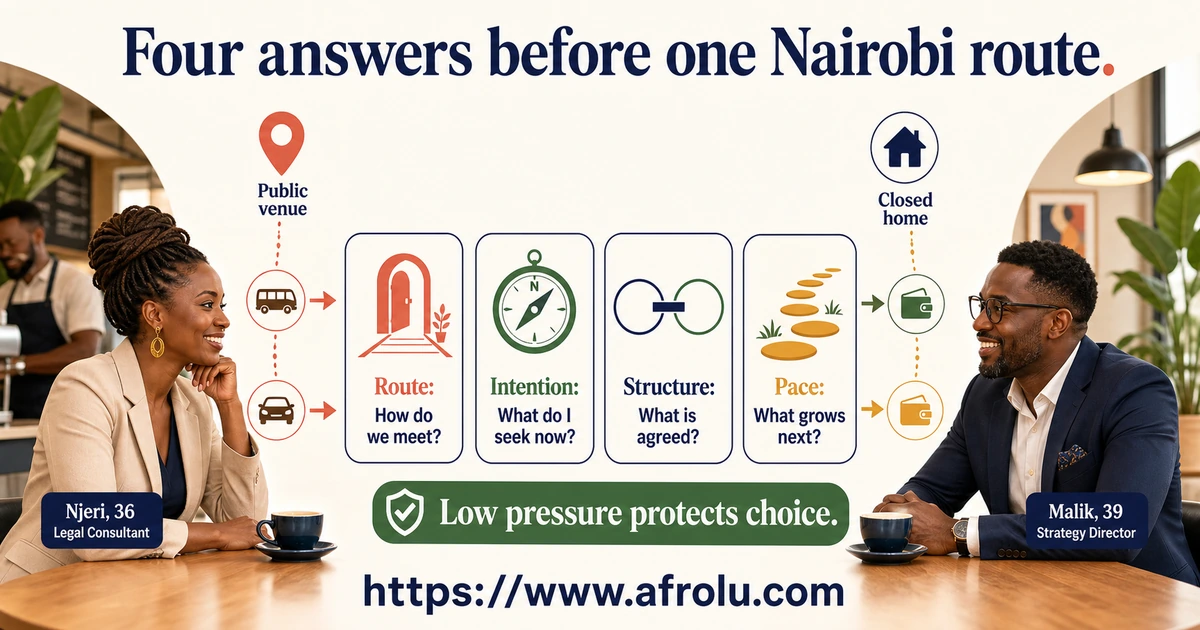
Choose four present answers before a Nairobi date asks for travel, disclosure or commitment.
Written and edited by Clarisse Uwimana · Dating Culture Editor
Separate four answers. Meeting route says whether contact began through an app, introduction, activity or another path. Intention says whether you are exploring, seeking casual companionship or open to lasting partnership. Structure says whether exclusivity or another agreement exists; never infer it. Pace controls messaging, meetings, disclosure, touch, home access and commitment, which may move at different speeds. Wrap those answers in one Nairobi plan: a confirmed public staffed place, limited duration, affordable scope and independent return. Low pressure protects the ability to say yes, no, not yet or a smaller offer. It does not excuse vague plans, forced disclosure, money tests or permanent ambiguity.
Dating basics · New Relationship Starters
Which answer describes how we meet, which describes what I seek, which has been mutually agreed and which controls how quickly access grows?
Low-pressure Nairobi dating re-entry is not one relationship type. It is a decision system for adults beginning again. The meeting route, current intention, present relationship structure and available pace each answer a different question. Nairobi supplies the logistical context of place, time, cost, privacy and return. Low pressure describes freedom around each choice, not the absence of clarity. Several labels may apply at once, and every consequential answer can change only through new shared words and freely chosen conduct.
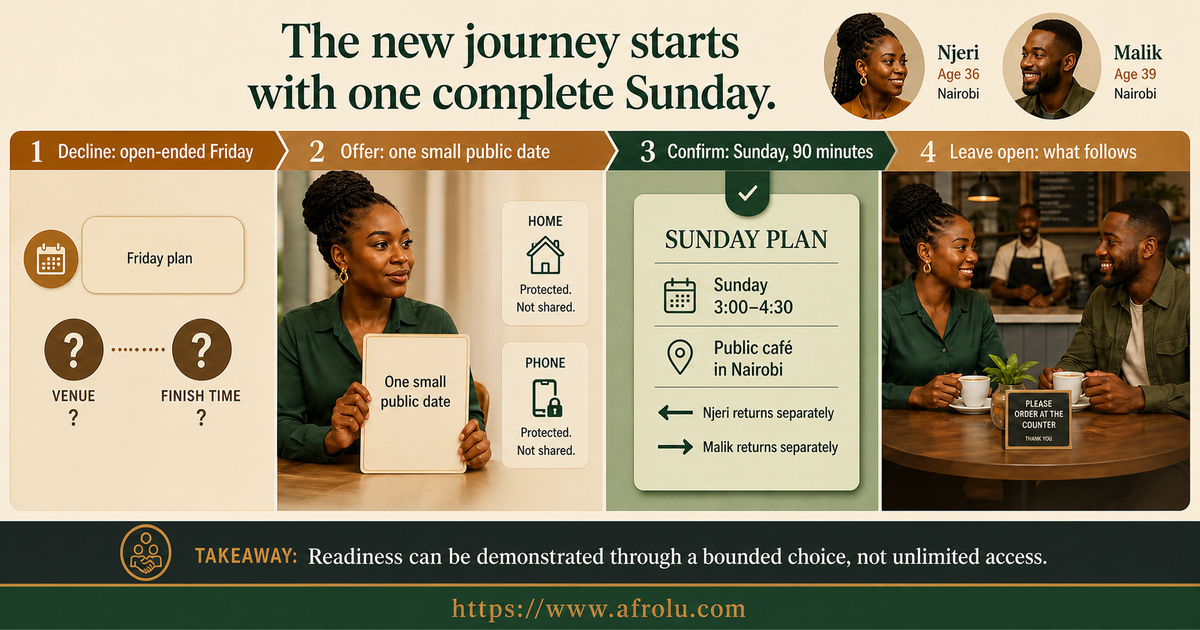
Njeri and Malik are fictional adults. Njeri is 36 and dating after rebuilding her weekly life; Malik is 39 and open to partnership without rushing it. Njeri declines Malik's unfinished Friday invitation and offers one public ninety-minute meeting. Malik later proposes a complete Sunday plan with separate transport. At the date, Njeri says she is exploring and Malik says his eventual direction is serious. They leave exclusivity and a second date open. Njeri reviews capacity, clarity, reciprocity and privacy after returning home, then offers one more bounded meeting because she wants it. Her new journey advances through smaller accurate answers rather than a performance of complete readiness.
The four-answer re-entry map
Make every dating word answer one present question
Beginning again often feels like one large verdict. Clarisse separates the decision into four smaller answers and one practical city wrapper.
The map distinguishes meeting route, intention, structure and pace, then tests only the next public plan while privacy and exit remain protected.
Meeting route
Name how contact began and which public transition works without borrowing trust from the route.
Present intention
State the current range—exploration, casual scope or serious direction—without promising a result.
Relationship structure
Define exclusivity and relevant disclosure in shared words rather than inference.
Available pace
Choose how messaging, meetings, disclosure, touch and access can grow while no remains free.
A re-entry map
Separate the four dating answers before Nairobi logistics become real
Beginning again can follow divorce, bereavement, recovery, relocation, caregiving, a long pause or a simple change of mind. Those histories are not one personality type, and no adult owes a new match a complete explanation. Start with the meeting route: an app, friend introduction, activity, faith community, professional network or chance encounter. The route explains how contact began. It does not establish the relationship's seriousness, safety or likely result.
The second answer is intention. An adult may want light companionship, deliberate exploration, a serious partnership or simply one conversation to see whether dating currently fits. Intent can be honest without being permanent. Say what you are open to now and what you are not promising. Low pressure means the other adult can accept, decline or offer something different without punishment; it does not require either person to pretend that future direction is irrelevant.
The third answer is present structure. Exclusivity, non-exclusivity and relevant disclosure require shared words. They do not arise from frequent messages, a good first date, profile changes, physical intimacy or one person's private hope. If sexual choices become relevant, discuss consent, other partners, testing and prevention before the choice. A new journey deserves current facts rather than an agreement reconstructed afterward.
The fourth answer is pace: how quickly meetings, disclosure, touch, home access, contact and commitment grow. Pace can differ across domains. Someone may enjoy weekly public dates while keeping home and workplace details private. Nairobi logistics then form a practical boundary around all four answers: confirm a public place, cost, time and independent return before travelling. A complete city plan makes the emotional experiment smaller without pretending any setting can guarantee safety.
One bounded beginning
Njeri declines an unfinished Friday and accepts one complete Sunday
Njeri is 36 and has not dated since moving jobs and rebuilding her weekly routine. She is curious about connection but does not yet know whether she wants casual companionship or a serious relationship. Malik is 39 and says he is open to partnership without rushing the label. After several messages, he suggests Friday evening and says they can decide where to go once she is on the way. Njeri notices that a vague plan would require the widest time window and the least control.
She answers with her current offer: one staffed public cafe, ninety minutes, separate travel and no assumption about what follows. She cannot do an open-ended Friday. She does not explain her past relationship, share her home, send live location or apologise for being careful. Malik initially says he likes spontaneity. Njeri leaves the invitation declined rather than negotiating against herself. Low pressure applies to her no as much as it applies to his preferred style.
The next day Malik proposes Sunday from three until four-thirty at a cafe both can identify independently. He asks whether the price range and area work and accepts separate transport. Njeri agrees. At the date, they discuss what beginning again means without treating disclosure as an admission test. Njeri says she is exploring; Malik says he eventually hopes for a committed partnership. They do not convert that difference into instant incompatibility or an invented agreement.
They leave on time and choose no relationship label. Njeri later records four facts: the revised plan was complete, her limits stayed intact, conversation was reciprocal and their intentions need more discussion. She offers one more public date because she wants it, not because accepting Sunday created a debt. Malik can accept or decline. The new journey remains a sequence of small consent-based choices rather than a test of whether Njeri has fully recovered or become fearless.
The practical wrapper
Build the city plan around the adult answer, not the other way around
A usable date invitation names a public staffed setting, meeting time, expected duration and confirmation point. Check the place through a route or listing you find yourself rather than relying only on a pin sent by a new match. Consider daylight, crowd level, accessibility, traffic, weather and how the return works under current conditions. Afrolu does not prescribe a venue or neighbourhood; availability changes, and familiarity for one adult may be impractical for another.
Keep transport under personal control as far as reasonably possible. Do not leave toward a floating destination or depend on the date as the only route home. Preserve fare, charge and a backup, and decide what a late venue change does to the agreement. Saying yes to one cafe does not require travel to a second private setting. A polite person may propose a change; a free answer still includes no, another public alternative or ending the date.
Choose a cost that does not compete with essentials, debt obligations, health, care or safe return. Paying more cannot prove healing, openness or serious intent. Discuss how the immediate bill will be handled before assumptions become leverage. A payment never buys extension, touch, transport, home access or another meeting. If a match requests fare, an emergency transfer, a code or account access before meeting, pause the romantic frame and respond to the financial risk itself.
Privacy can grow by purpose. A date needs the availability and meeting point, not a home address, employer system, identity document, financial record or continuous location trail. Tell a trusted person the basic adult plan and arrange a check-in when useful, while avoiding unnecessary circulation of either person's sensitive data. If threats, tracking, blocked movement, coercion or fraud appear, shift from dating analysis to creating distance, preserving useful evidence when safe and using suitable venue, platform, financial, legal or local support.
What progress looks like
Look for clarity that grows without demanding faster access
Progress can be small and still observable. Plans become complete before travel. Questions receive present answers. A changed plan comes with notice and one usable repair. Each adult sometimes asks, proposes, travels and follows up. A boundary changes the plan without starting a campaign to reverse it. None of these behaviours guarantees a future relationship; together they show whether the current structure is workable enough for another limited choice.
Vagueness is not the same as a slow pace. It appears when consequential questions remain permanently unusable: every date is a maybe, intent changes to match the audience, exclusivity is implied but never stated, or follow-up depends on one person chasing. Low effort is another pattern: the words may sound clear while one adult carries planning, reassurance, spending and repair. You do not need to diagnose avoidance or bad intent to decline an arrangement that keeps transferring uncertainty to you.
Pressure often arrives disguised as proof. A match may ask for a home address to prove trust, a personal history to prove honesty, physical access to prove attraction, instant exclusivity to prove seriousness or spending to prove investment. Replace the proof request with the actual choice. You can be interested and still keep the address private; open to serious partnership and still be non-exclusive today; attracted and still decline touch. If the answer is repeatedly argued with, reduce access.
Also notice your own capacity without turning discomfort into a moral verdict. New dating may use more concentration, recovery time or uncertainty than expected. That can justify fewer messages, shorter meetings, a different route, a pause or an ending. When anxiety, grief or another health concern is persistent, severe or affects broader life, qualified support may help. A dating checklist cannot diagnose readiness, and a match should not become the evaluator of whether you are healed enough to deserve choice.

Measure what became clearer without using speed, spending, home access or constant messaging as proof.
Words for the present
Use short scripts for route, intention, structure and pace
For the meeting route, name the setting you will actually use: a public staffed place for a limited period, with independent arrival and return. If the match prefers home, vehicle or an open-ended evening, the available plans differ. You may offer one alternative without proving why the original setting is uncomfortable. If no shared plan exists, the meeting does not happen yet. Interest does not require movement toward an incomplete destination.
For intention, speak in present-tense range rather than lifetime certainty. You might be exploring slowly, open to a relationship if compatibility develops, or interested only in casual companionship. Ask what the other person is making room for now. A difference can lead to a smaller experiment or a respectful end. Do not promise seriousness to preserve attention or dismiss the question as pressure when the other adult needs it for informed choice.
For structure, ask directly whether either person dates or seeks others and what changes should be disclosed. Do not use the word exclusive until each adult can describe the same agreement. A profile pause, frequent contact or sex is not a substitute. If the answer is not yet, decide what choices remain comfortable under uncertainty. Consent and sexual-health conversations stay activity-specific regardless of the relationship label.
For pace, choose one next step rather than negotiating the whole journey. That may be another short date, a week with less messaging, one status conversation, no home access or a pause. Include a review point when ambiguity has a cost. The other adult can say the pace does not fit. Compatibility is not created by persuading someone to tolerate more speed or more waiting than they freely want.

Ask one decision at a time and leave genuine room for yes, no, not yet or a different offer.
A capacity review
Review twenty-one ordinary days without grading the romantic result
Choose a short window that includes ordinary work, rest and responsibilities. Note whether dating fit without making the entire week revolve around messages or recovery. The aim is not to count contacts or manufacture a streak. Ask whether planned meetings were small enough to remain freely chosen and whether your basic sleep, money, attention and commitments stayed intact. Capacity is a practical input, not a judgment about worthiness.
Review clarity separately. Can you state how you meet, what each adult seeks now, what the present structure is and which pace is available? An honest not yet can be clearer than impressive future language. If one answer remains costly and blank, choose a direct conversation. Do not add disclosure, sex, spending or home access in the hope that the missing words will appear afterward.
Review reciprocity without creating a performance ledger. Did both adults sometimes propose, listen, travel, adapt and repair? Did a no remain intact? Were affordable options respected? A temporary imbalance can have context; repeated one-way work is still information. Ask whether the current connection returns enough knowledge, care or enjoyment for the capacity it uses. The answer need not accuse anyone.
Finally, choose the next size. Continue the same bounded pattern, resize contact or dates, pause while another part of life needs capacity, or leave because the fit is insufficient. A pause is not a manipulation tactic and should not demand that someone wait. A clear ending is not proof that re-entry failed. The review succeeds when it returns choice to the adult from present evidence instead of forcing a romantic outcome.

Review capacity and evidence after a few ordinary weeks, then continue, resize, pause or leave.
Do not merge these labels
Keep meeting route, casual scope, serious direction, exclusivity and slow pace separate
App-based or online-first describes a route into contact. Activity dating describes the setting around a shared task. Casual dating describes a lighter present scope, though adults still need honesty, consent and safety. Serious dating describes direction toward possible lasting partnership. These are not ranked stages. Someone can meet through an app, begin with casual exploration and later decide that serious direction is or is not available.
Exclusive and non-exclusive describe the present structure. They deserve explicit agreement because different adults use the same dating labels differently. Serious intent does not automatically create exclusivity, and casual scope does not automatically make the connection non-exclusive or sexually active. State what applies now, what relevant information should be disclosed and how a change is requested before anyone acts on an assumption.
Slow dating describes pace. It can serve casual, exclusive or serious arrangements. Low pressure describes the freedom around decisions: the ability to decline, pause or offer a smaller step without punishment. Slow and low-pressure often support each other, but neither excuses perpetual vagueness or one-way effort. A measured pace should still create enough evidence for both adults to decide whether the arrangement fits.
Nairobi is the practical context, not a relationship structure. Travel time, public settings, cost, weather, accessibility and return shape which dates are feasible. Avoid turning one neighbourhood, venue or spending level into a character test. The correct question is whether the complete plan works for both adults today while privacy, money, transport and consent stay under their control. Then update each relationship label only when shared words and conduct justify it.
Eight re-entry decisions that keep the four answers separate
Amina moves from messages to one public plan
Amina is 34 and enjoys an app conversation but does not want another week of continuous messaging. She proposes one daytime cafe date and keeps her home, employer and live location private. Moving offline changes the meeting route; it does not create exclusivity, serious intent or consent to anything beyond that meeting.
Name the public plan and preserve every relationship answer for its own conversation.Brian does not outsource trust to the mutual contact
Brian is 41 and meets a match through a friend. He appreciates the context but verifies the venue, controls his return and asks the match directly what she seeks. A trusted introduction can reduce uncertainty about how contact began; it cannot guarantee conduct or make private disclosure obligatory.
Use the introduction as one fact, then make independent adult choices from current evidence.Wairimu keeps exploration honest
Wairimu is 38 and is open to companionship but unsure about a long-term partnership. Her date says he wants marriage soon. She does not mirror that certainty to avoid losing him. They decide one more conversation would not solve the time-horizon difference and close respectfully.
State the present range honestly and let a consequential mismatch remain visible.Otieno asks before changing his choices
Otieno is 36 and has gone on four good dates. His match calls them exclusive although they never discussed it. Otieno pauses the label and asks what it would include, including dating others and relevant sexual-health disclosure. Warmth becomes a reason for a direct conversation, not evidence that it already happened.
Define the current agreement in words both adults can repeat before acting on it.Lydia keeps convenience out of her address
Lydia is 33 and has limited time after work. A new match proposes bringing dinner to her home as the easiest low-pressure option. Lydia declines and offers a short public meal another day. Convenience does not create a legitimate need for private location or make a boundary evidence of distrust.
Offer only the setting you want and observe whether the no remains complete.Kiptoo shares the lesson, not the whole archive
Kiptoo is 44 and is asked why his last relationship ended before the first date. He says he learned to discuss plans earlier and keeps names, messages and intimate history private. Honest re-entry does not require supplying another person's story or proving innocence to a stranger.
Share present relevance at the depth you choose; protect third-party and intimate information.Zawadi treats the new location as a new decision
Zawadi is already preparing to leave when her match moves the date from a cafe to a private apartment nearby. She declines the revised setting and does not travel. The first yes covered a specific public plan, not any substitute offered at the same time.
Reassess every material change and keep independent return available.Moses refuses a pre-meeting transfer
Moses is 39 and receives a request to send fare as proof that he is serious. He sends nothing, protects his payment credentials and cancels. He does not need to establish whether the story is fraudulent before refusing a financial test from someone he has not met.
Separate romantic interest from payment and verify claims through channels you find independently.Evidence that a gentle Nairobi journey is still becoming clearer
The meeting route is named without being treated as proof of seriousness, safety or compatibility.
Each adult can state a current intention without promising a permanent destination.
Exclusivity and relevant disclosure are discussed directly rather than inferred from frequency or chemistry.
The pace can differ across messaging, dates, disclosure, touch, home access and commitment.
Public plans become complete before either adult begins travel or spends significant money.
Both adults sometimes ask, propose, adapt and repair instead of assigning the journey to one organiser.
A boundary changes the plan without repeated bargaining, shame or demands for proof.
Home, employer, devices, identity records, accounts and live location remain private until a real purpose supports access.
A low-pressure rhythm still produces clearer answers and observable next choices over time.
Affordable, time-bounded dates are treated as valid evidence rather than weak investment.
Either adult can resize, pause or end the connection without the past effort becoming leverage.
Health, consent, fraud or immediate-safety concerns receive suitable support beyond romantic interpretation.
Route each moment to the decision it actually changes
| Situation | What it may mean | What to do next |
|---|---|---|
| You met through a trusted friend. | The route into contact has social context, but current conduct remains untested. | Plan and assess independently rather than borrowing the friend's trust as a guarantee. |
| A match says they are seeing what happens. | The intention range is broad and may or may not fit your needs. | Ask what they are available for now and which outcomes they already know they do not want. |
| Frequent messages are called exclusivity. | Attention is being confused with a present relationship agreement. | Define whether either adult dates or seeks others and what change or disclosure would mean. |
| The first meeting has no confirmed venue. | The practical plan is too incomplete for safe, bounded movement. | Wait for a public place, time and return plan or decline this invitation. |
| A home date is described as lower pressure. | Convenience is being merged with private access and a narrower exit. | Choose a public alternative or do not meet; low pressure does not require home entry. |
| A date asks for detailed relationship history immediately. | Curiosity may exceed the current purpose and third-party privacy. | Share only the present lesson or boundary you want; decline the archive request. |
| One adult makes every plan and repair. | Low effort may be hiding inside a gentle pace. | Request one specific reciprocal action and decide from whether it occurs. |
| A match asks for fare before meeting. | Financial pressure is present regardless of the explanation. | Send nothing, protect codes and verify independently or cancel. |
| You feel depleted after each otherwise respectful date. | The current size or timing may exceed your capacity even without misconduct. | Resize the next step, pause or end without diagnosing either adult. |
| A boundary is accepted and a public alternative appears. | One useful piece of respect and problem-solving evidence is present. | Notice it while continuing to assess the longer pattern. |
| You want different relationship directions. | A real compatibility difference may be visible early. | Do not use low pressure to hide it; choose a smaller experiment only if both genuinely want one. |
| A threat, tracking attempt or blocked exit appears. | The task has shifted from dating clarity to immediate safety. | Create distance where possible and use suitable venue, trusted, platform, legal or emergency support. |
Scripts for route, intention, structure, pace and privacy
“I am open to one short public meeting. I will arrive and leave separately.”
“I am beginning again and exploring slowly. I am not promising a relationship outcome yet.”
“I eventually want a committed partnership, and I still make each present step separately.”
“Are either of us dating or actively seeking other people right now?”
“One public date a week is the pace I can freely offer at the moment.”
“I can share what I learned, but I am not discussing private details about my former partner.”
“I am not meeting at either home. A public place another day works for me.”
“I will leave only after the public venue and time are confirmed.”
“I do not send fare, codes or account information before a date.”
“I planned the last two meetings. Please make the next complete offer if you want to continue.”
“This amount of contact is more than I can sustain. I am available for a smaller rhythm.”
“The available relationship does not fit me, so I am ending the romantic contact.”
Know the difference
Low pressure versus low clarity
Each adult remains free to decline, pause or offer a smaller step. Plans and consequential answers can still be specific.
Key questions, plans or expectations stay unusable while one person carries uncertainty, logistics or emotional interpretation.
A gentle journey should preserve choice and gradually improve information; vagueness does neither automatically.

Use the smallest accurate label for each dimension and keep the city plan outside the relationship definition.
Compare the nearby dating terms before choosing a label
| Type or dimension | What it describes | Best next question |
|---|---|---|
| Meeting route | How contact began or where adults meet: app, introduction, activity, event or chance encounter. | Which public transition from contact to meeting works now? |
| Casual dating | A lighter present relationship scope that still requires honest boundaries and consent. | What does casual include and exclude for each adult? |
| Serious dating | Direction toward evaluating a possible lasting partnership, without a guaranteed result. | Which present behaviours express that direction? |
| Exclusive dating | A shared present agreement about dating or seeking others and relevant disclosure. | What exactly is agreed, and how can it change? |
| Slow dating | A deliberate pace for meetings, disclosure, intimacy or commitment. | Which domain should move slowly, and what modest progress remains visible? |
| Low pressure | Freedom to say yes, no, not yet or a different offer without punishment. | Does the response preserve a genuinely free answer? |
| Vagueness | A consequential question or plan repeatedly remains too unclear to use. | Which specific answer or confirmation point is missing? |
| Nairobi logistics | The current place, time, route, cost, privacy and return around a date. | Is the full city plan workable before either adult travels? |
| Consent | A free present agreement to a specific activity that can be withheld or withdrawn. | What does each adult choose now, independent of the dating label? |
| Re-entry capacity | The time, energy, attention and uncertainty an adult can sustainably give now. | Should the next choice continue, shrink, pause or end? |
Build one low-pressure Nairobi experiment in six moves
Write four answers
Name meeting route, current intention, present structure and available pace without borrowing one answer from another.
Build one city wrapper
Confirm public place, time, affordable scope and independent return before movement or spending begins.
Choose disclosure by purpose
Share what the current decision needs while home, employer, history, devices and accounts stay protected.
Test one modest plan
Use a time-bounded date or conversation to create evidence without promising a larger outcome.
Watch the response to no
Respect appears in changed conduct, not only in reassuring language about boundaries.
Review the size
Continue, resize, pause or leave from capacity and evidence rather than pressure to prove readiness.
Questions organised around the four present answers
Choose a few prompts that fit the moment. This is a reference library, not a list to complete.
Meeting route and logistics
Turn contact into one complete public plan without opening private systems.
- Which public setting works for both of us?
- When is the place and time considered confirmed?
- How will each adult arrive and return?
- What duration and cost fit comfortably?
- What happens if the venue changes?
Present intention
Describe the available range instead of performing certainty.
- What are you genuinely open to now?
- Which outcome are you not offering?
- How would serious direction show in present behaviour?
- What uncertainty can each of us tolerate?
- When should we revisit this answer?
Structure and consent
Keep relationship agreement and activity-specific choices separate.
- Are either of us dating or seeking others?
- What change should be disclosed before action?
- Which sexual-health conversation is relevant before sex?
- How will either adult request a structure change?
- Which activities are not on offer now?
Pace and re-entry capacity
Choose a next step small enough to remain freely yours.
- Which amount of contact is sustainable?
- What information remains private for now?
- What would modest progress look like?
- What sign would make us resize or pause?
- Which review date prevents indefinite ambiguity?
What the research and public guidance can actually support
People use online dating for overlapping reasons
Pew Research Center's 2022 U.S. adult survey reports several reasons for using dating services, including long-term partnership, casual dating and social connection. Afrolu uses that finding only to resist treating meeting route as one intention. Ask the adult in front of you rather than assigning a goal from app use.
Evidence limit: The survey is U.S.-based and does not estimate Nairobi intentions or predict an individual match.
Online meeting has changed how some couples connect
Research using a nationally representative U.S. survey examined online meeting as a pathway into relationships. That supports separating the contact route from the later relationship. It does not show that online-first connections are safer, more serious or more compatible than introductions or offline encounters.
Evidence limit: Historical U.S. couple data cannot prescribe an individual dating route in Kenya.
Consent remains specific and ongoing
NHS public guidance explains that sexual activity requires active consent, that an earlier yes or a relationship does not supply consent, and that consent can be withdrawn at any time. Afrolu applies that principle to each touch and sexual choice. Neither casual scope nor serious hope supplies consent for the next act.
Evidence limit: Public education is not jurisdiction-specific legal advice or an individual safety assessment.
Sexual-health conversations should happen before sex
CDC guidance encourages honest partner conversations before sex, including relevant STI information and testing. That supports asking before choices become urgent. A relationship label or appearance cannot establish infection status, and Afrolu does not provide an individual testing schedule or treatment plan.
Evidence limit: Use qualified local healthcare for testing, prevention, symptoms and treatment decisions.
Online dating can include unwanted conduct
Pew's U.S. survey records unwanted sexual messages, continued contact, insults and threats among some online dating users. The practical lesson is to keep platform controls, boundaries and exits available. A population percentage cannot determine whether a particular person is safe or whether a route should be avoided entirely.
Evidence limit: Self-reported U.S. experience rates do not transfer directly to Nairobi or predict one date.
Romantic urgency does not verify a money request
FTC consumer guidance describes romance scams that build trust before requesting money, often using travel, health or urgent stories. Do not send money, codes or account access to an online love interest. Independently verify claims and contact the relevant financial provider promptly after suspected loss.
Evidence limit: A warning pattern does not prove criminal intent; respond to observable financial risk and use suitable local support.
Six shortcuts that make re-entry less clear
Calling every route a dating type
An app or introduction says how contact began; it does not decide intent, structure, safety or future compatibility.
Using low pressure to avoid answers
Freedom and directness can coexist. Permanent ambiguity transfers the cost of interpretation to the other adult.
Proving readiness through access
Home, history, touch, money and constant availability are separate choices, not certificates of healing or interest.
Letting chemistry write exclusivity
A warm pattern cannot create a shared agreement that was never discussed.
Travelling toward a maybe
An incomplete place or time narrows options and increases avoidable pressure before the date starts.
Making a pause mean failure
A capacity-based pause can be the clearest and most responsible result of a re-entry review.
Use a reviewed resource that matches the decision
This guide focuses on the relationship decision, so it does not rank dating apps. Check current prices, safety tools, and local availability before choosing a service.
Explore the guide library
Show more related guides
Continue with Afrolu
Show more Afrolu guides
Research and public guidance reviewed for this re-entry map
Afrolu reviewed these health, research, safety, or public guidance resources while editing this page. They support the behaviour and safety guidance; they do not diagnose any individual described by a reader.
Low-pressure Nairobi dating re-entry questions
What is the best type of dating when I am beginning again?
There is no universally best type. Separate the meeting route, current intention, present relationship structure and pace. Then choose one small plan that fits your capacity, privacy, budget and safety needs. The useful type is the one you can describe honestly and freely choose now, not the label that sounds most healed or desirable.
Does low-pressure dating mean casual dating?
No. Low pressure describes freedom around decisions. Casual describes a lighter present relationship scope. A serious or exclusive relationship can also move without pressure, and a casual connection can become coercive. State scope, structure and pace separately so nobody uses one label to invent another answer.
How soon should I disclose why my last relationship ended?
There is no universal date number. Share what the present decision genuinely needs, at a depth you choose, while protecting intimate and third-party information. You can describe a lesson or boundary without supplying names, private messages or an evidentiary archive. More disclosure should follow purpose and earned trust, not a stranger's demand for proof.
Should I say I want something serious if I am still unsure?
State the uncertainty precisely. You might be open to a lasting partnership if compatibility develops while currently exploring. That gives the other adult usable information without promising an outcome. If they need immediate certainty or a faster timetable, the difference may be real compatibility information rather than a problem to persuade away.
When does dating become exclusive?
When both adults explicitly agree on what exclusivity means, including whether either dates or seeks others, relevant disclosure and how a change is requested. Frequent messages, sex, profile changes, spending or a good date do not create the agreement automatically. Discuss sexual health before relevant choices regardless of the label.
Is a home date lower pressure than a public Nairobi date?
It may feel informal, but it also adds private location access and can narrow an exit. Early re-entry can stay small in a public staffed place for a defined period with independent return. Declining either home needs no proof of danger. Choose the setting that preserves the options you currently need.
How much should I spend on a first date in Nairobi?
Afrolu does not set a price because circumstances and prices change. Choose an amount that protects essentials, obligations and safe return. Discuss the immediate plan without demanding household accounts. Expensive dates do not prove seriousness, and payment never purchases extra time, touch, transport, disclosure or follow-up.
What if a match asks me to send fare before we meet?
Do not send fare, gifts, codes or account access as a romantic proof. Protect your payment credentials and independently verify claims through channels you locate yourself. You can cancel without diagnosing the person. If money was sent after deception, contact the financial provider promptly and use relevant reporting support.
How do I know whether slow progress is actually vagueness?
Slow progress still produces usable facts: complete plans, direct present answers, reciprocal effort and respected limits. Vagueness repeatedly leaves consequential questions or logistics blank while one person waits or interprets. Name the missing answer and a review point. If the pattern stays unusable, resize or leave without assigning a diagnosis.
Does pausing dating mean I was not ready?
No. A pause may reflect current capacity, a poor route, an incompatible offer or another priority. Make it a clear adult decision rather than a test that demands someone wait. Persistent or life-interfering anxiety, grief or health concerns may benefit from qualified support, but a dating page cannot diagnose readiness or prescribe treatment.
One thing to do now
Choose one complete next step, not a complete future
Write one present sentence for route, intention, structure and pace. Do not begin travel until place, time and return are complete. Expand disclosure, access or commitment only for a clear purpose supported by shared words and repeated conduct. Review whether capacity, clarity, reciprocity and privacy improved after a few ordinary weeks. Continue, resize, pause or leave without making any outcome a verdict on whether you deserve connection.