Diaspora · low-pressure long-distance dating
Low-Pressure Long-Distance Dating for the Diaspora
Build low-pressure long-distance dating across diaspora time zones with clear terms, fair visit plans, digital boundaries, and realistic future conversations.

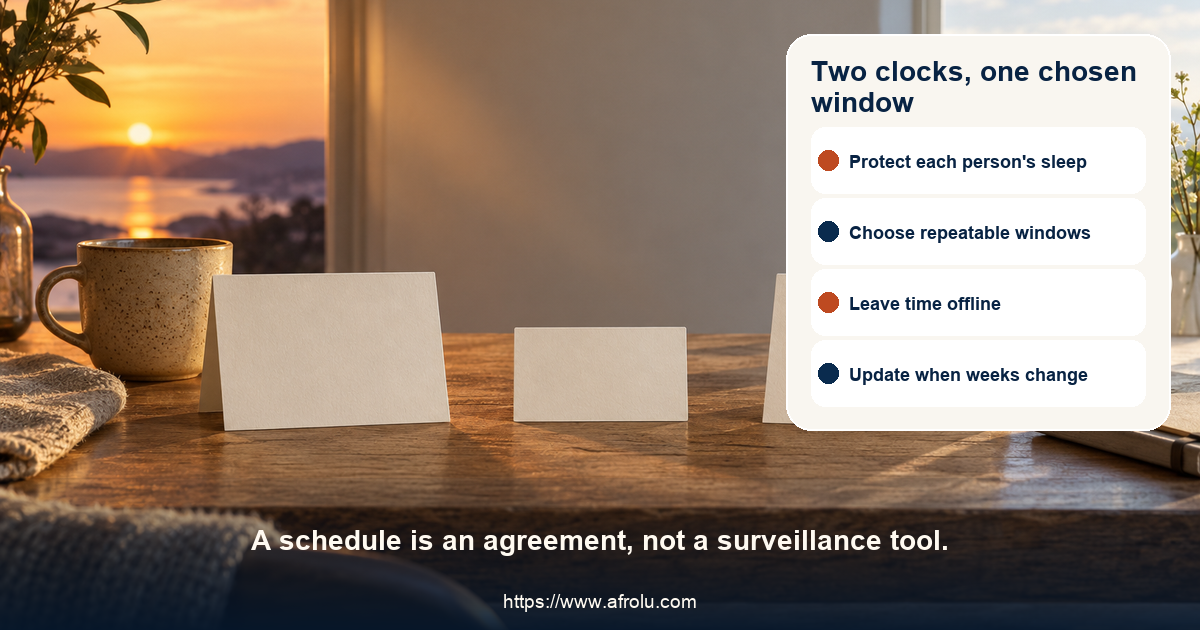
Agree on a rhythm instead of monitoring one another.
Written and edited by Tariro Ncube · Diaspora Dating Editor
Define the current relationship terms and agree on call windows that respect both time zones. Plan visits only after verifying logistics, costs, lodging, and independent exit options; never use money, passwords, location sharing, or intimate images as proof of love. Discuss family and future location as personal questions, check current official sources for travel and immigration details, and set a mutual point to review whether the arrangement still fits.
Dating basics · Diaspora Daters
How can diaspora adults date long-distance at a low-pressure pace without slipping into indefinite ambiguity, surveillance, or unequal travel costs?
Low-pressure long-distance dating is a mutually chosen pace across geographic distance, with enough present clarity for both adults to understand contact, exclusivity, visits, and what remains undecided. Diaspora identity may shape individual ties and choices, but it does not prescribe a shared culture or future location.
From Nairobi and Manchester, Asha and Kofi find a call window that does not keep either person awake every night. They agree they are exploring rather than exclusive, then plan a first meeting with separate lodging and clear costs. Their connection feels more relaxed because the terms are spoken; neither has to treat a transfer or a relocation promise as proof.
diaspora · distance and mutual pace
Make distance workable without turning contact into control
Separate low-pressure cadence from undefined status, a visit from proof, and diaspora identity from assumptions about home.
Agree on contact anchors, keep travel independent, ask personal future questions, and review what each adult contributes.
What is agreed now?
Pace, exclusivity, and future intent are separate questions.
Does the rhythm work both ways?
Protect sleep and offline life across time zones.
Can we each choose freely?
Check costs, lodging, transport, and return options.
What is feasible?
Discuss work, family, legal status, and individual ties.
diaspora · distance · pace
Low pressure should describe the pace, not erase the relationship question
Across countries, time zones, work shifts, family obligations, and travel costs can make a traditional weekly dating rhythm unrealistic. Low pressure may mean not demanding immediate labels, allowing asynchronous replies, or keeping visits infrequent while two people learn. It should not mean one adult silently waiting while the other controls when the relationship counts, whether it is exclusive, or when a visit might happen.
Separate distance from definition. You can agree to explore without exclusivity, to speak twice a week, or to review whether travel is feasible after a few months. Those are present terms even when the long-term outcome remains unknown. Ask what each person wants now, what they are not promising, and which unanswered question would make the arrangement too uncertain for you.
Diaspora can carry language, family, faith, work, and migration histories, but none should be assumed from a person's accent, passport, surname, or home country. Ask how each adult wants to handle holidays, family introductions, privacy, and future location. A respectful conversation makes room for mixed identities and different ties; it does not demand that one person perform a cultural role to qualify as serious.
Low-pressure is a mutual agreement about demands, not an exemption from responsibility. If plans change, update the other person. If interest fades, say so rather than keeping a distant connection warm for convenience. If the uncertainty begins costing more than the companionship returns, you may end it without proving that either person is a villain.
communication · ordinary life
Choose a rhythm that respects time zones instead of demanding constant availability
Start with a practical map of waking hours, shift work, care, and private time. One adult may be ending work as the other begins the day. Choose a call window that both can usually keep, plus a simple way to say a week has changed. This reduces avoidable guesswork without making either person account for every hour or prove where they are.
Decide what counts as enough contact for each of you. One person may enjoy a voice note; another may prefer a longer call every few days. There is no universal message count. The test is whether both adults can describe a workable rhythm, whether each contributes to sustaining it, and whether a request for more or less contact can be discussed without threats or punishment.
Leave room for local life to remain local. Friends, family, sleep, study, and work should not have to wait until the time-zone overlap opens. You can be warm without keeping a video call running in the background, sharing passwords, or sending a live location to manage fear. If someone frames normal offline time as betrayal, ask whether the relationship is becoming surveillance rather than connection.
A useful repair after a missed call is specific: acknowledge the miss, explain only what is needed, and propose another time if you want one. It is not an obligation to provide receipts, photos, or employer details. Repeatedly promising a rhythm that never happens is different from one disrupted week; respond to the pattern you can observe.
visits · money · verification
Plan travel as two adults' independent choices, not a test of devotion
Before a first visit, verify ordinary identity and plan details through more than a profile or document photo. Decide who chooses and pays for each part, where each adult will stay, and what happens if a flight, work schedule, or health issue changes. Keep enough money and transport options to make your own decisions; do not make one person dependent on the other for every step.
Cross-border travel can involve entry requirements, insurance, work leave, caregiving, and local rules. Check authoritative, current sources for the countries and citizenships involved rather than relying on a partner's summary or a dating article. If those costs or requirements make a visit impractical, a connection can still be real; pretending a trip is easy does not make it affordable.
Be wary when a new online connection asks for a visa fee, travel emergency, customs charge, investment, or account transfer and says the visit will happen as soon as you pay. The FTC describes requests for money as a common romance-scam pattern, including travel stories. Do not send money or gifts to an online sweetheart you have not met in person; verify independently and speak with someone you trust.
A first in-person meeting should not require sharing a bedroom, surrendering your passport, or staying in a private home if that does not feel right. You may choose separate accommodation, a public daytime meeting, and an independent return. These arrangements do not accuse the other person of wrongdoing; they preserve options while online familiarity becomes offline evidence.

Keep each adult's travel choices visible and reversible.
future plans · feasibility
A shared future needs practical questions, not a relocation promise
Long-distance affection can make moving sound like the obvious ending. Yet the adults may have careers, children, parents, health needs, legal status, or community ties that do not move neatly. Ask what each person would want if relocation were not on the table next year. That answer helps reveal whether the connection is valued in itself or mainly as a route out of a current situation.
Discuss possibilities without turning them into commitments: which countries feel imaginable, what would need to be true, which person would have options for work, and when to review. Use current government sources or qualified immigration advice for legal questions. Do not rely on a romantic partner, recruiter, or informal forum as the sole authority on immigration status or financial feasibility.
A fair future conversation includes the option that neither person moves. It also acknowledges unequal costs: one adult might leave family support, language comfort, professional recognition, or caregiving behind. Ask who would carry each cost and how the decision could be revisited. If only one person is expected to sacrifice while the other keeps every option, the plan is not yet mutual.
You do not need a closing-the-distance date to decide whether to keep dating today. You do need honesty about the absence of a plan if that absence affects your choice. A good interim agreement says what is known, what remains undecided, and when both people will revisit it—without presenting an uncertain future as a promise already secured.

Talk about constraints for both people before making commitments.
digital intimacy · consent
Online closeness still needs consent, privacy, and the freedom to stop
Agree on how you want to communicate before increasing intimacy. You may prefer voice calls to video, decline intimate images, or ask that a conversation stay on the dating platform while you are getting to know someone. A platform's verification badge or encrypted message does not ensure that a person will respect privacy or that content cannot be copied.
If you choose sexual communication, talk about what is welcome, what is not to be saved or shared, and what you will do if either person changes their mind. Consent remains specific and ongoing online as well as in person. Never treat a prior image, flirtatious conversation, or long history as permission for a new request. Pressure, threats, or blackmail are reasons to stop and seek support.
Avoid account-sharing as a shortcut to trust. A password, one-time code, financial login, identity document, or access to a relative's account can expose more than a couple's feelings. Keep multi-factor authentication private and use the platform's blocking and reporting tools where appropriate. If an abusive partner has access to your device or could see your searches, seek safety guidance before making changes that might alert them.
A long call can create a sense of familiarity, but it cannot show every part of offline life. Keep learning through consistency: how the person responds to a no, whether details stay coherent, and whether ordinary plans are followed. You are allowed to value the connection and still protect the parts of your life that do not need to cross a screen.

Offline time is compatible with care and consent.
compatibility · culture · care
Let each person show ordinary life instead of building a relationship from highlights
A long-distance connection can concentrate attention into curated calls: best lighting, planned topics, and a narrow window when both people are available. Make room for mundane reality without making surveillance normal. Talk about how a workday went, what a weekend actually allows, and which family or community commitments are non-negotiable. Each adult chooses what to show and what to keep private.
Diaspora can mean belonging to several places at once. Ask before assuming a person wants to return, marry within a community, speak a particular language at home, or follow a family's preferred timeline. Those questions are not side topics if they affect the future; they are part of learning whether the two adults' lives can meet without one identity being treated as a problem to solve.
Observe how a difference is handled. A disagreement about money, faith, children, holidays, or where to live does not automatically end the connection. Can both adults listen, ask follow-ups, and admit what is not negotiable? Or does one turn a boundary into proof that the other is not committed? The response to difference is more informative than pretending agreement to keep a call pleasant.
Do not use access as a measurement of trust. A partner may choose not to introduce you to family yet, show a home, share live location, or keep a call private. There may be many reasons. Ask what the boundary means to them and decide whether the arrangement still works for you; avoid recruiting relatives or online followers to force disclosure.
review · next decision
A low-pressure agreement still deserves a point where both people check its cost
A review need not be an ultimatum. You might choose it after two visits, a season of calls, or a work change. Each person can name what feels nourishing, what is draining, and what they can realistically offer next. If one adult wants a label and the other does not, discuss the difference plainly instead of letting one person's waiting become the invisible default.
Look at the work as well as the affection. Who finds overlapping call times? Who researches travel from authoritative sources? Who pays which costs? Who changes plans when a visit becomes impossible? A balanced relationship does not need identical contributions, but a pattern where one adult supplies all money, travel, emotional labor, and patience deserves a direct conversation.
If the connection is exclusive, discuss what that means across distance and how either person would update the agreement if their feelings change. If it is not exclusive, that also needs enough clarity to make choices about sexual health and emotional expectations. There is no right structure for every couple; there is a right to know which structure you are actually in.
Low pressure should leave both people more able to choose, not less able to ask. If the arrangement has no visit horizon, no honest account of constraints, or no reciprocity after repeated conversations, you may decide to end it. You do not have to disprove the other person's affection first. A connection can be meaningful and still not fit the life you want to build.
Eight diaspora dating moments involving time zones, visits, money, privacy, and the future
The only call is at midnight
One adult repeatedly loses sleep while the other keeps the convenient evening hour.
Rotate call windows or choose asynchronous contact both can sustain.Low pressure means no answer
One person says they are not ready for a label; the other is unsure whether exclusivity exists.
Ask which present terms are agreed and choose whether the uncertainty works for you.The ticket is already bought
A visit is treated as proof that the other adult must share lodging or intimacy.
Restate that travel is not consent; arrange separate options or leave.A visa fee appears
An online match asks for a transfer to unlock a planned visit.
Do not pay; verify through authoritative sources and talk to someone you trust.One person must relocate
Only one adult is expected to leave work, family, and community behind.
List costs and options for both people before making a promise.A private image is requested
Someone frames sending an intimate photo as proof of trust.
Decline unless you genuinely choose it; pressure does not create consent.A culture is assumed
A partner predicts the other's marriage or language preferences from their background.
Ask the person what matters to them instead of assigning a role.Calls are warm but plans never form
The connection has no concrete visit conversation after months of promises.
Ask what is feasible now and decide how long uncertainty remains acceptable.Fourteen signs that a long-distance pace is mutual rather than controlling or vague
Both adults can define low pressure without erasing whether the connection is exclusive.
A missed call receives a reasonable update rather than a location demand.
Contact fits two time zones without one person routinely sacrificing sleep.
Each adult contributes to call planning and makes room for offline life.
A video call or profile badge is not treated as complete identity proof.
Travel dates and costs are discussed before money is spent.
Each person has independent lodging, transport, and a way to change a visit.
No one sends visa, customs, emergency, or investment money under romantic urgency.
Family, language, faith, and home-country preferences are asked rather than assumed.
A future relocation conversation includes practical costs for both adults.
Neither person's password, code, document, or live location is required as proof.
Digital intimacy stays within specific boundaries that can be withdrawn.
The couple can revisit exclusivity, sexual health, and visit expectations honestly.
Either person can end the arrangement without being required to prove a lack of love.
A practical map for contact, travel, money, digital intimacy, and relocation questions
| Situation | What it may mean | What to do next |
|---|---|---|
| We call it low pressure | The pace may be gentle, but exclusivity and intent may remain unclear. | Ask which terms are actually agreed today. |
| A call was missed | A schedule changed or an expectation was not met; neither proves betrayal by itself. | Send a simple check-in and discuss a workable contact rhythm. |
| One adult loses sleep | The overlap may be unfairly weighted toward one time zone. | Rotate windows or use messages that do not require instant replies. |
| A first visit is proposed | Travel can create cost and dependence before offline trust exists. | Verify details and preserve independent lodging and transport. |
| A visa fee is requested | The money story may be hard to verify and emotionally urgent. | Do not transfer funds; check government information and independent support. |
| Relocation is expected | The future plan may carry unequal costs or legal constraints. | Discuss feasible options for both and seek qualified immigration advice. |
| They ask for my code | Account access is not a healthy relationship milestone. | Keep one-time codes and passwords private. |
| They want an intimate image | Digital consent and privacy are separate from affection. | Choose freely; say no or pause if you feel pressured. |
| Family expectations differ | A cultural assumption may be replacing a personal answer. | Ask what this adult values and what they can negotiate. |
| Months pass without a visit plan | The future may be uncertain or not a shared priority. | Ask what is feasible now and choose your own review point. |
Twelve scripts for negotiating distance without demanding proof
“I want a relaxed pace, and I still need to know whether we are dating exclusively.”
“Could we choose two call windows that work across both time zones and review them next month?”
“I missed our window yesterday. I am okay, and I can call Thursday if that works for you.”
“I care about our calls and also keep evenings for friends and rest; can we plan rather than stay constantly available?”
“Before booking, let us list each person's travel, lodging, and return costs separately.”
“I would like us to verify the visit details in a way we can each check independently.”
“I am not comfortable sending photos, and that is not a test of how I feel about you.”
“I am open to discussing where we might live, but I cannot promise to move before we check work and legal options.”
“What role do family, faith, and language play in the kind of partnership you want?”
“I will not transfer travel or emergency money to someone I have not met in person.”
“What parts of this long-distance pace feel good, and what would need to change for it to work?”
“I value what we shared, but this arrangement no longer fits the relationship I want.”
Know the difference
Low-pressure distance versus a connection kept indefinitely vague
Both adults name the present arrangement, agree on a sustainable call cadence, plan visits with independent options, and revisit the future without promising what they cannot control.
One person controls contact and future promises while the other supplies patience, travel money, proof of loyalty, or a relocation plan without a shared review point.
A gentle pace still needs mutual terms and a way to revisit them.

Low pressure still needs reciprocity and a review point.
A chosen low-pressure rhythm is different from one-sided waiting
| Type or dimension | What it describes | Best next question |
|---|---|---|
| Low-pressure | A pace with room for work and individual lives, not a ban on clarity. | Agree on one contact expectation and one review moment. |
| Long-distance | Geography changes visit logistics but does not define commitment. | Plan travel with costs and exits visible to both adults. |
| Exclusive | A mutual agreement about other partners, separate from call frequency. | Ask directly before making choices that rely on exclusivity. |
| Casual | A present offer that may or may not include future commitment. | State whether visits, intimacy, or other dates are part of it. |
| Serious intention | A future direction that still needs present evidence and practical feasibility. | Discuss what each person can do now, not only someday. |
| Digital intimacy | A private communication choice, not identity verification or obligation. | Set limits on images, accounts, storage, and sharing. |
| Committed relationship | An ongoing agreement that may include distance and negotiated routines. | Discuss the responsibilities both adults actually accept. |
| Visit-based dating | A connection organized around occasional in-person trips. | Keep each visit affordable, reversible, and independently arranged. |
| Undefined | A key term has not been agreed even if emotional intimacy feels high. | Ask what the uncertainty means for your next decision. |
A simple plan you can use today
Gentle pace can have clear terms
Low pressure describes demands, not whether each adult knows the current agreement.
Time zones need negotiation
A rhythm should not rely on one person's sleep or constant availability.
A visit is a shared logistics project
Dates, costs, lodging, and an exit plan matter before a ticket is purchased.
Relocation is not a proof of love
Work, family, legal status, money, and preference shape what is feasible.
Digital closeness has boundaries
Calls, photos, codes, and location access are separate choices.
Diaspora is personal
Ask about culture and belonging rather than inferring a future from identity.
Questions organised by purpose and depth
Choose a few prompts that fit the moment. This is a reference library, not a list to complete.
Present agreement
Define the relationship you have, not the future you hope it becomes.
- Are we exclusive?
- What can each person offer now?
- Which unanswered term affects my choice?
Time-zone rhythm
Build continuity without requiring constant presence.
- Which call windows work both ways?
- What is enough between calls?
- How do we update a changed week?
First visit
Keep practical details and exit options visible.
- How will each person pay?
- Where will each person stay?
- Can either adult change the plan independently?
Future and culture
Ask personal questions without assigning a community script.
- Which family ties matter to me?
- What could relocation cost each person?
- When should we review feasibility?
What deserves a closer look
How much contact is enough?
Enough is a mutually workable routine that provides the continuity each person wants without making one adult continuously available. Agree on windows and update expectations when shifts, care, or time zones change.
Evidence limit: There is no universal number of calls that proves interest.
What belongs in a first-visit plan?
Identity verification, dates, total cost, lodging, local transport, independent funds, and a return option should be discussed before booking. Each adult should know what they can cancel or change.
Evidence limit: Travel and entry rules depend on current official requirements for each traveler.
When is a travel request a concern?
A new online connection asking for emergency funds, visa fees, gift cards, crypto, or an investment is a reason to pause and verify. The FTC specifically warns against sending money to an online sweetheart not met in person.
Evidence limit: Use your country's official reporting and financial-protection services.
When should relocation be discussed?
Discuss it when the question affects whether you continue, but keep it exploratory until work, family, legal status, finances, and personal preference have been checked by reliable sources.
Evidence limit: Afrolu cannot determine immigration eligibility or recommend a legal route.
Does a long call verify who someone is?
A call can add context, but it cannot independently verify every identity claim or establish that a person will respect your boundaries offline. Keep learning from consistent, checkable behavior.
Evidence limit: No online verification method can guarantee identity or safety.
How do diaspora expectations enter dating?
They may shape language, family ties, holidays, religion, or where someone imagines home, but people within a community differ. Ask each adult what matters rather than treating heritage as a script.
Evidence limit: Do not generalize a person's values from nationality or ethnicity.
Shortcuts that confuse calls, travel, culture, or money with commitment
Calling vagueness low pressure
A gentle pace still allows both adults to know what is currently agreed.
Using constant calls as proof
Availability does not verify identity or guarantee commitment.
Letting one time zone set every term
A routine that depends on one person's sleep is unlikely to feel mutual.
Sending visit money under urgency
A romantic story cannot independently verify a travel or visa request.
Promising relocation too early
Legal, work, family, financial, and personal feasibility take real investigation.
Treating a photo as owed
Digital intimacy remains optional even in an emotionally close relationship.
Plan a long-distance rhythm, clarify exclusivity, or review online safety
Use current official government sources for travel and immigration questions. Afrolu cannot verify an identity, payment request, or future promise.
Explore the guide library
Show more related guides
Continue with Afrolu
Show more Afrolu guides
Sources used for this guide
Afrolu reviewed these health, research, safety, or public guidance resources while editing this page. They support the behaviour and safety guidance; they do not diagnose any individual described by a reader.
Questions about diaspora dating across countries and time zones
Can long-distance dating be low-pressure?
Yes, if both adults agree on what low pressure means: a sustainable contact rhythm, the current dating structure, and how they will revisit unanswered questions. Low pressure should not leave one person unknowingly waiting for exclusivity.
How often should we talk across time zones?
There is no universal cadence. Choose call windows that fit both people's sleep, work, and care, and decide whether asynchronous messages are enough between calls.
Does frequent contact mean we are exclusive?
No. Exclusivity is a separate agreement about other partners. Ask directly rather than inferring it from calls, affection, or a long chat history.
How can we plan a first visit?
Verify practical details independently, agree on dates and costs, choose lodging and transport that leave each person options, and check current government travel rules for the people and countries involved.
Should I pay a visa or travel fee for an online match?
Do not send money or gifts to an online sweetheart you have not met in person. The FTC warns that romance scammers may invent travel or emergency expenses. Verify independently and ask someone you trust.
Should I relocate for a long-distance relationship?
Do not promise a move before you understand work, family, legal status, finances, and your own preference. Consult current government information or qualified immigration advice for legal questions.
Is a video call enough to verify someone's identity?
A video call offers some context but does not guarantee identity, honesty, or offline safety. Treat it as one piece of information and keep financial and travel decisions independent.
Do I have to share my live location with a partner?
No. Location sharing is a separate privacy choice, not a condition of trust. Discuss a contact routine that does not become monitoring.
Can diaspora dating include different cultural expectations?
Yes, and no two people should be assumed to share the same expectations because of background. Ask about family, faith, language, holidays, and future location as personal questions.
How do I know if low pressure has become limbo?
Notice whether the present terms can be discussed, plans and visits are reciprocal, and both people can name a review point. If one adult carries all the cost and waiting, ask whether the arrangement still meets your needs.
One thing to do now
Keep the connection gentle, mutual, and honest about what comes next
State the present structure, agree on a contact rhythm that protects both people's ordinary lives, and verify any travel and money decision independently. Ask about culture and future location without assigning a role. Revisit the balance of effort and feasibility at a chosen point; do not treat constant access, a ticket, or a shared heritage as a guarantee of commitment.