Diaspora dating · casual, clearly defined
Casual Dating Across Borders: Keep the Terms Clear
Explore casual dating across borders with clear contact, travel, money and privacy boundaries, without assuming distance means commitment or relocation.

Name the agreement before planning a visit.
Written and edited by Nia Kato · Profile Advice Editor
Separate geography from intention. Define contact, exclusivity, intimacy, privacy, costs, and visits one at a time; choose a call rhythm and any travel plan that both adults can afford and leave independently; keep identity and financial access private; and revisit the offer when either person's needs change.
Dating basics · Diaspora Daters
How can we keep a cross-border casual connection enjoyable without letting distance, travel, or assumptions decide the terms?
Cross-border casual dating is a mutually understood, non-prescriptive arrangement between adults whose locations affect contact or meetings. The phrase does not determine exclusivity, relocation, intimacy, or future commitment. Those terms remain separate choices that both people should be able to describe, accept, revise, or decline.
When Asha visits a city for work, she and Malik have enjoyed a few relaxed evenings together. He reads the next visit as a sign that they are becoming exclusive; she had understood their connection as occasional and open. Before either books another trip, they talk about what they each want now. They may not choose the same arrangement, but the honest difference is easier to act on than a promise inferred from a ticket.
cross-border dating · separate the terms
A casual connection can be warm without becoming a travel promise
This guide separates geography from commitment, contact from surveillance, and a visit from a decision about intimacy or the future.
Clarify one present term, choose a rhythm and plan you can sustain independently, then review what both adults actually do.
What is casual here?
Define the term that changes your next choice.
When can we connect?
Choose overlap without requiring constant access.
What does a visit include?
Keep cost, lodging, and intimacy as separate decisions.
What remains personal?
Share voluntarily; keep accounts and documents private.
diaspora dating · casual intention
Distance explains logistics, not what either adult has agreed to call the connection
A person living between countries may be used to people reading a whole story into a few practical facts. A different time zone does not automatically mean a secret life, a planned move, a visa request, or a long-distance relationship. Begin with the specific invitation in front of you: what contact is being offered, what would make it enjoyable, and what would you like to keep separate for now?
Casual is a particularly small word for several possible arrangements. It might mean occasional dates while both adults keep other options open, affection without a future promise, a connection that resumes during visits, or simply a lighter pace. None of those meanings is universal. If the distinction would change your choices, ask directly rather than trying to decode frequency, affectionate language, or how far someone is willing to travel.
Separate the dimensions that distance tends to blur. Someone can be casual and exclusive, serious but not exclusive yet, emotionally warm without planning to relocate, or interested in a visit without offering a partnership. You may want the same arrangement or discover that your expectations diverge. Clarity does not force a more serious outcome; it gives each person enough information to decide whether this lighter one works.
Give your own answer at the scale you can honestly support. You could say that you enjoy talking and are open to meeting when travel already brings you to the same city, while not promising visits or exclusivity. That is a real offer, not a lesser version of dating. Let the other adult accept, ask a question, propose a different arrangement, or decline without being persuaded into your preferred meaning.
labels · reciprocity · informed choice
A casual label is fair only when both adults can describe the same practical boundaries
A casual arrangement can be considerate without becoming exclusive or permanent. Both people still need to know what they are agreeing to now. Does each adult expect regular calls? Is meeting possible only during a planned trip? Are either of you seeing other people? Would a visit include intimacy, or is it simply a date? Ask the narrow question that changes your own decision instead of requesting a forecast neither person can guarantee.
The word casual sometimes protects useful flexibility; at other times it becomes a shield against answering any question while one person expects frequent attention, emotional support, or sexual access. Look at the terms, not the label's reputation. A connection can be light and still include notice, a truthful answer about exclusivity, respect for a no, and updates when a plan or intention changes.
Discuss sexual health and protection before the intimate decision they affect, in language both adults understand. Distance does not make that conversation less relevant, and a visit or ticket does not settle it in advance. Each person can decide what information is necessary and what remains private. No earlier date, flirtation, or sexual history replaces a current voluntary answer to the next step.
A mismatch may be simple rather than dramatic: one person wants spontaneous messages and occasional visits; the other wants regular calls and a clearer commitment. Say what you can offer and hear the response without treating either preference as a flaw. If the available arrangement does not fit, you may leave it casual, negotiate a specific change, or stop. A useful label makes those options speakable.

Ask the question that changes your own decision.
time zones · contact rhythm
A workable contact rhythm needs a window, not constant proof that the other person is available
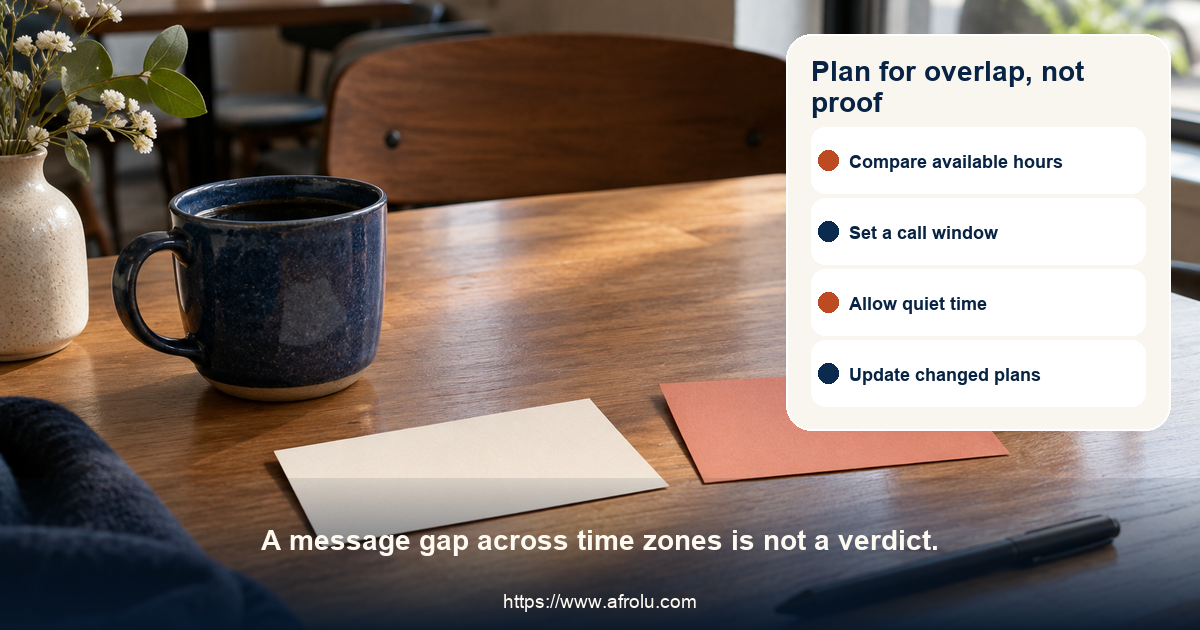
When one adult wakes as the other finishes a workday, spontaneous texting can become a poor measure of interest. Instead, compare the actual hours you each control. Perhaps a short call on one shared evening is realistic, or messages can be answered when convenient without a daily promise. State the pattern you can keep; do not offer round-the-clock access simply to reassure someone who is anxious about distance.
A time-zone difference can also turn routine into monitoring. Requests for screenshots, live location, proof of where you are, or immediate video calls do not become necessary because travel is involved. You can explain that you are unavailable and return at the time you said. If the other person needs a different amount of contact, that is useful compatibility information, not a reason to surrender ordinary privacy.
Make changes legible when they affect a plan. If a shift, caregiving duty, or trip interrupts the usual call, a brief update may be considerate when you have agreed to one. But both adults need room for quiet hours, missed messages, and private time. A relationship does not become more sincere because it consumes sleep or requires one person to prove devotion at a costly hour.
Notice the difference between imperfect timing and a pattern of keeping you permanently on standby. One missed call can be explained by ordinary life. Repeatedly confirming a plan and disappearing without any update, while expecting you to remain available for sudden contact, may not suit you. Describe the practical effect rather than guessing at motives: 'I need plans I can count on, even if we meet less often.'
travel · cost · independent plans
A visit is a logistics decision, not a relationship milestone or a test of who cares more
A proposed visit can carry more emotional weight than a local date because flights, leave, and family arrangements may sit behind it. Keep those investments separate from a promise about the relationship. You can meet only when travel already makes sense, decline a visit for now, or choose a shorter public meeting. Ask what each person expects the trip to mean before either adult spends money.
Do not assume that the person who travels will stay in the other's home, or that the host will manage every practical detail. Independent accommodation and transport may protect choice when feasible. If cost makes those options unrealistic, scale down the plan or postpone it rather than treating dependence as proof of closeness. The traveler should keep control of their documents, payment methods, return plan, and access to trusted support.
Avoid turning a visit into a financial test. A request to pay for a ticket, transfer a deposit, share account access, receive funds, or cover an emergency deserves separate verification and advice from someone outside the new connection. Romance-scam approaches can sound patient and personal. Do not send money to demonstrate trust, and do not let a booked journey make you feel obliged to continue a meeting that no longer feels right.
Before meeting, choose a public place and a time boundary that fit your own comfort. Tell a trusted person the general plan if that is useful, keep a route home you control, and decide what would prompt you to leave. A journey does not grant access to a body, private photographs, family introductions, or future travel. Both adults may revise the plan when new information changes what they want.

Choose travel only when the plan fits your own budget and comfort.
privacy · digital contact · money
International context does not justify collecting another adult's documents, address, accounts, or constant location
A conversation about where someone lives may help decide whether a call or meeting is possible. It does not require an exact address, passport image, work badge, immigration record, bank statement, or contact list. You can describe the city or broad time zone relevant to planning and leave identifying details private. Apply the same limit to information about relatives, roommates, colleagues, and anyone else who has not agreed to be part of the date.
Financial boundaries matter especially when the connection spans currencies or an upcoming journey. Keep your own accounts, tickets, and payment methods. Do not receive or move money for a person you are dating, send verification codes, buy gift cards, or invest through a link they provide. If there is a genuine emergency, verify through an independent channel and seek trusted advice instead of letting urgency make the decision for you.
Moving a conversation off a dating platform can feel like a natural step, but you can choose when and which channel to use. Review profile visibility, old public posts, and location settings before linking accounts. You do not need to provide a live location to show that you care. If someone repeatedly bypasses a block, contacts your workplace or family, or tracks where you go after you asked them not to, preserve relevant evidence where safe and seek local specialist support.
Privacy is not the same as deception. If a fact materially changes another adult's consent, sexual-health decision, exclusivity agreement, or travel plan, discuss it at the point it matters. For unrelated personal history, you may share gradually or decline the topic. A fair casual arrangement leaves both adults able to distinguish relevant honesty from an unearned demand to inspect each other's lives.
conversation · culture · personal context
Curiosity about a diaspora experience should invite an answer, not assign someone a story
Diaspora is a broad description, not a reliable biography. It cannot tell you where an adult grew up, how they relate to relatives, which community matters, what languages they speak, or whether they intend to move. Questions that treat someone as a cultural representative can turn a casual date into unpaid explanation. Let them choose which context they want to share, and return to the decision both of you are making.
If a difference affects the plan, ask about that difference directly and neutrally. You might ask which language is comfortable for a call, whether a public setting feels preferable, or how much notice helps with travel. You need not ask about a person's legal status, income, family expectations, religion, or origin unless that information is genuinely relevant and the conversation is welcome. Relevance does not remove the right to decline.
Share your own expectations without presenting them as rules attached to a nationality or community. If you want casual dating to remain private, say what privacy means to you and ask what the other person is comfortable with. If relatives or community events may eventually be involved, do not treat an introduction as automatic proof of commitment. Two adults can care about each other and still set different boundaries around public visibility.
When a question lands badly, listen to the boundary instead of defending the intention behind it. You can apologize briefly, clarify what practical detail you actually need, and let the other person decide whether to continue. The aim is not to eliminate every awkward moment; it is to make correction possible without mockery or pressure. A considerate casual connection allows identity to remain individual rather than turning it into a promise or performance.
review point · keep or change the offer
Keep a casual cross-border connection only while its real terms match what you can freely choose
Before the next call or visit, write a private note about what you want now and which term remains uncertain. Maybe you are comfortable with affectionate conversation but not paying for a trip; perhaps you want to meet during an existing visit without agreeing to exclusivity. A small standard helps distinguish a chosen casual arrangement from one you are tolerating because the alternative feels like losing a rare connection.
Use behaviour that has had time to repeat. Does each adult suggest workable times? Are cancellations communicated? Can you say no to travel or a call without being accused of indifference? Does the person answer the question you asked, even when the answer is not the one you hoped for? No single interaction proves character, but recurring respect or recurring pressure can guide your next choice.
If the terms change, name the change before relying on it. A new wish for exclusivity, more regular contact, an in-person visit, intimacy, or less privacy can alter another person's decisions. Explain what you can offer and leave the other adult free to accept, counter, or stop. Previous airfare, gifts, emotional disclosure, and time together do not create a debt to continue the arrangement.
Distance can make an imagined future feel vivid, but you do not need to settle that future to decide whether the present is worthwhile. Keep the parts that are mutually clear, ask about the one part that is not, and make the next step proportionate to what you know. If the connection no longer fits, you can end it without proving that anyone is bad. A good choice remains yours even when it is disappointing.

Review the four terms before agreeing to travel.
Eight cross-border situations where distance changes a practical dating choice
A city becomes a biography
A match expects you to explain family, origin, language, and legal status after learning you live abroad.
Share only the context you want; return to the detail needed for the current plan.Casual, but assumed exclusive
One person thinks the connection is open while the other has silently stopped dating others.
Ask what exclusivity means before changing your own choices.Calls cross sleep hours
The only proposed calls repeatedly fall during one adult's work or rest window.
Offer a sustainable shared window or accept that timing may not fit.A trip is treated as proof
A person asks you to book travel to prove the connection is serious.
Separate the relationship conversation from the travel decision.The host expects an overnight
A visitor is told that staying at the other person's home is part of the plan.
Choose independent lodging, a public meeting, or postpone the visit.A transfer is urgent
A new date requests a ticket payment, account code, or temporary transfer before a visit.
Pause and verify independently; do not share access or send funds under pressure.Location sharing becomes mandatory
One adult demands continuous location access because the other lives in a different country.
Keep location private and decide whether the boundary is respected.One person wants more contact
A casual weekend pattern no longer meets one adult's preference for regular calls.
State the new need and allow a genuine yes, no, or counteroffer.Fourteen signs that contact, visits, money, and privacy remain voluntary
Both adults can explain what casual means in this particular connection.
A visit is discussed as travel, not as a relationship test.
Neither person assumes a move, visa, or relocation from a time-zone difference.
A call rhythm works around both people's sleep and responsibilities.
Missed messages do not trigger surveillance or repeated proof demands.
Questions about identity and family remain voluntary and proportionate.
Both people know whether other dates are part of the current agreement.
Sexual-health and consent conversations happen before the choice they affect.
Travel costs and accommodation are agreed without implied debt.
Each adult keeps independent access to money, documents, and transport.
A person may decline a visit without being accused of dishonesty.
Digital privacy settings and communication channels remain a choice.
Changes in contact or intention are stated rather than left for inference.
An ending is accepted without contacting relatives, work, or new accounts.
A decision map for labels, calls, travel, disclosure, and changing needs
| Situation | What it may mean | What to do next |
|---|---|---|
| They say casual | The word may not answer exclusivity, intimacy, or contact. | Ask only the term that changes your next decision. |
| They message at odd hours | Time zones or personal habits may explain timing; neither proves intent. | Offer a call window that preserves sleep and work. |
| A visit is proposed | Travel can mean different things to each adult. | Discuss expectations before booking or hosting. |
| I am asked to pay | A ticket or emergency request is not verified by romance. | Pause payment and check independently with trusted support. |
| They want my location | Distance may be offered as a reason to monitor. | Keep live location under your control and observe the response. |
| I do not want to host | Accommodation and intimacy are separate choices. | Offer a public meeting or independent lodging if you still want to meet. |
| We disagree about exclusivity | The present offer may not meet both adults' expectations. | Decide whether a revised agreement fits you; do not infer one. |
| Family questions feel intrusive | Curiosity may have exceeded what the decision needs. | Set the boundary without supplying substitute private details. |
| Calls keep falling through | Schedules may not overlap, or reliability may be uneven. | Suggest one realistic alternative and assess the repeated pattern. |
| I want to end it | Distance does not make you responsible for a final trip or meeting. | Use a channel that feels safe and state the ending clearly. |
Twelve calm ways to ask about the terms that affect a real choice
“When you say casual, what would that mean for us over the next few weeks?”
“Are either of us dating other people, and what would we want to disclose?”
“Our hours do not line up easily. What call window could you actually keep?”
“I do not expect instant messages; I would like an update if a confirmed plan changes.”
“What would you hope this visit includes, apart from seeing each other?”
“I am not booking a trip to prove how I feel. I will decide based on the plan and my budget.”
“I would meet in public and arrange my own place to stay.”
“I am happy to share that gradually, but I would rather not discuss legal or family details yet.”
“Before we decide about intimacy, can we talk about testing, protection, and what each of us wants?”
“I do not share continuous location. I can let you know when I arrive if I choose.”
“This weekend-only pattern no longer works for me; I would like more planned contact.”
“I am not continuing this connection. Please do not contact me through my family or work.”
Know the difference
Casual across distance versus a travel promise nobody made
Contact, visits, exclusivity, costs, privacy, and intimacy are discussed as separate choices both adults can revise.
Tickets, time-zone calls, or affectionate messages are treated as proof of commitment, relocation, hosting, or future access.
Distance can shape a plan; only a clear agreement defines the connection.

Compare stated terms with expectations attached to travel.
An explicit casual agreement is not the same as an assumed travel promise
| Type or dimension | What it describes | Best next question |
|---|---|---|
| Casual | A present arrangement whose exact boundaries are not universal. | Ask what it changes about contact, other dates, and intimacy. |
| Exclusive | A separate agreement about dating others, not a travel plan. | Define what each adult includes before relying on it. |
| Long-distance | Geography describes logistics, not commitment level. | Discuss contact windows, visit costs, and realistic capacity. |
| Visit-based | Meetings happen around travel already planned or chosen. | Clarify whether visits are optional and what each includes. |
| Cross-border serious | Long-term intent still leaves timing, capacity, and consent to discuss. | Ask what is concrete now without promising a move. |
| Open arrangement | Other connections may continue under agreed disclosure boundaries. | Discuss information relevant to consent and sexual health. |
| Private connection | Privacy can protect both people but should not conceal a material term. | Agree what remains private and what affects another choice. |
| Time-zone rhythm | Contact depends on overlapping hours and chosen availability. | Choose a schedule neither adult must sustain at a personal cost. |
| Undefined | A needed term has not been agreed, even if feelings are strong. | Decide which answer you need before you travel or invest. |
A simple plan you can use today
Geography is not a promise
Do not infer relocation, exclusivity, or commitment from a border or time zone.
Casual needs usable terms
A light arrangement still needs enough honesty for both adults to choose.
Travel stays optional
A ticket does not buy access, gratitude, intimacy, or a relationship label.
Schedules are finite
Agree a contact window instead of treating availability as proof of care.
Privacy is individual
Ask about the practical detail without demanding a complete identity story.
Money deserves distance
Verify urgent requests independently and keep accounts and codes private.
Questions organised by purpose and depth
Choose a few prompts that fit the moment. This is a reference library, not a list to complete.
The offer
Describe only what has been said and agreed.
- What does casual mean here?
- Which term changes my next choice?
- What have I assumed from distance?
The shared clock
Choose a contact rhythm that respects both lives.
- Which hours overlap naturally?
- What is a realistic call frequency?
- What does a respectful cancellation look like?
The visit
Keep travel, money, lodging, and intimacy distinct.
- Would I make this trip without relationship pressure?
- Can I pay for my own plan?
- What public, independent option feels comfortable?
The boundary
Decide what remains private and what affects informed choice.
- Which details are relevant now?
- What account or location access will I keep private?
- How will I respond to an urgent request?
What deserves a closer look
Keep geography and commitment on separate axes
A relationship may be local or cross-border while remaining casual, exclusive, serious, or undecided. Ask the axis that affects your choice.
Evidence limit: Distance alone cannot determine a person's intention.
Choose overlap rather than constant availability
Compare the hours each adult can freely use and make a plan that does not rely on lost sleep or continuous reporting.
Evidence limit: No single message pattern measures affection.
Treat a visit as a standalone decision
Discuss cost, lodging, public meetings, transport, and what the trip includes before spending or hosting.
Evidence limit: This guide cannot give immigration or travel-law advice.
Ask for context only when it changes a decision
A city or time zone may matter for planning; family records, documents, and legal status usually do not belong in an early dating audit.
Evidence limit: People differ in what they choose to share.
Keep romance outside account access
Do not send codes or route money; independently verify emergencies, tickets, and investment requests before acting.
Evidence limit: Editorial guidance cannot identify a scammer or verify a person.
Make a changed offer explicit
More contact, exclusivity, intimacy, or an ending can change another adult's choices and deserves a clear conversation.
Evidence limit: A conversation cannot guarantee agreement or safety.
Shortcuts that let a ticket or time zone stand in for an agreement
Treating a flight as commitment
Travel shows effort only in that moment; it cannot define a relationship agreement.
Assuming casual means open
Exclusivity and disclosure need direct conversation.
Reading every gap as rejection
Hours, work, sleep, and chosen privacy can affect reply timing.
Trading financial access for trust
A transfer, code, or document does not verify a romantic story.
Using identity as a shortcut
Diaspora does not reveal one person's family, faith, language, or plans.
Hosting because someone travelled
A visitor's cost does not obligate accommodation, intimacy, or extended time.
Compare casual dating, long-distance expectations, or digital privacy
Choose a resource for the decision you are making now. These editorial guides cannot verify a person's identity, intentions, or travel documents.
Explore the guide library
Show more related guides
Continue with Afrolu
Show more Afrolu guides
Sources used for this guide
Afrolu reviewed these health, research, safety, or public guidance resources while editing this page. They support the behaviour and safety guidance; they do not diagnose any individual described by a reader.
Questions about casual dating across borders and time zones
Does distance make casual dating long distance?
Not by itself. First agree what the connection is; geography then informs calls, meetings, and travel.
Does casual mean we can date other people?
There is no universal rule. Ask whether either adult is seeing others and what should be disclosed.
Should I travel to show I am serious?
No. Travel is a separate financial and safety choice, not proof you owe or want commitment.
Do I have to host someone who visits?
No. Hosting, accommodation, intimacy, and meeting in public are separate choices.
How often should we call across time zones?
Choose a realistic overlapping window that respects both people's sleep and responsibilities.
Should I share my passport or residence documents?
No dating label requires document access. Keep identity records and financial credentials private.
How do I know whether a money request is genuine?
Romance cannot verify it. Pause, do not transfer funds or codes, and check independently with trusted support.
Do I need to explain my diaspora background?
Only share what you want. Ask or answer practical questions without treating identity as a complete biography.
Can a casual arrangement become more serious?
It can if both adults choose that change; talk about present terms instead of assuming a future.
Is this travel, immigration, or relationship-safety advice?
No. It is general editorial decision support, not legal advice or an individual safety assessment.
One thing to do now
Choose the next step that remains voluntary on both sides
Name what you want in the present, ask what casual changes about the next decision, set independent limits for contact, money, privacy, and any visit, then compare the agreement with repeated conduct. Do not infer commitment, relocation, consent, or financial trust from distance or travel effort.