Feeling, question and fact each receive the right response
Find Clarity for a Diaspora First Date in Nairobi
A three-pocket Nairobi first-date guide for diaspora adults, with intent questions, public plans, protected records, transport, money and consent.

Soothe the feeling, ask the question, act on the fact.
Written and edited by Tariro Ncube · Diaspora Dating Editor
Sort every concern into feeling, question or fact. Regulate ordinary nerves with food, rest, a short plan and a familiar independent route. Ask directly about present intent, other dating, venue, duration and spending while allowing uncertainty about future location. Act on facts such as identity contradictions, repeated private-venue switches, tracking, document demands, money urgency, threats or ignored no. Confirm a staffed public venue yourself, control transport, set a clear end and trusted check-in, and keep home, hotel, immigration, employer, banking and family records private. Afterward, compare feeling, answers and conduct before another bounded public step.
First dates · Diaspora Daters
Which concerns are feelings to regulate, questions to ask or observable facts that require a safer change before a Nairobi first date?
Diaspora first-date clarity in Nairobi is the practice of giving anticipatory feeling, missing relationship information and observable conduct separate responses. A three-pocket route combines a proportionate intent conversation with a complete public date plan while private records, continuous tracking, money, home, hotel, relocation and consent remain independent choices.
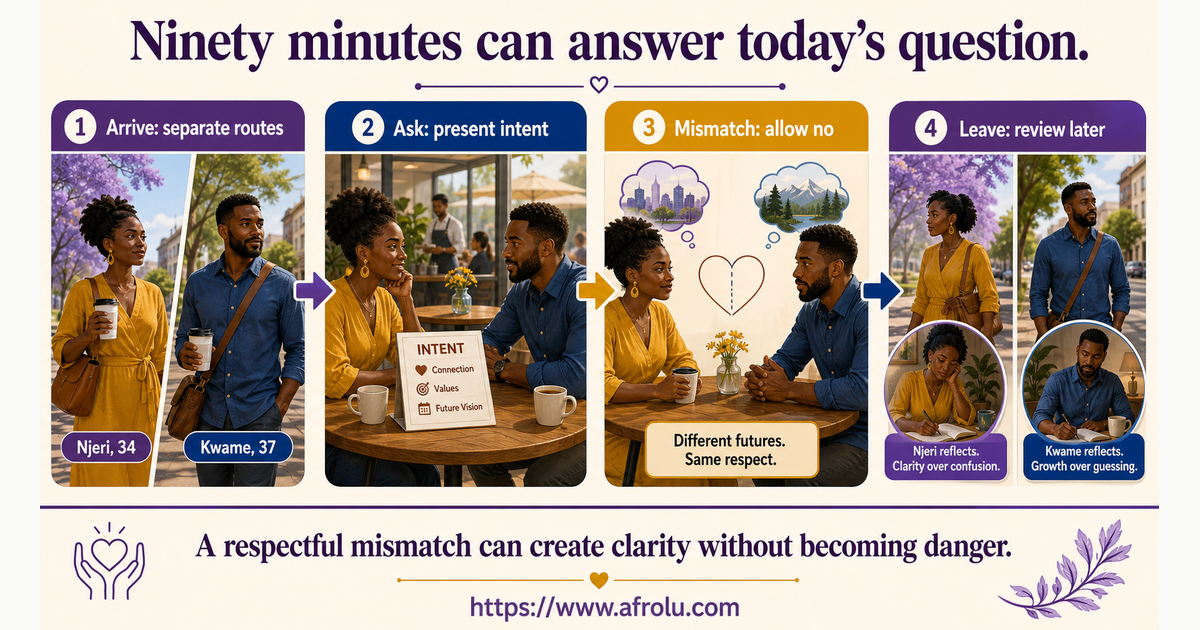
Njeri and Kwame are fictional diaspora-connected adults, 34 and 37. They meet for ninety minutes at a generic staffed Westlands venue and arrive independently. Both want partnership, but Kwame hopes for a Kenya-based future while Njeri cannot promise to return. They allow the mismatch without pressure, leave separately and choose one more public date while keeping accommodation, records and family information private.
The three-pocket Nairobi clarity route
Give every first-date concern the response it can actually use
Tariro separates ordinary anxiety, answerable uncertainty and conduct that changes safety before completing a bounded public meeting.
Three pockets organise the concern; a six-stop envelope protects venue, time, transport, spending, check-in and exit without surveillance.
Feeling
Regulate enough to choose without asking anxiety to predict the person.
Question
Ask present intent and logistics directly while allowing an honest unknown.
Fact
Change the plan when contradiction, pressure, money or surveillance reduces choice.
Public and leaveable
Complete six practical stops while private records remain closed.
Let clarity stay proportionate
A first date needs enough information for one meeting, not an entire life
A diaspora-connected first date in Nairobi may carry more questions than a nearby coffee. One adult may live abroad, have returned recently or move between places; the other may be locally based or equally mobile. Time zones, travel windows, family expectations, work, money and future location can make a ninety-minute meeting feel like a referendum on an entire life. It is not. The first date needs enough clarity for one safe, voluntary meeting and perhaps one next conversation.
Clarity is a direct answer with room for no. Ask what each adult is open to exploring now, whether either is dating others, how the public date will work and which future questions remain undecided. Clarity is not unrestricted access. A passport, visa, hotel booking, employer record, family address, bank statement, live location or payment does not prove relationship intention and can create new risk.
First-date anxiety is anticipatory worry about an unfamiliar social encounter. It may show up as racing thoughts, self-consciousness or fear of awkward silence even when the plan is consistent. Anxiety is not a safety detector or a diagnosis. Observable conduct still matters. Identity contradictions, repeated private-venue pressure, surveillance, financial urgency, threats or punishment after a no change the facts and deserve action.
This page does not assume one diaspora culture or one Nairobi dating experience. It does not recommend a particular district, business, transport provider or immigration path. Conditions, traffic and personal needs vary. Choose a staffed public setting and transport you independently judge suitable, share a useful plan with a trusted person at your discretion and use current local information for immediate safety or travel decisions.
Sort uncertainty into three pockets
Regulate a feeling, ask a question and act on an observable fact
The feeling pocket holds internal experience: butterflies, excitement, uncertainty, self-consciousness or worry about being judged. Use food, rest, breathing, a familiar route, comfortable clothing, a brief plan and a prepared opening question. The goal is not to eliminate every feeling. It is to keep enough attention available to notice the date and make choices.
The question pocket holds missing information another adult can reasonably answer: present intention, relationship structure, venue, duration, spending, transport or broad future-location hopes. Ask directly and allow uncertainty. A person may not know whether they would ever relocate; that is different from refusing to say whether tonight's venue is public or whether a money request was made.
The fact pocket holds observable conduct and independently checked information. A named public venue exists. The story stays consistent. A booking can be confirmed through a source you locate yourself. Or the venue repeatedly shifts to a home or hotel, identities conflict, a match demands continuous tracking, requests immigration papers or creates financial urgency. Facts change the plan; they are not private puzzles that must be solved alone.
Some concerns contain all three. You may feel nervous, need to ask about exclusivity and notice a last-minute private switch. Respond separately: regulate enough to think, ask the relationship question if still relevant and decline the changed venue. Sorting does not promise certainty. It prevents one intense feeling from swallowing useful questions or one romantic answer from erasing a risky fact.
Njeri and Kwame keep the meeting small
A respectful future-location mismatch can make the first date more useful
Njeri and Kwame are fictional adults, 34 and 37. Njeri is visiting Nairobi for several weeks after years abroad; Kwame lives in the city and has family connections elsewhere. They have held two live calls and want a first coffee. Njeri is anxious that the meeting will become a conversation about permanent return. She places that fear in the feeling pocket and prepares one direct question about present intention.
They confirm a staffed public venue in Westlands for ninety minutes, each using transport they arrange independently. Njeri shares the useful plan with a trusted friend but keeps accommodation and family addresses private. Kwame knows the district and time, not a room number or exact daily itinerary. They agree to a modest spending range and no airport, hotel or home collection.
At the table, Njeri asks whether Kwame is exploring casual connection or a serious direction. Both are open to partnership. Kwame hopes a future partner would live in Kenya within two years; Njeri cannot promise a return and may continue working abroad. The difference raises emotion but no pressure. Kwame asks what remains possible; Njeri says she can only explore without a relocation promise.
They leave separately at the planned time. The next day, both agree that the date was warm and the location question is substantial. They choose one more public meeting and remain non-exclusive. The clarity did not come from documents, surveillance or forced certainty. It came from an honest mismatch being allowed to remain information rather than a test of loyalty.
Read ordinary nerves, mismatch and risk separately
Compatibility can be declined; coercion changes the safety plan
Ordinary nerves can coexist with a verified public plan and respectful communication. If preparation makes the meeting feel manageable, proceed only if desired. Cancelling for anxiety is also allowed; no one owes a date to prove confidence. Notice whether the other adult accepts a shorter duration or a reschedule without demanding a medical explanation.
Compatibility questions include serious versus casual direction, exclusivity, faith, communication rhythm, children, career mobility and future geography. Different answers can be painful without being dangerous. Ask what each adult can genuinely offer and avoid bargaining against a firm life constraint. A person who respectfully declines your preferred future is giving clarity.
Safety facts include repeated identity contradictions, unwanted tracking, pressure to share documents or hotel details, financial urgency, a private venue after a public agreement, intoxication pressure, threats, stalking or retaliation. Cancel or leave when choice has materially changed. You do not need to meet so the person can explain. Preserve relevant evidence and tell a trusted person where useful.
If immediate danger occurs in Kenya, a current Directorate of Criminal Investigations page lists 999, 911 and 112 as police hotlines. Use current local information and services appropriate to the circumstances. For non-immediate concerns, platform reporting, financial providers, venue staff, trusted people, legal advice or specialised support may be more appropriate. This guide cannot assess an individual incident.

Give each concern the response it can actually use.
Use clarity without interrogation
Ask about intent, place and time while documents, tracking and payment stay closed
To ask intent: ‘What are you hoping to explore now—without promising where either of us will live?’ This keeps a serious direction discussable while refusing to turn the first date into a relocation commitment. Follow with structure only if relevant: ‘Are either of us dating other people, and what should we understand before intimacy?’
To confirm the plan: ‘I can meet at this staffed public venue from three to four-thirty and will arrange my own transport.’ A complete invitation has a place, beginning, end and route each adult controls. If the venue materially changes, either can decline without being accused of wasting travel or rejecting the relationship.
To protect records and location: ‘I do not share passport, immigration, banking, employer, hotel or family records as proof. I also do not share continuous live location with a match.’ A trusted person may receive selected date details at your choice. That is different from giving the date surveillance access.
To cancel: ‘The identity contradictions and private-venue pressure mean I will not meet. Do not contact me again.’ No further debate is required. If money was sent or an account was exposed, contact the provider promptly and secure access. If unwanted contact continues, retain useful evidence and seek platform, legal, police or specialised support suited to the conduct.

Ask the relationship question and keep the unrelated access closed.
Complete the practical envelope
Seal venue, duration, transport, spending, check-in and exit before leaving
Choose a staffed public venue you can independently confirm and reach. Check current opening information and the practical route yourself. Do not rely only on a screenshot or link from the match. A district name is not a safety guarantee; assess the specific setting, time, accessibility and your own circumstances. Keep home and accommodation outside the first plan.
Set a realistic duration and spending cap. Ninety minutes is an example, not a rule. A clear end can reduce uncertainty and leaves room to extend only through mutual choice. Eat, carry essentials and avoid spending that creates debt or emotional leverage. Each adult can pay according to a discussed arrangement; no bill purchases another location, more time or physical access.
Arrange independent transport and a usable exit. Keep phone power, essential funds and any medication under your control. A trusted person can know the plan and expected check-in without receiving unnecessary private information about the other adult. Live location may be shared with a trusted person if freely chosen, but a match is not entitled to continuous monitoring.
If the person, venue or plan changes materially, reassess before moving. Do not follow a new private route because politeness, travel cost or diaspora community connection makes refusal feel awkward. Leave when consent, mobility or communication becomes constrained. In immediate danger, use current emergency support; otherwise choose the provider, platform, venue, trusted or qualified channel that matches the concern.

Make the date small, public, affordable and easy to leave.
Review after the nervous peak
Compare feeling, answers and conduct before choosing another meeting
After returning independently, let your body settle before turning one moment into a verdict. Ask what anxiety predicted and what actually occurred. Awkwardness, silence or imperfect chemistry may simply mean the date was unfamiliar. Enjoyment is real but cannot prove identity, future location or long-term safety. Hold both positive feeling and limited evidence.
Review the question pocket. Did present intention, structure and broad geography receive usable answers? Which topics remain open because they genuinely require time? A respectful uncertainty can support another meeting; a firm mismatch can support closure. Do not collect documents or involve families to force a clearer future than the adults can honestly state.
Review the fact pocket. Were venue, time, spending, transport, privacy and consent respected? Did a changed plan receive a genuine choice? Were any identity contradictions, money requests, tracking demands or retaliation minimised during the date? Act on conduct proportionately. You do not have to prove a complete story before reducing access.
Continue with one bounded public step when feeling, answers and facts align. Clarify one important question before another date when information is incomplete. Pause or close when compatibility is poor or choice has shrunk. If reporting or support is needed, preserve only the useful evidence and avoid public accusations that expose private information. The goal is an accurate next decision, not certainty about the person's entire character.
Eight diaspora Nairobi first-date moments where the right pocket matters
A complete public plan still feels emotionally large
The venue, time and transport are consistent, but the returnee worries about awkwardness and future questions.
Regulate, shorten the date if desired and keep observing facts.Serious and casual hopes need words
One profile says long-term while the recent conversation remains ambiguous.
Ask what the adult is open to now without demanding a future promise.Two honest location timelines differ
One adult expects to remain in Nairobi; the other cannot promise a return from abroad.
Treat the answer as compatibility information and decide freely.Clarity is confused with accommodation access
A match asks for a room number and offers to collect the visitor to prove local support.
Keep accommodation private and use independent transport.Diaspora identity becomes a records demand
Passport, visa or employer papers are requested before the date as evidence of honesty.
Refuse unnecessary records and reassess the request.A public café repeatedly becomes a home
The plan changes after a clear no and the match says a private place is more authentic.
Cancel or remain with the original public plan; do not follow pressure.Travel cost becomes a relationship test
A match requests an urgent transfer for transport and says refusal shows diaspora distrust.
Send nothing and protect payment accounts.Warmth and mismatch coexist respectfully
The date is enjoyable, future-location answers differ and both leave independently without pressure.
Choose another bounded meeting or close from compatibility, not fear.Evidence that clarity and privacy can coexist on a first meeting
{'label': 'Identity', 'title': 'Basic details remain consistent', 'detail': 'Live conversation and ordinary context align without demands for a private dossier.', 'reading': 'Useful partial evidence'}
{'label': 'Intent', 'title': 'Present direction can be discussed', 'detail': "Serious, casual or uncertain answers leave room for the other adult's no.", 'reading': 'Relational clarity'}
{'label': 'Venue', 'title': 'The meeting remains staffed and public', 'detail': 'No last-minute home or hotel switch follows a stated boundary.', 'reading': 'Practical choice'}
{'label': 'Duration', 'title': 'A clear end receives respect', 'detail': 'Extension is optional rather than proof of chemistry or trust.', 'reading': 'Bounded time'}
{'label': 'Transport', 'title': 'Each adult controls arrival and departure', 'detail': 'No one withholds a route, phone, documents or essential fare.', 'reading': 'Usable mobility'}
{'label': 'Privacy', 'title': 'Home, hotel, records and family stay closed', 'detail': 'Enough information is shared for the date, not for surveillance.', 'reading': 'Proportionate access'}
{'label': 'Spending', 'title': 'Cost remains modest and discussed', 'detail': 'A bill does not buy more time, another venue or physical contact.', 'reading': 'Financial autonomy'}
{'label': 'Mismatch', 'title': 'Different future plans can remain respectful', 'detail': 'No one is shamed or pressured to promise relocation.', 'reading': 'Compatibility information'}
{'label': 'Consent', 'title': 'Every social and physical step stays current', 'detail': 'Travel, community ties and past messages do not replace a present answer.', 'reading': 'Free choice'}
{'label': 'Exit', 'title': 'A no or departure remains uncomplicated', 'detail': 'The adult can leave without retaliation, pursuit or financial leverage.', 'reading': 'Safety-supporting conduct'}
Sort the concern before choosing the response
| Situation | What it may mean | What to do next |
|---|---|---|
Scripts for intent, venue, time, transport, records, money and cancellation
“What are you hoping to explore now, without promising where either of us will live?”
“Are either of us dating other people, and what should we understand before intimacy?”
“I meet first at a staffed public place; I will not switch to a home or hotel.”
“I can meet from three to four-thirty and will decide then whether I want another date.”
“I will arrange my own arrival and return.”
“I do not share passport, immigration, banking, employer, hotel or family records as proof.”
“I may share selected details with a trusted person, not continuous tracking with a match.”
“I am keeping this date within a modest range and will not send travel money.”
“Our location timelines differ, and I will not promise a move today.”
“The contradictions and private-plan pressure mean I will not meet. Do not contact me again.”
Know the difference
The five-state diaspora first-date clarity map

Do not soothe a risky fact or investigate an ordinary feeling.
Compare nerves, questions, mismatch, safety facts and permission
| Type or dimension | What it describes | Best next question |
|---|---|---|
| Nerves | ||
| Question | ||
| Mismatch | ||
| Safety fact | ||
| Permission | ||
| Diaspora context | ||
| Nairobi plan | ||
| Next-day review |
Build the three-pocket Nairobi route in six moves
Sort three pockets
Ask present intent
Complete the Nairobi envelope
Close private records
Act on changed facts
Review the next day
Questions organised by feeling, clarity, route and facts
Choose a few prompts that fit the moment. This is a reference library, not a list to complete.
Feeling questions
Care for anxiety without asking it to predict the person.
- What am I feeling?
- What preparation would help?
- Can the date be shorter?
- Do I still freely want to go?
- What would help me leave?
Clarity questions
Ask present relationship questions and allow uncertainty.
- What are we exploring now?
- Are either of us dating others?
- Which location hopes differ?
- What remains unknown?
- Can either adult say no?
Route questions
Complete the public plan before movement.
- Is the venue independently confirmed?
- What is the duration?
- Who controls transport?
- What spending range fits?
- Who receives the check-in?
Fact questions
Act when observable conduct changes choice.
- Are identities consistent?
- Did the venue stay public?
- Were records requested?
- Was money made urgent?
- Do I continue, pause or close?
What local, privacy, consent, travel and consumer sources can support
A current Kenyan police page lists emergency hotlines
The Directorate of Criminal Investigations lists 999, 911 and 112 among police hotlines. Use current local information and the service appropriate to immediate danger; non-emergency concerns may need another channel.
Evidence limit: This page cannot assess urgency, response availability or the correct authority for an individual incident.
Purpose and data minimisation are useful safeguards
Kenya's Data Protection Act requires covered processing to have lawful, explicit purposes and limits information to what is necessary. In dating, avoid documents and location access unrelated to the first meeting.
Evidence limit: The Act has defined application and exemptions; this page does not provide legal advice.
Romance scams may use travel and emergency stories
The U.S. Federal Trade Commission describes remote trust-building followed by travel, emergency or investment requests. Do not send money to prove diaspora trust, and contact the provider promptly after suspicious loss.
Evidence limit: U.S. reporting routes and remedies vary by jurisdiction and payment provider.
A relationship, payment or previous yes does not create current consent
NHS public-health guidance explains active consent and withdrawal. Apply that principle to each physical, photographic and location decision on the date.
Evidence limit: The source explains UK context; legal definitions and support pathways differ.
Documents, insurance and backup access are travel tasks
The UK Foreign, Commonwealth & Development Office checklist focuses on destination requirements, insurance, health, documents and backups. These tasks do not prove romantic intention or require sharing records with a match.
Evidence limit: The checklist is written for British travellers; use current official guidance for your own citizenship and journey.
Relevant conversations belong before sex
Current U.S. Centers for Disease Control and Prevention guidance encourages partners to discuss testing and prevention before sexual contact. Diaspora identity and exclusivity labels are not clinical information.
Evidence limit: CDC material is U.S. guidance; seek locally appropriate clinical advice for individual care.
Six shortcuts that give anxiety or access the wrong job
Use a reviewed resource that matches the decision
This guide focuses on the relationship decision, so it does not rank dating apps. Check current prices, safety tools, and local availability before choosing a service.
Explore the guide library
Show more related guides
Continue with Afrolu
Show more Afrolu guides
Official guidance used for this Nairobi clarity route
Afrolu reviewed these health, research, safety, or public guidance resources while editing this page. They support the behaviour and safety guidance; they do not diagnose any individual described by a reader.
Diaspora first-date anxiety and Nairobi clarity questions
Does first-date anxiety mean I should cancel?
Not automatically. Put the feeling beside the plan and facts. Preparation, a shorter duration and independent transport may make a consistent public date manageable. You may still cancel for any reason. Do not use calming techniques to override contradictions, private-venue pressure, tracking, money urgency or lost choice.
What should diaspora adults clarify before a Nairobi first date?
Clarify present intent, whether either dates others if relevant, the staffed public venue, duration, spending and independent return. Future location can be discussed as a direction, not settled as a promise. Keep home, hotel, immigration, employer, banking and family records private.
Should I share my hotel or home address with the date?
No. A district and public meeting point are enough. Arrange your own transport and keep accommodation and home access separate. A trusted person may receive selected useful details at your choice; the match is not entitled to room numbers, family addresses or continuous tracking.
Are passport or visa documents useful proof of dating intent?
No. They may expose identity and immigration data while saying little about honesty, relationship structure or consent. Check only what the meeting needs through proportionate, independent means. Never share account credentials, full document images or employer systems to buy reassurance.
How long should a low-pressure first date in Nairobi be?
There is no universal length. Ninety minutes is one example that gives conversation a clear boundary. Choose a duration that fits transport, energy and accessibility. Extension should be mutual and optional; a bill, long journey or good conversation does not purchase more time.
Is a different relocation plan a red flag?
Not by itself. It is compatibility information when both adults state their constraints honestly and accept disagreement. Pressure, deception, retaliation or demands for a relocation promise change the facts. A first date may reveal that two good people cannot build the same geography.
What if the venue changes from public to private?
You can keep the original public plan or cancel. Do not follow a home or hotel switch because politeness, travel cost or community connection creates pressure. If the person ignores your no, stop negotiating and use trusted, venue, platform or emergency support appropriate to the risk.
Should I send fare to a diaspora match before meeting?
No payment proves trust. Romance scams may use travel, emergencies or investments to create urgency. Each adult should fund essential transport and retain a return. If a suspicious transfer occurred, contact the provider promptly, secure accounts and use relevant reporting channels.
Who should know about the first date?
Choose a trusted person and share what helps them support you: the public venue, time, expected check-in and transport plan, at a depth you control. Avoid unnecessary private information about the match and do not ask a friend to investigate or confront them.
How should I decide on a second date?
Review three pockets after you return: how the feeling changed, whether important questions received honest answers and whether venue, time, privacy, money, transport and consent were respected. Continue with one bounded public step, clarify one question, pause or close from that combined evidence.
One thing to do now
Let one public meeting answer only the questions it can
Soothe a feeling, ask a question and act on a fact. Complete the Nairobi envelope—venue, duration, transport, spending, check-in and exit—without opening unrelated records or location access. Continue when answers and conduct preserve choice; clarify one uncertainty before another meeting; pause or close when incompatibility is firm or observable pressure changes safety.