Feeling, fact, plan, freedom
Plan a Calm First Date During a Diaspora Weekend
A practical guide for adults meeting during a trip: separate ordinary first-date nerves from incompatibility and observable risk, then protect lodging, transport, money, time, and consent.
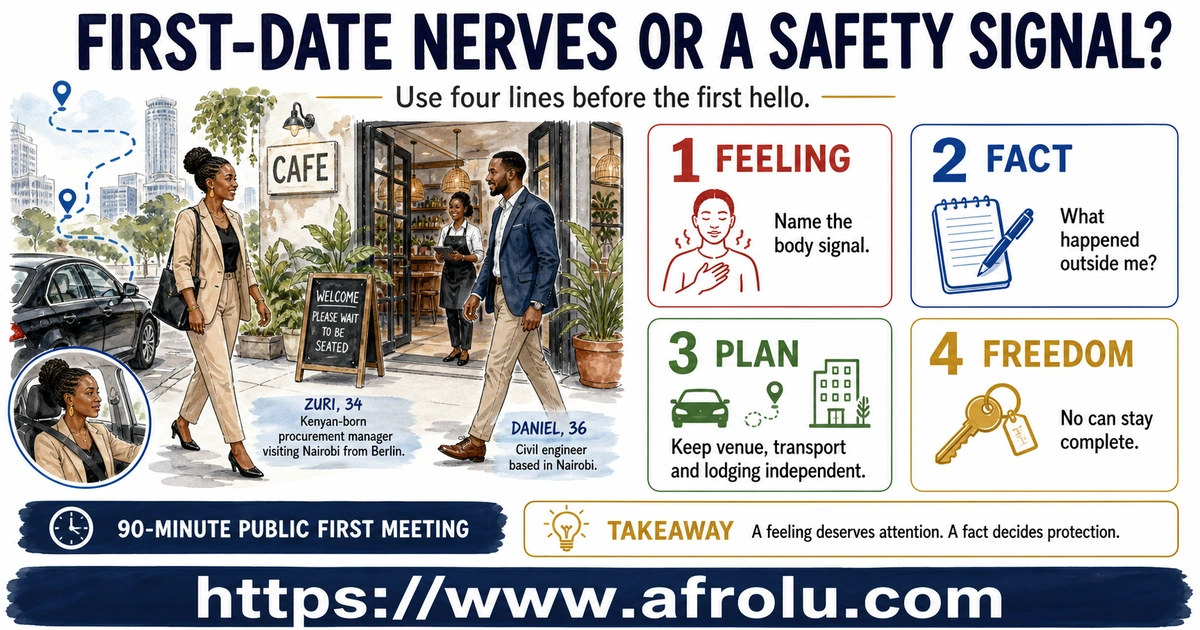
A feeling deserves attention; an observable fact decides what protection the first-date plan needs.
Written and edited by Adwoa Boateng · Dating Safety Editor
Use four separate checks. Feeling: name what your body and mind are doing without treating the sensation as a prediction. Fact: verify identity details, the staffed public venue, the start and end time, and whether the other adult accepts your limits. Plan: keep lodging private, arrange independent transport, tell a trusted person the venue and check-in, and carry enough charge and money to leave. Freedom: remember that a flight, hotel, meal, gift, long chat, or warm video call never purchases extra time, a private location, touch, sex, or a second date. Ordinary nerves may soften when the plan becomes concrete. A respectful mismatch can end without blame. Identity contradictions, money or document requests, stalking, threats, a forced venue change, or an ignored no are observable reasons to postpone, cancel, leave, and seek appropriate support.
First dates · Diaspora Daters
How can I calm ordinary first-date nerves without explaining away a fact that makes the meeting unsafe?
First-date anxiety is anticipatory worry before an unfamiliar social meeting. It can include a fast heartbeat, tense muscles, dry mouth, self-conscious thoughts, or an urge to rehearse every sentence. One nervous afternoon does not diagnose an anxiety disorder and does not prove that a date is dangerous. Incompatibility is a difference in preferences, values, attraction, timing, or relationship goals that can be handled without coercion. A safety signal is an observable event such as deception, monitoring, financial pressure, threats, unwanted contact, or refusal to respect a limit. The three can feel uncomfortable, but they call for different responses.
Zuri is 34, a Kenyan-born procurement manager living in Berlin. She will be in Nairobi for her aunt's birthday and agrees to meet Daniel, 36, a civil engineer she has spoken with online for six weeks. On Saturday morning, Zuri's stomach feels tight and her mind produces awkward endings to a date that has not begun. She does not ask the feeling to decide. The facts remain steady: their live calls match the profile, Daniel accepts a staffed cafe, the meeting is 11:30 to 1:00, and he has never asked for money, documents, her hotel, or a ride. Her plan is independent: her cousin has the venue and check-in time, her hotel stays private, and her return car is hers to order. During coffee, Daniel asks whether she wants lunch. She says not today. He accepts the answer and walks with her only as far as the cafe entrance. Zuri leaves still unsure about chemistry but clear that ordinary nerves, respectful disappointment, and unsafe pressure are not the same thing.
The arrival brief
Read four lines before the first hello
Travel can make one coffee feel like the centre of an entire weekend. Shrink the decision back to its real size: one adult meeting another adult for a contained period in a public place.
Write one line for feeling, one for fact, one for plan, and one for freedom. The method does not promise safety or diagnose anxiety. It stops one strong sensation from erasing evidence and stops a reassuring story from erasing a concerning fact.
What is happening inside me?
Name the sensation and thought plainly: tight stomach, fast speech, excitement, self-consciousness, or an urge to cancel. A feeling is real information, not a verdict.
What happened outside me?
Check identity consistency, venue, time, money requests, contact behaviour, and the response to a limit. Use an event you could describe without guessing motive.
What small action restores choice?
Confirm the public meeting, shorten the date, keep hotel details private, arrange transport, add a check-in, or cancel. Protection should match the facts.
Can I still change my answer?
Either adult can leave, decline touch, refuse a second location, or decide against another date. Courtesy does not require continued access.
Friday evening: sort discomfort before solving it
Nerves, mismatch, and danger belong in different columns
Ordinary nerves usually describe your internal experience while the agreed facts remain stable. You may worry about silence, clothes, attraction, accent, cultural fluency, or saying the wrong thing. A short public plan may still feel usable, and the other adult has not needed to argue with your boundaries.
A compatibility mismatch is observable too, but it is not automatically danger. One adult wants a full afternoon and the other wants coffee. One dates toward partnership and the other is exploring casually. When both can hear the difference and decline without punishment, the result may simply be no date or no second date.
A safety signal changes freedom or access. Identity details conflict. A public venue suddenly becomes a hotel room. A match asks for a fare, code, passport image, package, or urgent transfer. A no produces anger, tracking, threats, repeated calls, or an unwanted appearance. Do not use a breathing exercise to make an unsafe plan tolerable. Change the plan, cancel, leave, and use appropriate support.

First-date discomfort can describe nerves, incompatibility, or observable risk; the proportionate response is different.
Saturday morning: protect the journey around the date
Your hotel, documents, transport, and family visit are not date access
A diaspora trip often contains several purposes: family, work, worship, rest, paperwork, or a celebration. The first date is one appointment inside that trip. Do not share the full itinerary, room number, booking account, passport copy, immigration portal, employer schedule, or a relative's address to prove that your travel story is genuine.
Choose a staffed public venue you can identify independently. Know how you will arrive and leave without the date. Keep your phone charged, retain money for the return, and share the venue and check-in with a trusted person. A check-in is support, not remote permission for every choice. Decide for yourself in the moment.
Separate lodging matters even if one adult travelled farther or paid more. Cost and effort do not buy hosting, a room visit, sex, more hours, family introductions, or an explanation for declining. If independent lodging or transport is not affordable, shorten, relocate, or postpone the meeting rather than building safety around hoped-for goodwill.

A small public plan, trusted check-in, independent arrival, and independent return make observation and exit easier.
11:30 to 1:00: let the date remain one date
A beginning, midpoint, and end give anxiety fewer blanks to fill
At the beginning, greet in the staffed area and keep personal belongings under your control. You do not need to announce a safety checklist or perform confidence. One ordinary opening question is enough. Notice whether the person resembles their live contact, tells a consistent story, and treats venue staff and your time with basic respect.
At the midpoint, ask a question that reveals present intention rather than trying to settle a shared future. Notice reciprocity: both adults speak, listen, ask, and leave room for uncertainty. Silence, lack of chemistry, or a different preference may be awkward without being dangerous.
Near the end, decide from the present rather than the travel story. You can finish at the agreed time, extend in the same public area, or decline a second stop. Say the line once. A respectful adult may feel disappointed and still accept it. Repeated persuasion after a clear no is new evidence, not a communication exercise you owe the date.

One clear line is enough; respect becomes visible in the other adult's response.
Any time: treat a changed fact as new information
A last-minute switch can be harmless, incompatible, or unsafe
A closed cafe, traffic disruption, illness, or family emergency can change a plan. The useful question is not whether plans ever change. Ask whether the explanation is checkable, the alternative preserves the original level of public access and independence, and either adult can postpone without retaliation.
If the venue closes, choose another staffed public place together or meet another day. If a date repeatedly proposes a home, hotel, parked car, remote area, or pickup after you decline, the issue is no longer a closed cafe. The pattern is pressure toward private access. Do not disclose your live location while negotiating your way out.
If you feel threatened or followed, move toward staff or a populated place, contact a trusted person and appropriate local help, and preserve relevant messages when safe. Emergency and legal options vary by country. This guide cannot assess immediate risk; use local services and qualified support for the actual situation.
After 1:00: review before writing the next story
Separate relief, attraction, compatibility, and safety in the debrief
The drop in anxiety after leaving does not prove that the person was unsafe; the rise of excitement does not prove that the person is trustworthy. Give your body time to settle, then record a few observable moments: what stayed consistent, what felt reciprocal, how a limit was received, and whether you controlled the exit.
Ask four different questions. Did I enjoy enough of the conversation to want another? Do our intentions and ordinary lives appear compatible enough to learn more? Did the person respect time, privacy, money, location, and consent? What would the next meeting need? A yes in one column does not force a yes in the others.
Close the loop in a way that fits the evidence. Offer one specific next plan, send a brief kind decline, pause while verifying a changed fact, or block and report concerning contact. If anxiety is persistent, severe, or interfering with work, relationships, or ordinary life, seek assessment from a qualified health professional rather than using a date guide as a diagnosis.

Relief is not proof of danger and attraction is not proof of trust; review four separate questions first.
Four Saturday moments that need four different responses
Zuri feels nervous while every agreed fact stays stable
Her stomach is tight, but Daniel's identity details, public venue, time, and response to her boundaries remain consistent.
She eats, checks the route, uses slow comfortable breathing, keeps the 90-minute plan, and gives herself permission to leave at any point.Musa wants an afternoon; Wanjiku has space for one coffee
Neither plan is wrong. The conflict is date length and energy, not identity or coercion.
Wanjiku offers 75 minutes. Musa says that does not suit him, and they do not meet. A clear no resolves the mismatch without turning it into danger.A public lunch repeatedly becomes a hotel-room proposal
After Amina declines twice, the match says privacy will prove she trusts him and asks for her room number.
She cancels, shares the messages with a trusted person, tells the hotel not to disclose guest details, and blocks or reports contact as appropriate.A closed venue receives a public alternative, not a private shortcut
The cafe is unexpectedly shut when Kamau and Thandi arrive separately. Both can see the closure and neither wants to improvise in a car.
They choose another staffed venue nearby, send the update to their check-ins, and keep the original end time. The change preserves choice.Six signs the meeting plan protects choice without claiming certainty
Identity details remain consistent across ordinary live contact and the in-person meeting.
The staffed public venue, duration, and independent arrival and return stay easy to confirm.
Neither adult needs a hotel address, room number, family address, document, password, code, or account access.
A shorter date, separate payment, no alcohol, no touch, or no second location is accepted without punishment.
A practical plan change preserves public access, two exits, and the right to postpone.
After the date, contact remains proportionate and stops when either adult asks it to stop.
Match the response to the observable event
| Situation | What it may mean | What to do next |
|---|---|---|
| Your heart races while the verified public plan remains unchanged | Your body may be responding to uncertainty, excitement, self-consciousness, or previous experience. | Name the feeling, use one familiar regulation tool, and keep or cancel by choice; the sensation alone is not a safety test. |
| One adult wants dinner after coffee and accepts a no | A preference differed and was handled respectfully; chemistry or timing may still be uncertain. | End at the agreed time and decide later whether another date fits. No explanation beyond the clear answer is required. |
| The venue closes and a nearby staffed alternative is offered | A checkable disruption has a proportionate solution that preserves public access and independent transport. | Confirm the new venue yourself, update the check-in, keep the end time, or postpone without guilt. |
| A public meeting becomes a home, hotel, car, or remote-location request | The new plan increases private access and may remove witnesses, transport, or an easy exit. | Decline the switch. Choose another public venue or cancel; do not share the live location or lodging details. |
| A fare, visa, customs, investment, device, or emergency payment appears | Romantic trust and urgency are being placed around a financial request that requires independent verification. | Send nothing, avoid supplied payment links, preserve relevant messages, and use official provider or reporting channels. |
| A no leads to tracking, threats, repeated contact, or an unwanted appearance | Choice is no longer being respected and the situation may require support beyond a dating conversation. | Move toward safety, involve trusted or venue support, preserve evidence when safe, and use relevant local emergency, legal, or platform help. |
Five lines that keep the public plan and the exit visible
“I can meet at this staffed cafe from 11:30 to 1:00, and I will arrive and leave independently.”
“I keep my hotel and room details private. We can meet at the agreed public venue.”
“I am not deciding about another location now. I will decide after coffee if I want more time.”
“No. I am leaving now. Do not follow me or contact my hotel.”
“The agreed public plan changed after I said no, so I will not meet. Do not contact me again.”
Know the difference
A first date during a trip or a romantic weekend together?
One contained public meeting with a clear end, separate lodging, independent transport, and no automatic status or physical access.
Several activities or extended private time with more shared logistics. It requires substantially more trust and is never owed because one adult travelled.
Being in the same city for a weekend does not turn date one into a shared weekend. Keep the first meeting small enough to observe and leave.

Keep date one small enough to observe and leave; adults can choose more only after more evidence and a fresh yes.
Separate nerves, incompatibility, risk, and weekend access
| Type or dimension | What it describes | Best next question |
|---|---|---|
| First-date anxiety | Anticipatory worry before an unfamiliar meeting; one episode is not a diagnosis or a prediction of the date. | What am I feeling, and which observable facts support or change the plan? |
| Social anxiety disorder | A clinical condition assessed by qualified professionals, involving persistent fear or anxiety and meaningful interference in daily life. | Is anxiety recurring, severe, or limiting ordinary life enough to discuss with a health professional? |
| Compatibility mismatch | A difference in pace, attraction, values, date format, or goals that both adults can decline without coercion. | Can we name the difference, offer one alternative, and accept a no? |
| Observable safety signal | Deception, threats, monitoring, money or document pressure, unwanted access, or refusal to respect a boundary. | What protection, cancellation, exit, evidence, or support matches what happened? |
| First in-person date during travel | A contained meeting inside a larger independent trip; the traveller retains lodging, transport, schedule, and documents. | Can this remain one public appointment with a clear end and two exits? |
| Romantic weekend together | Extended shared time and logistics that require greater trust; it is a separate choice, not the default reward for travel. | Do we have enough real-life evidence for more dependency, and can either adult still choose less? |
The 90-minute arrival-to-return plan
Twenty-four hours before
Confirm the staffed public venue, 90-minute window, identity details, separate transport, and trusted check-in.
Ten minutes before
Eat, use the bathroom, check charge and return funds, notice the feeling, and choose one comfortable breathing rhythm if useful.
The first ten minutes
Meet in the staffed area, keep belongings with you, confirm the person and plan, and begin with one ordinary question.
The final twenty minutes
Decide whether to finish, continue only in the same public setting, or decline another stop. Keep the return independent.
Thirty minutes after
Complete the check-in, let activation settle, and review enjoyment, compatibility, respect, and safety as separate questions.
Questions for Friday preparation, Saturday changes, and the debrief
Choose a few prompts that fit the moment. This is a reference library, not a list to complete.
Write Friday's four lines
Keep feeling, fact, plan, and freedom separate.
- What sensation or prediction is loudest right now?
- Which identity, venue, time, money, and boundary facts are actually known?
- What one action would make the plan more independent or easier to leave?
- Can I still cancel, shorten, decline touch, or leave without relying on the date?
Test a Saturday change
A practical disruption should have a proportionate public solution.
- Can I verify why the original plan changed?
- Does the alternative preserve a staffed public place and two exits?
- Can either adult postpone without guilt, anger, or unwanted contact?
- Which trusted, venue, platform, or local support is appropriate if pressure continues?
Debrief after the return
Wait for activation to settle, then review separate questions.
- What did I enjoy, and what did I merely feel relieved to finish?
- Which compatibility question became clearer?
- How were time, privacy, money, location, and consent handled?
- Do I want a specific next date, a kind decline, more verification, or no contact?
Four ways a useful safety plan becomes confused
Treating every nerve as intuition
A sensation may reflect uncertainty, excitement, or anxiety. Pair it with observable facts and retain the right to cancel for any reason.
Using calm to dismiss a changed fact
Breathing can support thinking, but it should not make identity contradictions, pressure, money requests, or ignored consent acceptable.
Giving the date the whole trip
Hotel details, family addresses, documents, transport, and the weekend itinerary create access that one first meeting does not need.
Debriefing chemistry as character
Strong attraction or relief after the date does not verify trust. Review enjoyment, compatibility, respect, and safety separately.
Use a reviewed resource that matches the decision
This guide focuses on the relationship decision, so it does not rank dating apps. Check current prices, safety tools, and local availability before choosing a service.
Explore the guide library
Show more related guides
Continue with Afrolu
Show more Afrolu guides
Primary guidance and research behind this first-date brief
Afrolu reviewed these health, research, safety, or public guidance resources while editing this page. They support the behaviour and safety guidance; they do not diagnose any individual described by a reader.
Diaspora weekend first-date questions
Does first-date anxiety mean I should cancel?
Not automatically, and you never need a diagnosis or dramatic reason to cancel. Name the feeling, check observable facts, and decide whether the contained public plan still preserves choice.
How can I tell ordinary nerves from a safety signal?
Nerves mainly describe your internal response. A safety signal is an observable event such as identity contradiction, financial pressure, monitoring, threats, a forced private venue, or refusal to accept a boundary.
Should an online match know my hotel during the first meeting?
No. Meet at a public venue and keep the hotel name, room number, booking details, and live location private. Ask accommodation staff not to disclose guest information if unwanted access is a concern.
Is a 90-minute first date too short after one person travelled?
No. Travel does not buy time or access. A contained first meeting gives both adults enough space to observe and decide whether another public date makes sense.
What should my trusted check-in person know?
Share the public venue, start and expected end, the match details you consider useful, and what action to take if you miss the check-in. Avoid posting the plan publicly.
What if the public venue is unexpectedly closed?
Choose another staffed public place you can confirm independently, update the check-in, and keep separate transport and the original end time. Postpone if the only proposed alternative is private.
Should I use alcohol to calm first-date nerves?
Do not rely on alcohol as the only way to tolerate the meeting. It can affect judgment and capacity. Choose a plan you can manage while preserving clear decisions, and seek professional help for persistent anxiety.
What if my date asks for fare or visa money before meeting?
Do not send it. Avoid supplied links and payment instructions, preserve relevant messages, and use official financial-provider, platform, fraud, or police channels appropriate to the situation.
Does a good video call make the first date safe?
No. It adds one layer of evidence but cannot verify every identity, relationship, financial, or conduct claim. Keep the first in-person plan public, contained, and independently leaveable.
When should I seek professional help for dating anxiety?
Consider a qualified health professional when anxiety is persistent, severe, difficult to control, or interfering with work, relationships, travel, or ordinary activities. Use local urgent support for immediate mental-health or safety crises.
One thing to do now
Write the public plan, private boundaries, and return before Saturday
Keep the date when verified facts support the plan, your exit remains independent, and the other adult responds respectfully to limits. Change or decline the plan when preferences do not fit. Postpone or cancel when essential facts cannot be verified. Leave and seek local, platform, venue, legal, medical, or emergency support appropriate to the situation when coercion, threats, stalking, violence, or ignored consent removes free choice.