After the first date · Nairobi choices
Text after a Nairobi date while keeping location choices yours
Follow up after a first date in Nairobi with clear boundaries. Plan a public second meeting, choose your own transport and protect private location details.
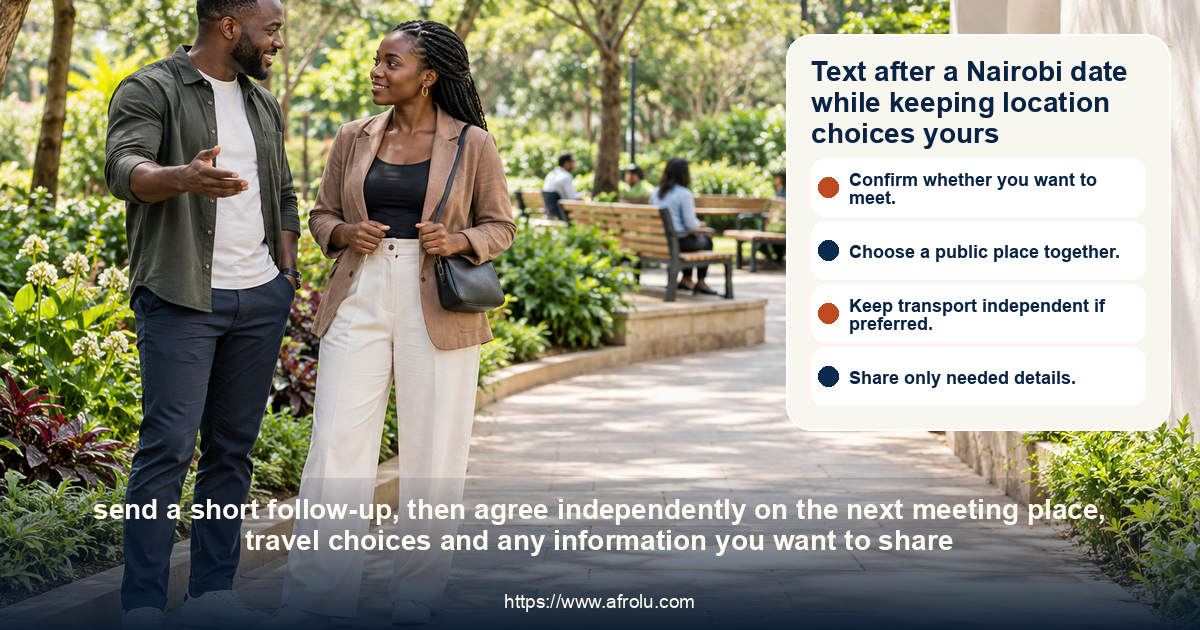
Agree on a meeting point while keeping transport and location disclosure in your control.
Written and edited by Ruth Akinyi · Local Dating Editor
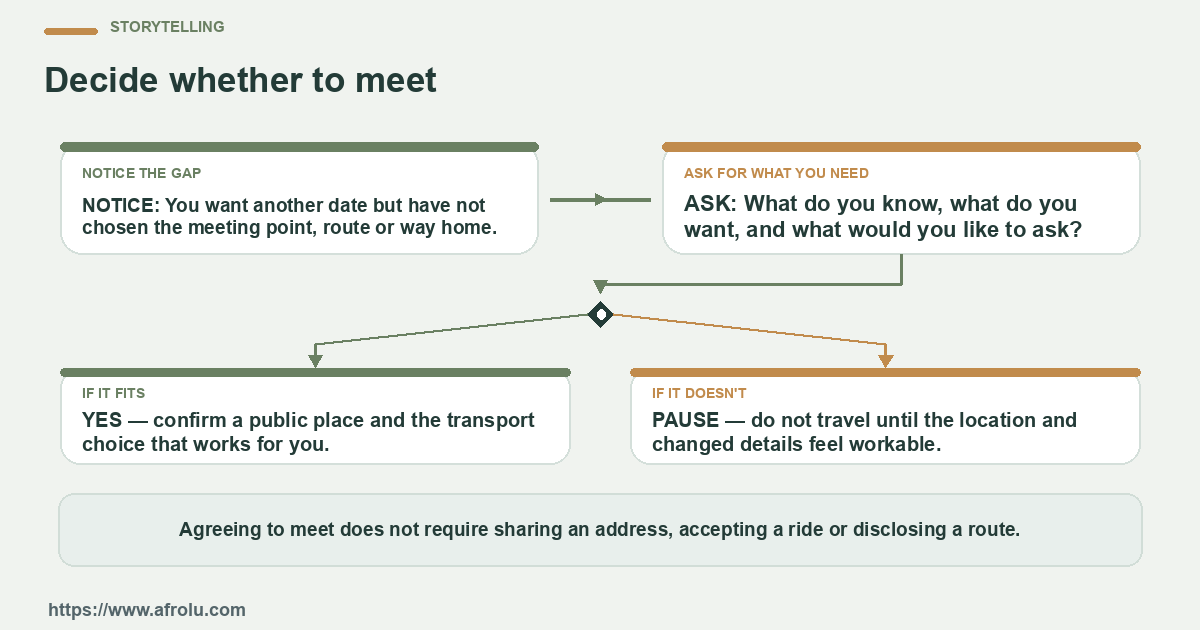
Say whether you want to meet again, then discuss the place and practical details separately. You may suggest a public location, arrange your own transport and keep your home address or live route private. A public venue is not a guarantee of safety. If plans change, pause and decide whether the revised details still work before travelling.
First dates · Late Entrants
How do I follow up after a Nairobi first date while keeping the next meeting and location details comfortable for me?
A safety-aware follow-up separates interest from logistics. It lets each adult choose whether to meet again, where to meet, how to travel and what information to share. A friendly post-date message is not consent to a ride, another activity, a location disclosure or a second meeting.
Illustrative scenario: After an enjoyable first meeting in Nairobi, one person sends a warm note and suggests seeing each other again. They agree on a public place and a daytime window, while each arranges their own transport. When the venue suggestion changes later, they pause to check whether the new location and route still suit them before confirming anything.
Decide whether to meet again
A positive message can stay separate from the logistics
You may have enjoyed the conversation and still want time to decide about a second meeting. If you do want to continue, send a direct note that says so. Do not treat a polite thank-you as an agreement to see the person again, and do not let the other adult treat your warm reply as permission to choose every detail.
A next date has several separate parts: whether you both want it, the activity, the location, timing, cost and travel. You can discuss these one at a time. A simple question such as “Would you like to meet again somewhere public next week?” opens the choice without requiring you to share your address or usual route.
Nairobi includes different neighbourhoods, traffic patterns and travel options, so the plan should reflect your actual circumstances rather than a generic checklist. Choose a place and time that make sense for you. You can decline a location or suggest another one without giving a detailed explanation of your home or routine.
Choose the meeting point
A public venue is one consideration, not a promise of safety
If a public setting feels right to you, suggest one that both adults can reach. Confirm the venue and meeting time before leaving. Consider daylight, traffic, cost, access and how you would return, based on your own needs. These choices can make a plan more practical, but no venue or arrangement can guarantee another person's behavior.
Keep control of your transport if that is what you prefer. A lift can be offered, accepted or declined; the offer is not a reason to give up your own plan. If you choose to travel together later, decide that separately and make sure the arrangement still feels comfortable. You do not owe a ride because someone paid for a meal or sent a kind message.
If the other person changes the location at the last minute, pause before travelling. Ask what changed and decide whether the new place works for you. You can keep the original plan, propose a different venue or cancel. The point is to make a fresh choice with current details rather than follow a change simply because you already said yes to meeting.

Review observable details when deciding whether an adult in Nairobi following up after a first date while protecting location, transport and personal boundaries fits.
Protect location and personal details
A second date does not require your home address
You can meet someone without sharing where you live, which building you work in or the route you take each day. A nearby public landmark may be enough to coordinate. Avoid sending real-time location, a home pin or a full itinerary just to prove that you trust the person. Trust is not created by disclosing more than you want.
Kenya's Office of the Data Protection Commissioner publishes information about personal-data rights and processing. Those rules address how data is handled; they do not make every private message confidential or verify a date's identity. This guide draws a practical privacy boundary from that distinction rather than presenting the law as a dating-safety guarantee.
If someone asks for a detail you would rather keep private, you can redirect: “I will meet you at the venue, but I do not share my home address.” If the person continues to press, you can reconsider the plan or stop contact. You do not have to disclose more in order to make a boundary legitimate.

Adapt one short question to discuss an adult in Nairobi following up after a first date while protecting location, transport and personal boundaries.
Keep each choice voluntary
A follow-up is not consent to another activity
A yes to coffee does not mean yes to a ride, a private location, physical contact or a later invitation. Each new choice deserves its own agreement. RAINN describes consent as voluntary and specific to an interaction; this is general educational material, not Kenyan legal advice. You may also decide that you no longer want to meet, even if the other person is disappointed.
Notice how a boundary is received, but do not turn one moment into a psychological diagnosis. A person may misunderstand; you can clarify once if you want. If they keep pushing after you have said no, you can end the exchange and use the options available to you. Your own comfort is enough reason to stop a plan.
For an upcoming meeting, consider what would help you make your own decisions: arranging your return, telling a trusted person if that feels useful, or choosing a time that fits your day. These are optional practical choices, not guarantees. Select the steps that suit your situation and avoid sharing more information than you want.
Confirm and choose again
A changed plan deserves a fresh decision
Before leaving, make sure you and the other adult mean the same venue, time and activity. If one detail changes, you can stop and review it before agreeing. Do not assume a change is harmless or dangerous from the message alone; check the practical facts available and choose based on your own comfort.
After meeting, reflect on what actually happened. Were the plans clear? Could each person ask for a change? Did you retain control over transport and information? These prompts are not a safety score, and a good first date cannot guarantee the next one. They can help you decide whether you want another interaction and what conditions you prefer.
If you decide not to continue, a concise message is enough: “Thank you for meeting. I do not want another date.” You may also stop replying or use block and report features if the situation calls for them. If you need local help, seek current Nairobi or Kenyan support information rather than relying on overseas hotline details.

Keep these choices nearby when an adult in Nairobi following up after a first date while protecting location, transport and personal boundaries.
Common moments in an adult in Nairobi following up after a first date while protecting location, transport and personal boundaries
An invitation stays broad
For an adult in Nairobi following up after a first date while protecting location, transport and personal boundaries: The idea of meeting is raised without a time, activity or place.
Ask for the detail you need and keep other plans until the invitation is confirmed.A free window moves
For an adult in Nairobi following up after a first date while protecting location, transport and personal boundaries: Work, sleep, travel or family changes when one adult is available.
Share an update and suggest a new option only if it works for you.A bounded plan is offered
For an adult in Nairobi following up after a first date while protecting location, transport and personal boundaries: Someone suggests send a short follow-up, then agree independently on the next meeting place, travel choices and any information you want to share with practical details.
Accept, decline or revise the plan without pressure.A response arrives later
For an adult in Nairobi following up after a first date while protecting location, transport and personal boundaries: A message appears after you have made another plan or gone to sleep.
Decide whether to respond now; do not treat timing as a relationship score.A label is unclear
For an adult in Nairobi following up after a first date while protecting location, transport and personal boundaries: The adults use the same dating word but have not described what it means.
Ask which term affects the next choice and explain your own meaning.The meeting point changes
For an adult in Nairobi following up after a first date while protecting location, transport and personal boundaries: The location or end time changes after the original plan.
Pause and choose again before agreeing to the new details.The preferences differ
For an adult in Nairobi following up after a first date while protecting location, transport and personal boundaries: One adult wants more contact, commitment or time than the other can offer.
Name the mismatch and decide whether the available arrangement suits you.A boundary is named
For an adult in Nairobi following up after a first date while protecting location, transport and personal boundaries: One person says a location, activity or disclosure does not feel right.
Respect the limit without repeated bargaining or punishment.Notice choices and actions, not imagined motives
The next meeting is proposed as an invitation, not an assumption.
A public place is selected by mutual agreement.
Each adult can arrange their own transport if that is preferred.
A home address is not demanded as proof of trust.
A ride offer can be declined without pressure.
The route and end time are considered before either adult agrees.
A location change is checked with the other person before travel.
A text about enjoying the date is not treated as consent to another activity.
Personal details are shared only when needed and chosen.
A request to move to another app is a separate choice.
Neither adult is pressured to send live location or travel alone.
The meeting plan can be paused if details change unexpectedly.
A boundary is accepted without repeated requests for justification.
A person can end contact even if the first date seemed pleasant.
Choose a response that fits the moment
| Situation | What it may mean | What to do next |
|---|---|---|
| An invitation stays broad | The idea of meeting is raised without a time, activity or place. | Ask for the detail you need and keep other plans until the invitation is confirmed. |
| A free window moves | Work, sleep, travel or family changes when one adult is available. | Share an update and suggest a new option only if it works for you. |
| A bounded plan is offered | Someone suggests send a short follow-up, then agree independently on the next meeting place, travel choices and any information you want to share with practical details. | Accept, decline or revise the plan without pressure. |
| A response arrives later | A message appears after you have made another plan or gone to sleep. | Decide whether to respond now; do not treat timing as a relationship score. |
| A label is unclear | The adults use the same dating word but have not described what it means. | Ask which term affects the next choice and explain your own meaning. |
| The meeting point changes | The location or end time changes after the original plan. | Pause and choose again before agreeing to the new details. |
| The preferences differ | One adult wants more contact, commitment or time than the other can offer. | Name the mismatch and decide whether the available arrangement suits you. |
| A boundary is named | One person says a location, activity or disclosure does not feel right. | Respect the limit without repeated bargaining or punishment. |
| The answer is uncertain | The other adult may be undecided or may want different terms; uncertainty alone does not establish motive. | Ask one practical follow-up, then choose your own limit. |
| Your comfort changes | A new feeling or changed circumstance can be enough reason to revise a plan. | Say what you want now and keep the next choice voluntary. |
Words you can adapt to your own voice
“I am interested in an adult in Nairobi following up after a first date while protecting location, transport and personal boundaries, and I want to be clear about what works for me.”
“Would you like to plan send a short follow-up, then agree independently on the next meeting place, travel choices and any information you want to share?”
“I enjoyed meeting you. If we meet again, can we agree on a public place and make our own way there?”
“I can share a public meeting point and broad availability, not your home address, live location or regular route, but I am keeping other details private.”
“Can we agree on a message sent when you can write clearly, followed by a plan only if both adults want one before I change my plans?”
“That time no longer works for me. I can suggest another option if I still want to.”
“It sounds as if we want different terms right now. Have I understood you?”
“My preference or availability has changed. Would you like to revisit what we discussed?”
“I am not comfortable with that plan, so I will not go ahead with it.”
“I can meet for about two hours, then I need to head home.”
“I want to think about that before I answer. I will get back to you if I decide to.”
“I have appreciated meeting you, but I do not want to continue dating.”
Know the difference
Compare a welcome message with separate travel choices with a follow-up treated as consent to share location
Each adult chooses whether to meet, how to travel and what location details to share.
One person assumes a positive text means the other must disclose an address or accept a ride.
Agreeing to meet does not require sharing an address, accepting a ride or disclosing a route.

Compare a shared agreement with an assumption in an adult in Nairobi following up after a first date while protecting location, transport and personal boundaries.
Compare a welcome message with separate travel choices and a follow-up treated as consent to share location
| Type or dimension | What it describes | Best next question |
|---|---|---|
| A feeling | Interest, uncertainty or disappointment describes an experience, not an agreement. | Notice it and decide whether you want to talk. |
| A label | Words such as casual or serious may mean different things to different adults. | Explain your meaning and ask what the other person means. |
| A present intention | A person can describe what they hope to explore without guaranteeing an outcome. | Ask what that intention means for a current choice. |
| A clear plan | A time, place, activity and practical details have been agreed. | Confirm the details and keep the choice voluntary. |
| A boundary | A person names what they will or will not do. | Respect it without asking repeatedly. |
| A changed plan | A schedule, location or comfort level has shifted. | Offer or accept a new option only if it works. |
| An open possibility | A future idea has been mentioned but no present step is agreed. | Separate hope from what is available today. |
| A mismatch | Two adults want different pace, contact or commitment. | Decide whether the actual arrangement suits you. |
| A new choice | Either adult wants to revise, pause or end the arrangement. | State the change and let both adults respond freely. |
Six practical ideas to keep nearby
No universal dating clock
A thoughtful pace is personal; this page does not set a number of dates or weeks.
Terms need explanation
A label is useful only when both adults understand what it means.
Small steps give context
For an adult in Nairobi following up after a first date while protecting location, transport and personal boundaries, one manageable next step may be more useful than a big promise.
Boundaries remain yours
You can protect time, privacy, money, transport and physical comfort.
Use what you can observe
Compare what was agreed with what happened without guessing motive.
Choose again
Continue, clarify, adjust, pause or stop as your needs change.
Questions for planning and reflection
Choose a few prompts that fit the moment. This is a reference library, not a list to complete.
Before a plan
Choose conditions that fit your real life.
- What do I want from this interaction?
- Which detail or boundary matters?
- What is one step I actually want?
During the conversation
Ask the question that affects your next choice.
- What does this term mean to me?
- What does the other adult want now?
- Can either of us say no freely?
Afterward
Notice your experience without turning it into a verdict.
- Could I be myself?
- Did the plan and boundary hold?
- Do I want another step?
If something changes
Revisit the plan without assigning motive.
- What changed?
- What do I want now?
- Would a pause or ending fit better?
What research and guidance can—and cannot—tell you
Kenyan data protection
Kenya's ODPC publishes information about personal data and data-subject rights.
Evidence limit: The law addresses data processing and does not guarantee confidentiality in a private chat.
Online dating privacy
Australia's eSafety Commissioner discusses location and personal information in dating.
Evidence limit: Its guidance is Australian and should not be treated as a Nairobi-specific safety assessment.
Safer dating choices
RAINN offers general suggestions for online and in-person meetings.
Evidence limit: No checklist can eliminate risk or guarantee behavior.
Consent
RAINN describes consent as voluntary, specific and ongoing.
Evidence limit: This is general U.S. education, not Kenyan legal advice.
Digital boundaries
love is respect discusses boundaries around communication and privacy.
Evidence limit: It is relationship education, not a location-safety guarantee.
Romance fraud
The FTC describes common money-request patterns in online romance scams.
Evidence limit: It is U.S. consumer guidance and cannot assess a specific Nairobi match.
Common assumptions that add pressure
Using availability as proof
Work, sleep and distance affect a schedule but do not reveal a person's whole intent.
Treating a label as an agreement
Adults can mean different things by casual, serious or exclusive.
Treating a call as verification
A conversation does not confirm every profile claim or future plan.
Promising travel before details
Time, cost, lodging and consent are separate practical choices.
Oversharing to create trust
A new connection does not need access to every private detail.
Demanding instant certainty
You can ask a direct present-tense question and allow an honest answer.
Choose the next meeting details yourself
These information links are clearly labelled, non-commercial and do not promise a relationship outcome.
Explore the guide library
Show more related guides
Continue with Afrolu
Show more Afrolu guides
Research and practical guidance used for this guide
Afrolu reviewed these health, research, safety, or public guidance resources while editing this page. They support the behaviour and safety guidance; they do not diagnose any individual described by a reader.
Questions about an adult in Nairobi following up after a first date while protecting location, transport and personal boundaries
Should I share my location after a first date?
That is your choice. A positive follow-up does not require live location or a home address.
How should I arrange a second date in Nairobi?
Agree on the place and practical details that affect you. Choose transport that feels manageable for you.
Is meeting in a public place a guarantee of safety?
No. A location can be one practical consideration, but it cannot guarantee another person's behavior.
Can I decline a lift?
Yes. You may choose your own transport without proving a reason.
What if they ask where I live?
Share only what you want. You can suggest meeting at a public location instead.
Should I text my friend the person's details?
You decide what information to share with someone you trust; consider your own privacy and context.
What if the agreed place changes at the last minute?
Pause and decide whether the new location still works before travelling.
Does a warm text mean I agreed to another date?
No. It can express appreciation; another meeting still needs a clear invitation and an answer.
Should I keep messaging if I feel uncomfortable?
No. You can stop replying, block or report through the service if that fits the situation.
Can I ask for a different meeting plan?
Yes. Suggest the conditions you prefer; the other adult can accept, decline or offer another option.
One thing to do now
Choose the next step that fits your actual needs
Express interest if you want to, then choose the meeting place, travel and information you are comfortable sharing as separate decisions.