After the first date · work-aware pace
Show interest after a date without promising constant contact
Write an honest follow-up after a first date during a busy work season. Share a real time window, set expectations and keep your other plans intact and open.
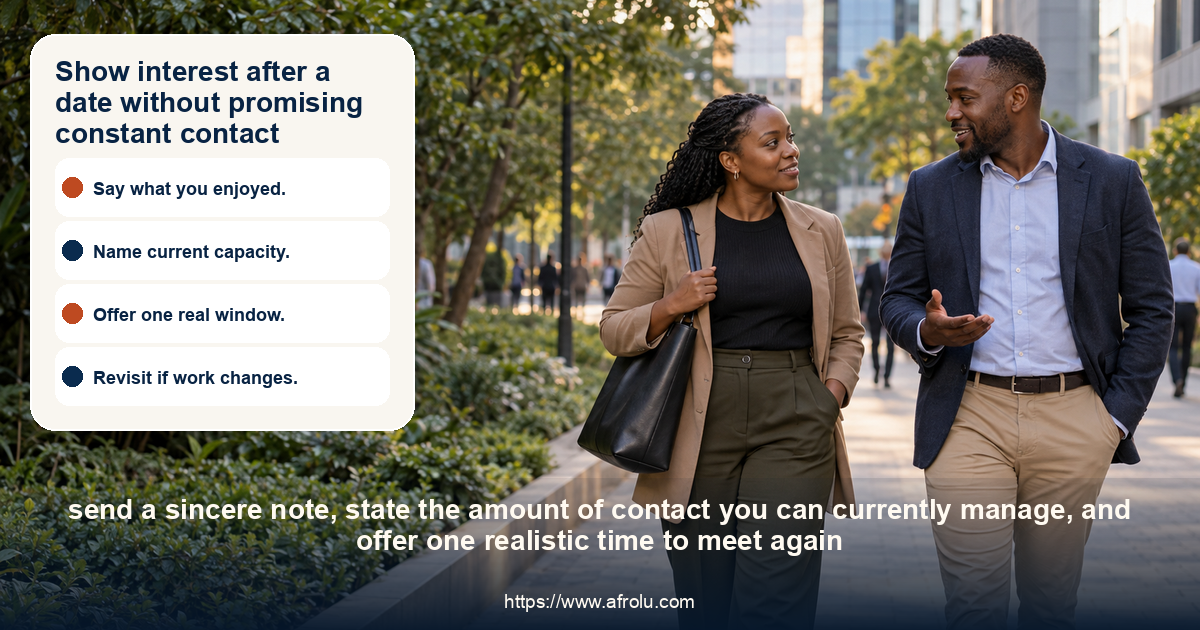
Offer a date window that fits the work capacity you can maintain.
Written and edited by Liya Bekele · Horn of Africa Editor
Send a sincere note when you can, mention that your week is full if it affects a plan, and offer a date you can realistically keep. There is no universal texting quota, and response speed alone does not establish interest. You do not owe employer or client details. If work changes your availability, update the other adult and decide whether you still want to reschedule.
First dates · Late Entrants
How can I show interest after a first date when work limits my time and response windows?
A work-aware follow-up aligns the words of interest with the time an adult can actually offer. It avoids promising constant contact to prevent disappointment and avoids treating a busy calendar as an excuse that must be proven. Each person can decide whether the current rhythm works for them.
Illustrative scenario: After dinner, one adult enjoyed the date but is entering a deadline week. They text the next day to say so, mention the part of the conversation they liked and offer the following Saturday if they genuinely want to meet again. The other adult can accept, suggest another window or decide that a slower pace is not right for them.
Separate interest from capacity
A busy week does not need to become a character test
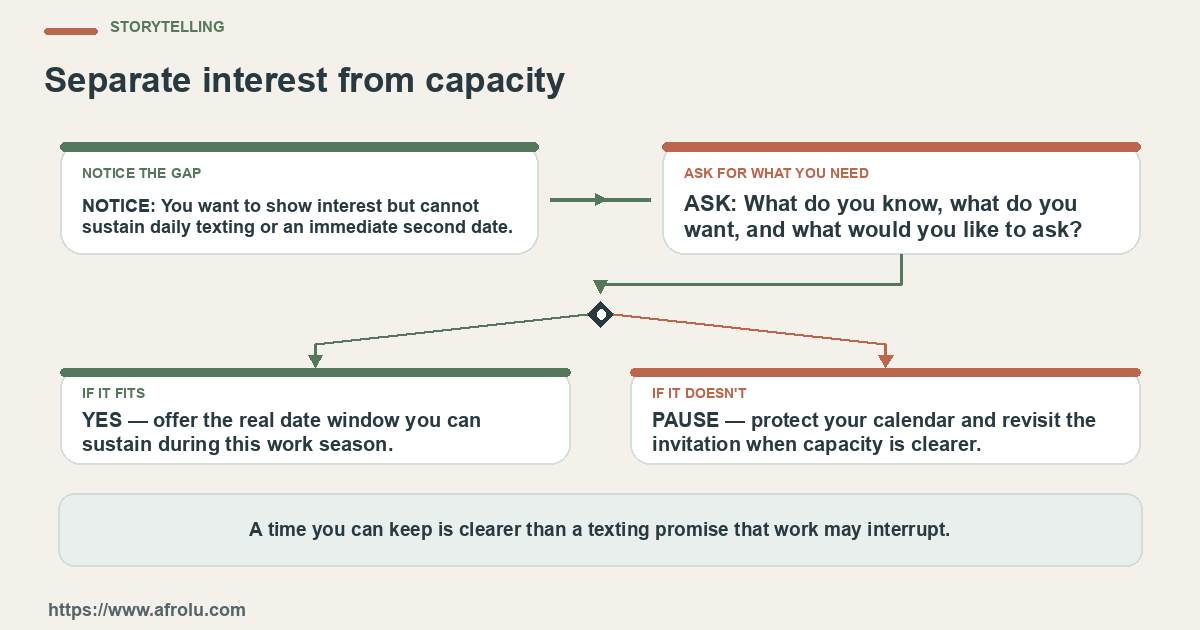
A first date may leave you interested while your work calendar remains crowded. You do not have to choose between pretending you have endless time and disappearing without context. A short message can express both truths: you enjoyed meeting, and you are not available to text or meet constantly this week.
No universal response window tells two adults what their connection means. A delayed message may have many explanations, including work, rest, access, uncertainty or simply a different communication style. If timing matters to your choice, ask about contact preferences directly rather than using a timestamp as a test neither person agreed to take.
You may share a broad description such as “I am in a deadline week” without naming your employer, client, project or confidential responsibilities. Give only enough context to make a plan understandable. The other adult can decide whether your current availability suits them, just as you can decide whether their preferred pace works for you.
Offer a time you can keep
A realistic invitation is kinder than a promise made under pressure
If you want another date, suggest a specific window that fits your real calendar. “I can do Saturday afternoon next week” is easier to answer than “soon” and does not require you to reserve every evening. Include an activity if you know what you want, or ask the other person what kind of plan suits them.
A date is not set until both adults have agreed on the relevant details. If the time depends on an uncertain work commitment, say so rather than presenting it as confirmed. Keep existing obligations until you decide to change them. You may choose not to rearrange work at all; dating does not require sacrificing a commitment to prove interest.
A reschedule can be direct: “My deadline moved and I cannot do Thursday. I would still like to meet next week; does Saturday afternoon suit you?” If you do not have another time or no longer want a second date, say that instead. Avoid offering a replacement merely to soften a no that you already mean.

Review observable details when deciding whether an adult with a demanding work season who wants to follow up after a first date without promising constant contact fits.
Discuss message expectations
Contact preferences can differ without either person being wrong
One adult may enjoy frequent messages; another may prefer a few thoughtful exchanges outside work. Neither preference automatically proves deeper interest. If you want to keep dating, explain what you can comfortably offer and ask what the other person prefers. Then decide whether there is enough overlap for both people to feel considered.
A message sent during a workday does not obligate an immediate response. You may mute notifications, focus on a task or rest without announcing each gap. If you know that a busy period will affect a plan, sharing that broad fact can help. You do not need to keep a conversation running all day to prove that the date mattered.
If your preferred rhythms remain far apart, name the practical mismatch rather than diagnosing motive. You might say, “I am not able to message throughout the day. Would a check-in in the evening work for you?” The other adult can answer honestly, and you can choose whether that arrangement suits you.

Adapt one short question to discuss an adult with a demanding work season who wants to follow up after a first date without promising constant contact.
Keep work and personal privacy
An explanation does not require confidential details
It may be enough to say that a launch, shift pattern or busy season is limiting your time. Do not forward work messages, reveal confidential schedules or share access credentials to make your explanation seem credible. Keep company systems, colleagues and clients outside a new dating connection unless there is a separate, appropriate reason to involve them.
Privacy runs in both directions. You can ask how someone prefers to communicate without requesting a full work calendar. The eSafety Commissioner discusses personal-information risks on dating services; its guidance is Australian and does not set employment rules, but it can prompt a careful choice about details shared online.
If someone repeatedly demands proof of your work or pressures you to cancel a meaningful obligation, decide what boundary you want. You might restate your availability once, suggest a different time or stop the conversation. A boundary is a choice about your own action; you do not need to convince the other person that your week is busy enough.
Review the pace as conditions change
One difficult week does not decide the future rhythm
After a few exchanges, notice whether both people can make and keep plans in the context of ordinary life. Is the communication clear enough for you? Do invitations include real options? Can either adult say that a week is too busy? These observations help you consider fit without turning one deadline or one delayed reply into a diagnosis.
A demanding season may pass, continue or change shape. You do not need to predict the exact date before communicating honestly. If you are not available to date for a while, you can say so and decide whether you want to leave the connection open. The other adult may choose a different path, and neither person has to wait indefinitely.
If you want to continue, set one next step that reflects the time you truly have. If you do not, end the conversation kindly and clearly. Career decisions and dating decisions should remain yours to make; do not promise to change roles or hours to secure a second meeting. A workable connection makes room for both people's actual lives.

Keep these choices nearby when an adult with a demanding work season who wants to follow up after a first date without promising constant contact.
Common moments in an adult with a demanding work season who wants to follow up after a first date without promising constant contact
An invitation stays broad
For an adult with a demanding work season who wants to follow up after a first date without promising constant contact: The idea of meeting is raised without a time, activity or place.
Ask for the detail you need and keep other plans until the invitation is confirmed.A free window moves
For an adult with a demanding work season who wants to follow up after a first date without promising constant contact: Work, sleep, travel or family changes when one adult is available.
Share an update and suggest a new option only if it works for you.A bounded plan is offered
For an adult with a demanding work season who wants to follow up after a first date without promising constant contact: Someone suggests send a sincere note, state the amount of contact you can currently manage, and offer one realistic time to meet again with practical details.
Accept, decline or revise the plan without pressure.A response arrives later
For an adult with a demanding work season who wants to follow up after a first date without promising constant contact: A message appears after you have made another plan or gone to sleep.
Decide whether to respond now; do not treat timing as a relationship score.A label is unclear
For an adult with a demanding work season who wants to follow up after a first date without promising constant contact: The adults use the same dating word but have not described what it means.
Ask which term affects the next choice and explain your own meaning.The meeting point changes
For an adult with a demanding work season who wants to follow up after a first date without promising constant contact: The location or end time changes after the original plan.
Pause and choose again before agreeing to the new details.The preferences differ
For an adult with a demanding work season who wants to follow up after a first date without promising constant contact: One adult wants more contact, commitment or time than the other can offer.
Name the mismatch and decide whether the available arrangement suits you.A boundary is named
For an adult with a demanding work season who wants to follow up after a first date without promising constant contact: One person says a location, activity or disclosure does not feel right.
Respect the limit without repeated bargaining or punishment.Notice choices and actions, not imagined motives
The message expresses interest without claiming unlimited availability.
A suggested time fits the sender's real calendar.
Work constraints are described broadly without exposing confidential details.
Neither adult is expected to reply during work hours.
The sender does not promise a texting frequency they cannot maintain.
A busy week is not treated as proof of low interest or high commitment.
A reschedule includes a new option only when one is genuine.
The recipient can say the proposed rhythm does not work for them.
A message is not used to demand immediate reassurance.
Rest and work obligations remain valid priorities.
Repeated cancellations are discussed as a practical pattern, not a diagnosis.
The date plan includes a time both adults confirm.
Both adults can revisit their expectations after a work change.
A mismatch can be acknowledged without asking someone to resign or reorganize.
Choose a response that fits the moment
| Situation | What it may mean | What to do next |
|---|---|---|
| An invitation stays broad | The idea of meeting is raised without a time, activity or place. | Ask for the detail you need and keep other plans until the invitation is confirmed. |
| A free window moves | Work, sleep, travel or family changes when one adult is available. | Share an update and suggest a new option only if it works for you. |
| A bounded plan is offered | Someone suggests send a sincere note, state the amount of contact you can currently manage, and offer one realistic time to meet again with practical details. | Accept, decline or revise the plan without pressure. |
| A response arrives later | A message appears after you have made another plan or gone to sleep. | Decide whether to respond now; do not treat timing as a relationship score. |
| A label is unclear | The adults use the same dating word but have not described what it means. | Ask which term affects the next choice and explain your own meaning. |
| The meeting point changes | The location or end time changes after the original plan. | Pause and choose again before agreeing to the new details. |
| The preferences differ | One adult wants more contact, commitment or time than the other can offer. | Name the mismatch and decide whether the available arrangement suits you. |
| A boundary is named | One person says a location, activity or disclosure does not feel right. | Respect the limit without repeated bargaining or punishment. |
| The answer is uncertain | The other adult may be undecided or may want different terms; uncertainty alone does not establish motive. | Ask one practical follow-up, then choose your own limit. |
| Your comfort changes | A new feeling or changed circumstance can be enough reason to revise a plan. | Say what you want now and keep the next choice voluntary. |
Words you can adapt to your own voice
“I am interested in an adult with a demanding work season who wants to follow up after a first date without promising constant contact, and I want to be clear about what works for me.”
“Would you like to plan send a sincere note, state the amount of contact you can currently manage, and offer one realistic time to meet again?”
“I enjoyed meeting you. This week is full, but I can meet next Saturday if you would like to plan something.”
“I can share the broad work constraint and a time you can offer, not employer names, clients or sensitive work details, but I am keeping other details private.”
“Can we agree on a message sent when you can write clearly, followed by a plan only if both adults want one before I change my plans?”
“That time no longer works for me. I can suggest another option if I still want to.”
“It sounds as if we want different terms right now. Have I understood you?”
“My preference or availability has changed. Would you like to revisit what we discussed?”
“I am not comfortable with that plan, so I will not go ahead with it.”
“I can meet for about two hours, then I need to head home.”
“I want to think about that before I answer. I will get back to you if I decide to.”
“I have appreciated meeting you, but I do not want to continue dating.”
Know the difference
Compare interest with an honest work window with availability promises made to avoid disappointment
A person names a real time they can offer and lets the other adult decide whether that rhythm suits.
Someone promises frequent messages or a quick reunion despite knowing work may prevent it.
A time you can keep is clearer than a texting promise that work may interrupt.

Compare a shared agreement with an assumption in an adult with a demanding work season who wants to follow up after a first date without promising constant contact.
Compare interest with an honest work window and availability promises made to avoid disappointment
| Type or dimension | What it describes | Best next question |
|---|---|---|
| A feeling | Interest, uncertainty or disappointment describes an experience, not an agreement. | Notice it and decide whether you want to talk. |
| A label | Words such as casual or serious may mean different things to different adults. | Explain your meaning and ask what the other person means. |
| A present intention | A person can describe what they hope to explore without guaranteeing an outcome. | Ask what that intention means for a current choice. |
| A clear plan | A time, place, activity and practical details have been agreed. | Confirm the details and keep the choice voluntary. |
| A boundary | A person names what they will or will not do. | Respect it without asking repeatedly. |
| A changed plan | A schedule, location or comfort level has shifted. | Offer or accept a new option only if it works. |
| An open possibility | A future idea has been mentioned but no present step is agreed. | Separate hope from what is available today. |
| A mismatch | Two adults want different pace, contact or commitment. | Decide whether the actual arrangement suits you. |
| A new choice | Either adult wants to revise, pause or end the arrangement. | State the change and let both adults respond freely. |
Six practical ideas to keep nearby
No universal dating clock
A thoughtful pace is personal; this page does not set a number of dates or weeks.
Terms need explanation
A label is useful only when both adults understand what it means.
Small steps give context
For an adult with a demanding work season who wants to follow up after a first date without promising constant contact, one manageable next step may be more useful than a big promise.
Boundaries remain yours
You can protect time, privacy, money, transport and physical comfort.
Use what you can observe
Compare what was agreed with what happened without guessing motive.
Choose again
Continue, clarify, adjust, pause or stop as your needs change.
Questions for planning and reflection
Choose a few prompts that fit the moment. This is a reference library, not a list to complete.
Before a plan
Choose conditions that fit your real life.
- What do I want from this interaction?
- Which detail or boundary matters?
- What is one step I actually want?
During the conversation
Ask the question that affects your next choice.
- What does this term mean to me?
- What does the other adult want now?
- Can either of us say no freely?
Afterward
Notice your experience without turning it into a verdict.
- Could I be myself?
- Did the plan and boundary hold?
- Do I want another step?
If something changes
Revisit the plan without assigning motive.
- What changed?
- What do I want now?
- Would a pause or ending fit better?
What research and guidance can—and cannot—tell you
Boundaries
love is respect encourages clear conversations about time and personal limits.
Evidence limit: It does not prescribe how often adults should message.
Consent
RAINN describes consent as voluntary and specific to the interaction.
Evidence limit: The material is general U.S. education, not legal advice.
Online privacy
eSafety describes privacy considerations for adults using dating services.
Evidence limit: Its platform recommendations are Australian and not a workplace confidentiality guide.
Safer dating
RAINN shares practical risk-reduction suggestions for meeting people.
Evidence limit: No schedule or venue guarantees another person's behavior.
Romance fraud
The FTC describes money requests that appear in online romance scams.
Evidence limit: The advice cannot establish intent in an individual conversation.
Work boundaries
The guide uses reader-directed planning rather than a research-backed texting quota.
Evidence limit: No source here establishes a universal response time or career-dating rule.
Common assumptions that add pressure
Using availability as proof
Work, sleep and distance affect a schedule but do not reveal a person's whole intent.
Treating a label as an agreement
Adults can mean different things by casual, serious or exclusive.
Treating a call as verification
A conversation does not confirm every profile claim or future plan.
Promising travel before details
Time, cost, lodging and consent are separate practical choices.
Oversharing to create trust
A new connection does not need access to every private detail.
Demanding instant certainty
You can ask a direct present-tense question and allow an honest answer.
Offer a time you can really keep
These information links are clearly labelled, non-commercial and do not promise a relationship outcome.
Explore the guide library
Show more related guides
Continue with Afrolu
Show more Afrolu guides
Research and practical guidance used for this guide
Afrolu reviewed these health, research, safety, or public guidance resources while editing this page. They support the behaviour and safety guidance; they do not diagnose any individual described by a reader.
Questions about an adult with a demanding work season who wants to follow up after a first date without promising constant contact
Should I text immediately after the date?
There is no universal timing rule. Send a thoughtful message when you can, rather than using speed to prove interest.
How do I show interest during a busy work week?
Say that you enjoyed the date, describe your current capacity briefly and offer a time you can actually keep.
Do I need to text every day?
No universal quota fits everyone. Discuss contact preferences and decide whether the actual rhythm suits you.
Should I explain what I do at work?
Only share what you choose. A broad note about a demanding week may be enough to explain availability.
What if I cannot meet for two weeks?
You may offer a date later if you genuinely want one; the other person may decide that the wait does not suit them.
Does a slow reply mean someone is not interested?
Not on its own. Work, rest and other circumstances are unknown unless the person chooses to explain them.
What if my schedule changes after I send the message?
Update the other adult and offer an alternative only if it is real. You can also decide not to reschedule.
Should I cancel work to make the second date?
That is your choice. Do not promise or rearrange work under pressure to prove romantic interest.
How can I tell if the pace works?
Compare what each adult wants and can offer over time; neither person has to accept a rhythm that feels wrong.
Can I stop dating during a demanding season?
Yes. You may pause or end contact when your capacity or preference changes.
One thing to do now
Choose the next step that fits your actual needs
Express interest, name only the work constraint that affects the plan, and offer a realistic time instead of an availability promise you cannot keep.