After the first date · casual clarity
Follow up after a first date without blurring casual intentions
Write a post-date text that shows interest without creating pressure. Explore casual expectations, direct invitations and room for either adult to choose.
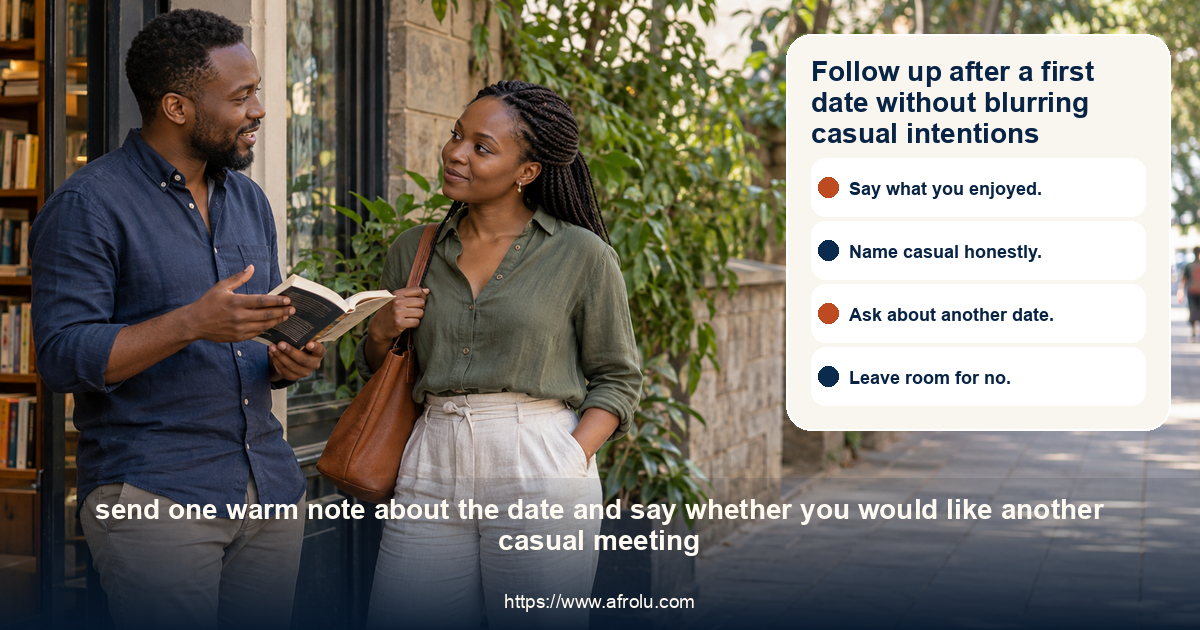
Close the loop with honest interest and make another casual invitation optional.
Written and edited by Amina Wanjiru · Senior Dating Apps Editor
Mention one thing you enjoyed, say whether you would like another date and describe what casual means to you if that affects the other person's decision. A short reply, kiss or second-date invitation does not establish exclusivity or a promise. Send a message you can stand behind, then let the other adult answer freely. You can appreciate the date and still decide later that you do not want to continue.
First dates · Late Entrants
What can I text after a first date if I want to see the person again but keep expectations casual and clear?
A clear post-date text closes the loop on one meeting and, when wanted, opens a specific next conversation. It separates appreciation, interest, a proposed date and relationship agreements instead of making one message carry all four meanings. Casual dating can still include honest expectations, consent, privacy and the freedom to change your mind.
Illustrative scenario: After an enjoyable coffee, one adult wants another date but is not looking for exclusivity. They send a note mentioning the conversation they liked, say they would be open to meeting again casually and ask whether the other adult wants that too. The recipient can answer yes, ask what casual means, suggest different terms or decline without being tested.
Close the loop
A kind follow-up does not need to solve the whole relationship
After a first date, a simple message can acknowledge the time you shared without turning it into a verdict. Mentioning one genuine detail, such as a funny story or a place you both discussed, sounds more personal than a copied line. You do not need a perfect script or a strategic delay to make the message count.
Then decide what you actually want to communicate. You may want another date, feel unsure, or prefer to end things kindly. A thank-you alone can express appreciation without promising a second meeting. If you do invite the person out, say so clearly enough that they do not need to decode a compliment as a plan.
There is no reliable universal hour for sending a follow-up. Reply timing alone does not disclose another adult's work, rest, access or interest. Send the message when you can be thoughtful and honest. After that, make your own plans rather than waiting beside your phone or treating silence as a complete account of what happened.
Make casual understandable
A label can describe different arrangements to different people
Casual may mean occasional dates, no current exclusivity, a lighter pace, or something else entirely. The word does not carry one universal agreement. If you already know that you do not want a committed relationship, say that plainly instead of using a warm invitation to leave the other person guessing about a point that matters to them.
You do not have to attach a long disclaimer to every text. A focused line can do the work: “I enjoyed meeting you and would like another date. I am dating casually at the moment; is that something you are open to?” This shares your current position and makes space for an answer without asking the recipient to accept it.
If your preference is still developing, describe that uncertainty rather than presenting it as a fixed plan. You can ask what the other person hopes for and decide whether you want to continue with the information available. A different preference is not proof that either adult behaved badly. It may simply mean the arrangement does not suit both people.

Review observable details when deciding whether an adult who enjoyed a first date but wants casual interest to stay honest and understandable fits.
Offer a real next step
An invitation is more useful when it can be answered
If you want another date, offer one manageable idea rather than a vague “we should do this again sometime.” You might mention a weekend market, a short walk or a place you discussed. Add a day or broad time window when you know it works. The other person can accept, decline or suggest another option.
Avoid sending a string of invitations to force clarity from someone who has not replied. One direct message is usually enough to make your interest understandable. You can decide how long you are comfortable leaving the invitation open, then resume your day. The recipient owes you neither an immediate answer nor a second date because the first one was pleasant.
Before treating the next meeting as a plan, confirm the activity, time and practical details that matter to each of you. You may want to discuss cost, transport, physical boundaries or whether you are meeting casually. Keep the details proportionate to the invitation. A short date can be clear without demanding a promise about the relationship's future.

Adapt one short question to discuss an adult who enjoyed a first date but wants casual interest to stay honest and understandable.
Keep consent and boundaries current
One date does not grant continuing access
A pleasant evening does not create an obligation to keep texting, share photographs, move to another messaging service or agree to another date. If you want to continue contact, make the invitation and let the other person answer. A yes to one interaction applies to that choice; it does not decide every later one.
RAINN's public education describes consent as voluntary and specific to an interaction. This guide uses that principle as general relationship education, not as a statement of Kenyan law. A boundary can also concern topics, money, timing, privacy or how you travel. You may state what you will do without demanding that another adult share your view.
If the person declines or does not respond, you can feel disappointed and still respect the choice. If your own comfort changes, you can withdraw an invitation or end contact. A boundary does not need a courtroom case behind it. Brief, respectful communication is often enough; if a situation feels unsafe, prioritize practical support that fits your circumstances.
Choose after you know more
A second date is one choice, not a contract
After sending a follow-up, pay attention to what was actually agreed and how you feel, not to a hidden score based on how quickly a reply appears. Did both people explain what they wanted? Was the invitation mutual? Could each person say no or suggest a different plan? These questions can help you decide whether the arrangement suits you today.
If you meet again, you can revisit casual expectations as your preferences become clearer. You do not owe a definitive label because someone asks, and you should not imply certainty you do not feel. If expectations differ, name the difference and decide whether you want to continue. You may pause, adjust the pace or end dating without first proving fault.
If you are unsure, send a message that reflects that uncertainty: “I enjoyed meeting you. I am still deciding whether I want another date, so I do not want to imply a plan yet.” This gives the other adult useful information and protects both people's ability to choose. Clear does not mean cold; it means the words and the intention match.

Keep these choices nearby when an adult who enjoyed a first date but wants casual interest to stay honest and understandable.
Common moments in an adult who enjoyed a first date but wants casual interest to stay honest and understandable
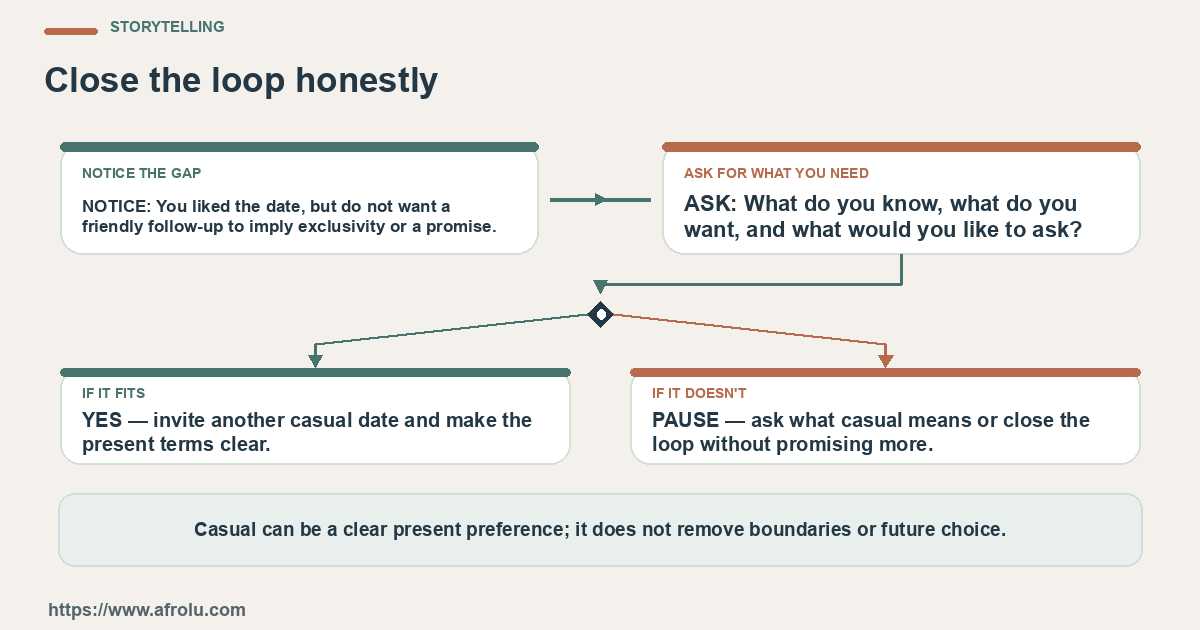
An invitation stays broad
For an adult who enjoyed a first date but wants casual interest to stay honest and understandable: The idea of meeting is raised without a time, activity or place.
Ask for the detail you need and keep other plans until the invitation is confirmed.A free window moves
For an adult who enjoyed a first date but wants casual interest to stay honest and understandable: Work, sleep, travel or family changes when one adult is available.
Share an update and suggest a new option only if it works for you.A bounded plan is offered
For an adult who enjoyed a first date but wants casual interest to stay honest and understandable: Someone suggests send one warm note about the date and say whether you would like another casual meeting with practical details.
Accept, decline or revise the plan without pressure.A response arrives later
For an adult who enjoyed a first date but wants casual interest to stay honest and understandable: A message appears after you have made another plan or gone to sleep.
Decide whether to respond now; do not treat timing as a relationship score.A label is unclear
For an adult who enjoyed a first date but wants casual interest to stay honest and understandable: The adults use the same dating word but have not described what it means.
Ask which term affects the next choice and explain your own meaning.The meeting point changes
For an adult who enjoyed a first date but wants casual interest to stay honest and understandable: The location or end time changes after the original plan.
Pause and choose again before agreeing to the new details.The preferences differ
For an adult who enjoyed a first date but wants casual interest to stay honest and understandable: One adult wants more contact, commitment or time than the other can offer.
Name the mismatch and decide whether the available arrangement suits you.A boundary is named
For an adult who enjoyed a first date but wants casual interest to stay honest and understandable: One person says a location, activity or disclosure does not feel right.
Respect the limit without repeated bargaining or punishment.Notice choices and actions, not imagined motives
The message refers to one real moment from the date rather than a copied compliment.
The invitation says whether another meeting is wanted.
Casual is explained instead of used as a substitute for clarity.
Neither person assumes that a warm reply means exclusivity.
The next suggestion includes a day or activity only if it is genuine.
Both adults can keep their own plans while a time is undecided.
A slower reply is not treated as a diagnosis of interest.
A no or different preference is accepted without bargaining.
Physical affection during a date is not treated as consent to future contact.
A request to move platforms can be considered separately from interest.
The writer avoids implying that the recipient owes a response.
The second plan is discussed before either person changes commitments.
A mismatch about casual terms can be named without blame.
Either adult can change their mind after sending a positive message.
Choose a response that fits the moment
| Situation | What it may mean | What to do next |
|---|---|---|
| An invitation stays broad | The idea of meeting is raised without a time, activity or place. | Ask for the detail you need and keep other plans until the invitation is confirmed. |
| A free window moves | Work, sleep, travel or family changes when one adult is available. | Share an update and suggest a new option only if it works for you. |
| A bounded plan is offered | Someone suggests send one warm note about the date and say whether you would like another casual meeting with practical details. | Accept, decline or revise the plan without pressure. |
| A response arrives later | A message appears after you have made another plan or gone to sleep. | Decide whether to respond now; do not treat timing as a relationship score. |
| A label is unclear | The adults use the same dating word but have not described what it means. | Ask which term affects the next choice and explain your own meaning. |
| The meeting point changes | The location or end time changes after the original plan. | Pause and choose again before agreeing to the new details. |
| The preferences differ | One adult wants more contact, commitment or time than the other can offer. | Name the mismatch and decide whether the available arrangement suits you. |
| A boundary is named | One person says a location, activity or disclosure does not feel right. | Respect the limit without repeated bargaining or punishment. |
| The answer is uncertain | The other adult may be undecided or may want different terms; uncertainty alone does not establish motive. | Ask one practical follow-up, then choose your own limit. |
| Your comfort changes | A new feeling or changed circumstance can be enough reason to revise a plan. | Say what you want now and keep the next choice voluntary. |
Words you can adapt to your own voice
“I am interested in an adult who enjoyed a first date but wants casual interest to stay honest and understandable, and I want to be clear about what works for me.”
“Would you like to plan send one warm note about the date and say whether you would like another casual meeting?”
“I enjoyed meeting you. Would you like to see each other again casually, with clear expectations?”
“I can share your current preference and a simple invitation, not private contact details or a promise about the future, but I am keeping other details private.”
“Can we agree on a message sent when you can write clearly, followed by a plan only if both adults want one before I change my plans?”
“That time no longer works for me. I can suggest another option if I still want to.”
“It sounds as if we want different terms right now. Have I understood you?”
“My preference or availability has changed. Would you like to revisit what we discussed?”
“I am not comfortable with that plan, so I will not go ahead with it.”
“I can meet for about two hours, then I need to head home.”
“I want to think about that before I answer. I will get back to you if I decide to.”
“I have appreciated meeting you, but I do not want to continue dating.”
Know the difference
Compare warm interest with plain terms with a pleasant message treated as an agreement
The sender says what they enjoyed and invites another date while leaving the other adult free to answer.
One person assumes that a quick reply, a kiss or a second-date idea settles exclusivity or commitment.
Casual can be a clear present preference; it does not remove boundaries or future choice.

Compare a shared agreement with an assumption in an adult who enjoyed a first date but wants casual interest to stay honest and understandable.
Compare warm interest with plain terms and a pleasant message treated as an agreement
| Type or dimension | What it describes | Best next question |
|---|---|---|
| A feeling | Interest, uncertainty or disappointment describes an experience, not an agreement. | Notice it and decide whether you want to talk. |
| A label | Words such as casual or serious may mean different things to different adults. | Explain your meaning and ask what the other person means. |
| A present intention | A person can describe what they hope to explore without guaranteeing an outcome. | Ask what that intention means for a current choice. |
| A clear plan | A time, place, activity and practical details have been agreed. | Confirm the details and keep the choice voluntary. |
| A boundary | A person names what they will or will not do. | Respect it without asking repeatedly. |
| A changed plan | A schedule, location or comfort level has shifted. | Offer or accept a new option only if it works. |
| An open possibility | A future idea has been mentioned but no present step is agreed. | Separate hope from what is available today. |
| A mismatch | Two adults want different pace, contact or commitment. | Decide whether the actual arrangement suits you. |
| A new choice | Either adult wants to revise, pause or end the arrangement. | State the change and let both adults respond freely. |
Six practical ideas to keep nearby
No universal dating clock
A thoughtful pace is personal; this page does not set a number of dates or weeks.
Terms need explanation
A label is useful only when both adults understand what it means.
Small steps give context
For an adult who enjoyed a first date but wants casual interest to stay honest and understandable, one manageable next step may be more useful than a big promise.
Boundaries remain yours
You can protect time, privacy, money, transport and physical comfort.
Use what you can observe
Compare what was agreed with what happened without guessing motive.
Choose again
Continue, clarify, adjust, pause or stop as your needs change.
Questions for planning and reflection
Choose a few prompts that fit the moment. This is a reference library, not a list to complete.
Before a plan
Choose conditions that fit your real life.
- What do I want from this interaction?
- Which detail or boundary matters?
- What is one step I actually want?
During the conversation
Ask the question that affects your next choice.
- What does this term mean to me?
- What does the other adult want now?
- Can either of us say no freely?
Afterward
Notice your experience without turning it into a verdict.
- Could I be myself?
- Did the plan and boundary hold?
- Do I want another step?
If something changes
Revisit the plan without assigning motive.
- What changed?
- What do I want now?
- Would a pause or ending fit better?
What research and guidance can—and cannot—tell you
Boundaries and communication
love is respect offers guidance for naming relationship boundaries and preferences.
Evidence limit: It is U.S.-based educational material, not a formula for what casual dating must mean.
Consent
RAINN explains that consent should be voluntary and specific to an interaction.
Evidence limit: The resource is general U.S. education, not local legal advice.
Digital privacy
Australia's eSafety Commissioner discusses privacy risks in online dating.
Evidence limit: Its platform guidance is Australian and cannot guarantee a private message stays private.
Safer dating choices
RAINN suggests practical steps for online and in-person dating.
Evidence limit: No checklist can guarantee another person's conduct.
Romance fraud
The FTC describes common online romance scam patterns and money requests.
Evidence limit: This U.S. consumer guidance cannot determine an individual match's motive.
Financial requests
The FTC advises people not to send money to an online romantic contact.
Evidence limit: This source addresses fraud prevention, not ordinary dating etiquette.
Common assumptions that add pressure
Using availability as proof
Work, sleep and distance affect a schedule but do not reveal a person's whole intent.
Treating a label as an agreement
Adults can mean different things by casual, serious or exclusive.
Treating a call as verification
A conversation does not confirm every profile claim or future plan.
Promising travel before details
Time, cost, lodging and consent are separate practical choices.
Oversharing to create trust
A new connection does not need access to every private detail.
Demanding instant certainty
You can ask a direct present-tense question and allow an honest answer.
Send a warm follow-up with clear casual terms
These information links are clearly labelled, non-commercial and do not promise a relationship outcome.
Explore the guide library
Show more related guides
Continue with Afrolu
Show more Afrolu guides
Research and practical guidance used for this guide
Afrolu reviewed these health, research, safety, or public guidance resources while editing this page. They support the behaviour and safety guidance; they do not diagnose any individual described by a reader.
Questions about an adult who enjoyed a first date but wants casual interest to stay honest and understandable
How soon should I text after a first date?
There is no reliable universal clock. Send a message when you can say what you mean; timing by itself does not prove interest.
What can I text if I want another casual date?
Mention something you enjoyed, say you would like to meet again, and describe casual in the present terms that matter to you.
Does a quick reply mean they want a relationship?
No. A reply shows that a message was answered; it does not establish exclusivity, intent or a future agreement.
Should I say I only want something casual?
If that affects the other adult's choice, describe your present preference plainly and invite them to share theirs.
Do I owe a second date because the first went well?
No. Either adult may decide not to continue, even after a pleasant meeting.
What if I am unsure whether I want another date?
You can wait, reply kindly without promising, or say you need time. Avoid sending an invitation you do not mean.
Does a delayed reply mean rejection?
Not on its own. You can decide how long you want to leave an invitation open without guessing the reason for silence.
When should we discuss exclusivity?
When it affects your choices. Ask directly; do not infer it from the number of dates or message frequency.
Can casual dating still have boundaries?
Yes. Discuss contact, consent, privacy and expectations that matter to either adult.
What if we mean different things by casual?
Explain the mismatch and decide whether the arrangement each person wants still works.
One thing to do now
Choose the next step that fits your actual needs
Name one real moment, state the next step you want and keep the other adult free to answer without pressure.