Three-window planning table · parent weekend clarity
Plan a Low-Pressure Weekend Without Exposing Family Life
A sourced parent guide to talking-stage weekends: offer adult time, protect child data, make low-pressure plans, review conduct and close the route clearly.
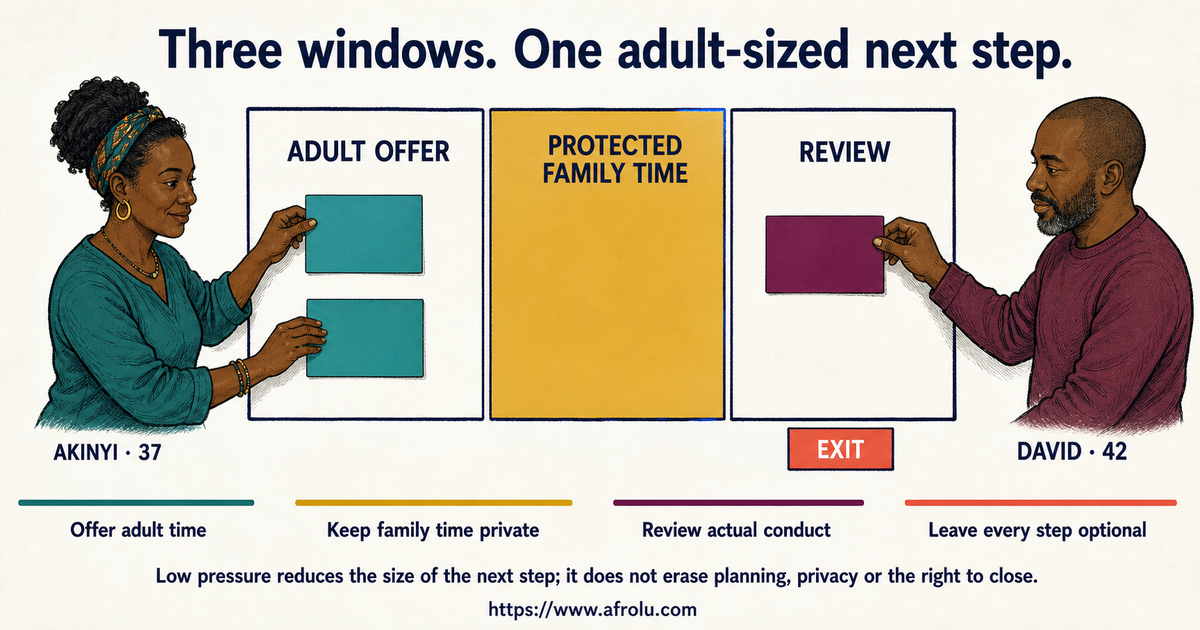
Keep the family window closed and make the adult offer answerable.
Written and edited by Grace Mutiso · Kenya Guides Editor
Use three windows. Put only freely offered adult time in ADULT OFFER, leave PROTECTED FAMILY TIME opaque, and put answers, counters, notice, delivery and respected exit in REVIEW. Then MEET ONCE, KEEP TALKING, SET A RHYTHM, ACCEPT A COUNTER, PROTECT TIME, PAUSE, CLOSE or SEEK PROTECTION according to present adult conduct.
Early relationship discovery · Parents Returning To Dating
How can an adult parent turn warm talking-stage interest into one answerable weekend plan without exposing a family calendar, confusing low pressure with ambiguity or letting a meeting open money, home, child or consent access?
A talking stage is informal adult romantic discovery before relationship scope or exclusivity is fully agreed. Low pressure means a small, voluntary and revisable next step, not vague access or low care. Parent status can be disclosed while all child and household data remains closed, because adult availability is enough to plan an adult date.
Akinyi, 37, and David, 42, are fictional Black African adult parents. Akinyi offers two adult weekend windows; David counters one with a different hour and shorter duration; they meet publicly and review separately. The story contains no child likeness, identity, voice, schedule, location, household fact, real contact or guaranteed romantic outcome.
Grace's three-window weekend table
Make one adult offer visible and every family detail unavailable
Grace keeps parenthood free of stereotype, low pressure answerable and the weekend small enough to enter, revise or release.
Offer adult time, close protected family time, review observable conduct and choose one route without scoring either adult.
Adult offer
Show only a freely chosen time, duration, place, channel or activity.
Protected time
Leave every child, household, care, location and calendar detail opaque.
Review
Record answer, counter, notice, completion, repair and acceptance of no.
Return choice
Meet, talk, redesign, pause, close or protect from the strongest fact.
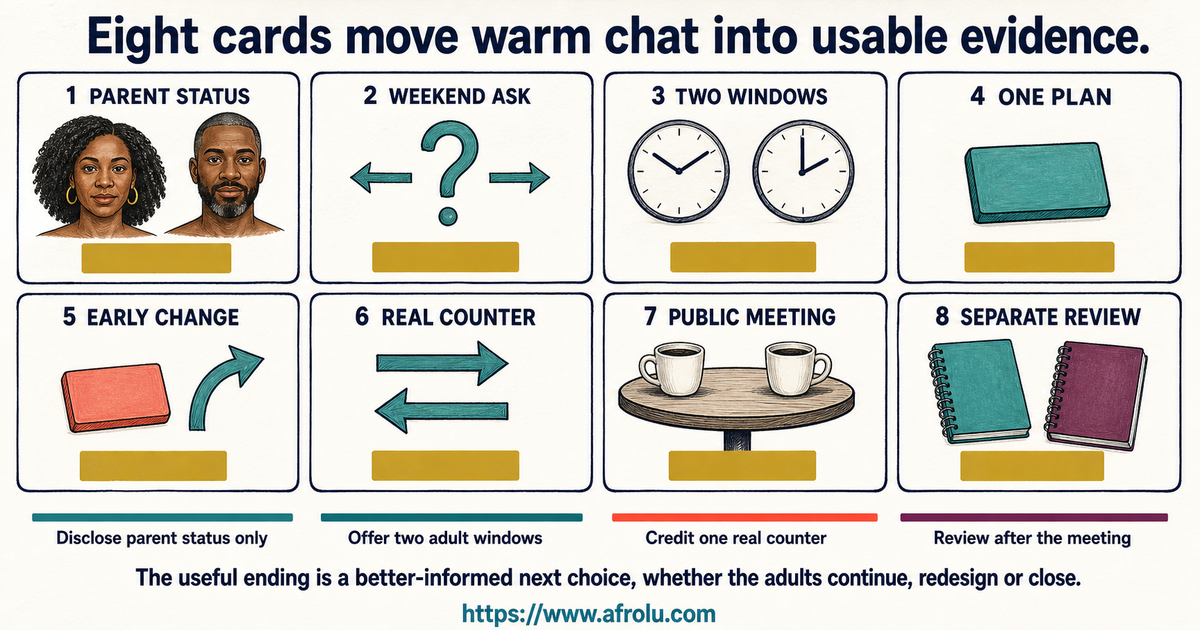
Define the stage before arranging the weekend
Talking, parenting and low pressure describe three different facts
A talking stage is the informal period in which adults are learning whether a romantic connection has enough mutual interest and fit to take shape. It is not automatically exclusive, casual, serious or a relationship. Warm messages, a match, repeated calls or a future idea cannot decide the scope alone. Name what exists today and allow both adults to revise it.
Parent means an adult has responsibilities and relationships outside this new contact. It does not reveal availability, household form, caregiving arrangement, income, seriousness or desire for family integration. Parent status may be shared when the adult chooses; a child's name, likeness, voice, age, school, routine, location, caregiver, device and calendar remain unnecessary for early romantic planning.
Low pressure means the next action is limited, voluntary and easy to revise. It does not mean low attention, indefinite ambiguity or a request that one adult reserve every weekend. A short public meeting can be low pressure and precise. Months of affectionate uncertainty can feel light in language while placing a heavy unspoken claim on time and hope.
Weekend describes one adult planning period, not a universal dating timetable. Some parents work weekends, observe religious time, rest, study, travel or have no dating availability then. The useful question is not why every other hour is closed. It is whether an adult can make one offer, receive a real counter, protect private time and choose again after observable conduct.
Use three windows instead of one exposed calendar
Adult offer, protected family time and review keep coordination proportionate
ADULT OFFER contains only time this adult freely wants to make available for dating. A useful entry names a day, approximate start, duration or activity and a workable response point. Two options can reduce back-and-forth, but one option is still a valid offer. An unanswered invitation stays an invitation; it never becomes a booking through silence or enthusiasm alone.
PROTECTED FAMILY TIME is deliberately blank. It holds whatever responsibilities, rest and relationships are not part of the dating offer without displaying why. The other adult does not need a care rota, household address, family photograph, school reference, caregiver identity or live calendar screenshot to respond. Privacy can be complete and the offered time can still be honest.
REVIEW happens after the answer or event, not while hope is filling the table. Record whether the person accepted, declined, supplied a counter that changed a fact, gave useful notice, arrived, participated, respected the ending and left privacy intact. A review is qualitative and local; it does not combine kindness, punctuality and attraction into a compatibility or safety score.
The table closes after one cycle. If Saturday is declined and Sunday is countered, the adults decide on Sunday or release the weekend. If no answer arrives by the stated planning point, the offering adult returns the time to personal use. Neither adult is punished. The device prevents a small talking-stage possibility from occupying every unoffered part of adult life.
Follow one adult-only planning cycle
Akinyi and David use notice and a counter without disclosing a family schedule
After two weeks of enjoyable conversation, Akinyi asks whether David wants a short public meeting. She says she is a parent and keeps family information private during early dating. She offers Saturday at 15:00 or Sunday at 18:00, each for about an hour. The proposal says nothing about home, family members, care arrangements or the rest of either day.
David wants to meet but cannot use either option. Before Akinyi's planning point, he counters with Sunday at 16:30 at a staffed public café and asks whether forty-five minutes would work. His counter changes the start, duration and place; it does not ask Akinyi to justify her other time. Akinyi accepts and keeps her own transport and departure plan.
On Sunday David sends proportionate notice that he will be ten minutes late, arrives within that revised time and asks about Akinyi's interests rather than her household. Akinyi enjoys the conversation. Neither treats one pleasant meeting as exclusivity, family readiness or proof of future reliability. The meeting completes only the plan that both adults actually made.
They review separately. Akinyi wants another adult date and a similarly bounded rhythm. David likes her and realises he cannot sustain weekend planning this month, so he offers one midweek call without a promise beyond it. Akinyi may accept, counter or close. The story's success is not continued romance; it is that privacy, choice and an honest capacity difference survived the cycle.
Disclose parent status without opening child data
Availability can be shared while names, images, places and family access remain closed
An adult may say, 'I am a parent and I plan dates around existing responsibilities.' That sentence offers relevant context without inviting inspection. It does not owe the number, ages or genders of children; a school, routine, location, photograph, video or voice note; another caregiver's identity; a household calendar; or an explanation of why one weekend window is unavailable.
Australia's eSafety Commissioner explicitly advises people to minimise profile information about children, avoid child images or videos on dating profiles, prevent a dating contact from contacting children and avoid meetings while children are present. The warning is strong and relevant, but its services, laws and evidence base are Australian. This guide adopts the narrower privacy habit without claiming universal legal effect.
A second eSafety resource explains that photographs, videos, school names, addresses and contact details may reveal identifying information or travel beyond the intended audience. That does not mean every parent has the same online practice. It means a new romantic contact never needs a child's likeness or identifying data as proof that the parent's availability, affection or stated family boundary is genuine.
If a contact repeatedly asks to see, speak with or locate a child, seeks school or household facts, proposes an early family meeting, or approaches a family channel after being refused, stop treating this as ordinary weekend coordination. Share nothing further. Consider platform reporting, account and location security, safe evidence preservation and current locally appropriate protection rather than another test of romantic patience.

Read the adult offer; never inspect the family system.
Keep ease and clarity in the same plan
Notice, delivery and a review point distinguish flexibility from a holding pattern
A low-pressure ask permits four usable answers: yes, a real counteroffer, not now or no. The offering adult does not make disappointment into punishment. The receiving adult does not keep the weekend indefinitely by replying with affection but no answer. A decision point can be practical rather than dramatic: if no plan is agreed by Friday afternoon, both calendars are free.
Relational-uncertainty research can support humility about ambiguous romantic communication, but it cannot prescribe this table. Two laboratory studies examined cortisol responses during staged hurtful or supportive interactions among young adults connected to one eastern United States university. Their samples, tasks and existing dating relationships differ markedly from adult parents arranging a talking-stage weekend, and associations do not diagnose any individual.
A recent qualitative study of 35 lone mothers in French-speaking Switzerland found varied expectations about repartnering along adult- and family-oriented positions. It excluded fathers from the final analysis and reflects interviews from 2012 to 2015 in Vaud and Geneva. Use it only against one-size-fits-all assumptions: parents do not share one romantic project, timetable or desired level of integration.
Clarity therefore comes from this pair's actual conduct. Did the question receive an answer? Did a counter change a time, duration, activity or scope? Was notice early enough to make another choice? Did the agreed plan happen, and could either adult close afterward? These observations cannot certify safety or long-term fit, but they can end an indefinite weekend reservation.
Protect the route around the meeting
Public plans, independent money, adult consent and direct-risk exits stay separate
For a first meeting, consider a staffed public place, independent arrival and departure, a charged phone under one's control and a check-in with a trusted adult. Share the meeting plan with that trusted person rather than a child. Do not move the venue to a private home because the talking stage feels unusually warm or because a short weekend window seems inconvenient.
Keep money independent. Each adult can control their own ordinary spending and transport. A request for fare, an emergency transfer, investment, gift card, cryptocurrency, code, account access or paid verification is not made safer by parenthood, serious language or a promised weekend. The United States Federal Trade Commission offers useful fraud warnings, but US reporting and recovery routes do not automatically apply elsewhere.
Consent remains specific, voluntary, informed, present and revisable for each adult act. A match, parent disclosure, scheduled date, paid drink, previous yes or later intention does not decide touch, sexual conversation, images, exclusivity or another meeting. The World Health Organization's sexual-health framework supports respectful and coercion-free interaction globally; it is not a personal medical plan or local consent-law opinion.
Threats, tracking, account intrusion, financial deception, image abuse, coercion, attempted child access or contact that overrides no do not belong in the three-window review. End the planning route, reduce reachable family and location data, save relevant records only when safe, and identify the provider, financial, specialist, legal or emergency response appropriate to the event. Never arrange a meeting merely to gain certainty.

Say what is available and keep every private family fact closed.
Return the weekend through one honest route
Continue, redesign, pause, close or protect without ranking the adults
MEET ONCE when one bounded public plan is wanted and feasible. KEEP TALKING when both prefer conversation and no meeting promise is being implied. SET A RHYTHM when recurring contact would benefit from an explicit frequency and review. ACCEPT A COUNTER when the changed time, duration, channel or scope genuinely fits rather than merely preventing an ending.
PROTECT TIME when the romantic offer is acceptable but unoffered hours keep being treated as negotiable. Restate only the adult window and release the rest without defence. PAUSE as a complete present stop without secret exclusivity, a guaranteed return date or repeated check-ins. A pause should give time back, not turn one adult into the keeper of a dormant future.
CLOSE when the available pace, intention or weekend pattern does not fit. Akinyi or David can end after a polite date, an honest counter or no wrongdoing at all. They owe no parenting evidence, personality theory or final debate. SEEK PROTECTION when fraud, coercion, tracking, child-access attempts, image abuse, threat or defeated closure is the strongest present fact.
The practical next step offers three distinct routes: understand the talking stage, design a mutually slower dating rhythm, or prepare for first-date anxiety without exposing a family system. Choose only the question that exists today. The table has done its job when an adult offer is answerable, protected time stays opaque and the weekend returns whether romance continues or not.

A small route can deepen discovery or return the weekend.
Eight moments when a parent weekend needs one visible adult decision
Context without a family file
An adult says they are a parent and offers one date window without explaining the household, care arrangement or closed hours.
Answer the adult offer and leave every child and family detail unrequested.A weekend becomes answerable
Saturday afternoon or Sunday evening is offered for one short public meeting, with a Friday planning point.
Accept one, make a fact-changing counter or release the weekend completely.Affection does not reserve the slot
A friendly reply says meeting would be lovely sometime but accepts, declines and counters neither option.
Name the planning point once, then return the time if no agreement forms.The new proposal changes the plan
Neither offered window works, so the other adult proposes a different hour, shorter duration and public place before the deadline.
Decide whether the revised facts fit; do not demand the reason behind unavailable time.Notice arrives before departure
A work or personal constraint changes the arrangement. Notice reaches the date while their own response options are still usable.
Credit the notice, then accept, counter or close from impact and overall fit.Availability becomes family inspection
A date asks for a family schedule, child's image, school clue or household explanation as proof that a weekend limit is real.
Decline the request, disclose nothing further and treat repeated access attempts as a protection fact.A meeting request becomes a transfer story
The supposed weekend plan now depends on fare, an emergency, paid verification, a code, gift card or cryptocurrency.
Send and receive nothing; secure any exposure and use current provider or reporting routes.No is followed through another channel
After the talking stage ends, new accounts, a workplace reference or attempted family contact defeats the chosen exit.
Preserve useful evidence when safe, secure accounts and location, and seek suitable protection.Sixteen markers across scope, calendar, delivery and protection
Talking-stage scope is named rather than inferred from warmth or message frequency
Exclusivity stays unassigned until both adults explicitly agree
Parent status is self-disclosed without a family evidence request
Low pressure keeps yes, counter, not now and no genuinely available
An adult offer names a usable time, duration, channel or activity
Protected family time remains opaque rather than explained or inspected
Notice arrives early enough for the other adult to make a different plan
A usable counter revises time, duration, channel or scope
Curiosity and conversational labour move in both directions
The agreed meeting, call or close completes at its stated size
A missed plan receives proportionate repair without a loyalty test
An adult no is accepted without bargaining, ridicule or alternate-channel pursuit
No child's name, likeness, voice, school, routine or location enters the route
Homes, exact locations, devices and identity records remain separately controlled
Money, codes, gifts and transfers never become proof of interest
Threat, tracking, fraud, coercion, image abuse or defeated exit bypasses scoring
Ten questions for one three-window weekend review
| Situation | What it may mean | What to do next |
|---|---|---|
| What is the relationship scope? | Fits: Both adults call it a talking stage and know what is not agreed. Needs review: Warmth is carrying an exclusivity assumption. Stop: Scope is imposed through pressure or threat. | Name today's scope once when safe; close or protect if choice is defeated. |
| Is the adult offer usable? | Fits: A time, duration or activity can receive an answer. Needs review: Interest is warm but the invitation has no edges. Stop: Access is demanded without agreement. | Offer one bounded plan or return the weekend. |
| Does low pressure preserve every answer? | Fits: Yes, counter, not now and no all remain acceptable. Needs review: One answer triggers repeated persuasion. Stop: Refusal produces retaliation or exposure. | Reduce contact; route coercion beyond another dating conversation. |
| Is protected time still private? | Fits: Only adult availability is exchanged. Needs review: One family question needs redirecting. Stop: Child or household proof is pursued. | Disclose nothing further and secure any exposed route. |
| Did the counter change a fact? | Fits: A different time, duration, place or channel is offered. Needs review: The same hope returns without a plan. Stop: The counter requires family, home or device access. | Credit practical revision only; refuse access tests. |
| Was notice useful? | Fits: The other adult can still choose and reorganise. Needs review: A late change needs one proportionate repair. Stop: Repeated surprise arrival or location knowledge appears. | Review ordinary fit separately from tracking or stalking risk. |
| What actually completed? | Fits: The agreed contact happened at its stated size. Needs review: Several offers remain unfinished. Stop: Completion was conditioned on money, images or unwanted intimacy. | Return to observed delivery and protect consent. |
| Can the meeting stay adult-only and public? | Fits: Each adult controls transport, contact and departure. Needs review: A venue change reduces comfort or independence. Stop: Home or child access is made a condition. | Decline or redesign; seek protection for unsafe access attempts. |
| Does each adult retain control of money? | Fits: Each adult controls their own ordinary cost. Needs review: An unexpected fare or gift request appears. Stop: Transfers, investments, codes or accounts are requested. | Send nothing and contact relevant providers if exposure occurred. |
| What does review support now? | Fits: One next route is wanted and feasible. Needs review: Fit needs one smaller redesign or complete pause. Stop: Threat, fraud, tracking, image abuse or defeated no is present. | Choose the smallest honest route; bypass review for direct protection. |
Twelve lines for scope, timing, privacy, consent and closure
“I am a parent; family details stay private while we talk.”
“I see this as a talking stage; exclusivity is not agreed.”
“Low pressure works when the next plan is still clear.”
“I can offer Saturday at 15:00 or Sunday at 18:00.”
“Neither works; I can offer Sunday at 16:30 for forty-five minutes.”
“I need to change our plan, and I am telling you before you leave.”
“I share availability, not screenshots of my private calendar.”
“I do not share child information or arrange family contact in early dating.”
“I am meeting in public and leaving independently.”
“A new dating contact receives no funds, transfers or access to my accounts.”
“This plan agrees one meeting; every other choice remains separate.”
“This rhythm does not fit, so I am closing the talking stage.”
Know the difference
Low-pressure planning makes one adult window answerable; vague reservation keeps an entire weekend emotionally occupied
Adult time is offered, family time remains opaque, and actual conduct is reviewed before another choice.
Warm interest leaves multiple hours pending while scope, counters, privacy and an ending remain unstated.
Keep the step small and its edges visible; neither parenthood nor attraction needs a family calendar or permanent promise.

Use the nearest label only far enough to choose a route.
Talking stage, slow dating, undefined holding and direct-risk states
| Type or dimension | What it describes | Best next question |
|---|---|---|
| Talking stage | Adults are exploring romantic fit while scope or exclusivity remains partly undefined. | Name today's scope and choose one answerable action. |
| Mutual slow dating | Both want a reduced rhythm and continue to answer, deliver, repair and review small plans. | Agree the rhythm without treating quiet time as reserved. |
| Friendship | Both understand the contact as non-romantic and neither preserves an implied dating future. | Keep the label only if it is freely wanted by both. |
| First-date planning | A single meeting is being coordinated without promising a later relationship. | Protect public meeting, independent travel and a clean exit. |
| Serious direction | One or both seek partnership generally, while this connection's present scope remains separate. | Translate direction into current agreements one at a time. |
| Undefined holding | Warmth recurs but invitations, counters and closure remain incomplete enough to reserve hope. | Set one planning point or return the time. |
| Respectful close | A stated ending releases the weekend and remains closed on every contact route. | Release the weekend without requesting family evidence or friendship. |
| Romance fraud | Invented affection becomes leverage for funds, login codes, records, accounts or another valuable asset. | Stop transfers, secure exposure and report through current routes. |
| Unsafe family access | A contact pursues child, household, school, home or family-channel access or defeats no. | Share nothing further and seek locally appropriate protection. |
Offer adult time, protect family time and review what actually happened
Parent status is context
It can be disclosed without providing any child's likeness, identity, schedule, place or contact route.
Low pressure has edges
A small offer still names enough time, scope and response point for either adult to choose.
Protected time stays opaque
Coordination needs adult availability, never the private system that makes other hours unavailable.
A counter changes something
A different time, duration, place, channel or scope is evidence that planning became mutual.
Review is not scoring
Delivery and repair inform one next route but never certify character, parenting, compatibility or safety.
Direct risk takes a bypass
Child-access pursuit, fraud, threat, tracking, coercion, image abuse and defeated no need protection routes.
Questions for the adult offer, protected time, review and route
Choose a few prompts that fit the moment. This is a reference library, not a list to complete.
Adult offer
Make only the dateable window visible.
- What scope exists?
- Which time is freely offered?
- What size fits?
- When does it release?
Protected time
Leave the family system closed and unexplained.
- Which family details remain off limits?
- Is child likeness absent?
- Is the home address still withheld?
- Can I decline proof?
Review
Use conduct at its real size, never as a score.
- Was there an answer?
- Did the counter change a fact?
- Was notice useful?
- What completed?
Route
Return the weekend through one honest choice.
- Meet or keep talking?
- Set rhythm or pause?
- Close?
- Does risk need protection?
What uncertainty, repartnering, time-use and safety sources can support
Relational Uncertainty and Cortisol Responses to Hurtful and Supportive Messages from a Dating Partner
Two observational laboratory studies support the modest claim that relational uncertainty can shape stress responses around hurtful and supportive partner communication.
Evidence limit: Participants were young adults linked to one eastern United States university, largely in serious heterosexual relationships, and completed artificial tasks; the work is not about parents, talking stages or weekend planning and cannot prescribe a timeline.
Lone Mothers’ Expectations About Repartnering: Between Family Project and Adult Relationship
The qualitative analysis supports recognising that lone mothers described varied adult- and family-oriented expectations rather than one standard repartnering project.
Evidence limit: The final analysis covered 35 mothers interviewed in 2012/2013 and 2015 in Vaud and Geneva, Switzerland; it excludes fathers, cannot represent all parents or places, and does not test this planning framework.
Kenya Time Use Survey 2021
The official survey supports acknowledging that paid work, unpaid care and other activities occupy real time in Kenya, so availability should not be reduced to a personality judgement.
Evidence limit: The national survey is based on the 2021 Kenya Continuous Household Survey and measures population time use; it is not dating research, does not prescribe weekends and cannot reveal any individual's availability or family system.
Online dating
The Australian eSafety Commissioner supports minimising profile data, avoiding child images and videos, preventing contact with children, using safer meeting habits and responding to abuse.
Evidence limit: The page reflects Australian laws, services, evidence and platform arrangements; it cannot guarantee safety, replace local advice or determine whether a particular adult is trustworthy.
Privacy and your child
The official resource supports the narrow warning that photos, videos, school names, addresses and contact details may identify a child or travel beyond the intended audience.
Evidence limit: It is Australian general online-safety guidance, not a universal parenting rule, legal opinion for another country or reason to place responsibility for predatory conduct on a parent or child.
Sexual health
WHO frames sexual health through respect and choice, including the possibility of safe sexual experiences without coercion, discrimination or violence.
Evidence limit: The global topic page is not personalised medical advice, a local consent-law interpretation, proof of compatibility or a substitute for qualified care and current emergency support.
What To Know About Romance Scams
FTC warnings support declining fare, gift, emergency, investment, cryptocurrency and supposed verification payments requested by a match.
Evidence limit: Those warnings and recovery channels are United States-specific; ordinary planning uncertainty is not itself evidence of fraud.
Six ways low pressure becomes exposure, assumption or another test
Explaining the entire closed window
A date needs the offered adult time, not a household, care or family record.
Using low-pressure language to excuse no plan
Ease protects choice; it does not require weekends to remain indefinitely available.
Treating a counter as rejection
A changed, feasible proposal may show more practical participation than warm agreement without delivery.
Making one date a relationship level
A completed meeting proves only that the bounded plan happened, not exclusivity or family integration.
Using parent stereotypes
Parenthood predicts neither scarcity, seriousness, vulnerability, gender role nor desired relationship structure.
Sending direct risk through another script
Fraud, child-access pursuit, threat, tracking, coercion and defeated no require protective action, not persuasion.
Name the stage, slow the rhythm, or prepare one adult meeting
Stage definition, slower pacing and first-date preparation each have their own Afrolu route. Use only the one matching today's adult choice, and keep every child likeness, identity, schedule, place and contact route outside it.
Explore the guide library
Show more related guides
Continue with Afrolu
Show more Afrolu guides
Seven bounded sources for parent time, privacy, consent and protection
Afrolu reviewed these health, research, safety, or public guidance resources while editing this page. They support the behaviour and safety guidance; they do not diagnose any individual described by a reader.
Parent questions about talking stages, weekends and child privacy
What does a talking stage mean for a parent?
It means an adult is informally exploring romantic fit before scope or exclusivity is fully agreed. Parenthood is life context, not a relationship structure or availability score. Name what exists today, make one bounded adult offer and keep all child, household and family-contact information outside the early dating route.
How can a weekend date stay low pressure and still be clear?
Offer one or two usable times, a rough duration or activity and a planning point. Make yes, a real counter, not now and no equally possible. Low pressure comes from a small, voluntary and revisable step. It does not require an adult to leave several unagreed hours emotionally reserved.
Do I need to explain why the rest of my weekend is unavailable?
No. Share only the adult availability you choose. Work, rest, worship, study, care and other responsibilities can remain private, as can every household arrangement. A date can decide whether the offered window fits without seeing a calendar screenshot, receiving family details or evaluating the reason behind closed time.
What counts as a real counteroffer?
It changes at least one practical fact: day, start, duration, place, channel or scope. ‘I would love to sometime’ expresses interest but does not counter the plan. A counter can be declined without blame. It also should not demand proof about parenting, access to a home or an explanation of private time.
Should I put pictures of my children on a dating profile?
This guide recommends keeping every child's likeness and identifying data off the dating route. Australia's eSafety Commissioner specifically advises avoiding child images or videos on dating profiles and minimising child information. Its jurisdiction is Australian, but the narrow privacy practice is useful: a new romantic contact does not need child proof.
When should a new date meet my children?
This early talking-stage guide does not set that timeline. It keeps all meetings adult-only and all family access closed. Family introduction is a separate later decision that depends on the adults, children, context and locally appropriate guidance. A match's urgency, serious intent or pleasant first date cannot decide it for a parent.
Does being a parent mean I should only date seriously?
No. Parenthood does not determine relationship intention. Adults may seek serious partnership, slow exploration, casual dating, friendship or no dating, subject to honest scope and consent. State your own present direction and ask the other adult's. Do not turn parent status into a gender role, moral standard or prediction of commitment.
What if a plan changes at the last minute?
Look at impact, notice and repair rather than guessing motive. One late change may be inconvenient and still reparable; a pattern may simply not fit. Ask for a new concrete offer if you want one, or return the time. Surprise arrivals, tracking or unexplained location knowledge are different and need protection.
Should I send fare so the first meeting can happen?
Do not send, receive or move money, codes, gift cards, cryptocurrency, account access or paid verification for a new online dating contact. Keep control of your own transport and spending. If money or credentials were exposed, contact the relevant provider promptly and use current location-appropriate fraud and reporting routes.
When should I stop planning and seek protection?
Stop the talking-stage route when threats, tracking, account intrusion, financial deception, image abuse, attempted child or family access, physical or sexual harm, or an overridden no appears. Tighten devices and location exposure, retain relevant records if safe, and choose presently available support whose professional, legal or emergency remit fits what occurred.
One thing to do now
Let the weekend return with every family detail still closed
Continue only while present scope can be named, every answer stays usable, adult offers have edges, protected time remains opaque, counters change a fact, notice and delivery are proportionate, meetings remain adult-only, money and consent stay separate, and closure holds. Route fraud, threat, tracking, child-access pursuit, image abuse, coercion or defeated no directly toward protection.