Slow dating · adult students · weekend planning
Plan a weekend date around boundaries you control
Plan a weekend date on your terms: choose the public setting, time, budget and transport that fit, and reassess any changed plan before going by choice.
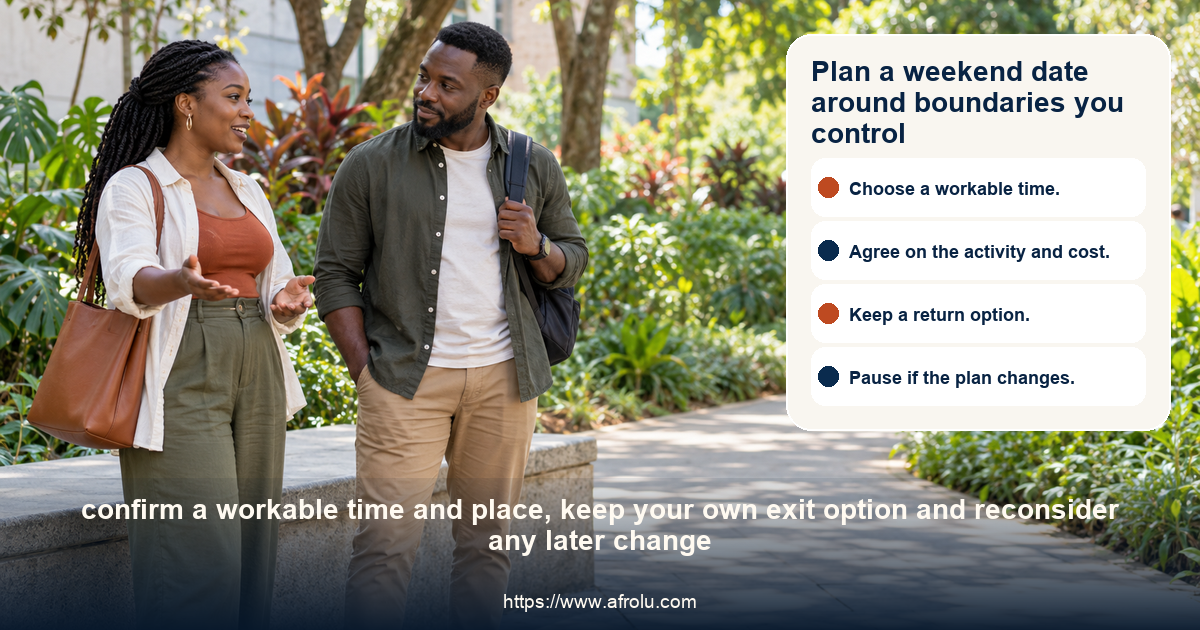
Choose practical conditions that suit you, while remembering no venue can guarantee another person's conduct.
Written and edited by Ruth Akinyi · Local Dating Editor
Choose the conditions you can control: a time you can manage, an activity that fits your budget, a meeting point you are comfortable reaching and a return option that works for you. Share only the details you choose. A public venue or check-in can be useful for some people but cannot guarantee safety. If any part of the plan changes, pause and decide again before accepting it.
Intentional dating · Students
What can I decide before a weekend date so that the plan fits my own comfort and practical limits?
Practical weekend planning is the process of choosing meeting details and boundaries that make a date manageable for you. It cannot predict another person's conduct or eliminate risk. The useful outcome is a plan you freely choose, with a clear way to revise or leave, rather than a checklist presented as a guarantee or a reason to blame yourself if someone behaves badly.
Illustrative scenario: Two adult students plan a Saturday afternoon walk and coffee. Before leaving, one confirms the meeting point, chooses a return time, keeps the fare home and tells a trusted friend only the broad plan. When the other person suggests changing locations, they pause and decide whether the new option still works. Each step is a choice, not proof of safety.
Choose the conditions
A plan should fit your actual weekend
A weekend may be your only free period, but it can also hold rest, work, errands or family commitments. Pick an activity that suits your own capacity rather than agreeing because you fear the invitation will disappear. A modest public plan can leave both adults room to talk and end the date without turning the meeting into an all-day obligation.
Discuss cost before you arrive if it matters to you. You can suggest a walk, a simple meal or another affordable activity and say how long you have. You do not owe an elaborate venue, a gift or a second activity to prove interest. If your finances are tight, state the option that works; a respectful date can accept a limit or suggest an alternative.
A clear end time helps you plan the rest of the day and provides a natural point to decide whether you want to continue. It is not a prediction of how the meeting will feel. You may leave earlier if you choose, and you may extend the date only when you genuinely want to. Each next step remains optional.
Agree on a meeting point
Public is an option, not a promise
Some people prefer to meet in a public place at first; others may have different needs. If you choose a public setting, select one you can find and leave without depending on the person you are meeting. You can keep your home address, exact routine and private location details to yourself while still agreeing on a practical meeting point.
Make your arrival and return plan separately from the other person's offer. You might use your own fare, choose a route you already know or decide to meet only during daylight. These are personal options, not universal requirements. If you want a trusted person to know the broad plan, share only what you are comfortable sharing and choose someone you trust.
A recommendation or familiar venue cannot guarantee how an encounter will go. If the suggested location feels wrong to you, decline it or offer another option. If you cannot find an alternative you want, postponing is reasonable. Your comfort is enough to revise a plan; you do not need to convince anyone that a venue is objectively unsafe.

Review observable details when deciding whether an adult student deciding how to plan a first or early weekend date around personal comfort, cost, time and transport fits.
Reconsider changes
A new detail deserves a fresh choice
An adult may need to reschedule for an ordinary reason, but a change still affects what you agreed to do. Ask what changed and consider whether the revised time, activity or route works for you. You can keep the original plan, suggest another date or decline. A message already sent does not remove your right to reconsider.
Be cautious about sharing exact live location, identity documents, passwords or financial account details. Kenya's data protection framework concerns how organizations process personal data; it does not guarantee what an individual will do with a private message. Share personal information gradually and avoid sending something merely because a new match says it proves trust.
If you feel pressured to go somewhere private, send money, drink more than you want or ignore a clear limit, you may stop the interaction and seek support. You do not need to diagnose the other person or explain your decision at length. If you face immediate danger, contact an appropriate local emergency or trusted support service; this guide is not a local crisis service.

Adapt one short question to discuss an adult student deciding how to plan a first or early weekend date around personal comfort, cost, time and transport.
Set boundaries in plain words
A limit can be brief and specific
You can state a boundary about touch, alcohol, photographs, transport, spending or the time you will leave. A useful sentence says what is true for you: “I am happy to meet for coffee, and I will arrange my own ride home.” You do not have to turn the boundary into an accusation or offer personal history to justify it.
Consent is not a one-time pass. A person can agree to a date and decline a different activity; either adult can pause or change their mind. RAINN's educational information offers a general framework for voluntary consent, but individual situations and local law can differ. Listen for the answer and do not use persistence to make a no sound like a maybe.
If a boundary is not respected, you may leave, end the conversation, contact someone you trust or use platform reporting tools where relevant. If someone becomes angry, prioritize the option that feels most practical to you. A checklist is not a substitute for support, and responsibility for another person's harmful conduct belongs to that person.
Review without self-blame
Preparation supports choice but cannot control another person
A date can feel comfortable and still not be right for a second meeting. You can review whether the time, location, cost and conversation suited you, and whether the other adult respected your choices. These details inform your decision; they do not promise what another person will do in the future or prove that you should have known more beforehand.
If you want to continue, suggest one next step and keep the same agency around details. You can choose a call, another public meeting or more time before deciding. If you prefer to stop, a short message may be sufficient when contact feels safe; you do not owe a detailed explanation to someone you have just met.
If an encounter involved coercion, harassment or harm, consider reaching out to someone you trust or a relevant local support organization. The resources cited here may be based outside Kenya and are not emergency services. Seek information that fits your location and circumstances. Whatever happened, using every suggested precaution is not a condition for deserving help or being believed.

Keep these choices nearby when an adult student deciding how to plan a first or early weekend date around personal comfort, cost, time and transport.
Common moments in an adult student deciding how to plan a first or early weekend date around personal comfort, cost, time and transport
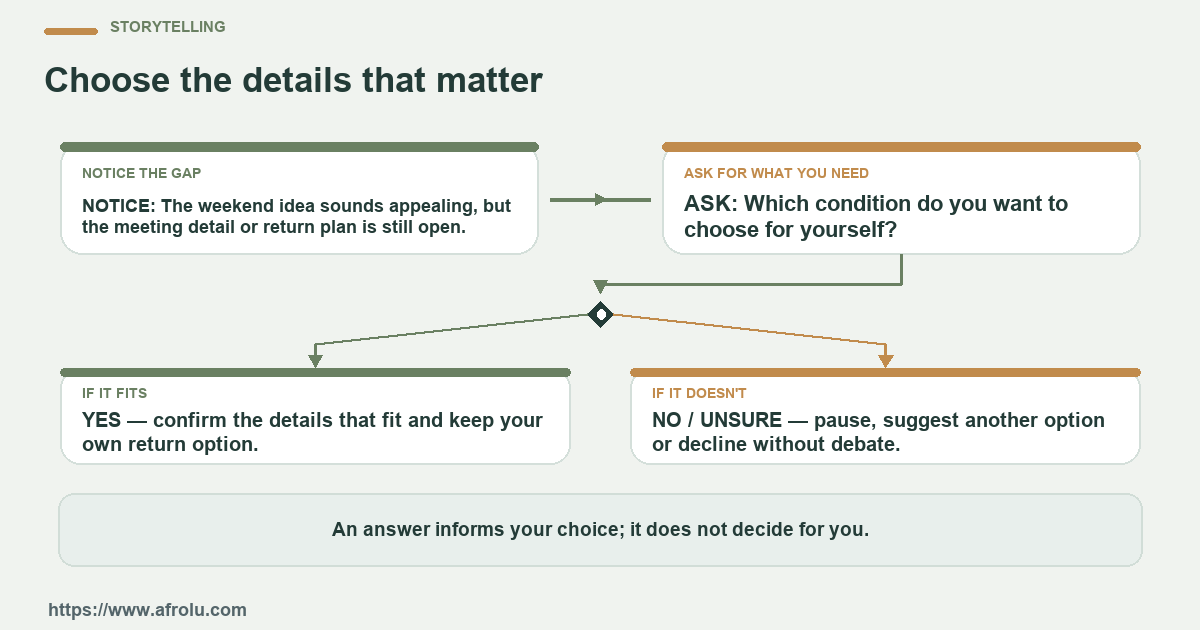
An invitation stays broad
For an adult student deciding how to plan a first or early weekend date around personal comfort, cost, time and transport: The idea of meeting is raised without a time, activity or place.
Ask for the detail you need and keep other plans until the invitation is confirmed.A free window moves
For an adult student deciding how to plan a first or early weekend date around personal comfort, cost, time and transport: Work, sleep, travel or family changes when one adult is available.
Share an update and suggest a new option only if it works for you.A bounded plan is offered
For an adult student deciding how to plan a first or early weekend date around personal comfort, cost, time and transport: Someone suggests an affordable public activity with a meeting point and return option the reader chooses with practical details.
Accept, decline or revise the plan without pressure.A response arrives later
For an adult student deciding how to plan a first or early weekend date around personal comfort, cost, time and transport: A message appears after you have made another plan or gone to sleep.
Decide whether to respond now; do not treat timing as a relationship score.A label is unclear
For an adult student deciding how to plan a first or early weekend date around personal comfort, cost, time and transport: The adults use the same dating word but have not described what it means.
Ask which term affects the next choice and explain your own meaning.The meeting point changes
For an adult student deciding how to plan a first or early weekend date around personal comfort, cost, time and transport: The location or end time changes after the original plan.
Pause and choose again before agreeing to the new details.The preferences differ
For an adult student deciding how to plan a first or early weekend date around personal comfort, cost, time and transport: One adult wants more contact, commitment or time than the other can offer.
Name the mismatch and decide whether the available arrangement suits you.A boundary is named
For an adult student deciding how to plan a first or early weekend date around personal comfort, cost, time and transport: One person says a location, activity or disclosure does not feel right.
Respect the limit without repeated bargaining or punishment.Notice choices and actions, not imagined motives
The activity and cost are clear before either person commits.
The meeting point is one you can assess yourself.
The end time leaves room to make another choice.
Your transport plan does not depend on a new date.
No one calls a public venue a guarantee.
A proposed location change is discussed before departure.
You can decline an activity without being shamed.
A broad plan can be shared without revealing a home address.
Money and affection are not treated as proof of commitment.
Consent is checked for each activity.
A trusted-person check-in is optional and chosen by you.
A late change receives a fresh decision.
Your comfort matters even if the other person disagrees.
Support remains available if a date goes badly.
Choose a response that fits the moment
| Situation | What it may mean | What to do next |
|---|---|---|
| An invitation stays broad | The idea of meeting is raised without a time, activity or place. | Ask for the detail you need and keep other plans until the invitation is confirmed. |
| A free window moves | Work, sleep, travel or family changes when one adult is available. | Share an update and suggest a new option only if it works for you. |
| A bounded plan is offered | Someone suggests an affordable public activity with a meeting point and return option the reader chooses with practical details. | Accept, decline or revise the plan without pressure. |
| A response arrives later | A message appears after you have made another plan or gone to sleep. | Decide whether to respond now; do not treat timing as a relationship score. |
| A label is unclear | The adults use the same dating word but have not described what it means. | Ask which term affects the next choice and explain your own meaning. |
| The meeting point changes | The location or end time changes after the original plan. | Pause and choose again before agreeing to the new details. |
| The preferences differ | One adult wants more contact, commitment or time than the other can offer. | Name the mismatch and decide whether the available arrangement suits you. |
| A boundary is named | One person says a location, activity or disclosure does not feel right. | Respect the limit without repeated bargaining or punishment. |
| The answer is uncertain | The other adult may be undecided or may want different terms; uncertainty alone does not establish motive. | Ask one practical follow-up, then choose your own limit. |
| Your comfort changes | A new feeling or changed circumstance can be enough reason to revise a plan. | Say what you want now and keep the next choice voluntary. |
Words you can adapt to your own voice
“I am interested in an adult student deciding how to plan a first or early weekend date around personal comfort, cost, time and transport, and I want to be clear about what works for me.”
“Would you like to plan an affordable public activity with a meeting point and return option the reader chooses?”
“I can meet in the afternoon at a place I can reach, and I will make my own way home. Does that work for you?”
“I can share a public meeting point and broad plan, not your home address or full weekend routine, but I am keeping other details private.”
“Can we agree on a weekend period with a clear start and end that leaves each adult free to choose again before I change my plans?”
“That time no longer works for me. I can suggest another option if I still want to.”
“It sounds as if we want different terms right now. Have I understood you?”
“My preference or availability has changed. Would you like to revisit what we discussed?”
“I am not comfortable with that plan, so I will not go ahead with it.”
“I can meet for about two hours, then I need to head home.”
“I want to think about that before I answer. I will get back to you if I decide to.”
“I have appreciated meeting you, but I do not want to continue dating.”
Know the difference
Compare a plan chosen with room to revise with a changed plan accepted under pressure
Both adults confirm a time, activity and return choice, and either can reconsider a change.
A prior yes is treated as a reason to accept a new location or private activity.
Your plan can reduce some practical uncertainty, but no venue or checklist controls another person's behavior.

Compare a shared agreement with an assumption in an adult student deciding how to plan a first or early weekend date around personal comfort, cost, time and transport.
Compare a plan chosen with room to revise and a changed plan accepted under pressure
| Type or dimension | What it describes | Best next question |
|---|---|---|
| A feeling | Interest, uncertainty or disappointment describes an experience, not an agreement. | Notice it and decide whether you want to talk. |
| A label | Words such as casual or serious may mean different things to different adults. | Explain your meaning and ask what the other person means. |
| A present intention | A person can describe what they hope to explore without guaranteeing an outcome. | Ask what that intention means for a current choice. |
| A clear plan | A time, place, activity and practical details have been agreed. | Confirm the details and keep the choice voluntary. |
| A boundary | A person names what they will or will not do. | Respect it without asking repeatedly. |
| A changed plan | A schedule, location or comfort level has shifted. | Offer or accept a new option only if it works. |
| An open possibility | A future idea has been mentioned but no present step is agreed. | Separate hope from what is available today. |
| A mismatch | Two adults want different pace, contact or commitment. | Decide whether the actual arrangement suits you. |
| A new choice | Either adult wants to revise, pause or end the arrangement. | State the change and let both adults respond freely. |
Six practical ideas to keep nearby
No universal dating clock
A thoughtful pace is personal; this page does not set a number of dates or weeks.
Terms need explanation
A label is useful only when both adults understand what it means.
Small steps give context
For an adult student deciding how to plan a first or early weekend date around personal comfort, cost, time and transport, one manageable next step may be more useful than a big promise.
Boundaries remain yours
You can protect time, privacy, money, transport and physical comfort.
Use what you can observe
Compare what was agreed with what happened without guessing motive.
Choose again
Continue, clarify, adjust, pause or stop as your needs change.
Questions for planning and reflection
Choose a few prompts that fit the moment. This is a reference library, not a list to complete.
Before a plan
Choose conditions that fit your real life.
- What do I want from this interaction?
- Which detail or boundary matters?
- What is one step I actually want?
During the conversation
Ask the question that affects your next choice.
- What does this term mean to me?
- What does the other adult want now?
- Can either of us say no freely?
Afterward
Notice your experience without turning it into a verdict.
- Could I be myself?
- Did the plan and boundary hold?
- Do I want another step?
If something changes
Revisit the plan without assigning motive.
- What changed?
- What do I want now?
- Would a pause or ending fit better?
What research and guidance can—and cannot—tell you
Personal boundaries
love is respect provides general prompts for communicating relationship boundaries.
Evidence limit: It is U.S.-based educational material, not Kenyan legal guidance.
Consent
RAINN explains consent as voluntary and specific to an interaction.
Evidence limit: It is general public information, not individualized support.
Romance fraud
The FTC identifies common patterns involving online relationships and money.
Evidence limit: This cannot assess an individual or replace local reporting.
Kenyan data rights
The ODPC describes rights about data processed by organizations.
Evidence limit: It cannot guarantee how a private date handles shared information.
Dating privacy
Australia's eSafety Commissioner discusses privacy and location settings.
Evidence limit: Its platform advice is Australian and not a local route assessment.
Personal safety planning
The U.S. National Domestic Violence Hotline provides planning guidance.
Evidence limit: Its services are not a Kenyan emergency response.
Common assumptions that add pressure
Using availability as proof
Work, sleep and distance affect a schedule but do not reveal a person's whole intent.
Treating a label as an agreement
Adults can mean different things by casual, serious or exclusive.
Treating a call as verification
A conversation does not confirm every profile claim or future plan.
Promising travel before details
Time, cost, lodging and consent are separate practical choices.
Oversharing to create trust
A new connection does not need access to every private detail.
Demanding instant certainty
You can ask a direct present-tense question and allow an honest answer.
Ask what serious means today
These information links are clearly labelled, non-commercial and do not promise a relationship outcome.
Explore the guide library
Show more related guides
Continue with Afrolu
Show more Afrolu guides
Research and practical guidance used for this guide
Afrolu reviewed these health, research, safety, or public guidance resources while editing this page. They support the behaviour and safety guidance; they do not diagnose any individual described by a reader.
Questions about an adult student deciding how to plan a first or early weekend date around personal comfort, cost, time and transport
Is a public place always safe?
No location can guarantee another person's behavior. Choose a setting that suits your own decision.
Should I share my home address?
No. A public meeting point is enough to plan a first date if that is what you choose.
Should I let the other person arrange my ride?
You may prefer an arrival and return option you control.
What if the location changes at the last minute?
Pause and decide whether the new place, time and route still work for you.
Do I need to tell someone where I am going?
That is a personal option. Share only what you want with someone you trust.
Can I leave before the planned end?
Yes. You can change your mind and end a meeting at any time.
What should I do if I feel pressured?
You may decline, leave, contact someone you trust or use available platform support.
Does an earlier yes mean I must continue?
No. Consent and plans can be revised.
Who is responsible if someone ignores my boundary?
The person who ignores the boundary is responsible for that choice; a checklist cannot prevent all harm.
Are the linked support resources Kenyan emergency services?
Some sources are based outside Kenya and are not local emergency contacts.
One thing to do now
Choose the next step that fits your actual needs
Confirm the plan details you need, keep your own limits available and reconsider any change before you go along with it.