Slow dating · adult students · distance-aware rhythm
Build a long-distance rhythm that leaves room for study and rest
Choose a manageable call rhythm around study and rest, discuss present expectations, and keep identity checks, travel and commitment separate over time.

A call can add context but cannot verify every claim or promise a relationship outcome.
Written and edited by Liya Bekele · Horn of Africa Editor
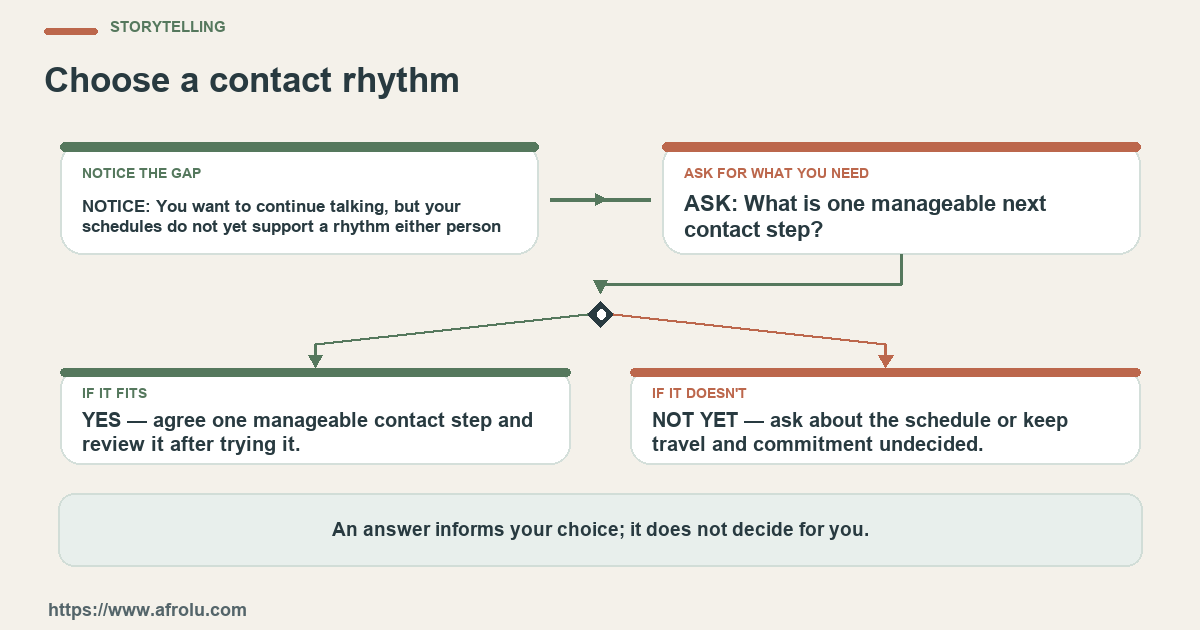
Agree on a communication rhythm that fits both adults' time, study, work and rest. A planned call can add context but cannot verify every claim or decide the future. Keep travel, money, exclusivity and serious intent as separate conversations, and do not promise more contact than you can sustain. If the rhythm is not enough for one person, discuss the mismatch and choose whether the current arrangement works.
Intentional dating · Students
How can we date across distance at a thoughtful pace without making calls or travel a test of commitment?
Slow long-distance dating for an adult student means building familiarity through manageable, mutually chosen contact while keeping major decisions distinct. A call is one interaction, travel is another decision, and commitment needs its own conversation. The aim is not to delay forever or produce proof by constant availability; it is to learn whether present communication and follow-through suit both adults.
Illustrative scenario: Two adults studying in different places enjoy exchanging messages, but their class and work hours rarely overlap. They choose one short call each week, allow ordinary messages to wait and agree to discuss a visit only after reviewing time, cost and lodging. The routine gives them a chance to learn about one another without making a missed call a verdict.
Build a rhythm you can keep
Contact should fit two real schedules
Different cities may mean different class timetables, work hours, family routines or time zones. Start by comparing broad periods when each person is usually available, not by demanding a full calendar. You might choose one call a week and keep ordinary messages asynchronous. A plan can be revisited if term dates or work obligations change.
A call window is an invitation, not a compulsory attendance test. If an exam, shift or family need interferes, send a short update when practical and suggest another time only if you want to. Repeated missed plans may tell you that the current arrangement is not working, but they do not let you read the other adult's motive without asking.
Some people prefer messages; others feel more connected through voice. Ask which format helps each of you communicate and whether either option feels intrusive. A relationship does not require you to be available whenever the other person is free. If the only workable schedule costs you sleep or study time, say so and decide whether another rhythm exists.
Let contact teach you something
A conversation gives context, not certainty
Talking live may help you notice communication style, shared interests and whether questions feel mutual. It does not establish every detail about someone's identity, history or future plan. Keep expectations proportional to what you have learned. If a detail matters before a larger decision, ask about it and use appropriate independent checks instead of relying on emotional closeness alone.
You can notice whether both adults get room to speak, whether a boundary is heard and whether plans match what was said. These are observations, not a diagnostic score. A single interrupted call or difficult week may have an ordinary explanation. Repeated evasiveness about practical matters may be enough reason to slow down, ask again or decide that you do not want to continue.
Keep private information limited while trust grows. Sharing a broad city or time window may be enough; you do not need to send identification documents, a home address, intimate images or a live location to prove affection. Kenya's data protection information explains organizational responsibilities, not whether a private recipient will keep a message confidential. Choose disclosure deliberately.

Review observable details when deciding whether an adult student dating across distance who wants a sustainable contact rhythm and separate choices about travel and commitment fits.
Separate intent from future promises
Serious words need present-day meaning
Words such as serious, intentional or committed can mean different things across distance. Ask how the other adult understands the word in today's choices: exclusivity, frequency of contact, meeting family, or simply taking time to learn. You can state your own hopes without treating them as a promise or assuming that both people have made the same agreement.
If you want exclusivity, ask whether it has been discussed and chosen. Do not rely on how often someone calls or on a future possibility mentioned during an emotional conversation. If either person is unsure, you can decide whether the available arrangement fits you while the answer remains open. You are allowed to want more clarity before investing more time.
Travel should be planned separately from relationship intent. A visit involves cost, schedules, accommodation, local transport and comfort. Do not send money to an online romantic connection because of an emergency, ticket or investment story. If you choose to travel, make the practical arrangements independently and only after the details suit you; a visit cannot guarantee compatibility.

Adapt one short question to discuss an adult student dating across distance who wants a sustainable contact rhythm and separate choices about travel and commitment.
Make difficult questions smaller
A focused conversation can prevent guesswork
Distance can make a conversation feel like a rare opportunity to cover everything. That pressure can lead adults to promise more than they understand or to hide a concern. Pick the decision that affects you first: contact rhythm, exclusivity, privacy or a proposed visit. A smaller question allows both people to answer without being pushed to decide a whole future.
Try: “I am enjoying this, and I would like to know whether you want us to date exclusively now.” Then listen for the actual answer. A clear no can hurt and still be useful. “I do not know yet” is also information. You can decide whether waiting with the current terms feels acceptable or whether you would rather step back.
If a call becomes tense, you can take a break and return only if you want to. Written messages may help you organize a question, but they can also be misunderstood; ask for clarification instead of treating tone as proof. Respect for a pause is important. No person owes continuous access because the relationship is long-distance.
Review the pattern, not the clock
Progress is mutual learning, not a call quota
Compare the rhythm you chose with the one you actually experienced. Were messages and calls reciprocal enough for you? Could each person explain a change? Did the contact leave space for study and rest? These observations describe the current arrangement. They cannot guarantee a future, and you do not need a fixed number of calls before making your own choice.
If you want to continue, suggest one next step that is specific and realistic: another call, a conversation about exclusivity or a rough period to revisit visit logistics. Avoid making a major promise just to reduce a moment of uncertainty. Either person can decline a proposed step, and the other can decide whether that answer fits their needs.
If the arrangement is too inconsistent, too costly or too demanding, say what you need and choose accordingly. You may continue, ask for a change, pause or end contact. You do not have to establish that someone acted badly to decide that long-distance dating is not working for you. Keep friends, study and daily routines available as parts of your life.

Keep these choices nearby when an adult student dating across distance who wants a sustainable contact rhythm and separate choices about travel and commitment.
Common moments in an adult student dating across distance who wants a sustainable contact rhythm and separate choices about travel and commitment
An invitation stays broad
For an adult student dating across distance who wants a sustainable contact rhythm and separate choices about travel and commitment: The idea of meeting is raised without a time, activity or place.
Ask for the detail you need and keep other plans until the invitation is confirmed.A free window moves
For an adult student dating across distance who wants a sustainable contact rhythm and separate choices about travel and commitment: Work, sleep, travel or family changes when one adult is available.
Share an update and suggest a new option only if it works for you.A bounded plan is offered
For an adult student dating across distance who wants a sustainable contact rhythm and separate choices about travel and commitment: Someone suggests one planned call or message exchange followed by a review of what worked with practical details.
Accept, decline or revise the plan without pressure.A response arrives later
For an adult student dating across distance who wants a sustainable contact rhythm and separate choices about travel and commitment: A message appears after you have made another plan or gone to sleep.
Decide whether to respond now; do not treat timing as a relationship score.A label is unclear
For an adult student dating across distance who wants a sustainable contact rhythm and separate choices about travel and commitment: The adults use the same dating word but have not described what it means.
Ask which term affects the next choice and explain your own meaning.The meeting point changes
For an adult student dating across distance who wants a sustainable contact rhythm and separate choices about travel and commitment: The location or end time changes after the original plan.
Pause and choose again before agreeing to the new details.The preferences differ
For an adult student dating across distance who wants a sustainable contact rhythm and separate choices about travel and commitment: One adult wants more contact, commitment or time than the other can offer.
Name the mismatch and decide whether the available arrangement suits you.A boundary is named
For an adult student dating across distance who wants a sustainable contact rhythm and separate choices about travel and commitment: One person says a location, activity or disclosure does not feel right.
Respect the limit without repeated bargaining or punishment.Notice choices and actions, not imagined motives
The planned contact window considers both schedules.
A call can be moved without a character verdict.
Messages do not need an immediate response.
Neither person is expected to be available at all hours.
A video call is not treated as complete identity verification.
Exclusivity is discussed separately from call frequency.
Travel involves its own time, cost and lodging decision.
Money is not sent to prove affection or seriousness.
Private documents and home details remain under personal control.
Both adults can propose a different communication rhythm.
Study and sleep remain protected when time zones differ.
A missed call can be clarified without diagnosing motive.
A future hope is distinguished from an agreement.
Either adult may pause or end the connection.
Choose a response that fits the moment
| Situation | What it may mean | What to do next |
|---|---|---|
| An invitation stays broad | The idea of meeting is raised without a time, activity or place. | Ask for the detail you need and keep other plans until the invitation is confirmed. |
| A free window moves | Work, sleep, travel or family changes when one adult is available. | Share an update and suggest a new option only if it works for you. |
| A bounded plan is offered | Someone suggests one planned call or message exchange followed by a review of what worked with practical details. | Accept, decline or revise the plan without pressure. |
| A response arrives later | A message appears after you have made another plan or gone to sleep. | Decide whether to respond now; do not treat timing as a relationship score. |
| A label is unclear | The adults use the same dating word but have not described what it means. | Ask which term affects the next choice and explain your own meaning. |
| The meeting point changes | The location or end time changes after the original plan. | Pause and choose again before agreeing to the new details. |
| The preferences differ | One adult wants more contact, commitment or time than the other can offer. | Name the mismatch and decide whether the available arrangement suits you. |
| A boundary is named | One person says a location, activity or disclosure does not feel right. | Respect the limit without repeated bargaining or punishment. |
| The answer is uncertain | The other adult may be undecided or may want different terms; uncertainty alone does not establish motive. | Ask one practical follow-up, then choose your own limit. |
| Your comfort changes | A new feeling or changed circumstance can be enough reason to revise a plan. | Say what you want now and keep the next choice voluntary. |
Words you can adapt to your own voice
“I am interested in an adult student dating across distance who wants a sustainable contact rhythm and separate choices about travel and commitment, and I want to be clear about what works for me.”
“Would you like to plan one planned call or message exchange followed by a review of what worked?”
“I like talking with you and want a rhythm I can keep during term. Which call window could work for both of us?”
“I can share broad availability and your current preference, not your full timetable, home address or live location, but I am keeping other details private.”
“Can we agree on a repeatable call window that respects each adult's study, work, sleep and time zone before I change my plans?”
“That time no longer works for me. I can suggest another option if I still want to.”
“It sounds as if we want different terms right now. Have I understood you?”
“My preference or availability has changed. Would you like to revisit what we discussed?”
“I am not comfortable with that plan, so I will not go ahead with it.”
“I can meet for about two hours, then I need to head home.”
“I want to think about that before I answer. I will get back to you if I decide to.”
“I have appreciated meeting you, but I do not want to continue dating.”
Know the difference
Compare a contact rhythm both can sustain with constant access used as proof
Each adult chooses a realistic window and can update it when school, work or rest changes.
Reply speed and daily calls are treated as tests of affection, trust or seriousness.
Distance needs practical conversation, not constant availability or a rushed promise to travel.

Compare a shared agreement with an assumption in an adult student dating across distance who wants a sustainable contact rhythm and separate choices about travel and commitment.
Compare a contact rhythm both can sustain and constant access used as proof
| Type or dimension | What it describes | Best next question |
|---|---|---|
| A feeling | Interest, uncertainty or disappointment describes an experience, not an agreement. | Notice it and decide whether you want to talk. |
| A label | Words such as casual or serious may mean different things to different adults. | Explain your meaning and ask what the other person means. |
| A present intention | A person can describe what they hope to explore without guaranteeing an outcome. | Ask what that intention means for a current choice. |
| A clear plan | A time, place, activity and practical details have been agreed. | Confirm the details and keep the choice voluntary. |
| A boundary | A person names what they will or will not do. | Respect it without asking repeatedly. |
| A changed plan | A schedule, location or comfort level has shifted. | Offer or accept a new option only if it works. |
| An open possibility | A future idea has been mentioned but no present step is agreed. | Separate hope from what is available today. |
| A mismatch | Two adults want different pace, contact or commitment. | Decide whether the actual arrangement suits you. |
| A new choice | Either adult wants to revise, pause or end the arrangement. | State the change and let both adults respond freely. |
Six practical ideas to keep nearby
No universal dating clock
A thoughtful pace is personal; this page does not set a number of dates or weeks.
Terms need explanation
A label is useful only when both adults understand what it means.
Small steps give context
For an adult student dating across distance who wants a sustainable contact rhythm and separate choices about travel and commitment, one manageable next step may be more useful than a big promise.
Boundaries remain yours
You can protect time, privacy, money, transport and physical comfort.
Use what you can observe
Compare what was agreed with what happened without guessing motive.
Choose again
Continue, clarify, adjust, pause or stop as your needs change.
Questions for planning and reflection
Choose a few prompts that fit the moment. This is a reference library, not a list to complete.
Before a plan
Choose conditions that fit your real life.
- What do I want from this interaction?
- Which detail or boundary matters?
- What is one step I actually want?
During the conversation
Ask the question that affects your next choice.
- What does this term mean to me?
- What does the other adult want now?
- Can either of us say no freely?
Afterward
Notice your experience without turning it into a verdict.
- Could I be myself?
- Did the plan and boundary hold?
- Do I want another step?
If something changes
Revisit the plan without assigning motive.
- What changed?
- What do I want now?
- Would a pause or ending fit better?
What research and guidance can—and cannot—tell you
Safer online dating
RAINN offers general advice about online and in-person dating choices.
Evidence limit: It is not an identity-verification method or a guarantee.
Location privacy
Australia's eSafety Commissioner discusses dating-app location controls.
Evidence limit: Its advice cannot assess a particular route or platform setting in Kenya.
Kenyan data rights
The ODPC explains rights concerning personal data handled by organizations.
Evidence limit: This does not promise that private recipients will keep messages confidential.
Kenyan data law
The ODPC publishes Kenya's Data Protection Act and related information.
Evidence limit: The Act is not a personal relationship or identity-verification tool.
Personal safety planning
The U.S. National Domestic Violence Hotline explains individualized planning.
Evidence limit: Its contact pathways are not local Kenyan services.
Romance scam patterns
The FTC describes online romance scams and money requests.
Evidence limit: U.S. consumer guidance cannot determine a specific person's intent.
Common assumptions that add pressure
Using availability as proof
Work, sleep and distance affect a schedule but do not reveal a person's whole intent.
Treating a label as an agreement
Adults can mean different things by casual, serious or exclusive.
Treating a call as verification
A conversation does not confirm every profile claim or future plan.
Promising travel before details
Time, cost, lodging and consent are separate practical choices.
Oversharing to create trust
A new connection does not need access to every private detail.
Demanding instant certainty
You can ask a direct present-tense question and allow an honest answer.
Plan a first meeting on your terms
These information links are clearly labelled, non-commercial and do not promise a relationship outcome.
Explore the guide library
Show more related guides
Continue with Afrolu
Show more Afrolu guides
Research and practical guidance used for this guide
Afrolu reviewed these health, research, safety, or public guidance resources while editing this page. They support the behaviour and safety guidance; they do not diagnose any individual described by a reader.
Questions about an adult student dating across distance who wants a sustainable contact rhythm and separate choices about travel and commitment
How often should we call across distance?
There is no universal schedule. Choose a rhythm both adults can realistically keep.
Does a video call verify someone's identity?
No. It may add context but does not confirm every profile claim.
Should I answer every message immediately?
No. Agree on expectations that leave room for study, work and rest.
Does serious intent mean we are exclusive?
Not automatically. Discuss exclusivity directly if it affects you.
Should we plan a visit quickly?
Travel is a separate choice involving cost, timing, lodging and comfort.
Should I send money for a ticket?
Do not use money to prove care. Review independent consumer guidance before acting on a request.
What if our free time rarely overlaps?
Compare realistic windows and decide whether the available rhythm meets your needs.
Does a missed call mean they are not interested?
One missed call does not establish motive. Ask whether they want to reschedule.
Can a relationship be serious and move slowly?
Yes. Intent, pace and contact are separate topics.
Can I stop if the current arrangement is not enough?
Yes. You may choose based on what is available now without proving fault.
One thing to do now
Choose the next step that fits your actual needs
Choose one contact step that both adults can manage, then review the experience before adding travel, money or promises.