Slow dating · parents · serious intent in Nairobi
Discuss serious dating without rushing family introductions
Discuss serious intent in Nairobi while keeping family introductions and future plans separate. Build clarity around time, privacy and the next choice.
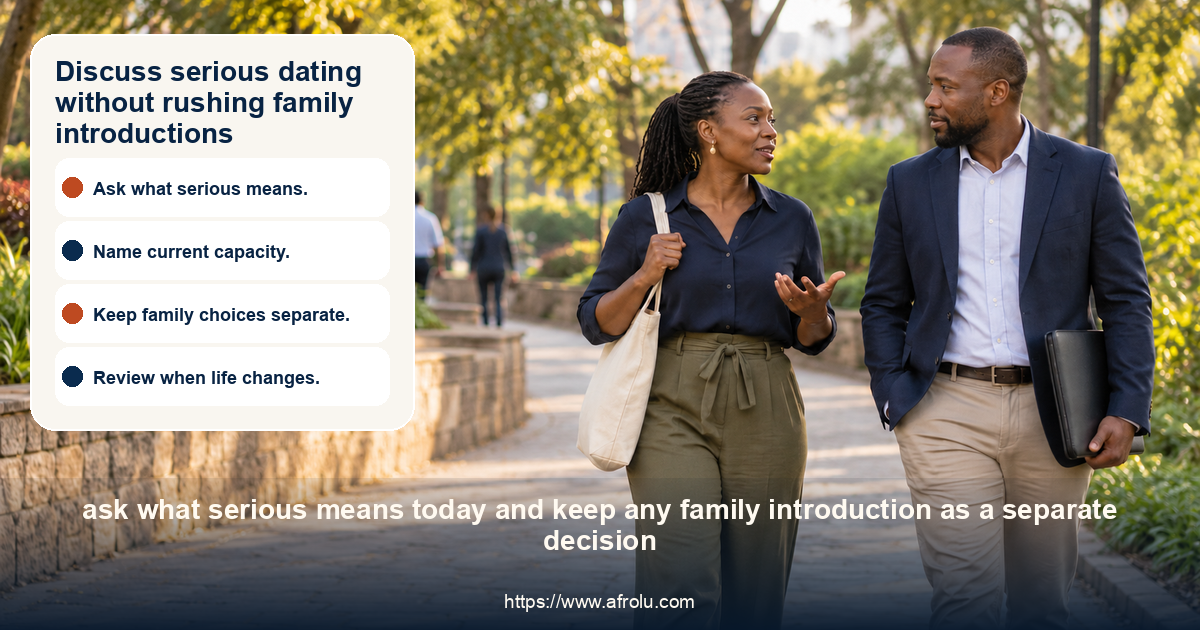
Discuss what serious means now and keep family introductions on their own timeline.
Written and edited by Liya Bekele · Horn of Africa Editor
Ask what serious means to each adult in the present: regular time together, exclusivity or openness to a longer-term relationship may be different choices. Discuss the part that affects your next step and keep family introductions separate. You do not need to promise marriage, a timeline or early access to children to show interest. A thoughtful pace can still be honest about what you hope for and what you can offer now.
Intentional dating · Parents Returning To Dating
How can I discuss serious intent without treating a family introduction or future promise as proof?
Serious dating describes an intention adults may want to explore; it does not guarantee compatibility, marriage or a particular timeline. For a parent in Nairobi, clarity can mean discussing present expectations, practical time and privacy before deciding whether to involve family. Each of those decisions may happen at a different pace, and there is no universal date count that settles them.
Illustrative scenario: Two adults in Nairobi say they are looking for something serious. One thinks that means exclusivity soon; the other wants to keep learning about the relationship before changing family routines. They define the present question, compare available evenings and agree to revisit exclusivity after more conversation. No child is asked to meet or approve a new partner as a shortcut to certainty.
Define serious in the present
A label is useful when both adults explain it
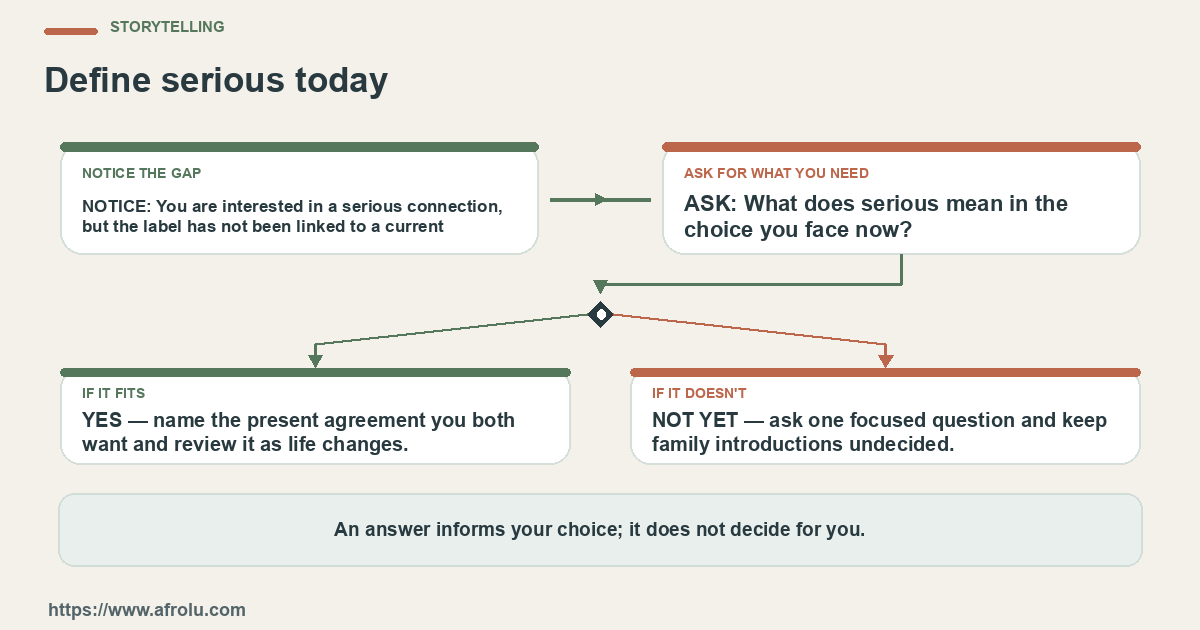
One adult may use “serious” to mean exclusivity, another may mean intentional dating with room to learn, and someone else may be describing a hope for a long-term relationship. The label alone does not tell you which meaning is intended. Ask a present-tense question about the choice that matters instead of trying to decode tone or frequency.
You might say, “I am interested in building a committed relationship if we continue to fit. What are you hoping for now?” The answer can be certain, uncertain or different from yours. You can decide whether that answer works today without asking either person to predict marriage, living arrangements or the next several years.
If exclusivity affects how you date, name it directly and discuss what it would mean in practice. A serious label does not automatically settle contact, sexual consent, money or family plans. Each subject may need its own conversation. A useful pace leaves room for both adults to share a preference and change it if new information appears.
Keep family introductions separate
A child is not a relationship test
A new partner meeting a child is a meaningful family choice, not a required milestone at a fixed week or date count. Consider your own circumstances, your child's privacy and comfort, and what you know about the adult you are dating. This guide cannot set a parenting rule for your family, and an introduction should not be used to settle uncertainty between adults.
You can say, “I keep dating and family introductions separate while I get to know someone.” That statement is clear without promising when the boundary will change. It also avoids inviting a new partner into details about a child's school, regular activities or location before you have chosen to share them.
Kenya's ODPC publishes guidance about children's personal data online. It addresses privacy and data handling, not the timing of family introductions. As a practical precaution, avoid posting identifiable child images or routines on dating profiles. If a particular family situation raises legal or child-welfare questions, seek qualified local guidance rather than relying on a dating article to decide it.

Review observable details when deciding whether an adult parent in Nairobi who wants to explore serious intent while moving thoughtfully on family introductions fits.
Make time practical in Nairobi
Intent still has to fit ordinary days
Nairobi travel, work hours and care arrangements can make some dates easy and others unrealistic. Choose a time and meeting point that suit you, and share only the detail needed to plan. A broad window such as “after work on Thursday” may be enough; an employer name, home route or child's location is not required for the conversation to be honest.
If the other person proposes a long evening or a distant activity, you can suggest a shorter alternative or a different day. Cost, transport and an end time matter when they affect your choice. A public setting may be one practical preference, but no place guarantees another person's conduct or removes the need to pay attention to your own comfort.
Notice whether both adults contribute to making plans workable. One person's schedule may be more flexible at first, but a continuing arrangement can be reviewed as responsibilities shift. Ask directly if you need a different rhythm. If the available plan repeatedly requires you to cancel work or care, you can decide that it no longer fits without treating the decision as a failure.

Adapt one short question to discuss an adult parent in Nairobi who wants to explore serious intent while moving thoughtfully on family introductions.
Talk about capacity and boundaries
A serious conversation can stay specific
Several questions can feel tangled together: how much time to spend, whether to be exclusive, how to handle privacy and what a future might look like. Separate them so one answer does not stand in for all the others. Start with the decision that affects what you do next, and ask for the other adult's present view.
You might explain, “I can make one evening a week work at the moment, and I want to know whether that pace feels mutual.” You are offering real capacity, not a guarantee that every week will look the same. The other person can say what they need too. If the arrangements do not align, each adult can decide whether to continue.
Boundaries apply to digital communication, physical contact and family information as well as time. A serious intention does not entitle someone to a child's photograph, your private address or an immediate explanation for every schedule change. Share details gradually and by choice. If you feel pressured, you can pause the conversation and seek support from someone you trust.
Review without forcing a timeline
New information can change what fits
A present agreement may work for a while and then need an update. A job change, new care responsibility or a shift in what either adult wants can affect the relationship. Say what has changed at the level you are comfortable sharing, and ask whether the current rhythm still suits both of you. Earlier plans do not remove the right to reconsider.
If the connection is growing, choose a next step proportionate to what you know. You might discuss exclusivity, plan a regular date or agree on another conversation after a known busy period. There is no need to move in together, combine finances or introduce a child to show that the connection is important. Those are distinct decisions with distinct consequences.
If you discover a mismatch, describe it plainly: “I want to keep dating, but I am not ready to involve family.” The other person can decide whether that works for them, and you can listen without promising to change. Seriousness is most useful when it helps adults speak honestly about the present; it cannot guarantee a shared future.

Keep these choices nearby when an adult parent in Nairobi who wants to explore serious intent while moving thoughtfully on family introductions.
Common moments in an adult parent in Nairobi who wants to explore serious intent while moving thoughtfully on family introductions
An invitation stays broad
For an adult parent in Nairobi who wants to explore serious intent while moving thoughtfully on family introductions: The idea of meeting is raised without a time, activity or place.
Ask for the detail you need and keep other plans until the invitation is confirmed.A free window moves
For an adult parent in Nairobi who wants to explore serious intent while moving thoughtfully on family introductions: Work, sleep, travel or family changes when one adult is available.
Share an update and suggest a new option only if it works for you.A bounded plan is offered
For an adult parent in Nairobi who wants to explore serious intent while moving thoughtfully on family introductions: Someone suggests one present-tense conversation about intent followed by a date both adults choose with practical details.
Accept, decline or revise the plan without pressure.A response arrives later
For an adult parent in Nairobi who wants to explore serious intent while moving thoughtfully on family introductions: A message appears after you have made another plan or gone to sleep.
Decide whether to respond now; do not treat timing as a relationship score.A label is unclear
For an adult parent in Nairobi who wants to explore serious intent while moving thoughtfully on family introductions: The adults use the same dating word but have not described what it means.
Ask which term affects the next choice and explain your own meaning.The meeting point changes
For an adult parent in Nairobi who wants to explore serious intent while moving thoughtfully on family introductions: The location or end time changes after the original plan.
Pause and choose again before agreeing to the new details.The preferences differ
For an adult parent in Nairobi who wants to explore serious intent while moving thoughtfully on family introductions: One adult wants more contact, commitment or time than the other can offer.
Name the mismatch and decide whether the available arrangement suits you.A boundary is named
For an adult parent in Nairobi who wants to explore serious intent while moving thoughtfully on family introductions: One person says a location, activity or disclosure does not feel right.
Respect the limit without repeated bargaining or punishment.Notice choices and actions, not imagined motives
Each adult explains what serious means to them in the present.
Exclusivity is discussed rather than assumed from time together.
A long-term hope is not presented as a guaranteed outcome.
Family introductions remain a separate choice from dating intent.
A parent's career or care load is treated as real capacity, not a defect.
A child is not asked to validate a new relationship.
Neither adult demands access to family details as proof of trust.
Both people can ask about a future without demanding an immediate promise.
A city date plan includes practical time and travel details.
Each adult may reconsider when new information appears.
A different preference is discussed without shaming either person.
Plans are compared with follow-through rather than romantic language alone.
A serious label does not require an early move or financial commitment.
A pause or ending remains available when the arrangement no longer fits.
Choose a response that fits the moment
| Situation | What it may mean | What to do next |
|---|---|---|
| An invitation stays broad | The idea of meeting is raised without a time, activity or place. | Ask for the detail you need and keep other plans until the invitation is confirmed. |
| A free window moves | Work, sleep, travel or family changes when one adult is available. | Share an update and suggest a new option only if it works for you. |
| A bounded plan is offered | Someone suggests one present-tense conversation about intent followed by a date both adults choose with practical details. | Accept, decline or revise the plan without pressure. |
| A response arrives later | A message appears after you have made another plan or gone to sleep. | Decide whether to respond now; do not treat timing as a relationship score. |
| A label is unclear | The adults use the same dating word but have not described what it means. | Ask which term affects the next choice and explain your own meaning. |
| The meeting point changes | The location or end time changes after the original plan. | Pause and choose again before agreeing to the new details. |
| The preferences differ | One adult wants more contact, commitment or time than the other can offer. | Name the mismatch and decide whether the available arrangement suits you. |
| A boundary is named | One person says a location, activity or disclosure does not feel right. | Respect the limit without repeated bargaining or punishment. |
| The answer is uncertain | The other adult may be undecided or may want different terms; uncertainty alone does not establish motive. | Ask one practical follow-up, then choose your own limit. |
| Your comfort changes | A new feeling or changed circumstance can be enough reason to revise a plan. | Say what you want now and keep the next choice voluntary. |
Words you can adapt to your own voice
“I am interested in an adult parent in Nairobi who wants to explore serious intent while moving thoughtfully on family introductions, and I want to be clear about what works for me.”
“Would you like to plan one present-tense conversation about intent followed by a date both adults choose?”
“I am open to building something serious. What does that mean for you at this stage?”
“I can share your present intention and broad availability, not a child's name, school or routine, but I am keeping other details private.”
“Can we agree on a regular but manageable city date that fits work, care and travel before I change my plans?”
“That time no longer works for me. I can suggest another option if I still want to.”
“It sounds as if we want different terms right now. Have I understood you?”
“My preference or availability has changed. Would you like to revisit what we discussed?”
“I am not comfortable with that plan, so I will not go ahead with it.”
“I can meet for about two hours, then I need to head home.”
“I want to think about that before I answer. I will get back to you if I decide to.”
“I have appreciated meeting you, but I do not want to continue dating.”
Know the difference
Compare present intent with a chosen pace with a serious label treated as a future guarantee
Both adults describe what they want now and decide separately about time, exclusivity and family involvement.
One person assumes that a label settles marriage, a timeline or an introduction to children.
Serious intent can be real while future decisions remain open and separately discussed.

Compare a shared agreement with an assumption in an adult parent in Nairobi who wants to explore serious intent while moving thoughtfully on family introductions.
Compare present intent with a chosen pace and a serious label treated as a future guarantee
| Type or dimension | What it describes | Best next question |
|---|---|---|
| A feeling | Interest, uncertainty or disappointment describes an experience, not an agreement. | Notice it and decide whether you want to talk. |
| A label | Words such as casual or serious may mean different things to different adults. | Explain your meaning and ask what the other person means. |
| A present intention | A person can describe what they hope to explore without guaranteeing an outcome. | Ask what that intention means for a current choice. |
| A clear plan | A time, place, activity and practical details have been agreed. | Confirm the details and keep the choice voluntary. |
| A boundary | A person names what they will or will not do. | Respect it without asking repeatedly. |
| A changed plan | A schedule, location or comfort level has shifted. | Offer or accept a new option only if it works. |
| An open possibility | A future idea has been mentioned but no present step is agreed. | Separate hope from what is available today. |
| A mismatch | Two adults want different pace, contact or commitment. | Decide whether the actual arrangement suits you. |
| A new choice | Either adult wants to revise, pause or end the arrangement. | State the change and let both adults respond freely. |
Six practical ideas to keep nearby
No universal dating clock
A thoughtful pace is personal; this page does not set a number of dates or weeks.
Terms need explanation
A label is useful only when both adults understand what it means.
Small steps give context
For an adult parent in Nairobi who wants to explore serious intent while moving thoughtfully on family introductions, one manageable next step may be more useful than a big promise.
Boundaries remain yours
You can protect time, privacy, money, transport and physical comfort.
Use what you can observe
Compare what was agreed with what happened without guessing motive.
Choose again
Continue, clarify, adjust, pause or stop as your needs change.
Questions for planning and reflection
Choose a few prompts that fit the moment. This is a reference library, not a list to complete.
Before a plan
Choose conditions that fit your real life.
- What do I want from this interaction?
- Which detail or boundary matters?
- What is one step I actually want?
During the conversation
Ask the question that affects your next choice.
- What does this term mean to me?
- What does the other adult want now?
- Can either of us say no freely?
Afterward
Notice your experience without turning it into a verdict.
- Could I be myself?
- Did the plan and boundary hold?
- Do I want another step?
If something changes
Revisit the plan without assigning motive.
- What changed?
- What do I want now?
- Would a pause or ending fit better?
What research and guidance can—and cannot—tell you
Children's information
ODPC guidance addresses protections for children's personal data online.
Evidence limit: It does not prescribe when a date should meet a child.
Data rights in Kenya
ODPC outlines rights and principles for personal-data processing.
Evidence limit: It cannot guarantee how a private contact handles information.
Boundaries
love is respect describes ongoing conversations about relationship boundaries.
Evidence limit: It is U.S.-based relationship education, not family counselling.
Consent
RAINN explains voluntary and ongoing consent.
Evidence limit: This resource does not resolve local legal questions.
Online privacy
eSafety advises adults to limit personal and family details in dating profiles.
Evidence limit: Its examples relate to Australian services and are not a guarantee.
Fraud awareness
The FTC describes online romance-scam patterns.
Evidence limit: It cannot prove that an individual match has a particular intent.
Common assumptions that add pressure
Using availability as proof
Work, sleep and distance affect a schedule but do not reveal a person's whole intent.
Treating a label as an agreement
Adults can mean different things by casual, serious or exclusive.
Treating a call as verification
A conversation does not confirm every profile claim or future plan.
Promising travel before details
Time, cost, lodging and consent are separate practical choices.
Oversharing to create trust
A new connection does not need access to every private detail.
Demanding instant certainty
You can ask a direct present-tense question and allow an honest answer.
Clarify what serious means today
These information links are clearly labelled, non-commercial and do not promise a relationship outcome.
Explore the guide library
Show more related guides
Continue with Afrolu
Show more Afrolu guides
Research and practical guidance used for this guide
Afrolu reviewed these health, research, safety, or public guidance resources while editing this page. They support the behaviour and safety guidance; they do not diagnose any individual described by a reader.
Questions about an adult parent in Nairobi who wants to explore serious intent while moving thoughtfully on family introductions
Does serious dating mean marriage?
Not automatically. Ask what the word means to each adult and which present choice it affects.
When should someone meet my child?
There is no universal number of dates. Consider your family's needs and decide separately from a relationship label.
Do I need to introduce a date quickly to prove intent?
No. A family introduction is a separate decision that does not need to serve as proof.
Should serious dating mean exclusivity?
Only if both adults discuss and choose that agreement; frequency alone does not establish it.
Can I date seriously while working full time?
You can describe the time you have and decide whether the available rhythm suits both adults.
How do I talk about children without sharing identifying details?
Use broad, relevant information and keep names, schools, routines and locations private unless you choose otherwise.
Is a future plan the same as a promise?
No. A hope can guide a conversation, while an agreement requires shared present choices.
Should a new partner meet my co-parent?
This guide cannot set that decision. Keep co-parenting arrangements separate and choose what fits your circumstances.
What if we mean different things by serious?
Name the mismatch and decide whether the present arrangement works for you.
Can I slow down after dating for a while?
Yes. Either adult may revisit pace or boundaries when their needs change.
One thing to do now
Choose the next step that fits your actual needs
Translate serious intent into one present conversation, and decide separately about exclusivity, time and any family introduction.