A bridge log for established lives
Use a 12-Week Clarity Log for Slow Dating After 40
A practical slow-dating guide for adults over 40 covering direction, pace, privacy, careers, homes, money, health, repair, and clear next choices.

Track direction, contact, meetings, repair, privacy, and one next step. Slow can be calm without becoming vague.
Written and edited by Jean-Claude Mukendi · Relationship Guides Editor
Use twelve weeks as an example review window, not a universal deadline. Track six things: direction, contact rhythm, real meetings, repair, privacy, and one next step. Slow dating can protect established lives while trust develops. It should still create small evidence that both adults can name. Keep homes, accounts, work systems, and health records separate. At the review, choose among continuing, clarifying, pausing, or closing. No outcome is an automatic promotion. Repeated warmth without plans, repair, or review is a different offer.
Intentional dating · Late Entrants
Does this careful pace contain mutual direction and observable movement, or am I waiting inside warmth that never becomes a usable relationship?
Slow dating is a deliberately limited pace for learning about another adult. It may use fewer meetings, narrower disclosure, later integration, or longer reflection between choices. Slow describes pace. It does not automatically mean casual, exclusive, serious, safe, or compatible. A deliberate pace has a named direction, mutual participation, and visible next steps. A stalled pattern repeats attention while useful decisions remain unavailable. Neither pattern can be identified from one quiet week. Read conduct across several ordinary moments.
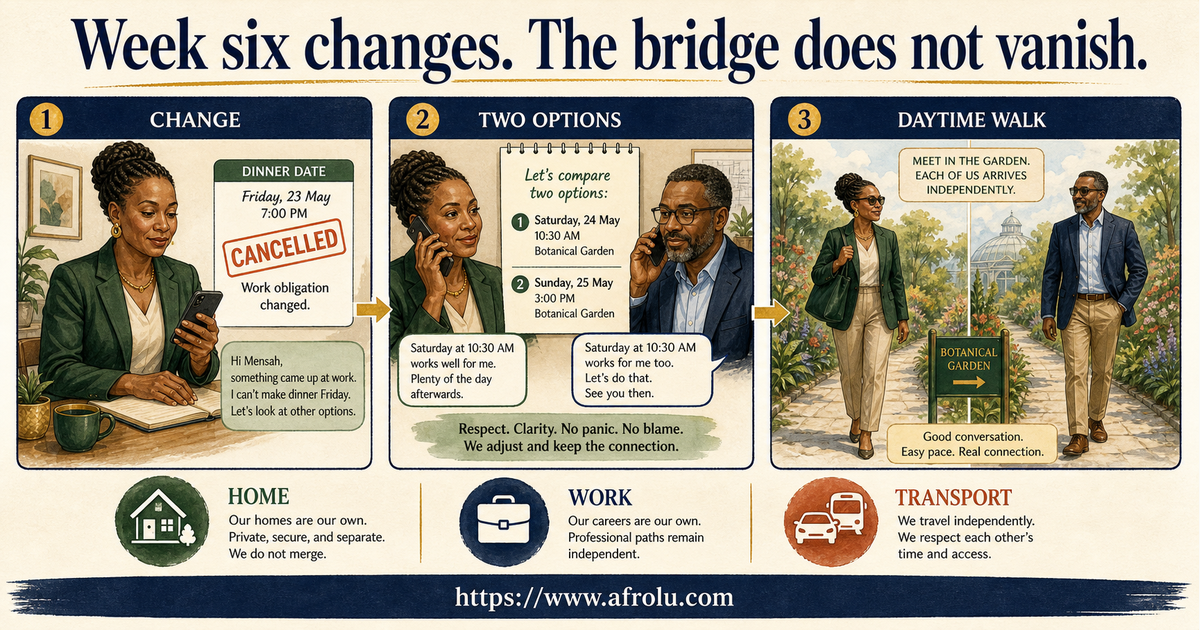
Safiya and Mensah are made-up adults. Safiya is 49 and directs regional operations. Mensah is 53 and works as a quantity surveyor. Both have full careers, separate homes, personal finances, health privacy, and long-standing communities. They agree to move slowly after their second date. At week six, Mensah cancels dinner because a project changed. He does not provide private employer documents. He apologises, offers two smaller public alternatives, and accepts Safiya's choice. They take a Saturday botanical walk using separate transport. That repair does not prove lifelong fit. It does add one relevant bridge to their twelve-week log.
The established-life bridge log
Protect the life you built while testing whether a new connection can move
Returning adults often bring homes, careers, families, health histories, finances, and trusted routines. A careful pace can respect that complexity without hiding the relationship.
Jean-Claude reads twelve weeks as an example evidence window. Each bridge must be mutual, specific, proportionate, and reversible. Private systems remain under each adult's control.
Name the direction
Say what slow means, what each adult hopes to build, and which commitments do not exist. Choose a contact rhythm that leaves work, rest, and other relationships intact.
Repeat a workable rhythm
Turn interest into calls or meetings both adults can hold. Share gradually while homes, accounts, devices, health files, and work systems remain separate.
Observe change and repair
Notice what happens after a cancellation, boundary, disagreement, or changed need. A usable repair matters more than a dramatic apology.
Choose the next bridge
Compare the log with your actual needs. Continue, clarify, pause, or close without treating elapsed time as a debt or relationship award.
Orientation
Use twelve weeks as a review window, never as a universal deadline
A later return to dating may begin inside a life that already works. You may own or rent a home, lead a team, support relatives, manage health needs, or protect quiet routines. New affection does not require immediate integration. Slow dating can create enough room to notice conduct before access expands. The useful question is not whether the pace looks romantic from outside. Ask whether the pace gives both adults reliable information.
The twelve-week log is a planning example. It is not a promise that clarity arrives on day eighty-four. Some adults need less time, while others need more. Travel, care, disability, religious practice, grief, work cycles, and local conditions can shape the rhythm. The log prevents time from becoming invisible. It creates four moments to ask what is true and what remains unknown. Either adult can choose sooner when fit or safety is already clear.
Record only six categories. Name the relationship direction. Note the agreed contact rhythm. Record actual meetings rather than imagined ones. Mark plan changes and repairs. Notice whether privacy and consent remain intact. End each period with one possible next step. The log should never contain passwords, medical records, bank details, employer documents, live location, or another person's information. It is a memory aid, not a surveillance file.
Each bridge remains small enough to reverse. A next step might be another public date, a clearer status talk, or a pause during a demanding month. It need not be home access, shared money, travel, sex, exclusivity, or family integration. Those choices have separate consequences. When someone uses the passing weeks to claim access, the log has stopped serving free choice. Return to the present agreement and protect your independent systems.
A week-six repair
Safiya and Mensah turn a cancelled dinner into useful evidence
Safiya and Mensah chose two calls and one meeting every two weeks. The rhythm fits their current work without creating constant access. In week six, Mensah cancels Friday dinner. He says a project requires his attention. He does not send a workplace screen or ask Safiya to inspect his calendar. A concise fact is enough for the immediate change. She can still feel disappointed and decide what response she needs.
Mensah offers Saturday morning at a botanical garden or Tuesday evening at a public cafe. Both options include a time and manageable duration. Safiya chooses the walk and keeps her planned family call later that day. They travel separately and pay their own small costs. Neither adult proposes a home visit as the convenient replacement. The repaired plan protects their existing lives while keeping the connection observable.
During the walk, Safiya explains that repeated last-minute changes would not fit her. Mensah does not promise that work will never interfere. He says he can warn earlier when possible and offer a replacement within two days. Safiya can evaluate that concrete offer later. She does not need access to his employer, client, or device. Trust will depend on repeated conduct, not proof collected from systems that were never hers to inspect.
Their week-six note contains three facts. A plan changed, a specific repair appeared, and both adults accepted the smaller plan freely. It also contains an open question about future reliability. They do not award the relationship a higher status. They retain separate homes, money, and health information. The next bridge is one ordinary date and another review. This modest conclusion keeps hope proportionate to evidence.
What stays yours
Inventory established-life boundaries before affection starts negotiating them
Start with home. Decide whether early dates happen only in public, which address details remain private, and how each adult travels home. A key, alarm code, spare room, or unannounced visit carries more consequence than another cafe meeting. Serious interest does not erase that difference. If a home invitation eventually fits, define its purpose and duration. Either adult may change their mind before or during the visit.
Keep money and property under independent control. Choose dates each adult can afford without debt. Do not add a new date to accounts, transfers, contracts, investments, insurance, or essential bills. A successful career or visible home can attract genuine interest and deceptive stories alike. Avoid guessing motives from status. Use the same protective rule for everyone: no urgent transfers, codes, financial logins, or asset decisions during early dating.
Protect work and community roles. A date does not need client names, internal schedules, confidential documents, staff contact, or workplace access. Community reputation should not be used as collateral. Meet people independently when practical, especially before identity and conduct are established. If the connection ends, neither adult should threaten professional exposure or recruit colleagues into private conflict. Unwanted contact may require local support and stronger safety steps.
Health information belongs to the adult whose health it describes. Share what is relevant to consent, sexual health, access, or the specific plan. Do not demand a complete history as a loyalty test. When sexual activity becomes relevant, discuss consent, partners, testing, prevention, and necessary disclosure. Use qualified local healthcare for individual advice. A dating guide cannot decide testing needs, treatment, or the right disclosure timing for every condition.
Observable movement
Separate deliberate pace from indefinite delay without reading minds
A deliberate pace usually contains direction. The adults can say whether they are exploring, casual, exclusive, or considering a serious partnership. They may not know whether this specific connection will last. That uncertainty is honest. A stalled pattern often keeps the hopeful language while avoiding the present answer. Ask what the words require today. Future affection cannot substitute for a current agreement that both adults can choose.
Progress also appears through reciprocal planning. Both adults initiate sometimes, protect agreed time, and offer alternatives after real changes. The totals need not be mathematically equal. One may travel more while the other manages cost or scheduling. Mutuality means the burden is discussable and acceptable. A repeated pattern of warm messages and unusable plans may still feel intimate. It may also remain too small for one adult's needs.
Disclosure can widen gradually without becoming proof. Share a personal value, then notice whether it is received carefully. Share a relevant scheduling fact without opening private files. An adult who respects limits can still ask thoughtful questions. Pressure for a home address, account access, intimate images, medical documents, passwords, or constant location is not healthy progress. Stop the pace discussion and use a safety response when control or deception appears.
Review the pattern after ordinary friction. A boundary, missed call, changed date, or difference of opinion shows whether repair is possible. Nobody must perform perfect calm. Look for ownership, a proportionate alternative, and changed conduct. Repeated apologies without a usable change are still evidence. So is silence whenever a direct question appears. You do not need a diagnosis before deciding that the available pattern does not fit.

Slow is visible through small repeated actions. Warm words without plans, repair, or review leave an adult waiting.
Words to use
Use present-tense sentences for pace, privacy, money, health, and plans
Begin by defining slow in behaviour. One adult may mean one date each month. Another may mean exclusive dating without family integration. A third may mean several public meetings before physical intimacy. The label cannot carry all those meanings. State the contact and meeting rhythm you can offer. Then ask whether the other adult can genuinely choose it. A reluctant yes should not be treated as agreement secured forever.
Use a next-step question when contact feels warm but static. Ask which date both adults can hold, or which status answer needs discussion. Do not demand a dramatic gesture. A small plan produces better evidence than a sweeping future speech. If no specific step is available, decide whether continued contact still serves you. You can end a pleasant connection because its actual size does not fit.
State established-life boundaries without apologising for success or history. Say that homes and money remain separate. Say that work systems are private. Say that health details will be shared when relevant to a mutual choice. These statements do not accuse the other adult. They define the present offer. A respectful person may ask for context, feel disappointed, or decline. They still leave the boundary intact.
Use ending words when review produces a mismatch. Name the available pattern and the need it does not meet. Avoid litigating every message or assigning a personality label. A direct ending can be kind and final. When the other adult ignores that ending, stop debating. Block contact, preserve relevant evidence, tell a trusted person, and use suitable local support when threats, tracking, or unwanted arrival occurs.

Use short present-tense words for pace, privacy, money, health, and the next plan. Leave room for a free no.
The review
Choose among continuing, clarifying, pausing, or closing at week twelve
Continue when the direction remains compatible and the rhythm works. Name the next small bridge rather than increasing every form of access. You might add one longer date or discuss exclusivity. You might keep the current pace because it already serves both adults. Continuing does not require a public announcement, shared home, financial link, trip, sex, or family role. Each larger choice needs its own conversation and free agreement.
Clarify when useful evidence exists but one answer remains too vague. Ask the narrowest question. You might need a direction answer, a reliable meeting rhythm, or clarity about other partners. Set a real time for the conversation. Do not spend another twelve weeks repeating the same request without deciding what silence means for you. The other adult may answer honestly and still offer something that does not fit.
Pause when present capacity is temporarily too small and both adults understand the pause. Define contact, exclusivity, privacy, and a review point. A pause is not secret ownership of another person's future. Either adult may decide not to restart. An undefined pause can become another waiting room. If no review or honest agreement is possible, closing may describe reality more accurately.
Close when the pattern, fit, or safety no longer supports another bridge. You do not need a courtroom case. A relationship can be kind and still unavailable. A mismatch can involve pace, direction, time, distance, money, physical choices, family integration, or communication. Unsafe pressure requires a different exit. Prioritise distance, trusted support, account security, and qualified local help over a final explanatory meeting.

At week twelve, choose from four honest paths: continue, clarify, pause, or close. Protect separate lives in every path.
Nearby patterns
Compare a slow bridge with a stalled loop using conduct, not character labels
Slow dating protects pace while building knowledge. The direction can be named. Contact and meetings have a workable rhythm. Disclosure widens by consent. A change receives repair. Reviews create choices. One adult may still decide the pace feels too slow. That is a fit answer, not evidence that either person failed. A mutually careful structure only works while it remains acceptable to both adults.
A stalled loop preserves emotional attention while useful decisions keep disappearing. There may be affectionate messages, recurring explanations, or distant future plans. Yet the present date, status answer, repair, or review stays unavailable. The impact matters even when the reason is understandable. An adult can have genuine constraints and still offer too little relationship for another person's needs.
Do not diagnose avoidance, trauma, narcissism, fear, or dishonesty from this pattern. Those claims exceed what ordinary dating evidence can prove. Describe the action instead. Say that three proposed dates did not produce a meeting. Say that a status question remains unanswered. Then name your boundary. Concrete language reduces argument and keeps the decision tied to the relationship actually available.
Both paths retain an exit. Time already invested does not create a duty to continue. Nor does age make every promising connection scarce. Established adults are allowed to protect peace and seek a structure that fits. Closing one relationship is not a verdict on future possibility. It is a present choice based on the bridge, the loop, and the life you are responsible for now.
Eight established-life moments where a smaller bridge creates clarity
Lerato and Kabelo replace daily texting with two reliable calls
Lerato is 47 and leads a procurement team. Kabelo is 51 and manages a workshop. Daily messages interrupt both workdays. They choose Tuesday and Sunday calls, plus one date every two weeks. The smaller rhythm feels more attentive because both adults can hold it. They review after one month.
Choose repeatable contact instead of proving interest through constant availability.Njeri keeps her address private after a warm fourth date
Njeri is 45 and Omondi is 50. Omondi suggests cooking at her home after four public dates. Njeri likes him but is not ready to share her address. She offers a daytime cooking class instead. Omondi accepts. The alternative continues dating without turning affection into home access.
Keep the home boundary and offer a public alternative only when you want one.Thandi shares the relevant limit without opening her medical file
Thandi is 56 and Ayo is 58. A long evening would be difficult for Thandi, so she proposes lunch. She does not provide a diagnosis or records. Ayo accepts the usable fact and asks about access needs. Relevant planning grows without making private health information a trust test.
Share what supports consent and access. Keep unrelated health details under your control.Abena refuses an urgent transfer during an online slow connection
Abena is 52 and has spoken with Kojo, age 55, for six weeks. Kojo requests money for travel before their first meeting. He frames the transfer as proof of seriousness. Abena does not send money or share account details. She pauses contact and checks the story independently.
Treat urgent money as a safety issue, not as the next bridge in intimacy.Mpho wants weekly meetings while Daniel can offer one monthly date
Mpho is 44 and Daniel is 48. Both want a serious partnership. Their available pace does not match. Daniel's monthly offer is honest, and Mpho's weekly need is valid. They stop after three dates. Shared direction cannot repair a rhythm that leaves one adult chronically dissatisfied.
Treat a pace mismatch as decision-ready information instead of demanding reluctant availability.Safiya judges Mensah's replacement plan rather than his private work proof
Mensah cancels their week-six dinner and offers two public alternatives. Safiya chooses the botanical walk. She records the repair and keeps an open question about reliability. One response adds evidence without erasing the missed plan. Later conduct will show whether repair is a pattern.
Record the change, the repair, and what happens next without demanding surveillance.Fatima asks Idris for one usable date after seven weeks of messages
Fatima is 46 and Idris is 49. Their messages are warm, but three meeting ideas remain undecided. Fatima offers two specific dates and asks Idris to choose one. He cannot. She ends the romantic contact. She does not need to decide whether his reasons were sincere.
Ask for one concrete bridge. Choose from the answer rather than the imagined explanation.Joseph and Kamau keep the same pace after their week-twelve review
Joseph is 60 and Kamau is 54. Their twice-monthly dates are reciprocal and calm. Both want exclusivity, but neither wants home integration now. They keep separate homes and retain the current rhythm. Progress does not require increasing every form of access at once.
Continue the pace that fits while naming which decisions remain separate.Ten signs that a careful pace contains real movement
Both adults can explain what slow means in contact, meetings, disclosure, and review.
The present direction is named without promising a future result.
Calls and dates recur through a rhythm both adults can reasonably hold.
Initiation, travel, cost, and planning burdens are discussable rather than silently assigned.
A changed plan receives a specific repair and later conduct supports the repair.
Homes, accounts, devices, work systems, and health records remain under independent control.
Disclosure expands by relevance and consent instead of pressure for total access.
A direct question receives an answer, a named delay, or an honest inability to answer.
Review points produce choices instead of restarting the same uncertainty.
Either adult can continue, clarify, pause, or close without punishment or threats.
Choose from observable conduct without guessing motives
| Situation | What it may mean | What to do next |
|---|---|---|
| Replies become less frequent during a demanding work period. | Capacity may be lower. The change alone does not prove rejection, safety, or commitment. | Ask for one workable contact point and observe whether a clear answer appears. |
| The connection feels deep, but the dating direction remains unnamed. | Emotional disclosure may be growing while each adult holds a different future expectation. | Ask what each adult hopes to build and which agreement exists today. |
| One cancellation receives an apology and two replacement dates. | A real disruption may have occurred, followed by a proportionate repair. | Choose a replacement when it fits and watch whether future conduct becomes reliable. |
| Several affectionate conversations produce no usable meeting plan. | Warmth is present, but the available relationship may remain entirely remote or undefined. | Offer two concrete options, then decide what an unavailable meeting means for you. |
| A date requests home access because public plans feel too formal. | The preferred pace includes more private access than one adult currently wants. | Keep the boundary. Offer a public alternative only when you genuinely choose it. |
| An adult requests money before the first in-person meeting. | The request creates financial risk and may match a romance-fraud pattern. | Do not send money or share access. Verify independently and use suitable reporting support. |
| One adult wants health details that are unrelated to the next choice. | Reassurance is being sought through information that remains private and unnecessary. | Share only relevant facts. Use qualified healthcare for individual sexual-health decisions. |
| Week twelve arrives with real progress and one unanswered status question. | The relationship may support clarification without requiring every boundary to change. | Ask the narrow question and choose the next bridge from the answer. |
| The current rhythm is mutual but still feels too small for one adult. | A fit mismatch can exist even when both adults act respectfully. | Request a realistic change or close without turning either need into a defect. |
| An ending is followed by repeated contact, tracking, or threats. | The issue has moved beyond pace and into unwanted or potentially unsafe conduct. | Stop debating, preserve relevant evidence, strengthen privacy, and seek suitable local support. |
Ten present-tense scripts for slow and visible progress
“I want a careful pace with visible progress. I can offer two calls and one date every two weeks.”
“I hope to build a serious partnership. I am still deciding whether we fit that direction.”
“I enjoy our messages. Which of these two public dates can you genuinely hold?”
“I am not ready for home visits. I can meet at the garden cafe on Saturday.”
“I do not send money or join accounts during early dating. Let us choose an affordable plan.”
“My work systems remain private. I can share the time that affects our plan.”
“A shorter daytime date works for me. I will share health information when it affects our choice.”
“I understand the plan changed. Please offer one replacement date you can hold.”
“The current rhythm is calm, but I need more regular meetings. Can you offer that?”
“Our contact remains warm, but the available relationship does not fit me. I am ending it here.”
Know the difference
Deliberate slow dating and stalled dating create different evidence
The adults name direction, choose a workable rhythm, and meet in real settings. Disclosure widens by consent. Changes receive repair, and review points create new choices.
Attention continues, but direct answers, usable plans, reciprocal effort, repair, or review remain repeatedly absent. Motives may still be unknown.
The distinction is not a diagnosis. Describe what happened, how often it repeated, and whether the available structure meets your needs. Either path can be left.

Slow dating has a direction, small actions, repair, and review. A stall repeats warmth without a usable next bridge.
A deliberate bridge and a stalled loop are not the same offer
| Type or dimension | What it describes | Best next question |
|---|---|---|
| Slow and exploring | Adults learn at a deliberate pace without an exclusive or serious agreement. | Name other dating activity, contact rhythm, privacy, and the next review. |
| Slow and exclusive | Adults agree not to date others while keeping meetings, disclosure, or integration gradual. | Define exclusivity and discuss sexual health before relevant choices. |
| Slow and serious | A long-term direction is named, but homes, money, family, and future plans remain separate decisions. | Choose one present action that fits the serious direction without promising an outcome. |
| Slow and long-distance | Geography limits meetings, so calls, visits, cost, identity, and future location need explicit plans. | Set one verified public meeting and keep travel money under independent control. |
| Intentional pause | Adults temporarily reduce or stop dating with clear contact, exclusivity, and review terms. | Name what the pause means and allow either adult to decline restarting. |
| Stalled connection | Warm contact continues while specific meetings, answers, repair, or review repeatedly disappear. | Ask for one concrete bridge and decide from the answer. |
| Private integration | Home, financial, workplace, health, or family access expands beyond ordinary dating contact. | Treat each access change as a separate choice with its own boundary. |
| Relationship ending | One adult decides the available pace, direction, fit, or conduct does not support continuation. | Use a clear ending and strengthen safety when contact is not respected. |
The twelve-week bridge-log answer
Slow describes pace, not commitment
A slow connection can be casual, exclusive, serious, local, or long-distance. Name direction and present agreements separately. A careful pace cannot create commitments that were never discussed.
Established lives deserve proportionate bridges
Homes, careers, finances, health, families, and routines may carry real consequence. Let access expand through separate reversible decisions rather than one sweeping proof of trust.
Responsiveness is wider than speed
A thoughtful answer, kept plan, respectful boundary, or useful repair may show care. Immediate reply speed alone cannot measure interest, intimacy, or compatibility.
A log records conduct, not private systems
Write down dates, agreements, repairs, and choices. Never collect passwords, live location, medical files, work records, bank details, or another person's information.
Review is not promotion
A twelve-week conversation may support continuation, clarification, pause, or closure. Time invested does not entitle either adult to exclusivity, sex, money, travel, home access, or family integration.
Fit can be absent without wrongdoing
Two respectful adults may need different contact, pace, disclosure, or future direction. A clear ending can honour both needs better than reluctant continuation.
Twenty questions across four review stages
Choose a few prompts that fit the moment. This is a reference library, not a list to complete.
Questions for weeks one to three
Name the direction and a pace both adults can hold.
- What does slow dating mean in your actual week?
- What relationship direction are you hoping to explore?
- Which commitments exist today, and which do not?
- How often can each adult communicate without performing constant access?
- Which public meeting can we genuinely hold next?
Questions for weeks four to six
Build knowledge while private systems remain closed.
- Does our contact rhythm feel mutual and usable?
- Which disclosure would help the next choice?
- Which home, money, work, health, or family details remain private?
- How will we communicate a changed plan?
- What repair would feel proportionate?
Questions for weeks seven to nine
Observe friction without turning the log into surveillance.
- What happened after a boundary was heard?
- Did each adult initiate and carry a fair share?
- Were apologies followed by a usable change?
- Can each adult ask for more, less, or different without punishment?
- Which uncertainty now needs a direct answer?
Questions for weeks ten to twelve
Choose one honest path from the accumulated evidence.
- What moved during these twelve weeks?
- Which need is being met, and which remains unmet?
- Do we continue, clarify, pause, or close?
- What is the smallest next bridge both adults freely choose?
- Which independent boundaries remain unchanged?
Six evidence notes with their limits kept visible
Choice volume can make early selection harder
Experimental research has examined how larger online choice sets can increase searching and reduce decision quality in particular tasks. Afrolu applies a limited lesson. More profiles do not guarantee better clarity. Adults returning to dating can define a few relevant criteria, review a manageable number of matches, and move promising contact toward a verified public meeting.
Evidence limit: Small experimental samples and designed choice tasks cannot predict one adult's real relationship outcome.
Variety research does not create a perfect app limit
A separate experimental study found that high variety could make mate-choice decisions more confusing in its samples. That finding does not prove that every dater should view a fixed number of profiles. Use it as a reason to notice endless comparison. Slow dating should increase observation of real conduct, not merely extend profile browsing.
Evidence limit: The study context, samples, and choice design limit any direct application to current African dating markets.
Intimacy involves disclosure and perceived responsiveness
Diary research on interpersonal exchanges found links among disclosure, perceived partner responsiveness, and experienced intimacy. It did not define a required disclosure speed. Afrolu uses the narrower lesson: listen to how a relevant disclosure is received. Gradual sharing can support intimacy while documents, passwords, money, and unrelated health facts stay private.
Evidence limit: The studies describe measured interactions in their samples. They do not certify a partner or prescribe timing.
Sexual health needs a present conversation
CDC guidance encourages adults to talk with partners before sex so informed choices about testing and prevention are possible. Age, a slow pace, exclusivity, or serious hope does not answer those questions. Discuss the partners and practices relevant to the choice. Ask a qualified local clinician which testing, prevention, or treatment applies to you.
Evidence limit: Public-health information cannot replace individual medical assessment or local clinical guidance.
Romance fraud can use distance, trust, and urgent money stories
FTC consumer guidance describes patterns involving online trust, inability to meet, urgent stories, and requests for difficult-to-recover payments. An established adult's care, success, or generosity should not become leverage. Never send money, codes, or account access to move an early romance forward. Verify identity and travel independently. Contact the provider quickly after suspected loss.
Evidence limit: A warning pattern does not prove fraud. Suspected crime or loss needs suitable local reporting and financial support.
A review log is an editorial tool, not a validated relationship test
Afrolu created the twelve-week bridge log to organise ordinary observations. It has not been clinically validated and cannot score compatibility, attachment, honesty, or safety. Its value is practical. It keeps direction, contact, meetings, repair, privacy, and next choices in view. Adults may shorten, extend, or reject the example window according to their context.
Evidence limit: Do not use the log for diagnosis, treatment, legal evidence, or surveillance.
Six shortcuts that turn a careful pace into confusion
Treating slow as automatically serious
Pace cannot answer direction or exclusivity. Ask each question directly and keep the present agreement visible.
Using access as evidence of trust
Home keys, money, documents, health files, devices, and work systems create consequence without proving care.
Explaining every quiet week as rejection
Capacity changes. Ask for one clear contact or repair point, then judge the pattern across time.
Explaining endless delay for the other adult
A plausible story cannot create a meeting, answer, or rhythm. Decide from the relationship actually offered.
Turning twelve weeks into an entitlement
Elapsed time cannot purchase commitment or access. The review leaves every choice voluntary.
Diagnosing a stalled pattern
Ordinary dating evidence cannot prove a personality disorder or hidden history. Describe conduct and make your decision.
Use a reviewed resource that matches the decision
This guide focuses on the relationship decision, so it does not rank dating apps. Check current prices, safety tools, and local availability before choosing a service.
Explore the guide library
Show more related guides
Continue with Afrolu
Show more Afrolu guides
Sources used for choice, intimacy, sexual health, and fraud context
Afrolu reviewed these health, research, safety, or public guidance resources while editing this page. They support the behaviour and safety guidance; they do not diagnose any individual described by a reader.
Slow dating after 40: clear answers
How slow is too slow when dating after 40?
No universal number of dates or weeks answers that question. Define the rhythm you need and compare it with the relationship actually available. A careful pace can work when direction, meetings, mutual effort, repair, privacy, and review remain visible. It becomes too slow for you when the offer repeatedly misses your needs and no realistic change is available.
Does slow dating mean the relationship is serious?
No. Slow describes pace, while serious describes a long-term direction. A connection can be slow and casual, slow and exclusive, or slow and serious. Ask what each adult wants and which commitments exist today. Do not infer seriousness from elapsed time, frequent messages, emotional disclosure, gifts, or home access.
Why does this guide use a twelve-week log?
Twelve weeks creates four memorable review stages for this editorial method. It is not a clinical test or deadline. You may review earlier, later, or not use the log. Its purpose is to keep direction, contact, meetings, repair, privacy, and the next choice visible before months of uncertainty become difficult to remember.
Should I share my home address to show trust?
No. Home access is a separate decision with practical consequences. Continue in public while identity, conduct, and fit develop. Use independent transport and keep keys, codes, documents, and household information private. If you later choose a home visit, define its purpose and remember that consent can change at any time.
How much health information should I disclose while dating slowly?
Share information that is relevant to consent, sexual health, access, or a specific plan. You do not owe a complete medical file as proof of honesty. Before sex, discuss partners, testing, prevention, consent, and necessary disclosure. Ask a qualified local healthcare professional about testing, symptoms, treatment, and individual circumstances.
What if a demanding career keeps changing our dates?
One change does not define the pattern. Ask for a usable repair, such as a smaller plan or another date. Notice whether warnings become earlier and alternatives become reliable. You do not need employer proof. If repeated disruption leaves the relationship too small, you may request a different rhythm or leave without declaring the career illegitimate.
Can we be exclusive while keeping separate homes and finances?
Yes. Exclusivity concerns dating other people according to your shared definition. It does not merge homes, accounts, assets, work systems, family roles, devices, or health records. Keep each access decision separate. Discuss sexual health and consent before relevant choices because the exclusivity label cannot provide those answers by itself.
What if someone asks for money before we meet?
Do not send money, gifts, codes, account access, or financial documents. Urgent travel, health, work, or family stories can appear in romance fraud. Verify independently and speak with a trusted person. If money already moved, contact the bank or payment provider quickly. Use suitable reporting support for your location.
How do I know whether slow dating has stalled?
Look for repeated absence of usable decisions. Warm messages may continue while meetings, direct answers, reciprocal planning, repair, or reviews keep disappearing. Ask for one concrete bridge. You do not need to diagnose the reason. Decide whether the actual pattern meets your needs, and leave when it does not.
Is it too late to end after investing several months?
No. Time, age, disclosure, gifts, or hope do not create a duty to continue. Review the present fit and choose from current evidence. Use a clear ending when safe. If the ending brings threats, tracking, account attacks, or unwanted contact, stop debating and seek trusted, financial, platform, or local safety support.
One thing to do now
Protect your established life and choose the next honest bridge
Ask what moved since the previous review. Count direct answers, reciprocal contact, real meetings, workable repair, protected boundaries, and a freely chosen next step. Do not count emotional intensity, expensive gifts, home access, financial help, or private records as proof. Choose the smallest next action supported by the pattern. Leave when the available relationship does not fit, or when pressure makes a free choice harder.