Slow dating · diaspora adults · long distance
Build a steady long-distance rhythm across time zones
A low-pressure long-distance rhythm uses agreed calls and realistic gaps. Keep travel, money and commitment separate; review it when time zones change.
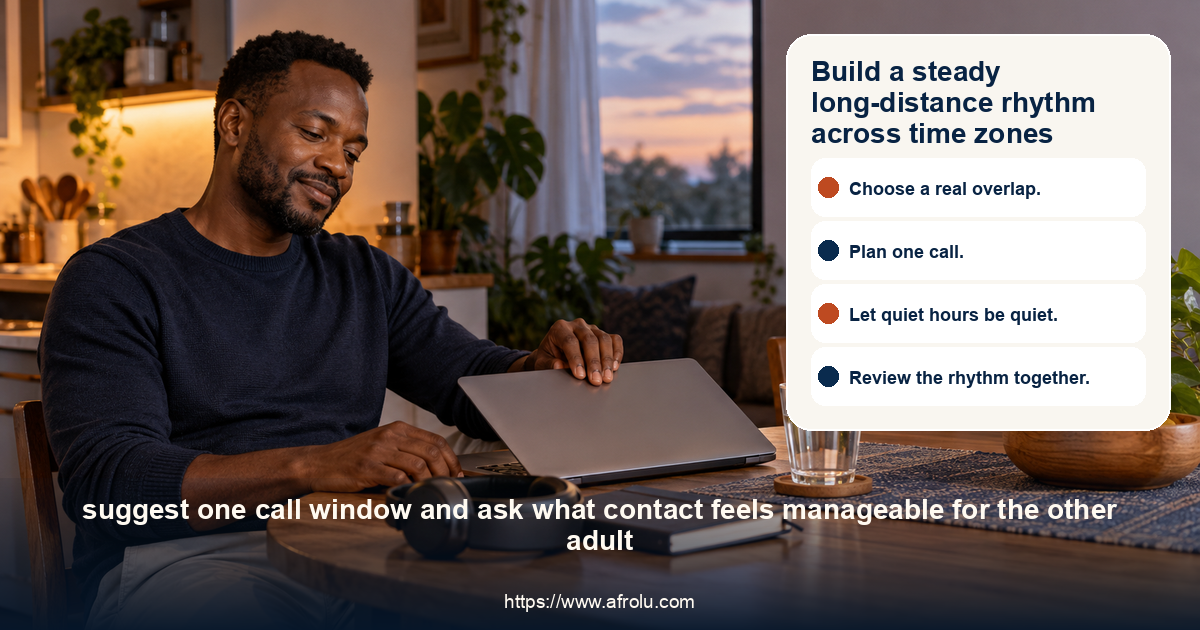
A mutually chosen contact plan can reduce guesswork but cannot prove identity or predict a relationship.
Written and edited by Nala Okafor · Africa Dating Platforms Editor
Start with what you can actually sustain: an agreed call window, a message when you are free, or a simple check-in after a busy week. Ask whether the plan works for the other adult, then review it when work, sleep or location changes. Keep a call separate from a visit, and a visit separate from commitment. No contact rule can verify identity, predict a relationship or guarantee safety.
Intentional dating · Diaspora Daters
How can we build a low-pressure rhythm when our time zones and routines differ?
Low-pressure long-distance dating means making space for contact and learning without requiring constant proof of attention. A workable rhythm can include asynchronous messages, planned calls and quiet periods. It should be discussed rather than inferred from reply speed, and it should leave both adults free to change the arrangement or decide that distance does not suit them.
Illustrative scenario: One adult lives abroad and the other is in Kenya. They enjoy their calls, but a work shift and a family commitment disrupt the first schedule they tried. Instead of treating the missed call as evidence, they discuss a different window, agree to send a short update when a plan changes, and leave a future visit undecided until both want to discuss the practical details.
Make the rhythm mutual
Low pressure still includes a clear plan
Long-distance contact is shaped by sleep, work, caregiving and time zones. A slower rhythm can feel comfortable when both people understand it; the same amount of contact can feel confusing when one person expects daily calls and the other expects occasional messages. Ask about the expectation rather than deciding that either preference is the only reasonable one.
Choose a small plan that can survive ordinary life: one call on a day that usually overlaps, a voice note when schedules do not line up, or a message to say a planned call needs to move. Avoid promises such as “I will always answer immediately.” A realistic arrangement leaves room for missed windows, changing shifts and a conversation about whether the plan still works.
Write down the part you actually agreed, not the story you hope it implies. A Sunday call may mean that both adults want to speak on Sunday; it does not automatically mean exclusivity, a visit or a commitment. If you want to understand those questions, ask them separately. Clear plans can make dating easier without asking a call to carry several meanings.
Use the gaps honestly
Quiet hours do not need an invented explanation
Asynchronous messages let each person respond when they have room, rather than forcing both adults to be online together. You might agree that neither person owes a reply during sleep or work, while still sending a brief note if a planned conversation cannot happen. That is a practical courtesy, not a rule that can reveal how much someone cares.
If a missed call disappoints you, name the event and the effect without declaring motive: “We missed the time we planned, and I would like to know whether you want to choose another.” The answer and later follow-through give you useful information about the arrangement. They do not tell you everything about the other person's private thoughts.
Review after trying the rhythm for a little while, or sooner when a real change occurs. Maybe a time-zone shift makes your old window impractical; perhaps one adult needs more contact than the other can offer. Talk about the specific choice at hand. You may adjust the plan, accept the mismatch, pause or end the connection without making either person the villain.

Review observable details when deciding whether a Kenyan diaspora adult building a low-pressure long-distance dating rhythm across time zones fits.
Let calls add context
A video call is contact, not full verification
A live conversation can help you notice whether you can ask questions, share a laugh or discuss something difficult. It can also help you decide if you want another call. But a video image does not independently confirm a person's name, employment, location, relationship status or intentions. Keep important claims separate from the feeling of closeness that a good conversation can create.
A long-distance relationship can involve sincere feelings and still include unknowns. Avoid turning gifts, travel plans, an intense declaration or a move to private messaging into proof. The U.S. Federal Trade Commission warns that romance scammers may build trust from far away and later request money for travel or an emergency. If an online love interest asks you for money, do not send it; contact your financial provider promptly if you already paid.
You can move at a pace that allows a claim to be checked through ordinary, independent means. Ask questions in context, avoid sharing account access or financial information, and talk to a trusted person if pressure makes you feel rushed. Caution is not an accusation. It is a way to preserve your choices while you learn what is true.

Adapt one short question to discuss a Kenyan diaspora adult building a low-pressure long-distance dating rhythm across time zones.
Keep travel separate
A call does not create a trip obligation
A visit includes more than the excitement of meeting. Consider leave from work, travel cost, where each person would stay, local transport, health needs and what happens if either adult changes their mind. Discuss each detail openly. Neither person should have to borrow money, transfer funds, share a passport or accept lodging to demonstrate affection.
If one adult proposes a visit, ask what is known and what remains undecided. You can respond, “I am open to talking about a visit, but I am not booking anything today.” The Federal Trade Commission's romance-scam guidance is especially relevant when someone you have not met asks for travel money or another urgent payment. Keep financial decisions independent of a romantic promise.
If you choose to meet, make a separate plan for your own arrival, accommodation and return. Tell a trusted person what you are comfortable sharing and how you want them to check in. A plan may reduce uncertainty, but it cannot guarantee another person's behavior. You can delay or cancel if the details stop feeling right.
Decide whether distance fits
Compatibility includes the logistics you both live with
Look at the practical pattern: do both adults make time they can genuinely offer, share changes when possible, and listen when the other person asks for clarity? These observations help you decide whether the current arrangement suits you. They are not a hidden-motive test, and they do not guarantee that a long-distance relationship will last.
Ask about current intent in plain language if it matters: “Are you interested in exploring a serious relationship, or do you want to keep this casual?” A sincere answer may include uncertainty. You can decide whether that answer works for you now instead of waiting for a future promise that neither person can guarantee.
Keep the rest of your life intact while deciding. Stay connected to friends, work, rest and interests; don't make every available hour a call slot. Continue if the arrangement remains mutually chosen. Clarify, adjust, pause or stop if it no longer fits. The right next step is the one you freely want, not the one that proves distance is worth enduring.

Keep these choices nearby when a Kenyan diaspora adult building a low-pressure long-distance dating rhythm across time zones.
Common moments in a Kenyan diaspora adult building a low-pressure long-distance dating rhythm across time zones
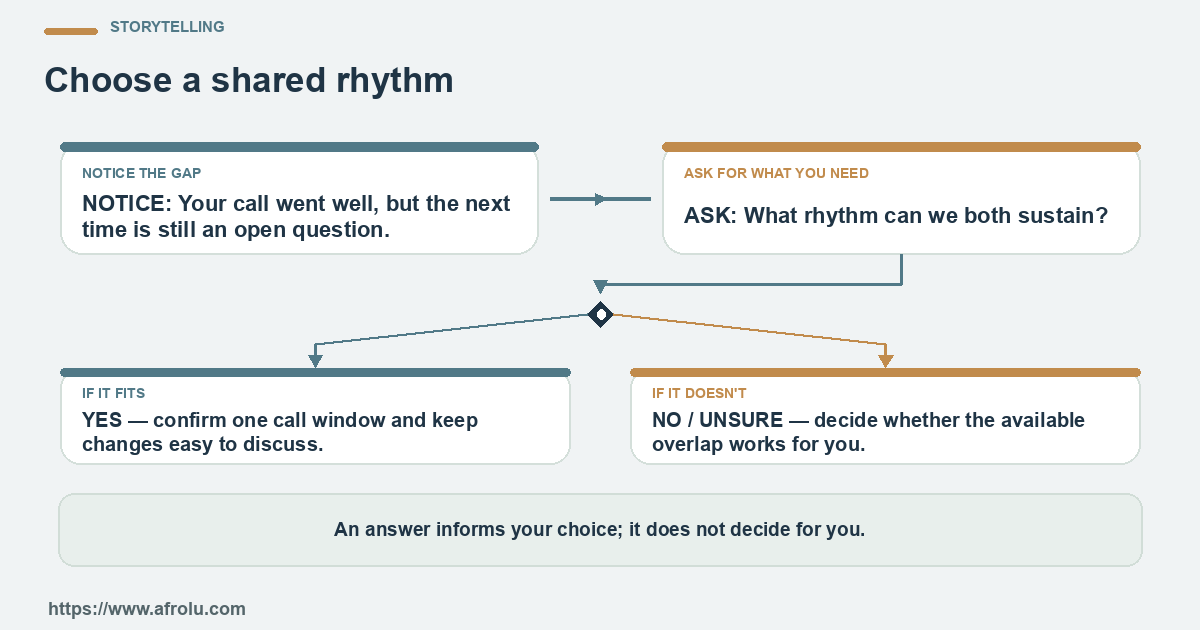
An invitation stays broad
For a Kenyan diaspora adult building a low-pressure long-distance dating rhythm across time zones: The idea of meeting is raised without a time, activity or place.
Ask for the detail you need and keep other plans until the invitation is confirmed.A free window moves
For a Kenyan diaspora adult building a low-pressure long-distance dating rhythm across time zones: Work, sleep, travel or family changes when one adult is available.
Share an update and suggest a new option only if it works for you.A bounded plan is offered
For a Kenyan diaspora adult building a low-pressure long-distance dating rhythm across time zones: Someone suggests one agreed call or voice-note exchange that both adults can realistically keep with practical details.
Accept, decline or revise the plan without pressure.A response arrives later
For a Kenyan diaspora adult building a low-pressure long-distance dating rhythm across time zones: A message appears after you have made another plan or gone to sleep.
Decide whether to respond now; do not treat timing as a relationship score.A label is unclear
For a Kenyan diaspora adult building a low-pressure long-distance dating rhythm across time zones: The adults use the same dating word but have not described what it means.
Ask which term affects the next choice and explain your own meaning.The meeting point changes
For a Kenyan diaspora adult building a low-pressure long-distance dating rhythm across time zones: The location or end time changes after the original plan.
Pause and choose again before agreeing to the new details.The preferences differ
For a Kenyan diaspora adult building a low-pressure long-distance dating rhythm across time zones: One adult wants more contact, commitment or time than the other can offer.
Name the mismatch and decide whether the available arrangement suits you.A boundary is named
For a Kenyan diaspora adult building a low-pressure long-distance dating rhythm across time zones: One person says a location, activity or disclosure does not feel right.
Respect the limit without repeated bargaining or punishment.Notice choices and actions, not imagined motives
Sleep and work hours are considered.
Both adults suggest a contact window.
Asynchronous messages are acceptable by agreement.
A missed call can be discussed.
No one promises constant access.
Changes are shared when practical.
Quiet hours are not treated as proof.
A call is not a travel commitment.
Visits and finances remain separate choices.
Profile claims are not verified by video alone.
Each person keeps friends and routine.
A contact mismatch can be named.
The rhythm can be revisited.
Either adult may pause or end the connection.
Choose a response that fits the moment
| Situation | What it may mean | What to do next |
|---|---|---|
| An invitation stays broad | The idea of meeting is raised without a time, activity or place. | Ask for the detail you need and keep other plans until the invitation is confirmed. |
| A free window moves | Work, sleep, travel or family changes when one adult is available. | Share an update and suggest a new option only if it works for you. |
| A bounded plan is offered | Someone suggests one agreed call or voice-note exchange that both adults can realistically keep with practical details. | Accept, decline or revise the plan without pressure. |
| A response arrives later | A message appears after you have made another plan or gone to sleep. | Decide whether to respond now; do not treat timing as a relationship score. |
| A label is unclear | The adults use the same dating word but have not described what it means. | Ask which term affects the next choice and explain your own meaning. |
| The meeting point changes | The location or end time changes after the original plan. | Pause and choose again before agreeing to the new details. |
| The preferences differ | One adult wants more contact, commitment or time than the other can offer. | Name the mismatch and decide whether the available arrangement suits you. |
| A boundary is named | One person says a location, activity or disclosure does not feel right. | Respect the limit without repeated bargaining or punishment. |
| The answer is uncertain | The other adult may be undecided or may want different terms; uncertainty alone does not establish motive. | Ask one practical follow-up, then choose your own limit. |
| Your comfort changes | A new feeling or changed circumstance can be enough reason to revise a plan. | Say what you want now and keep the next choice voluntary. |
Words you can adapt to your own voice
“I am interested in a Kenyan diaspora adult building a low-pressure long-distance dating rhythm across time zones, and I want to be clear about what works for me.”
“Would you like to plan one agreed call or voice-note exchange that both adults can realistically keep?”
“Would one planned call most weeks suit you, or would a different rhythm feel better?”
“I can share your broad time zone and available window, not your exact rota or address, but I am keeping other details private.”
“Can we agree on one overlapping call period plus room for asynchronous messages before I change my plans?”
“That time no longer works for me. I can suggest another option if I still want to.”
“It sounds as if we want different terms right now. Have I understood you?”
“My preference or availability has changed. Would you like to revisit what we discussed?”
“I am not comfortable with that plan, so I will not go ahead with it.”
“I can meet for about two hours, then I need to head home.”
“I want to think about that before I answer. I will get back to you if I decide to.”
“I have appreciated meeting you, but I do not want to continue dating.”
Know the difference
Compare a mutual contact rhythm with constant availability as a test
Both adults agree on a realistic next call and can communicate when the plan needs to move.
One person watches reply speed and treats every quiet period as a verdict.
Agree on a plan you can both sustain; keep quiet hours separate from assumptions about intent.

Compare a shared agreement with an assumption in a Kenyan diaspora adult building a low-pressure long-distance dating rhythm across time zones.
Compare a mutual contact rhythm and constant availability as a test
| Type or dimension | What it describes | Best next question |
|---|---|---|
| A feeling | Interest, uncertainty or disappointment describes an experience, not an agreement. | Notice it and decide whether you want to talk. |
| A label | Words such as casual or serious may mean different things to different adults. | Explain your meaning and ask what the other person means. |
| A present intention | A person can describe what they hope to explore without guaranteeing an outcome. | Ask what that intention means for a current choice. |
| A clear plan | A time, place, activity and practical details have been agreed. | Confirm the details and keep the choice voluntary. |
| A boundary | A person names what they will or will not do. | Respect it without asking repeatedly. |
| A changed plan | A schedule, location or comfort level has shifted. | Offer or accept a new option only if it works. |
| An open possibility | A future idea has been mentioned but no present step is agreed. | Separate hope from what is available today. |
| A mismatch | Two adults want different pace, contact or commitment. | Decide whether the actual arrangement suits you. |
| A new choice | Either adult wants to revise, pause or end the arrangement. | State the change and let both adults respond freely. |
Six practical ideas to keep nearby
No universal dating clock
A thoughtful pace is personal; this page does not set a number of dates or weeks.
Terms need explanation
A label is useful only when both adults understand what it means.
Small steps give context
For a Kenyan diaspora adult building a low-pressure long-distance dating rhythm across time zones, one manageable next step may be more useful than a big promise.
Boundaries remain yours
You can protect time, privacy, money, transport and physical comfort.
Use what you can observe
Compare what was agreed with what happened without guessing motive.
Choose again
Continue, clarify, adjust, pause or stop as your needs change.
Questions for planning and reflection
Choose a few prompts that fit the moment. This is a reference library, not a list to complete.
Before a plan
Choose conditions that fit your real life.
- What do I want from this interaction?
- Which detail or boundary matters?
- What is one step I actually want?
During the conversation
Ask the question that affects your next choice.
- What does this term mean to me?
- What does the other adult want now?
- Can either of us say no freely?
Afterward
Notice your experience without turning it into a verdict.
- Could I be myself?
- Did the plan and boundary hold?
- Do I want another step?
If something changes
Revisit the plan without assigning motive.
- What changed?
- What do I want now?
- Would a pause or ending fit better?
What research and guidance can—and cannot—tell you
Romance fraud
The FTC warns that online romance scammers may build trust from a distance and request money.
Evidence limit: U.S. consumer guidance cannot verify a particular person or replace local reporting channels.
Requests for money
The FTC advises against sending money, gift cards or cryptocurrency to an online love interest.
Evidence limit: This is consumer guidance; contact your provider promptly if you believe you paid a scammer.
Digital dating safety
Australia's eSafety Commissioner discusses location, profile privacy and platform safety controls.
Evidence limit: The resource is Australian and cannot guarantee that a person or platform is safe.
Kenyan data privacy
The ODPC explains what counts as personal data and how organizations process it.
Evidence limit: The guidance does not validate identity in a private video call.
Consent
RAINN describes consent as a clear, voluntary and ongoing conversation.
Evidence limit: It is general U.S.-based public education, not local legal advice.
Boundaries
love is respect encourages people to communicate their own relationship boundaries.
Evidence limit: A resource can offer prompts but cannot decide what contact rhythm fits you.
Common assumptions that add pressure
Using availability as proof
Work, sleep and distance affect a schedule but do not reveal a person's whole intent.
Treating a label as an agreement
Adults can mean different things by casual, serious or exclusive.
Treating a call as verification
A conversation does not confirm every profile claim or future plan.
Promising travel before details
Time, cost, lodging and consent are separate practical choices.
Oversharing to create trust
A new connection does not need access to every private detail.
Demanding instant certainty
You can ask a direct present-tense question and allow an honest answer.
Agree on one contact window
These information links are clearly labelled, non-commercial and do not promise a relationship outcome.
Explore the guide library
Show more related guides
Continue with Afrolu
Show more Afrolu guides
Research and practical guidance used for this guide
Afrolu reviewed these health, research, safety, or public guidance resources while editing this page. They support the behaviour and safety guidance; they do not diagnose any individual described by a reader.
Questions about a Kenyan diaspora adult building a low-pressure long-distance dating rhythm across time zones
How often should we call across time zones?
There is no universal schedule; agree on a rhythm that fits both adults.
Does a missed call mean they are not interested?
Not by itself. Ask whether they want to choose another time.
Can we message asynchronously?
Yes, if both people understand what to expect and feel comfortable with it.
Should I answer while I am working?
You may set a boundary around work, sleep and other responsibilities.
Does a video call verify someone's identity?
No. It can add context, but it does not confirm every profile claim.
Should I pay for a visit?
Travel and money are separate decisions. Never send money to an online love interest.
What if our schedules rarely overlap?
Discuss realistic options and decide whether the available rhythm works for you.
Can we plan a visit before becoming exclusive?
You can discuss a visit, but agree on its practical details separately.
How do I handle a change in time zone?
Tell the other person when you can and revisit the plan together.
Can I end a long-distance connection?
Yes. You do not have to continue an arrangement that no longer fits.
One thing to do now
Choose the next step that fits your actual needs
Agree one contact step you both can sustain, make changes explicit when possible, and decide separately whether any future visit fits your time, money and comfort.