Adult student dating · serious direction
Adult Students’ Serious Situationships in Nairobi
For adult students in Nairobi, define serious situationship terms, plan independent dates, protect privacy and consent, and respond safely to pressure.
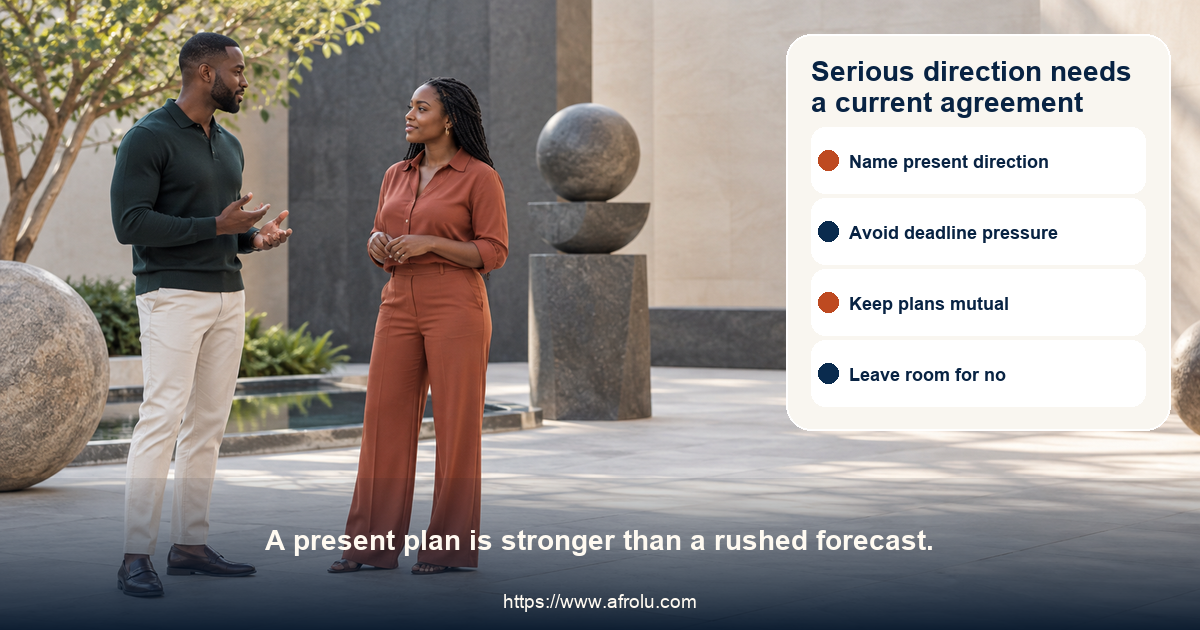
Serious direction starts with a present agreement.
Written and edited by Grace Mutiso · Kenya Guides Editor
Treat serious direction as a present agreement, not an urgent promise. Plan each Nairobi date with independent movement and a clear end point, make capacity and privacy visible without overdisclosure, and discuss exclusivity, consent, health, images, and pace before assumptions matter. Keep money, accounts, codes, and documents out of dating. If a no is ignored, access narrows, or fear appears, protect yourself and use support.
Relationship clarity · Students
Is this a mutual serious direction, a capacity mismatch, a Nairobi date-planning question, a privacy or verification issue, an intimacy decision, a money request, unwanted pursuit, or conduct that makes me feel unsafe?
A serious situationship is recurring contact with affection, intimacy, or expectation that is being explored with intention but without a fully shared commitment definition yet. For adult students in Nairobi, the practical test is whether current terms, local date logistics, capacity, privacy, consent, independent systems, and endings remain freely chosen instead of treating adult study or city context as a relationship script.
Wanjiku likes someone she has been seeing, but their serious talk is not matched by a reliable plan. She asks what serious direction means over the next few weeks, proposes a bounded adult date with her own transport, keeps her routine and accounts private, and discusses other dates before intimacy. The replies reveal whether the connection can grow without sacrificing her control.
adult student dating · serious direction
Wanjiku makes a serious situationship readable without letting urgency, city shorthand, access, or hope choose for her
This guide separates mutual serious direction from a capacity mismatch, a practical Nairobi date plan, privacy pressure, assumed intimacy, financial manipulation, unwanted pursuit, and fear—without treating adult students or Nairobi as stereotypes.
Make serious direction present, plan each adult date independently, choose a sustainable rhythm, use proportionate verification, keep consent current, protect money and systems, and switch to safety when freedom narrows.
Make serious present
A current agreement is more useful than a rushed promise about the future.
Keep movement independent
A mutually chosen date plan should preserve arrival, exit, and changed-mind options.
Choose a usable rhythm
Serious follow-through fits real adult life without making anyone permanently on call.
Protect systems
Money pressure, access demands, and ignored boundaries need control and support.
adult study · serious direction
Wanting a serious relationship does not require an immediate commitment, constant access, or a promise that neither adult can yet make
Adult students arrive in dating with varied lives, goals, responsibilities, resources, and preferences. None of those features tells you whether someone should date casually, seek commitment, or move quickly. A serious situationship becomes healthier when it starts with a present answer: what contact, planning, exclusivity, and care can each person honestly offer right now?
Serious does not have to mean permanent. It may mean that both adults want to explore partnership deliberately, make plans with reasonable notice, discuss intimacy before assumptions matter, and say when the arrangement is no longer working. It does not mean that a date, a shared interest, or a warm future conversation has settled every decision about access or commitment.
A relationship can become confusing when one person treats serious intent as a reason to rush. You may be asked to define the future before there is a reliable present pattern, or to prove interest by sacrificing time, privacy, or a boundary. A direct question is more useful: 'What does serious direction mean to you over the next few weeks, and what can you genuinely sustain?'
You can be open to serious dating and still say not yet to exclusivity, intimacy, an overnight, a private setting, or a particular plan. Another adult may want a faster pace, and that may be a mismatch rather than a failure. The aim is to choose a direction that both adults can continue freely, not to make your hope do the work of an agreement.
Nairobi · adult logistics · independent choice
A city can shape the practical details of a date, but it does not predict anyone's character, relationship needs, or safety level
Nairobi can matter because two adults have to decide when and where to meet, how long a plan lasts, and how each person gets there and back. Those are ordinary dating questions, not evidence that the city itself makes a relationship risky or a person trustworthy. Treat the practical plan in front of you as the relevant information.
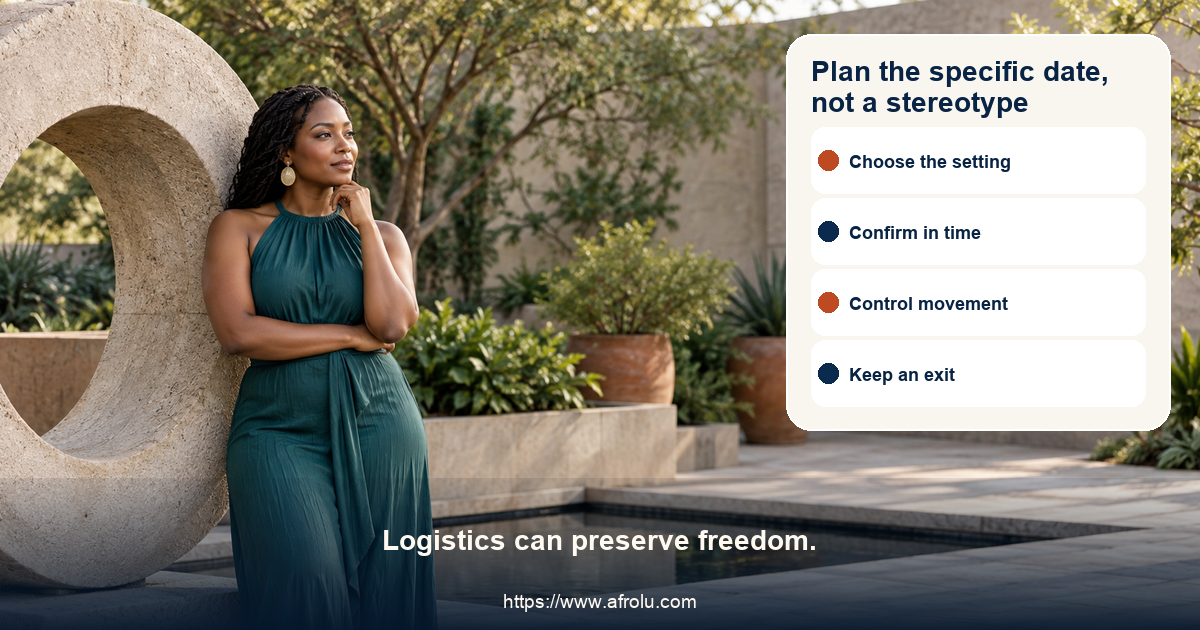
Use a bounded plan that neither adult has to interpret: a mutually chosen public setting, an approximate start and finish, confirmation before travel, personal transport or a route you control, and an easy way to shorten the date. These choices are not a judgement about the other person. They preserve the ability to respond to the actual interaction instead of a hoped-for version.
Do not let convenience turn into an obligation. A person may offer a ride, suggest a private place, or want to change the plan after you arrive. You can keep the original setting, meet for a shorter time, or leave. A serious interest can hear a practical boundary without asking you to abandon your own movement, phone, money, or ability to decide.
Keep each plan local to itself. You do not need to disclose your complete routine, address, class schedule, social circles, or route history in order to arrange one adult date. If a person presses for details you do not want to share, respond to the request, not to an imagined accusation: 'I keep that private,' or, 'I am meeting in the place we agreed.'
availability · study · sustainable contact
Serious direction is easier to trust when it fits real capacity rather than making one adult perform permanent availability or apology
A serious situationship does not need constant messaging in order to be meaningful. Adult students may have changing demands and still be capable of honest dating. The key is to make the part that affects another person visible: whether you are available for a call, when a date can be confirmed, whether a busy period changes contact, and what you can realistically offer without becoming depleted.
Use simple agreements. You might choose one planned call, a weekend date with a confirmation point, or a period of lower contact that is named rather than disappearing. You do not owe a complete accounting of your time. You do owe enough clarity that another adult is not left waiting, reading silence as a promise, or asked to prove interest through instant replies.
Look at follow-through rather than a single difficult week. A changed plan can be ordinary; a recurring pattern of future talk, last-minute invitations, and warm reassurance after unexplained gaps can indicate that serious direction is not available in the present. You do not need to prove bad faith to decide that the pattern does not meet your need for a relationship with direction.
If capacity differs, try a smaller plan before making a larger promise. Choose fewer but reliable dates, a lower message rhythm, or a pause while one or both adults reset. If no honest shared rhythm exists, that is fit information. Serious dating should not ask you to shrink the rest of your life until only the connection remains.

A smaller plan you can keep is meaningful.
online dating · digital privacy · gradual access
A serious direction can justify a direct conversation, but it does not justify demands for documents, passwords, live location, account access, intimate images, or a detailed personal map
A person you meet online may appear familiar quickly, especially after frequent messages. It is reasonable to notice whether key details are consistent, to prefer a live conversation before a larger plan, and to use report or block tools if something feels wrong. It is not necessary to provide documents, passwords, account recovery details, private images, or continuous location as proof that you are genuine.
Keep early information layered. You can decide when to share a surname, an exact address, your daily schedule, social accounts, intimate pictures, or details about people in your life. Staying on a platform with safety tools at first, avoiding automatic account links, and meeting where you can leave independently create time to evaluate the connection without creating access you later need to undo.
A respectful adult can ask for reassurance without making your privacy the cost. They may prefer a live call, a confirmed plan, or a slower pace. You can choose what you are comfortable with. If the request becomes a demand for proof, an argument about your boundary, or a reason to monitor you, stop treating it as a verification question and begin protecting access.
Do not make social visibility a replacement for trust. Mutual contacts, familiar names, or a shared city do not mean that your routine, home, accounts, or private messages are public property. Let disclosure follow your own comfort and the relationship's demonstrated respect, not the pressure of someone wanting a faster answer.
consent · health · serious terms
Serious direction does not create automatic exclusivity or consent; both adults still need room to discuss the next intimate decision and change their minds
A situationship can feel serious because the conversations are deep or the time together is meaningful. That feeling may be real, but it does not answer practical questions. One adult may assume regular dates mean exclusivity, another may be open to dating others. One may want physical intimacy, another may want a longer period of conversation. The task is to make those differences speakable before anyone relies on an assumption.
Try language that is specific and proportionate. 'Before we become physical, are we seeing other people and what information do we each need?' or, 'I am interested in seeing where this goes, but I am not planning an overnight today,' creates clarity without demanding a lifetime guarantee. You can talk about testing, protection, images, and pacing as care for the next decision.
Consent is not borrowed from yesterday. A previous kiss, date, conversation, ride, relationship label, or future plan does not settle touch, sex, images, or a private location later. An adult who is disappointed can still respect a pause or changed mind. Pushing, bargaining, sulking, isolating someone from transport, or claiming that serious interest means access are reasons to slow down or leave.
If a person will not discuss a question that affects your health, safety, or freedom, treat that response as information. You can keep the connection non-intimate, alter the terms, or end it. Clarity is not a demand for matching preferences; it is a way to keep both adults able to choose with the information they need.

Ask when the answer changes your plan.
money · identity · independent systems
A serious possibility does not make it safe to send money, receive funds, share a code, open an account, provide documents, buy a ticket, or solve an urgent story
Adults in study can have widely different financial circumstances, but no one needs to turn those circumstances into a dating script. A person may offer generosity, ask for help, or describe an urgent problem. The safest rule is the same regardless of who has more or less at a particular moment: do not send, receive, move, lend, or manage money and identity tools through a new or undefined connection.
A request can sound plausible: a payment problem, a delayed journey, a fee, a medical issue, a device failure, a lost document, or a chance to meet. The urgency may be sincere or manipulative. You do not need to solve that question before declining. Verify an organisation independently using a contact you find yourself, and do not use a person you are dating as the channel for transfers, codes, accounts, documents, or purchases.
Keep dates financially independent enough that a change of mind remains easy. Use a plan you can afford and leave, keep your own payment method, and do not let one person use spending to buy a commitment, ride, private access, or emotional debt. A caring gesture can be offered, but it cannot turn into leverage when the relationship is still being defined.
If someone asks you to keep a financial request secret, becomes angry at a no, promises repayment to overcome your boundary, or says you are the only person who can help, reduce access. A serious relationship should make your systems safer to manage, not turn them into proof of affection or a rescue route.

Keep money, systems, and hope separate.
fit · unwanted contact · protection
A mismatch in serious direction can be handled directly; repeated pursuit, threats, monitoring, image pressure, or fear need a response that increases control
Not every hard dating experience is a safety problem. A person may not want the same kind of serious relationship, may be unable to offer enough capacity, or may simply lose interest. You can choose an ending because the fit is wrong without diagnosing their motives. A short, honest message can be enough when it feels safe and the other person is likely to respect it.
The category changes when someone keeps contacting you after a clear no, starts new accounts after block, watches your activity, pressures you for images, threatens to expose private information, uses mutual contacts to regain access, tracks you, or makes you afraid. These behaviours reduce voluntary choice and often need more than another relationship conversation.
Start with access. Stop sharing details, adjust privacy settings, use block and report tools, and preserve messages or screenshots only if doing so is safe. Tell someone you trust what is happening. If you are in immediate danger or feel at risk, use local emergency, specialist, or technology-abuse support rather than trying to manage the situation alone.
You do not owe a final meeting, a detailed explanation, or further emotional labour after you have chosen an ending. The person may be disappointed, but their disappointment does not restore access. Let serious direction mean respect for your present decision too, including the decision that this connection is over.
Eight serious situationships where direction, Nairobi date logistics, capacity, privacy, intimacy, money, a mismatch, or unwanted contact changes the next move
Serious is treated as immediate
A person wants a major commitment answer before there is a reliable pattern of plans, contact, or direct conversation.
Name the current direction you can offer and ask for a modest present agreement.A city detail becomes a dating shortcut
A date is proposed, but one adult is asked to give a full routine, accept a ride, or change to a private plan for convenience.
Keep a mutually chosen, independently reachable adult plan with a clear end point.Capacity needs a usable rhythm
One adult has less time for a period but sends no clear update, leaving the other to infer whether the serious direction changed.
Name a smaller contact plan or pause rather than making silence do the work.Privacy is made into a test
Someone asks for documents, passwords, location, social accounts, or private images as evidence of serious interest.
Use proportionate verification and keep private systems under your control.Regular dates mean different things
One adult assumes a serious direction has already created exclusivity while the other has not agreed to it.
Ask before intimacy or another decision depends on the answer.Hope becomes an urgent rescue
An apparent emergency arrives with a request for money, a code, account help, documents, a ticket, or a purchase.
Decline and independently verify any organisational claim.Interest cannot become a usable plan
Both adults want serious dating in theory but cannot create a rhythm that protects either person's time or well-being.
Try a smaller agreement or end the connection without blaming either adult.A no becomes repeated access
After a clear ending, new accounts, mutual contacts, threats, or monitoring are used to restart the relationship.
Reduce access, use platform tools, and seek support if it causes fear.Fourteen observable signs that serious direction remains mutual, sustainable, independent, vague, access-driven, financially risky, or unsafe
Serious direction is translated into present plans, contact, consent, and follow-through rather than a deadline.
Nairobi is handled as a practical date-planning context, not a stereotype about people or risk.
A meeting plan is mutually chosen, independently reachable, and easy to shorten or leave.
Address, routine, route, accounts, documents, images, and private contacts remain gradual and controlled.
A smaller contact rhythm is named instead of using silence to manage capacity changes.
Study, work, rest, friends, privacy, and other adult responsibilities remain visible alongside dating.
Other dates, exclusivity, health, touch, sex, images, pace, and overnight plans are current conversations.
A changed mind is accepted without bargaining, guilt, isolation from transport, or demands for proof.
No transfer, account, code, document, ticket, purchase, or secret financial task enters the connection.
A person can decline a private or changed plan without being told serious interest creates an obligation.
A relationship mismatch can be named without turning adult study or city context into blame.
A return after a gap offers changed present conduct rather than claims old access.
A clear ending remains an ending, not a reason for new accounts or mutual contacts to intervene.
Monitoring, threats, image pressure, repeated pursuit, or fear shift the task to safety.
A proportionate decision map for serious terms, adult Nairobi plans, capacity, privacy, consent, money, mismatch, and safety
| Situation | What it may mean | What to do next |
|---|---|---|
| You want serious direction | You may be open to intentional dating without being ready for a full commitment today. | State the present relationship shape you can offer and ask what the other adult means by serious. |
| A date is proposed in Nairobi | The location needs practical planning, not assumptions about character or danger. | Choose a mutually agreed public or independent plan, confirmation, transport, and an end point. |
| Capacity changes | A busy period can be ordinary; silence can create unnecessary uncertainty. | Name a smaller rhythm or pause that protects both adults from waiting. |
| A person wants more proof | They may seek reassurance, or they may be seeking private access that has not been earned. | Use a voluntary live check if useful; keep documents, passwords, location, and accounts private. |
| Intimacy is possible | Serious interest does not settle exclusivity, health, images, consent, or an overnight. | Discuss the exact topic needed before the next decision. |
| One adult pays or offers a ride | Generosity can be kind, but it should not create debt or control of the plan. | Keep personal payment, transport, and an exit available. |
| A money request arrives | Dating is not a safe financial or identity verification channel. | Do not send, receive, move, lend, share, or open anything; independently verify any claim. |
| A serious mismatch appears | Both adults can want serious dating yet lack a workable shared pace or terms. | Try a smaller arrangement only if it meets your real need; otherwise end it. |
| A past contact returns | Familiarity may feel meaningful, but old access has expired. | Treat the return as a new invitation and decide from current follow-through. |
| A no is ignored | The issue has moved from relationship fit into unwanted contact or risk. | Reduce access, report or block where appropriate, and use trusted or specialist support if it continues. |
Twelve complete lines for serious direction, an adult date plan, capacity, privacy, exclusivity, money, a mismatch, and an ending
“I am open to exploring something serious, but I want to make decisions from what we can actually offer now.”
“When you say serious, what would that change about contact, plans, exclusivity, or how we handle uncertainty?”
“I am comfortable meeting in the place we agreed, with my own arrival and end time.”
“This week I can offer a shorter rhythm rather than disappear. Would a planned call on Saturday work?”
“I keep my address, route, schedule, accounts, and private images gradual while I get to know someone.”
“Before we make this more intimate, are we seeing other people and what information do we each need?”
“I want to keep this date to the plan we made, and I am not agreeing to an overnight today.”
“I do not send, receive, or move money, codes, documents, accounts, or tickets in dating connections.”
“Thank you, but I am arranging my own transport and payment so I can keep the plan simple.”
“I want a serious direction with a clearer rhythm than this, so I am stepping back rather than leaving it undefined.”
“This connection no longer works for me, and I am not available to keep discussing the decision.”
“I have asked for no further contact. Do not reach me through new accounts or other people.”
Know the difference
Compare serious direction that remains voluntary with a pattern that uses urgency, access, or a city context to bypass clear adult choices
Both adults can name a present rhythm, independent plan, privacy boundary, consent conversation, and relationship direction without turning hope into debt.
Future language replaces present conduct, a plan removes independent movement, proof demands replace trust, or a no is treated as something to negotiate.
Serious intent is more credible when it leaves each adult more free to choose the next step.

Serious intent differs from pressure.
Keep voluntary serious direction distinct from urgent intensity, access pressure, and conduct that reduces freedom
| Type or dimension | What it describes | Best next question |
|---|---|---|
| Direction | Serious direction names a present path; urgency asks for a future promise before a pattern exists. | State what you can offer over the next few weeks. |
| Nairobi plan | Independent logistics preserve choice; a convenience shortcut can remove it. | Choose a mutually agreed setting, transport, confirmation, and end time. |
| Capacity | A shared rhythm makes time visible; silence turns one adult into an interpreter. | Offer a smaller, reliable plan or a clear pause. |
| Verification | A voluntary check is proportionate; surveillance demands documents, accounts, passwords, or location. | Keep private systems under your control. |
| Intimacy | Current consent invites a conversation; assumed access treats serious interest as permission. | Ask before the decision changes. |
| Money | A healthy connection leaves financial systems alone; a risky one uses urgency or obligation. | Do not transfer, receive, or share money and identity tools. |
| Generosity | An offer is optional; leverage makes transport, payment, or access a debt. | Keep an independent way to arrive, pay, and leave. |
| Mismatch | Different capacity can be named; blame turns adult context into a reason to override a boundary. | Choose the relationship shape that actually fits. |
| Ending | Respect accepts no; unwanted pursuit routes around it. | Reduce access and use support if freedom narrows. |
A simple plan you can use today
Serious is a present practice
Direction becomes credible through current plans, direct answers, care, and room to change course—not an immediate permanent promise.
A city is logistics, not fate
Nairobi can shape the details of a date, but respect and safety depend on the actual plan and conduct.
Capacity can be honest and small
A limited rhythm is more useful than intense contact that neither adult can sustain.
Privacy can be proportionate
A live conversation or public plan can provide useful reassurance without handing over documents, accounts, location, or private images.
Consent remains particular
Serious interest does not decide touch, sex, images, exclusivity, health information, an overnight, or a changed mind.
Financial independence protects hope
Money, codes, documents, accounts, and urgent rescue stories should stay outside a situationship.
Questions organised by purpose and depth
Choose a few prompts that fit the moment. This is a reference library, not a list to complete.
Serious direction
Use before future hope becomes a deadline.
- What do I mean by serious over the next few weeks?
- What promise would I be making only to relieve pressure?
Adult Nairobi plan
Use before a date's logistics are assumed or changed for convenience.
- Can I arrive and leave independently?
- What details do I need to keep private for this one plan?
Capacity and privacy
Use before intensity substitutes for a sustainable pattern.
- What rhythm can I actually keep?
- What verification is proportionate without giving away control?
Consent and protection
Use before intimacy, a money request, a return, or an ignored boundary changes the task.
- What needs a current conversation before I agree?
- What action gives me more control if a no is ignored?
What deserves a closer look
Make serious direction current
Describe the contact, planning, exclusivity, and care you can honestly offer over the next few weeks.
Evidence limit: Do not mistake a future promise for a present agreement.
Plan one adult date independently
Use a mutually chosen location, confirmation, personal transport or route, payment, and exit.
Evidence limit: A city does not decide the quality of the plan.
Build a rhythm around real life
Name a smaller sustainable pattern instead of disappearing or demanding permanent access.
Evidence limit: Study and adult life do not need to be sacrificed to prove interest.
Verify proportionately
Use a live conversation or public plan if useful while keeping documents, accounts, location, and images controlled.
Evidence limit: Caution does not require surveillance.
Discuss the next intimate choice
Ask about other dates, health, protection, images, exclusivity, pace, and an overnight before assumptions matter.
Evidence limit: Prior closeness does not settle a new decision.
Keep hope and systems separate
Refuse money, account, code, document, and urgent rescue requests; reduce access if pressure or pursuit appears.
Evidence limit: Do not wait for proof before choosing more control.
Shortcuts that turn serious intention into urgency, city shorthand, access pressure, or financial risk
Treating serious as immediate
A serious direction can be thoughtful and gradual; urgency is not proof of commitment.
Making Nairobi a risk stereotype
The relevant evidence is the specific adult plan and conduct, not an imagined city story.
Using intensity as capacity
Frequent messages and future talk cannot substitute for a rhythm both adults can maintain.
Trading privacy for reassurance
Documents, passwords, accounts, location, and images are not required proof of serious interest.
Letting generosity create debt
A ride, payment, or invitation should not remove independent choice or produce access obligations.
Waiting for certainty before protecting yourself
Money pressure, threats, monitoring, ignored boundaries, or fear need more control and support now.
Ask stronger first-date questions, define exclusivity, or read green flags before carrying serious direction forward
Choose the guide that fits the immediate decision. An editorial resource can help you name a preference or a pattern, but it cannot promise another adult's honesty, availability, or conduct.
Explore the guide library
Show more related guides
Continue with Afrolu
Show more Afrolu guides
Sources used for this guide
Afrolu reviewed these health, research, safety, or public guidance resources while editing this page. They support the behaviour and safety guidance; they do not diagnose any individual described by a reader.
Questions about serious situationships for adult students in Nairobi
Can an adult student want a serious situationship?
Yes. Serious direction can mean intentional present choices and conversations without requiring a rushed commitment or a particular dating script.
Does Nairobi change how I should think about dating safety?
Treat it as a practical planning context. Choose an independently reachable adult plan, confirmation, transport, and exit based on the date itself, not city stereotypes.
How do I ask what serious means?
Ask what it changes over the next few weeks: contact, plans, exclusivity, intimacy, future conversations, or how a change of mind is handled.
What if I have limited time to date?
Name a smaller rhythm you can sustain instead of promising constant access. A limited honest plan is better than unexplained availability gaps.
Should I share my class schedule, address, route, or accounts?
No. Keep routine, address, account, document, image, and contact details gradual until you freely want to share them.
Can I say no to a private location or overnight plan?
Yes. Serious interest does not create access. You can keep the original plan, choose a public setting, or leave at any point.
How do I ask about exclusivity?
Ask before an intimate or health decision depends on it: are we seeing other people, and what terms would each of us need if that changes?
What if someone offers to pay or give me a ride?
An offer can be kind, but you can keep your own transport and payment so the plan remains easy to change or leave.
What if someone asks for money or an urgent favour?
Do not send, receive, move, lend, or share money, codes, documents, accounts, tickets, or purchases through dating. Verify claims independently.
What if they keep contacting me after I end it?
Use block and report tools, preserve information only if safe, tell someone you trust, and seek local or specialist support if repeated contact or fear continues.
One thing to do now
Choose the next serious connection that leaves your movement, systems, and freedom intact
Choose the smallest next action that protects your time, adult privacy, private systems, current consent, independent transport, money, support network, and ability to redesign or end a connection without bargaining away freedom.