New dating journey · Nairobi clarity
New Journey Situationship Clarity in Nairobi
For adults on a new dating journey in Nairobi, clarify situationship terms, plan independent dates, protect consent and privacy, and respond safely to pressure.
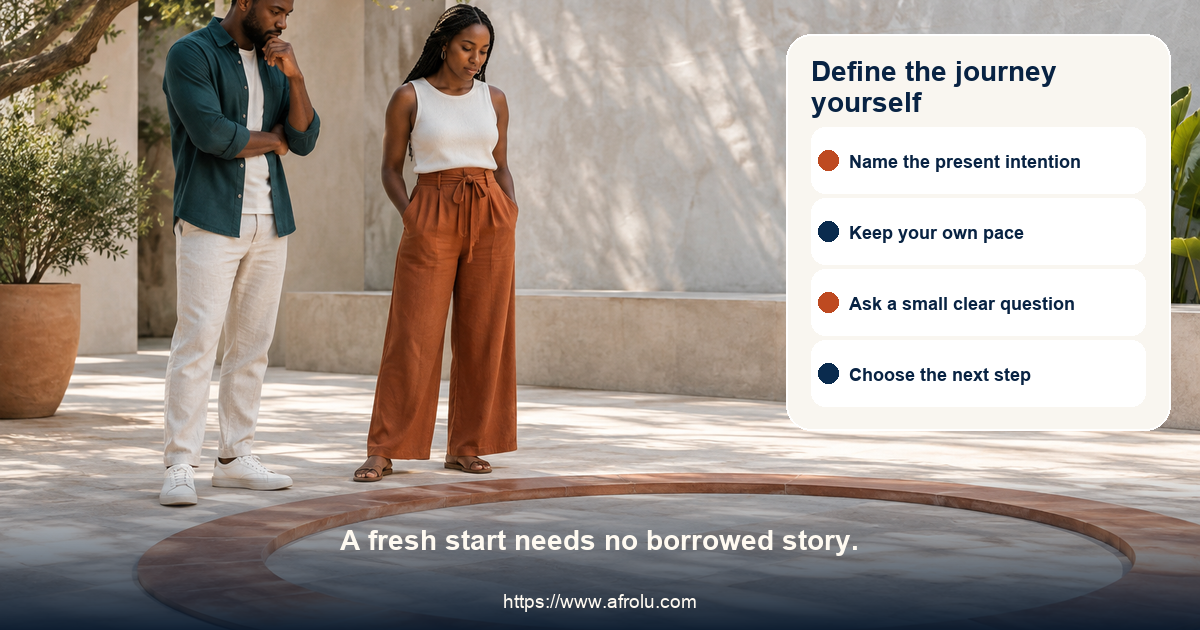
Newness stays yours to define.
Written and edited by Grace Mutiso · Kenya Guides Editor
Let a new journey remain yours to define. Treat Nairobi as a setting for practical adult decisions, not a dating script. Ask for present terms, make plans you can enter and leave independently, keep consent, privacy, money, and accounts under your control, use conduct as information, and reduce access if a clear boundary is ignored.
Relationship clarity · New Relationship Starters
Is this a connection I can define in my own words, a practical local plan, an unclear terms question, an assumption about consent or privacy, a pattern without follow-through, or access pressure that needs a safety response?
A new-journey situationship in Nairobi is recurring contact with interest or intimacy but without a fully shared relationship definition, while one adult is exploring a fresh dating intention. It does not assume a past story. The useful question is whether present plans, terms, consent, privacy, independent systems, and exit choices remain freely chosen.
Asha is open to meeting people after deciding she wants a more intentional dating life. A lively connection in Nairobi begins with short-notice invitations and daily chat, but no answer about other dates. She asks for a confirmed public plan, states that she keeps location private, uses a direct terms question, and declines a payment-related request. The answers show her whether the connection has room for her judgement.
new dating journey · Nairobi clarity
Asha keeps a fresh start personal, a Nairobi plan practical, and an undefined connection readable
This guide distinguishes a present dating intention from assumed recovery, local logistics from city stereotypes, direct terms from silent assumptions, and ordinary ambiguity from conduct that narrows freedom.
Define your own journey, plan independently, ask the small question that matters, keep consent and privacy current, use follow-through as evidence, and close risky access when needed.
Keep it yours
A new chapter does not require a past narrative or a faster pace.
Plan practically
Independent logistics let you choose a date in real time.
Ask before assumption
A current answer is more useful than a private script.
Protect control
Money, privacy, and access stay under your control.
new journey · present clarity
Starting a new dating chapter does not prove that you are recovering from anything, ready for every kind of connection, or required to turn early chemistry into a relationship
The phrase 'new journey' is often filled with assumptions about a previous breakup, a life transition, loneliness, or a decision to start over. None of those need be true. Treat it as a present preference rather than a diagnosis. That leaves room for you to say what you want without being asked to narrate a past that is private, irrelevant, or simply not yours.
A situationship can feel especially vivid when it is the first connection in a new phase of life. That feeling deserves care, not automatic meaning. Before you call it promising, ask what is actually happening: how you communicate, whether plans materialise, what each person wants, whether other dates are in the picture, and how either adult can say no without losing safety or dignity.
Clarity does not require a grand relationship talk at the first spark. It can begin with a small question: 'What are you hoping this connection could be right now?' or 'I am enjoying this, and I want to keep the pace deliberate.' Specific language makes it less likely that one person will quietly build a future around a level of contact the other sees as casual.
You are free to proceed slowly, meet more people, choose a defined relationship, keep something light, pause, or opt out. None of those choices prove that you are cautious, hurt, modern, traditional, or difficult. The useful measure is whether the connection gives you more agency, not whether it performs a story other people expect from a new beginning.
Nairobi dating · everyday logistics
Nairobi is where adults make ordinary decisions about time, meeting places, privacy, transport, costs, and support; it is not a shortcut for guessing someone's intentions, safety, background, or relationship style
A city can make dating feel abundant, fast, and public, but no urban label tells you whether a specific connection is mutual. It is more useful to discuss the ordinary mechanics of a plan: when you will meet, how it is confirmed, whether the venue is public, how each person will get there and leave, and what happens if either person needs to change the arrangement.
Choose places and routes that work for your own preferences and circumstances. You do not need to share a home address, accept collection from a private location, depend on a date for payment or transport, or treat a glamorous venue as evidence of seriousness. A simple independently reachable meeting can give both adults better information than a complicated plan that makes one person feel trapped.
Keep cost assumptions clear. Decide what you are comfortable spending, bring your own means of payment, and do not let an invitation create an unspoken obligation. Paying for a meal, choosing a particular neighbourhood, or having a polished social presence does not change consent. A respectful date remains possible when either adult can shorten it, decline an invitation, or choose a less costly plan without a penalty.
Nairobi-specific advice should not erase individual judgement. You know what time, venue, support, and independence make a plan feel workable. The point is not to avoid connection; it is to set up a meeting where you can respond to the person rather than to pressure created by logistics, expense, assumptions, or the wish to make a first date memorable.
situationships · direct language
A lively message thread, a few dates, physical attraction, or a shared city routine do not define the relationship, exclusivity, availability, privacy, or a future plan unless both adults have said what they mean
Ambiguity has a habit of feeling easier until someone needs to make a real decision. One adult may assume daily messages mean focus; another may assume that no one has asked for exclusivity. One person may think a date is a private invitation; another expects a short public coffee. These differences are normal. They become harmful only when silence is asked to do the work of consent and communication.
Use language that fits the point of uncertainty. 'Are you dating other people at the moment?' is a practical question before you decide about intimacy or sexual health. 'I am looking for occasional dates, not a relationship right now,' gives a person a usable answer. 'I need plans with a bit more notice' tells them what has to change for you to continue comfortably.
Listen to the answer and the response to your question. A person may want a different relationship shape, and that can be disappointing without being a moral failure. What matters is whether the difference is said honestly and whether your boundary is met without ridicule, pressure, ghosting as punishment, or a sudden demand that you accept more access than you offered.
If direct language repeatedly produces fog, treat the fog as information. You do not need to extract the perfect label from someone who cannot give you a present answer. You can make the connection lighter, pause it, or end it. Clarity is useful because it prevents you from renting space in an imagined relationship while your actual options grow smaller.

Ask before an assumption takes hold.
consent · boundaries
No amount of familiarity, local convenience, dating history, affection, expense, or conversation creates an automatic yes to touch, intimacy, images, a private space, location sharing, or a change in relationship terms
Situationships can create false shortcuts. A person may assume that several dates mean an overnight is expected, that a warm exchange justifies a private image, or that meeting close to one another makes a home invitation inevitable. None of those conclusions follow. The next choice belongs to the adults making it at that moment, and it can be different from last week, last night, or an earlier message.
State boundaries in ordinary sentences. 'I am keeping this meeting public,' 'I do not share live location,' and 'I want to pause here' are all enough. You do not need to disclose a private reason, make the boundary humorous, or promise that you will feel differently later. A considerate adult might ask a question for clarity; they do not treat your explanation as a negotiation opening.
Digital privacy deserves the same attention as physical privacy. Keep your address, routine, account details, passwords, private photos, and location tools under your control. If you decide to share something, do so because it suits you, not because another person has turned reassurance into a test. Gradual disclosure gives you a way to revise the relationship without surrendering your daily safety.
An incompatible boundary can reveal a difference in fit. You can choose a more limited connection, a public-only date, a pause, or an ending. The goal is not to make every situation work. It is to keep the situation honest enough that attraction does not force you to choose between connection and autonomy.

Keep every choice live.
follow-through · mutuality
A plan that is proposed, confirmed, revised honestly, and respected tells you more about a situationship than a long exchange about intention that never becomes a practical invitation
A useful plan has enough detail for you to choose it: a day, time, location, and an understanding of what happens if either person cannot make it. That does not mean every date must be formal. It means neither adult is expected to reserve their time indefinitely or to infer that a vague 'later' should outweigh other parts of their life.
Pay attention to repair. When plans change, does the person say so directly, acknowledge the inconvenience, and suggest another realistic option? Or do they disappear, return with charm, and expect the same access as before? The distinction is not about perfection. It is about whether your time is treated as a full life to coordinate with rather than a blank space waiting to be filled.
Do not make a complex date a substitute for clarity. Independent payment, a setting you can leave, and a short first plan can be more revealing than a high-cost evening. If someone says the plan must become private, expensive, or spontaneous in order to count, you can decline. Their disappointment does not create a reason to abandon the standard that keeps you comfortable.
A connection can stay light and still show follow-through. If the person cannot make a workable plan or does not repair after a disruption, you do not need to interpret that as a challenge to become more appealing. It may simply mean the current offer is not enough. Use that information to redesign your availability rather than continuing to chase a rhythm that never arrives.
online safety · unwanted access
An unclear answer can be a compatibility issue; a request for money, account access, documents, private images, constant location, or repeated contact after a no is a safety issue that deserves stronger boundaries
A person may ask for help with an apparent emergency, a payment, a booking, a code, or a digital task. You can feel sympathy and still refuse. Do not send, receive, hold, or move funds through dating, and do not share a verification code, password, identity record, or device access. If a claim involves an organisation, use contact details you find independently rather than a link in the request.
Notice whether technology is being used to narrow your choices. Repeated calls after you say you are unavailable, requests for live location, demands to see messages, threats to reveal private material, and new profiles after a block are not relationship misunderstandings that you are obliged to repair. They are signs that access needs to be reduced and support may be useful.
Start with actions that restore room: change privacy settings, use in-platform block and report tools, tell someone you trust, and preserve messages only when doing so is safe. You may not need to confront the person or meet them to provide closure. If you feel in immediate danger, seek emergency assistance where you are; if the pattern continues, consider specialist support rather than carrying it alone.
Keep your response proportionate but firm. A disappointment or different relationship preference can end with a simple message. Monitoring, threats, account pressure, image abuse, or fear deserve a different approach. You are allowed to protect your routine, body, money, digital life, and support network without first proving that another adult had bad intentions.

Keep accounts, money, and access separate.
practical reset · self-trust
The most useful clarity rule is one that still works when you want the connection to succeed, when you are tempted by a flattering invitation, or when you feel reluctant to disappoint someone
Write one sentence that can guide a real invitation. Perhaps: 'I only make plans I can enter and leave independently,' or 'I ask about other dates before I make an intimacy decision.' A clear sentence reduces the work of deciding in the moment. It also helps you see whether a person respects the limit, rather than relying on chemistry to explain why you feel uneasy.
Use the rule before you spend, travel, share, stay, or reply. Ask whether you would still choose the action if the connection remained exactly as it is. If not, pause. You do not have to prove that the other person is wrong or unsafe in order to wait for a better plan. Delaying a decision often clarifies whether interest can survive a boundary.
Look for evidence that stays ordinary: plans confirmed in time, a no met with respect, a clear answer about a material question, privacy left alone, and repair after a missed expectation. These are not promises of a particular outcome. They are conditions that make a low-pressure, emerging, or serious connection easier to choose with open eyes.
A new journey belongs to you even when another adult is involved. You can enjoy discovery without handing your judgement to the story of a fresh start. The goal is not a perfect label or a dramatic ending. It is a next step that preserves your capacity to decide what comes after it.
Eight new-journey situationships where a plan, terms, privacy, cost, money, or unwanted access changes the next move

The assumed backstory
Someone asks you to explain what you are recovering from before respecting your pace.
Keep the past private and state the present choice.The glossy city plan
A complicated invitation makes you depend on their payment, transport, or private location.
Choose a simpler independently reachable meeting.The daily-message assumption
Frequent chat is treated as exclusive dating without a conversation.
Ask directly before a decision it affects.The home invitation
Local convenience is used to make a private setting feel inevitable.
Keep the meeting public if that is what you choose.The unconfirmed date
You are expected to stay free for a vague plan that arrives late.
Set a confirmation time and make other plans if it passes.The costly night
Expense is offered as a reason to accept more access or intimacy.
Keep payment and consent separate.The urgent code
An apparent emergency becomes a request for a transfer, document, or account action.
Keep independent systems closed to the request.The boundary workaround
After you step back, messages appear through new profiles or mutual contacts.
Reduce access and use support if pressure continues.Fourteen observable signs that a Nairobi connection remains mutual, vague, access-driven, financially risky, or unsafe
They respect a new journey without assigning a private backstory.
A Nairobi plan can be reached and left independently.
You receive enough detail to choose a date rather than hold your whole day open.
Cost is discussed or handled without creating debt.
They can say what they want now without forcing a future promise.
A question about other dates is met directly.
Public, private, physical, and digital boundaries are accepted immediately.
Your address, routine, accounts, and location remain under your control.
A cancellation is repaired with notice and a realistic alternative.
They do not use city status or social polish as proof of seriousness.
Money, codes, devices, documents, and account access remain separate.
A different relationship preference can be spoken without retaliation.
You can tell a trusted person about a plan without being isolated.
A clear end is respected without monitoring, threats, or workarounds.
A proportionate decision map for a new journey, local logistics, terms, consent, plans, money, a return, and safety
| Situation | What it may mean | What to do next |
|---|---|---|
| They ask about your new journey | Curiosity or an attempt to demand a personal narrative. | Share only what you freely choose and return to the present. |
| They propose a date | An invitation or a plan that reduces independent choice. | Choose timing, setting, payment, and transport you control. |
| They keep a plan vague | Flexibility or an expectation that you will wait. | Ask for a confirmation time. |
| They say it is casual | An honest lighter offer or a label without terms. | Ask what messages, plans, other dates, and intimacy mean. |
| They want private time | A request that still needs current consent. | Name what setting you choose today. |
| They spend money | A freely offered gesture or potential leverage. | Keep your boundary and exit unchanged. |
| They ask for a code | A safety boundary, whatever the reason sounds like. | Do not share it or act through your account. |
| They request location | A preference or a widening access demand. | Keep live location and routine private. |
| They return after silence | A new invitation rather than a continuation owed. | Ask what is actually different now. |
| They ignore no contact | Conduct needing protection rather than more clarity. | Block, report, and seek support if needed. |
Twelve complete lines for present intention, a Nairobi plan, terms, consent, location, money, repair, and an ending
“I am keeping my past private; what matters is what I want now.”
“I will meet somewhere public that I can reach and leave independently.”
“If we have not set the details by midday, I will make other plans.”
“What are you looking for from this connection at the moment?”
“Before that changes, are you dating other people?”
“I am keeping this date public.”
“I do not share live location or my home address early on.”
“I do not send, receive, or move money through dating.”
“I am choosing a plan within my own budget and comfort.”
“The cancellation is fine; I need a concrete alternative before I hold another slot.”
“I am looking for a clearer arrangement, so I am stepping back.”
“I do not want further contact. Please do not reach out again.”
Know the difference
A chosen new beginning versus an unclear connection that takes over
Adults make practical plans, ask direct questions, protect consent and privacy, and remain free to redesign or leave.
City convenience, attention, expense, or a fresh-start story substitutes for terms while access steadily expands.
Newness is not a reason to give a connection more authority than its conduct has earned.

Newness should not reduce choice.
Keep deliberate exploration distinct from a fresh-start story that expands access without choice
| Type or dimension | What it describes | Best next question |
|---|---|---|
| A new journey | A present preference with no required explanation. | State what you want now. |
| A demanded backstory | Private history is treated as the price of respect. | Keep disclosure voluntary. |
| A practical Nairobi date | Each adult can reach and leave the plan independently. | Choose a setting and time you control. |
| A dependent plan | Payment, transport, or location gives one adult too much leverage. | Simplify or decline it. |
| Clear casual terms | Limits and other dates can be named without shame. | Choose whether they fit you. |
| Convenient ambiguity | Attention stays high while basic questions remain unanswered. | Ask once and use the answer. |
| A repair | A changed plan is addressed directly with a new realistic offer. | Decide from the actual alternative. |
| A chase | Vague invitations require you to keep proving availability. | Stop holding space for it. |
| A respected exit | A no leads to reduced contact, even with disappointment. | Seek protection if access persists. |
A simple plan you can use today
Newness needs no narrative
You can date without turning private history into public evidence.
Cities are settings, not scripts
Every plan still needs independent logistics and consent.
Terms are practical
A small present question can prevent a large private assumption.
Privacy grows by choice
Location, accounts, images, and a home invitation remain voluntary.
Repair shows fit
A revised plan can be meaningful when it respects your time.
Safety changes the response
Account pressure, threats, and unwanted contact need more control, not more explanation.
Questions organised by purpose and depth
Choose a few prompts that fit the moment. This is a reference library, not a list to complete.
Present intention
Use before a new-journey story turns into assumptions.
- What do I want now?
- What am I not offering yet?
Practical plan
Use before a Nairobi meeting takes shape.
- Can I arrive and leave independently?
- What cost and timing work for me?
Terms and consent
Use before intimacy, exclusivity, a private location, or a relationship change.
- What exact question needs an answer?
- What remains my boundary today?
Safety
Use when urgency, account requests, or unwanted contact appear.
- Which access needs to close?
- Who can help me protect my routine?
What deserves a closer look
Keep the story open
Name present desires without offering a past narrative you do not want to share.
Evidence limit: Do not let curiosity become a demand.
Choose independent Nairobi plans
Use public settings, clear timing, your own transport, and payment you control.
Evidence limit: Do not let city imagery replace practical judgement.
Ask before assumption
Clarify casual dating, other dates, plans, and a changed pace directly.
Evidence limit: Do not seek a lifetime promise.
Keep every choice live
Discuss touch, images, location, privacy, and private settings at the moment they matter.
Evidence limit: Do not use familiarity as a shortcut.
Use conduct as information
Look for notice and a realistic alternative after a changed plan.
Evidence limit: Do not keep a whole day open for a vague offer.
Reduce risky access
Keep accounts and money separate; block, report, and seek support if pressure becomes unwanted.
Evidence limit: Do not meet for closure if it limits safety.
Shortcuts that turn a fresh connection into stereotype, debt, assumption, or unwanted access
Letting a fresh start set the pace
It can make early chemistry feel like a commitment.
Using Nairobi as a stereotype
A city label cannot tell you whether a specific plan is safe or mutual.
Calling silence a relationship definition
Terms about exclusivity and intimacy may differ privately.
Letting expense create debt
A date's cost never changes consent or freedom to leave.
Trading privacy for reassurance
Address, routine, accounts, and images are difficult to reclaim.
Negotiating persistent access
Repeated unwanted contact often requires a safety response.
Define the relationship, ask a direct question, or protect a boundary before the next Nairobi plan
Choose the resource that fits the decision in front of you. An editorial guide can help name a preference or pattern, but it cannot guarantee another adult's honesty, future capacity, or conduct.
Explore the guide library
Show more related guides
Continue with Afrolu
Show more Afrolu guides
Sources used for this guide
Afrolu reviewed these health, research, safety, or public guidance resources while editing this page. They support the behaviour and safety guidance; they do not diagnose any individual described by a reader.
Questions about new dating journeys, situationships, and Nairobi clarity
What does a new dating journey mean?
It can mean whatever you choose: curiosity, a fresh intention, a routine change, or simply openness to meeting people.
Do I need to explain my past to date?
No. You can state what you want now without disclosing a private history.
How should I plan a Nairobi date?
Choose a setting, time, payment, and transport that let you arrive, leave, and change your mind independently.
Does frequent messaging mean exclusivity?
No. Ask directly before you make a decision that depends on the answer.
Can I keep a date public?
Yes. A public setting is a valid boundary regardless of chemistry, convenience, or prior dates.
Do I owe more because someone spent money?
No. Expense never creates consent, privacy, intimacy, or a relationship obligation.
Should I share live location?
Only if you freely choose. A new connection does not need your address, routine, or location access.
What if plans are repeatedly vague?
Set a confirmation rule and decide from the actual offer rather than continuing to hold time open.
What if someone asks for financial help?
Keep funds, accounts, documents, and codes separate, and verify any claim independently.
When do I need a safety response?
Use one when a clear boundary is ignored or contact involves monitoring, threats, private material, account pressure, or fear.
One thing to do now
Choose the next connection that leaves your story, pace, and independent systems intact
Choose the smallest next action that protects your own pace, private history, time, body, location, money, accounts, independent movement, support network, and ability to revise or end contact without bargaining away freedom.