Seven-threshold lantern path · faith voluntary
Keep Faith Voluntary When Early Affection Moves Fast
A faith-inclusive guide to love-bombing pressure in casual dating, with voluntary belief, community privacy, consent, money safety and clear exit scripts.
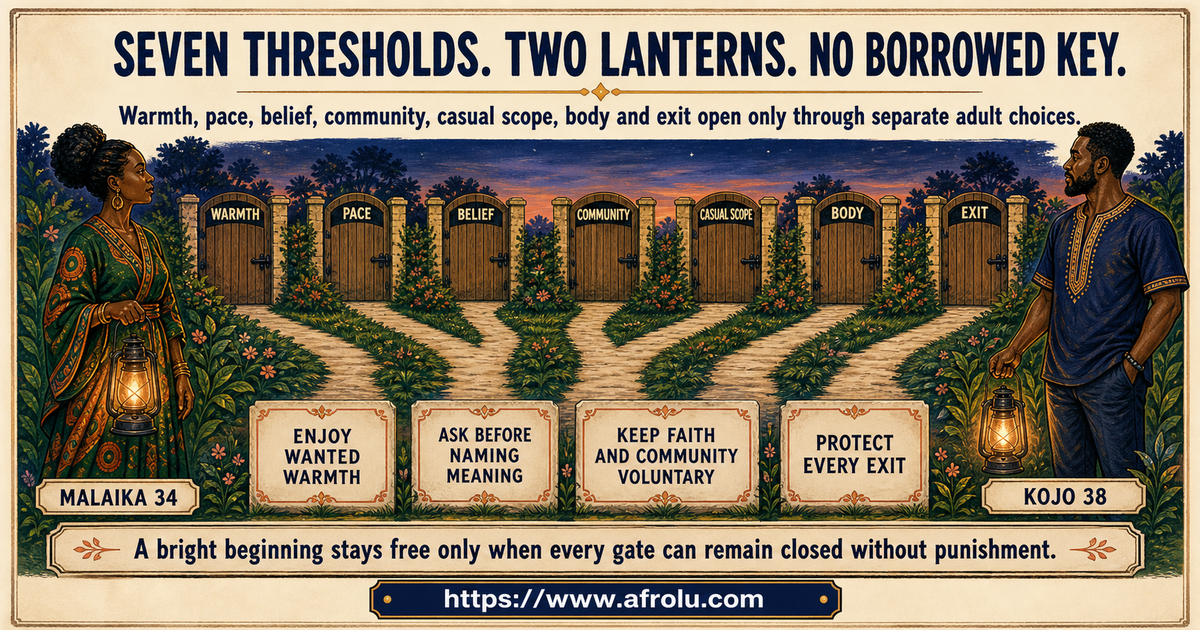
Warmth may light the path; it does not own the gate.
Written and edited by Samira Benali · Faith and North Africa Editor
Walk seven separate thresholds: WARMTH, PACE, BELIEF, COMMUNITY, CASUAL SCOPE, BODY and EXIT. Receive wanted words without treating them as prophecy. Define non-exclusivity, keep practice and advisers voluntary, discuss sexual health directly and watch what follows one real no. Then ENJOY, SLOW, CLARIFY, PAUSE, CLOSE, SEEK CARE or SEEK SAFETY HELP. Money pressure, threats, tracking, image abuse, impersonation and third-party bypass go straight to protection.
Emotional safety · Faith-Led Daters
How can a faith-led adult enjoy strong early affection without letting spiritual language, community pressure or casual scope override consent and safety?
Love bombing is a descriptive label for repeated intense affection or attention linked with pressure, accelerated access or consequences around boundaries. It is not a diagnosis, proof of motive or synonym for every exciting start. Wanted intensity, casual mismatch, spiritual pressure, persistent impairment, romance fraud and unsafe control require different routes.
Malaika, 34, enjoys Kojo's faith-shaped warmth but keeps their connection non-exclusive and declines a community announcement. When a third party repeats the romantic pressure, she ends contact and protects privacy. Both adults, beliefs, communities and events are fictional and represent no religion.
The faith-voluntary casual-safety seven-threshold lantern path
Let affection glow while every adult choice keeps its own gate
Samira treats faith as personal context and possible support, never as a score, stereotype or borrowed authority over casual scope and consent.
Receive the words, separate the thresholds, state one real boundary, observe delivered conduct and use the direct safety trail when needed.
Receive warmth
Enjoy words without letting them decide tomorrow.
Protect belief
Practice, doubt and meaning remain personal.
Name casual scope
Intensity cannot silently create commitment.
Follow conduct
Enjoy, slow, pause, close, use care or protect.
A bright sentence is not a prophecy
Enjoy early affection without giving spiritual language decision-making power
Love bombing is a descriptive behaviour label, not a diagnosis and not proof that someone planned harm. This guide looks at repeated intense affection when it travels with accelerated access, pressure or consequences around a boundary. One lavish compliment, early hope or faith-shaped phrase cannot reveal motive. Describe what was requested and what followed no.
Faith can be a source of comfort, ethics, celebration, doubt, community or private practice. Adults may belong to the same tradition, different traditions or none, and still use faith language differently. A match does not gain authority to interpret your life because they share a label. Personal belief remains voluntary before, during and after a casual connection.
Casual scope must also remain visible. Two adults may choose non-exclusive dates without a current commitment, yet still want warmth and respect. Intense future language can quietly rewrite that agreement for one person. Ask whether exclusivity, public visibility, sexual contact or community involvement has actually been discussed instead of letting excitement make the decision.
Use a real boundary rather than a secret test. Protect one evening, decline a public label or keep an adviser outside the connection because that is what you genuinely want. The response supplies evidence. If threats, stalking, forced contact, image abuse, financial pressure or third-party monitoring already exists, do not wait for more evidence or a perfect label before seeking safety help.
Walk the seven-threshold lantern path
Open warmth, faith, community and casual intimacy one choice at a time
The path has seven thresholds: WARMTH, PACE, BELIEF, COMMUNITY, CASUAL SCOPE, BODY and EXIT. Each adult carries a separate lantern, because one person's certainty cannot light the other's decision. The path is an editorial tool, not theology, therapy or a risk score. A threshold may remain closed even while others feel welcome.
WARMTH allows compliments, frequent contact and hopeful language that both adults genuinely enjoy. PACE asks how often contact happens and when plans become commitments. BELIEF protects practice, non-practice, questions and doubt. A shared faith word may invite a conversation, but it cannot announce compatibility, exclusivity, sex, forgiveness or a future on behalf of another adult.
COMMUNITY covers friends, family, leaders, groups, public posts and private advice. Support can help when it is independently chosen, confidential and safe. It becomes pressure when a new match recruits other people to persuade, monitor, shame or deliver messages after no. You may seek counsel without giving the adviser control over relationship status or consent.
CASUAL SCOPE, BODY and EXIT remain adult agreements. Non-exclusivity needs words; sexual contact needs specific consent and health discussion; an ending needs no spiritual hearing. If EXIT is bypassed through new accounts or community intermediaries, stop walking the ordinary path. Protect privacy, evidence, movement and contact through services suited to the actual risk and location.
Malaika keeps her name off tomorrow
A fictional casual beginning reveals its pressure through a community bypass
Malaika is a fictional 34-year-old Black African adult, and Kojo is a fictional 38-year-old Black African adult. Both draw on personal faith without a named religion or institution. Each manages home, money, transport, devices, community ties, sexual-health choices and exit. Neither represents a gender, country, belief system or universal dating pattern.
During five bright days of messages, Kojo says their meeting feels guided and speaks about a shared future. Malaika enjoys the tenderness but reminds him that she is offering non-exclusive casual dates. When he asks to tell people in her faith community that the connection is special, she says no and asks that her name remain private.
Kojo apologises, yet the next day a community acquaintance messages Malaika to say she should not fear what is meant for her. Malaika cannot know exactly what Kojo intended, but she can observe that her clear limit did not hold. She tells the acquaintance not to relay messages and ends the romantic channel without debating spiritual meaning.
Malaika tightens profile visibility, saves the relevant messages and tells one trusted person what happened. The story does not reward suspicion, prove love bombing or condemn faith. It shows why repeated reopening matters. A different person might accept the first boundary completely; that delivered repair would support only one small next choice, never permanent trust or access.
Read sixteen lantern markers after a real no
Watch warmth, faith, casual scope, repair and exit without judging a soul
WARMTH and PACE remain free when praise survives correction, contact can end for the night, and a slower plan receives one fair answer. Excitement is not automatically suspicious. Pressure becomes more visible when language grows grander after a limit, time is treated as proof, or a private pause is recast as rejection that must be repaired immediately.
BELIEF and COMMUNITY remain voluntary when adults can define faith words differently, keep practice private and choose their own advisers. Watch for claims that doubt proves disloyalty, that a leader's opinion settles status, or that community visibility is required. The concern is not religion itself; it is using belief or other people to reduce free choice.
CASUAL SCOPE and BODY remain clear when non-exclusivity is spoken, affection creates no relationship promotion and every sexual choice receives adult consent. Discuss testing, protection and relevant partner agreements directly. A gift, prayer, apology, meal or shared value buys no image, touch, sex, secrecy or changed scope. A casual agreement can end for simple incompatibility.
ACCESS and EXIT require a separate safety trail. Money requests, account codes, threats, tracking, image abuse, impersonation and contact through others after closure are concrete facts. They do not need sixteen markers or a love-bombing conclusion. Secure what is exposed, preserve useful evidence where safe and use current platform, financial, legal, health or emergency routes that fit the location.

One respected boundary is useful; one direct danger fact still takes priority.
Use twelve lines that keep the lanterns separate
Receive faith-shaped affection without surrendering meaning, scope or safety
Use these scripts only where direct conversation feels safe. Start with the choice in front of you instead of accusing someone of love bombing. A concise sentence preserves uncertainty about motive while making access clear. The other adult remains free to accept, suggest one respectful alternative or leave. Repeated persuasion is new conduct, not a request for better wording.
For warmth, say, ‘I like hearing that; it does not decide our future.’ For meaning: ‘Please ask what that faith phrase means to me before using it for us.’ For belief: ‘My practice and doubt are mine to share freely.’ These lines welcome personal faith without letting one interpretation govern both adults.
For community, say, ‘Do not announce this connection or involve anyone without my yes.’ For casual scope: ‘I am offering non-exclusive casual dates, not a commitment.’ If exclusivity is required now, either adult may decline the match. Neither shared values nor early intensity changes the present structure without a mutual conversation.
For sex, discuss protection, testing and current agreements before contact, then ask for consent to the specific step. Pause can include: ‘Do not ask others to check on me.’ Closure can include: ‘Do not contact me through my community.’ If stating those words may increase risk, skip the script and move to protection rather than negotiating.

Faith-aware clarity asks; it never recruits belief to make no harder.
Keep faith and casual intimacy freely chosen
Protect belief, sexual health, community privacy, money and movement separately
Adults may choose abstinence, sexual intimacy or a changing boundary for reasons that include faith, health, desire or privacy. No option makes someone more worthy. Before sex, discuss the specific acts, protection, testing and relevant agreements, using current local clinical guidance. Nobody must disclose a theology or complete health history to say no to sexual contact.
Choose community support that preserves agency. A trusted leader, friend or counsellor may help you think, but the match should not select the adviser, control what is shared or receive private reports. Seek an alternative source if advice uses fear, shame or belonging to force contact. Specialist services should respect belief while addressing safety facts without stereotyping faith communities.
Keep money out of sacred proof. Do not send an offering, fare, emergency payment, investment, gift card, fee, code or account access because affection is framed as providence. Verify any legitimate charity, event or expense through independently found official information. A generous gesture also buys no reply, public label, sex, forgiveness or continued casual dating.
For meetings, use a public place, known time and independent return. Keep home, community schedule and live location private until freely chosen and proportionate. If someone threatens disclosure, appears uninvited, contacts others to monitor you or shares intimate material without consent, the problem has moved beyond pace. Use safety planning and local support appropriate to the risk.
Choose a next path without trying to read a soul
Let observed conduct decide whether to enjoy, slow, pause, close or protect
ENJOY when affection remains wanted, casual scope is understood and each no leaves both adults free. SLOW when you want fewer messages, later future talk or one public plan at a time. CLARIFY one phrase, relationship term or community boundary when the conversation feels safe. These routes create evidence without pretending to predict character.
PAUSE when you want romantic contact quiet, with or without a return date. CLOSE when interest, pace, belief practice, community preference or casual structure no longer fits. A sincere person can still be incompatible, and an unclear motive need not keep contact open. Faith does not create a duty to forgive quickly, remain reachable or provide a final debate.
SEEK CARE when distress or impaired daily functioning remains severe or persistent across settings. SEEK SAFETY HELP when there are threats, tracking, sexual coercion, image abuse, financial exploitation, impersonation or defeated closure. Care and safety are not more dramatic versions of slowing down. They are different destinations with different professional and jurisdictional limits.
Review only what a safe action revealed: did the request stop, did community privacy return, did money remain closed, or did contact move elsewhere? Do not collect harmless details in a secret case file or monitor the other person. Choose enough evidence for your own next step. The aim is free adult choice, not certainty about another soul.

The right path is the one current conduct supports, not the one another person calls faithful.
Eight moments when bright faith language meets pace, casual scope or safety
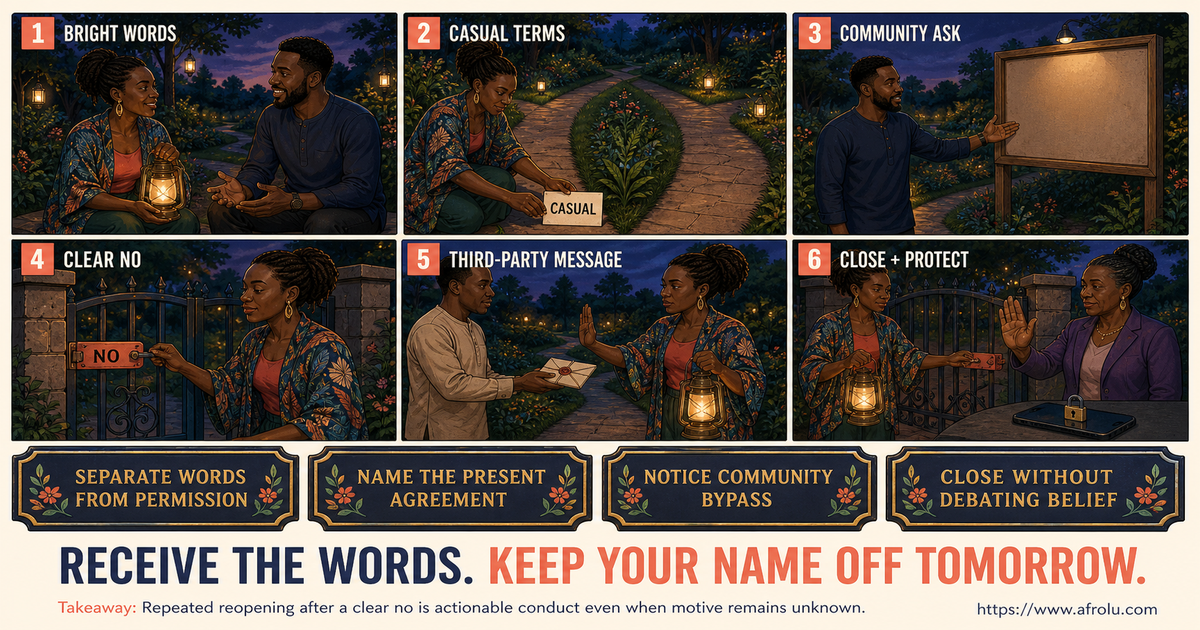
The answered-prayer message
A match uses a faith-shaped phrase after two days, and you enjoy the affection without sharing its meaning.
Receive the words and ask before adopting the interpretation.The nightly devotion call
A casual connection begins to assume a long call every night although no contact rhythm was agreed.
Offer the frequency you choose and let the other adult decide.The doubt correction
A private question about faith is treated as evidence that you are not ready for the relationship.
Keep belief private and reject the romantic conclusion.The early announcement
A match wants a group or family to hear that the connection is spiritually significant after one date.
Decline public meaning and keep your name private.The silent promotion
Non-exclusive casual dates are suddenly described as a committed courtship without a mutual conversation.
Restate today's agreement and accept a mismatch.The sacred offering
An urgent payment, fare or donation is framed as a chance to prove trust or shared values.
Send nothing and verify independently through official channels.The values shortcut
Shared beliefs and a paid dinner are used to imply sexual access or secrecy after the meeting.
Name consent and sexual-health choices separately, then leave pressure.The community messenger
A third party delivers romantic or spiritual pressure after you closed the connection.
Stop relay contact, preserve useful evidence and seek fitting support.Sixteen lantern markers for warmth, belief, community, consent, repair and exit
Praise accepts correction — facts can interrupt the romance without punishment; enjoy only the warmth you want.
Future words stay tentative — hope is not repeated as prophecy or debt; keep tomorrow unclaimed.
Calls can end — an evening closes without guilt, monitoring or a larger promise; choose real contact hours.
Slower pace remains safe — fewer messages receive acceptance or one fair counteroffer; avoid secret delay tests.
Faith words invite meaning — neither adult dictates what a phrase must mean; ask and listen.
Practice stays voluntary — prayer, worship, doubt or non-participation can remain private; share freely or not at all.
Advisers stay chosen — each adult selects independent support; no one recruits an authority to pressure the other.
Community stays private — no announcement, post or group discussion occurs without permission; correct visibility promptly.
Casual scope stays present — non-exclusivity and current intent remain spoken; future warmth does not silently promote it.
Relationship change needs two yeses — exclusivity or commitment follows a conversation; accept a different answer.
Sexual health gets words — protection, testing and relevant agreements are discussed before sexual contact.
Consent remains specific — faith, affection, gifts and earlier contact never pre-authorise the next step.
Money stays unholy proof — fares, offerings, fees, investments, gifts and codes are absent; send nothing under pressure.
Repair changes conduct — an apology leads to the request stopping; do not grade eloquence.
Wider functioning remains impaired — severe effects continue across settings; seek qualified local care.
Exit is bypassed — threats, tracking, impersonation, image abuse or community relays continue contact; seek direct protection.
Ten threshold questions that do not require a diagnosis or spiritual verdict
| Situation | What it may mean | What to do next |
|---|---|---|
| Can warmth survive a factual correction? | Fits: The compliment adjusts without punishment. Needs review: Meaning needs one question. Stop: Correction triggers guilt or a grander claim. | Keep words separate from access. |
| Can the pace become smaller? | Fits: Less contact remains safe and kind. Needs review: One respectful counteroffer appears. Stop: Slowing brings monitoring or pressure. | Slow or close from delivered conduct. |
| Is faith personally defined? | Fits: Practice and doubt remain voluntary. Needs review: A phrase has different meanings. Stop: Belief is used to decide for you. | Return authority to each adult. |
| Is community involvement chosen? | Fits: Advice and visibility require permission. Needs review: One disclosure needs correcting. Stop: Others are recruited after no. | Close relay routes and protect privacy. |
| Is casual scope still accurate? | Fits: Present non-exclusivity is understood. Needs review: One future hope needs separating. Stop: Intensity silently creates commitment. | Restate today's agreement or leave. |
| Can money stay outside meaning? | Fits: Affection carries no payment request. Needs review: A gift needs declining. Stop: Offering, fare, fee, investment or code appears. | Send nothing and verify independently. |
| Are sexual health and consent explicit? | Fits: Each adult choice receives direct words. Needs review: A relevant discussion is unfinished. Stop: Faith or casual scope is used as consent. | Stop the step and restore free choice. |
| Does repair reach behaviour? | Fits: The declined request stays closed. Needs review: Evidence is still brief. Stop: Praise, prayer or a third party reopens it. | Judge the delivered change, not the apology. |
| Does severe impact continue elsewhere? | Fits: A boundary restores ordinary room. Needs review: Wellbeing needs a safer review. Stop: Impairment remains persistent across settings. | Use qualified local care. |
| Which fact carries the highest risk? | Fits: Wanted intensity or mismatch remains a choice. Needs review: Fraud requires prompt reporting. Stop: Threat, tracking, force or defeated exit appears. | Use protection before relationship analysis. |
Twelve lines for meaning, faith, casual scope, sexual health and closure
“I like hearing that; it does not decide our future.”
“Please ask what that faith phrase means to me before using it for us.”
“My practice and doubt are mine to share freely.”
“Do not announce this connection or involve anyone without my yes.”
“I am offering non-exclusive casual dates, not a commitment.”
“We have not agreed exclusivity; if you need it now, we may not fit.”
“I can meet in public from 15:30 to 16:30 and will travel separately.”
“I do not send offerings, fares, fees, gifts or account access.”
“Before sex, I discuss protection, testing and current agreements directly.”
“Faith, affection and payment do not replace a clear yes for this step.”
“I am taking seven days without romantic contact; do not ask others to check on me.”
“I am ending romantic contact; do not contact me through my community.”
Know the difference
Wanted early intensity and a love-bombing pattern are not the same conclusion
Warmth, frequent contact or future hope remains enjoyable while each boundary, meaning and relationship choice stays free.
Affection repeatedly travels with accelerated access, borrowed authority or consequences when a limit closes.
Casual mismatch, spiritual pressure, imperfect repair, persistent impairment, romance fraud and unsafe control require narrower routes than one slang label.

Name what can be observed, then use the route that fits its limits.
Separate wanted intensity from pressure, mismatch, fraud and unsafe control
| Type or dimension | What it describes | Best next question |
|---|---|---|
| Wanted intensity | Strong affection remains wanted and every adult boundary keeps working. | Enjoy one small next step without forecasting. |
| Infatuation | Early focus or idealisation describes a feeling, not permission or proof of harm. | Keep pace, facts and separate choices visible. |
| Fast compatibility | Several present preferences align quickly, while future fit remains unknown. | Verify through ordinary time and mutual plans. |
| Love-bombing pattern | Repeated intense attention travels with pressure, access or consequences around limits. | Reduce access and decide from delivered conduct. |
| Casual mismatch | One adult wants a non-exclusive present while another wants commitment now. | Name the mismatch and accept a close. |
| Spiritual pressure | Belief, practice, authority or community is used to make refusal harder. | Seek independent, faith-respecting support and protect choice. |
| Delivered repair | A misstep is acknowledged and the specific request actually stops. | Use that evidence only for the next decision. |
| Persistent impairment | Sleep, focus, enjoyment or ordinary tasks remain severely affected across settings. | Seek qualified local care without self-diagnosis. |
| Romance fraud | Affection or sacred meaning carries urgent money, gift, code or investment requests. | Send nothing and use fitting reports. |
| Unsafe control | Threats, tracking, sexual coercion, image abuse or defeated exit creates direct risk. | Protect access and seek current local safety help. |
Walk the seven thresholds while each adult carries a separate lantern
Let words stay words
A moving faith phrase can be received without becoming a shared prophecy or agreement.
Carry separate lanterns
Each adult keeps authority over belief, doubt, pace, community and future.
Define casual now
Non-exclusivity, contact and what is not promised need present-tense language.
Watch what follows no
Delivered repair matters more than an apology, compliment or explanation.
Keep sacred proof free of money
An offering, fare, gift, fee, code or investment never verifies love or faith.
Use the safety trail
Threats, tracking, image abuse and third-party bypass need protection before interpretation.
Questions for the lantern, the threshold, the casual path and the safety trail
Choose a few prompts that fit the moment. This is a reference library, not a list to complete.
Lantern
Receive warmth without prophecy.
- Which words felt welcome?
- What meaning is mine?
- What remains unknown?
- Can correction stay safe?
Threshold
Keep faith and community chosen.
- What practice stays private?
- Who may know?
- Who chooses advice?
- Can no remain outside debate?
Casual path
Define scope and adult consent.
- Is this non-exclusive?
- What contact fits?
- What needs a new conversation?
- Are sexual-health choices spoken?
Safety trail
Follow the clearest current fact.
- Did the request stop?
- Was another person recruited?
- Is money or access involved?
- Does danger bypass dialogue?
What current official faith-abuse, consent, online-safety and coercive-control guidance supports
eSafety identifies love bombing among coercive-control warning signs
The official guidance places intense early promises beside monitoring, location demands, account access and other repeated tactics that can restrict choice.
Evidence limit: Its legal, reporting and emergency context is Australian; examples do not prove motive or label every intense start.
The Hotline describes four common signs of love bombing
The survivor-support article discusses early labels, exaggerated compliments, costly gifts and communication overload while encouraging readers to check their own comfort.
Evidence limit: It is U.S.-based educational guidance, not a diagnostic test, prevalence study or judgment about faith.
GOV.UK sets out Domestic Abuse Act 2021 statutory guidance
The guidance recognises faith as possible support while sacred teaching, secrecy, obedience or community pressure may also be exploited within abuse.
Evidence limit: It addresses England and Wales law and specified relationships; it cannot decide a case or legal status elsewhere.
DOJ Office on Violence Against Women describes domestic violence
The official page distinguishes technological, economic, sexual, emotional and coercive behaviour from ordinary relationship disappointment.
Evidence limit: Its definitions, helplines and justice context are U.S.-specific and cannot label conduct under another jurisdiction.
RAINN explains respect, boundaries and ongoing agreement
The guidance supports clear, voluntary adult consent without pressure, manipulation, fear or assumptions based on flirting and past encounters.
Evidence limit: It is U.S. survivor-support information, not local law, clinical care or proof about a particular event.
CDC describes patterns of unwanted harassing or threatening tactics
The public-health page includes repeated contact, following, unwanted appearances, surveillance and location tracking that cause fear or safety concern.
Evidence limit: Its statistics and resources are U.S.-specific; only local qualified services can assess risk and law.
Six ways bright affection can become prophecy, pressure or unwanted investigation
Diagnosing the beginning
One intense message is treated as proof of a fixed personality. Describe the request and response instead.
Borrowing spiritual certainty
One adult's meaning decides both futures. Ask what the words mean to each person.
Letting community vote
Leaders, friends or family are asked to settle adult status. Keep advice chosen and non-binding.
Promoting casual by atmosphere
Warmth silently becomes exclusivity or commitment. Change scope only through mutual words.
Turning forgiveness into access
An apology or faith value is used to demand another chance. Repair must reach conduct.
Collecting harmless evidence
Uncertainty becomes surveillance. Record only what supports your safety and next decision.
Let warmth stay warm without giving it faith, body or future access
You do not need to decide another adult's motive before slowing a request. Choose the resource that fits the observable issue—intensity, a crossed boundary or a safety concern—and keep casual scope explicit.
Explore the guide library
Show more related guides
Continue with Afrolu
Show more Afrolu guides
Live authoritative sources with Australian, UK and U.S. limits stated precisely
Afrolu reviewed these health, research, safety, or public guidance resources while editing this page. They support the behaviour and safety guidance; they do not diagnose any individual described by a reader.
Faith-led questions about intense affection, casual scope, community and safety
Is love bombing a diagnosis?
No. It is a descriptive label commonly used for intense affection linked with pressure, accelerated access or consequences around limits. One strong start cannot reveal motive or diagnose a person. Describe requests, responses, repetition and impact, then choose a proportionate boundary, closure, care or safety route.
Can intense faith-shaped affection be sincere?
Yes, and sincerity still does not decide pace, compatibility or safety. Receive wanted words while keeping belief, casual scope, community visibility, money, consent and exit separate. The response to a real limit supplies more useful evidence than guessing whether the first feeling was genuine.
Does faith-led dating have to be serious?
No. Faith context and relationship structure are different. Adults may choose non-exclusive casual dates while holding personal values, or decide that casual scope does not fit them. Name today's agreement directly. No faith label silently creates exclusivity, commitment, sex, public visibility or a future promise.
Can I keep my faith practice private from a match?
Yes. You may freely share, question or withhold personal practice, doubt, advisers and community routines. Broad values and availability can be enough for an early date. A match may decide that they need more shared practice, but they cannot make disclosure or participation the price of a safe no.
When is community involvement supportive?
It is supportive when you choose the person, information and purpose, and the advice leaves you free. It becomes pressure when a match selects an authority, demands disclosure, turns belonging into punishment or recruits others after no. Seek independent, confidential and faith-respecting support where possible.
How do I correct an early public relationship label?
Say what is accurate now: for example, ‘We are casually dating and have not agreed exclusivity or a public label.’ Ask for the post, announcement or message to be corrected or removed where possible. If visibility continues through new people or channels, protect privacy and consider direct safety support.
What should casual partners discuss before sex?
Discuss consent to the specific acts, protection, testing, relevant partner agreements and what each adult wants afterward. Use current local clinical advice for personal health decisions. Faith, casual scope, a gift, a meal or a previous yes cannot authorise sexual contact or image sharing now.
Should I send an offering, fare or gift to prove shared values?
No. Affection or spiritual meaning cannot verify a payment request. Do not send offerings, fares, fees, gift cards, investments, codes or account access under romantic pressure. Check any legitimate charity or expense through independently found official details. Contact the provider promptly if money already moved.
Do I owe forgiveness or another chance after an apology?
No. Forgiveness, reconciliation, restored access and continued dating are separate choices. An apology becomes useful evidence only when the specific conduct stops. You may accept words and still slow, pause or close. Faith cannot make refusal unsafe or require a timetable for renewed contact.
When should I stop explaining and seek safety help?
Move to protection when there are threats, stalking, tracking, sexual coercion, image abuse, impersonation, financial exploitation, uninvited appearances or contact through others after closure. Preserve useful evidence where safe, secure devices and money, and use platform, legal, health, specialist or emergency services suited to your location.
One thing to do now
Keep your lantern, your meaning and every gate key
Continue only while correction remains safe, pace can shrink, faith and advisers stay voluntary, casual scope is accurate, money stays closed, sexual health and consent receive direct words, repair changes conduct and exit works. You need no love-bombing verdict to slow or close. Use qualified care for persistent impairment and direct safety help for fraud, threats, tracking, force or defeated closure.