One relationship, two career lanes
Build a Serious Long-Distance Plan Around Two Careers
A practical long-distance guide for professionals covering contact, visits, career continuity, cost, safety, sexual health, location reviews, and closure.
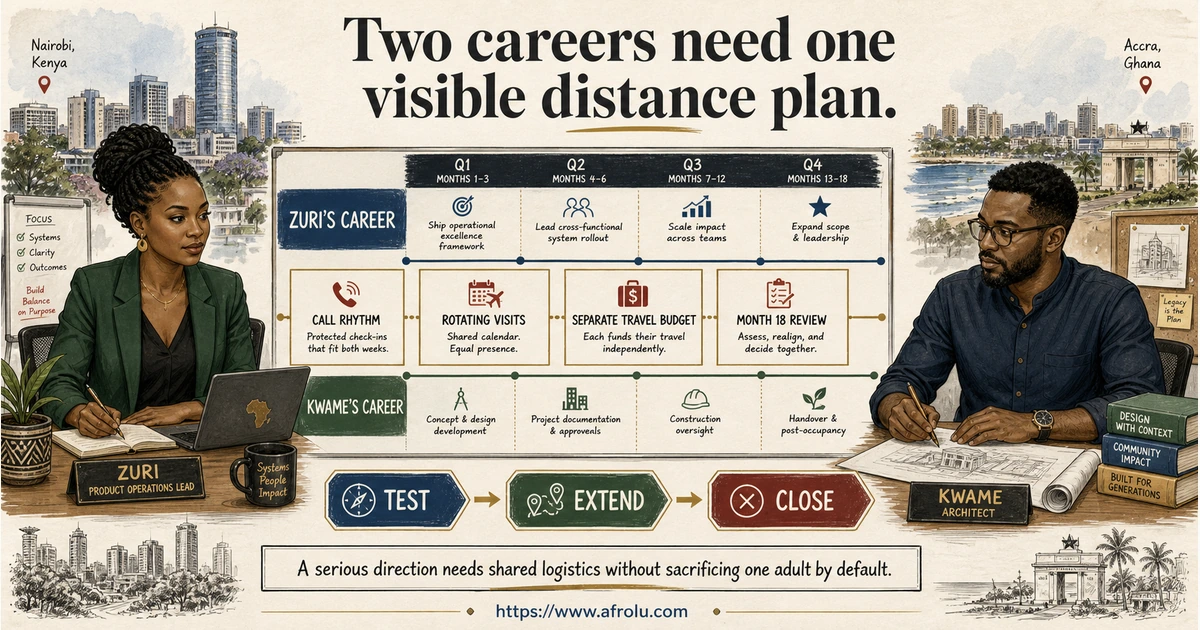
Track two careers, communication, visits, cost, safety, and a reviewable closing path.
Written and edited by Nia Kato · Profile Advice Editor
Build a two-career board with six lanes. Define the serious agreement and a contact rhythm. Rotate verified visits when possible. Keep travel money and private systems under each adult's control. Record repair after cancellations. Set a location review with three honest choices: test a location, extend the distance with clear terms, or close. Eighteen months is an example window, not a deadline. Do not promise relocation, employment, residency, or legal outcomes that qualified local professionals have not confirmed. Serious direction needs a path, but it cannot assign sacrifice in advance.
Distance and diaspora · Professionals
Can this serious relationship build ordinary shared life without treating one career, city, budget, support network, or body as the automatic cost of closing distance?
Serious long-distance dating is a relationship with a shared long-term direction while the adults live in different places. Distance changes communication, visits, cost, privacy, sexual-health decisions, and location planning. It does not guarantee lower quality, eventual relocation, or compatibility. A closing-distance path names when and how the adults will investigate living nearer. Indefinite distance names continued geography without that expectation. Both structures require informed agreement and an available exit.
Zuri and Kwame are made-up professionals. Zuri is 35 and leads product operations in Nairobi. Kwame is 38 and practises architecture in Accra. They agree that their relationship is serious and exclusive. Their first six months include weekly calls and rotating visits paid independently. A project later delays Kwame's quarter-two visit. He owns his cancellation costs, shares only the usable work fact, and offers two repairs. They choose a verified video planning date and a later visit window. Neither career becomes the default loser.
The two-career closing-distance board
Make the serious direction practical without making one adult disappear
Long-distance professionals carry two work systems, two budgets, two communities, and often two countries. A durable plan gives each lane equal visibility before one location becomes the assumed answer.
Nia separates ordinary relationship maintenance from a possible location transition. Each step is specific, mutual, financially controlled, reviewable, and subject to qualified local advice where needed.
Daily relationship
Agree on calls, messages, quiet hours, visits, consent, other partners, privacy, and repair. Build a relationship that exists between major trips.
Career continuity
Record each adult's work seasons, development needs, location limits, and unacceptable losses. Do not treat title or income as the only measure of career value.
Visit and cost evidence
Rotate travel when practical, choose budgets independently, verify bookings, and record how changes are repaired. No visit should require account access or financial rescue.
Location review
Investigate daily life, career impact, housing, support, health, and freedom. Then test, extend, or close. Qualified local guidance handles legal and administrative facts.
Orientation
Begin with two equal career lanes and one shared relationship lane
Start with the relationship that exists now. Name serious direction, exclusivity, communication, physical boundaries, other partners, and the right to change course. A closing-distance discussion cannot repair an undefined relationship by itself. Two adults may share a serious direction and still need different contact rhythms. Write the present offer in language both can repeat before projecting a shared address.
Give each career its own lane. Record demanding seasons, work locations, professional licences, learning goals, income needs, flexibility, and support. These are questions for investigation, not reasons one job automatically wins. A career includes identity, colleagues, future options, and accumulated knowledge. Paid income also does not capture care, community, or unpaid responsibilities that a move could disrupt.
Use the shared lane for contact, visits, cost, and repair. Plan a rhythm that works across time zones and workdays. Schedule quiet time without demanding continuous access. Rotate travel when practical, but do not chase numerical equality when health, routes, cost, or care differ. Fairness means the burden is visible, discussed, and acceptable. It also means either adult can say a proposed trip is unaffordable.
Set a location review before temporary becomes endless by accident. This guide uses eighteen months as an example, not a deadline. The review may lead to a reversible location test, a defined extension, or closure. It cannot confirm visa, residency, employment, tax, housing, or healthcare outcomes. Gather those facts from qualified sources in the relevant places before relying on them.
A visit changes
Zuri and Kwame repair a cancelled trip without transferring the loss
Kwame planned to visit Nairobi during quarter two. A project schedule changes three weeks before travel. He tells Zuri that work now conflicts with the visit. He does not send client documents or ask her to contact his employer. Zuri can be disappointed without demanding confidential proof. The usable question is what the change costs and whether the relationship receives a credible alternative.
Kwame handles the booking he made and does not request an urgent transfer. He offers two later windows and a long video planning session on the original weekend. Zuri checks her work lane before accepting. One alternative would collide with her product launch, so they choose the other. Both adults confirm through their own devices and accounts. No shared password or one-time code is required.
They use the video session for ordinary planning rather than a performance of closeness. They compare the revised visit budget, discuss a public first-day plan, and leave work documents closed. They also revisit their communication rhythm during the delay. Kwame can offer one shorter weekday call and their established weekend call. Zuri prefers that honest rhythm to constant messages sent while either adult is distracted.
The cancelled visit remains part of the record. Repair does not erase impact. If project changes repeatedly remove their visits, the relationship may become unworkable despite sincere effort. Their next board review asks whether completed meetings and daily-life knowledge are growing. Serious love can understand a demanding career without promising to survive a structure that never becomes physically real.
Present agreement
Define serious distance before planning the place where it might close
Define serious in present language. It may mean a shared intention to build a lasting partnership. Ask whether dating is exclusive and what exclusivity includes. Discuss contact with other people, social media, disclosure, and how either adult raises change. A serious label does not grant device access or constant availability. It also does not guarantee that the relationship will survive location investigation.
Build communication around capacity. Choose which calls need scheduling and which messages can wait. Protect sleep, work, exercise, friends, family, faith, and quiet. Research has examined texting and relationship maintenance in particular long-distance samples. It does not establish a universal message quota. Judge whether your chosen rhythm supports connection, truth, repair, and both adults' functioning.
Visits need agreements about dates, duration, accommodation, cost, privacy, work, physical intimacy, and exit. A visit is not blanket consent. Each adult controls their documents and money. Keep a return plan available. For a first meeting, verify identity through multiple signals, meet in public, tell a trusted person, and avoid dependency for transport or lodging. No video history can guarantee safety.
When sexual activity becomes relevant, discuss consent, other partners, testing, prevention, and needed health disclosure. Distance and exclusivity do not answer those questions. A visit can carry emotional pressure because time and travel cost feel scarce. Neither expense nor longing creates an obligation to touch or have sex. Use qualified local healthcare for personal testing, symptoms, prevention, or treatment.
Observable evidence
Read six distance signals without opening private systems
Begin with identity and consistency. Video calls, a coherent history, independent searches, and real-world meetings can reduce uncertainty. None provides certainty alone. Notice whether work, location, and availability claims remain broadly consistent without demanding private records. Refusal of every live interaction or in-person plan matters. So do requests for secrecy, identity documents, intimate images, or account access.
Next read contact and visits together. Frequent texting may support some couples, but it can also create intensity without shared daily life. Completed meetings reveal how adults handle time, fatigue, cost, disagreement, public conduct, and ordinary silence. A serious relationship may have fewer visits because routes are difficult. The board should still show honest planning, fair burden, and decisions based on the meetings that actually occurred.
Repair is the fourth signal. Travel and professional work create real disruption. Look for timely notice, ownership, financial responsibility, proportionate alternatives, and changed conduct. Endless apologies with no workable meeting plan provide a different pattern. Avoid diagnosing motives. You can decide that repeated cancellations make the relationship unavailable without proving that anyone lied.
Money and location complete the dashboard. Keep bookings, bank access, investments, transfers, codes, and documents separate. A distant person who cannot meet but requests urgent travel, medical, work, customs, fee, or investment money may match official scam warnings. Stop, verify independently, and seek support. In an established verified relationship, serious direction should still include a date for an honest location review.

Read the pattern across calls, visits, repair, money, privacy, and the closing question.
Words to use
Ask one practical question for each distance lane
Start with the weekly relationship. Ask which calls each adult can hold and which messages can remain asynchronous. Name quiet hours. Decide what happens after a missed call. This conversation is not a test of maximum access. It designs a rhythm that permits attention. If one adult needs more contact, ask whether a realistic change is available rather than using monitoring to manufacture reassurance.
Use visit language that includes burden. Ask who travels, who pays, where each person stays, and how work and recovery time are protected. A cheaper route may still carry a heavier visa, health, care, or time burden. This guide cannot evaluate those facts. Confirm them through qualified sources. If a visit requires financial dependence or private documents sent through a romantic partner, pause and seek independent advice.
Use career language before naming a mover. Ask what continuity each adult needs and which losses would be difficult to reverse. Explore more than salary. Consider development, professional identity, support, care, health access, community, safety, and daily life. Avoid promising that work or legal permission will be available. A location idea remains a hypothesis until real facts and a freely chosen experiment support it.
Use closure language when the board remains impossible. Say that serious direction is not producing a workable shared geography. Name the current limit without degrading either career or city. A relationship can be loving and still impractical. Stop negotiating if financial pressure, threats, tracking, document misuse, or unwanted contact appears. Use suitable local, platform, financial, or legal support.

Use short scripts for rhythm, visits, cost, privacy, health, and the location review.
The location review
Choose a reversible test, a defined extension, or closure
Test a location only after gathering reliable facts. A test might involve an extended visit or another reversible arrangement that is lawful and practical. Define duration, housing, work boundaries, money, health access, support, privacy, and an exit. Do not resign, transfer assets, or rely on unconfirmed permission because the relationship feels serious. Qualified local professionals should verify legal, immigration, employment, tax, and housing questions.
Extend the distance when both adults still choose it and a new period has clear terms. Name the reason, contact rhythm, visit plan, budget, and next review. An extension should not recycle the same hope without new information. It may be reasonable during a defined training programme, project, care season, or investigation. Either adult can decide that another interval costs too much, even when the reason is genuine.
Close when geography, career needs, cost, daily-life fit, or trust does not support a shared path. Do not frame closure as proof that the relationship was fake. Long-distance relationships can be meaningful and still end. Settle only obligations that were truly agreed. Protect accounts, documents, devices, intimate images, and workplace information. Use a direct ending and avoid travelling for a final meeting when safety feels uncertain.
Whichever path you choose, update the relationship agreement. A location test may change contact, exclusivity, privacy, money, and physical choices. An extension may change the visit burden. Closure ends romantic expectations and access. Keep each consequence visible. The board succeeds when choices and uncertainties remain visible. It should also show how each adult can protect their life when the plan changes.

At the review, choose a reversible location test, a defined extension, or closure.
Nearby structures
Separate a closing-distance path from honestly indefinite distance
A closing-distance path investigates whether the adults can live nearer. It identifies possible locations, career consequences, daily-life knowledge, visits, budgets, support, and review dates. The path may still end in extension or closure. Calling distance temporary does not guarantee that a move will become lawful, available, affordable, healthy, or desirable. The label describes an intention to investigate.
Indefinite distance states that no relocation path currently exists or is desired. Adults may value the relationship and maintain stable visits across places. That structure can work for some people. It should not be presented as temporary to retain someone who needs co-location. Ask whether each adult freely accepts the ongoing geography, cost, touch limits, health choices, and absence from daily life.
A stalled distance relationship avoids both answers. It may contain future-location speeches without investigation, completed visits, or review. Do not diagnose the reason. Ask for one specific action, such as a verified visit or a date to compare location facts. If the action remains unavailable, decide whether the real structure fits. Years invested do not create a duty to wait indefinitely.
Every structure keeps an exit. A serious label does not make relocation compulsory. A move does not prove love, and refusing one does not prove indifference. Both adults may protect careers, homes, support, health, and financial control. The best plan is not the plan with the grandest sacrifice. It is the plan whose facts, burdens, freedoms, and uncertainties remain visible enough for two adults to choose.
Eight professional distance moments where the board protects both lives

Amina and Kofi replace nightly calls with three protected windows
Amina is 32 and Kofi is 36. Their nightly calls interrupt sleep and early work. They choose two weekday calls and one longer weekend call. Messages can wait. The smaller rhythm improves attention without reducing their serious agreement. They review after a month rather than measuring love through exhaustion.
Build repeatable contact that protects sleep, work, and ordinary independent life.Kwame owns the cost while Zuri chooses between two repairs
Kwame's project delays a planned visit. He handles his booking, provides a concise explanation, and offers two new windows. Zuri checks her own launch schedule. They select one later trip and a video planning date. Neither adult must reveal private work documents or send emergency money.
Make responsibility, cost, alternatives, and the next review visible after a change.Lebo and Samuel keep the first visit public and independently funded
Lebo is 34 and Samuel is 37. They have video-called for four months and plan their first meeting. Each books independently and retains a return option. The first day remains public. Trusted adults know the plan. Previous calls reduce uncertainty but do not remove the need for ordinary safety.
Verify through multiple signals, keep money and transport controlled, and meet in public first.Nadia and Tayo count recovery time as part of the visit burden
Nadia is 39 and has travelled for four consecutive visits. Tayo is 41 and paid more of the direct cost. They notice that money alone does not balance time and fatigue. Tayo takes the next trip and they shorten it around his work. Fairness becomes discussable rather than assumed.
Count cost, time, preparation, fatigue, work impact, and care before judging fairness.Miriam refuses a fee request from someone she has never met
Miriam is 44. A distant match claims that a final travel fee will unlock their first meeting. He asks for an urgent transfer and tells her to keep it secret. She sends nothing, contacts a trusted person, and checks the story independently. Serious words cannot make a risky payment safe.
Stop money and document sharing, verify independently, and use suitable reporting support.Esi and Daniel compare losses before naming a location test
Esi is 31 and Daniel is 35. Both have location-dependent professional development. They list career continuity, support, housing, health access, and daily life without choosing a mover. They gather independent facts and plan an extended visit. The test remains reversible and creates no legal promise.
Investigate both locations and both careers before treating one move as obvious.Chipo and Fatou discuss other partners before a reunion
Chipo is 33 and Fatou is 36. Their agreement changed during a long interval between visits. Before the reunion, they discuss other partners, consent, testing, prevention, and needed disclosure. They seek qualified care for personal questions. The expensive trip does not create physical obligation.
Have the relevant conversation before the visit and keep consent specific during it.Joseph and Kamau close when neither location path fits
Joseph is 42 and Kamau is 40. After eighteen months, both careers and care roles remain strongly location-bound. Indefinite distance does not meet either person's needs. They close without calling the relationship a failure. They revoke shared access, settle only agreed costs, and keep private documents separate.
End when the serious direction has no workable geography and indefinite distance does not fit.Ten signs that serious distance has mutual and practical direction
Both adults can describe the serious agreement, exclusivity, and right to change it.
The communication rhythm protects sleep, work, health, friends, family, and independent time.
Identity and key life facts are verified through multiple signals without private-system access.
Visits become real, independently controlled, and safe enough for each adult to leave.
Travel cost, preparation, fatigue, recovery, and work impact are discussed together.
Cancellations receive timely ownership, proportionate alternatives, and changed conduct.
Accounts, transfers, documents, passwords, intimate images, and work systems remain protected.
Consent and sexual-health conversations happen before relevant choices despite distance or exclusivity.
Both career lanes and support networks remain visible in every location discussion.
A dated review can lead to testing a location, extending with terms, or closing.
Choose from the distance event without guessing motives
| Situation | What it may mean | What to do next |
|---|---|---|
| Messages become less frequent during a demanding project. | Work capacity may be lower. The change alone cannot prove rejection or continued commitment. | Ask for one sustainable contact point and observe whether the rhythm returns or receives repair. |
| Video calls are repeatedly avoided before any in-person meeting. | Privacy, access, deception, or another constraint could be present. | Do not increase money or document access. Require suitable verification before travel or deeper reliance. |
| One person pays most direct travel costs while the other travels more often. | Different burdens may be balancing, but neither adult should be required to guess. | Compare money, time, fatigue, recovery, work, and care, then agree on the next fair allocation. |
| A visit is cancelled because work changes. | A genuine disruption may have occurred, and the repair will provide additional evidence. | Name responsibility, cost, two alternatives, and the date when the visit plan will be reviewed. |
| A distant partner requests urgent money for travel or an emergency. | The request creates risk and may resemble official relationship-scam warnings. | Do not transfer money or documents. Verify independently and use suitable financial or reporting support. |
| One career is described as more portable without verified facts. | Income or title may be hiding licensing, development, care, health, or support consequences. | Investigate both careers and locations through qualified independent sources before assigning a mover. |
| The next reunion creates pressure for physical intimacy. | Scarcity, cost, and longing are being confused with consent. | Keep consent specific and reversible. Discuss relevant sexual health before the visit. |
| Future-location talk repeats without a visit or fact-gathering step. | The emotional future may be growing while the practical path remains stalled. | Ask for one verified action and decide what its continued absence means for you. |
| Both adults value the relationship but neither wants to relocate. | Indefinite distance may be the only honest structure currently available. | Ask whether that structure genuinely fits both adults, or close without assigning blame. |
| A location discussion brings threats, account attacks, or document misuse. | The situation has moved beyond relationship planning toward unsafe conduct. | Stop negotiation, secure access, preserve relevant evidence, and seek qualified local support. |
Ten scripts for contact, visits, careers, health, location, and closure
“I can hold Tuesday and Sunday calls. Messages between them may wait during work and sleep.”
“Tonight no longer works. I can offer tomorrow at the same time or Saturday morning.”
“You made the last two trips. Let us compare cost, time, fatigue, and my next workable window.”
“I will book through my own account and keep an independent return option.”
“I can explain the scheduling fact. I will not share client files or workplace access.”
“Before the visit, I want to discuss consent, other partners, testing, and prevention.”
“Which parts of each career must remain viable before we test a location?”
“Let us verify work, housing, health, and legal facts independently before relying on this option.”
“I can extend the distance six months with two visits and a review in November.”
“Our relationship is serious, but no workable shared geography exists. I am ending it here.”
Know the difference
A closing-distance path and indefinite distance are different offers
Adults investigate possible locations, protect both careers, complete visits, gather independent facts, and choose a reversible test, defined extension, or closure.
Adults choose continued geography without implying that relocation will occur. Contact, visits, cost, physical needs, privacy, and review still require shared terms.
Neither structure guarantees success or deserves automatic moral ranking. The useful question is whether the named structure, burdens, freedoms, and likely duration fit both adults.

Compare the actual structure: direction, visits, cost, daily-life knowledge, location review, and exit.
A closing path and indefinite distance are different honest offers
| Type or dimension | What it describes | Best next question |
|---|---|---|
| Serious long-distance dating | Adults share a long-term direction while living in different places. | Define exclusivity, contact, visits, cost, consent, privacy, and location review. |
| Closing-distance path | Adults actively investigate whether and how they might live nearer. | Gather independent facts and design one reversible location test. |
| Indefinite distance | No relocation is currently planned, and ongoing geography is part of the offer. | Decide whether contact, visits, cost, and limited daily life remain acceptable. |
| Temporary work separation | An established local relationship is separated by a defined work period. | Name the expected review, visits, uncertainty, and what happens if timing changes. |
| Online-only connection | Adults communicate remotely and have not yet completed an in-person meeting. | Verify identity, protect money, and plan a safe independently controlled meeting. |
| Location trial | One or both adults temporarily experience daily life in a possible location. | Define lawful status, duration, money, housing, work, support, and exit independently. |
| Relocation decision | An adult considers a high-consequence move that may affect career, home, support, and legal status. | Use qualified local advice and keep the choice free from romantic or financial pressure. |
| Distance ending | One adult decides the available geography or plan no longer fits. | Close clearly, revoke access, and strengthen safety if the ending is not respected. |
The two-career closing-distance answer
Distance does not determine quality by itself
Studies comparing long-distance and geographically close relationships report varied patterns in specific samples. They do not promise that distance helps or harms one couple. Read your agreement, conduct, fit, and context.
Maintenance is wider than message count
Calls, texts, visits, shared activities, repair, practical support, and protected independence can all matter. No study supplies one correct communication quota for every profession or time zone.
Visits reveal different information
Remote contact can build knowledge and intimacy. In-person time adds evidence about ordinary routines, fatigue, public conduct, disagreement, touch, cost, and shared silence.
Fairness is not always equal counting
One adult may pay more while another travels more. Compare money, time, preparation, fatigue, work, health, and care. The burden should remain visible and freely accepted.
A closing path is an investigation
Possible location, career, housing, health, support, legal, and financial facts need independent verification. Serious intention cannot guarantee that a workable move exists.
Ending does not erase meaning
A long-distance relationship may be real and valuable while no shared geography remains viable. Closure can honour the connection and protect both adults from indefinite sacrifice.
Twenty questions across relationship, visit, career, and closing lanes
Choose a few prompts that fit the moment. This is a reference library, not a list to complete.
Questions for the weekly relationship
Design connection that works between visits.
- Which calls can each adult reliably hold?
- Which messages may wait during work and sleep?
- How will a missed call receive repair?
- What privacy and device boundaries remain intact?
- Does the present rhythm meet both adults' needs?
Questions for visits and money
Keep every trip independently controlled and proportionate.
- Who travels next, and what burdens does that create?
- Which costs can each adult afford without debt?
- Who controls bookings, accommodation, and return options?
- Which public and trusted-person safety steps fit?
- What happens when a visit changes?
Questions for two careers
Investigate rather than assigning sacrifice.
- Which career seasons and development needs matter?
- What support, care, health, and community would each location change?
- Which facts need qualified independent confirmation?
- What losses would be hard to reverse?
- Could a lawful location test answer the remaining questions?
Questions for the closing review
Choose a test, defined extension, or closure.
- What did completed visits reveal about daily life?
- Was communication and repair sustainable?
- Did money, privacy, consent, and safety remain protected?
- Is a credible shared geography available?
- Which of the three routes do both adults freely choose?
Six research and safety notes with their limits visible
Long-distance relationship quality varies within studied samples
Research has compared relationship quality, commitment, and stability in long-distance and geographically close relationships. Results challenge simple assumptions that distance automatically weakens a couple. They do not certify a particular relationship. Use agreement, conduct, completed meetings, repair, practical fit, and safety to evaluate your situation.
Evidence limit: Study populations and measures cannot predict one couple's quality or relocation outcome.
Positive outcomes have multiple predictors rather than one distance formula
Another study examined predictors of positive outcomes among long-distance dating relationships. Such work describes associations in a particular sample. It does not provide a message quota, visit count, or closing deadline. Afrolu keeps the smaller lesson: measure several dimensions and avoid treating geography as the only cause.
Evidence limit: A correlational pattern cannot establish what will work for professionals in different countries or careers.
Texting can support maintenance without replacing shared life
Research has linked texting with satisfaction in long-distance samples and has studied social-network use for relationship maintenance. Neither finding makes more contact universally better. Text is one channel. Adults still need direct answers, rest, privacy, real visits where possible, repair, consent, and a practical understanding of daily life.
Evidence limit: Measured associations do not prescribe frequency or prove that a remote identity is genuine.
Geographic change can alter relationship decisions
Population research has examined how distance relates to moving together or breaking up. It provides context for the importance of geography. It cannot tell a couple who should move. Career, housing, support, health, safety, law, finances, and personal freedom require case-specific facts and choices.
Evidence limit: Population patterns cannot supply immigration, legal, employment, housing, tax, or healthcare advice.
Relationship scams can use distance and urgent money
Scamwatch warns that deceptive contacts may build trust, avoid meeting, request money, seek accounts, promote investments, or ask for secrecy. Distance can make stories harder to verify. Never transfer money or identity documents to make an unverified romance progress. Check independently, tell a trusted person, and contact financial providers quickly after suspected loss.
Evidence limit: Warning signs do not prove a crime. Reporting and recovery options vary by location.
Sexual-health conversations remain necessary across geography
CDC guidance encourages partners to talk before sex so they can make informed choices about testing and prevention. Distance, serious direction, and exclusivity cannot replace the conversation. Discuss other partners and needed disclosure before a reunion. Ask qualified local healthcare which testing, prevention, or treatment applies to you.
Evidence limit: General public-health guidance cannot replace individual medical care.
Six shortcuts that make one career or one budget carry the distance
Measuring love through constant access
Continuous messages can damage sleep and work without proving trust or commitment.
Counting only ticket cost
Travel also uses time, preparation, fatigue, recovery, work flexibility, health, and care capacity.
Making one career automatically portable
Titles and income hide licensing, development, support, health, identity, and future options.
Using the partner as a legal or travel authority
Verify immigration, employment, tax, housing, and healthcare facts through qualified independent sources.
Sending money to make a first meeting happen
Urgent travel or fee requests create serious risk. Keep payments and documents under your control.
Calling distance temporary without a path
A comforting label cannot replace visits, fact-gathering, a location review, and an honest alternative.
Use a reviewed resource that matches the decision
This guide focuses on the relationship decision, so it does not rank dating apps. Check current prices, safety tools, and local availability before choosing a service.
Explore the guide library
Show more related guides
Continue with Afrolu
Show more Afrolu guides
Sources used for distance, maintenance, geography, scams, and sexual health
Afrolu reviewed these health, research, safety, or public guidance resources while editing this page. They support the behaviour and safety guidance; they do not diagnose any individual described by a reader.
Serious long-distance dating for professionals: clear answers
Can a serious relationship work long-distance between two professionals?
It can, but no label or study guarantees success. Define the relationship, communication, visits, cost, consent, privacy, repair, and location review. Protect both careers and independent lives. Decide whether the actual contact and physical availability meet both adults' needs. A meaningful relationship can still be impractical.
How often should long-distance couples communicate?
There is no universal quota. Choose a rhythm that supports connection while protecting sleep, work, health, friends, family, and quiet. Include scheduled calls and messages that may wait. If one adult needs more contact, ask whether a sustainable change is possible. Monitoring cannot safely replace an agreement.
How should professional couples split travel costs?
Compare more than ticket price. Include time, preparation, fatigue, recovery, accommodation, work impact, health, and care. Equal totals are not always fair. Keep bookings and accounts controlled independently. Neither adult should borrow, send urgent transfers, or share financial access to prove commitment.
How can I verify someone before a first long-distance visit?
Use multiple signals, such as live video, consistent details, independent searches, and a public meeting. Tell a trusted adult and keep transport, accommodation, money, documents, and return options controlled. No verification method guarantees safety. Stop if money, secrecy, intimate images, codes, accounts, or identity documents are requested.
Does paying for a visit create an obligation to have sex?
No. Travel cost, distance, exclusivity, serious direction, gifts, or accommodation never create consent. Consent is specific, voluntary, and reversible. Discuss other partners, testing, prevention, and needed disclosure before sexual activity. Use qualified local healthcare for individual advice and keep an independent exit available during visits.
Who should move when both careers matter?
Do not assign a mover from salary or title alone. Investigate career continuity, development, licensing, housing, support, care, health, safety, finances, daily life, and personal willingness in both locations. Use qualified independent advice for legal, immigration, tax, work, and housing facts. A reversible test may reveal more than argument.
How long should we wait before closing the distance?
No universal deadline fits every route, career, or country. This guide uses eighteen months as an example review window. Set a date that prevents temporary from becoming invisible. At review, choose a lawful reversible test, a defined extension, or closure. Do not rely on legal or work outcomes that have not been independently confirmed.
What if an emergency prevents a planned visit?
Ask for the usable fact, responsibility for booked costs, proportionate alternatives, and the next review. Do not demand confidential work or health proof. A real emergency can happen. Repeated emergencies and money requests create a different pattern. Never send funds, codes, documents, or account access to make an unverified visit possible.
Can we choose indefinite long-distance dating?
Yes, if both adults understand that no relocation is planned and genuinely accept the contact, visits, cost, physical limits, and absence from daily life. Review when needs change. Do not call the distance temporary merely to retain a partner who needs co-location. Either adult can leave when indefinite geography no longer fits.
When should a serious long-distance relationship end?
End when trust, safety, practical fit, or a workable geography is absent and realistic change is unavailable. You do not need to prove that the relationship was fake. Use a clear ending and revoke shared access. Threats, tracking, account attacks, financial loss, document misuse, or unwanted contact need stronger privacy and qualified local support.
One thing to do now
Build one relationship while keeping two adult lives visible
Read six kinds of evidence together: agreement, communication, completed visits, fair repair, protected money, and a reviewable location path. Do not use message volume, expensive travel, shared passwords, private work proof, or urgent transfers as commitment measures. Ask what each career and location would gain or lose. Test assumptions with reversible steps. Use qualified local experts for immigration, employment, tax, housing, healthcare, or legal questions.