Adult capacity · safer career-season dating
Ghosting for Adult Students: Safer Career-Season Dating
A safer dating guide for adult students in a career season: respond to ghosting, protect privacy and consent, set plans, and recognise pressure early.
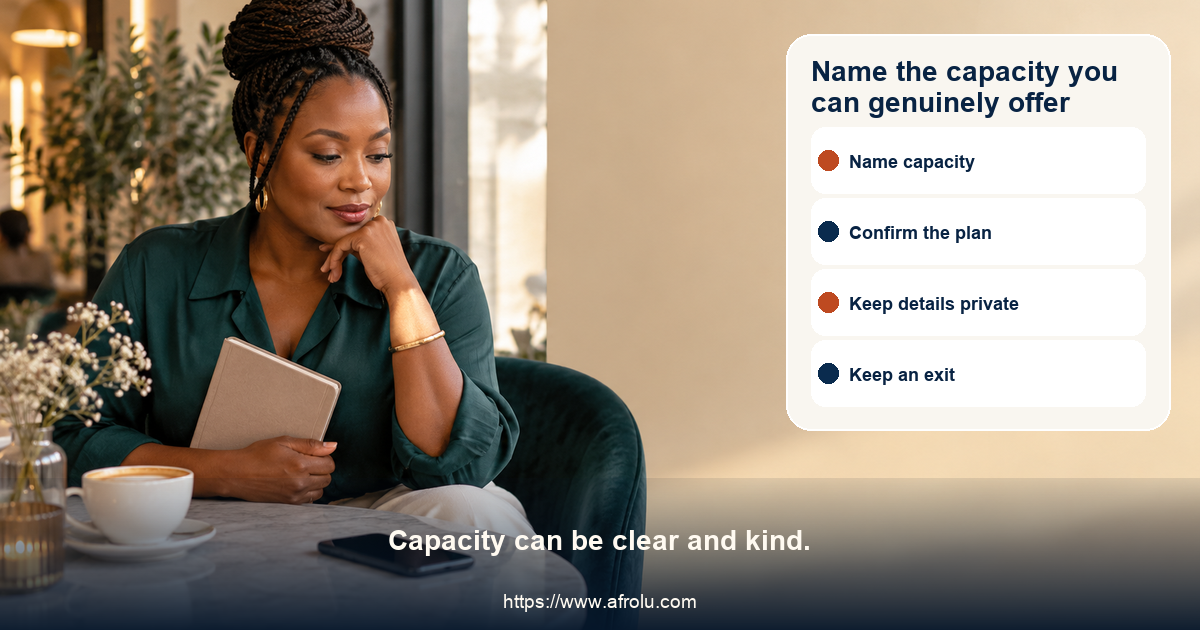
Capacity can be clear and kind.
Written and edited by Grace Mutiso · Kenya Guides Editor
Date at the scale your real capacity supports. Make small clear plans, set a release point before holding an evening open, and ask one practical question only when an answer helps. Keep work routines, accounts, location, money, codes, and documents private; make dates easy to leave and consent current. A returning message is a fresh choice, not a scheduling command. If contact becomes coercive, persistent, financially manipulative, or frightening, reduce access and use support.
Dating behaviour · Students
Is this an unconfirmed plan, an ordinary capacity mismatch, a return worth a smaller arrangement, a request for private work or digital access, money, unwanted pursuit, or conduct that makes me feel unsafe?
Ghosting during an adult study and career-heavy season is reduced or ended contact without a direct closing conversation. The useful distinction is between a capacity shift, an unconfirmed plan, a pace mismatch, observable repair, pressure for access, financial manipulation, unwanted pursuit, and conduct that reduces your ability to choose.
Nia is completing adult study while protecting a demanding work season, so she suggests a short public meeting. The match never confirms. She uses the evening to rest. When a late message asks her to share a work-related detail and meet privately, Nia keeps her privacy and public-setting boundary. She decides that any return will need to fit her real time rather than require her to reorganise it.
adult capacity · safer career-season dating
Nia dates at a scale that protects her time, energy, privacy, and freedom to choose
This guide separates a quiet plan from a capacity mismatch, a returning message, private-detail pressure, financial requests, unwanted pursuit, and fear—without treating an adult's full season as a reason to accept less safety or clarity.
Name real capacity, choose a small plan, ask once when useful, protect private access, make consent practical, read returns through current conduct, and shift to protection when pressure reduces freedom.
Name the scale
A small truthful plan is more useful than performed availability.
Release the slot
An unconfirmed date does not own an already full evening.
Keep it gradual
Work routines, accounts, and location do not belong to early dating.
Protect freedom
Pressure, money, and fear require more than better coordination.
adult study · career season
A full season does not require you to date as though you have no boundaries
Adult study and a demanding career season can make dating feel like one more item competing for attention. You may be drawn to someone while also protecting sleep, concentration, friends, health, and commitments you chose before the match appeared. That tension does not make you unavailable for connection. It means the pace needs to be designed around real capacity rather than an imagined version of endless availability.
Say what you can genuinely offer now. That might be a short public meeting, a planned call, occasional messages, or a pause until a demanding period passes. Directness is kinder than trying to maintain a level of contact that leaves you depleted. A compatible person does not need you to perform permanent enthusiasm in order to believe that you are interested.
The same principle applies when someone else says they are busy. Capacity can be a truthful explanation, but it becomes useful only when it is paired with a choice: a different time, a smaller plan, or a clear ending. Repeatedly invoking a full schedule while expecting you to remain available creates ambiguity, not low pressure. You can notice that pattern without deciding anyone's character.
Should a plan go quiet, resist turning the blank into another responsibility. Your study, work, rest, and private life remain real even when a conversation stalls. If clarity would alter your evening, send one brief coordination note; otherwise direct the available hours toward something that supports you. A new connection should not become the loudest demand in an already full season.
quiet contact · proportionate follow-up
One practical message can be enough when a thread falls silent
Ghosting can feel especially irritating when time is already scarce. You may resent having held a slot, wonder whether you should have sent a different message, or feel tempted to explain why the unanswered plan mattered. Pause before spending more effort than the connection has earned. The essential question is usually plain: is this plan still happening, or should I make another one?
If the answer will change your day, send one short check-in. 'Are we still meeting at six, or should I use the evening differently?' is direct and leaves room for a clear response. It does not require you to disclose your whole schedule or argue for the importance of your time. A person who wants to continue can respond with an arrangement; a person who does not can leave the question unanswered.
Read a response by whether it gives you usable information. A charming message that avoids a time, a repeated explanation with no proposed alternative, or an apology that expects instant availability may not fit your capacity. You can acknowledge it and still decline to rearrange your day. A workable connection should reduce unnecessary coordination work rather than turn it into another invisible task.
You may also decide that no message is the best choice. Silence can be enough information, especially if the pattern already feels one-sided. The goal is not to become indifferent. It is to keep your attention proportionate to the relationship that actually exists, so that dating remains one part of a full adult life rather than the part that consumes all available energy.
privacy · adult boundaries
A new connection does not need a record of your routine, devices, or career life
Someone may ask where you work, when you are free, who you see, which account you use, or whether they can reach you somewhere more private. You can keep your answer broad or say no. A first date usually needs a public meeting point and a time; it does not need a detailed route through your workday, access to a professional profile, or a record of when you are alone.
Choose channels and settings you can control. Staying on an app, keeping a separate communication boundary, meeting publicly, and arranging your own transport can make it easier to change your mind. These choices are not a rejection of connection. They prevent early interest from becoming unearned access to the parts of your life that require more trust and more time.
Take special care when someone asks for live location, screenshots, a private photo, a new app, a verification code, a payment favour, or details that could make you easier to locate or pressure. You can decline without proving that the request is dangerous. The fact that it makes you less free to choose what you share is enough reason to keep the answer brief.
If a privacy limit is ignored, revise the setup instead of supplying a longer explanation. Close pathways you no longer want to use, block or report where useful, preserve material only when doing so is safe, and involve a trusted person if the behaviour continues. Someone suited to you will understand that agreeing to a date does not grant inspection rights over your career season or private life.

One clear line can protect your energy.
consent · independent movement
A planned date does not remove your right to stop, shorten, or leave
A date can start well and still feel different after twenty minutes. You may want to leave earlier, stay in the public setting, decline another venue, stop physical contact, or go home without explaining every detail. Those are ordinary adult decisions. A prior message, a compliment, a drink, a gift, or the fact that you made time does not turn into permanent permission for anything else.
Choose practical arrangements that leave you room to act on a changed feeling. Meet somewhere public if that is your preference, retain your own route home, avoid letting a new match take control of payment or transport, and choose a length you can end without a complicated exit. You are not creating drama by planning for choice. You are making consent easier to practise in real time.
If someone pressures you to stay because they rearranged their work, spent money, or say the date will be awkward to end, remember that their disappointment does not decide your body or time. You can repeat the boundary once, leave, or seek help if you cannot safely disengage. A suitable match will not require you to sacrifice your comfort to prove that the date was worthwhile.
Current consent also applies beyond an in-person meeting. You can decline images, calls, late-night contact, video, account access, or disclosures that no longer feel right. A connection does not become safer because you have already been warm, responsive, or physically close. What matters is whether you are freely choosing the next thing that happens now.
safety · category change
Limited time is ordinary; control, money, and fear are not capacity issues
A person may be overloaded, lose interest, forget a plan, or decide that dating does not fit their current season. Those outcomes can sting while still belonging to the ordinary uncertainty of early contact. You might release the thread, make one check-in, or conclude that you need steadier follow-through. That proportion keeps every imperfect interaction from becoming a crisis that consumes your energy.
The category changes when a new match asks you to send money, receive funds, share an account, provide a code, reveal documents, or solve a financial problem. Attraction, career talk, and apparent urgency do not turn an early connection into a safe transaction route. Keep every system separate and consult a recognised institution directly if you need to check a claim.
It also changes when someone will not accept your reduced availability or a no. Repeated messages, new accounts after a block, threats, monitoring, blackmail, pressure for sexual material, or behaviour that leaves you afraid are not signs that you need a better scheduling system. Shut down access where possible, draw on support, and contact emergency services or specialist help when you face immediate risk or cannot safely disengage.
You do not need to know exactly why someone is applying pressure before you protect yourself. It is enough to recognise that the interaction is making your time, privacy, body, money, or movement feel less voluntary. You can block, report, seek support, or end contact because freedom is the condition for a real yes, not a reward for a perfectly argued boundary.

Capacity is not permission for pressure.
return after ghosting · present capacity
A returning message can be considered without giving it control of your schedule
Someone who reappears after a gap may offer a convincing account of why they disappeared and ask to reconnect immediately. Before weighing that explanation, check your own capacity and interest. Would reopening the thread feel steady? Could a modest plan fit without displacing commitments and comfort you have already chosen to protect? Your present answer matters as much as their past account.
If you remain interested, choose a scale that works for you: a brief scheduled call, a public coffee with a clear end time, or a message exchange that can pause when you need it to. This is not a test of another person. It is a way to see whether they can take part in a connection that respects the actual shape of your life rather than the one they would prefer you to have.
Do not compensate for the earlier absence by offering more access. A return does not require a private account, location, intimate image, financial detail, late-night availability, or a meeting that is hard to leave. Trust grows through ordinary respect for a limit. It weakens when a person treats an explanation as a reason you should abandon the boundaries that made you feel safe.
You can choose not to restart. A brief close, or no reply when that is safer or more restful, is legitimate. A connection can end before it becomes a relationship, and an adult can decide that without casting either person as a villain. You are choosing a pace that supports your life, not judging someone else's capacity to be different.
next move · sustainable openness
Let one quiet thread sharpen your next choice instead of draining your confidence
Choose one adjustment you can use in the next conversation. You might decide to confirm plans earlier, offer shorter first meetings, keep communication channels limited, decline late pivots, reserve certain hours for rest, or treat repeat vagueness as a sign of mismatch. These choices are not proof that you are too busy for connection. They are how you make connection compatible with the life you actually have.
Keep your non-dating life visibly present. Make room for study, work, rest, friends, and the small pleasures that help you feel grounded. A compatible person should fit alongside those things. They should not demand that you turn exhaustion into availability or make your private life less secure in order to keep a new conversation alive.
You may revise your preference after a difficult interaction. Perhaps you learn that you need clearer confirmation, more independent logistics, slower disclosure, or a different contact rhythm. That is not a failure to be relaxed. It is an adult using experience to improve future choices. Openness does not require repeating the same conditions after they have shown you that they do not work.
Where contact includes financial pressure, threats, coercion, unwanted pursuit, monitoring, or fear, choose protection over further analysis. End contact where you can, preserve information only if it is safe, and seek trusted, specialist, platform, or urgent support appropriate to the situation. You do not owe a final meeting, a more persuasive explanation, or one more chance to someone who is reducing your freedom.

Choose the move that supports your life.
Eight adult-study and career-season situations where clear capacity protects dating energy and safety

A proposed date never gains a time
A match suggests meeting after a demanding week but leaves the plan vague until the evening arrives.
Set a release point and use the time for the rest or plan you already need.A person treats limited capacity as lack of interest
They expect instant replies despite knowing you have a full season and question every delay.
Name a sustainable contact rhythm and notice whether it is respected.A first meeting asks for more time than you can freely give
A match dismisses your short public plan and proposes a long private alternative.
Keep the modest arrangement or decline the escalation.Early chat seeks work and routine details
Someone wants information about your schedule, work location, private accounts, or when you are alone.
Share less and keep the answer limited to what the present plan needs.A new connection turns into a digital favour
They want a verification code, document, payment help, or access to an account because of an urgent problem.
Keep financial and digital systems outside the connection.Silence is followed by a request for immediate attention
A person reappears late and wants a lengthy call or private meeting despite your existing plans.
Choose a smaller future step only if it fits your current capacity.A changed mind is treated as wasting their effort
During a date, the person pushes you to stay, switch settings, or offer more than you want.
State the boundary, leave if needed, and seek help if you cannot safely disengage.Reduced contact is bypassed through new accounts
After you step back, the person uses other profiles or people around you to continue contact.
Block, keep evidence only if safe, and use support appropriate to the behaviour.Fourteen observable signs that a dating rhythm is sustainable, vague, pressuring, controlling, or unsafe
They can hear that your capacity is limited without demanding proof that you are interested.
They make a clear, modest plan that fits the time you can genuinely offer.
They can reschedule or release a plan early instead of leaving you on standby.
They treat a direct question about timing as ordinary coordination rather than a challenge.
They do not ask for your work routine, private account, device, location, or professional detail as evidence of trust.
They accept a public setting, independent transport, a defined end time, and a changed mind.
They do not use career ambition, study commitments, or their own busy schedule to excuse pressure for instant access.
They return after a gap with an arrangement you can freely accept, decline, or change.
They keep money, documents, verification, payments, codes, and investment narratives outside early dating.
They do not use a gift, a reservation, a compliment, or time spent together to claim touch, images, or more availability.
They accept a no, a pause, or an ending without guilt, punishment, repeated messaging, or a character judgement.
They do not bypass limits through alternative accounts, private routes, or people around you.
They leave you with enough energy for the rest of your life rather than making dating another invisible job.
They never use threats, monitoring, financial pressure, humiliation, coercion, blackmail, or fear to preserve contact.
A proportional decision map for plans, capacity, private access, money, returns, and safety
| Situation | What it may mean | What to do next |
|---|---|---|
| A plan has no time or setting | The idea to meet is not yet a mutual arrangement. | Keep the slot yours until a clear plan exists. |
| You need a reply before rearranging your evening | One practical question would give useful information. | Ask once whether the date is still on or should move. |
| Someone says they are busy but offers no alternative | Their capacity may be real, but the connection may not fit your rhythm. | Name what works for you or release the thread. |
| A person expects constant availability | Your capacity is being treated as something they can manage or override. | Set a contact boundary and reduce access if pressure continues. |
| A first plan becomes private or very long | The new logistics may make a changed mind harder to act on. | Keep a public, bounded plan or decline. |
| Work or account details are requested | Early contact is seeking access it does not need. | Keep details broad and choose the channel you control. |
| A person asks for money, codes, or verification | Dating is being used as a route into financial or digital systems. | Do not transact, share, or solve the problem for them. |
| A return follows a gap | Context may be sincere without showing a new pattern yet. | Choose a short, planned next step only if it suits you. |
| A boundary is debated or bypassed | The issue has moved from disappointment toward pressure. | Stop explaining and reduce contact routes. |
| You feel afraid or unable to leave | Dating coordination is no longer the primary task. | Prioritise safety and seek urgent or specialist support as appropriate. |
Twelve complete lines for capacity, plans, privacy, consent, a return, and an ending
“Are we still meeting at six, or should I use the evening differently?”
“I have not heard back, so I have made another plan.”
“I am interested, and I only have room for a small plan this week.”
“I do not do constant messaging, but I value clear plans.”
“I am not sharing that work or routine detail.”
“I am meeting in public and arranging my own way home.”
“I am not continuing with that tonight.”
“I do not share codes, accounts, documents, or payment help in new dating.”
“If we reconnect, it would need to be a short plan made in advance.”
“This pace is not workable for me.”
“Do not contact me again.”
“I am stepping away and will seek support if you continue.”
Know the difference
A full season, a missed plan, and pressure for access need different answers
A plan remains unconfirmed, someone names a scheduling change, or two adults want different contact rhythms without demands for access or control.
A person seeks money, private routine details, device access, repeated contact, leverage, or control after a boundary is clear.
Treat limited capacity as a practical dating question and protect yourself when behaviour begins to reduce your freedom.

Different capacity patterns need different moves.
Keep a full season distinct from patterns that seek access or reduce freedom
| Type or dimension | What it describes | Best next question |
|---|---|---|
| Open plan | A date has been suggested but not made mutual. | Use the time independently until a clear arrangement exists. |
| Capacity shift | Someone says their time or energy changed. | Decide whether the revised rhythm fits you. |
| Pace mismatch | Both adults may be interested but want different contact levels. | Name your preference and observe whether it can be respected. |
| Quiet fade | Messages end without a direct close. | Ask once only if an answer changes your next practical move. |
| Observable return | A person offers a smaller workable plan after silence. | Choose current contact at a scale that suits you. |
| Private-detail pressure | Work, routine, location, or devices are treated as access they should have. | Share less and reinforce the boundary. |
| Financial request | Romance is used to reach money or systems. | Do not transfer, receive, lend, or verify for them. |
| Boundary bypass | A stated limit is ignored through repetition or another route. | Reduce access and preserve safety options. |
| Fear or coercion | Contact makes independent choice feel unsafe or impossible. | Seek support and urgent help suited to the risk. |
A simple plan you can use today
Capacity can be honest
A small plan or a pause can communicate interest more truthfully than constant availability.
A confirmed date saves energy
Clear timing prevents a potential meeting from consuming an already full evening.
One check-in is enough
A practical question can release a quiet plan without turning it into a task of persuasion.
Private details need not speed up
Work routines, accounts, location, and devices can remain yours while early trust develops.
Current consent includes logistics
Independent transport and a bounded meeting make a changing feeling easier to act on.
Safety changes the task
Financial pressure, monitoring, coercion, unwanted pursuit, and fear need protection rather than better scheduling.
Questions organised by purpose and depth
Choose a few prompts that fit the moment. This is a reference library, not a list to complete.
Choose your real capacity
Make a plan that fits the season you are actually living.
- What amount of time feels voluntary?
- What type of meeting leaves me energised?
- What would be too much this week?
Release the quiet plan
Keep a possible date from consuming time you need elsewhere.
- When will I stop waiting?
- Would one question give useful information?
- What will I do if no answer comes?
Protect private access
Keep early interest separate from routine, accounts, and work details.
- What detail is unnecessary now?
- Which channel feels under my control?
- What request would make me slow down?
Choose the response category
Separate a busy season from conduct that requires protection.
- Has someone asked for money, access, or secrecy?
- Has my no been respected?
- Who can support me if contact escalates?
What deserves a closer look
Limited time can still be meaningful
A small truthful plan lets adults assess fit without pretending that every season has unlimited bandwidth.
Evidence limit: It cannot make two incompatible rhythms match.
Clear edges reduce hidden work
A day, time, setting, and change path make dating easier to coordinate around a full life.
Evidence limit: They do not guarantee another person will follow through.
A gap is not a task assignment
One coordination question can provide current information without requiring you to manage another adult's motives.
Evidence limit: It cannot produce a satisfying explanation.
Professional details can stay gradual
Keeping routines, accounts, and work information limited preserves choice as trust develops.
Evidence limit: It is not proof that every new match is unsafe.
A reversible date supports a real yes
Independent travel, public settings, and a defined time make a changed mind easier to act on.
Evidence limit: They cannot remove every risk.
Pressure is not a scheduling problem
Money requests, tracking, threats, coercion, and repeated unwanted contact call for reduced access and support.
Evidence limit: The safest local action depends on the circumstances.
Shortcuts that turn a full season into waiting, access, pressure, or risk
Performing unlimited availability
Trying to look easygoing can turn a full season into depletion and resentment.
Letting a vague plan occupy your evening
Unconfirmed dating time should not displace rest or commitments that already matter.
Overexplaining your schedule
A new person does not need a detailed routine in order to respect a boundary.
Making a first date hard to leave
Lengthy, private, or dependent logistics can make a changed mind unnecessarily difficult.
Treating a return as a priority demand
An explanation does not require immediate access to your time or private life.
Handling a financial or digital favour
A new connection is not a safe route for money, documents, codes, or account access.
Use one focused resource for a boundary, a useful first-date question, or a steadier post-date message
Choose the resource that fits the decision in front of you. A guide can help you name a preference, but it cannot promise another adult's interest or conduct.
Explore the guide library
Show more related guides
Continue with Afrolu
Show more Afrolu guides
Sources used for this guide
Afrolu reviewed these health, research, safety, or public guidance resources while editing this page. They support the behaviour and safety guidance; they do not diagnose any individual described by a reader.
Questions about ghosting for adult students dating during a career season
Can I date while I have limited time for adult study and work?
Yes. The useful question is not whether you have unlimited availability; it is whether you can offer a pace and plan that are honest, voluntary, and sustainable.
Should I ask about a date if someone has gone quiet?
Ask if an answer changes what you will do next. One practical question about the plan is often enough.
What if I do not want to follow up?
You can let the quiet thread end and use the time elsewhere. No further message is a valid choice when you do not need more information.
Does a smaller first plan make me look uninterested?
No. A short public meeting or scheduled call can show more reliable interest than a large promise you cannot comfortably keep.
Do I need to explain my work or study schedule in detail?
No. You can give only the broad information needed for a plan and keep your routine, employer, accounts, location, and private communications gradual.
What should I do if someone asks for money, a code, or account help?
Keep money, documents, verification, codes, transfers, and account access outside a new connection. Use official sources for independent information.
Can I leave a date early if my comfort changes?
Yes. You can shorten a meeting, leave, decline a new setting, or say no to touch or any other request. Your present comfort is enough reason.
Can a returning message after ghosting be sincere?
It can be. You can acknowledge context while choosing whether a small future plan or no renewed contact fits your capacity now.
Does ghosting always mean I am unsafe?
No. A quiet ending can be disappointing without being dangerous. Coercion, financial pressure, monitoring, repeated unwanted contact, threats, and fear are different categories.
How can I stay open after a disappointing plan?
Carry one practical preference forward, such as earlier confirmation or a smaller first meeting, rather than making one interaction a rule against connection.
One thing to do now
Choose the next move that supports your life instead of consuming it
Choose the smallest next action that protects your time, energy, private routine, independent movement, current consent, money, support network, and ability to end contact without negotiating your comfort.