Parents · serious Nairobi dating and privacy
Ghosting for Parents Dating Seriously in Nairobi
Ghosting for parents dating seriously in Nairobi: keep family life private, make adult plans clear, protect money, and know when pressure needs support.
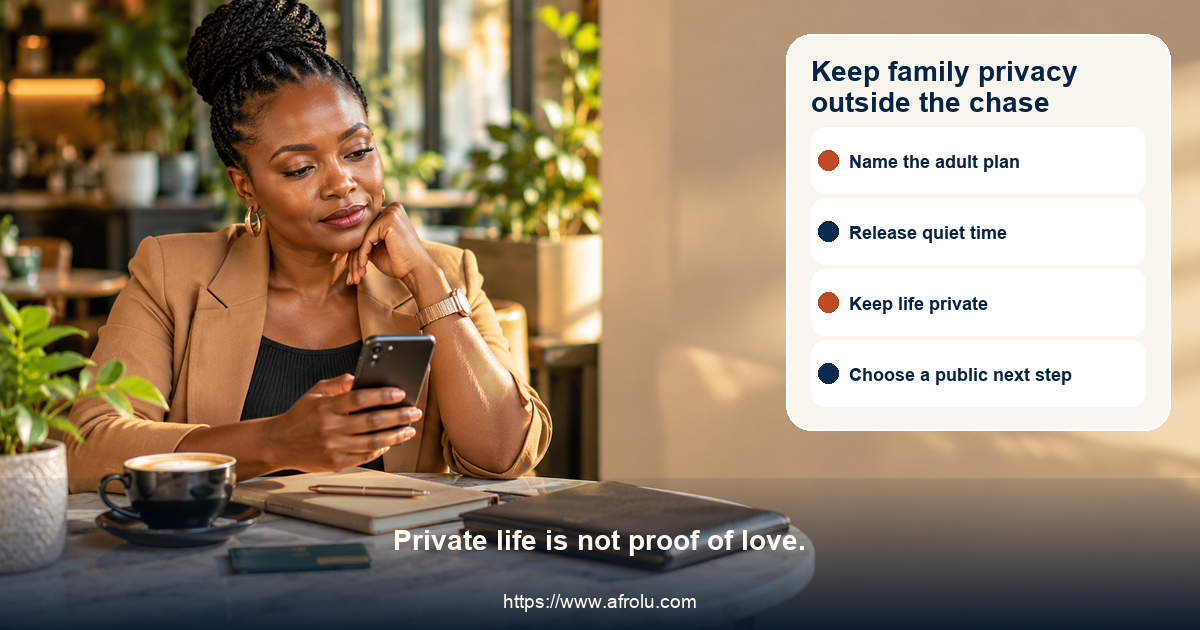
Keep a quiet chat adult-sized.
Written and edited by Grace Mutiso · Kenya Guides Editor
Ghosting can hurt without requiring you to expose family life or chase an answer. Name the actual adult plan, use one short follow-up only if it helps, and return the time to your own life. Keep early dating public and adult-only; layer addresses, routines, contacts, accounts, money, and household resources carefully. If someone pressures access, bypasses a boundary, repeats contact, threatens, monitors, exploits, or frightens you, reduce access and seek appropriate support.
Dating behaviour · Parents Returning To Dating
Is this an ordinary quiet adult conversation, a missed public plan, a repair, a pace mismatch, or a pattern that uses family access, home information, transport, money, accounts, indirect contact, coercion, threats, monitoring, blackmail, or fear to make your choices smaller?
Ghosting for parents dating seriously is a reduced or ended adult dating conversation without a direct explanation. It is not proof that anyone is unsafe or that a parent should share more private life to be taken seriously. The useful distinction is between a quiet chat or compatibility mismatch and conduct that reduces free choice through household-access pressure, financial or digital extraction, indirect contact, coercion, threats, monitoring, blackmail, repeated unwanted contact, or fear.
Amina has one free evening for a public Nairobi date, but the match never confirms. She releases the plan instead of giving more details about her household. When the person returns with a home-pickup offer, a request for money, and questions about people around her, Amina sees that serious dating is not measured by how quickly a new adult connection enters private life; it is measured by whether the boundary remains hers.
parents · serious Nairobi dating and privacy
Amina keeps a quiet dating connection from becoming a route into home, family life, money, or her freedom to choose
This adult-only guide separates ordinary dating silence from patterns that make a parent's time, household privacy, resources, body, support, or ending less freely chosen.
Name the adult fact, layer private information, make public plans clear, read present seriousness, keep resources closed, end without household debate, and choose the move that protects tomorrow.
Keep it adult-sized
A quiet dating chat does not need to enter your whole private life.
Share by present need
A new adult match can know enough without receiving a map of family life.
Read the next boundary
Commitment is meaningful when a public no and a careful pace remain respected.
Protect the exit
Indirect contact, money pressure, coercion, threats, and fear deserve less access and more support.
a quiet dating chat does not belong in your whole household
Parents can be disappointed by ghosting while keeping an early adult connection separate from family routines and private life
When you are a parent, dating often happens around a life that is already full of commitments, care, work, rest, and people whose privacy matters to you. That can make a sudden quiet chat feel especially disruptive: you may have made rare time for a date, adjusted a routine, or imagined whether the connection could become serious. The disappointment is real. It does not make a new adult match entitled to more access or make you responsible for chasing an explanation.
Start with the narrow fact. Was a public adult-only plan confirmed and missed? Did a conversation simply taper off? Did someone say they would reply by a certain time? A single gap does not tell you why another person went quiet, and it does not justify searching their workplace, asking mutuals to locate them, arriving at an event, or offering family details to make them return. You can care about clarity without turning private life into a route back to you.
If a short follow-up would settle your own decision, make it about the adult plan: “I had held time for our date. If you are no longer interested, please say so; otherwise I will make other arrangements.” Then release the time. Do not keep a whole weekend, home plan, or emotional future waiting for a person who has not made a present-tense choice. Your schedule can return to you even if the message never receives an answer.
A serious relationship becomes meaningful through the behaviour that follows ordinary inconvenience. A person may need to reschedule, change their mind, or decide that dating a parent is not right for them. Those can be compatibility facts. The concern is not a person who leaves; it is a person who uses silence, a return, or a promise of seriousness to pressure you for a private address, household access, family details, money, physical intimacy, or an ending on their terms.
keep family information layered while trust is still new
A serious dater can know you are a parent without receiving names, routines, locations, photographs, or a role in family life
Begin with broad context. You can say that your availability is planned, that early dates are adult-only, or that you prefer public meetings without naming a home address, school, family schedule, care arrangements, former relationship details, photographs, neighbourhood pattern, or the people who support you. A compatible person can work with a general answer. They do not need a map of your private life to decide whether they enjoy your company.
Ghosting can create a temptation to explain more in order to make a person reappear: perhaps if they understood why you could not meet, they would respond, or perhaps a family introduction would prove that you are serious. Resist that trade. Another adult's silence is not evidence that your privacy needs are too high. You can want commitment and still decide that information about your household becomes relevant only after a relationship has shown reliability over time.
Digital details deserve the same care. A photo background, location tag, calendar image, local group post, ride request, contact suggestion, or shared event may reveal a routine you did not intend to disclose. Review what a new match can see, particularly if a conversation ends or becomes pressuring. If changing a setting could make someone react badly, seek support and make a safety plan rather than trying to fix every account while the person may be watching.
Do not confuse a request for closeness with a right to information. A date may feel curious about your life, disappointed that a plan changed, or eager to show they would be a serious partner. Those feelings do not create access to your home, private network, or family routine. A person who hears a clear privacy boundary and makes the next adult-only plan easier is offering useful evidence. A person who keeps bargaining is asking you to shrink a boundary that protects more than the date.

An adult boundary protects a whole life.
make serious early dates easy to confirm and easy to leave
A public adult-only plan can show whether someone respects your time better than a grand promise about joining your life
Choose a plan that fits the life you actually have. A daytime coffee, a meal near a public venue, or an event with an independent arrival and exit can be enough to learn whether conversation and consideration feel mutual. You can say what time you are available and leave when planned. You do not have to share why the window ends, invite someone to wait near a home, or make a rare free evening into a test of whether they will finally treat you as serious.
Make confirmation practical. Agree when the date becomes real and when you will release the time if it is not. If the person goes quiet, use one simple message or make another plan. Do not arrange a pickup from home, a private after-date location, a surprise visit, or a household shortcut in an attempt to avoid another cancellation. A person who wants to date you can meet you in a format that protects your independence and your existing life.
Watch the response to ordinary logistics. A respectful dater may apologise for a late change, offer a different public time, and accept that you already have other commitments. A pressuring dater may ask you to prove that you are really busy, say that a serious relationship requires spontaneous access, turn a meal or ride into leverage, or suggest that meeting people close to you would solve the uncertainty. The distinction is whether your decision remains yours after the plan changes.
Nairobi offers many possibilities for adult social life, but you do not need to make a city a justification for bypassing privacy. Choose a place that works for you, tell a trusted person a broad plan when useful, and keep your transport and payment separate. A date who genuinely wants a serious future can tolerate early plans that are public, modest, and adult-only. A relationship that cannot survive those limits is not made stronger by speeding past them.
read serious intent through present boundaries
A person can want commitment and still accept that adult dating, family privacy, consent, and time cannot be rushed into a shared household
Future talk can be comforting after ghosting because it seems to offer an answer to uncertainty. A returning match may say they now understand your value, want to meet everyone important to you, or are ready to prove they are serious. Let the next small behaviour matter more than the dramatic framing. Can they confirm a public plan? Can they accept a limited date window? Can they respect a no to a home visit, pickup, travel request, intimate image, shared account, or family introduction? Those answers tell you whether seriousness has room for your autonomy.
Do not ask household members to validate a new adult connection or to soften someone's disappointment. Early dating can remain between adults even when your goal is eventually serious. You do not need to expose family routines, show photographs, arrange a meeting, or explain care decisions to prove that you are not hiding anything. A person who treats this boundary as a personal insult is describing their own expectation, not uncovering a defect in yours.
Consent stays current in every serious relationship stage. A long conversation, a gift, a date paid for by someone else, a return after silence, or a promise of a future does not decide a private visit, touch, sex, an overnight plan, alcohol, photographs, or an extra hour. You can make an adult plan smaller at any point. A person may decide that the pace is not for them, but they may not make disappointment into a reason to pressure you.
If a person becomes angry when you protect adult-only dating, sends repeated messages after a boundary, or tries to get information through friends, family, local contacts, workplaces, or public posts, shift away from proving seriousness. Reduce access. A serious relationship should make your ability to care, rest, work, and make private decisions more secure, not force you to defend why a new adult does not yet have a role in your household.

Serious intent must leave room to choose.
keep money, digital access, and household resources outside the connection
A quiet or returning match does not need your home, account, financial help, code, document, transport route, or family network to show that you care
Be direct about money. Do not lend, receive, transfer, invest, route, or hold funds for a new date. Requests about transport, medical costs, rent, school-related expenses, a ticket, a family emergency, a package, an account, a loan, or cryptocurrency may carry an emotional story that makes refusal feel harsh. The relationship has not earned a right to your finances, and a person who is genuine can accept that your resources are not part of the early connection.
Keep account and location information layered too. Do not share a code, password, banking screen, document, calendar, address, booking reference, household key, family contact list, or access to a private device as a way to rebuild a quiet conversation. A person who says a code or document will prove trust is asking you to make a digital risk feel romantic. Use independent official channels for any real account or travel question rather than a link, call, or payment route sent by a match.
A returned person may offer help with household logistics, rides, repairs, errands, or care in a way that feels appealing after a busy week. It is reasonable to appreciate a kind offer and still decline. Early access can be hard to unwind if the relationship becomes unclear. Choose adult-only plans until you freely decide that deeper integration makes sense. Help that becomes a claim on your time, home, family, money, or physical intimacy is not neutral help.
If someone uses financial pressure, account requests, location clues, a new profile, contact through people around you, or threats to bypass a boundary, take the pattern seriously. You do not need to identify their intention before lowering access. Protect relevant accounts, tell trusted adults not to share information, preserve safe evidence if needed, and seek appropriate support if the behaviour continues or makes you afraid. The goal is a household life that is not organised around a dating connection's demands.
end an adult connection without making family life the argument
A quiet mismatch can close with no further contact; pressure, repeat messages, monitoring, or fear may require a more protected exit
For a straightforward ghosting experience, you can let the chat remain closed. If you want to send a final line, keep it clear: “I am not continuing this connection. I wish you well.” You do not have to explain a care schedule, list every missed message, or defend why a serious relationship requires more reliability. A person can disagree with your decision without gaining another adult-only date or any access to the rest of your life.
If someone reappears with a promise that they are now serious, decide from the present boundary rather than guilt about their return. You may ask for a public, limited plan; you may choose a slower restart; or you may decline entirely. Do not meet privately to reduce their disappointment, introduce anyone, share a route, accept a ride from home, or move an ending into a space that makes leaving harder. The connection can end without a performance of kindness that costs you privacy.
When there are shared local circles, protect the adult boundary without making a public spectacle. Ask trusted people not to pass on messages or disclose details. Keep work, community, and family events separate from a personal ending. You can decline an invitation or leave a space if you need to, but you do not need to make everyone choose a side. The point is not to control a story; it is to prevent a quiet dating matter from becoming a route to your household.
If contact becomes threatening, repeated, coercive, financially exploitative, sexually pressuring, monitoring, blackmailing, or frightening, stop treating it as a relationship closure discussion. Use a protected exit, seek support that fits your situation, and choose urgent local help when immediate safety is at risk. Preserve information only when it is safe, and make account or privacy changes in a way that does not increase danger. Your first responsibility is restoring safety and freedom around your life.

Choose the move that protects private life.
let serious dating protect the life you already built
A relationship worth developing leaves you more able to care, work, rest, choose privacy, seek support, and decide the pace of access
After a quiet or confusing dating interaction, ask what remains under your control. Can you keep your home and routine private? Can you make an adult-only public plan? Can you say no to a ride, late visit, family introduction, money request, image, touch, or new account without having to manage a crisis? Can you maintain rest, care, work, and trusted support? These are serious-dating questions because a future cannot be healthy if the present keeps reducing your choices.
Separate ordinary incompatibility from intrusion. A person may want more spontaneous weekends, a faster pace, or a relationship style that does not fit your life. That can be disappointing and still leave both people free to walk away. Repeated pressure for home access, family details, money, digital access, secrecy, unwanted contact, threats, or fear is different. It is not solved by more explaining. It calls for less access and, when needed, support.
Choose one proportionate action. Confirm a public date, release a quiet plan, state a privacy boundary, decline a ride, tell a friend, change an account setting, stop replying, archive a chat, ask for a clear adult plan, or seek help. You do not need to decide whether every person is good or bad before acting. You only need to decide what access and pace you can freely offer today.
Parents can want romance, commitment, tenderness, partnership, and a serious future while keeping a new connection adult-only until it earns more integration. The strongest proof of a person's seriousness is not how quickly they enter your calendar or private world. It is whether they respect the structures that let you remain a whole person with choices, support, privacy, and a safe ability to leave.
Eight adult parent dating moments after quiet contact

A public date is never confirmed
A parent clears an adult-only evening for a public coffee, but the match does not confirm and goes quiet after a friendly message.
Release the time and make another plan; do not share more household detail to persuade someone to reply.A match returns with a specific public alternative
A person apologises for a missed date, offers a clear daytime public plan, and accepts that the parent's availability is limited.
Decide whether the repair suits you while keeping the connection adult-only and independent.A quiet match proposes a home pickup
After several days of silence, a match says they want to prove they are serious by collecting the parent from home or dropping by with a gift.
Decline the address exchange and choose a public venue or no restart.Seriousness is framed as early household access
A returning dater says a serious relationship should involve introductions, family photographs, or knowledge of routines before trust has developed.
Keep the relationship between adults and restate that information is shared by your own pace.A logistical offer becomes leverage
A match offers a ride, errand, repair, or household help, then becomes offended when the parent declines and keeps the plan public.
Treat help as optional and reduce access if the offer becomes a claim on time or private life.A romantic return includes a financial emergency
Someone who went quiet says a family or transport crisis requires a private transfer and promises that refusing means you do not trust them.
Do not send, receive, lend, route, or invest money; use independent official help if fraud is a concern.Different relationship pace is named honestly
A dater wants more spontaneous availability than a parent can offer, and both adults acknowledge that the rhythm may not fit without pressure or insult.
Treat the difference as compatibility information and choose what respects your life.An ending is bypassed through local contacts
After a clear no, a person asks mutual acquaintances for family details or sends messages through people who know the parent.
Ask contacts not to share information, narrow personal routes, and seek support if contact continues or feels unsafe.Signals about adult plans, privacy, access, money, consent, and safety
They can accept a broad availability window without asking for proof, household details, or a family schedule.
They are comfortable with public adult-only plans and with you arranging your own arrival, payment, and departure.
They do not treat a missed date, a rare free evening, a gift, a meal, a ride, or a return after silence as leverage for more access.
They understand that serious dating can remain between adults while trust, compatibility, and safety are still being established.
They respect a no to a home pickup, address exchange, private visit, family introduction, photograph, household help, late plan, or intimate request.
They do not ask for names, routes, routines, care arrangements, family contacts, location tags, or private digital information they do not need.
They can confirm or change a public plan without making you apologise for responsibilities outside the relationship.
They repair a missed commitment through a changed adult plan rather than promises of future household access or pressure for instant seriousness.
They keep money, transfers, loans, codes, accounts, documents, tickets, and financial emergencies separate from early dating.
They do not use friends, relatives, workplaces, local groups, events, or new profiles to bypass a quiet chat or a clear ending.
They keep consent current and do not treat serious intent, prior warmth, a date, a ride, a gift, or a returning message as permission.
They can hear that a relationship pace does not fit without making your family life the reason you must change.
They do not react to privacy boundaries with guilt, repeated messages, monitoring, threats, blackmail, unwanted contact, or fear.
They leave you able to care, rest, work, keep a home private, lean on support, and end contact without the household becoming exposed.
Choose a proportionate next move
| Situation | What it may mean | What to do next |
|---|---|---|
| A public plan is not confirmed | A date may be unavailable or uninterested, but your time does not need to remain open. | Release the slot and send one short message only if it helps you close the adult plan. |
| They return after silence | A return can be a repair attempt, a vague reopening, or a request for more access than you want. | Choose a limited public plan, a slower restart, or no restart from your current needs. |
| They ask for a home pickup | A ride can sound helpful while creating an address and dependent-transport route. | Meet independently in public or decline without explaining the household. |
| They want family information | Curiosity can be normal; repeated requests can become pressure for private access. | Offer only broad context and reduce access if the boundary is negotiated. |
| They frame early integration as serious | Future talk can be used to make access to private life feel owed. | Keep dating adult-only until sharing more is freely chosen and supported by trust. |
| They offer household help | Help can be generous, but it can also accelerate access before you are ready. | Decline or choose a different adult-only plan if the offer changes the balance of the connection. |
| They ask for money or account help | Urgency around resources can create financial or identity risk. | Do not transact, share codes, or provide documents; use official channels independently. |
| They contact people around you | Indirect messages can turn a personal dating boundary into a household visibility problem. | Ask trusted adults not to share details, narrow personal routes, and seek support if it continues. |
| They pressure an intimate or private plan | Serious dating does not cancel current consent or the right to a public and independent exit. | Say no, leave, slow the plan, or end contact without trying to soften the limit. |
| You feel fear or exposure | The concern has changed from dating pace to safety and privacy protection. | Use a protected exit and urgent local support when necessary. |
Twelve lines for adult-only plans, privacy, access, money, and ending
“I had held time for our date. I am making other arrangements now.”
“I get to know people as adults first. Family life is not part of this stage.”
“That detail is private. I have shared the context I want to share.”
“I will meet you at the venue and make my own way home.”
“I do not host early dates at home. A public plan is what works for me.”
“I appreciate the offer, and I have the logistics covered.”
“I do not lend, transfer, receive, or move money in a dating connection.”
“I am not agreeing to a private or intimate plan tonight.”
“I am open to serious dating, and I still move carefully with private life.”
“I am not reopening this connection. Please respect that.”
“Do not contact people around me for information or messages.”
“I am not discussing this further. I am taking steps to protect my privacy.”
Know the difference
A quiet chat, a public repair, a pace mismatch, private-life pressure, and fear need different parent dating responses
A person can make a public plan, respect limited availability, accept adult-only early dating, hear a privacy boundary, keep resources separate, and leave a mismatch without pursuing private life.
Home or family-access pressure, rides that demand an address, money or account requests, indirect contact, repeated messages, monitoring, coercion, threats, blackmail, and fear make serious dating less freely chosen.
A serious future is only useful when the present boundary around private life, consent, and a free exit remains yours to decide.

The pattern—not the promise—sets access.
Separate a quiet chat, a repair, a mismatch, pressure, and fear
| Type or dimension | What it describes | Best next question |
|---|---|---|
| A quiet adult chat | A conversation slows or ends without a confirmed household or family plan. | Use one optional adult-to-adult note or let the chat close. |
| A missed public date | A confirmed adult-only plan does not happen but can be acknowledged and repaired. | Release the time and decide whether a specific new plan works. |
| A careful repair | A person proposes a public limited plan and respects the parent's real availability. | Observe the next adult action before offering more trust. |
| A vague return | A returning person wants warmth, urgency, or access but avoids a clear plan. | Ask once for a practical adult plan or decline the restart. |
| A pace mismatch | Two adults want different degrees of spontaneity or relationship speed. | Treat it as compatibility information when both can leave freely. |
| Family shortcut | Seriousness is used to argue for an address, routine, introduction, photograph, or role in household life. | Keep dating adult-only and retain privacy. |
| Helpful pressure | Rides, errands, gifts, or assistance become a claim on time, home, or intimacy. | Decline the access and watch the response. |
| Financial or digital extraction | A quiet or returning match asks for money, codes, documents, account access, or a private route. | Keep resources separate and use independent official help if concerned. |
| A safety concern | Repeat contact, indirect messages, monitoring, coercion, threats, blackmail, or fear appear. | Use a protected exit and relevant support. |
Handle quiet dating contact without exposing private life
Keep silence adult-sized
A quiet dating chat can be disappointing without becoming a household problem or a reason to expose private routines.
Layer family context
Broad availability and adult-only dating can be enough until further sharing feels freely chosen and safe.
Make plans modest
Public time, independent transport, a confirmation point, and a finish time reveal more than a grand promise of instant integration.
Read present seriousness
A serious dater respects a no to access, privacy, intimacy, money, and a changed plan in the present.
Keep resources closed
Household help, accounts, codes, money, documents, addresses, routes, and contacts should not repair a quiet relationship.
Match ending to risk
Use a simple adult close for mismatch and a protected exit when behaviour becomes intrusive, coercive, or frightening.
Questions organised by purpose and depth
Choose a few prompts that fit the moment. This is a reference library, not a list to complete.
Name the adult fact
Keep a quiet chat or missed plan from expanding into a theory about another person or your household.
- What was actually arranged?
- What do I need to do with my own time now?
- What information does this person truly need for the next adult plan?
Protect private life
Review whether a return after silence is asking for more family access than trust supports.
- Does this request involve an address, routine, contact, image, route, or household role?
- Can I offer a broad answer instead?
- Would this access be easy to take back later?
Choose present seriousness
Judge a serious claim by how it behaves around an ordinary boundary.
- Can they accept a public adult-only plan?
- Can they hear no to a home, ride, introduction, money, or intimate request?
- Does the next plan leave my choices intact?
Read escalation
Identify when a dating concern needs more protection than another conversation.
- Has contact continued through people, accounts, or places after no?
- Is money, digital access, or private information being pressured?
- Who can help me protect privacy if I feel exposed or afraid?
Look more closely at quiet contact, privacy, public plans, seriousness, resources, and escalation
How to release a missed adult plan
Name the public date or confirmation once, then return the time to your own life without sharing more household context to earn a reply.
Evidence limit: Do not use mutuals, local contacts, workplaces, or public posts to pursue a quiet person.
How to share context in layers
Offer broad availability and adult-only boundaries instead of names, schedules, routes, addresses, contacts, images, or a map of household life.
Evidence limit: Privacy is not a test a date has to pass or a promise that you will never share more.
How to keep early serious dating independent
Use a confirmed public venue, separate arrival and exit, a finish time, and a clear cancellation point that protects your availability.
Evidence limit: A public plan cannot guarantee compatibility; revise it when your freedom to choose changes.
How to evaluate a returning match
Look for an adult public plan and respect for privacy, current consent, and your availability rather than future talk about instant integration.
Evidence limit: A promise of commitment does not make household access or intimacy owed.
How to keep money and access separate
Decline transfers, codes, documents, addresses, account access, household help, and private contact routes that early dating has not earned.
Evidence limit: Do not use a dating connection to solve financial, digital, or household emergencies.
How to protect a private life after an ending
Repeated unwanted contact, indirect messages, monitoring, coercion, threats, blackmail, financial exploitation, and fear warrant reduced access and support.
Evidence limit: Choose safety actions that fit your circumstances instead of a private confrontation.
Shortcuts that make a quiet connection more exposed than it needs to be
Explaining family life to win a reply
A quiet match does not need more private information in order to decide whether to continue dating.
Using household access as serious-dating proof
Family routines and private spaces should not be recruited to validate a new adult connection.
Holding a rare free window indefinitely
An unconfirmed plan should not displace rest, support, and the rest of your own life.
Accepting a ride or help because someone returned
A helpful offer can create an access route that feels harder to reverse after the relationship changes.
Calling every pace mismatch a red flag
Different availability can be a respectful incompatibility when neither adult pressures the other to change.
Meeting privately to manage an ending
Someone's desire for closure does not override your privacy, independent movement, or safer adult boundary.
Choose one resource that fits the relationship pace, an unclear conversation, or the boundary you need to keep
Use an exclusive-dating guide for a serious direction, a talking-stage resource for early adult clarity, or a recovery guide when quiet contact is asking for more of your attention than it gives back.
Explore the guide library
Show more related guides
Continue with Afrolu
Show more Afrolu guides
Sources used for this guide
Afrolu reviewed these health, research, safety, or public guidance resources while editing this page. They support the behaviour and safety guidance; they do not diagnose any individual described by a reader.
Questions about ghosting for parents dating seriously in Nairobi
Does ghosting mean I should share more about why my time is limited?
No. A quiet match does not need family details, schedules, addresses, or routines to decide whether to continue. A broad adult explanation is enough.
Should I send a final message after a quiet dating chat?
You can, but you do not have to. One short adult-to-adult line can close a missed plan without turning your private life into the debate.
Can a returning match ask to pick me up from home?
You can decline. Independent public transport and a venue meeting protect both your address and your ability to leave.
When is it reasonable to introduce family life to someone I date?
That choice is yours and can be gradual. Early serious dating can remain adult-only while you observe reliability, compatibility, and respect for boundaries.
What if someone says I am not serious because I keep family details private?
Privacy is not a lack of commitment. A compatible person can decide whether the pace works for them without demanding access to private life.
Can I refuse household help after someone goes quiet and returns?
Yes. A ride, errand, gift, repair, or logistical offer can be declined when it would make a new connection more integrated than you want.
What if a dating match asks for money because of a family emergency?
Do not lend, transfer, receive, invest, route, or hold money for a dating connection. Use independent official information if you are concerned.
Does serious dating mean I owe a private or intimate plan?
No. Serious intent, a date, a gift, a returning message, or future talk never settle current consent, a home visit, touch, sex, images, or an overnight.
What should I do if they contact people around me after I end it?
Ask trusted adults not to share information, narrow personal routes, preserve safe evidence if useful, and seek support if contact continues or feels unsafe.
When is this more than ghosting?
It is more than a quiet dating matter when there are repeated unwanted messages, monitoring, coercion, financial exploitation, threats, blackmail, unwanted approaches, or fear.
One thing to do now
Let serious dating protect the life you already built
Choose the smallest next action that preserves adult-only early dating, family privacy, independent movement, money and account boundaries, current consent, trusted support, and the ability to end contact without bringing private life into the negotiation.