Low-pressure distance · adult capacity
Ghosting for Late Entrants: Low-Pressure Long-Distance Dating
A low-pressure long-distance dating guide for late entrants: set contact expectations, respond to ghosting calmly, protect privacy, and recognise pressure.
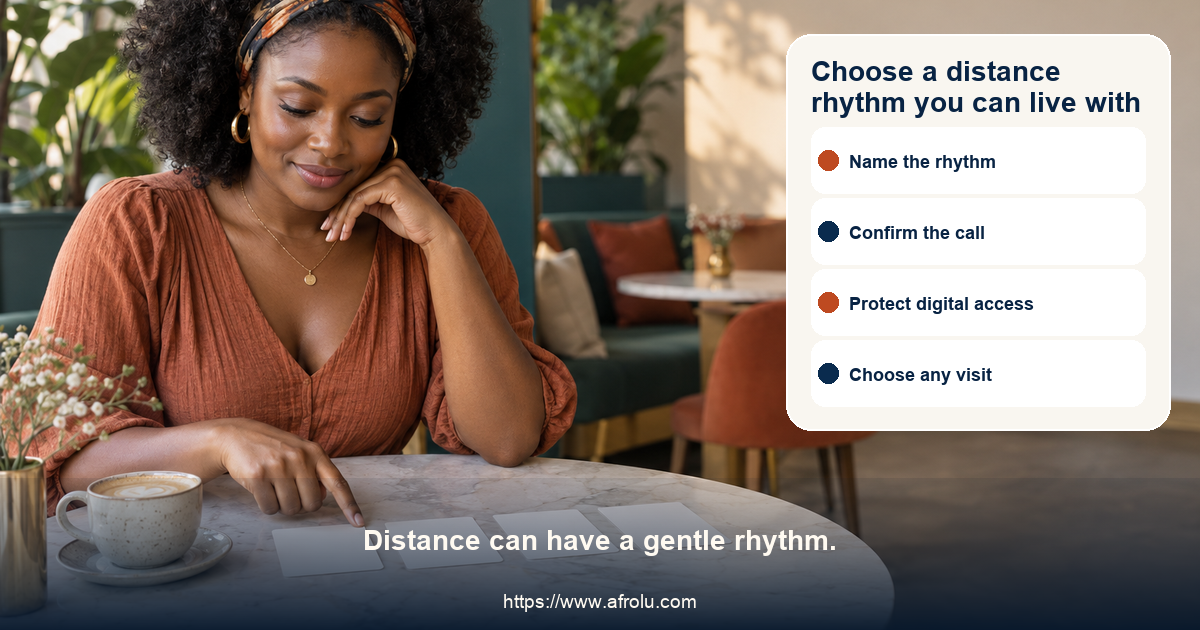
Distance can have a gentle rhythm.
Written and edited by Grace Mutiso · Kenya Guides Editor
Let a long-distance connection have a realistic rhythm instead of permanent availability. Confirm calls before holding your evening open, ask one practical question when it helps, and treat silence as information rather than a demand for pursuit. Keep digital details, location, money, codes, and account access private. Any future meeting should be public, independently organised, and easy to change. If conduct becomes coercive, persistent, financially manipulative, or frightening, reduce access and use support.
Dating behaviour · Late Entrants
Is this an unconfirmed call, a contact mismatch, a return worth a smaller agreement, a request for digital access, money, or a hard-to-leave meeting, unwanted pursuit, or conduct that makes me feel unsafe?
Ghosting in low-pressure long-distance dating is reduced or ended contact without a direct closing conversation. The useful distinction is between an open call, a capacity shift, a contact mismatch, observable repair, digital pressure, financial manipulation, unwanted pursuit, and conduct that reduces your ability to choose.
Jonah has enjoyed several thoughtful calls with someone who lives elsewhere, but a promised Friday conversation passes without confirmation. He goes to a local event rather than waiting online. When a warm message arrives later asking him to share a live location and make immediate visit plans, Jonah keeps his channel and privacy boundary in place and decides that any restart must begin with a call he can freely accept or decline.
low-pressure distance · adult capacity
Jonah lets a distant connection add warmth without taking over his local life
This guide separates a missed call from a contact mismatch, a returning message, digital pressure, future-meeting pressure, financial requests, unwanted pursuit, and fear—without treating distance as a reason to surrender choice.
Choose a workable rhythm, ask once when useful, protect digital access, make meetings reversible, read returns through a new agreement, and change to protection when pressure narrows freedom.
Name the pace
A chosen contact rhythm can be clear without becoming constant.
Release the call
An unconfirmed conversation does not claim your evening.
Keep it gradual
Distance does not create a right to location, accounts, or devices.
Protect freedom
Pressure, money, and fear need more than a better distant conversation.
long-distance dating · low pressure
Distance needs an agreement, not a permanent state of availability
Entering or returning to dating later in adulthood does not make a long-distance conversation a rare chance that must be protected at all costs. You may have a full local life, a preference for slower connection, or simply a wish to see whether words and actions fit before enlarging the relationship. Distance does not change your right to a pace that feels voluntary and sustainable.
Name the kind of contact that is realistic rather than impressive. You might enjoy occasional calls, brief messages on certain days, or a plan to check in after a busy period. A useful agreement is not a promise to be constantly reachable. It is a shared understanding that helps each person recognise a pause without having to invent a story about it.
Low pressure is not the same as low information. A person can say that their capacity is limited, suggest another time, or explain that they no longer want to continue. What makes a distant connection difficult is not necessarily a gap; it is a pattern in which one adult is repeatedly left guessing while the other keeps access open only when it is convenient for them.
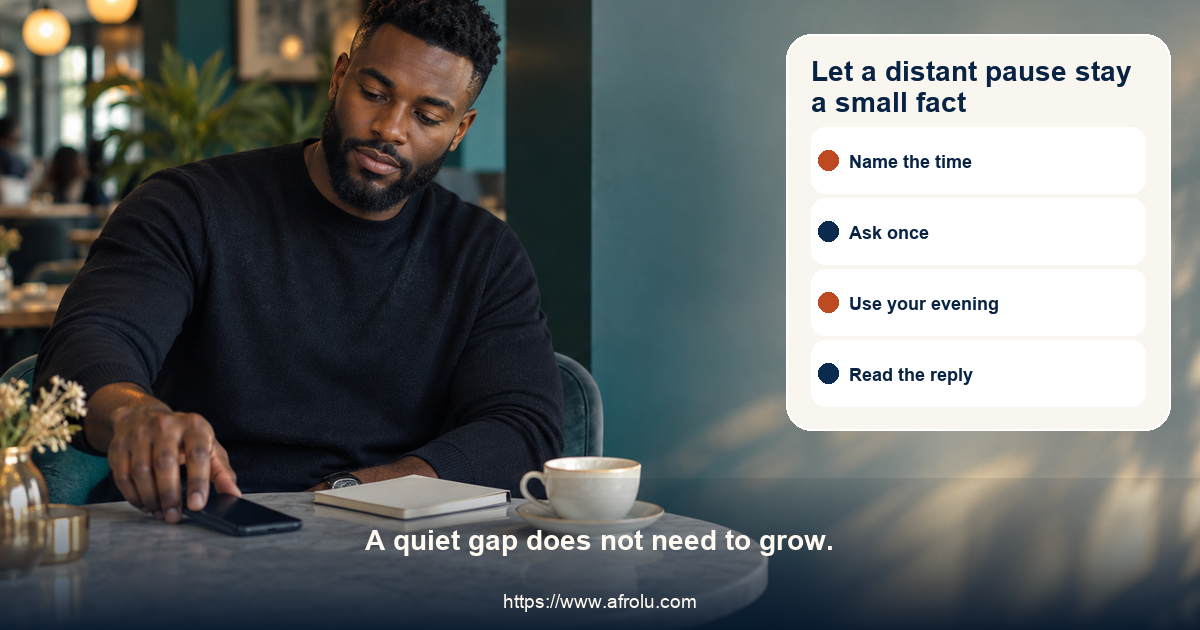
If a proposed call or conversation never becomes mutual, let the time return to your own evening. You may send one practical question if an answer changes your plan, or you may decide the silence is sufficient information. A long-distance beginning should fit alongside the relationships, routines, rest, and curiosity you already have, not consume them through waiting.
quiet gap · communication choice
A short question can clarify a distant plan without becoming pursuit
Distance can make a quiet gap feel larger because you cannot rely on ordinary shared context. It is easy to read a delayed message as a complete verdict on the connection, especially when the conversation had felt vivid. Pause before assigning meaning. The only certain fact may be that a message or planned call has not happened yet. That fact is enough to guide a proportionate next choice.
If you need to know whether a call remains on, ask directly: 'Are we still talking tonight, or should we choose another time?' The wording leaves room for a yes, a no, a reschedule, or no answer. It also keeps you from sending several messages designed to make the other person explain a life you cannot see. One usable question is often more respectful to both people than an accumulating appeal.
Read the reply by whether it creates a real next step. A warm apology without a time may be kind but cannot hold your evening. A new call becomes meaningful when it is something you can accept, decline, or adjust. If the response stays noncommittal or arrives after the moment has passed, you can release the thread without turning the distance into an investigation.
It is equally valid to make no contact. You may prefer to notice whether someone returns with a clear arrangement, or you may simply recognise that the rhythm is not for you. A low-pressure choice is not a performance of detachment. It is a decision to give your attention where it is met with enough consistency to be enjoyable.
distance · digital privacy
A far-away connection does not need closer access to your devices or routine
Digital contact can become intense quickly because messages, calls, and shared photos create the feeling of everyday closeness. That feeling may be genuine, but it does not make every request harmless. Consider what a person actually needs for the next agreed conversation. Most long-distance dating needs a channel you chose and a time to talk; it does not need a live location, a home view, a device screen, or a record of your routine.
Keep communication on a platform or method you can control until you have enough reason to change it. You can decline a request to move to a private account, send intimate material, turn on location sharing, reveal an address, or provide a code. You do not have to prove that the other person is dangerous in order to protect a detail. It remains yours because you have not chosen to offer it.
Pay attention when reassurance turns into monitoring. A person who asks why you were offline, demands immediate proof, wants screenshots, or insists on knowing exactly where you are may be seeking more control than a new connection should hold. You can say no, reduce the information available, and avoid arguing about whether their concern sounds romantic or reasonable.
If pressure continues, change the conditions rather than increasing your explanation. Limit or close the channel, block when needed, retain material only when it is safe, and tell someone you trust if the behaviour becomes persistent. A connection that respects distance will make room for your privacy. One that tries to erase it is not becoming closer in a healthy way.

A clear line can keep distance light.
future meeting · independent movement
A future visit is an invitation, not a debt created by months of messages
When a distant connection begins to discuss meeting, the anticipation can make it tempting to compress many decisions into one ambitious plan. You may feel pressure to make the occasion meaningful because it took time to arrange. Begin with what preserves choice instead: a public setting, a manageable time window, independent travel decisions, and a plan that can be shortened if your comfort changes.
You do not need to prove seriousness by agreeing to stay in a private space, share transport, or give someone control of the practical details. A person who respects you will understand that a first in-person meeting can be straightforward and bounded even after many thoughtful conversations. The point is not to distrust every possibility. It is to let comfort and consent remain current once the interaction becomes physical and local.
A message history does not create permission for touch, images, an extended visit, a private venue, spending money, or any next step you do not want. You may enjoy a conversation and still decide that meeting is not right. You may arrive and decide that the plan should be shorter. You are allowed to revise without treating the other person's preparation as a bill you must pay with access.
Be cautious if someone responds to a boundary by making you responsible for their expense, disappointment, or loneliness. Those feelings may be real, but they do not determine your next move. Keep your ability to leave central, and choose an arrangement that does not require an isolated meeting in order to honour a connection that is still becoming known.
proportion · safety
A distant silence can hurt without being a safety event; pressure and fraud require a different response
A person may lose momentum, manage their time poorly, or decide that long-distance dating does not work for them. None of those outcomes is pleasant, yet they can remain ordinary mismatch. You can let the conversation end, ask once, or decide that you prefer a different rhythm. Keeping the response proportionate protects you from living inside a distant person's silence.
The category changes when the relationship is used to open financial or digital systems. Do not lend, receive, transfer, invest, verify, or share documents for a person you are dating at a distance. A crisis story can be emotionally compelling and still leave you exposed. Use banks, service providers, or official sources for independent information rather than acting through the person asking for help.
It also changes when a person insists on access after you say no. Repeated accounts, threats, blackmail, pressure for sexual images, monitoring, or attempts to make you afraid are not evidence of devotion or a challenge to solve by communicating more gracefully. Restrict access, seek support, and use urgent help if there is immediate danger or you cannot safely disengage.
You do not need to decide whether another person is secretly good or bad before taking a protective action. It is enough that the conduct is narrowing your freedom to choose contact, privacy, money, or movement. You can end a distant conversation because it has become costly or frightening, even when you cannot explain every detail of the other person's intent.

Distance does not erase boundaries.
return after ghosting · low-pressure repair
A renewed message does not restore the old rhythm automatically
A person who returns may say that work, health, travel, family, or overwhelm interrupted them. You may believe some or all of that context, and you still do not have to decide the future in the same message. Ask whether you want to reopen the thread at all. Your present interest matters as much as the explanation for their past absence.
If you remain curious, choose an experiment with a clear limit: a short call at a time you select, a conversation about contact preferences, or a simple plan for the next week. This is not a way to make someone prove their worth. It is a way to see whether their current conduct leaves you relaxed enough to continue, rather than asking you to rebuild trust through imagination.
Do not compensate for a return by sharing more intimate material, moving to a less secure channel, promising a visit, or making yourself available at inconvenient hours. A repair that needs immediate access is not a repair that respects your choices. Trust can increase through repeated ordinary reliability, and it can remain limited if that is what the available pattern supports.
You may decide that the gap changed the connection for you. A brief close, or no reply when further contact is not useful or safe, is legitimate. Low-pressure dating includes the freedom to stop before a relationship becomes an obligation. You do not need a dramatic reason to prefer a rhythm that feels steadier and more mutual.
forward preference · adult capacity
Let the experience refine your standards without making your life smaller
Choose one practical rule for your next long-distance conversation. You might decide to agree on a check-in rhythm before investing heavily, keep calls within a time range that suits you, use a specific release point for unconfirmed plans, delay personal details, or keep any first in-person meeting public and independently organised. A usable preference protects more peace than a long post-mortem of a silent thread.
Keep the rest of your life visibly active. Continue with local friendships, interests, rest, work, and the ordinary pleasures that make you feel like yourself. A compatible distance connection should have room beside those things. It should not require you to watch a screen, reorganise sleep, or suspend your plans in hopes that a person elsewhere will finally make contact.
There is no age or timeline by which you must accept an uncomfortable arrangement in order to have a chance at connection. You can be open to an unexpected bond while remaining selective about the way it enters your days. Revising a preference after a disappointing gap is not guardedness. It is information becoming useful.
If contact includes coercion, financial pressure, threats, persistent unwanted pursuit, or fear, move toward protection rather than trying to improve the long-distance dynamic. End channels where you can, keep evidence only when safe, and seek trusted, specialist, or urgent help appropriate to your circumstances. You are allowed to protect your future without offering a final opportunity for debate.

Choose the move that protects your pace.
Eight distant-dating situations where a low-pressure rhythm protects adult capacity
A planned conversation has no confirmed time
A person says they want to talk over the weekend but never turns the idea into a real call.
Set a release point and use the evening without waiting at a screen.A new connection assumes constant availability
Messages become tense whenever you are offline for ordinary parts of your life.
Name a contact rhythm that is sustainable and see whether it is respected.Distance is used to ask for proof of where you are
A match wants screenshots, a live location, or details of your day to feel reassured.
Decline the monitoring request and reduce what is available if pressure continues.A person insists on a more private communication route
They frame moving immediately to another app or account as a test of trust.
Stay on the channel you chose until you independently want to change it.A first meeting is designed to be hard to leave
Messages turn quickly into a request for a private stay, shared travel, or an extended visit.
Choose a public, independently organised plan or do not meet yet.A distant match needs money or a digital favour
A compelling crisis asks you to transfer funds, receive a payment, or share a code.
Keep financial and account systems outside the relationship and verify independently.Silence is followed by a burst of affection
A person wants instant late-night calls and a promise to visit after being absent for days.
Choose a small next step only if it fits your current comfort.A limit is bypassed through new accounts
After you stop responding, the person continues through different profiles or contacts people around you.
Block, preserve material only if safe, and use support appropriate to the pattern.Fourteen observable signs that a long-distance rhythm is workable, vague, controlling, pressuring, or unsafe
They can agree on a realistic contact rhythm without treating every delayed reply as a personal slight.
They can confirm a call, move it early, or say they are unavailable without leaving you to guess for days.
They understand that low pressure can still include clear information and a respectful ending.
They do not demand constant replies, screenshots, location, private routines, or proof of availability.
They accept the communication channel you choose and do not turn a new platform into a test of trust.
They can talk about a future meeting without making travel, a private stay, or an extended visit the only acceptable option.
They respect independent transport, public settings, and a defined end time for any first in-person plan.
They return after a gap with a workable contact proposal instead of intensity alone.
They keep money, transfers, codes, documents, payment accounts, and investment stories outside dating.
They do not use distance, loneliness, expense, or preparation to claim more access than you offered.
They accept a no, a pause, or a reduced contact rhythm without guilt, repetition, or moral pressure.
They do not reach you through alternate profiles or people around you after you limit contact.
They leave you more able to enjoy your local life rather than more compelled to monitor a screen.
They never use threats, humiliation, blackmail, surveillance, financial pressure, coercion, or fear to keep connection.
A proportional decision map for calls, digital access, future meetings, money, returns, and safety
| Situation | What it may mean | What to do next |
|---|---|---|
| A distant call remains an idea | There is no mutual arrangement yet. | Keep the time available for your own evening until a call is confirmed. |
| You need an answer before you change plans | One practical question would give you usable information. | Ask once whether the call is still happening or should move. |
| Replies slow without a clear change | Capacity may have shifted, or the rhythm may no longer fit. | Name your preferred pace or decide that the silence is enough information. |
| A person asks for live proof or location | Reassurance has moved toward monitoring. | Decline and keep digital access more limited. |
| A new channel is framed as mandatory | The request may be trying to change your control over contact. | Stay where you are unless moving independently feels right. |
| A future meeting requires a private or hard-to-leave plan | The logistics may make a changed mind harder to act on. | Choose public, independent, reversible arrangements or decline. |
| Money or verification appears in the conversation | A relationship is being asked to carry a financial risk. | Do not transact, receive, lend, or share systems. |
| A return follows a long gap | Context may be real without showing a new pattern yet. | Choose a short, planned contact only if you want current information. |
| A limit is bypassed through another account | Your preferred level of contact is not being respected. | Restrict access and use reporting or support where useful. |
| You feel afraid or unable to disengage | The connection has become a safety issue. | Prioritise safety and seek appropriate urgent or specialist help. |
Twelve complete lines for a call, privacy, a future meeting, consent, a return, and an ending
“Are we still speaking at seven, or should we choose another time?”
“I have not heard back, so I am using the evening differently.”
“I enjoy a contact pace that is clear but not constant.”
“I am staying on this platform for now.”
“I am not sharing live location or that level of detail.”
“If we meet, I will arrange my own travel and keep the plan public.”
“I do not want to extend the plan.”
“I do not send money, receive payments, or share codes with someone I am dating.”
“I would only restart with a short call arranged in advance.”
“This contact rhythm does not work for me.”
“Do not contact me further.”
“I am stepping back and will use support if this continues.”
Know the difference
A delayed message, a distance mismatch, and a demand for control need different responses
A call is unconfirmed, someone says their capacity changed, or the two adults prefer different contact rhythms without pressure for access.
A person seeks money, passwords, tracking, sexual material, repeated contact, leverage, or control after a boundary is clear.
Keep a quiet distant thread proportionate and use stronger protection when behaviour moves toward access or fear.

Choose the response that fits the pattern.
Keep a quiet distant gap distinct from patterns that seek access or reduce freedom
| Type or dimension | What it describes | Best next question |
|---|---|---|
| Open call | A conversation has been suggested but not made mutual. | Release the time unless a clear confirmation arrives. |
| Capacity change | Someone says their availability has altered. | Decide whether the new rhythm suits you. |
| Contact mismatch | Both people may be interested but want different levels of communication. | Name your preference and observe whether it fits. |
| Quiet fade | Messages stop without a direct close. | Ask once only if the answer changes your next plan. |
| Observable return | A person offers a specific smaller contact after an absence. | Choose a short next step if it feels right. |
| Digital pressure | Privacy is treated as a problem to overcome. | Limit details, tracking, and channel access. |
| Financial request | Romance is used as a route into money or systems. | Keep transfers and verification outside the connection. |
| Boundary bypass | A stated limit is ignored through repetition or another profile. | Reduce access and preserve safety options. |
| Fear or coercion | Contact makes independent choice feel unsafe. | Seek support and urgent help appropriate to the risk. |
A simple plan you can use today
Distance needs a rhythm
A modest contact agreement can reduce guessing without creating permanent availability.
One check can be enough
A short question about a call often gives more useful information than a long theory of silence.
Digital closeness has boundaries
Messages and calls do not create a right to live location, private accounts, devices, or images.
A future meeting can stay reversible
Independent travel, public settings, and a bounded plan keep consent active once people meet.
Returns should create a new action
A smaller agreed contact can show more than a highly emotional explanation.
Safety changes the response
Financial pressure, tracking, unwanted pursuit, and fear need protection rather than better long-distance communication.
Questions organised by purpose and depth
Choose a few prompts that fit the moment. This is a reference library, not a list to complete.
Choose the rhythm
Define a distance pace that feels light rather than watchful.
- How often do I genuinely want to talk?
- What does a useful reschedule look like?
- What gap would tell me the rhythm is not a fit?
Release the call
Keep an unconfirmed conversation from taking over your evening.
- When will I stop waiting?
- What will I do instead?
- Do I need one practical answer first?
Protect digital access
Keep connection separate from tracking or device access.
- What detail is unnecessary for this stage?
- Which channel feels under my control?
- What request would make me slow down?
Plan any meeting
Make a future visit voluntary and easy to change.
- How will I travel independently?
- What setting preserves my exit?
- What would make me decline the plan?
What deserves a closer look
A simple contact agreement reduces guessing
Naming a rough time to talk or a way to reschedule can make distance easier to enjoy.
Evidence limit: It cannot guarantee continued interest.
A quiet gap is not a full diagnosis
One practical question can clarify a plan without forcing either adult to reveal every motive.
Evidence limit: It cannot make someone be reliable.
Distance does not cancel digital boundaries
Keeping location, accounts, images, and devices private preserves choice as trust develops.
Evidence limit: It is not proof that every match is unsafe.
A future visit can remain reversible
Public plans and independent movement make a changing feeling easier to act on.
Evidence limit: They cannot remove every uncertainty.
Repair can begin at a smaller scale
A short scheduled call allows present conduct to become visible without a large emotional reset.
Evidence limit: It does not obligate renewed contact.
Control is not reassurance
Money requests, tracking, threats, and repeated unwanted contact need reduced access and appropriate support.
Evidence limit: The safest action depends on local circumstances.
Shortcuts that turn distance into waiting, monitoring, pressure, or risk
Treating constant contact as proof
Availability can be intense without being compatible, respectful, or sustainable.
Keeping every evening open for a call
An unconfirmed conversation should not displace your own life.
Offering location to settle anxiety
Tracking may increase access without building genuine trust.
Making a first visit hard to leave
Private, shared, or lengthy logistics can make a changed mind costly.
Letting a return erase every boundary
Context does not require restored access, availability, or intimate disclosure.
Solving a distant financial emergency
Romance does not make money or account systems safe to share.
Use one focused resource for a contact boundary, a future meeting, or a calmer first-date question
Choose the resource that fits the next decision in front of you. A guide can help you name a preference, but it cannot promise another adult's interest or conduct.
Explore the guide library
Show more related guides
Continue with Afrolu
Show more Afrolu guides
Sources used for this guide
Afrolu reviewed these health, research, safety, or public guidance resources while editing this page. They support the behaviour and safety guidance; they do not diagnose any individual described by a reader.
Questions about ghosting in low-pressure long-distance dating for late entrants
How much contact is reasonable in low-pressure long-distance dating?
Choose a rhythm both adults can realistically sustain. The key is that pauses and changes are readable, not that either person remains constantly available.
Should I ask why a planned call did not happen?
Ask if the answer will change your next choice. A simple question about whether to reschedule is usually more useful than an investigation into the silence.
What if I prefer not to send another message?
You can let the gap stand and use your time elsewhere. No follow-up is a valid decision when you do not need more information.
Does distance mean I should share more location or routine details?
No. A distant connection can be genuine while your address, live location, accounts, routine, and device information remain private.
Can I decline a private stay or a long visit after months of messages?
Yes. Message history does not create an obligation to travel, stay privately, share transport, or accept a plan that is difficult to leave.
What should I do if someone asks for money or a code?
Keep transfers, loans, documents, payment accounts, codes, and verification outside the connection. Use official sources for any independent check.
Can a returning message be sincere?
It can be. You can acknowledge the context while deciding whether a smaller planned call or no renewed contact suits you now.
Does ghosting always mean a safety risk?
No. A quiet ending can hurt without being unsafe. Tracking, financial pressure, unwanted repeated contact, coercion, threats, and fear are different categories.
How can I know whether a contact rhythm fits me?
Notice whether it leaves you calm enough to enjoy your local life, make plans, and say no without managing someone else's reaction.
What if a boundary causes the conversation to end?
That outcome can be useful information. A compatible connection should make room for your privacy, pace, and ability to change your mind.
One thing to do now
Choose the next move that keeps a distant connection local to your own life
Choose the smallest next action that protects your time, digital privacy, independent movement, current consent, money, support network, and ability to end contact without negotiating your comfort.