Diaspora daters · Nairobi safety and clarity
Ghosting Safety for Diaspora Daters in Nairobi
Ghosting safety for diaspora daters in Nairobi: handle silence without pursuit, protect privacy and money, and know when unwanted contact needs support.
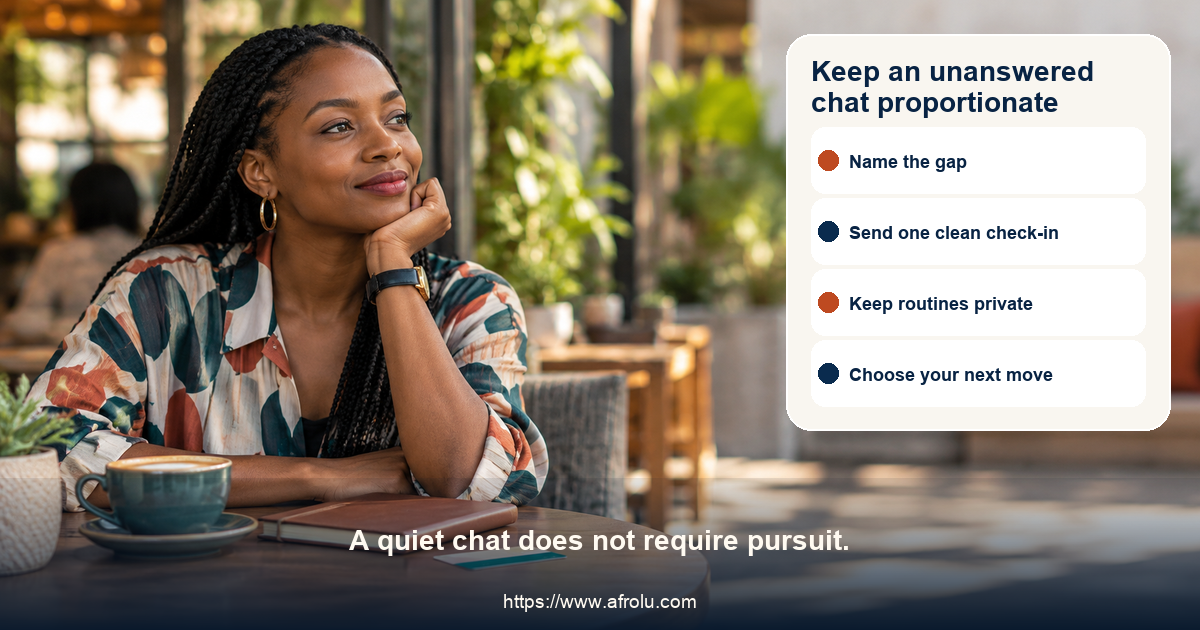
Silence is not an invitation to pursue.
Written and edited by Tariro Ncube · Diaspora Dating Editor
Ghosting can be hurtful without proving danger. Name the actual gap, use one low-pressure follow-up only if it helps, and then return to your own plans. Keep community groups, addresses, travel details, documents, codes, and money out of the search for closure. If contact becomes repeated, coercive, financially urgent, monitoring, threatening, or frightening, reduce access and seek appropriate support.
Dating behaviour · Diaspora Daters
Is this an ordinary unanswered dating conversation, a mismatch, a chance to ask once for clarity, or a pattern involving money, privacy, repeated unwanted contact, coercion, threats, or fear that deserves a more protective response?
Ghosting is an abrupt reduction or end in dating contact without a direct explanation. It is not a diagnosis, a cultural trait, or proof of bad intent. For diaspora daters in Nairobi, the useful distinction is between an unanswered chat or mismatch and conduct that narrows choice through privacy pressure, financial requests, unwanted repeated contact, monitoring, coercion, threats, or fear.
Maya has a warm coffee date in Nairobi with a match she met online, then hears nothing after one friendly follow-up. A mutual offers to find out what happened. Instead of turning a quiet chat into a community investigation, Maya keeps her route and profile private, lets the conversation close, and notices that a later return with a ticket request changes the decision completely.
diaspora daters · Nairobi safety and clarity
Maya lets an unanswered message remain small while keeping her city plan, money, and privacy under her control
This guide separates ordinary silence from conduct that makes a diaspora dater's local visibility, information, resources, consent, or safety less freely chosen.
Name the actual gap, keep a city plan reversible, use one clean follow-up, sort risk by conduct, layer private information, end without public pursuit, and choose an evidence-sized next move.
Do not investigate a quiet chat
One unanswered note is not a reason to map someone else's life.
Keep routes independent
A public Nairobi plan can be warm without giving away a private route.
Leave mutuals out
Support is useful; pressure through a network is not.
Read the behaviour
Money pressure, repeat contact, coercion, threats, and fear require less access and more support.
silence is information, not an investigation assignment
A missing reply can hurt without requiring you to chase, accuse, or map a stranger's life
Diaspora dating can make a quiet phone feel bigger than it is. A person may be balancing a new city, relatives in several places, work across time zones, a recent move, or a week that simply does not leave room for dating. None of those possibilities makes silence pleasant. They do mean that a delayed response is not a licence to build a private theory, contact people around them, or turn ordinary uncertainty into surveillance.
Begin with the part you can know. Was there a clear plan that was missed? Had you exchanged enough information to make a practical check-in appropriate? Was the last message a question, an invitation, or simply a conversation that paused? Naming the actual gap keeps disappointment from becoming a story about nationality, immigration status, culture, or a supposed rule that everyone from one community dates in the same way.
If you want to follow up, choose one direct, low-pressure message that leaves room for no reply: “I enjoyed meeting you. If you do not want to continue, a short note would help, but no pressure to respond.” Then stop. A second, third, or indirect route rarely produces the clarity you want. It usually transfers your distress into more access to someone who has not offered it.
You are allowed to decide that silence does not work for you. That is a compatibility decision, not a verdict. You can archive a chat, stop checking a profile, return to your own plans, and choose future dates who communicate in a way that suits you. The point is not to train yourself not to care. It is to keep care from becoming a reason to abandon your privacy, dignity, or freedom to leave.
let a city plan stay a city plan
Nairobi dating can be warm and local without requiring a new match to know your route, home, or network
A city can make networks feel close. A mutual contact, neighbourhood group, professional association, church, alumni chat, or diaspora gathering may create a sense that everyone can be found through someone. Treat that feeling with care. A shared connection can make a public introduction easier; it does not give either person permission to ask where someone lives, which route they take, who hosts them, or whether a friend can explain their silence.
Choose early plans that do not depend on one person revealing more than the plan needs. Meet in a venue you can leave independently, tell a trusted person a broad plan if useful, and keep transport, accommodation, money, and documents under your own control. You do not need to give a date an airport pickup, a building name, a live location, a travel schedule, or a place in a family group to prove that you are open to meeting.
Do not turn Nairobi itself into a story about risk. Many people date safely and generously in the city every day. The relevant question is practical: does this particular plan increase your ability to choose, or does it make you dependent on someone you barely know? A person may prefer a different pace or venue; that can be an ordinary mismatch. Pressure to change a safe public plan, conceal it, or surrender independent transport deserves less access.
When a person goes quiet after a proposed meeting, let the unused plan stay unused. Do not visit a workplace, ask mutuals to locate them, turn up at an event because you saw a public post, or use community channels to demand an explanation. You can be disappointed and still decline to make a local network into a search party. A date who wants another plan can make one with you directly.
use one clean follow-up, then release the outcome
Clarity is a request you can make once, not a result you can extract by persistence
It helps to separate a desire for closure from an entitlement to it. You may reasonably prefer someone to say that they are not interested, have changed their mind, or cannot continue. They may not do that. A relationship that is just beginning has not earned a right to a detailed account of another adult's schedule, health, family, identity, or private experience. A courteous message is a request, not a summons.
Use a one-message rule when the concern is an ordinary communication gap. Send a note only if it is safe and genuinely useful, then remove yourself from the loop: mute the thread, stop rereading a profile, and make another plan for the evening. Do not enlist friends to send a different message, create a new account, compare online timestamps, or use a community directory to discover where the person might be. Those actions replace clarity with intrusion.
A reply can also give useful information. A person might apologise, explain briefly, and propose a specific new plan. You can decide whether that repair works for you without asking them to prove every detail. Or they may say they are not interested. A clean no can sting, but it lets both people move on. The problem is not a person choosing incompatibility; it is a pattern that makes your choices, safety, money, privacy, or consent less free.
If you have already sent several messages, shame will not improve the situation. Stop now, do not send a final essay, and choose a calming action outside the app. The most dignified correction is often less contact, not a better explanation. If you fear that your own reaction may become unsafe or compulsive, reach out to a trusted person or local professional support rather than using the other dater as the place to settle the feeling.
separate an unanswered chat from a safety concern
Ghosting is painful; threats, coercion, repeated unwanted contact, or fear require a different category of response
The word ghosting can flatten important differences. One person may drift away after a date. Another may disappear after borrowing money, pressuring you for intimate images, demanding a travel document, or collecting personal details. A third may reappear through new accounts after you have said no. These situations do not all deserve the same script. The fact to name is not “they ghosted”; it is the behaviour that changes what you can safely do next.
Watch for conduct that makes you feel watched, cornered, or responsible for preventing a reaction: demands for live location, pressure to meet privately after a silence, threats to expose messages, repeated calls from new numbers, contact through friends, sexual image coercion, financial urgency, or unexpected approaches near places you use. A single awkward message may be a reason to clarify or disengage. Repetition, escalation, coercion, threats, or fear are reasons to reduce access and seek support.
If you believe someone may have used a dating connection to obtain money or data, do not try to recover the relationship first. Contact your bank, payment provider, platform, or another relevant official service promptly, and tell someone you trust. Do not send a further payment to unlock a refund, prove your goodwill, or resolve a story about tickets, visas, medical needs, parcels, investments, or account access. Romance does not make a risky transfer safer.
When immediate safety is a concern, use local emergency or specialist support rather than an etiquette script. Preserve messages only when it is safe to do so, review accounts from a safe device if someone may have access, and consider whether blocking or reporting could escalate a controlling situation before doing it. The aim is not to produce a perfect case file or decide what label fits. It is to regain a safe amount of privacy, movement, rest, and support.

Let conduct choose the response.
protect the information that can outlast a chat
A new connection can know enough to date you without receiving your documents, route history, money, or social graph
Diaspora life can involve information that carries unusual weight: travel dates, a temporary address, family abroad, remittance habits, residence documents, employer details, a support network, or a period of uncertainty while settling. None of these facts is proof that you are withholding affection. Decide in advance what a new match does and does not need to know. A broad answer is often enough until a relationship has earned more practical trust.
Review small digital disclosures as well as obvious ones. A boarding pass photo, work calendar, live check-in, visa conversation, payment screenshot, tagged event, background in a video call, or “helpful” location share can reveal more than you planned. It is fine to be social online. The useful habit is asking whether a person needs this detail for the next date, or whether it simply makes it easier for them to follow, pressure, or contact you later.
Keep financial requests entirely outside a new dating connection. Do not lend, receive, transfer, invest, hold, or route funds for a match; share a verification code; or open a link they send to confirm an account, ticket, delivery, or visa. A person who is genuine may be disappointed by that rule, but they can respect it. Someone who makes urgency, secrecy, or affection the reason to break it is asking you to accept a risk that belongs to them.
If silence follows a boundary around money or personal information, let that be information too. You do not need to reopen access to prove that you were not suspicious or unkind. A person who only remains when you offer data, resources, or a private route to you is not offering the kind of connection that lets you keep choosing freely. Protecting yourself is not a judgment about an entire community or any migration story.

Direct does not mean invasive.
end a quiet connection without turning it into a public event
A concise close is enough for an ordinary mismatch; increased protection is appropriate when access is being pushed or fear appears
For an ordinary ghosting experience, you may not need to send anything at all. Archive the conversation and direct your energy elsewhere. If you prefer to close it, one sentence is enough: “I am going to move on from this connection. I wish you well.” Avoid a long diagnosis of why the person disappeared. It invites you to argue about an answer that may never be satisfying and gives the other person more material to negotiate.
If someone reappears after a silence, you still have choices. You may accept a brief explanation, ask for a more dependable plan, decline to restart, or simply not reply. A sudden message does not create a debt because you once liked them. Decide from what you need now: a clear plan, a slower pace, no contact, or a more protected exit. Compatibility can change without anyone needing to be publicly shamed.
Keep community contact separate from relationship closure. Do not post a name, photograph, workplace, or migration story to force an answer or warn a group unless there is a pressing safety reason and you are using an appropriate support or reporting route. Public exposure can spread private information, invite retaliation, and make a difficult dating experience harder for everyone. Speak privately to trusted support people about what happened instead.
If the ending is followed by threats, monitoring, repeated unwanted messages, sexual blackmail, fraud, contact through others, or fear, stop treating it as a closure problem. Adjust access, use platform reporting tools, keep trusted people informed, and seek relevant local support. You can act protectively even if you are uncertain about the other person's intentions. Your safety does not depend on delivering a final perfect explanation.

Choose the move that preserves freedom.
choose the next action that leaves you freer tomorrow
Good ghosting advice should make room for ordinary disappointment and make safety action clearer when facts become more serious
Before you act, ask a few grounded questions. What has actually happened: an unanswered message, a missed public plan, a request for money, a repeated contact after no, a threat, or a feeling of fear? What do I need for the next twenty-four hours: less screen time, one clean message, a friend, a privacy check, a cancelled plan, a report, or urgent support? These questions bring the decision back to observable facts.
Also ask whether your next step creates more access for the other person than the relationship has earned. Visiting a venue, handing over a location, sending money, sharing a document, offering a ride, forwarding a code, or asking mutual contacts to intervene can make you more exposed without producing clarity. A smaller action may be stronger: wait, archive, decline, adjust a privacy setting, or tell someone you trust what feels off.
Nairobi and diaspora communities contain many different people, histories, languages, and ways of dating. Resist any advice that turns a person's origin, passport, community, gender, or visibility into a risk score. Safety comes from patterns of conduct and the options available to you, not from stereotypes. A person can be local, newly arrived, familiar, charming, or highly recommended and still need to respect the same boundaries.
The outcome you want is not a flawless explanation of another adult's silence. It is a dating life in which you can be disappointed, hopeful, curious, and direct without becoming financially exposed, digitally visible, isolated from support, pressured into intimacy, or afraid to leave. Choose the next move that keeps that future available, then allow the unanswered question to become smaller than your own life.
Eight diaspora dating moments after a quiet connection
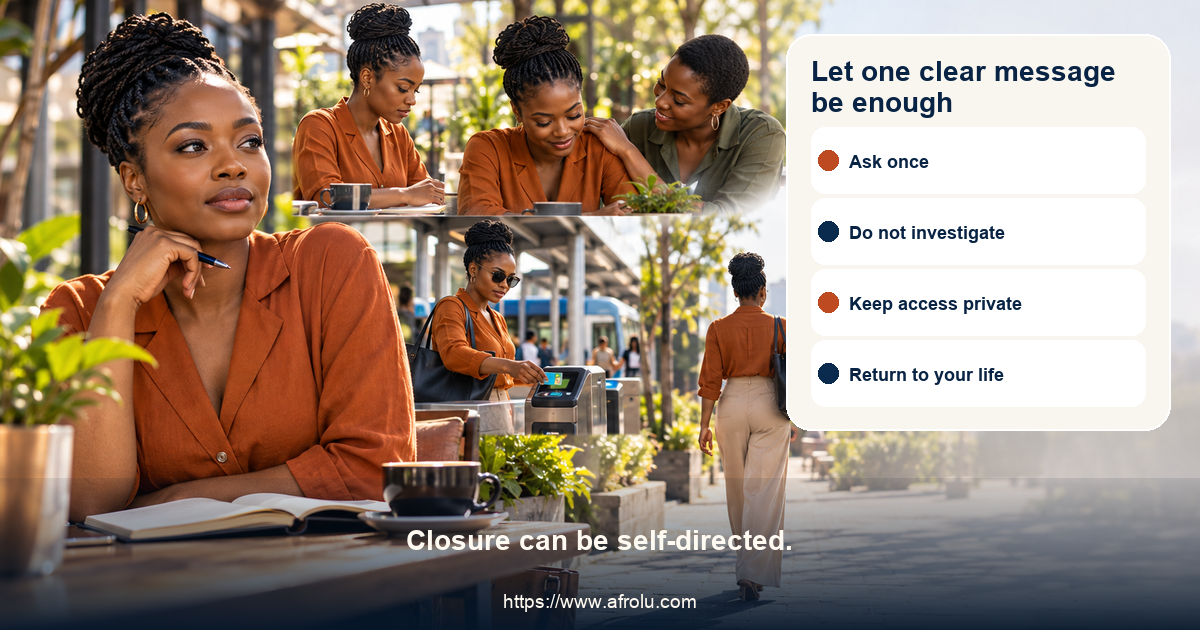
A pleasant public date has no follow-up
A diaspora dater in Nairobi exchanges a warm message after coffee, then receives no reply for several days and notices the urge to ask mutuals whether the other person is all right.
Send one optional check-in or archive the chat; do not use a local network to locate a person who has not invited contact.A weekend venue is never confirmed
A match suggests a Saturday plan, does not confirm it, and later posts publicly from another event without replying to the direct message.
Treat the plan as unused and make another arrangement rather than confronting them at the event or using the post as a location cue.A reply arrives with a specific repair
After a brief silence, a person acknowledges the missed message, offers a short explanation without oversharing, and proposes a concrete public time that you are free to decline.
Decide whether the repair and next plan work for you; an explanation is information, not an obligation to resume dating.Silence follows a financial boundary
A long-distance match becomes quiet after being told you do not send transfers, then returns with a story about a ticket and asks for help through a new payment app.
Do not send or receive funds, codes, or documents; use official financial or platform help if you suspect fraud.A mutual contact is asked to intervene
Someone who stopped replying is mentioned in a shared community group, and a friend offers to ask why they have not answered you.
Decline the intervention and keep a dating disappointment out of group pressure or public speculation.A reappearing match wants an address
A person who vanished before a public plan reappears and says they want to make it up to you by picking you up from home or meeting where you work.
Keep any restart public and independent, or decline it; do not exchange a quiet chat for a private route to you.A clear ending is bypassed
After you say you are moving on, the person contacts you through another profile and asks mutuals to tell you that they deserve one final conversation.
Do not restart the closure debate; preserve concerning contact if safe, block routes that are useful to block, and seek support if it continues.Messages become threatening
An online dater sends repeated unwanted messages, refers to places you visit, and says they will expose private conversations if you do not meet.
Move from dating etiquette to safety planning, trusted support, platform reporting, and urgent local help if you feel at risk.Signals about contact, community, privacy, money, consent, and safety
They can let an unanswered message remain unanswered without recruiting mutual contacts or community spaces to pursue you.
They make public plans with independent transport and do not treat home, work, travel, or accommodation details as proof of trust.
They accept that a broad account of diaspora life is enough until you choose to share more personal information.
They do not ask for documents, codes, account screens, remittance help, travel records, or financial transfers in a dating connection.
They can say they are no longer interested, or they can be quiet, without a later demand that you repair their choice for them.
They do not make a community, nationality, passport, faith group, or mutual contact into a route around a boundary.
They respect a public venue, a separate arrival, and a decision to leave without asking for a private explanation.
They do not use a return after silence to demand a home pickup, a live location, intimate images, money, or instant forgiveness.
They accept a no to a date, a call, a late-night plan, a document request, or an online connection without repeated bargaining.
They do not monitor public posts, turn up at events, or use friends and relatives to learn your routine after contact has ended.
They understand that a good date can still be an incompatibility and do not turn disappointment into accusation or public gossip.
They keep consent current and do not treat prior warmth, travel, a meal, or silence as permission for physical or digital access.
They do not create urgency around tickets, visas, emergencies, investments, recovery links, or a secret payment route.
They leave you able to protect your privacy, return to support, rest, and choose distance if the connection no longer feels right.
Choose a proportionate next move
| Situation | What it may mean | What to do next |
|---|---|---|
| One message is unanswered | A conversation may have paused, or a person may be choosing not to continue. | Wait, send one low-pressure check-in only if useful, then stop pursuing the answer. |
| A confirmed public plan is missed | A missed plan deserves practical information, not a search of a person's life. | Treat the plan as cancelled and decide whether a later repair is enough for you. |
| A match posts publicly while ignoring a message | A public post does not create an invitation to confront, visit, or contact them through others. | Archive the chat and make your next social plan independent of their response. |
| They return after silence | A return can be a repair attempt, a casual reconnection, or a request that does not suit you. | Ask for one clear plan, choose a slower restart, or decline without apology. |
| They ask for money or a code | Urgent financial or account requests can create serious fraud and privacy risk. | Keep money and account access separate; use an official service if you suspect a scam. |
| They want a home pickup after going quiet | A generous-sounding offer can increase access and reduce your ability to leave. | Keep transport independent and meet publicly only if you genuinely want to meet. |
| A mutual contact offers to investigate | Community familiarity can make a private dating situation more visible and more pressuring. | Thank them, decline the intervention, and keep the issue between you and your own support. |
| They contact you through new accounts | Repeated contact after a boundary can move beyond ordinary dating disappointment. | Reduce access, document safely if needed, report relevant accounts, and seek support. |
| They threaten exposure or appear near your routine | Threats, monitoring, or fear change the priority from clarity to safety. | Use a protected exit and urgent local support rather than another relationship conversation. |
| You want an explanation before moving on | Closure can be desirable, but pursuing it can keep the other person in control of your attention. | Choose a self-directed ending action that does not require a reply. |
Twelve lines for follow-up, privacy, money, restarting, and ending
“I enjoyed meeting you. If you do not want to continue, a short note would help; no pressure to reply.”
“I am going to move on from this connection. I wish you well.”
“I meet early dates at the venue and make my own way there and back.”
“I do not share my home or work location at this stage.”
“Please do not contact them on my behalf. I will leave this where it is.”
“I do not send, receive, lend, or move money in a dating connection.”
“I do not share codes, account access, tickets, or personal documents with someone I am dating.”
“If we reconnect, I need a specific public plan and a pace that works for me.”
“I do not want to reopen this connection. Please respect that.”
“I am not agreeing to that, even though we had been getting along.”
“Do not contact me through friends or new accounts.”
“I am not discussing this further. I am taking steps to protect my privacy.”
Know the difference
A quiet chat, a repair, a mismatch, pressure, and fear need different diaspora dating responses
A person may reply late, explain briefly, propose a public plan, decline politely, or let a chat end without using your community, money, information, or movement as a route to more access.
Financial urgency, document or location requests, mutual-contact pursuit, repeat accounts, monitoring, coercion, threats, blackmail, and fear turn a quiet connection into a reason for more protection.
The relevant evidence is conduct and freedom, not a stereotype or a theory about why someone went quiet.

Name the behaviour before the label.
Separate silence, repair, mismatch, pressure, and fear
| Type or dimension | What it describes | Best next question |
|---|---|---|
| A delayed reply | A person responds later without demanding that you excuse everything or offer extra access. | Decide whether the communication rhythm works for you. |
| An unanswered message | No reply may be a quiet end, but it is not a reason to track or confront someone. | Use one optional check-in or let the chat close. |
| A repair | A missed plan is acknowledged and replaced with a specific, public, mutually convenient option. | Observe the new plan before increasing trust. |
| A vague return | A person returns after silence with flirtation but no accountability or practical plan. | Ask once for clarity, slow down, or decline the reopening. |
| A community shortcut | Mutuals are asked to locate, persuade, or explain another adult's silence. | Keep the network out of private dating pursuit. |
| A money story | A quiet or distant connection becomes a reason for tickets, transfers, codes, or investment requests. | Do not transact; use independent official help if fraud is suspected. |
| A privacy breach | Location, documents, routines, or contacts are requested as a test of seriousness. | Layer information and retain independent movement. |
| Repeated unwanted contact | New accounts, mutuals, or locations are used after a person has said no or stopped engaging. | Reduce access, preserve safe evidence, and seek support. |
| A safety concern | Threats, coercion, stalking behaviours, blackmail, or fear appear. | Use a safety-led response and urgent assistance when needed. |
Handle a quiet chat without turning it into pursuit
Name the gap precisely
An unanswered note, a missed plan, a financial request, and a threat are different facts with different responses.
Keep a one-message ceiling
One respectful check-in can express your preference without turning uncertainty into pursuit.
Make city plans reversible
Independent arrival, public venues, and limited location sharing preserve freedom in a new connection.
Keep community separate
Mutual groups can offer support without being used to find, pressure, or expose a date.
Layer diaspora information
Travel, documents, remittances, family locations, and support networks can stay private until sharing is truly useful.
Escalate for behaviour, not silence
Move toward safety support when coercion, monitoring, repeated unwanted contact, fraud, or fear enter the picture.
Questions organised by purpose and depth
Choose a few prompts that fit the moment. This is a reference library, not a list to complete.
Name the fact
Use concrete language before deciding what the silence means.
- What exactly was unanswered or missed?
- What evidence do I actually have?
- What story am I adding because I feel hurt?
Choose contact
Decide whether one clean message would help or whether less contact is stronger.
- Would one low-pressure check-in reflect my values?
- What will I do if there is no reply?
- Which routes of contact will I not use?
Protect access
Check whether the next move gives a new match more private information than the relationship needs.
- Do they need this location or document for the plan?
- Can I arrive and leave independently?
- Would a trusted person know enough to support me?
Escalate wisely
Use behaviour, not a label, to decide when support is needed.
- Has contact become repeated, coercive, threatening, or frightening?
- Which account, payment, or privacy step is safe today?
- Who can help without exposing more information?
Look more closely at contact, city plans, diaspora privacy, money, returns, and escalation
How to handle one unanswered note
A single optional check-in can state your preference, after which you can archive the conversation and stop pursuing a response.
Evidence limit: Do not use new accounts, mutuals, or public posts to keep the conversation alive.
How to keep Nairobi dates reversible
Choose venues, transport, and timing that do not require a match to know your home, workplace, accommodation, or exact route.
Evidence limit: A public plan cannot guarantee safety; leave if the plan stops feeling freely chosen.
How to share context without handing over a dossier
Offer broad facts about your life rather than documents, travel dates, remittance habits, family locations, or identifiers that a new connection does not need.
Evidence limit: Privacy is not an accusation against someone or a community.
How to respond to a romantic money story
Keep transfers, investment pitches, tickets, codes, and account recovery requests out of dating and use official services when a transaction worries you.
Evidence limit: Do not send another payment to prove trust or obtain a refund.
How to choose whether to restart
Ask whether the person can offer a clear, public, low-pressure next plan and whether that is actually what you want now.
Evidence limit: You do not owe access because the first connection felt promising.
How to recognise when this is no longer a ghosting problem
Repeated unwanted contact, monitoring, threats, coercion, blackmail, fraud, or fear call for reduced access and relevant safety support.
Evidence limit: Choose actions that are safe for your situation rather than confronting a person alone.
Shortcuts that make a quiet connection more invasive
Making silence a cultural diagnosis
A missing reply does not prove anything about a person's nationality, migration story, language, or community.
Using mutuals as investigators
Community pressure can expose private information and bypass another adult's choice not to continue.
Treating public posts as invitations
A visible event or photo does not make it appropriate to confront, visit, or locate a quiet match.
Trading privacy for reassurance
A home address, document, code, or live location rarely produces the clarity a new connection lacks.
Calling every disappointment danger
Ordinary incompatibility and risky behaviour require different levels of response.
Waiting for perfect closure
A self-directed ending often restores more peace than another attempt to extract an explanation.
Choose one resource that fits the behaviour in front of you
Use a ghosting guide for an ordinary communication gap, a boundary resource when a person asks for more access, or an online-safety route when the pattern is changing your freedom to move or communicate.
Explore the guide library
Show more related guides
Continue with Afrolu
Show more Afrolu guides
Sources used for this guide
Afrolu reviewed these health, research, safety, or public guidance resources while editing this page. They support the behaviour and safety guidance; they do not diagnose any individual described by a reader.
Questions about ghosting safety for diaspora daters in Nairobi
Is one unanswered message ghosting?
It may be a quiet end or a simple delay, but one gap alone rarely tells you enough to explain another person. Choose a proportionate response rather than a theory.
Should I send a second message after being ghosted?
If you want to express a preference, one low-pressure follow-up is enough. Repeated messages tend to create more distress and access, not more reliable clarity.
What if we have mutual friends in Nairobi?
Do not ask them to locate, persuade, or explain the person. Use friends for your own support while keeping the dating situation private.
Does a public post mean they are deliberately ignoring me?
Not necessarily. A public post is not evidence that you should confront them, attend their event, or contact them through another route.
Can I decline someone who returns after months of silence?
Yes. A return is not a debt. You can ask for a clear plan, choose a slow restart, or decide that you no longer want the connection.
Why should I keep money separate if the person went quiet?
Financial urgency, codes, documents, transfers, and investment requests can create risk regardless of how affectionate or apologetic the story sounds.
Is it unfair to protect my address and travel details?
No. Early dating does not require a home address, work route, accommodation, documents, or live location. Share only what the next plan needs.
When does ghosting become a safety issue?
It becomes a different problem when repeated unwanted contact, monitoring, threats, coercion, blackmail, fraud, or fear appear. Reduce access and seek support.
Should I name them publicly to get closure?
Public exposure can spread private information and invite escalation. For ordinary hurt, use trusted private support; for harm, use appropriate reporting or safety channels.
How can I stop checking their profile?
Mute or archive the thread, remove notification cues, make an offline plan, and tell someone you trust that you are redirecting your attention away from the unanswered chat.
One thing to do now
Let the unanswered question become smaller than your own life
Choose the smallest next action that preserves directness, community privacy, independent movement, money and data boundaries, current consent, support, and a genuine ability to stop or leave.