The first-meeting arrival runway
Meet a Serious Long-Distance Match Without Making the Date an Exam
A calm first-meeting plan for adult students dating across distance: travel, nerves, study time, identity, money, consent and the journey home.
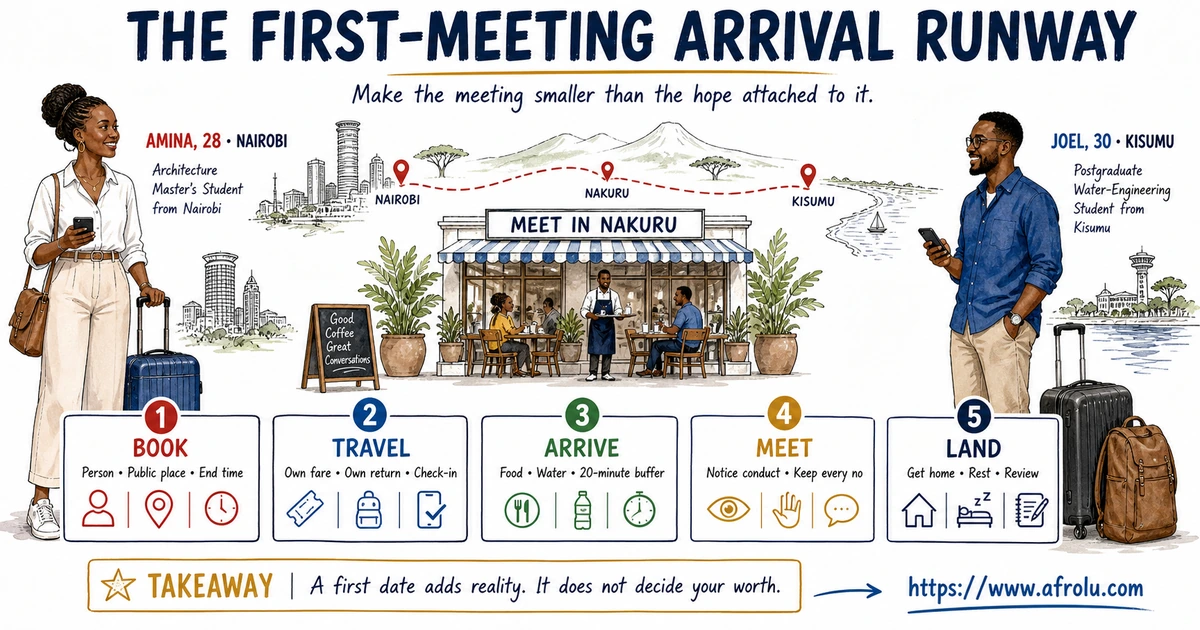
Book a verified public plan, keep travel independent, allow an arrival buffer, notice conduct and review only after both adults are home.
Written and edited by Nia Kato · Profile Advice Editor
Make the meeting smaller than the hope attached to it. Before anyone books, confirm the person, public venue, date, cost ceiling, independent transport or lodging, check-in, and end time. Put lectures, assignments, sleep, medication, food, and the return journey into the plan; exhaustion can make a normal first conversation much harder. On arrival, give both adults 20 minutes to orient, order, and become present before grading chemistry. If your body feels loud, describe the sensation, name the feared prediction, check the facts around you, and choose one small reset. Do not use calming techniques to explain away a changed identity story, money request, private-venue pressure, unwanted touch, blocked transport, or anger at a no. Serious intent, months of calls, travel cost, and a gift create no right to a room, more time, sex, documents, or commitment. After both adults are home, separate facts, feelings, compatibility, and the next step. Ordinary nerves may settle as the date becomes real; incompatibility can be respectful; danger requires distance and support. Persistent anxiety that disrupts study, relationships, or daily life belongs with a qualified health professional, not a dating checklist.
First dates · Students
How can two adult students make a long-awaited first date feel manageable without ignoring incompatibility, pressure, or a real safety concern?
First-date anxiety is the worry, self-consciousness, or physical activation an adult may notice before or during a first meeting. This guide uses the phrase for an everyday experience; it does not diagnose social anxiety disorder or any other condition. Serious long-distance dating means the adults have named a committed direction or are intentionally assessing one while ordinary in-person access is limited. Neither seriousness nor distance proves compatibility. Anxiety is an internal experience, practical overload comes from conditions such as hunger or a long journey, incompatibility is an honest mismatch, and danger is supported by observable conduct such as deception, coercion, threats, or interference with choice.
Amina is 28 and completing an architecture master's degree in Nairobi. Joel is 30 and doing postgraduate water-engineering research in Kisumu. After four months of video calls, they agree that they are dating seriously enough to meet, but not so seriously that the first date must decide a future. Nakuru gives each an independent route and avoids turning either residence into the venue. They choose a staffed daytime cafe, pay their own fares, keep a two-hour window, and each sends one arrival and departure message to a trusted friend. Amina's bus is late. By the time she arrives, her hands are warm, her stomach is tight, and her mind is rehearsing an apology for ruining the day. Joel does not turn the delay into a test. He agrees to keep the original end time because Amina needs to review studio work that evening. They ask for a quieter table, order food, and let the first few minutes be ordinary. Amina names that she needs a moment to settle; Joel says he is nervous too without asking her to reassure him. Later, he suggests a longer walk. She declines because of the return bus, and he accepts the answer once. The date is not cinematic. It is warm, a little uneven, and useful. Only after both are home do they compare what they learned. Their best evidence is not that every nerve disappeared. It is that lateness, silence, a study deadline, and a no could all fit inside the meeting without punishment.
Four instruments for the arrival
Read the plan, the body, the person, and the exit separately
Months of remote conversation can make one meeting carry an entire imagined relationship. Four separate readings stop a loud feeling from becoming the only evidence.
Ask one question in each column before continuing, adjusting, or leaving. No column cancels another: a good plan cannot excuse bad conduct, and a nervous body does not automatically make a respectful person unsafe.
Is the meeting specific and reversible?
Confirm person, public place, time, spending limit, independent journey, check-in, and return before either adult leaves.
What sensation and condition are present?
Notice heat, pulse, stomach, breath, fatigue, hunger, noise, and travel load without turning the first explanation into a fact.
What are they actually doing now?
Observe patience, curiosity, consistency, boundaries, spending, and response to a changed plan instead of comparing them with a screen-built ideal.
Can either adult shorten or end freely?
Keep phone, money, documents, transport, lodging, consent, and the end time under individual control throughout the date.
Checkpoint one: reduce avoidable uncertainty
Confirm eight facts before either student spends or travels
Confirm the person through consistent ordinary contact; the exact day and city; a staffed public first venue; the expected duration; the spending ceiling; each adult's transport and lodging where needed; one limited check-in; and the route home. A video call or profile badge adds information but cannot prove every claim. Recurring identity contradictions deserve a pause before a ticket, transfer, or visit.
Put both academic calendars beside the date. Mark classes, placements, work, prayer, medication, care duties, assignments, and the next morning's obligations. A first meeting does not become more serious because an adult abandons essential work. A shorter date with a clear ending usually gives two nervous people more usable choice than a full day whose success depends on constant energy.
Keep travel funds separate from tuition, rent, food, study tools, and the safe return. Do not send fare, booking, device, visa, hospital, customs, investment, or emergency money because the meeting feels emotionally important. If a genuine plan changes, verify it through a channel and provider you found independently. A smaller or later meeting is better evidence than a pressured rescue.

Confirm the person, staffed public meeting, essential-money boundary and return before hope becomes a payment.
Checkpoint two: protect the journey
Build an arrival buffer so travel strain does not grade the connection
A long journey can add an early start, traffic, unfamiliar streets, hunger, heat, noise, motion sickness, delayed transport, and worry about the trip home. Those conditions can make attention and conversation harder. Plan time to use a restroom, eat, hydrate, charge a device, check the return, and orient to the venue before the emotional work of meeting.
Each adult controls their own ticket, identity document, medication, device, money, and return. Share enough information for a trusted check-in without sending live access to every movement. If lodging is required, keep it independently booked and do not make a new date's room or residence the only fallback. Fatigue should never remove the ability to leave.
Agree in advance that a major delay may shorten or move the date without becoming proof of weak interest. When Amina's bus is late, Joel's useful response is not a grand rescue. He confirms that she is safe, accepts the original end time, and lets her arrive without an emotional debt. Flexible planning is one of the first pieces of in-person compatibility evidence.

Care makes room for arrival: accept a delay, keep the end time, meet physical needs, ask one real question and review after the journey home.
Checkpoint three: let two adults arrive
Use the first 20 minutes for orientation, not a chemistry verdict
Remote familiarity and physical familiarity are different. Voice, pace, height, eye contact, movement, silence, scent, and shared space all arrive at once. Begin with a simple task: find the table, order, notice the room, and exchange one ordinary detail about the journey. A briefly awkward opening is not a reliable summary of attraction or compatibility.
If the body feels loud, describe the sensation in plain words: warm face, tight stomach, fast pulse, dry mouth, restless legs, or a blank mind. Then name the prediction separately: 'I will have nothing to say' or 'They will think the pause means rejection.' Check the observable facts. Choose one small action such as water, feet on the floor, a quieter seat, a gentle unforced breath, or a short restroom pause. The goal is a little more choice, not perfect calm.
Move attention outward with one real detail, one follow-up, and one proportionate story of your own. Naming mild nerves can lower the performance load: 'I take a few minutes to settle after travel.' No one owes a diagnosis or private history. The other person's response matters. Patience and ordinary warmth are useful; ridicule, interrogation, unwanted rescuing, or using a disclosure to demand access are useful for a different reason.

Clear words can set a public plan, name travel strain, protect study time, keep travel independent and end venue pressure.
Checkpoint four: keep evidence outside the breathing exercise
Do not calm yourself past a changed identity, a pressured no, or a blocked exit
Anxiety often speaks in broad forecasts about performance. A present safety concern has conduct attached: the person does not match important identity details, pushes a private venue, asks for money or codes, controls transport, demands a residence address, takes a device, pressures alcohol, touches after a no, follows, threatens, or makes departure harder. Regulation cannot make those facts acceptable. Move toward staff or other people, contact trusted support, and use your own exit.
Consent is specific, current, and capable of changing. Months of calls, a serious label, exclusivity, travel expense, food, a gift, an earlier kiss, or shared hope creates no later yes. Meeting in person does not agree to a ride, room, images, sex, an overnight stay, or a second date. You may leave without proving hidden intent or offering a clinically calm explanation.
Incompatibility is different from danger. Two respectful adults may discover that their study rhythms, religion, relationship pace, physical preferences, family plans, or future cities do not fit. Neither person has to become unsafe for the date to end. A clear mismatch can be disappointing and still be handled with dignity, separate transport, and no attempt to bargain someone out of a boundary.
Checkpoint five: land before deciding
Wait until both adults are home, then sort facts, feelings, fit, and the next step
Close the practical loop first. Confirm safe arrival where that was agreed, charge devices, eat, rest, and return to the work that was protected. Do not demand an immediate relationship verdict from a bus, station, airport, or exhausted bedroom. A delayed answer after travel is not automatically a mixed signal.
Use four columns. Facts record what was observable: the plan, punctuality, questions, boundaries, spending, warmth, repair, and return. Feelings record nervousness, ease, attraction, disappointment, or uncertainty without treating emotion as proof. Fit asks whether study lives, pace, values, and in-person behaviour could work. Next step chooses one proportionate action.
The action may be a second public date, another video call before travel, a slower rhythm, a direct compatibility conversation, professional support for persistent anxiety, or a clear ending. Review the whole meeting instead of making its most awkward ten seconds the official history. One date is evidence, not a final examination of either adult's worth.

Get home, eat, rest and return to study. Then separate observable facts, feelings, compatibility and one proportionate next step.
Four moments when nerves, study, distance, and safety need different answers
Travel strain makes Amina feel as if she has already failed
The bus delay is real and her body is activated, but identity, venue, return, and Joel's conduct remain consistent.
Keep the original end time, eat, orient, and let the first 20 minutes provide new information.A warm date still needs to end before studio work
Joel would enjoy a longer walk; Amina needs the planned return and evening review block.
Treat the deadline as a real limit, not a rejection test. A second plan can be discussed after both are home.A new account asks for money before the meeting
The message uses familiar details but changes the payment channel and demands immediate action.
Transfer nothing. Verify through the established contact and the transport provider independently.One adult treats the long journey as a reason to move the date indoors
The public date is ending, but the invitation becomes pressure after the other adult declines.
Use the independent return, move toward people or staff, and seek appropriate support if departure is challenged.Six signs the first meeting preserves warmth and adult choice
The person, city, public venue, timing, cost, and return remain consistent before travel.
Both academic schedules can change the meeting without becoming loyalty tests.
Each adult controls money, ticket, lodging, documents, device, medication, and route home.
A pause, quiet moment, smaller plan, or request for a different seat is received without ridicule.
A no to more time, alcohol, touch, a room, images, or a second date is accepted once and fully.
After the meeting, both can discuss facts and fit without turning nerves or travel cost into a debt.
Match the response to the source of the discomfort
| Situation | What it may mean | What to do next |
|---|---|---|
| Your heart is fast before leaving, but the plan is confirmed and curiosity remains. | Ordinary anticipation may be arriving before any in-person evidence. | Shrink the goal to arriving, orienting, and completing the first agreed interval. You may still postpone or cancel. |
| The journey leaves you hungry, late, overstimulated, or exhausted. | Travel load may be reducing your ability to think and connect. | Eat, hydrate, find a quieter place, keep the original end time, or reschedule rather than grading chemistry inside overload. |
| Conversation is respectful, but your future city or study priorities do not fit. | This may be honest incompatibility rather than danger or a failure to relax. | Name the mismatch, avoid a sacrifice promise, and choose whether another conversation would add useful facts. |
| A name, photo, relationship-status claim, or travel story changes materially. | There may be confusion, concealment, impersonation, or another identity risk. | Do not move privately, transfer money, share documents, or surrender transport while the contradiction remains. |
| The date presses alcohol, touch, a room, more time, or a ride after you decline. | This is a boundary and consent problem, not an anxiety exercise. | End or distance the interaction, move toward people or staff, and use trusted, venue, platform, or emergency support as appropriate. |
| You replay one pause or sentence after arriving home. | Arousal and self-criticism may be editing the whole meeting around one detail. | Write neutral facts, feelings, fit, and one next step. Delay the overall verdict until rest returns. |
Five lines for the plan, arrival, study time, travel, and exit
“I want our first meeting to be public and about two hours. We can extend only if we both choose it in the moment.”
“The journey took more out of me than expected. I need food and a few quiet minutes before we decide how the date feels.”
“I am enjoying this and I am still leaving at the agreed time so I can finish my work tonight.”
“We each control our fare, lodging, documents, device, money, and return. I do not send emergency transfers.”
“I said no to changing the venue. I am ending the date now and leaving by my own route.”
Know the difference
Ordinary first-date nerves or a present unsafe signal?
The fear often centres on performance: silence, blushing, rejection, awkwardness, or not matching the online connection. The plan remains verifiable, curiosity can still exist, and the other adult accepts limits.
The concern attaches to conduct: identity contradiction, isolation, money or document requests, anger at a no, unwanted touch, monitoring, threats, or interference with transport and departure.
A body sensation deserves care. Observable pressure deserves action. You may leave while the distinction is still unclear.

Ordinary nerves may coexist with curiosity and accepted limits. Identity, money, consent or exit pressure requires action outside self-calming.
Separate nerves, overload, incompatibility, commitment, pressure, and danger
| Type or dimension | What it describes | Best next question |
|---|---|---|
| Ordinary first-date nerves | Anticipatory worry or body activation around novelty, evaluation, attraction, and uncertainty. | Can a smaller, public, reversible plan leave enough room to choose? |
| Travel overload | Fatigue, hunger, noise, delay, heat, unfamiliarity, or a difficult return reduces capacity. | Which physical or environmental condition can be changed before judging the connection? |
| Incompatibility | Two honest adult needs, values, schedules, physical preferences, or future plans do not fit. | Would another conversation add facts, or is a respectful ending already clear? |
| Serious long-distance dating | The adults name a committed direction while in-person compatibility and a practical future are still being tested. | What did this meeting show that calls could not show? |
| Boundary pressure | A request becomes guilt, bargaining, repetition, or punishment after a limit is stated. | Can the boundary be enforced from a public place with an independent exit? |
| Present danger | Deception, threats, stalking, coercion, unwanted contact, financial abuse, or blocked choice requires a safety response. | Which immediate distance, support, reporting, financial, legal, or emergency action fits the facts? |
Use the five-checkpoint arrival runway
Confirm eight facts
Person, date, city, public place, duration, budget, independent journey, and check-in should exist before travel.
Protect an arrival buffer
Leave room for food, water, rest, medication, orientation, and a delay without extending the original end time.
Use the 20-minute rule
Let both adults arrive before making a chemistry verdict, while keeping the safety override active from the first minute.
Read conduct outside the body
A sensation is internal; identity, money, consent, pressure, and departure behaviour are observable evidence.
Land before deciding
After safe return and rest, separate facts, feelings, fit, and one next step instead of replaying the loudest moment.
Questions for booking, arrival, and the journey home
Choose a few prompts that fit the moment. This is a reference library, not a list to complete.
Before either adult books
Answer practical questions before hope becomes a payment.
- Which identity details are consistent, and which important fact still needs checking?
- Where is the staffed public venue, and what is the natural end time?
- Who controls each fare, booking, document, device, lodging choice, and return?
- Which study, work, health, care, faith, or sleep commitments must remain protected?
During arrival and the date
Use these to separate conditions, feelings, and conduct.
- Am I hungry, tired, late, overheated, overstimulated, or worried about the route home?
- What sensation do I notice, and what prediction has my mind attached to it?
- What is this person actually doing when a plan changes or I state a limit?
- Can I pause, shorten, move publicly, or leave without depending on them?
After both adults are home
Review one meeting without making it the whole relationship.
- Which neutral facts show warmth, consistency, curiosity, boundaries, and repair?
- Which feeling belongs to travel or novelty, and which concern attaches to conduct?
- What did in-person time reveal about study rhythm, values, attraction, pace, and future location?
- Is the next step another public date, a call, a slower pace, support, or a clear ending?
Four ways a long-awaited date can become harder than necessary
Making the trip a relationship examination
One meeting can add important reality, but it cannot settle every future, compatibility, trust, or location question.
Grading chemistry inside travel overload
Hunger, fatigue, noise, delay, and return worry can crowd attention. Change the condition before treating it as the person.
Using alcohol as the only bridge
It can reduce useful judgment, complicate transport and consent, and interact with medication; individual advice belongs with a qualified professional.
Explaining away observable pressure as anxiety
Identity conflict, money requests, unwanted touch, anger at a no, and blocked exits require a response outside self-calming.
Use a reviewed resource that matches the decision
This guide focuses on the relationship decision, so it does not rank dating apps. Check current prices, safety tools, and local availability before choosing a service.
Explore the guide library
Show more related guides
Continue with Afrolu
Show more Afrolu guides
Sources behind the anxiety, interaction, consent, and fraud notes
Afrolu reviewed these health, research, safety, or public guidance resources while editing this page. They support the behaviour and safety guidance; they do not diagnose any individual described by a reader.
Long-Distance Student First-Date Anxiety: Questions
Is it normal to feel nervous before meeting a long-distance partner?
Many adults feel nervous when remote familiarity becomes an in-person meeting. Novelty, evaluation, attraction, travel, and serious hope can all raise activation. Occasional nerves are not automatically a disorder or a safety warning.
Should I cancel the first date because my body feels anxious?
The feeling does not dictate one answer. Check identity, venue, money, transport, exits, curiosity, and the person's response to limits. You may shorten, postpone, or decline for any reason; observable pressure or deception calls for a safety response.
How long should a first meeting after long-distance dating last?
There is no universal duration. A contained public plan with a natural endpoint can lower pressure. Two hours may suit Amina and Joel; another pair may need less. Extending is optional and must be mutual.
Should we meet halfway for the first date?
A halfway city can distribute travel and keep both residences private, but only when the venue, routes, cost, timing, and safe returns work for both adults. Equal distance is not automatically equal burden.
Should adult students share fare or lodging costs?
Only through a voluntary, affordable, verifiable plan. Protect tuition, rent, food, study tools, and return money. Neither adult should depend on a new match for the only booking, room, document, account, or route home.
What if the first few minutes feel awkward?
Let both adults orient before making a verdict. Order, settle, and ask one simple present-tense question. A pause may reflect travel or novelty. Continued disrespect, one-sidedness, or exhaustion after adjustment is still useful information.
How do I tell ordinary nerves from a danger signal?
Ordinary nerves often centre on performance and uncertainty. Danger may attach to identity contradictions, money or document requests, isolation, unwanted touch, anger at no, threats, following, or interference with departure. The distinction is imperfect, and you may leave while unsure.
Does serious intent mean we should stay together or have sex?
No. Serious intent, exclusivity, travel cost, gifts, food, lodging, and earlier affection do not create current consent. Time, venue, touch, sex, an overnight stay, and another date are separate choices.
How can I stop replaying the date afterwards?
Wait until you are safely home, fed, and rested. Write observable facts, feelings, compatibility questions, and one next action. Avoid treating one pause, reply delay, or awkward sentence as a complete judgment of the meeting.
When should I seek professional help for dating anxiety?
Consider qualified local support when anxiety is persistent, difficult to cope with, repeatedly blocks wanted activities, or affects study, work, relationships, or daily life. New or medically concerning physical symptoms also deserve appropriate healthcare assessment.
One thing to do now
Let the meeting add reality without taking away choice
Shrink a safe plan when uncertainty or ordinary nerves are high. Adjust food, rest, noise, timing, or pace when the body is overloaded. Discuss a respectful mismatch as compatibility information. End the meeting and seek appropriate support when identity deception, money pressure, isolation, threats, surveillance, unwanted touch, or a blocked exit removes free choice.