Five stops for one small weekend meeting with usable exits
Handle First-Date Anxiety with a Clear Student Weekend Plan
Plan an adult student weekend first date with clear facts, body support, public logistics, privacy, money, consent, exit scripts and a calm review.

Calm enough is a plan, not a promise to feel no nerves.
Written and edited by Nia Kato · Profile Advice Editor
Walk five stops. Check only the identity and venue facts the meeting needs. Support the body with ordinary food, rest, comfort and travel margin without demanding perfect calm. Seal a staffed public, time-bounded plan with independent phone, fare, payment and return. Keep student records, residence and live location private. Prepare short sentences for place, budget, pause, touch and leaving. Sort nerves, unknowns, mismatch and danger before responding. A paid meal, confirmation or warm conversation grants no consent. After rest, review factual consistency, fit and boundary response, then continue with one public date, revise the envelope or close.
First dates · Students
How can an adult student turn first-date anxiety into a small, clear weekend plan without treating every feeling as danger or dismissing material risk as nerves?
A clear weekend first-date plan for an anxious adult student is one bounded meeting organised through five stops: facts, body, logistics, permission and review. The calm loop aims for enough information and agency, not a symptom-free performance, and keeps privacy, essential money and departure independent.
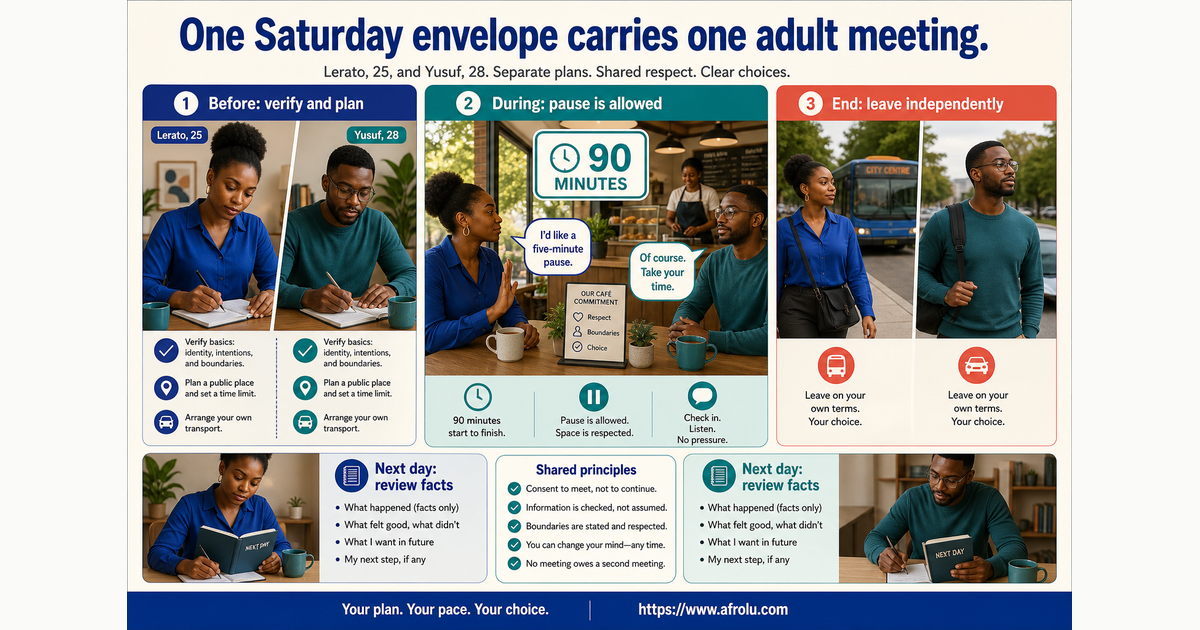
Lerato and Yusuf are fictional adult postgraduate students, 25 and 28. They plan a ninety-minute Saturday café date with separate transport and payment. Lerato attends while nervous because the envelope is complete. During the date she requests a five-minute pause; Yusuf respects it. They leave separately, and she chooses one public second date after a next-day factual review.
The five-stop weekend calm loop
Make one first date small enough for facts and choice to remain audible
Nia separates body activation, necessary information, a complete plan, present permission and next-day review for adult students.
The loop uses five stops, a ninety-minute envelope and a four-category signal sorter without diagnosing anxiety or promising perfect safety.
Facts and body
Check what matters and support ordinary capacity without a performance test.
Public plan
Seal place, time, transport, money, communication and support.
Current permission
Keep every yes, no, pause and exit specific and changeable.
Review
After rest, choose one next step from facts, fit and conduct.
Make the question smaller than the feeling
First-date nerves are information, not a verdict about the date
A weekend first date can arrive after lectures, assignments, placements, paid work, travel and a week of messaging. The body may respond with a fast heartbeat, tight stomach, restless thoughts or an urge to cancel. Those sensations matter, but do not by themselves reveal whether the match is safe, compatible or interested. Ask what category of information is actually present before assigning meaning.
Nerves describe body activation. Unknowns are unanswered questions or unverified logistics. Mismatch is a difference in preference, intention, conversation or attraction. Danger involves observable conduct or conditions such as threats, coercion, serious contradictions, trapping, stalking or inability to leave. A feeling can lead to a check, pause or plan change; facts and behaviour determine which response is proportionate.
Clarity does not mean eliminating uncertainty. A first date cannot establish the entire relationship. It needs enough information for one bounded adult meeting: who you reasonably believe you are meeting, where, for how long, how you will pay and travel, which boundaries matter and how you will leave. A complete small plan often gives the nervous system fewer open tasks, even if butterflies remain.
This guide is for adult students only. It is educational, not diagnosis, treatment or crisis care. If anxiety is severe, persistent or interferes with study and daily life, a qualified health professional can help. If there is immediate danger, leave when possible and use current local emergency support. Dating advice should never be used to override clinical needs, personal consent or material safety evidence.
Walk the five-stop calm loop
Facts, body, plan, permission and review each need one small task
At the facts stop, check the identity and logistics necessary for the meeting. Compare profile and conversation for basic consistency, use an in-app call if helpful and identify the venue independently. Do not send identity documents or turn curiosity into intrusive investigation. If a material contradiction affects the plan, pause or cancel. If the unknown is ordinary—what you will talk about—allow the date itself to provide information.
At the body stop, use ordinary supports that already suit you: eat, hydrate, sleep, reduce unnecessary rushing, wear something physically comfortable and arrive with time. A brief grounding exercise may help some people, but it is not a test or cure. Avoid using alcohol or another substance as courage. If prescribed treatment is involved, follow qualified medical guidance rather than a dating page.
At the plan stop, choose a staffed public place, a ninety-minute envelope, affordable spending and independent transport. Keep phone, fare and payment usable. A trusted person may know the broad plan and receive one agreed check-in. The match does not need residence, class schedule, student record or continuous location. A weekend calendar should still leave study, work and recovery possible.
At permission and review, remember that attending does not promise touch, another venue, a ride, a second date or continued messaging. Every yes can change. After leaving, let the body settle before grading the encounter. Review facts: Were limits respected? Did conversation travel both ways? Did the plan work? What do you actually want next? Choose one small answer rather than a lifetime prediction.
Lerato and Yusuf use one Saturday envelope
A respectful pause becomes better evidence than a perfectly calm performance
Lerato, 25, and Yusuf, 28, are fictional postgraduate students who have messaged for ten days. They choose a staffed café near a busy transport connection for Saturday afternoon. The date is planned for ninety minutes. Each controls fare and payment; Lerato tells a trusted friend the broad plan. Neither shares a residence, detailed class schedule or live location with the other.
On Saturday morning Lerato feels restless and imagines several awkward outcomes. She checks the loop. Facts are consistent enough for the plan. Her body is activated, so she eats, walks briefly and allows extra travel time. The public venue, phone, budget and return are complete. She decides to attend while keeping permission to leave. This is not proof that every worry was irrational; it is a proportionate answer to present evidence.
Halfway through the date Yusuf asks whether she wants to move to a quieter venue. Lerato says, ‘I want to stay here, and I need five minutes to reset.’ Yusuf accepts, gets water and does not press for an explanation. They resume, finish near the planned time and depart separately. Lerato does not owe a second location because the conversation was warm; Yusuf does not treat her pause as rejection.
The next day Lerato reviews: the plan worked, Yusuf respected the boundary, both asked questions and she wants another public date. She proposes a weekend daytime walk with the same independent transport. She does not conclude that Yusuf is a future partner or that anxiety has been cured. One date produced one next-step answer and useful conduct evidence.
Sort the signal before choosing the move
Nerves, unknowns, mismatch and danger should never share one response
For nerves, reduce open tasks and support the body. Confirm the envelope, prepare one opening question and remember the date can be short. You may still cancel. Do not force yourself through overwhelming distress to prove courage. When nervousness is persistent or impairing beyond this date, seek qualified support; a checklist cannot assess or treat an anxiety disorder.
For an unknown, identify the smallest check. Ask the meeting time, confirm the venue, use an in-app call or verify a material claim through an independent source. Decide whether the information is necessary now. You do not need to know a stranger's entire history, student record or residence. Excessive checking can create new privacy risks without making the first date predictable.
For mismatch, accept that two safe adults may not fit. Conversation style, spending, time, relationship direction, faith, substance use or physical preferences may differ. You can decline another date without proving wrongdoing. A brief answer protects both people better than inventing danger or agreeing from guilt. Attraction and compatibility are not moral grades.
For danger, prioritise leaving and support. Threats, forced movement, blocked exits, stalking, violence, serious identity contradiction, intoxication that compromises capacity or retaliation after a no are not butterflies to breathe through. Move toward staff or other people, contact a trusted person and use current emergency services when needed. Preserve evidence later if safe and relevant; immediate protection comes first.

Name the category before choosing the response.
Carry six sentences instead of a perfect script
Clarity can sound simple, warm and slightly nervous
Plan the meeting directly: ‘I prefer this staffed public café on Saturday from two until three-thirty.’ The sentence answers place and time without revealing a residence or full weekend schedule. If the match proposes a private or unfamiliar alternative, repeat the public plan or decline. A respectful response is useful evidence before either adult travels.
Protect budget: ‘I am keeping this date affordable and will pay my own way.’ Adult students may have limited funds, and a first date should not compete with tuition, food, rent or return fare. A gift or paid meal creates no obligation. Do not send device, transport, fee or emergency money to a new match. Contact the provider promptly if a suspicious transfer occurred.
Use a pause sentence: ‘I want five minutes and I am staying in this public place.’ The other person does not need a diagnosis or full explanation. A pause may lead to continuing, changing the plan or leaving. Consent stays current. A previous yes, strong messaging, a paid meal or limited weekend time does not authorise touch, images, recording or another venue.
End according to the evidence: ‘I enjoyed meeting you and do not want another date,’ or ‘This plan no longer feels safe, so I am leaving.’ The first is mismatch; the second is protection. Do not soften a safety decision to protect a stranger's feelings. If contact continues after a clear no, block access where appropriate and seek support suited to the conduct.

A usable sentence is part of the plan, even if the voice shakes.
Seal the weekend date envelope
Identity, public place, time, transport, money and support should all be usable
Check only what matters for this meeting. Use the platform's features and compare ordinary consistency. Identify the venue through its current public information; do not follow a last-minute private pin without understanding the change. Do not exchange identity documents. If verification remains materially incomplete, reschedule or cancel rather than paying for a service the match supplies.
Choose ninety minutes as an example, not a universal rule. A time box provides a natural end and protects the rest of the weekend. Either adult can leave sooner or extend by mutual choice when the plan remains safe and desired. Build enough travel margin that lateness does not create panic, and avoid scheduling immediately before an exam, shift or last transport option.
Keep transport, phone, money and return independent. A trusted person may know the broad plan and receive one check-in. Do not post live location publicly or give a new match continuous tracking. Preserve essential study funds. Romance scams can use fare, devices, fees, emergencies or investments; send no money to prove interest.
Know the immediate support route for the location. The Kenyan DCI page reviewed here lists its hotline and police emergency numbers 999, 911 and 112; check current official information when needed. Staff, trusted people, medical services or other local resources may be appropriate depending on the situation. A dating page cannot know present conditions or replace emergency judgment.

Prepare the exit before asking the body to settle.
Review after the body has had time to settle
Continue, revise or close from facts, fit, consent and practical impact
Continue when the plan worked, identity information remained consistent, conversation and curiosity travelled both ways and boundaries received respect. Choose one next step: another public date, a different activity or one relationship-intention question. Keep home, money, exclusivity, sex, private images and detailed schedules behind separate permissions. One pleasant afternoon cannot support every expansion.
Revise when interest exists but the plan created unnecessary strain. Change one element: a quieter public venue, shorter duration, daytime slot, lower-cost activity or clearer confirmation. If nerves obscured what you wanted, wait before answering. Revision should make the next envelope more usable; it should not require the other adult to manage your emotions or provide constant reassurance.
Close when attraction or fit is absent, the timing does not work or you simply do not want another date. A short message is sufficient. Close more protectively when boundaries, identity, money or safety became concerning. Do not meet privately to explain. Remove access, preserve useful evidence if appropriate and tell a trusted person when contact is persistent or threatening.
Seek qualified mental-health support when anxiety is persistent, severe or interfering with school, work or daily life. NIMH information reviewed here distinguishes occasional anxiety from anxiety disorders at a broad level; it cannot diagnose an individual. The first-date framework remains intentionally small: facts, body, plan, permission and review, with professional and emergency support outside the loop whenever the situation requires it.
Eight adult student weekend moments where the signal category changes the move
Butterflies appear before a complete plan
The facts and logistics are consistent, but an adult student still feels activated.
Support the body and keep permission to cancel or attend.A public café becomes a private pin
The match sends a last-minute location that is hard to identify independently.
Keep the original public plan or cancel.A record is requested to verify identity
A match asks for a student card, timetable or institution login before meeting.
Decline document exchange and use proportionate checks.An expensive venue becomes an interest test
Limited funds are mocked and a paid meal is framed as creating obligation.
Choose an affordable alternative or leave.Five minutes receives respect
One adult asks to remain in place and reset; the other accepts without interrogation.
Record the respectful response as useful evidence.The date is safe but conversation does not connect
Neither person behaves badly, yet one adult does not want another meeting.
Decline without inventing a red flag.The plan becomes materially unsafe
A match resists departure, pressures another venue or takes control of transport.
Move toward support, leave and use emergency help if needed.One second-date answer emerges
After rest, the adult compares facts, fit, boundary response and study impact.
Continue, revise or close with one proportionate choice.Evidence that a nervous first date still preserves clarity and choice
{'label': 'Facts', 'title': 'Necessary identity and venue details are consistent', 'detail': 'The plan does not depend on a private document exchange or mystery pin.', 'reading': 'Ready enough to choose'}
{'label': 'Body', 'title': 'Nerves are acknowledged without becoming the judge', 'detail': 'Ordinary support and permission to leave remain available.', 'reading': 'Self-support'}
{'label': 'Place', 'title': 'The meeting is staffed and public', 'detail': 'A private alternative is never required as proof of trust.', 'reading': 'Practical option'}
{'label': 'Time', 'title': 'The date has clear edges', 'detail': 'Study, work, travel and recovery remain possible afterward.', 'reading': 'Bounded plan'}
{'label': 'Money', 'title': 'Cost stays affordable and independent', 'detail': 'No gift, fare or payment creates obligation.', 'reading': 'Financial choice'}
{'label': 'Privacy', 'title': 'Residence and study systems stay protected', 'detail': 'No timetable, ID, account or live-location access is demanded.', 'reading': 'Proportionate information'}
{'label': 'Conversation', 'title': 'Curiosity travels both ways', 'detail': 'Neither adult must perform continuously or reveal everything.', 'reading': 'Possible fit'}
{'label': 'Pause', 'title': 'A boundary receives calm respect', 'detail': 'No guilt, mockery or retaliation follows a changed answer.', 'reading': 'Consent evidence'}
{'label': 'Exit', 'title': 'Either adult can leave independently', 'detail': 'Phone, transport, funds and route remain usable.', 'reading': 'Practical agency'}
{'label': 'Review', 'title': 'The decision waits for actual information', 'detail': 'One date becomes one next-step answer, not a self-worth grade.', 'reading': 'Clear proportion'}
Choose the next step from the five-stop calm loop
| Situation | What it may mean | What to do next |
|---|---|---|
Scripts for place, time, budget, privacy, pauses and endings
“I prefer this staffed public café and will not switch to a private location.”
“I can meet Saturday from two until three-thirty, and I will leave then.”
“I am keeping the date affordable and will handle my own payment and fare.”
“I share broad availability, not my residence, timetable, student records or live location.”
“I need five minutes and want to stay in this public place.”
“Please ask before physical contact; my answer can change during the date.”
“I am not going to the second location; we can finish here.”
“I am leaving now. Do not follow or contact me further.”
“Thank you for meeting; I do not want to continue romantically.”
“I would like another public daytime date with the same independent travel plan.”
Know the difference
The five-card weekend first-date sorter

Sort the finding before deciding whether to support, ask, decline or leave.
Compare nerves, unknowns, mismatch, danger and permission
| Type or dimension | What it describes | Best next question |
|---|---|---|
| Ordinary nerves | ||
| Persistent anxiety | ||
| Unknown fact | ||
| Preference mismatch | ||
| Boundary test | ||
| Immediate risk | ||
| Current consent | ||
| Second-date choice |
Build a weekend first-date envelope in six moves
Sort the signal
Support the body
Complete six pockets
Carry clear language
Observe boundary response
Review after rest
Questions organised by signal, plan, permission and review
Choose a few prompts that fit the moment. This is a reference library, not a list to complete.
Signal questions
Separate sensation, information, fit and safety.
- What is my body doing?
- Which fact is missing?
- Is this a preference mismatch?
- What conduct is observable?
- Do I need immediate help?
Plan questions
Seal one small weekend envelope.
- Is the venue identifiable?
- What is the time box?
- Who controls transport?
- Are phone and fare ready?
- Who knows the broad plan?
Permission questions
Keep every step current and reversible.
- Do I want to attend?
- May the plan change?
- Can I pause here?
- Do I want this touch?
- Can I leave now?
Review questions
Grade the evidence, not the person or performance.
- Were details consistent?
- Did curiosity travel both ways?
- Was my no respected?
- Did the plan protect study and money?
- What one step do I want next?
What official health, privacy and safety guidance can support
Occasional anxiety and anxiety disorders are not the same
The U.S. National Institute of Mental Health explains that anxiety can be a normal part of life, while anxiety disorders involve more persistent and impairing patterns. Afrolu does not diagnose from first-date nerves.
Evidence limit: The source is general U.S. health information and cannot assess an individual or provide treatment.
Practical stress-management exercises can be learned without promising zero distress
The World Health Organization's illustrated guide offers stress-management techniques for broad use. This page borrows only the modest idea of supporting attention and body while keeping medical care separate.
Evidence limit: A self-help guide does not replace diagnosis, therapy, medication guidance or crisis care.
Purpose and necessity encourage smaller information requests
Kenya's Data Protection Act includes principles related to lawful, purpose-specific and necessary processing. In adult dating, the cautious parallel is to protect records, residence and detailed routines.
Evidence limit: The Act has defined scope and exemptions; this page does not determine legal coverage.
Remote rapport can be followed by fare, device or emergency stories
The U.S. Federal Trade Commission describes romance scams that build trust and then request money. Protect essential student funds and contact the provider promptly after suspected loss.
Evidence limit: FTC reporting routes are U.S.-specific; use suitable local and provider channels.
A paid date, earlier yes or second venue never replaces a current answer
NHS public-health guidance describes active and withdrawable consent. Afrolu applies the principle to touch, sex, images and recording throughout the date.
Evidence limit: The source explains UK context; laws and support services vary by location.
Current official local channels matter when risk is immediate
The Kenyan Directorate of Criminal Investigations page reviewed here lists its hotline and police emergency numbers 999, 911 and 112. Check official information at the time of need.
Evidence limit: Numbers and service routing can change; use the immediate local support appropriate to present danger.
Six shortcuts that turn one first date into an examination
Use a reviewed resource that matches the decision
This guide focuses on the relationship decision, so it does not rank dating apps. Check current prices, safety tools, and local availability before choosing a service.
Explore the guide library
Show more related guides
Continue with Afrolu
Show more Afrolu guides
Official guidance used for this weekend calm loop
Afrolu reviewed these health, research, safety, or public guidance resources while editing this page. They support the behaviour and safety guidance; they do not diagnose any individual described by a reader.
First-date anxiety and weekend clarity questions for adult students
Is it normal to feel anxious before a first date?
Many people feel occasional anxiety about social situations, school, work or relationships. A nervous body does not by itself prove the date is dangerous or wrong. Sort what else is present and build a complete small plan. Persistent or impairing anxiety deserves qualified health support rather than self-diagnosis from a checklist.
How do I know whether it is nerves or a real warning sign?
Nerves are body activation. A warning needs observable information or conduct: serious contradictions, threats, coercion, blocked exits, stalking, intoxication affecting capacity or retaliation after a no. If uncertain, pause and check the smallest necessary fact. If danger is immediate, leave and seek support.
What is a good weekend first-date length for adult students?
There is no universal duration. Ninety minutes is a planning example that creates a natural edge while protecting travel, study and recovery. Either adult may leave sooner or extend by mutual choice. Avoid plans that end after safe transport or communication options disappear.
Should I share my student ID or timetable to verify myself?
No. Do not exchange IDs, records, logins or detailed schedules with a new match as trust proof. Use proportionate platform and conversation checks and identify the venue independently. Broad availability is usually enough. Protect credentials immediately if they were exposed.
Can I cancel even after confirming the date?
Yes. Confirmation is not a duty to attend. Send a concise cancellation when safe and practical; you do not owe private reasons. If the response becomes threatening or persistent, stop explaining, block access where appropriate and seek support suited to the conduct.
Should I drink alcohol to feel less nervous?
Do not rely on alcohol or another substance as courage. It can affect judgment and consent and may interact with health conditions or medication. Choose a plan you can attend as yourself. Follow qualified medical advice for treatment questions; this page cannot advise on medication or substance use.
What if I need a pause during the date?
Say what you need: remain in the public place, take five minutes, call someone or leave. You do not need to disclose a diagnosis. A respectful date accepts the pause without ridicule or pressure. If choice is obstructed, move toward staff or other support and use emergency help if needed.
Does paying for the date create an obligation?
No. A meal, ticket, ride or gift does not create consent, a second venue or another date. Keep essential student money and return fare controlled. Avoid transfers to a new match. If suspicious money was sent, contact the provider promptly and secure related accounts.
How soon should I decide about a second date?
You may answer during the date, after rest or not at all if safety requires no contact. Review factual consistency, conversation, boundary response, attraction, values and practical impact. One good date supports one modest next step, not exclusivity, home access or a relationship guarantee.
When should first-date anxiety get professional help?
Consider qualified support when anxiety is persistent, severe, worsening or interfering with school, work, relationships or daily activities. A clinician can assess context and options. Use immediate local crisis or emergency services for present danger or risk of harm; a dating guide is not crisis care.
One thing to do now
Let one complete date produce one next-step answer
Sort the signal first. Support ordinary nerves; ask or verify a necessary unknown; accept a compatibility mismatch; and leave or seek help for material danger. Continue when the plan and boundaries work, revise one logistics element when interest remains, or close without grading yourself. Persistent or impairing anxiety belongs with qualified health support outside the dating loop.