Adult students · casual scope and free choice
Casual Dating Red Flags for Adult Students: Keep Your Choice
Casual dating red flags for adult students: separate awkward moments from pressure, protect study time, money and consent, and choose a safe next step today.
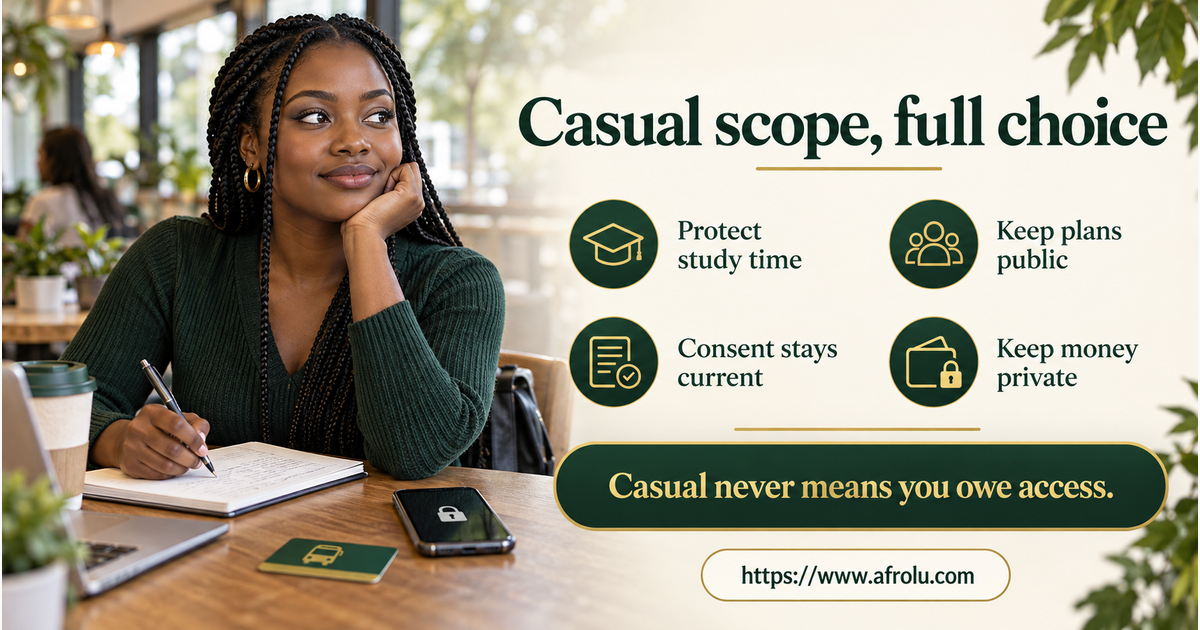
Casual can be light without making your choices smaller.
Written and edited by Grace Mutiso · Kenya Guides Editor
Treat casual dating as a lighter agreement, not lower-accountability access. Read the pattern around study time, public plans, consent, money, devices, images, and endings. Name one clear boundary, then judge the response and follow-through. A repeated demand, location pressure, financial request, image coercion, unwanted contact, or fear deserves reduced access and a safety response rather than more explanation.
Dating safety · Students
Is this casual connection leaving both adults free and informed, or is it using pressure, access, money, monitoring, or fear to make your life smaller?
Casual dating is a mutually chosen, lighter relationship scope. A red flag is an observed behaviour that changes what access is safe to give, such as repeated pressure, retaliation after a no, monitoring, financial leverage, coercion, threats, or unwanted contact. Neither term is a diagnosis or a substitute for immediate local support when someone feels unsafe.
Amani likes the lightness of a new connection until their study time, transport, phone, and answers start being treated as proof of interest. They stop trying to decode every message, name one boundary, keep dates public and exits independent, and watch the response. The result is useful whether the connection becomes kinder, reveals a mismatch, or needs to end.
adult students · casual scope and free choice
Amani keeps a casual connection from becoming a claim on study, privacy, money, or consent
This guide separates normal dating friction from behaviour that makes an adult student's ordinary life, body, time, or exit less free.
Name the scope, record the pattern, protect study and routines, keep consent current, separate money and devices, choose a risk-matched ending, and review the next level of access.
Light is not unaccountable
Casual needs present consent, privacy, and room for a clean no.
Read the response
What follows your boundary matters more than a persuasive excuse.
Keep it yours
Protect transport, money, accounts, images, routines, and study time.
Choose proportionately
Clarify a mismatch; reduce access and seek support when fear enters.
Casual does not mean careless
Start by separating a light agreement from low-accountability access
Casual dating can mean different things to different adults: occasional dates, an intentionally non-exclusive connection, a sexual relationship without a future commitment, or simply early exploration. None of those meanings supplies an agreement by itself. It is worth naming what matters now: whether either person is dating others, how plans are made or cancelled, what information is private, how sexual-health decisions are discussed, whether sleep and study time are protected, and how either person can stop without being punished.
A red flag is not a personality diagnosis or a reason to turn one awkward text into a prosecution. It is an observed behaviour that changes what access is safe to give. One late reply may be a busy day. A repeated demand for immediate replies, location proof, private-room access, money, passwords, photos, or sex after a no changes the situation. The task is to preserve choice while the evidence is still clear, rather than to collect enough proof to make another adult agree with your conclusion.
Begin with the smallest useful boundary. Amani can say that study hours are not dating hours, that plans need confirmation, and that a no to sex, photos, a ride, or an overnight stay is complete. A caring casual partner may have a different preference, but can still respond with an alternative or a clean ending. If a boundary brings ridicule, repeated bargaining, surveillance, threats, or fear, the issue is no longer how casual the arrangement is. It is how to reduce access and seek appropriate support.
Being an adult student does not create a duty to be endlessly flexible because someone else calls a connection casual. You can want companionship and still keep your routines intact. The most useful standard is practical: after a date or a boundary conversation, do you have more room to think, sleep, study, and choose, or are you spending more energy managing another person's reaction? That answer helps decide whether to continue, slow down, or leave.
Read a sequence, not a single embarrassing moment
Use four questions to tell ordinary friction from a pattern that narrows choice
Four columns can keep a reader out of mind-reading: the observable action, the practical impact, the answer given when it was named, and the next action you control. For example: 'They asked for a live location after I said I was studying; I felt watched and stopped concentrating; when I declined, they called repeatedly; I will silence the thread, keep my location private, and tell one trusted person.' This does not label the other person. It makes the boundary and safety response usable.
Look especially carefully at reversals. Someone may call a request harmless, then become angry when the answer is no. They may describe jealousy as care, insist that availability proves interest, or frame a private meeting as the only way to be spontaneous. Warmth before a boundary does not erase pressure after it. A respectful person can be disappointed, ask a direct question once, and still leave room for a genuine no, a counteroffer, or an end.
Do not turn the evidence ledger into a private investigation. There is no need to search their accounts, ask classmates to monitor them, or trade screenshots through a friend group to earn permission to leave. Preserve only what is relevant if you feel unsafe or need to report a platform issue. Otherwise, the point of noticing a pattern is to choose a proportionate next move: clarify, slow down, reduce access, end contact, block, document, or seek support.
Facts also protect fairness. If a person reschedules once, says why in broad terms, and offers a practical alternative, that is different from a recurring pattern of pressure. If your body feels tense but you cannot yet name the reason, you can still choose a public plan, take more time, or decline. The article does not ask you to trust every feeling as proof. It asks you to treat your safety, time, and freedom as enough reason to choose carefully.
Protect study, rest, and ordinary routines from becoming dating tests
A connection should fit around an adult student's life; it should not make coursework, sleep, or friendship feel like betrayal.
A repeated request to skip class, abandon a study session, or isolate from friends deserves attention because it changes the cost of access. So does a person who turns up uninvited near a lecture, shared residence, work shift, or routine route. Public proximity is not automatic permission to approach. If an encounter feels unsafe, choose a staffed public place, contact a trusted person or appropriate local support, and avoid a private confrontation designed to convince the other person to behave.
Keep educational and workplace systems separate from dating. Do not share timetable links, student portal access, library accounts, passwords, assessment drafts, device passcodes, or a location-sharing setting because a casual partner asks. If you choose to share broad availability, a simple statement is enough: 'I am not free until Sunday afternoon.' You do not owe proof, a screenshot, a live map, or the details of who you are with.
The reverse is true too. A study deadline is not a license to disappear after making plans or to keep someone on standby. A respectful low-capacity message can be short: 'I cannot meet this week, and I do not want to leave you guessing. I will reach out after my deadline if I still have room to date.' Clear limits make casual dating kinder for both people because neither is asked to infer a relationship from silence.
A person who likes you may want more time than you have. That is a compatibility question, not an emergency you must solve by overextending yourself. Try one sustainable rhythm and review the effect. If it gives both adults enough clarity and ease, keep it. If it produces resentment, secrecy, sleep loss, or repeated last-minute demands, let the information stand. A different availability is not automatically a moral failure; it can simply mean the arrangement is not workable.

Read the response to your boundary, not the excuse alone.
Keep consent current when the connection is casual
Past chemistry, a previous yes, a ride, a drink, or an earlier overnight stay does not decide the next answer.
Casual agreements may include sexual-health conversations, but those conversations need to be voluntary and specific. Adults can discuss testing, barriers, contraception, other partners, and what information is relevant to their own informed choice. No one owes medical records, photographs, proof of sexual history, or an answer under pressure. A person who treats a question, a pause, or a boundary as an insult is giving information about how they handle another adult's autonomy.
Alcohol, exhaustion, and late-night logistics can make a decision feel harder to revise. Build exit choices before the moment becomes complicated: meet in a public place when you are getting to know someone, retain control of your phone and transport, keep enough money or charge to leave, and tell a trusted person a broad plan if that helps. These are not accusations against every date. They are practical ways to make a change of mind possible.
If someone ignores a no, threatens, pressures for sexual images, uses images to bargain, or makes you afraid to leave, do not make safety depend on another private conversation. Preserve relevant evidence when safe, use platform reporting or blocking tools, and contact trusted, specialist, emergency, health, legal, or local support appropriate to the circumstances. A dating guide cannot assess immediate danger, and a label such as casual should never minimise it.
You never have to prove that someone intended harm before choosing a safer setting or asking for help. You can leave because you are uncomfortable, because the plan no longer suits you, or because another adult's response makes choice feel less free. The distinction between an awkward moment and coercion matters for how you describe what happened, but it should not become a barrier to protecting yourself. A good safety plan makes room for uncertainty and still preserves an exit.

A clear no can be short and still protect choice.
Keep money, digital access, and public identity outside the bargain
An offer can be generous; it cannot purchase more access, silence a boundary, or create a debt of affection.
Adult students can be targeted through apparently small requests: an urgent transfer, a mobile-money account, a verification code, an investment tip, a device loan, an accommodation contribution, or a request to receive funds for someone else. A compelling story is not a reason to act immediately. Keep your financial accounts, one-time codes, identity documents, and logins private. An online connection that asks for money or access before trust is established should be slowed down and independently checked, not rescued.
Digital boundaries matter even when no money is involved. Do not share device passcodes, cloud accounts, course portals, location history, private image folders, or access to an account in the name of transparency. A person can know you without being able to monitor you. Repeated requests for proof, demands to remove friends, fake accounts, unwanted calls, or threats to share content are not ordinary dating confusion; they can be part of technology-facilitated abuse and deserve a stronger response.
If you have already sent money or shared access, shame is not a useful next step. Contact the relevant bank, provider, platform, or account service promptly; change passwords from a safer device where needed; and ask a trusted person or appropriate specialist support to help you plan. Avoid paying more, meeting privately, or sending further material to make the pressure stop. The goal is to restore control, not to win an argument about intent.
Financial and digital boundaries can be stated before there is any problem: no transfers, no borrowing, no account use, no passwords, no verification codes, and no pressure to move a conversation through an unsafe channel. A compatible person can hear that rule without turning it into a test of trust. If they cannot, the disagreement has already answered an important question about what the connection would cost you. You do not need to negotiate safety into existence.
Choose an ending that matches the level of risk
Most casual connections can end with a short direct message; safety concerns may require less contact, not a better explanation.
When the issue involves repeated pressure but not immediate danger, reduce openings for negotiation. Send a short written boundary if doing so feels safe, stop sharing location or routine details, avoid meeting privately to explain, and ask a trusted person to know the broad situation. Blocking is not cruel when it is needed to protect attention, privacy, or peace. You do not need to keep a communication channel open to prove that your boundary is reasonable.
When there are threats, stalking, unwanted attendance at your routine places, image-based abuse, coercion, or fear, focus on safety over etiquette. Preserve relevant records if it is safe to do so, review account and location-sharing settings, contact platform or local services as appropriate, and seek urgent help if there is immediate danger. The practical response will vary by country and circumstance; a general guide cannot replace a local safety plan.
A clean ending also includes your own recovery. Tell one trusted person what happened without circulating another person's private information unnecessarily. Restore the routines that make you feel like yourself: study, sleep, movement, friendship, work, and time away from the thread. The lesson is not that casual dating is unsafe. It is that lightness is only light when both adults remain free, informed, and able to leave.
Sometimes the urge to reopen a conversation comes from missing the promise of what it might have been, not from evidence that the present offer is safe or suitable. Give yourself time before responding to a late apology or a new invitation. You can ask what has changed, request a public plan, or decide not to revisit it at all. Closure does not require you to remain reachable. Your attention is also a resource you are allowed to protect.

Choose the next move that keeps your life and exit yours.
Review the offer before you increase access
A short check-in can show whether this connection supports your life or quietly shrinks it.
A green answer is not perfection. It may look like a partner who apologises for a real mistake, changes a plan openly, accepts a no, offers alternatives, keeps personal data private, and does not ask you to make your world smaller. An amber answer may be a mismatch that needs a direct conversation. A red answer is a repeated pattern of coercion, surveillance, threats, or access pressure that calls for a safety response rather than another trial period.
Do not make a private safety decision into a group referendum. Friends can offer perspective, but they do not need every screenshot or intimate detail, and their approval is not required to leave. Choose one trusted person, one appropriate resource, or one calm plan. If the connection is ordinary but not right for you, a clear end is enough. If it feels unsafe, accept that the next step may be a quieter, more protected exit.
The most useful final question is small: what access am I willing to offer next? You might keep a public daytime date, move communication back to the app, pause intimacy, decline an overnight plan, stop lending money, end the connection, or seek support. The right action is the one that protects free choice now. You do not need a forecast about the whole relationship to decide what you will do today.
This is a guide to decisions, not a promise that good boundaries make every connection safe. Use your own knowledge of the situation. If an immediate threat, unwanted sexual contact, stalking, or coercion is present, move toward urgent local help rather than trying to complete a relationship review. In ordinary uncertainty, a simple standard is enough: continue only where your no, your privacy, and your practical way home remain fully yours.
Eight adult-student casual-dating moments
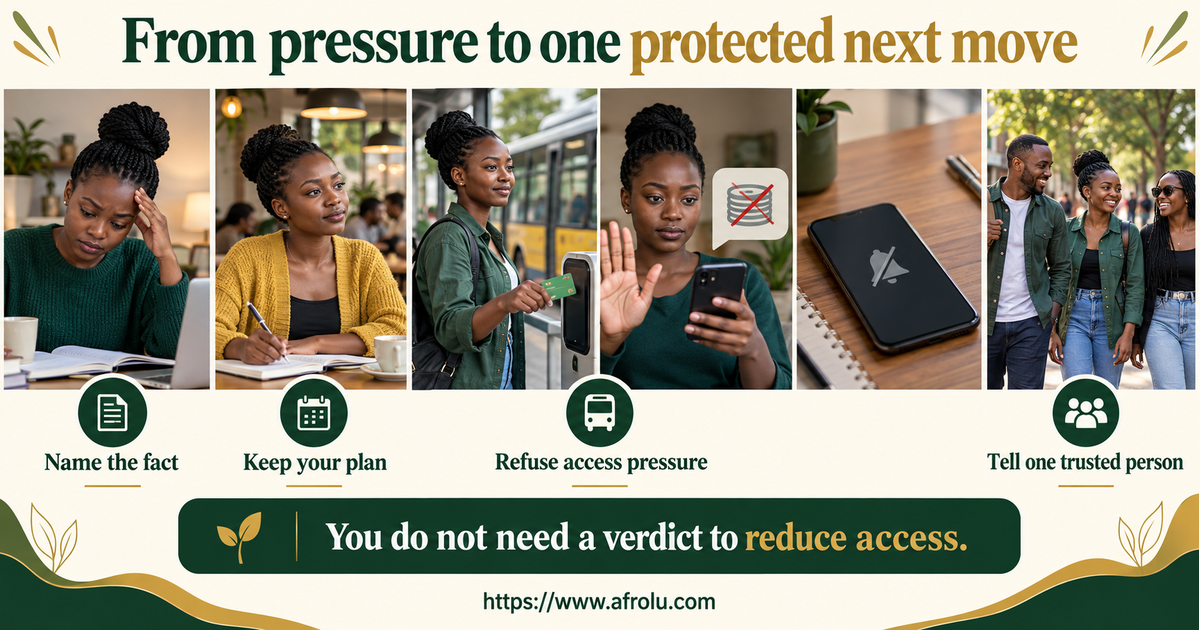
A same-night invitation meets a project deadline
Noor says she is unavailable because her assignment is due. The person replies that a casual arrangement should be spontaneous and sends repeated calls during her study block.
Noor silences the thread, states that study time is not negotiable, and watches whether the boundary is accepted without punishment.A plan changes from dinner to a private room
After a public date, Malik decides he wants to go home. His date says the ride they offered only makes sense if he comes upstairs first.
Malik keeps his own transport plan, leaves, and treats the conditional ride as pressure rather than a misunderstanding to soothe.Urgency appears before trust
A match asks Lindiwe to send a small transfer for a course fee and promises to repay it after they meet.
Lindiwe sends no money or codes, keeps the conversation on-platform, and ends contact if financial pressure continues.Private details become entertainment
Sam shares a boundary in confidence and later learns that fragments were repeated in a friend group chat.
Sam names the breach once, reduces what he shares, and ends the connection if accountability and change are absent.A previous image is treated as permanent permission
A casual partner asks for another private image after Amara says no and threatens to withdraw affection.
Amara does not bargain or send more material, preserves the threatening message if safe, and blocks or reports as needed.Routine knowledge becomes unwanted access
After an unanswered message, a date waits near Yusuf's regular study place and says they only wanted to surprise him.
Yusuf leaves with a friend or staff support, does not meet privately, and changes access settings or seeks help if the behaviour repeats.Two adults want different levels of contact
Farai enjoys occasional dates while his date wants daily calls and exclusivity.
They name the mismatch without blame; if neither offer works, they end the arrangement rather than policing one another.An apology becomes a changed plan
Tessa's date cancels late, acknowledges the impact, offers a specific alternative, and accepts her no when she is busy.
Tessa can treat this as a repairable disappointment while keeping her own schedule and observing future follow-through.Signals about study, consent, money, devices, and safe exits
They accept a study, work, sleep, or friend-time boundary without demanding proof.
They repeatedly frame your availability as evidence that you care enough.
They offer a public plan and respect a change of mind about where the date goes.
They make transport, a meal, a gift, or a previous date sound like a debt.
They can discuss sexual-health and intimacy choices without rushing or sulking.
They keep your private information, images, and disclosures out of group chats.
They call, message, or appear at your usual places after you asked for space.
They ask once for a detail and can accept a no without bargaining.
They use an apology to change conduct rather than to reset the same pattern.
They request money, codes, account access, or financial rescue before trust exists.
They want access to your device, location, schedule, or coursework as proof of honesty.
They make leaving a date harder by controlling the ride, phone, money, or venue.
They isolate you from friends, classmates, colleagues, or supportive routines.
They use threats, humiliation, fake accounts, or private images to regain access.
Choose a proportionate next move
| Situation | What it may mean | What to do next |
|---|---|---|
| A plan changes once with a clear apology | A normal disruption may be repairable when the impact is acknowledged and a realistic alternative is offered. | Choose whether the new plan works; do not sacrifice study or rest to prove flexibility. |
| Plans repeatedly become late-night private invitations | Convenience may be replacing mutual planning, especially if public alternatives are dismissed. | Offer one public, bounded option or step back from the pattern. |
| They ask for a live location | A logistical question can become monitoring when a no is not accepted. | Keep location private and use a broad meeting point only if you freely choose it. |
| They want money before meeting | An urgent story can be a scam or an access test; either way, financial independence is safer. | Do not transfer money, codes, or account access; use independent verification or end contact. |
| They seem disappointed by a boundary | Disappointment is not itself a red flag; the response to your no is the useful evidence. | Keep the boundary and observe whether they accept it without punishment. |
| They keep messaging after you end contact | Repeated unwanted contact can shift from persistence to harassment or stalking. | Stop debating, preserve relevant evidence if safe, block, and seek support when needed. |
| They request a private image | A request is not automatically unsafe, but pressure or retaliation removes free choice. | Decline without explanation; never send material to stop pressure. |
| They use a friend group to get information about you | Social overlap can become boundary crossing when others are recruited to monitor or persuade. | Ask friends not to relay information and reduce shared routine details. |
| You feel confused after every interaction | Confusion may signal a mismatch, inconsistent conduct, or pressure that needs a factual review. | Write down observable events and choose one clear question or a reduced-access step. |
| You feel afraid to say no or leave | Fear changes the task from relationship clarification to safety planning. | Prioritise a safe exit, trusted support, and appropriate emergency or specialist help. |
Twelve lines for time, consent, privacy, and ending contact
“I am not available during my study block. I will reply when I choose to return.”
“I am comfortable meeting here; I am not going somewhere private tonight.”
“I have my own way home, and I am leaving now.”
“Casual works for me only with clear consent, privacy, and room for both of us to say no.”
“I do not send money or codes to someone I am dating.”
“I am not sending that. Please do not ask again.”
“I asked for space. Do not keep calling or come to my usual places.”
“I am keeping our early conversation on the app and my account details private.”
“I do not want the same contact pattern, so I am stepping out of this connection.”
“I am pausing dating during this deadline period. I will not make plans I cannot keep.”
“I do not want to continue. Please do not contact me again.”
“I am not meeting privately to discuss this. I am getting support and need no further contact.”
Know the difference
A repairable date, a mismatch, and access pressure need different responses
A person can acknowledge a mistake, accept a no, offer a workable alternative, and leave your study, money, privacy, consent, and exit under your control.
Repeated bargaining, surveillance, financial leverage, image pressure, threats, unwanted attendance, or fear make access less free and call for a stronger safety response.
The casual label does not decide the risk. The observed pattern and your freedom to choose do.

Casual scope does not turn pressure into consent.
Separate a repair, a mismatch, and access pressure
| Type or dimension | What it describes | Best next question |
|---|---|---|
| One awkward date | A clumsy moment can be acknowledged, repaired, and followed by changed conduct. | Name the impact and see whether the repair is real. |
| Repeated pressure | The same no is revisited through guilt, sulking, bargaining, or punishment. | Reduce access and keep the boundary rather than explaining it again. |
| Casual dating | The commitment may be lighter, but consent, care, privacy, and endings still need agreement. | State the current scope and whether it works for you. |
| Undefined access | One person receives time, intimacy, or attention while avoiding the information needed for informed choice. | Ask one direct question or leave the arrangement. |
| Busy student week | A deadline may limit availability without requiring access to your schedule or proof. | Offer a realistic return point if you want one. |
| Monitoring | Location requests, account checks, or repeated calls turn availability into surveillance. | Keep devices and location private; seek support if it continues. |
| Free generosity | A date, gift, or ride is offered without a later claim on your body, time, or affection. | Accept or decline freely and keep your exit independent. |
| Financial leverage | Spending or a loan is used to demand sex, secrecy, access, or another chance. | Do not pay emotional debt; stop further transfers or access. |
| Safety concern | Fear, threats, stalking, coercion, or image-based abuse require more than a relationship talk. | Use a protected exit and appropriate support rather than private negotiation. |
Start with the access you are willing to offer
Read the response to no
Interest is not the test; whether a no remains safe after it is said is.
Keep the label modest
Casual describes scope, not permission to reduce consent or accountability.
Protect ordinary life
Study, work, sleep, friendship, and privacy are part of a healthy dating baseline.
Separate facts from theories
You can act on repeated behaviour without proving a hidden motive.
Make exits practical
Independent transport, charged devices, and public plans preserve the ability to change your mind.
Ask for support early
A trusted perspective can help before a pattern becomes harder to name alone.
Questions organised by purpose and depth
Choose a few prompts that fit the moment. This is a reference library, not a list to complete.
Access audit
Use before agreeing to the next date.
- What access am I actually comfortable offering?
- What would I not share for reassurance?
- Can I leave the plan independently?
Pattern audit
Use after a confusing interaction.
- What happened without interpretation?
- What was the impact on my time or safety?
- What changed after I said no?
Consent audit
Use before intimacy or a private plan.
- Can I change my mind freely?
- Do I control transport, phone, and a way home?
- Is the conversation voluntary rather than rushed?
Exit audit
Use when the connection no longer works.
- Is a short message safe enough?
- Who can know the broad plan?
- What access should I remove today?
Look more closely at consent, technology, money, and recovery
Current agreement beats past chemistry
Treat each meeting, touch, image, and plan as a present choice that can be revised.
Evidence limit: This guide cannot assess consent in a specific incident or replace urgent local support.
Urgency is not evidence
A request for transfers, codes, loans, or account use needs a pause and independent verification, not romantic rescue.
Evidence limit: A red flag is not proof that every request is fraud.
Digital access can outlast a date
Review sharing settings, account permissions, and who can see your routine when unwanted contact begins.
Evidence limit: Changing settings may need to be planned safely if someone could notice.
Shared places require boundaries
A public overlap does not give someone a right to approach, wait, or recruit others for information.
Evidence limit: Institutional support varies; use the local option that fits your circumstances.
Safety can change the communication plan
Use a concise end for ordinary mismatch and less direct contact when pressure, threats, or fear are present.
Evidence limit: Do not promise that blocking alone resolves every safety concern.
Return to the life outside the thread
Study, sleep, trusted relationships, and routines can restore perspective after a draining connection.
Evidence limit: Recovery does not require you to date again before you are ready.
Shortcuts that make a casual connection less safe
Calling every disappointment a red flag
That can blur the distinction between a repairable mistake, a mismatch, and a pattern that narrows safety.
Waiting for certainty about motive
You can reduce access because conduct does not work for you, even when you cannot explain why it happened.
Trading private details for reassurance
Passwords, timetables, live locations, images, and money often create more vulnerability rather than clarity.
Treating casual as low-consent dating
A lighter commitment does not lower the need for present, freely given choice.
Meeting privately to make an ending kinder
A face-to-face explanation is not required and may increase risk when pressure or fear is already present.
Letting shame delay support
Financial pressure, image threats, or repeated contact are easier to address when you tell someone early.
Choose one resource that fits the fact in front of you
Use a guide for a clear boundary, a safety plan for concerning conduct, or an independent public plan when you still want to date.
Explore the guide library
Show more related guides
Continue with Afrolu
Show more Afrolu guides
Sources used for this guide
Afrolu reviewed these health, research, safety, or public guidance resources while editing this page. They support the behaviour and safety guidance; they do not diagnose any individual described by a reader.
Questions about casual dating red flags for adult students
Can casual dating have red flags?
Yes. Casual dating can be ethical, but the lighter commitment does not remove the need for consent, privacy, honest scope, money boundaries, or a safe way to leave.
Is a late reply a red flag?
Not by itself. Look at the broader pattern: whether plans are communicated, limits are respected, and a missed commitment receives a usable repair.
What if someone says boundaries make casual dating too serious?
A boundary does not create a commitment. It states what access you are willing to offer. If the other person dislikes it, they can decline the arrangement without punishing you.
Do I owe a date because someone paid?
No. A meal, ride, ticket, or gift is not a claim on sex, private access, ongoing contact, or another date.
Should I share my timetable with a casual partner?
Share only what you freely choose. A broad availability statement is usually enough; you do not owe a portal link, screenshot, location history, or proof of your plans.
What should I do if a date asks for money?
Do not send money, codes, account access, or documents to a new online love interest. Pause, independently verify where appropriate, and consider ending or reporting the contact.
Is it controlling if someone asks where I am?
A practical question can be ordinary. It becomes concerning when location, proof, or constant updates are demanded, a no is not accepted, or the information is used to monitor or punish you.
Can I end a casual connection by message?
Usually, yes. A short direct message is enough for an ordinary mismatch. If you feel unsafe, reduce contact and use a safer, more protected exit rather than meeting privately.
What if they keep calling or appearing near my routine?
Treat repeated unwanted contact seriously. Preserve relevant evidence when safe, adjust access settings, tell a trusted person, use blocking or reporting tools, and seek appropriate local support if you are afraid.
How do I avoid becoming overly suspicious?
Use facts rather than assumptions. Distinguish a repairable mistake from a repeated pattern, name one boundary, and decide from the response and practical impact rather than trying to prove a motive.
One thing to do now
Let every next date leave your life and exit under your control
Choose the smallest next action that protects study, sleep, public access, independent transport, present consent, money, private accounts, images, support, and a real ability to decline or leave.