Adult students · low-pressure career seasons
Dating Red Flags for Adult Students in Low-Pressure Career Seasons
Dating red flags for adult students in career-heavy seasons: protect focus, professional boundaries, privacy and money while keeping dating voluntary.

A demanding season is not a consent waiver.
Written and edited by Thabo Mokoena · Dating Trends Editor
Date around the season you actually have. Name your capacity, use small public plans, protect focus and routine details, keep career help and money separate, and read the response to one clear boundary. Repeated time guilt, professional leverage, secrecy, routine access, financial pressure, monitoring, unwanted contact, coercion, threats, or fear deserves less access and a support-led safety response.
Dating safety · Students
Is this low-pressure connection fitting the future you are building, or is it using time guilt, career access, secrecy, money, monitoring, pressure, or fear to make your choices smaller?
Dating red flags for adult students in career-heavy seasons are observable behaviours that make time, study, work, professional opportunity, privacy, money, consent, routine, or an exit less voluntary. They include repeated guilt, career leverage, secrecy, financial pressure, monitoring, unwanted contact, coercion, threats, or fear. The phrase describes conduct, not a diagnosis or a judgment about academic or career ambition.
Thabo is balancing an adult degree, paid shifts, and career applications when a new connection begins to demand late-night time, asks for his timetable, and offers a referral that seems to require private access. He stops treating capacity as an apology, keeps the next plan public, separates career help from dating, and lets the response show whether to continue, slow down, or end contact.
adult students · low-pressure career seasons
Thabo keeps dating from becoming another demand on his focus, professional choices, safety, or future
This guide separates normal capacity differences during an adult student career-heavy season from conduct that makes time, opportunity, finances, privacy, body, or exit less freely chosen.
Name the real season, make a small plan, read silence without losing focus, keep career support clean, treat the first no as data, end without another workload, and review the room a connection leaves for the future.
Name the real season
A full calendar can be honest information rather than a test someone else must defeat.
Protect attention
Study, work, sleep, and recovery can remain intact while a new connection develops.
Keep support clean
Advice, referrals, and opportunity do not purchase access or secrecy.
Match the risk
Clarify a mismatch; reduce access and seek support when pressure or fear enters.
a demanding season is not a consent waiver
Keep dating low-pressure when study, work, applications, placements, and money already take real energy
Career-heavy seasons can make a small connection feel unusually important. During exams, shifts, placements, interviews, portfolio deadlines, visa paperwork, caregiving, or financial stress, a warm message may seem like relief. That relief is real. It does not mean a person should be able to demand access to your sleep, study time, home, devices, finances, body, or emotional capacity because they offered attention when life was hard.
A low-pressure arrangement starts with the actual season. You might have room for a public coffee after class, a short call once a week, a date after an assessment, or no dating for a month. Stating that capacity is not an apology. It gives both adults information about what exists now instead of creating a false promise that one person will later use to claim more time or reassurance.
Be careful when someone turns busyness into a moral test. They may say that a serious person would make time no matter what, that a late reply proves disinterest, or that an exhausted student owes a late-night visit to compensate for a cancelled plan. A compatible date can express a need for more consistency and can leave if the rhythm does not fit. Pressure begins when they make your limits something you must overcome to prove care.
You can want dating to remain light while also wanting it to be fair. The useful question is practical: does this person make it easier or harder to protect concentration, rest, paid work, study, friends, money, safety, and a free exit? A connection that requires you to shrink those foundations is not low pressure merely because nobody has named it serious.
make the next plan fit the actual workload
Use small agreements instead of vague availability promises
Choose plans that do not sabotage the season you are in. A daytime café near campus or work, a short public walk, a call before a fixed study block, or a weekend plan with a clear finish can make dating enjoyable without borrowing from sleep, tuition money, safety, or deadlines. Independent travel and a simple exit reduce the pressure to stay because someone spent money or rearranged their own time.
You do not owe a detailed academic or work diary to a new date. You can say that you have a deadline, a placement, a shift, or a limited week without naming the course, employer, supervisor, building, timetable, online platform, commute, or financial situation. A broad truth is enough. Repeated requests for your calendar, class location, manager, internship contacts, or study group can turn ordinary curiosity into access pressure.
A mismatch can be handled cleanly. One person may want spontaneous evenings and daily replies while the other can offer planned daytime dates and slower messages for a month. Neither must become the villain. Name the gap, make one alternative if you genuinely want to, and let the answer remain an answer if the rhythms are incompatible. Clarity is kinder than repeatedly cancelling under a promise that conditions will soon change.
Watch for a person who treats every practical limit as a negotiation. They may push a public date to a private address, request an overnight stay before an exam, insist that work stress is an excuse, or use access to notes, a network, a ride, a paid meal, or a job lead to create a debt. Support can be generous; it becomes risky when it asks you to trade safety or autonomy for it.

Read the response to your season, not the promise alone.
read a quiet period without letting it consume the workday
A missed message can be ordinary; recurring ambiguity should not become a second unpaid job
A student may feel compelled to answer immediately because the phone is always nearby during a lecture break, commute, shift, or late-night study session. That habit can give a new connection more power over attention than it has earned. You can choose a response rhythm that protects focus, mute a thread during study, and reply later without needing to prove that an assignment or job demand was real.
If someone goes quiet, resist turning the gap into detective work. Look at the pattern: was there a confirmed plan, did they communicate a change, have they previously returned only when they wanted emotional or sexual access, and does one direct practical message receive a clear answer? You do not need to settle the reason for silence in order to decide how much of your study and emotional energy to keep offering.
A single message can close the loop: 'I can plan when the date and time are clear. If you do not want to continue, please say so.' This protects your calendar without demanding constant contact. If there is no response, a vague future promise, or a repeated cycle of warmth and disappearance, you can release the time and stop reshaping your schedule around an uncertain connection.
Silence shifts into a safety concern when it comes with monitoring, threats, image pressure, attempts to contact classmates or colleagues, surprise appearances at a campus, workplace, placement, residence, commute, or routine place, or fear. Then the task is not to improve communication. Preserve information when safe, narrow visibility, tell someone trusted, and use appropriate institution, platform, local specialist, security, health, legal, advocacy, or emergency support.
keep career support from becoming a lever
Advice, notes, networks, referrals, mentorship, money, and professional access should never purchase dating access
Students often meet people through work, professional events, classes, group projects, placement, alumni networks, or career communities. That context can be ordinary, but it adds practical power questions. A person who offers a referral, feedback, a job lead, transport, study materials, a paid course, or an introduction should not make your romantic interest the condition for receiving it. If the help vanishes when you set a boundary, it was not clean help.
Be especially cautious with secrecy. A person may say that nobody needs to know about the connection, ask you to hide messages from a supervisor or classmates, request private meetings outside appropriate channels, or suggest that a professional opportunity depends on being flexible. Professional policies vary, and a guide cannot assess a particular workplace or institution. You can still choose public, documented, appropriate routes and seek an independent support person when something feels off.
Financial pressure may arrive through a career story as well: a course fee, laptop, visa document, travel ticket, investment, interview cost, project expense, emergency transfer, or account-verification request. Do not send money, receive money through your account, co-sign, share codes, borrow on someone’s behalf, or give access to bank, education, immigration, or work documents to make a date feel supported.
If someone holds a real or perceived position of influence over your work, study, housing, funding, grades, placement, or network, slow down. Keep communication where you can retain it, avoid being isolated, and use formal or independent support channels appropriate to the setting. You do not have to decide that the person intended harm before choosing a boundary that keeps your education and career choices yours.
let the first limit show you the shape of the connection
A low-pressure dater can hear no without asking you to manage their disappointment
A student boundary can be small: no late call before an exam, no home visit, no ride from a workplace, no private images, no money, no use of a campus location, no drinking tonight, no sex, no second date, or no conversation during a study block. Each is a present choice. You do not need to demonstrate that a boundary will apply forever before using it today.
A mistake can be repaired when someone hears impact, apologises without demanding forgiveness, and changes the next action. That differs from a person who says you are overreacting, calls study an excuse, insists that their expense gives them a claim, sulks after a no, or turns your career goals into proof that you are selfish. A person can prefer more availability; they cannot make your capacity their entitlement.
Notice indirect pressure too. A date may ask classmates about you, show up at a familiar cafe, use a group project or professional contact to reopen a closed conversation, or repeatedly message from new accounts. Shared community, campus, workplace, or career interest does not make your routine public property. Narrow the channels and tell people around you what information should not be relayed.
If you feel afraid, controlled, unable to leave, pressured sexually, financially trapped, threatened, monitored, or worried that a dating connection could affect safety at study or work, seek support early. Your response can be proportionate: a pause, a concise ending, a block, documentation, a trusted person, or a specialist and institutional safety route. You do not have to carry the problem alone because the relationship was casual or new.

A clear capacity statement does not need an apology.
end the connection without spending another deadline on it
A concise no can protect your time, concentration, and safety more than a prolonged explanation
For an ordinary mismatch, keep the message simple: 'This relationship is not a good fit for me, and I am stepping away.' You do not need to cite your marks, work hours, finances, roommates, commute, or personal history. Details can give a person material to debate rather than clarity. Your decision is the relevant information.
For repeated pressure, make the route smaller. Do not agree to meet alone after class, in a car, at a residence, at a workplace, or at a private location just to make the ending feel kinder. Use written contact if safer, stop sharing plans, keep relevant records where safe, and tell a trusted person. Blocking or reporting can be reasonable when someone keeps trying to reopen a connection you ended.
If someone uses academic, professional, housing, or network access to keep contact going, take the setting seriously. Save what is safe to keep, avoid retaliation or confrontation that could increase risk, and seek appropriate independent support through your institution, workplace, placement provider, professional body, security service, legal adviser, specialist service, or emergency route. Immediate danger calls for urgent local help.
After an ending, protect recovery time. Return to your study plan, paid work, friends, food, rest, movement, and the small routines that make an intense season manageable. A dating connection should not become another hidden workload. You can be disappointed, learn from the experience, and still refuse to let someone’s access to you be the measure of your future or worth.

Choose the move that leaves your future and exit yours.
review whether the connection protects the future you are building
A good low-pressure connection leaves your study, work, rest, money, and choices more workable
Use a short review after a few interactions. Can I set a study or work boundary without managing their mood? Can I keep campus, workplace, home, money, documents, devices, contacts, and routines private? Can I cancel for a deadline, sleep, a shift, or a family need? Does the person respect independent transport and a public plan? Can I say no to images, sex, alcohol, money, a private meeting, or a career favour without fear?
A stable pattern includes someone who respects a limited window, communicates a change, handles a delayed reply, accepts a public plan, keeps professional support clean, and makes a repair. A caution pattern may be a normal mismatch in capacity or future hopes. A serious pattern includes repeated time pressure, access through campus or work, secrecy, financial leverage, monitoring, unwanted contact, coercion, threats, or fear.
Choose the action that fits the evidence: another short public date, a clearer schedule conversation, less sharing, no professional overlap, a slower rhythm, a pause, a concise ending, a block, documentation, or a support-led exit. You do not have to prove a bad intention to protect a scholarship, job, study plan, housing, money, body, or future from an arrangement that is no longer freely chosen.
Adult students deserve relationships that can coexist with ambition and recovery. A date who values you will not require you to sacrifice sleep, concentration, safety, private information, or career choices to demonstrate care. If a connection needs that sacrifice, the low-pressure answer may be to make it smaller or let it go.
Eight adult student career-season dating moments
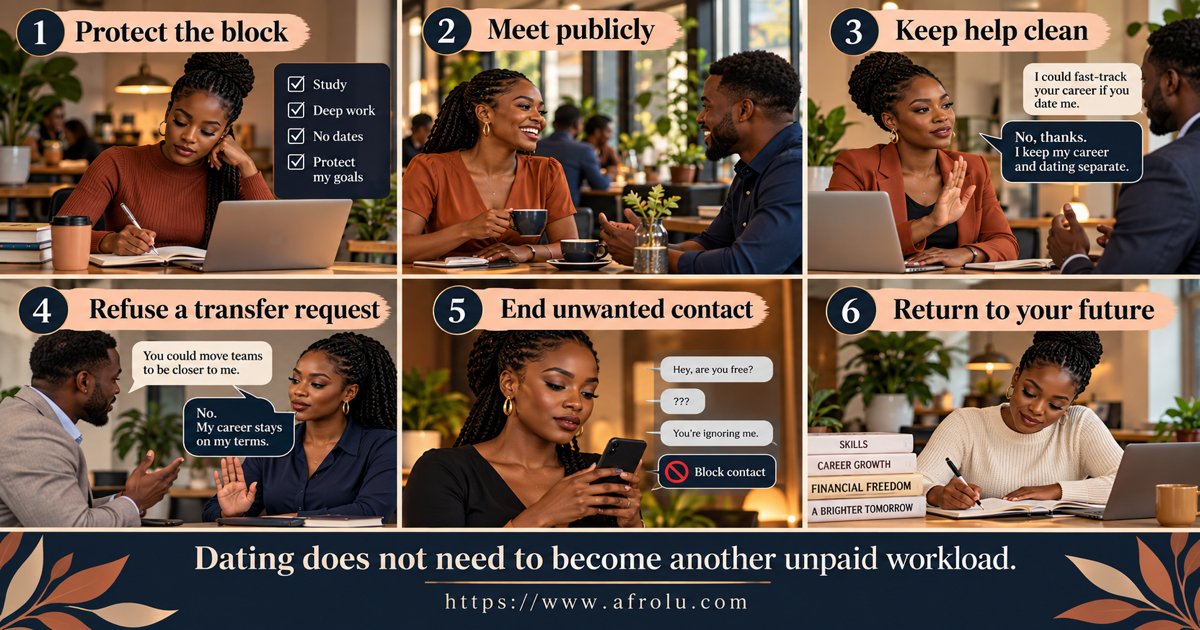
A late invitation becomes a test
A dater says a student who cares would skip revision and come over after a paid meal was planned.
Keep the study boundary, decline the private plan, and observe whether no is accepted.A busy day is used for guilt
A student replies after a placement shift and receives dozens of messages saying silence is cruel and proof of disinterest.
State the available communication rhythm once and reduce contact if the pressure continues.A deadline changes a public coffee
An assessment runs late; the date receives a clear update and offers another short public time without asking for proof.
Treat the response as compatible while continuing to observe the wider pattern.Career support becomes romantic leverage
Someone offers an introduction for an internship, then says the opportunity depends on being more open to a private date.
Keep professional support separate, use an independent route, and seek appropriate advice if influence is real.A boundary is bypassed through classmates
After a date ends, the person asks a classmate when the student will be in the library.
Ask peers not to relay information, preserve records if safe, and make visibility smaller.A remote emergency becomes a transfer request
A match says a training payment is due today and asks the student to receive money or share a card to help.
Do not use accounts, codes, or transfers; verify independently and step back from pressure.A productive meet becomes home access
A person suggests studying together but insists on coming to the student’s residence after public options are proposed.
Keep the plan public or decline; study support does not create home access.A shared route becomes unwanted contact
After a clear ending, a former date waits near a regular commute point and says the appearance is romantic.
Do not meet privately, tell someone trusted, document if safe, and seek support if fear or repeat contact continues.Signals about time, focus, career support, privacy, money, routine, and exits
They can accept a limited study or work window without turning it into proof that you do not care.
They make public plans that respect independent transport, a finish time, and your next-day responsibilities.
They do not ask for a detailed class, work, placement, commute, financial, immigration, or housing schedule.
They can hear a no to a late night, home visit, private study session, image, sex, alcohol, money, or second date.
They communicate a changed plan instead of creating an emergency around your response time.
They do not use notes, referrals, mentorship, a ride, a job lead, a paid meal, or a professional contact as leverage.
They respect that career advice and dating access are separate choices.
They do not ask you to hide the connection from appropriate workplace, campus, placement, or support channels.
They do not request money, codes, documents, banking screens, tuition details, benefit information, or account access.
They make a specific repair after crossing a deadline or boundary rather than calling study an excuse.
They do not use classmates, colleagues, supervisors, group chats, routines, or new accounts to bypass an ending.
They accept that an adult student can prioritise sleep, work, study, and financial stability without apology.
They do not leave you afraid to change a plan, protect a professional boundary, or go to class or work.
They do not turn a low-pressure relationship into another unpaid emotional workload.
Choose a proportionate next move
| Situation | What it may mean | What to do next |
|---|---|---|
| They want a late date before an exam | A preference for spontaneity can be ordinary until no is treated as a challenge. | State the study or rest boundary and keep the plan public, later, or cancelled. |
| They dislike a delayed reply | Different rhythms can be compatible; guilt and repeated monitoring are not required. | Name the response window you can offer and reduce contact if it is punished. |
| They ask for your timetable | Curiosity can become routine access or monitoring. | Give only the broad context you choose and keep schedules private. |
| They offer career help | Support can be useful, but a romantic condition makes it leverage. | Use an independent professional route and keep dating separate from the opportunity. |
| They request money or account help | Urgency can be a scam, an access test, or a financial burden you need not carry. | Do not send, receive, lend, co-sign, share codes, or disclose documents. |
| They want a private study session | Study can be social; home access and pressure need separate consent. | Choose a public library or café, or decline without defending the boundary. |
| They apologise after disrupting a deadline | A repair matters when the next plan protects the limit you named. | Watch for changed conduct rather than deciding from words alone. |
| They contact peers or colleagues | Indirect contact can bypass a clear boundary and expose routine information. | Ask others not to relay details and reduce visible channels. |
| They use institutional influence | A real or perceived power imbalance can affect work, grades, housing, funding, or safety. | Slow down, keep records if safe, and seek independent appropriate support. |
| You feel fear or cannot leave freely | The task has moved beyond dating clarity into safety planning. | Prioritise a protected exit and urgent local or specialist support. |
Twelve lines for capacity, public plans, career boundaries, and ending
“I have a demanding week, so I can offer a short public date at this time and no more.”
“I do not reply during study or work blocks. I will respond when I am free.”
“I can meet there, and I will make my own way home.”
“I am not inviting someone to my residence. A public study space works or we can leave it.”
“I keep professional opportunities separate from dating, so I will use another route for that.”
“I do not send money, receive transfers, share codes, or use my account for a dating connection.”
“My timetable and workplace details are private. I have shared what I want to share.”
“When the plan changed without notice, it disrupted my day. I need a clear update next time.”
“I am not available for that tonight. I am keeping my rest and study plan.”
“This arrangement does not fit how I work or study, so I am stepping away from it.”
“Do not ask people around me for my plans or contact me through other accounts.”
“I am not discussing this further. I am getting support and need no more contact.”
Know the difference
A demanding season, a time mismatch, clean career support, and leverage need different responses
A person can accept limited time, public plans, delayed replies, privacy, independent travel, professional boundaries, and a clear no while allowing study and work priorities to remain the student's own.
Time guilt, private-access demands, career conditions, secrecy, routine tracking, money pressure, new-account contact, coercion, threats, or fear turn a dating connection into a claim on the future you are building.
A full calendar does not decide the risk. The observed pattern and your freedom to choose do.

The pattern and freedom decide the next move, not a full calendar.
Separate a busy season, a time mismatch, clean support, and leverage
| Type or dimension | What it describes | Best next question |
|---|---|---|
| A busy season | A student names capacity and a date can choose whether the rhythm suits them. | Make a modest plan or accept an honest mismatch. |
| Time pressure | A deadline, tiredness, or late reply is used to demand more access or prove care. | Keep the limit and make the communication channel smaller. |
| Career support | Advice or a referral is offered without a romantic condition or private debt. | Use appropriate professional routes and accept or decline freely. |
| Career leverage | Notes, contacts, money, transport, funding, work, grades, or opportunity become payment for access. | Separate the opportunity and seek independent support. |
| A repair | A disruption is acknowledged and the next plan respects study, work, sleep, and public safety. | Observe the changed behaviour over time. |
| Routine access | Class, work, commute, residence, or group contacts become ways to track or reach you. | Limit shared details and ask others not to relay information. |
| A public plan | Both people can meet in a visible place and leave independently. | Use it as a practical early structure. |
| Private access pressure | A home, car, late-night, or isolated plan is framed as proof of trust or maturity. | Keep the plan public or decline. |
| A safety concern | Threats, stalking, coercion, unwanted contact, financial pressure, image abuse, or fear appear. | Use a protected exit and appropriate local support. |
Start with the career-season capacity and access you freely choose
Capacity is real information
A limited season can be named honestly without becoming a promise to be endlessly available later.
Keep plans small
A short public date with independent transport protects sleep, budget, safety, and the next day.
Treat focus as a boundary
Mute a thread, reply later, and protect study or work blocks without making a case for your schedule.
Keep career help clean
Advice, referrals, networks, notes, transport, money, and opportunity should not purchase intimacy or secrecy.
Layer routine details
Class, work, placement, commute, home, contact, and financial information can stay private early on.
End without another workload
A concise no can return time and attention to the future you are building.
Questions organised by purpose and depth
Choose a few prompts that fit the moment. This is a reference library, not a list to complete.
Season audit
Use before making a dating plan.
- What time and energy can I freely offer this week?
- What must remain protected for study, work, sleep, and money?
- What public plan has an easy exit?
Silence audit
Use before spending a work or study block on messages.
- What was actually agreed?
- Have I asked once for a clear plan?
- What response lets me release this time?
Career-boundary audit
Use when opportunity and dating overlap.
- Would this help remain available after a no?
- Can I use an independent appropriate route?
- What detail or setting needs to stay public and documented?
Ending audit
Use when the arrangement no longer fits.
- What contact route protects my routine?
- Who should know the broad facts?
- What access or visibility needs to become smaller?
Look more closely at capacity, silence, career boundaries, digital safety, money, and endings
A lighter plan can be more honest
Name the present time and energy you can offer instead of promising a rhythm that steals from sleep, work, study, money, or safety.
Evidence limit: A guide cannot decide compatibility for two adults.
A quiet period should not become a second job
Compare confirmed plans, one direct request, and the pattern over time before rearranging your schedule around someone else’s ambiguity.
Evidence limit: No pattern can reveal another person’s private motive with certainty.
Professional opportunity needs its own rules
Keep referrals, mentorship, study materials, projects, grades, funding, workplace access, and networking separate from romantic interest.
Evidence limit: Policies and power dynamics vary by setting; seek appropriate local advice when needed.
Routine details can travel beyond a chat
Protect schedules, work or class locations, contacts, accounts, images, location, and group channels, especially if a connection becomes pressuring.
Evidence limit: Change settings carefully if another person could notice and escalate.
Romance should not set education or career risk
Pause transfer, tuition, course, travel, equipment, investment, verification, document, and account requests; verify independently.
Evidence limit: A concerning request does not prove every person is committing fraud.
A shared setting can change the route
Use a concise ending for mismatch and a more protected, support-led plan when campus, work, housing, professional influence, unwanted contact, or fear appear.
Evidence limit: Blocking alone may not resolve every safety concern.
Shortcuts that make an adult student’s dating less freely chosen
Treating availability as a character test
A busy student can care and still have a limited response or dating window.
Using every break to manage a thread
Constant reassurance can turn a relationship into a drain on concentration and rest.
Sharing a detailed routine too early
Class, work, commute, residence, and financial information can make monitoring or unwanted contact easier.
Letting a favour create a debt
Notes, rides, referrals, gifts, money, and opportunities do not purchase romantic access.
Meeting privately to make an ending easier
A private campus, car, home, or workplace meeting can add pressure without resolving the mismatch.
Waiting for proof of bad intent
You can slow down or leave because the observable arrangement no longer protects your future choices.
Choose one resource that fits the fact in front of you
Use a student boundary guide for a clear limit, a slow-dating guide for a workable rhythm, or a burnout guide when dating and a demanding season are drawing too heavily on your capacity.
Explore the guide library
Show more related guides
Continue with Afrolu
Show more Afrolu guides
Sources used for this guide
Afrolu reviewed these health, research, safety, or public guidance resources while editing this page. They support the behaviour and safety guidance; they do not diagnose any individual described by a reader.
Questions about dating red flags for adult students in career-heavy seasons
Can a busy student date casually?
Yes. Casual dating can be ethical when the available time, contact, consent, privacy, money, and endings are clear and freely chosen.
Is a delayed reply a red flag?
Not by itself. Look for the wider pattern: whether plans are confirmed, a delay is communicated, and a direct request receives a workable response.
Do I have to show someone my timetable to prove I am busy?
No. A broad statement is enough. A new date does not need class, work, commute, placement, or residence details to respect a boundary.
What if a date says studying means I do not care?
They may prefer a different rhythm, but they cannot make your capacity a moral failure. Name the actual offer and decide whether it fits.
Can I accept a referral from someone I am dating?
Be cautious with any real or perceived influence. Keep support independent and appropriate, especially if it comes with secrecy, pressure, or a romantic condition.
Should I let a date come to my residence to study?
Only if you freely want that. A public study space, independent transport, and a clear exit are reasonable early options.
What if someone asks for course fees, a transfer, or a verification code?
Do not send, receive, lend, co-sign, share codes, documents, or account access. Pause and verify independently.
Can I end a connection by text if we share campus or work?
Usually, yes. Use the route that protects your safety and routine. Seek appropriate independent support if the person uses shared access to pressure or contact you.
When should I seek outside help?
Seek urgent or specialist local support when there are threats, coercion, stalking, unwanted contact, financial exploitation, image abuse, institutional pressure, or fear.
How do I avoid becoming wary of everyone?
Use proportionate facts. Separate a normal capacity mismatch, a repairable error, repeated access pressure, and conduct that makes your choices or safety smaller.
One thing to do now
Let every next date leave your focus, future, and exit under your control
Choose the smallest next action that protects study, work, sleep, professional opportunity, money, privacy, current consent, independent travel, trusted support, and a genuine ability to decline or leave.