Three blocks · one protected weekend
Make Dating Apps Fit Around Study, Not Consume the Weekend
An adult-student guide to dating-app overload, study boundaries, a three-block weekend reset, safer public plans, money, consent and a clear return choice.

Study, recovery and dating can share a weekend only when each has a visible boundary.
Written and edited by Thabo Mokoena · Dating Trends Editor
Use three independent blocks. FRIDAY RECOVER closes optional notifications and protects ordinary life without requiring an empty inbox. SATURDAY SORT gives one bounded app window to close unwanted threads, report unsafe contact and identify at most one useful question or plan. SUNDAY CHOOSE reviews energy, study continuity, reciprocity, plans and safety, then selects RETURN SMALL, PAUSE, CHANGE ROUTE, LEAVE, SEEK CARE or SEEK SAFETY HELP. No universal pause length or healthy chat count exists. Persistent impairment needs qualified local assessment; fraud, coercion, stalking, threats, image abuse or blocked exit use suitable safety channels immediately.
Dating wellbeing · Students
How can an adult student reduce dating-app load over one weekend, protect academic continuity and decide whether to return without self-diagnosis or unsafe shortcuts?
Dating-app burnout is a non-diagnostic description of unwanted load from profile review, messages, uncertainty, safety checks and planning. It may overlap with study stress, disappointment, low interest or wider distress. A clarity weekend changes app tasks to observe impact; it does not diagnose a condition, guarantee recovery or require a return.
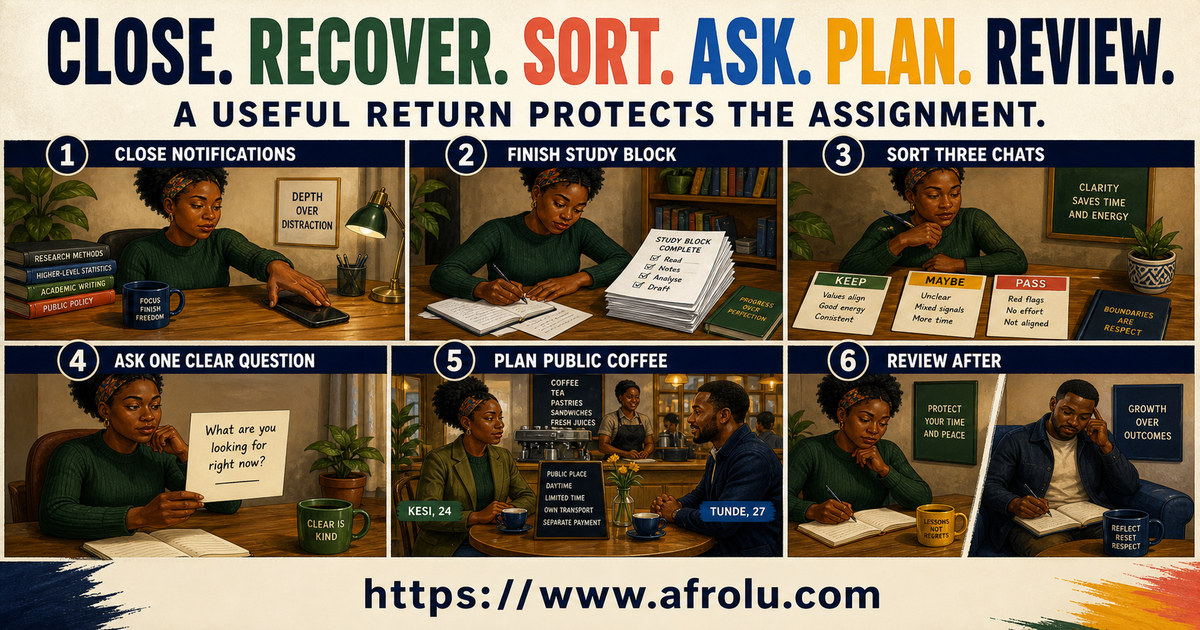
Kesi, a fictional 24-year-old postgraduate adult, closes optional alerts on Friday, finishes a protected Saturday study block, reduces twelve chats to three and accepts one independently planned Sunday coffee with Tunde, 27. She keeps one conversation active and the wider app queue paused after reviewing the actual impact.
The three-block adult-student weekend
Protect recovery, sort one small queue and make a Sunday choice
Thabo treats app fatigue as observable load rather than a diagnosis and keeps academic life, mental-health care and dating safety on separate lanes.
Close optional urgency, run one bounded app task, then choose the smallest route supported by delivered impact.
Recover
Close optional alerts and let rest exist before the inbox is empty.
Sort
Use one app window after a protected study block.
Choose
Return small, pause, change route, leave or seek suitable support.
Keep safety separate
Money, credentials, consent and exit never wait for the review.
Name the actual load
Dating-app burnout is a useful description only when it stays non-diagnostic
Adult students can experience online dating as a second inbox: profiles to assess, messages to interpret, safety claims to check, plans to arrange and rejection to absorb. Calling that bundle dating-app burnout can help Kesi describe depletion. It should not turn ordinary frustration into a medical verdict or make an app the sole cause of every difficult week.
Begin with observable load. Count active conversations, notification checks, unresolved plans, spending, missed study blocks and sleep interruption. Then name the effect: scattered attention, irritability, avoidance, numb swiping or loss of interest. A count is not a diagnosis; it simply reveals which tasks can be paused, reduced, delegated to a later time or ended.
Research among dating-app users reports associations between problematic or intensive use and some wellbeing outcomes, but cross-sectional findings cannot prove that apps caused an individual student's distress. People who already feel lonely, impulsive or low may use apps differently. Kesi therefore uses studies as context for questions, not as a score that tells her what condition she has.
If concentration, sleep, appetite, mood or ordinary functioning remain seriously affected beyond the app context, the useful next step is qualified local care rather than a better swiping system. Immediate danger or self-harm risk needs urgent local help. A weekend reset is an administrative experiment; it never replaces assessment, treatment or crisis support.
Build a three-block weekend
Friday recovery, Saturday sorting and Sunday choice keep dating outside the study plan
FRIDAY RECOVER begins by closing optional notifications and refusing to clear the queue. Kesi protects food, sleep, movement, friends, faith or quiet according to her actual life. She does not earn rest by finishing every chat. If paid work, caregiving or classes occupy Friday, recovery can be another block; the function matters more than the weekday name.
SATURDAY SORT is one pre-decided app window, perhaps twenty-five minutes after a study block. Kesi removes conversations she does not want, reports unsafe contact through the platform, answers only exchanges she freely chooses and identifies at most one question or plan that would produce useful evidence. The timer limits administration; it does not rush consent or affection.
SUNDAY CHOOSE asks whether the smaller setup improved attention and whether any connection delivered reciprocal effort. Options include returning with narrow limits, extending the pause, changing how she meets people, leaving a particular platform or leaving apps entirely. A match does not create a duty to reopen, and subscription cost already paid does not justify more depleted use.
Safety never waits for the Sunday review. Requests for money, identity documents, passwords, intimate images, controlled transport or secret meetings close the ordinary experiment. Preserve relevant records, use independently found platform, financial or official channels and seek appropriate local support. The clarity weekend is for manageable uncertainty, not for negotiating with coercion or fraud.
Follow one bounded return
Kesi protects a postgraduate deadline before testing one clear plan with Tunde
Kesi notices that she checks three apps whenever a difficult reading section slows her down. Twelve conversations are technically open, though most contain no question or plan. On Friday evening she disables optional alerts, writes her assignment tasks on paper and tells nobody she is taking a dramatic detox. She simply makes the next interruption less automatic.
After sleep and a protected Saturday study block, Kesi opens one app for twenty-five minutes. She closes eight stale threads, blocks one account that requested a verification payment and answers three people. Tunde has asked a specific question about her weekend availability. She states that she is studying and can consider one public Sunday coffee after noon.
Tunde accepts the short window, confirms the staffed venue and does not ask for Kesi's residence, student portal, live location or transport control. They each pay for their own order and leave independently. Pleasant conversation is evidence of one pleasant meeting. It does not repay Kesi's hard semester or require another date before she has reviewed her capacity.
On Sunday evening Kesi records that the narrow return did not disrupt study and that Tunde respected every boundary. She chooses one planned reply window during the week and keeps the other apps paused. If the meeting had felt flat, declining would also have completed the experiment. The point was an answerable route, not a romantic reward.
Read four independent lanes
App load, study continuity, recovery and safety should never be averaged into one score
APP LOAD fits when Kesi can name why she is opening the app and can close it after the chosen task. Redesign repeated checking, too many active threads and notifications that create false urgency. Stop paid verification, financial requests, impersonation or platform evasion. A smaller queue may help attention, but no queue size is universally healthy.
STUDY CONTINUITY fits when app use stays outside protected learning, paid work and deadlines. Redesign contact that repeatedly fragments reading or creates late-night recovery costs. Stop anyone who belittles education, demands proof during class, sabotages work or treats academic pressure as permission to control time. Genuine interest can tolerate a delayed response.
RECOVERY fits when sleep, meals, movement, friendship and ordinary pleasure remain available. Redesign a weekend that becomes pure profile administration or rejection review. Persistent impairment across activities deserves qualified assessment. Disinterest in apps can also be ordinary preference; Kesi does not need symptoms or a productivity argument to leave a service she no longer wants.
SAFETY fits when identity checks remain proportionate, meetings are public and leaveable, money stays separate and consent is specific. Stop threats, stalking, image abuse, sexual coercion or blocked exit. Keep immediate safety, platform reports, financial response and health care as distinct channels so that a generic boundary script does not replace suitable help.

The strongest study, health or safety fact chooses the next step; no total score is needed.
Use short capacity statements
Ten direct lines protect study, plans, money, consent and a clean ending
For time, Kesi can say, 'I answer dating messages on Saturday afternoon while this assignment is active.' She does not need to disclose grades, a timetable screenshot or her library location. Tunde may accept the rhythm, suggest another bounded point or decide it is too little. Clarity gives both adults information without assigning either one constant availability.
For movement, she can ask, 'Would you like a public coffee Sunday at one, or should we leave this here?' A real plan names place type, time, confirmation and independent return. If someone offers only affectionate check-ins, Kesi can ask for one next step once. Repeated vagueness becomes evidence rather than a puzzle she must solve.
For money and safety, she can say that she does not send funds, pay match-verification fees, share student credentials or exchange intimate images as proof. Before sex, adults should discuss consent, partners, testing and protection in time for informed choices. A profile intention, match or paid subscription proves none of those things.
For closure, 'This app rhythm no longer fits my semester, so I am stepping back' is complete. Kesi can close one connection while keeping the app, close the app while continuing an existing connection or stop dating for now. She owes neither a diagnosis nor an argument about whether the other person meant well.

Clarity names the available block and leaves the other adult free to accept, counter or close.
Choose a route on Sunday
Return small, pause, change route, leave or seek the right kind of support
RETURN SMALL when the bounded window stays within capacity and at least one exchange produces reciprocal, specific evidence. Keep the limit visible: one app, one window, a small active queue or one public plan. The experiment can be shortened at any point. Returning does not obligate Kesi to restore every notification or revive closed conversations.
PAUSE when even the reduced task competes with sleep, study or ordinary recovery. CHANGE ROUTE when Kesi still wants connection but not the current interface, volume or meeting pattern. She might prefer introductions through friends, activities or slower offline contact, while applying the same money, consent, identity and public-meeting protections.
LEAVE when apps are unwanted, not merely when a recovery target has been achieved. A dating service is optional infrastructure, not a developmental milestone. Deleting an account may require checking subscription cancellation and privacy controls separately. A pause without deletion can also be valid if Kesi wants time before making an account decision.
SEEK CARE when persistent distress or impaired functioning needs professional attention; SEEK SAFETY HELP when fraud, coercion, stalking, threats, image abuse or blocked exit is present. Those routes may overlap, but they solve different problems. Neither should be delayed until Kesi has finished a weekend worksheet or explained herself to a match.

The weekend produces a choice, not a duty to reopen the app.
Separate nearby explanations
App overload, study stress, disappointment, disinterest, impairment and danger need different responses
DATING-APP OVERLOAD is task-specific: opening, sorting and responding feel disproportionate, and reducing those tasks may help. STUDY STRESS can make any optional demand feel heavier, even when app use is modest. Both can coexist. Kesi tests them by changing one variable while refusing to assume that a better timer will solve a wider workload.
ORDINARY DISAPPOINTMENT follows a mismatch, non-reply or poor date and may ease without redesigning the entire dating system. LOW APP INTEREST means the format is simply not appealing. Neither state requires a clinical label. A person may enjoy dating and dislike apps, or enjoy apps in one season and choose none in another.
PERSISTENT IMPAIRMENT includes sustained difficulty with sleep, concentration, appetite, ordinary tasks or enjoyment across contexts. NIMH guidance supports considering professional help when severe or distressing symptoms persist and disrupt functioning, though readers should use relevant local care rather than treating a web page as assessment. Duration and severity matter more than a fashionable label.
UNSAFE CONDUCT includes fraud, coercion, stalking, threats, identity misuse, non-consensual image sharing or blocked exit. Reduce access and use suitable official, platform, financial, legal, health or emergency channels. Safety action should not wait for proof of someone's motive or be softened into a conversation about app fatigue.
Eight adult-student moments where app load needs a smaller decision
Notifications interrupt every reading block
The app opens whenever coursework becomes uncomfortable, even when no chosen dating task exists.
Disable optional alerts and move one purposeful check to a named weekend window.A large queue creates false obligation
Kesi feels she must answer twelve chats because they are visible, not because she wants twelve connections.
Close unwanted threads and retain only the smallest queue she can assess honestly.One person offers a concrete Sunday plan
Tunde names a staffed venue, time and confirmation point without requesting home access.
Accept, counter or decline from current capacity while keeping transport independent.A match asks for a verification fee
The payment is framed as a small safety step before they can meet.
Do not pay; stop contact and use independently found platform or financial reporting channels.Study strain continues during the pause
App alerts are gone, but sleep, focus and ordinary tasks remain seriously affected.
Treat the wider impairment as a health question and seek qualified local assessment.The app is manageable but unwanted
Kesi has energy and good grades yet dislikes profile sorting and message administration.
Leave the service without manufacturing burnout as permission.A date expects instant replies after coffee
A pleasant meeting is used to demand access throughout classes and late at night.
Restate the available rhythm once; reduce access if the boundary is punished.A Sunday review shows a smaller route works
One app window, one conversation and one public plan fit beside study and recovery.
Continue the bounded experiment and review delivered impact rather than expanding automatically.Twelve signals across app work, study, recovery and safety
{'name': 'Purposeful opening', 'detail': 'The app is opened for a named task rather than every moment of uncertainty.'}
{'name': 'Closable window', 'detail': 'Kesi can finish the chosen task and leave the interface without chasing completion.'}
{'name': 'Protected study', 'detail': 'Messages do not interrupt classes, paid work, laboratory time or a declared focus block.'}
{'name': 'Ordinary recovery', 'detail': 'Sleep, food, movement, friends, faith and non-dating pleasure remain available.'}
{'name': 'Small active queue', 'detail': 'Only conversations Kesi freely wants and can assess remain open.'}
{'name': 'Reciprocal questions', 'detail': 'The other adult contributes curiosity and context rather than consuming answers.'}
{'name': 'Specific next step', 'detail': 'Interest can become one bounded call or public meeting with confirmation.'}
{'name': 'Accepted delay', 'detail': 'A study-based reply gap is received without guilt, punishment or surveillance.'}
{'name': 'Separate money', 'detail': 'No match, verification scheme or urgent story receives funds or credentials.'}
{'name': 'Specific consent', 'detail': 'Coffee, touch, sexual conversation and sex remain separate freely changeable choices.'}
{'name': 'Independent exit', 'detail': 'Each adult controls transport, phone, account access and the ability to leave.'}
{'name': 'Complete no', 'detail': 'Kesi can pause, decline or leave the app without proving exhaustion.'}
Review the weekend through ten independent questions
| Situation | What it may mean | What to do next |
|---|---|---|
| Can I name why I am opening the app? | Fits: One chosen task is clear. Needs review: I am checking for relief from study discomfort. Stop: Someone is demanding proof or access now. | Use one bounded task, delay the check or close unsafe contact. |
| Does the window end when planned? | Fits: I can close after sorting or replying. Needs review: The queue repeatedly expands. Stop: Threats or extortion prevent disengagement. | Shrink the queue; use safety channels for coercive contact. |
| What happens to study continuity? | Fits: Protected blocks remain intact. Needs review: Messages fragment difficult work. Stop: A person sabotages or monitors education. | Move contact outside study and stop controlling access. |
| What happens to sleep and recovery? | Fits: Ordinary routines remain available. Needs review: Late checking creates a recovery cost. Stop: Persistent impairment affects daily functioning. | Protect sleep; consider qualified care for wider persistent symptoms. |
| Is reciprocity visible? | Fits: Both adults ask and answer proportionately. Needs review: One person carries every exchange. Stop: Attention is used to obtain money or intimate proof. | Ask for one clear next step or close the route. |
| Can interest become a bounded plan? | Fits: Time, public place and confirmation exist. Needs review: Warm contact stays unscheduled. Stop: Only secret or controlled meetings are offered. | Offer one leaveable plan and decline unsafe logistics. |
| Are money and identity protected? | Fits: Accounts and documents remain separate. Needs review: Oversharing is framed as closeness. Stop: Funds, passwords or student credentials are requested. | Stop the transfer and use independently found reporting help. |
| Is sexual choice still specific? | Fits: Consent and health questions can be discussed. Needs review: A match is treated as assumed access. Stop: Pressure, threats or image abuse appears. | Separate each choice and seek suitable support for abuse. |
| Do I actually want this format? | Fits: A smaller app route still appeals. Needs review: I want dating but not this interface. Stop: I feel unable to leave because of sunk cost or pressure. | Return small, change route or leave; payment does not create duty. |
| What is the narrowest next decision? | Fits: One option fits the evidence. Needs review: I need a longer pause before deciding. Stop: Immediate danger is present. | Choose the smallest route or bypass the review for urgent help. |
Ten lines for study time, public plans, money, consent and closure
“I answer dating messages on Saturday afternoon while this assignment is active.”
“I am keeping one conversation active, so I will not start another this weekend.”
“Would public coffee Sunday at one work, or should we leave this here?”
“If we have not confirmed by ten on Sunday, I will release the plan.”
“I am returning to coursework now and will not be available tonight.”
“I do not send money, pay match-verification fees or share account access.”
“I do not share my student portal, home address or live location.”
“Coffee is the only plan; any touch or sexual choice needs a separate yes.”
“The app load is not fitting my semester, so I am pausing without a return date.”
“This connection does not fit my available pace, so I am closing it here.”
Know the difference
Student dating-app overload and nearby states need different responses
Profile, message, safety and planning tasks consume more attention than the adult student wants or can give.
The wider pattern may require workload change, simple format choice, qualified care or access-focused safety action.
Describe the smallest supported problem, then match the response to its real lane.

Describe the smallest supported problem, then match the response to its actual lane.
Separate eight nearby student dating and wellbeing states
| Type or dimension | What it describes | Best next question |
|---|---|---|
| Dating-app overload | Dating administration is the main removable burden and a smaller setup changes its impact. | Pause, shrink or leave the app while observing wider functioning. |
| Study stress | Deadlines, workload or uncertainty remain difficult even when app contact is absent. | Use relevant academic, workload and health support rather than a dating timer alone. |
| Ordinary disappointment | One mismatch or silence hurts without producing a wider persistent pattern. | Allow the feeling, close the event and avoid converting it into a self-verdict. |
| Low app interest | The format is unwanted even when energy and functioning are intact. | Choose offline routes or no dating without inventing a disorder. |
| Persistent impairment | Sleep, concentration, appetite, enjoyment or ordinary tasks stay seriously affected across settings. | Seek qualified local assessment; a page cannot determine cause or care. |
| Unsafe conduct | Fraud, coercion, stalking, threats, image abuse or blocked exit changes the problem. | Protect access and use suitable platform, financial, legal, health or emergency help. |
| One manageable connection | A bounded exchange produces reciprocal questions and a safe specific plan. | Continue only at the tested size and review impact before expanding. |
| Subscription sunk cost | Past payment creates pressure to keep using a service that no longer fits. | Cancel renewal and decide future use separately from money already spent. |
Use the three-block clarity weekend in six moves
Name tasks before labels
Count checking, sorting, replying and planning without diagnosing yourself.
Protect Friday recovery
Rest is not a prize for emptying a dating queue.
Use one Saturday window
A timer bounds administration while consent and safety remain unhurried.
Make a Sunday choice
Return small, pause, change route, leave or seek the right support.
Keep study and money separate
No match receives coursework sabotage, credentials or funds.
Escalate by problem
Persistent impairment and dangerous conduct use different support lanes.
Questions for load, study, plans and the Sunday decision
Choose a few prompts that fit the moment. This is a reference library, not a list to complete.
Load
Name app-specific work.
- Why am I opening?
- How many threads do I want?
- Which alert interrupts?
- What cost is active?
- What can close now?
Study
Protect ordinary adult responsibilities.
- Which block stays phone-free?
- What deadline is real?
- When can I reply?
- What needs academic support?
- Does dating punish delay?
Plan
Move one exchange into evidence.
- What public place?
- When is confirmation?
- Who controls transport?
- What money stays separate?
- How will I leave?
Decision
Choose without a success ladder.
- Return small?
- Continue the pause?
- Change route?
- Leave the app?
- Which support lane fits?
What app-use research and current official guidance can support
A Swiss university study examines problematic dating-app use and health outcomes
The cross-sectional sample of adult university students supports asking about intensity, mood and sexual-health context.
Evidence limit: Associations cannot prove that app use caused an individual's symptoms or generalise to all students.
An ecological momentary pilot links objective app use with in-the-moment wellbeing questions
The design supports observing use and experience close together rather than relying only on a dramatic global label.
Evidence limit: A small pilot and short observation period cannot set a healthy usage threshold.
Research explores FOMO, usage fatigue, privacy concerns and joy of missing out
The findings support examining pressure to keep checking and whether stepping back creates useful agency.
Evidence limit: The study does not prove that a pause treats mental illness or suits every user.
NIMH separates everyday self-care from signs that merit professional help
Current guidance supports sleep, priorities, connection and seeking help when severe or distressing symptoms persist and impair functioning.
Evidence limit: U.S. guidance should be adapted to relevant local services and is not an individual assessment.
FTC guidance explains common online romance-scam money routes
The official resource supports never sending money or gifts to an online love interest not met in person and using independent reporting routes.
Evidence limit: A general scam pattern cannot determine the motive of every person or recover funds automatically.
CDC recommends partner conversations before sex
Current official guidance supports discussing partners, testing and prevention early enough for informed choices.
Evidence limit: The resource is U.S.-based and should be paired with appropriate local clinical guidance.
Six ways a reset becomes diagnosis, pressure or another task
Turning fatigue into a diagnosis
A descriptive label claims medical certainty. Repair: describe tasks, effects and duration.
Making rest conditional
Recovery is postponed until every chat is answered. Repair: close the queue first.
Using a timer to rush consent
Administrative speed becomes emotional or sexual pressure. Repair: keep choices separate.
Treating study as an excuse to disappear
Capacity is hidden instead of stated. Repair: name one available window or close.
Paying for verification
Safety language opens a financial route. Repair: never pay a match or supplied checker.
Scheduling an automatic return
A pause becomes a countdown regardless of evidence. Repair: review without duty.
Use a reviewed resource that matches the decision
This guide focuses on the relationship decision, so it does not rank dating apps. Check current prices, safety tools, and local availability before choosing a service.
Explore the guide library
Show more related guides
Continue with Afrolu
Show more Afrolu guides
Adult-student research, mental-health context and current safety guidance
Afrolu reviewed these health, research, safety, or public guidance resources while editing this page. They support the behaviour and safety guidance; they do not diagnose any individual described by a reader.
Adult-student weekend dating-app reset questions
Is dating-app burnout a medical diagnosis?
No. This guide uses it as a plain-language description of unwanted profile, message, safety and planning load. Similar experiences can accompany study stress, ordinary disappointment, low interest or wider mental-health concerns. Describe the tasks, effects and duration. Seek qualified local care when severe or distressing symptoms persist or impair ordinary functioning.
How long should an adult student pause dating apps?
There is no universal duration. Friday, Saturday and Sunday are functional blocks in this guide, not a treatment schedule. Review whether reduced app work changes study, sleep and ordinary recovery. Continue the pause if you want. Return small, change route or leave entirely without promising a date.
Should I delete every app during exams?
Only if that fits your choice. Disabling alerts, logging out, pausing visibility, cancelling renewal and deleting an account are different actions. Check privacy and subscription controls independently. Some adults keep one bounded conversation; others leave apps. Academic pressure does not remove consent or safety requirements.
How many active conversations are healthy?
Research does not provide one healthy number. Use the smallest queue you genuinely want and can assess without sacrificing study, recovery or honesty. A conversation should supply reciprocal questions or a realistic next step. Close visible threads that feel like obligations rather than keeping them as possible future inventory.
What if someone says my study boundaries show low interest?
They may need a different contact rhythm, and that mismatch is useful information. State one real window and one possible next step. They can accept, counter or close. Repeated guilt, surveillance, sabotage or demands for proof are not ordinary preference negotiations and justify reducing access.
Can I return for one person while keeping the app paused?
Yes. App visibility, messaging one existing match and accepting a public date are separate choices. Keep the plan bounded, protect identity and money, arrange independent transport and review delivered impact afterward. One pleasant meeting does not require reopening the whole queue or agreeing to another date.
What should I do about a dating verification fee?
Do not pay a match, a link they provide or a supposed verifier. Do not share banking or student-login details. Stop contact and navigate independently to the platform, financial provider or relevant official reporting channel. If money moved, contact the payment provider promptly and preserve useful records.
How do sexual-health conversations fit a low-load weekend?
They should occur before sex, not be squeezed into an exhausted moment. Discuss consent, current partners, testing, prevention and information needed for an informed choice. Coffee, touch, sex and an overnight stay remain separate decisions. A match badge or serious profile intention is not a health result.
When does app fatigue need professional support?
Consider qualified local help when distress is severe, persistent or interferes with sleep, concentration, appetite, enjoyment or ordinary tasks across contexts. A clinician can assess causes and options. Immediate self-harm risk or danger needs urgent local support; do not wait for a weekend reset to finish.
Is leaving dating apps giving up on relationships?
No. Apps are one meeting format, not a measure of openness to love or adulthood. You may date through friends, activities, faith communities or not at all. Leaving can be temporary or permanent. The useful question is whether the route fits your present values, capacity, privacy and safety.
One thing to do now
Give dating one honest block—not the whole weekend
Continue only while a deliberately small app route fits study, recovery, reciprocity, plans and safety. Pause or leave whenever the format is unwanted. Seek qualified local care for severe or persistent impairment, and use appropriate platform, financial, legal, health or emergency support for unsafe conduct without waiting for the weekend review.