New daters · low-pressure casual choice
Dating Red Flags for New Daters in Low-Pressure Casual Dating
Dating red flags for new daters in low-pressure casual dating: clarify plans, consent and silence, protect privacy and money, and keep a free exit in each plan.

Lightness is room to choose, not pressure to need nothing.
Written and edited by Amara Diallo · Francophone Africa Editor
Low-pressure casual dating can still be clear. Name the next plan, keep consent current, protect identity and money, notice the pattern behind silence, and read the response to one boundary. A repeated disappearance, private-plan pressure, demanded images, financial request, monitoring, coercion, unwanted contact, or fear deserves less access and a safety response rather than more explanation.
Dating safety · New Relationship Starters
Can this casual connection stay light and honest, or is silence, access, pressure, secrecy, money, monitoring, or fear making the arrangement less voluntary?
Dating red flags for new daters in low-pressure casual dating are observable behaviours that make plans, consent, privacy, money, digital access, time, or an exit less voluntary. They include repeated boundary bargaining, stop-start access, financial pressure, monitoring, unwanted contact, coercion, threats, or fear. The phrase describes conduct, not a diagnosis or a verdict on casual dating itself.
Leila is new to dating and enjoys an easy conversation until a public plan becomes a private invitation, a warm thread turns silent, and a returned message asks for more access without clearer intentions. She stops trying to prove she is relaxed enough, names one practical boundary, keeps her information layered, and chooses from the response whether to continue, slow down, or leave.
new daters · low-pressure casual choice
Leila keeps casual dating light without making clarity, consent, privacy, or a free exit optional
This guide separates normal uncertainty while learning to date from patterns that make a new dater's plans, body, information, money, or exit less freely chosen.
Name the present agreement, make the first plan practical, read silence by its pattern, keep safety ordinary, treat the first no as data, end proportionately, and review whether lightness still feels voluntary.
Keep the present honest
Casual can be clear without becoming a promise about the future.
Make choice practical
Public plans and independent travel leave both adults a free exit.
Read more than silence
One delay is not a verdict; recurring access without follow-through is information.
Match the risk
Clarify a mismatch and reduce access or seek support when pressure or fear enters.
low pressure is not no information
Let a casual connection stay light without making your choices guesswork
A person beginning to date may hear low pressure as an instruction to be endlessly easygoing. That can turn a useful wish for calm into a habit of ignoring their own uncertainty. A better starting point is smaller: decide what makes an early plan feel manageable, what information matters before intimacy, and what contact level would let you keep your ordinary week intact.
Casual does not have one universal script. One pair may enjoy occasional public dates and little messaging; another may want a weekly rhythm, sexual health conversations, or a clear rule about exclusivity. The useful question is not whether an arrangement sounds sophisticated. It is whether each person can name the present offer without having to pretend they want less, more, or different access than they do.
Pay attention when lightness is used to keep only one person informed. A match may call every scope question dramatic, disappear after requesting intimacy, or return only when they want attention. A single delayed reply can be ordinary. Repeated ambiguity that leaves one person unable to make a practical choice is information about the arrangement, not a test of their chill.
You do not need a permanent dating philosophy before the first date. You can choose one bounded plan, say what you know today, and revise it later. That flexibility is not a loophole for carelessness. It works when a change of mind can be spoken plainly and when neither adult has to surrender safety, privacy, money, consent, time, or dignity to keep the connection feeling easy.
make the first agreement small and visible
Name the next plan before trying to define a whole future
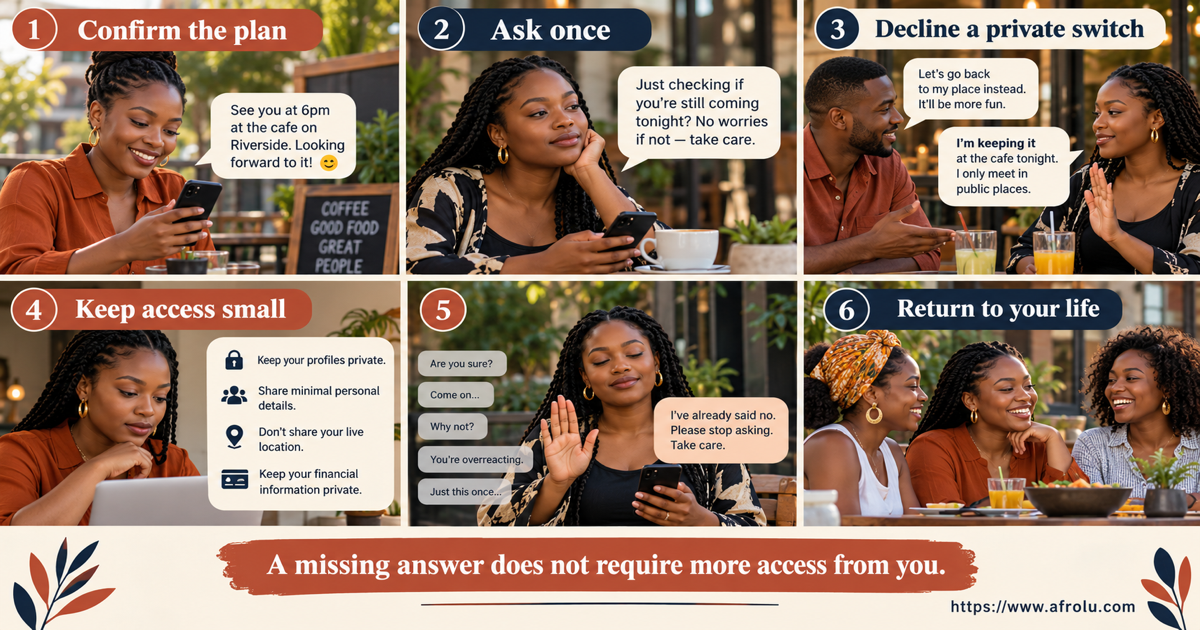
Before an early date, choose basics that require no mind-reading. Public venue, your own journey home, a start and finish window, and a broad reason to leave if you want to are practical rather than suspicious. You can enjoy chemistry while keeping the first meeting easy to exit. A person who respects that structure is showing that comfort does not depend on control.
If physical intimacy may be part of a casual connection, speak about present consent rather than assuming that flirtation, a date, money spent, a previous kiss, or the word casual has settled it. A current yes can change. Safer-sex, testing, contraception, photographs, sleepovers, and communication after a date are not awkward extras; they are the information that lets adults make a freely chosen decision.
A mismatch can be uncomplicated. Perhaps one person wants spontaneous late-night meetings while the other prefers daytime plans, or one wants a quick check-in after intimacy while the other wants more distance. Neither preference has to become evidence that someone is needy or cold. State the difference, offer a workable option once, and let an incompatible answer remain an answer.
Watch for a person who treats reasonable clarity as a negotiation they must win. They may resist telling you where a plan is, push to move it private, insist that a condom, video call, or independent transport is unnecessary, or use charm to reopen a no. The next move does not require diagnosing them. It may simply be a public plan, less sharing, a pause, or no further contact.

Look at the pattern and its effect on your choices.
read silence by its pattern and impact
Ghosting can hurt without making every quiet day a personal verdict
A newly dating person can turn a sudden quiet thread into a full investigation: rereading messages, checking activity, changing a boundary, or sending apologies for needs they never voiced. The discomfort is real, especially when the conversation had warmth. Yet an explanation you invent is not evidence. Notice what was actually promised, whether a plan was confirmed, and whether the silence is a one-off delay or a repeated pattern of access without follow-through.
Try a single grounded note if you still want an answer: 'I enjoyed meeting you. If you do not want to continue, a brief no is enough; otherwise I need a specific plan.' That sentence does not demand a confession. It gives the other person a workable route to be clear. If there is no response, a vague reply, or another cycle of warm return and disappearance, you have information to reduce your investment.
Do not let a casual label erase the impact of repeated vanishing. Casual is not a promise of constant availability, but it is not a right to collect attention, sexual access, emotional labour, private images, money, or travel plans while declining the minimal communication needed for informed consent. A pattern can be disappointing without being dangerous, and it can still be a reason to step away.
Silence becomes a safety issue when it sits beside monitoring, threats, account access, pressure for images, attempts to find you through friends, surprise appearances, or fear. Then the task is no longer to get a dating answer. Preserve information if safe, narrow contact and visibility, tell a trusted person, and use local emergency, specialist, platform, health, legal, or advocacy support appropriate to the risk.
keep safety ordinary rather than theatrical
A relaxed date can still protect identity, money, body, location, and exit
Use information in layers. A new match can know a broad neighbourhood, not your address; a work field, not your building or schedule; a first name, not account recovery details. Avoid sharing live location, codes, documents, financial screens, home access, workplace routine, or intimate material because someone says that trust should feel effortless. Trust grows from consistent conduct, not from making an early exit hard.
Digital pace matters too. A request to move immediately from an app to disappearing messages, to share a private number, to send photographs, or to verify an account through a link can be declined without a defence. If you decide to move platforms, keep control of privacy settings and consider what a screenshot, saved media item, or shared contact could reveal later.
Money deserves a firm early rule. Do not transfer funds, lend, invest, buy tickets, share codes, receive money for someone else, or use a personal account to prove interest. Romance scams often use urgency, travel, health, work, family, investment, or account problems. One odd detail is not proof of fraud, but it is enough to pause and verify independently rather than allowing urgency to set your financial risk.
If a date crosses a boundary, use the least engagement that protects you. You might leave a venue, end a call, block an account, ask a friend not to share information, or tell someone trusted what happened. If there are threats, stalking, coercion, unwanted sexual contact, image-based abuse, or immediate danger, seek urgent local help rather than trying to solve the situation through a final dating conversation.
treat the first no as useful data
The response to a boundary tells you more than a polished first impression
A boundary can be modest: no home visit, not tonight, no photographs, no money, no alcohol, no sexual contact, not on a work night, no extra messaging, no second date, or no use of a private detail. You do not have to attach a biography to it. A short statement gives the other person a chance to show whether they can tolerate a choice that does not centre them.
Sometimes a date makes a mistake and repairs it. They hear that a joke or assumption landed badly, apologise without bargaining, and change the next plan. That is different from a person who calls you uptight, says you led them on, gets angry, sulks, claims that a paid meal bought access, or keeps asking through new wording until they obtain a softer answer.
Be alert to pressure disguised as expertise about dating. Someone may say that casual daters should not expect communication, that adults do not need public meetings, that real chemistry means bypassing safety, or that a person who cares would give a second chance immediately. Preferences can be expressed; they cannot turn your limits into a debate you are obliged to lose.
When a pattern leaves you anxious about saying no, make the channel smaller. Stop explaining, cancel a private plan, remove access to location or images, avoid a face-to-face ending if it feels unsafe, and invite trusted support. A relationship need not qualify as dramatic or serious before you choose a response that protects your freedom.

You do not need a long defence after a boundary.
end an arrangement without turning it into a hearing
A clear no can be brief, kind, and proportionate to the level of risk
For a straightforward mismatch, one line is enough: 'I do not want to continue this connection. I wish you well.' You can send it by message, decline a final date, and leave unanswered questions unanswered. A person may dislike the decision without gaining a claim on your evening, your home, your body, your friends, or a review of every moment that led to it.
If the connection has involved repeated disappearance, you can end without first obtaining an explanation. 'This stop-start pattern does not work for me, so I am stepping back' is a statement of your capacity, not a courtroom finding. It does not require you to prove intention, compare your needs with theirs, or accept another charming return as evidence that the pattern no longer exists.
For ongoing pressure, remove the openings the person uses. Keep the record if safe, do not meet privately to discuss the end, block or report accounts as appropriate, and let a trusted person know the broad facts. If someone changes numbers, contacts friends, turns up near routines, threatens you, or makes you afraid, seek a safer, support-led route.
After ending contact, resist using loneliness or embarrassment as a reason to reopen it. Return to study, work, friends, hobbies, sleep, and the routines that remind you that a casual connection is one part of a life, not the measure of its value. You can date again with better information without making yourself endlessly available to a person who did not handle access responsibly.

Choose the move that leaves the next day in your hands.
review whether lightness still feels freely chosen
The best casual arrangement leaves room for your existing life
Use a short check after a few interactions. Can I say no without managing their mood? Do I know enough about the plan to consent to it? Can I keep my money, address, identity, messages, images, and schedule under my control? Can I leave a date independently? Can I state what I want without being mocked for wanting casual, careful, slow, sexual, nonsexual, frequent, or occasional contact?
A steady casual connection may include changed plans, different texting habits, and a decision not to become exclusive. The key is whether changes are named and whether both people retain choices. A concerning connection may include intermittent attention, secrecy that affects consent, boundary bargaining, financial pressure, demanded access, isolation, monitoring, coercion, or fear. Those patterns call for different levels of distance and support.
Choose the action that matches the fact, not the fantasy. That might be another public coffee, a slower rhythm, one scope conversation, no overnight plan, no money exchange, a pause from intimacy, a concise ending, a block, documentation, or a call to someone trusted. You do not need a grand reason to choose the option that leaves you safest and clearest.
Casual dating can be an enjoyable way to learn about people and yourself when it stays voluntary. Its quality is not measured by how little you need, how unavailable you can seem, or how long you tolerate ambiguity. It is measured by whether care, truth, consent, privacy, and a free exit remain possible while the connection is light.
Eight low-pressure casual dating moments
A public coffee becomes a private address
A match changes the plan to their flat after the dater has already travelled across town and says a public venue feels too formal.
Keep the original plan, choose another public place, or leave; a late switch never removes the right to decline.Silence is followed by a midnight invitation
After two weeks without a reply, a person returns with affection but avoids answering whether they still want to meet.
Ask once for a specific plan or step away from the stop-start pattern.A gift becomes a claim on intimacy
A date says the cost of the evening proves they should not be sent home alone.
Leave independently and name that spending does not create consent or access.A new match asks for account help
A person says their travel booking failed and sends a link asking the dater to verify a card or receive a transfer.
Do not use the link, send money, or share details; verify any story independently.Two adults want different rhythms
One person wants occasional daytime meetings and the other wants daily contact and exclusivity.
Name the difference without pathologising it, then choose whether to continue.Flirtation becomes a demand
After a clear no to intimate images, a date says a private picture would prove trust and promises to delete it.
Keep the no, save concerning messages if safe, and reduce contact if pressure persists.A boundary changes the next date
A match arrives late, hears that the uncertainty did not work, apologises, and confirms a public plan before the next meeting.
Treat the change as a repair while continuing to observe consistency.An ending is bypassed through friends
A former date asks mutual contacts where the dater will be at the weekend after being told not to contact them.
Ask friends not to share information, preserve evidence if safe, and seek support if the contact continues.Signals about plans, silence, consent, privacy, money, and exits
They can describe a casual offer without using the label to avoid honesty, consent, or care.
They accept a public first plan and independent transport without treating it as rejection.
They can hear a no to sex, alcohol, a home visit, images, or a late night without returning to it as a sales pitch.
They give enough information to make a present choice and do not demand more private information than they offer.
They name a changed plan rather than disappearing and reappearing only when access suits them.
They do not use money, travel, a gift, or a paid meal as leverage for intimacy or another date.
They do not ask for passwords, codes, documents, banking screens, live location, or account recovery help.
They respect a request to stay on a platform or use a communication channel that feels safer to you.
They accept that flirting or a previous date does not settle current consent.
They can handle an honest mismatch without calling your needs dramatic, needy, cold, or immature.
They do not pressure you to hide, rush, lie to friends, or surrender a safe way home.
They make a repair visible in their next action rather than using an apology to reopen the same pressure.
They do not use new accounts, mutual contacts, or routine places to bypass an ending.
They do not leave you afraid to decline, pause, ask a question, or stop responding.
Choose a proportionate next move
| Situation | What it may mean | What to do next |
|---|---|---|
| They say casual means no questions | They may prefer low commitment, but informed consent still needs basic clarity. | Ask what they are offering now and step back if clarity is punished. |
| A plan moves to a private address | Convenience can be genuine, yet privacy needs separate consent. | Keep the public plan or decline without defending the decision. |
| They go quiet before a confirmed date | A delay may be ordinary; repeated unannounced absence is a pattern to notice. | Send one practical check-in, then release the time if there is no clear reply. |
| They return after disappearing | Warmth does not erase a stop-start pattern. | Ask for a specific plan and decide from the response, not the renewed charm. |
| They request money or verification help | Urgency can be a scam, an access test, or a risk you do not want. | Do not transfer, lend, receive, or share account information. |
| They want intimate images | A request is not automatically harmful; pressure after no is the concern. | Keep images private and reduce contact if the boundary is negotiated. |
| They apologise for crossing a line | A repair matters only if the next action changes. | Name the needed change and observe it before increasing access. |
| They call your boundary dramatic | Mockery can be a route to make a clear no feel unreasonable. | Restate the limit once or end the plan; you do not need to persuade them. |
| They ask friends about you | Indirect contact can turn curiosity into a boundary bypass. | Ask others not to relay information and limit visible routines. |
| You feel fear or cannot leave freely | The task has changed from dating clarity to immediate safety. | Use a protected exit, tell someone trusted, and seek urgent local support when needed. |
Twelve lines for plans, silence, privacy, consent, and ending
“I am open to getting to know each other casually, and I still want us to be clear about the next plan.”
“I am meeting there, not at either home. I will make my own way back.”
“If you do not want to continue, a brief no is enough. Otherwise I need a specific plan.”
“I am staying on this app for now and I do not share private photos or live location early on.”
“That change does not work for me. I will keep the public plan or head home.”
“I like the flirting, and I am not agreeing to that tonight.”
“I do not send money, use links, share codes, or handle transfers for someone I am dating.”
“I heard the apology. I need the next plan to respect the limit I named.”
“I do not need constant contact, but unexplained disappearances do not work for me.”
“Our expectations are different enough that I am not continuing this connection.”
“I asked you not to contact me. Do not use new accounts or other people to reach me.”
“I am not discussing this further. I am getting support and need no more contact.”
Know the difference
A normal delay, a casual mismatch, recurring ambiguity, and pressure need different responses
A person can state a lighter preference, communicate a change, accept a public plan and current no, respect privacy and money boundaries, and alter a plan after impact is named.
Repeated vanishing, private-plan pressure, demanded images, financial urgency, boundary bargaining, monitoring, unwanted contact, coercion, threats, or fear turn a casual label into a claim on access.
The promise of an easy connection does not decide the risk. The observed pattern and your freedom to choose do.

The label does not decide the risk; the pattern and freedom do.
Separate a delay, a mismatch, recurring ambiguity, and pressure
| Type or dimension | What it describes | Best next question |
|---|---|---|
| A slow reply | A person communicates a delay or returns with a coherent, respectful plan. | Decide whether the rhythm suits you without inventing a motive. |
| Stop-start access | Warm contact appears when they want attention, then disappears when you need practical clarity. | Reduce investment and require a specific plan before continuing. |
| Casual scope | Both people can name what they are and are not offering while keeping consent and an exit free. | Check the present agreement rather than a label alone. |
| Vague access | One person receives intimacy or attention while avoiding the information needed for an informed choice. | Ask once for clarity or leave the arrangement. |
| A repair | Impact is acknowledged and the following action respects the boundary. | Watch consistency before sharing more access. |
| Boundary bargaining | The same no returns as charm, teasing, guilt, expense, urgency, or a different wording. | Make the channel smaller or end contact. |
| A gift | A meal or ride is offered freely and declining a next step remains safe. | Accept, split, or decline according to your preference. |
| Financial leverage | Money, travel, verification, or account access is framed as proof of care. | Do not transfer funds or data; verify independently. |
| A safety concern | Threats, stalking, coercion, unwanted contact, image pressure, or fear appear. | Use a protected exit and appropriate local support. |
Start with the casual plan and access you freely choose
Define lightness honestly
Low pressure can mean a modest present agreement, not a permanent refusal to communicate.
Make one plan visible
A public venue, independent travel, and a clear finish time reduce the amount you must guess.
Read patterns, not panic
One quiet day is not a verdict; recurring unannounced access without follow-through is useful evidence.
Keep consent current
Flirting, a date, expense, or a casual label never replaces a present freely given yes.
Protect information early
Location, images, identity details, money, accounts, and routines can stay private while trust is earned.
Let an ending be small
A short no can protect your next day better than a long attempt to achieve agreement.
Questions organised by purpose and depth
Choose a few prompts that fit the moment. This is a reference library, not a list to complete.
Before a first plan
Use this to make a light date practical.
- What venue and exit keep me comfortable?
- What information stays private today?
- What would make a late change a no for me?
After silence
Use this before sending another message.
- What was actually agreed?
- Have I asked once for a specific plan?
- What response would let me release this time?
Before intimacy
Use this to keep consent current.
- What do I freely want tonight?
- What safer-sex, image, sleepover, or transport question needs an answer?
- Can I leave without managing someone else's reaction?
Before continuing
Use this when the connection feels confusing.
- Can I say no without penalty?
- Is access reciprocal and informed?
- Would a smaller next step restore my choice?
Look more closely at scope, silence, consent, digital access, money, and endings
A casual label needs a present agreement
Discuss current contact, intimacy, privacy, safer sex, exclusivity, plans, and endings in the level of detail that lets each adult choose.
Evidence limit: A guide cannot decide the arrangement for two people.
Pattern matters more than an imagined explanation
Compare messages, confirmed plans, and the response to one practical request before deciding how much energy to keep offering.
Evidence limit: No pattern can reveal another person's private motive with certainty.
A current yes is specific
Check in around touch, sex, alcohol, sleepovers, images, and changes of plan; make leaving possible without a social penalty.
Evidence limit: General advice cannot assess a particular encounter.
Early access can outlast the date
Keep account recovery, location, images, devices, calendars, and social audiences under your control, especially if a connection turns pressuring.
Evidence limit: Change settings carefully if another person could notice and escalate.
Romance should not set your financial risk
Pause transfer, travel, investment, verification, document, and account requests; use independent channels to check a story.
Evidence limit: A strange request is not proof that every person is committing fraud.
Risk changes the amount of contact you need
Use a short close for an ordinary mismatch and a more protected, support-led plan when pressure, stalking, threats, coercion, or fear appear.
Evidence limit: Blocking by itself may not resolve every safety concern.
Shortcuts that make a casual arrangement less freely chosen
Treating casual as a vow of indifference
You can want a light connection and still require consent, clarity, and respectful endings.
Explaining every boundary
A short no is easier to maintain than a case someone can cross-examine.
Turning silence into self-blame
Another person's avoidance does not prove that you asked for too much or did something wrong.
Letting a paid plan create debt
Expense does not create access to your body, home, images, time, or another date.
Using private contact to make an ending nicer
A final private meeting can create more pressure than resolution when a boundary has already been ignored.
Waiting for a perfect label before acting
You can reduce access or end contact from the observable pattern in front of you.
Choose one resource that fits the fact in front of you
Use a boundary guide for a clear limit, a communication guide for an ordinary mismatch, or a safety route when pressure or fear makes a smaller plan necessary.
Explore the guide library
Show more related guides
Continue with Afrolu
Show more Afrolu guides
Sources used for this guide
Afrolu reviewed these health, research, safety, or public guidance resources while editing this page. They support the behaviour and safety guidance; they do not diagnose any individual described by a reader.
Questions about red flags in low-pressure casual dating
Can casual dating still have red flags?
Yes. Casual describes possible scope, not a lower standard for consent, honesty, privacy, money boundaries, respectful contact, or a free exit.
Is a slow reply the same as ghosting?
Not necessarily. Look for the wider pattern: whether plans are confirmed, a delay is communicated, and one clear request receives a workable response.
Should I ask why someone ghosted me?
You can ask once for clarity if you want to. If there is no answer or the stop-start pattern repeats, you can step back without solving the motive.
Do I owe a casual date an in-person ending?
No. A short message is usually enough for an ordinary mismatch. Choose a safer format if private discussion could create pressure or fear.
Is it rude to keep first dates public?
No. A public plan and independent travel are ordinary ways to preserve comfort and a free exit while getting to know someone.
What if a date says my boundary is too serious for casual dating?
A preference can be incompatible, but it cannot cancel your limit. Restate it once and choose an arrangement that keeps your choices intact.
Should I send intimate photos to show trust?
No. Do not share anything you do not freely want to share. Pressure, promises to delete, or claims that refusal proves distrust are warning signs.
What if someone asks for money after we match?
Do not send, receive, lend, invest, or verify funds through a dating contact. Pause and use an independent route to verify any story.
Can I enjoy dating without becoming suspicious of everyone?
Use proportionate facts: distinguish a repair, a mismatch, recurring ambiguity, and conduct that reduces your safety or choice.
When should I seek outside support?
Seek urgent or specialist local support when there are threats, coercion, stalking, unwanted sexual contact, financial exploitation, image abuse, repeated unwanted contact, or fear.
One thing to do now
Let a casual connection stay light because your choices stay intact
Choose the smallest next action that protects a clear plan, current consent, privacy, money, independent travel, a trusted support route, and a genuine ability to decline or leave.