New journey · serious dating after heartbreak
Dating After Heartbreak: Begin a Serious New Journey in Nairobi
A Nairobi guide to serious dating after heartbreak: assess capacity, protect history, choose public dates, set boundaries, and let conduct guide your next step.

A serious hope can begin with one modest, freely chosen step.
Written and edited by Grace Mutiso · Kenya Guides Editor
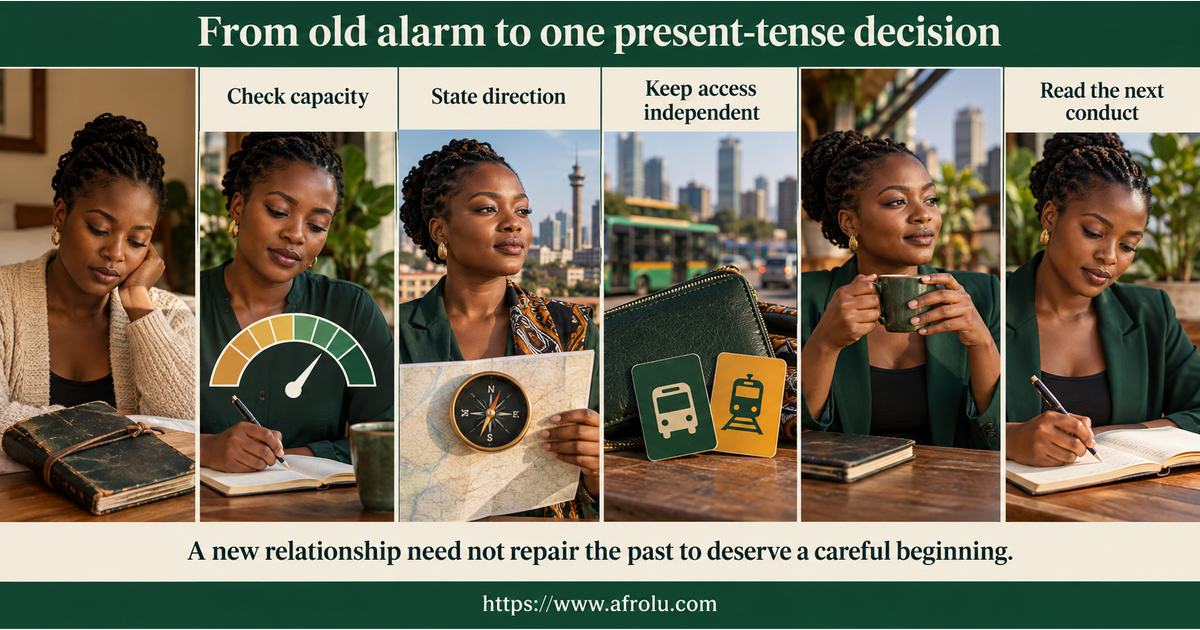
Start from present capacity rather than a perfect readiness deadline. Name a serious direction without implying immediate exclusivity, share relationship history in proportionate layers, use modest public dates with independent transport and return, keep money and private access separate, and decide from repeated conduct rather than a wish to repair the past through someone new.
Starting over · New Relationship Starters
How can an adult date seriously after heartbreak in Nairobi without turning a new connection into recovery proof, a rushed promise, or an unsafe source of pressure?
Dating after heartbreak means beginning new romantic contact after a significant relationship loss or ending. It does not require a reader to be fully finished with every emotion. For serious-minded adults in Nairobi, a useful approach separates present capacity, past history, current relationship agreements, public plans, boundaries, money, privacy, consent, and safety.
Wanjiru wants a serious relationship after a painful ending but refuses to make a new match responsible for proving she has moved on. She shares only broad history, chooses a short public coffee, arranges her own return, and says that serious intention is not immediate exclusivity. The next conduct gives her better information than a dramatic promise, while a pause or clean ending remains available if the offer does not fit.
new journey · serious dating after heartbreak
Wanjiru lets a serious hope grow beside recovery rather than replace it
Heartbreak can make a new connection feel both hopeful and high-stakes. This guide separates recovery, serious direction, public-plan safety, private history, and direct pressure so a new dating journey can remain truthful and voluntary.
Check present capacity, protect the old story, separate serious direction from relationship agreements, choose a public Nairobi plan, use present-tense boundaries, decide from conduct, and keep support outside the new match.
Start from today
Read what you can freely offer now instead of waiting for emotional perfection.
Keep agreements separate
Serious hope, exclusivity, contact, and future plans each need their own truth.
Make a modest first date
A current public venue, independent transport, and a finish time protect choice.
Read the next conduct
Boundaries, repair, and reciprocity show more than a new romantic promise.
Start with the present capacity
Dating after heartbreak is not a test of whether you are over the past
After a painful long relationship ends, Wanjiru wonders whether opening a dating app in Nairobi means she is moving too quickly or waiting too long. She wants a serious relationship eventually, but some evenings a profile prompt makes her miss the familiar routines of her former life. Other days she feels impatient to prove that the breakup did not define her. Both reactions make sense. Neither one has to decide whether she meets someone this week.
Heartbreak can include sadness, relief, anger, loneliness, disrupted confidence, practical changes, and questions about identity. It does not move through a universal timetable, and a dating guide cannot tell Wanjiru when she is healed enough for a relationship. A more useful question is narrower: can she make one present-tense dating decision without asking a new match to settle her grief, rescue her self-worth, or carry a commitment she is not ready to choose?
Wanjiru separates a serious direction from an immediate relationship promise. She can say that she is not looking for a casual arrangement if that is true, while still choosing a short public coffee rather than an intense weekend, immediate exclusivity, or a future-family conversation. Serious dating describes a direction she wants to explore. It does not turn the first person who is kind into an answer to the history she is still processing.
She begins with a small capacity check. Does she have room for one conversation, one public plan, and one honest response if the connection does not fit? Can she keep work, friends, rest, family, health, and privacy intact? If not, a pause is a valid choice. If yes, she can meet a new person slowly while allowing herself to discover whether the new connection is compatible with her life as it is now.
Keep the old story separate from the new person
Past pain can offer lessons without becoming a script for every new match
Wanjiru notices how quickly she wants to compare a new match, Peter, with her former partner. If Peter replies slowly, she feels an old alarm. If he is especially attentive, she worries that the attention cannot last. The feelings are information about her experience, not proof of Peter's intention. She gives herself time to notice the difference before she asks him to explain a pattern that has not yet happened.
She decides what history is useful to share early. It may be enough to say that she has had a significant relationship and is dating thoughtfully now. She does not need to disclose private details about a former partner, legal matters, health information, family conflict, finances, home access, or the exact reasons the relationship ended. Early honesty can be broad and accurate while private history remains private.
When a current moment connects to an old boundary, Wanjiru talks about the present behaviour. Rather than saying, 'My ex did this, so you must not,' she can say, 'I prefer a public first meeting,' or, 'I need time before sharing my home routine.' The boundary stands on its own. Peter does not need a case file in order to respect it, and Wanjiru does not have to relive the relationship in order to make a new choice.
This separation also protects Peter from being cast as either a corrective fantasy or a repeat of the past. He may be a good fit, an honest mismatch, or someone whose conduct raises real concern. Wanjiru can assess what he actually does: whether he keeps a plan, hears a no, handles a difference, stays proportionate about money and access, and returns after a misunderstanding with more clarity rather than more pressure.
Let serious intent become visible through ordinary conduct
A serious direction is not constant contact, immediate exclusivity, or a rushed future
Wanjiru tells Peter that she is interested in a relationship that could become serious, and that she prefers to get to know someone through consistent, real-world behaviour. Peter can say whether he is dating casually, considering other people, open to a committed relationship, or unsure. The conversation may be awkward, but it is kinder than letting labels, daily texting, or physical chemistry silently decide what the connection means.
They keep several decisions separate: whether to have another date, whether either person is dating others, how much contact fits, what each expects around money and privacy, and whether exclusivity is desired. A serious-minded person may still need time before an exclusivity agreement. A person who wants exclusivity may be incompatible with Wanjiru's pace. Neither answer becomes evidence of a moral defect when it is said directly and respected.
Serious intent is better observed in ordinary moments than in a large declaration. Peter confirms a public plan, accepts that Wanjiru will make her own way there, asks reciprocal questions, keeps private information private, and makes a usable repair if he has to change the plan. Wanjiru does the same. These actions do not guarantee a future relationship. They make it possible to assess whether their stated direction has practical support.
Wanjiru resists turning a new connection into a deadline for healing. She does not need Peter to promise that he is unlike her ex, explain every delay, or make a future commitment after one good date. If serious dating becomes real, it will show through clarity, reciprocity, repair, consent, and the fact that both adults can still make independent decisions. A serious label that cannot survive those basics is not yet a relationship structure.

You can be honest about direction without giving up present choice.
Make a Nairobi first plan simple and leaveable
An in-person date should create information, not force a relationship milestone
For a first date, Wanjiru proposes a daytime coffee or short activity in a staffed public place that both adults can reach independently. They agree on a rough start and finish rather than making an entire day the first test of compatibility. The plan has room for an ordinary no: either person can decline, arrive separately, leave separately, or decide that another date is not wanted. That flexibility makes the meeting more useful than a dramatic gesture.
She keeps logistics proportionate. Peter does not need her exact home address, employer, building, live location, commute, banking details, or private family routine to meet for coffee. Wanjiru names a broad area and controls her own transport. She does not ask Peter to fund the date, collect her, or solve a practical problem that would make it harder to leave. A small plan is not a lack of seriousness; it is a chance to see how the connection handles reality.
Wanjiru tells someone she trusts the broad plan and expected finish time. The trusted person is not there to evaluate Peter or approve the date. They provide a check-in and a route to support if Wanjiru wants to leave or the plan changes. She keeps her phone charged and her return arranged. These choices support her autonomy even if the date goes well, because comfort and enthusiasm should not quietly remove independent control.
If Peter changes a public plan to a private home, a hotel, a ride from her address, or an expensive arrangement that creates pressure, Wanjiru can return to the original plan or postpone. A payment, a journey, a gift, or a serious hope does not create a debt for more time, private access, alcohol, physical affection, another venue, or another date. Consent and logistics stay current throughout the meeting.
Use present-tense boundaries rather than a relationship post-mortem
A clear line protects the new connection from the old story and protects you from repeating it
Wanjiru writes down a few lines before she needs them: 'I keep first meetings public,' 'I do not share my home routine early,' 'I am dating seriously but not rushing exclusivity,' and 'I do not send or receive money in new connections.' The lines are specific enough to use when she is hopeful or anxious. They are not punishments for Peter, and they do not make him responsible for her former relationship. They describe what Wanjiru can freely offer now.
A respectful response may still show that the match is not right. Peter may want a faster relationship pace, more spontaneous time, or a different approach to money and privacy. Wanjiru can say that the fit is not there without persuading him to accept her terms. The problem is not a person having different preferences; it is pressure, guilt, anger, surveillance, or repeated bargaining that treats her boundary as a flaw to overcome.
She watches the second request. Someone may accept a public first plan, then later ask for a private visit; respect her contact window, then demand a late-night call; agree that money stays separate, then create an emergency story. A pattern of returning to the same access point is more informative than a polished apology. Wanjiru can slow down or end contact based on what happens, even if she cannot explain the person's motive.
If a boundary brings threats, stalking, blackmail, unwanted sexual pressure, account compromise, repeated contact after a stop, or fear, Wanjiru no longer treats the situation as a dating compatibility question. She can preserve relevant evidence, use platform tools, block where appropriate, tell trusted support, and seek local specialist, legal, health, or emergency help suited to the risk. A dating guide cannot assess immediate danger.

A past alarm and a present safety concern need different responses.
Choose a new journey from present evidence
Continue, slow down, pause, or close without asking a new match to settle the past
After a few dates, Wanjiru reviews concrete evidence rather than the intensity of her feelings. Has Peter shown up as agreed? Can they discuss serious direction without demanding a future? Does he accept a no? Does she feel able to be herself, keep her routines, and name uncertainty? The answers do not need to be perfect. They help her decide whether another small step would create useful information or merely extend hope without a stronger basis.
If the connection is promising, she can continue with a proportionate plan: another public date, a conversation about current dating agreements, or a more specific discussion about the relationship direction. She does not have to disclose everything or make a permanent choice because the dates have felt good. Seriousness can become clearer through repeated, ordinary conduct rather than a leap from heartbreak into a relationship identity.
If Wanjiru needs more time, she can reduce contact or pause. A pause can protect grief, work, health, family, or emotional capacity without declaring that she will never date again. She can say that she is not ready to continue at the current pace. Peter is allowed to decide that the pause does not work for him. Both adults can have a real boundary without making the other responsible for fixing it.
If the offer remains vague, one-sided, pressuring, or unsafe, Wanjiru can close. She may say that the connection does not fit what she is looking for and that she is not continuing. She does not need to use a new relationship to prove that she has moved on, and she does not need to remain in an unworkable connection because starting again feels difficult. The future stays open when she protects the present choice.
Let a new relationship sit beside a supported life
Grief, confidence, safety, and serious dating can benefit from more than one source of care
Wanjiru recognises that a first date can awaken both hope and grief. She makes room for support outside the dating connection: a friend who knows her well, exercise, sleep, time with family, faith or community practice, a creative routine, or time alone that does not feel like punishment. These choices help her remember that a new person's interest is not the only measure of whether she is rebuilding a life after loss.
She may choose to speak with a therapist, counsellor, or another qualified professional if the breakup or a new dating experience is making daily life difficult. A trusted friend can also help with practical first-date safety by knowing a broad plan and check-in time. Neither kind of support needs to make her dating decisions for her. The point is to increase her capacity to choose and to keep a new connection from carrying every emotional task.
If Peter's conduct causes fear, or if Wanjiru faces ongoing sadness, anxiety, sleep trouble, concentration problems, or hopelessness that interferes with life, a relationship guide is not enough. Suitable health care, local specialist support, platform reporting, legal advice, or emergency services may be appropriate depending on the situation. Asking for help is not evidence that she failed at dating or at recovery.
Wanjiru's final question is not whether she can erase the past before she is allowed to love again. It is whether this new journey leaves room for honesty, rest, friendship, safety, independent choice, and a serious relationship that can grow through evidence. A healthy future does not require abandoning the person she became through heartbreak. It should be able to meet her there.

Choose the smallest next move that respects your present capacity.
Eight serious new-journey moments in Nairobi
A slower reply brings back a feeling from the former relationship
A familiar feeling is information about your history, not proof about the new person.
Return to the current facts before making a claim.A new match asks whether you want a relationship
Direction can be named without an immediate commitment or exclusivity agreement.
Describe what is true today.A first date asks why the previous relationship ended
Honesty can be broad while private history remains private.
Share only what serves the current conversation.A coffee date becomes a private ride or home invitation
The shift can remove the exit you planned around.
Keep the public plan or postpone.A match spends money and expects more time or intimacy
Payment does not create a relationship or consent obligation.
Thank them if you wish and keep your own finish time.Someone says serious dating requires immediate exclusivity
Direction and exclusivity are separate agreements.
Name the stage you can honestly offer.A limit is accepted once and then requested through a new story
The pattern matters more than the first apology.
Reduce access or close based on current conduct.Closing a connection brings repeated accounts or threats
This moves beyond ordinary dating communication.
Save records, block, report, and seek appropriate support.Signals about capacity, direction, access, and safety
You can name what you are available for today without promising a healed future.
A serious direction is separated from immediate exclusivity or a future plan.
Past feelings are noticed without being projected automatically onto a new match.
Relationship history is shared in layers as relevance and trust grow.
A public first plan has a current time, modest scope, and independent return.
Your home, work, route, money, records, and live location remain private early on.
A payment or gift does not change your consent or finish time.
A match can hear a boundary without making it a referendum on your past.
A respectful mismatch remains possible without blame.
You observe the second request and the next conduct.
A pause can protect capacity without becoming a permanent verdict on dating.
A clean closure can be serious and self-respecting.
Friends, routine, and qualified care remain available outside the connection.
Persistent distress can call for support beyond a dating decision.
Threats, fear, stalking, coercion, or account pressure move the response to safety.
Choose the next move from present evidence
| Situation | What it may mean | What to do next |
|---|---|---|
| Grief wave | A new interaction has activated an old loss. | Pause and separate memory from present conduct. |
| Serious question | A match wants to know your relationship direction. | Name a serious hope without promising a timeline. |
| History request | A new person is asking for more private context than you want to give. | Share a broad truth or say you are not discussing that yet. |
| Public date | A practical meeting can create real-world information. | Keep arrival, cost, and return independently controlled. |
| Changed venue | The planned exit and privacy may be disappearing. | Keep the original public plan or postpone. |
| Fast exclusivity | A label is being asked to solve uncertainty too soon. | Separate direction, dating status, and exclusivity. |
| Boundary respect | A limit is heard and carried into the next interaction. | Continue only if the rhythm still fits. |
| Repeated pressure | Access is being requested through guilt, gifts, or a new story. | Reduce access or close without proving motive. |
| Need for pause | Capacity is not available for the current pace. | State the pause and let both adults choose from it. |
| Threat or fear | The situation has moved beyond compatibility. | Preserve records, block or report, and seek suitable support. |
Twelve lines for direction, history, plan, and boundaries
“I am interested in a serious relationship, and I prefer to build it through consistent, ordinary time together.”
“I have had an important relationship before, and I am not ready to share the details early on.”
“I am comfortable with a daytime public coffee and my own way home.”
“I do not share my starting point or accept pickups for a first date.”
“I am dating thoughtfully and am not rushing exclusivity.”
“I do not send or receive money in new online connections.”
“Thank you, but I am keeping the plan short and leaving at the time I chose.”
“I have answered that, and I need you to respect the limit.”
“I need to slow down and decide what I can genuinely offer right now.”
“It sounds like we want different relationship rhythms, and I do not want to force either one.”
“This connection does not fit what I am looking for, so I am not continuing.”
“Do not contact me again.”
Know the difference
A grief response, serious intention, a mismatch, and access pressure are different facts
A feeling from the past, a careful serious direction, a slow public first date, or a different pace can be handled with truth, boundaries, and room for either adult to choose.
Money demands, private access, gift obligation, ignored limits, threats, stalking, coercion, and fear require a firm boundary and appropriate safety support.
A new journey does not need to erase the past before it can protect the present choice.

A serious future and a present no can coexist.
Separate recovery, serious learning, mismatch, and pressure
| Type or dimension | What it describes | Best next question |
|---|---|---|
| Grief response | A feeling from the past rises during a new interaction. | Slow down and return to current facts. |
| Serious direction | A person names the kind of relationship they hope to build. | Ask what is true now and what is still open. |
| Slow learning | Two adults choose public, proportionate dates before major agreements. | Observe consistency and repair. |
| Different pace | A match wants a relationship structure you do not want yet. | Recognise incompatibility without blame. |
| Public plan | Arrival, cost, privacy, and return remain independent. | Use the plan to learn, not to prove commitment. |
| Gift obligation | Money or a gesture is linked to access or gratitude. | Keep your chosen boundary and finish time. |
| Repeated boundary | A no returns through a different request or pressure. | Reduce access or close. |
| Money or records | New romance is linked to transfer, codes, or documents. | Do not send and use platform tools. |
| Threat or stalking | Fear or unwanted pursuit appears. | Prioritise safety support. |
A present-tense start before a bigger relationship promise
Use present capacity
Readiness is about what you can freely offer today, not an emotional perfection test.
Share in layers
Broad truth can be honest without turning private relationship history into early access.
Separate the agreements
Serious direction, dating others, contact, exclusivity, and future plans each need their own conversation.
Keep plans modest
A public first date can create more useful evidence than a large romantic gesture.
Read the next conduct
The response after a boundary matters more than a reassuring promise.
Support the whole life
Friends, routine, qualified care, and safety support can make new dating decisions less fragile.
Questions organised by purpose and depth
Choose a few prompts that fit the moment. This is a reference library, not a list to complete.
Capacity check
Use before beginning a new conversation.
- What can I genuinely offer this week?
- What feeling belongs to the past?
- What would a small next step look like?
Direction check
Use before calling a new connection serious.
- What do I hope for generally?
- What exists now?
- What agreement is still missing?
Plan check
Use before a Nairobi first date.
- Is the plan public and current?
- Can I arrive and leave independently?
- What private fact can remain private?
Safety check
Use when access pressure appears.
- Is money, privacy, sex, secrecy, or fear involved?
- Can I stop contact safely?
- Who can I tell or contact for help?
Look more closely at recovery, disclosure, plans, and support
No universal readiness clock
Relationship loss can bring varied emotions and practical changes; a reader may need time, support, or a smaller dating pace.
Evidence limit: Afrolu cannot determine whether someone is ready to date.
Honesty in layers
Early conversation can include a broad truthful relationship history while private details wait for relevance and trust.
Evidence limit: No disclosure formula fits every person or situation.
Direction versus agreement
Serious intention, exclusivity, contact rhythm, and future plans are separate decisions that can develop at different speeds.
Evidence limit: No label guarantees commitment or compatibility.
Current public plans
A practical first meeting can be specific about a time and broad area while protecting home, work, and route privacy.
Evidence limit: A public setting does not certify a person or venue.
Present-tense lines
A boundary can state what you participate in without requiring a detailed account of the relationship that preceded it.
Evidence limit: A guide cannot judge another person's motive.
When more help is useful
Ongoing distress, fear, or threat can call for qualified health care, specialist local support, platform tools, legal advice, or emergency services.
Evidence limit: Afrolu is not a clinical, legal, or crisis provider.
Common shortcuts that make a new date carry too much
Using a new match as recovery proof
A relationship cannot reliably settle the meaning of a past loss.
Making a first date a milestone
A big gesture can create pressure before enough evidence exists.
Sharing the whole story early
A new person can respect a boundary without receiving a private history archive.
Treating serious intent as instant exclusivity
Direction and relationship structure are separate agreements.
Explaining every boundary through the ex
A present-tense limit can stand on its own.
Ignoring fear to appear healed
Safety concerns require protection, not another opportunity to prove openness.
Choose one resource for recovery, intention, or safety
Use a guide for post-heartbreak dating, serious direction, or observed warning patterns before asking a new connection to carry more than it can hold.
Explore the guide library
Show more related guides
Continue with Afrolu
Show more Afrolu guides
Sources used for this guide
Afrolu reviewed these health, research, safety, or public guidance resources while editing this page. They support the behaviour and safety guidance; they do not diagnose any individual described by a reader.
Questions about serious dating after heartbreak
Do I need to be fully over a breakup before dating?
There is no universal timeline. A useful question is whether you can make a present-tense dating choice without asking a new match to settle the past.
Can I want a serious relationship after heartbreak?
Yes. A serious direction can be honest while you still choose gradual, public, proportionate early dates.
How much should I share about a former relationship?
Share what serves the current decision. Broad truth can be honest while private details remain private.
Does a good first date mean I am ready for exclusivity?
No. A positive date can support another small step without deciding relationship structure.
Should a new match pick me up or know my address?
Keep early plans public and independently reachable; a broad meeting area is usually enough.
Do I owe more time because a date pays?
No. Payment, travel, gifts, or serious hope do not create a debt for access, intimacy, or another date.
What if a past relationship makes a new delay feel alarming?
Notice the feeling, compare it with the current facts and pattern, and state a present boundary if needed.
What if a match wants immediate exclusivity?
Separate serious direction from exclusivity. Name the stage you can honestly offer and allow an honest mismatch.
What if a person asks for money, records, or private images?
Do not send them. Preserve concerning contact, use platform tools, and seek support if needed.
What if I feel afraid or threatened?
Prioritise safety: preserve relevant records, reduce access, and seek appropriate local specialist, legal, health, or emergency support.
One thing to do now
Let a serious future meet the life you are rebuilding
Choose the smallest next step that protects present capacity, private history, a current public plan, independent transport and money, consent, an easy exit, and the freedom to continue, pause, or close without explaining the whole past.