Two tracks · no late-arrival clock
Return to Dating After Heartbreak Without an Age Deadline
A later-entry, career-aware guide to heartbreak, low-pressure dates, privacy, recovery capacity, present consent, varied timelines and a six-week review.
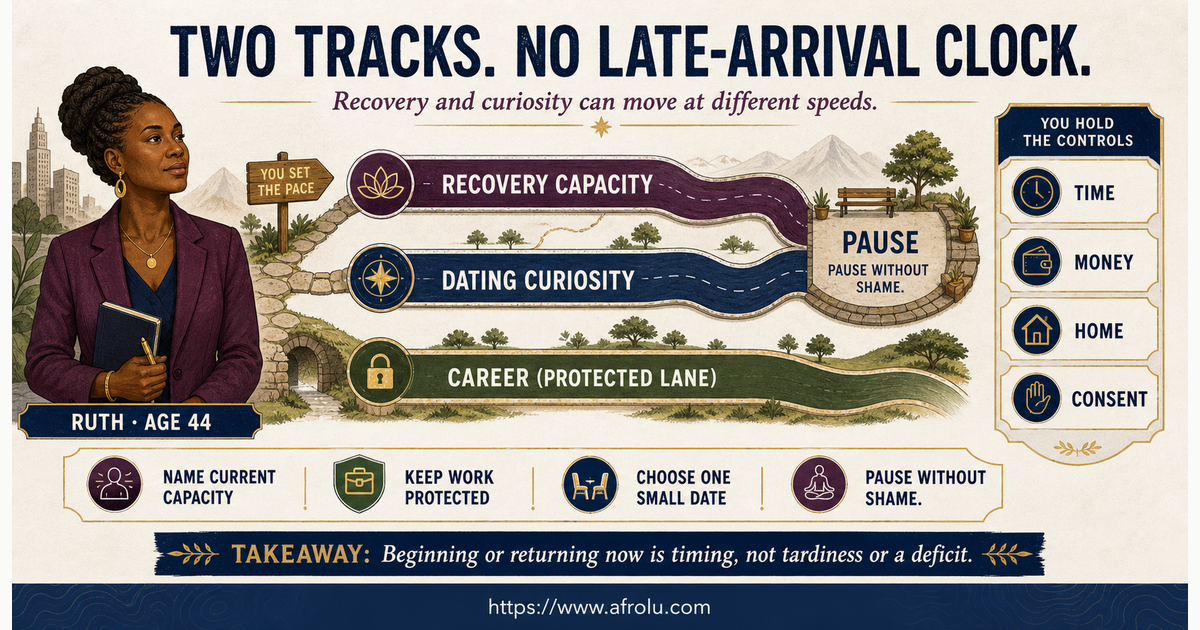
Recovery and curiosity may move at different speeds.
Written and edited by Clarisse Uwimana · Dating Culture Editor
Later entry means beginning or returning now; it never means tardiness or a deficit. Keep two tracks separate: RECOVERY CAPACITY covers daily functioning and support, while DATING CURIOSITY asks whether you want to know this particular adult. Protect a third practical career line. Choose one short public date, disclose only present-relevant context and keep money, transport and consent independent. Review after a reader-chosen interval without treating return as success. Persistent overwhelming impairment needs qualified care; pressure or danger needs appropriate safety help.
Starting over · Late Entrants
Can I explore one new connection while grief still changes from day to day, without sacrificing work, oversharing history, assigning the new adult to heal me or obeying an age-based deadline?
Low-pressure dating after heartbreak is a bounded present-tense experiment in which an adult explores genuine curiosity without promising that a new connection will erase the past, certify recovery or become a commitment. Recovery, desire, career capacity and external conduct remain separate evidence lines.
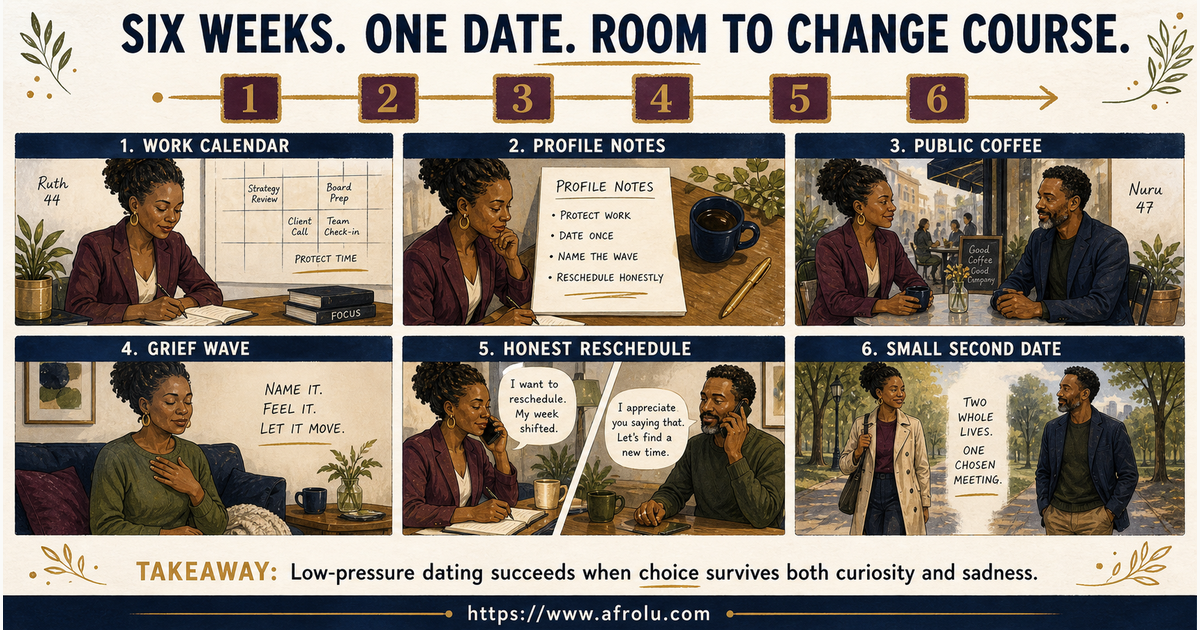
Ruth and Nuru are fictional mature adults, 44 and 47. Ruth protects a demanding project, chooses one seventy-minute coffee and later reschedules when a grief wave and deadline collide. At six weeks, two dates and honest limits support another small month. The outcome is not a cure or age victory; it is continued informed choice.
The two-track re-entry map
Let recovery and curiosity travel at different speeds
Clarisse removes the age clock, protects the career line and gives one small date only the job it can perform.
Assess function and support, name person-specific curiosity, design a bounded meeting and review several equally valid outcomes.
Recovery capacity
Observe daily function and use trusted or qualified support without demanding emotional perfection.
Dating curiosity
Choose this adult for present interest rather than proof, rescue or replacement.
Career capacity
Keep essential work, rest and money visible inside the dating design.
Several complete outcomes
Continue, pause, change route or seek support without ranking one as recovery.
Remove the false deadline first
Beginning or returning later is timing, not tardiness, damage or a deficit
In this route, 'later entry' means beginning or returning to dating at a later point in adult life. It never means tardiness, failure, reduced desirability or a missed deadline. Ruth may be dating after a long partnership, a focused career chapter, caregiving, grief, divorce, widowhood, personal choice or no previous relationship at all. Those histories are not interchangeable.
Heartbreak can affect mood, sleep, concentration, identity and daily functioning, but a dating guide cannot diagnose depression or prescribe a healing date. Studies find varied trajectories in specific samples. Averages are useful for research questions; they are unsafe as promises that a reader should be ready by month one, month three or any birthday.
Readiness is also not the absence of every memory or difficult feeling. A respectful first date can coexist with sadness, comparison or nervousness. The practical test is whether Ruth can make a present choice, see Nuru as a separate adult, keep work and ordinary care functioning, communicate relevant limits and stop or seek support when the experience becomes overwhelming.
There is no obligation to date as proof of recovery. A pause, friendship, community activity, one short date or a larger app break can all fit. Persistent overwhelming symptoms, major daily-life interference or safety concerns deserve suitable local professional help. A new match should not be assigned the role of clinician, rescuer or evidence that the past no longer matters.
Separate recovery from curiosity
Two tracks can move at different speeds without cancelling each other
RECOVERY CAPACITY asks whether Ruth can sleep, work, eat, manage ordinary responsibilities, access support and tolerate reminders without the whole day collapsing. A difficult week may require more care or a pause. It does not erase every prior step. Recovery can include fluctuation, and no new date is entitled to private details about therapy, health or the former relationship.
DATING CURIOSITY asks whether Ruth genuinely wants to know this particular adult, not merely prove attractiveness, escape silence, replace an ex or satisfy an age deadline. Curiosity can be small. One public coffee may be enough. It should survive the possibility that the meeting is pleasant but not transformative and that either adult says no afterward.
CAREER CAPACITY is a third practical line, not a rival to romance. Protect immovable deadlines, leadership responsibilities, travel, rest and financial stability. Choose low-pressure times that do not turn a date into a reward after exhaustion. A compatible adult may want more availability and still accept that the present season does not offer it.
The tracks can produce different actions. Strong curiosity with low capacity may mean a later date. Improving recovery with no desire may mean no dating. Stable functioning and one manageable question may support a small experiment. Threats, money pressure, sexual coercion or disrespect are external conduct and should never be averaged against how healed Ruth feels.
Follow a small experiment, not a transformation arc
Ruth lets one date be one date while work and grief remain real
Ruth, 44, ended a long relationship nine months ago and is leading a demanding project. She feels more stable in ordinary life but still has sharp memory waves. Instead of declaring herself healed, she writes two tracks. Recovery capacity is mostly steady with support. Dating curiosity is narrow: she wants one public coffee, no rapid exclusivity and no pressure to narrate the former relationship.
She meets Nuru, 47, after three specific messages. They agree to seventy minutes near Ruth's office, arrive independently and pay an affordable share. The conversation is pleasant. When Nuru asks what she wants, Ruth says she is open to low-pressure dating and will not make a long-term promise from one meeting. He says he prefers a steady path but can decide one date at a time.
Two days later, a work milestone and an anniversary reminder produce poor sleep and intrusive memories. Ruth does not call the date a mistake or ask Nuru to reassure her all night. She says she cannot meet that weekend and offers a later Sunday. Nuru accepts without becoming her counsellor. Ruth uses existing support and keeps the work boundary.
At week six they have had two short dates. Ruth still feels grief sometimes and also sees Nuru as a distinct person. She chooses another low-pressure month with no exclusivity assumption. If either adult wants a different pace, they will name it. The experiment succeeds because consent, functioning and honest expectations remain available—not because romance has cured heartbreak.
Keep four evidence lenses independent
Recovery, curiosity, capacity and conduct should never become one score
RECOVERY can continue when difficult feelings rise and settle while ordinary choices remain available. Pause when reminders dominate the date or aftercare repeatedly consumes days. Seek qualified support when distress is persistent, overwhelming or interfering with daily functioning. A symptom should not be hidden to appear dateable, and a new match should not be made responsible for treating it.
CURIOSITY is present when Ruth wants to learn about Nuru as a separate adult and can accept uncertain outcomes. Pause when the main goal is to prove worth, provoke an ex, erase loneliness immediately or recreate a familiar bond. Mixed motives are common; the question is which one controls the next action and whether it can be named honestly.
CAPACITY is workable when the date fits money, travel, career, sleep and existing support. Review one demanding week or redesign duration. Pause when dating repeatedly displaces essential work or rest. Low-pressure does not mean permanently vague; it means the effort and commitment asked today match what both adults can freely offer.
CONDUCT is respectful when pace, privacy, money, consent and a changed plan are accepted. A mismatch can end without blame. Stop when Nuru pressures for ex details, compares grief to loyalty, demands access, sends financial requests, controls transport, ignores sexual boundaries or retaliates after no. External pressure is not evidence that Ruth is simply unhealed.

Do not average grief, desire, fit and safety into one readiness score.
Keep disclosure present-tense and proportionate
Ten short sentences make low-pressure dating honest without turning it into therapy
For PACE: 'I am open to one date at a time.' 'I am not ready to discuss exclusivity.' 'I prefer short plans during this work season.' Those lines name current capacity and leave Nuru free to want something else. Low-pressure dating must not be used to promise an eventual commitment Ruth cannot yet offer.
For HISTORY: 'A past relationship ended, and I keep the details private.' 'A memory is strong today; it is not your job to fix it.' 'I want to know you as yourself.' Relevant context is available without making Nuru absorb private records, compete with the former partner or become the test of whether Ruth has recovered.
For CAPACITY: 'This deadline means I need to reschedule.' 'I can offer Sunday afternoon, or we can leave it.' 'I do not send money or share account access.' Career pressure, finances and digital safety remain discussable. An alternative is an offer, not a demand that Nuru wait through an unknown season.
For CHOICE: 'I am interested, and this physical answer is no.' 'I do not want another date.' 'I need a pause and cannot ask you to wait.' Consent, attraction and continuation are separate. Use a brief safe ending, then access controls and suitable support if the boundary is ignored or external risk appears.

Share what affects the present date, not your whole history on demand.
Review the design rather than grading healing
Five cards keep self, work, desire, boundaries and distress visible
SELF asks whether identity is widening beyond the former relationship and the new connection. Ruth should still recognise friendships, interests, routines and private goals. Research on self-concept after breakup suggests identity recovery can matter, but the cited small young-adult study cannot prescribe what a mature adult must feel by week six.
WORK asks whether key responsibilities, sleep and financial stability remain intact. DESIRE asks whether Ruth chooses Nuru rather than a generic role he could fill. BOUNDARIES asks whether pace, history, money, transport and consent remain effective after disappointment. These cards can point in different directions and should not be averaged into a single pass mark.
DISTRESS asks about persistence, intensity and interference across daily life. A grief wave after a date may call for rest or familiar support. Repeated inability to function, overwhelming symptoms or worsening health deserves qualified local assessment. This page cannot determine whether dating should continue alongside care; the reader and appropriate professionals must decide from the full context.
Choose CONTINUE SMALLER, PAUSE, CHANGE ROUTE or SEEK SUPPORT. Changing route might mean friendship, offline introductions or no active dating. Tell Nuru only what affects his choice. Do not use a sixth-week conversation to promise a future, demand reassurance or compare progress with an ex's imagined life. The review exists to restore agency.

The review date measures fit; it does not certify healing.
Name the present purpose
Low-pressure re-entry, rebound dating, avoidance, companionship and pause are not synonyms
LOW-PRESSURE RE-ENTRY is a small, honest dating experiment with bounded time and no promise that the new adult will repair the past. REBOUND DATING is commonly used when a new connection begins soon after a breakup or partly manages distress. Timing alone cannot reveal function, and research does not support one simple moral verdict for every rebound.
AVOIDANCE means dating activity mainly helps prevent contact with grief, identity questions or necessary practical work. That possibility deserves reflection, not shame. COMPANIONSHIP may be the present goal when both adults understand that closeness is not an agreed long-term relationship. A RECOVERY PAUSE removes romantic tasks while ordinary support and identity receive attention.
A new connection can contain more than one purpose. Ruth may enjoy Nuru, feel less lonely and still encounter grief. Ethical clarity comes from relevant truth: what she can offer, what remains undecided, whether other dating exists and which role he is not being asked to carry. Nuru remains free to decide that the present route does not meet his needs.
Choose the route that protects both adults' informed choice. Continue when expectations and capacity fit. Redesign when pace or label is the problem. Pause when dating crowds recovery or career. Seek qualified care for persistent impairment and suitable safety help for coercion or danger. No new relationship should be prescribed as treatment.
Eight later-entry moments where grief, curiosity and career meet
Ruth uses one short Sunday session
The app is a bounded discovery tool rather than a test of whether she is healed.
End on time even if no promising match appears.A former memory surfaces during a pleasant date
Sadness and curiosity coexist without proving the meeting was wrong or right.
Return to the present and leave or pause if capacity drops.Nuru asks why the relationship ended
Relevant context can be offered while private detail remains Ruth's choice.
Name the boundary and redirect to present expectations.A project deadline takes the planned weekend
One reschedule can be honest when it includes a realistic alternative and freedom to decline.
Offer the Sunday that exists, not an indefinite promise.Sleep and concentration worsen for several days
The change deserves care and may change dating capacity without creating a universal forecast.
Pause the date and use existing or qualified support as needed.Ruth notices Nuru's habit differs from her ex
Difference is information about a new adult, not automatic proof of danger or superiority.
Ask about the present habit instead of making a hidden comparison test.Nuru wants exclusivity sooner
His preference and Ruth's limit can both be legitimate while the routes do not fit.
Discuss once, then end or continue only through a mutual agreement.A no is framed as evidence that Ruth is damaged
External disrespect is not a recovery exercise she must pass.
End the date or contact and use suitable support if pressure continues.Ten signs across recovery, curiosity, capacity and conduct
A difficult memory can be noticed without controlling the entire date
The new adult is seen as distinct rather than a replacement or comparison test
Curiosity survives the possibility of no second date or instant transformation
Work, sleep, money, friends and ordinary responsibilities remain intact
Pace and relevant history can be named without forced disclosure
The reader can pause without treating age or time as an emergency
Dating is mainly being used to prove worth, provoke an ex or escape every feeling
A new match is expected to regulate distress or certify recovery
Persistent overwhelming symptoms interfere with ordinary daily functioning
Pressure, money requests, tracking or coercion is treated as external conduct
Review low-pressure re-entry through ten separate questions
| Situation | What it may mean | What to do next |
|---|---|---|
| Is curiosity about this adult specific? | Fits: Ruth wants to learn who Nuru is. Needs review: Some comparison is noticed and can be redirected. Stop: Any person could fill the role of proof or escape. | Pause before assigning a stranger a recovery job. |
| Can a difficult feeling coexist with choice? | Fits: The feeling rises while options remain. Needs review: The date needs shortening or redesign. Stop: Distress is overwhelming or persistently impairing. | Use suitable support and do not force exposure through dating. |
| Does career capacity remain real? | Fits: Dates fit work, money and rest. Needs review: One deadline needs rescheduling. Stop: Essential responsibilities repeatedly collapse. | Reduce or pause dating rather than borrowing from the career line. |
| Can pace be stated honestly? | Fits: One date at a time is mutually understood. Needs review: A different pace needs discussion. Stop: Future commitment is implied to prevent departure. | Correct the promise and let the other adult choose. |
| Is history disclosure voluntary? | Fits: Only relevant present context is shared. Needs review: A curious question is redirected. Stop: Private details or records are demanded. | Protect privacy and act on repeated pressure. |
| Is the new adult allowed to be separate? | Fits: Differences are explored directly. Needs review: One comparison is named and released. Stop: Nuru is graded against or used to reach the ex. | Stop the comparison test and reassess readiness for this date. |
| Can consent remain current? | Fits: Every answer is specific and reversible. Needs review: A mismatch ends respectfully. Stop: Sadness, cost or patience is used to demand access. | Leave or close; heartbreak never removes present consent. |
| Can either adult decline the route? | Fits: No is accepted without diagnosis. Needs review: Disappointment is repaired once. Stop: Age, damage or scarcity is used as pressure. | Reject deficit framing and end access if it repeats. |
| Does the review invite several outcomes? | Fits: Continue, pause and stop are equally real. Needs review: Return is being treated as the preferred result. Stop: Dating is declared the only proof of healing. | Rewrite the review around function and free choice. |
| What kind of help fits the strongest signal? | Fits: Trusted support matches ordinary strain. Needs review: Qualified assessment may be useful. Stop: Danger, coercion or crisis requires urgent suitable help. | Do not use a date, app or article as the wrong kind of support. |
Ten lines for pace, history, work, money, consent and pause
“I am open to one date at a time.”
“I am not ready to discuss exclusivity.”
“I prefer short plans during this work season.”
“A past relationship ended; I keep details private.”
“This feeling is not your job to fix.”
“I want to know you as yourself.”
“I can offer Sunday, or we can leave it.”
“I do not send money or share account access.”
“I am interested, and this answer is no.”
“I need a pause and cannot ask you to wait.”
Know the difference
Five post-heartbreak routes can contain sadness without sharing the same purpose
A small dating experiment is chosen for genuine curiosity, with honest limits and no demand that the new adult repair the past.
Rebound, avoidance, companionship or pause may fit differently depending on function, disclosure, capacity and mutual agreement.
The presence of grief is not the whole ethical test; present consent and truthful expectations carry more weight.

A new connection may accompany recovery; it cannot be assigned to complete it.
Separate five post-heartbreak routes without moral ranking
| Type or dimension | What it describes | Best next question |
|---|---|---|
| Low-pressure re-entry | One small date explores a distinct adult without assigning a recovery outcome. | Review curiosity, function and boundaries after each step. |
| Rebound dating | A new connection begins near a breakup and may partly regulate distress or restore security. | Name what can honestly be offered and avoid universal moral claims. |
| Avoidance through dating | Activity mainly prevents contact with grief, identity or practical recovery work. | Pause and use suitable support rather than adding romantic volume. |
| Companionship | Closeness is the present aim without an agreed long-term direction. | Make expectations and endings explicit. |
| Recovery pause | Romantic tasks stop while ordinary life, support and identity receive attention. | Review only when genuine desire returns, without a deadline. |
| Friendship | Mutual non-romantic connection is not kept as a hidden waiting room. | Accept the stated bond or step back. |
| Serious dating | Long-term direction is stated but still requires current capacity and evidence. | Do not use serious intent to rush exclusivity or healing. |
| Unsafe connection | Pressure, tracking, money demands, coercion or threats create a separate risk route. | Protect access and use appropriate local help. |
Use the two-track re-entry map in six moves
Remove the age clock
Beginning or returning later is timing, never tardiness, failure or a deficit.
Separate two tracks
Recovery capacity and dating curiosity may move independently.
Protect the career line
Work, rest and money remain part of compatibility rather than proof of avoidance.
Keep disclosure proportionate
Share present effects without surrendering a private breakup history.
Let one date stay small
A public meeting can answer fit without becoming treatment or commitment.
Review several outcomes
Continue, pause, change route and seek support are equally complete choices.
Questions for recovery, curiosity, career and review
Choose a few prompts that fit the moment. This is a reference library, not a list to complete.
Recovery questions
Observe function without a deadline.
- How is ordinary sleep?
- Can work still happen?
- Which feeling is strongest?
- What support already exists?
- Is qualified help needed?
Curiosity questions
See the new adult separately.
- Why this person?
- What do I want to learn?
- Can no be acceptable?
- Am I proving something?
- What can one date answer?
Career questions
Protect the life already built.
- Which deadline is immovable?
- What date window is real?
- Is cost comfortable?
- How will I return?
- What happens after rescheduling?
Review questions
Keep every outcome open.
- Is identity widening?
- Does desire remain?
- Did boundaries hold?
- What did distress do?
- Continue, pause, change or support?
What breakup research and stress guidance can—and cannot—support
A small study treats breakup as a stress model
The study compared adults after recent breakups with partnered adults and documented varied mood, anxiety, intrusive-thought and sleep experiences, supporting careful attention without assuming every painful reaction is a disorder.
Evidence limit: The sample was small and cannot diagnose a reader or set a recovery timetable.
Longitudinal emerging-adult research examines coping pathways
The study followed 196 emerging adults and reported associations linking attachment insecurity, self-punishment or accommodation coping with later distress, offering group-level questions about support and self-blame.
Evidence limit: The sample and model do not determine Ruth's attachment, cause or treatment.
Repeated measures explore self-concept recovery
A small young-adult study collected self-concept and wellbeing observations across eight visits after separation, informing the guide's attention to identity beyond relationship roles.
Evidence limit: The research cannot prescribe an identity exercise or generalise a mature-adult timeline.
Trajectory research finds varied post-breakup patterns
The study identified several depressive-symptom trajectories and associations involving rumination and daily-life interference, supporting the rejection of one universal route or clock.
Evidence limit: Trajectory groups are research descriptions, not labels readers should apply to themselves.
A young-adult cohort observed average recovery with important caveats
The cohort found temporary average symptom change around breakups while explicitly discussing structural advantage, individual variation and the risk of ignoring wider context.
Evidence limit: Its sample average must not be turned into a three-month deadline for Ruth or any reader.
WHO supports coping and qualified help when needed
WHO public-health guidance explains that stress can affect mind and body and advises seeking health care when symptoms make coping or daily functioning difficult.
Evidence limit: General guidance does not diagnose heartbreak, prescribe dating exposure or replace local care.
Six ways age and recovery pressure distort re-entry
Using age as urgency
Later entry is treated as lateness. Repair: choose from present capacity and desire.
Waiting to feel nothing
Readiness becomes emotional perfection. Repair: assess choice, function and honesty.
Assigning a healer
The new adult carries recovery. Repair: keep support outside the date.
Oversharing to prove honesty
Privacy is surrendered under pressure. Repair: disclose only what affects current choice.
Sacrificing the career line
Dating proves availability. Repair: fit dates around essential work and rest.
Making return the success state
A pause looks like failure. Repair: allow every review outcome equal dignity.
Use a reviewed resource that matches the decision
This guide focuses on the relationship decision, so it does not rank dating apps. Check current prices, safety tools, and local availability before choosing a service.
Explore the guide library
Show more related guides
Continue with Afrolu
Show more Afrolu guides
Breakup distress, coping, identity, trajectories and stress sources
Afrolu reviewed these health, research, safety, or public guidance resources while editing this page. They support the behaviour and safety guidance; they do not diagnose any individual described by a reader.
Dating-after-heartbreak questions for later-entry professionals
Am I too late to date after heartbreak?
No. In this guide, later entry means beginning or returning at a later point in adult life; it never means tardiness, failure or a deficit. There is no age deadline. Decide from present desire, functioning, practical capacity and safety. You may date slowly, pause, choose companionship or not date without treating any route as lost time.
How long should I wait after a breakup?
Research does not provide one universal waiting period. Studies use specific, often young-adult samples and report varied trajectories. Ask whether ordinary functioning is stable enough, curiosity is about this person, expectations can be honest and a date can remain small. Persistent overwhelming impairment deserves qualified assessment. Timing alone cannot certify readiness or predict harm.
Do I need to be completely healed before a first date?
No one can define complete healing through the absence of every memory or feeling. Sadness can coexist with choice. The important questions are whether you can see the new adult separately, keep ordinary life functioning, communicate present limits and stop freely. Dating should not be prescribed as treatment, and pausing remains a valid outcome.
How much should I tell a new date about my ex?
Share only context that affects informed choice now: the relationship ended, the pace you can offer, any continuing practical contact that matters and what remains undecided. You do not owe private messages, therapy details or a full account. Avoid using the new person to process the former relationship or prove that one partner was better.
What is low-pressure dating after heartbreak?
It is a small, honest route with bounded time and no hidden promise that dates will remove grief or become a commitment. One short public meeting, independent transport and a clear review may be enough. Low pressure still requires truthful scope, sexual-health conversations when relevant, current consent, money boundaries and respectful endings.
Is dating soon after a breakup always a rebound?
No single timeline or label explains function. A new connection may include attraction, companionship, avoidance, comfort and genuine compatibility at once. The ethical task is honest present expectations and freedom for both adults. If dating mainly prevents necessary functioning or makes a stranger responsible for recovery, a pause and suitable support may fit better.
How can I protect a demanding career season?
Mark immovable work, travel, sleep and financial needs before offering date time. Choose short plans near a practical route and avoid using dates as rewards after exhaustion. Reschedule with one realistic option and freedom to decline. A compatible person may want more availability; a clean mismatch is healthier than an implied future you cannot support.
What if a grief wave hits after a good date?
Meet basic needs, use familiar support and avoid declaring the date a mistake while highly activated. Name the effect without asking the new person to treat it. You may shorten, reschedule or pause. Seek qualified care when symptoms are persistent, overwhelming or impairing. A good date does not guarantee recovery, and sadness does not automatically cancel genuine interest.
How do I know whether I am comparing everyone with my ex?
Notice whether differences become automatic verdicts, whether you ask this adult direct questions and whether curiosity can survive an unfamiliar answer. One comparison is ordinary. A repeated secret test can prevent real discovery. Name the pattern privately, return to present conduct and pause if the new person is mainly being used to reopen or defeat the former relationship.
When should I stop dating and seek help?
Pause when dating repeatedly overwhelms daily functioning, crowds necessary recovery or requires false promises. Seek qualified health support for persistent or severe distress. Use suitable safety, legal or emergency help for threats, stalking, coercion, violence, fraud or blocked access. An app, date or guide cannot diagnose, treat or assess immediate danger for you.
One thing to do now
Let one small date answer only for the present
Continue smaller while curiosity is specific, ordinary functioning holds, expectations are honest and the new adult respects pace, privacy, work, money and consent. Pause when dating mainly serves proof, escape or repeatedly disrupts daily life. Seek qualified care for persistent overwhelming impairment and suitable safety support for threats, tracking, fraud, coercion or violence.