Three-mark planner · adult students 25+ · Nairobi
Spot Breadcrumbing in Low-Pressure Adult Student Dating
A Nairobi breadcrumbing guide for adult students 25+: separate low-pressure dating from vague returns, protect study time, meet safely, and choose clearly.
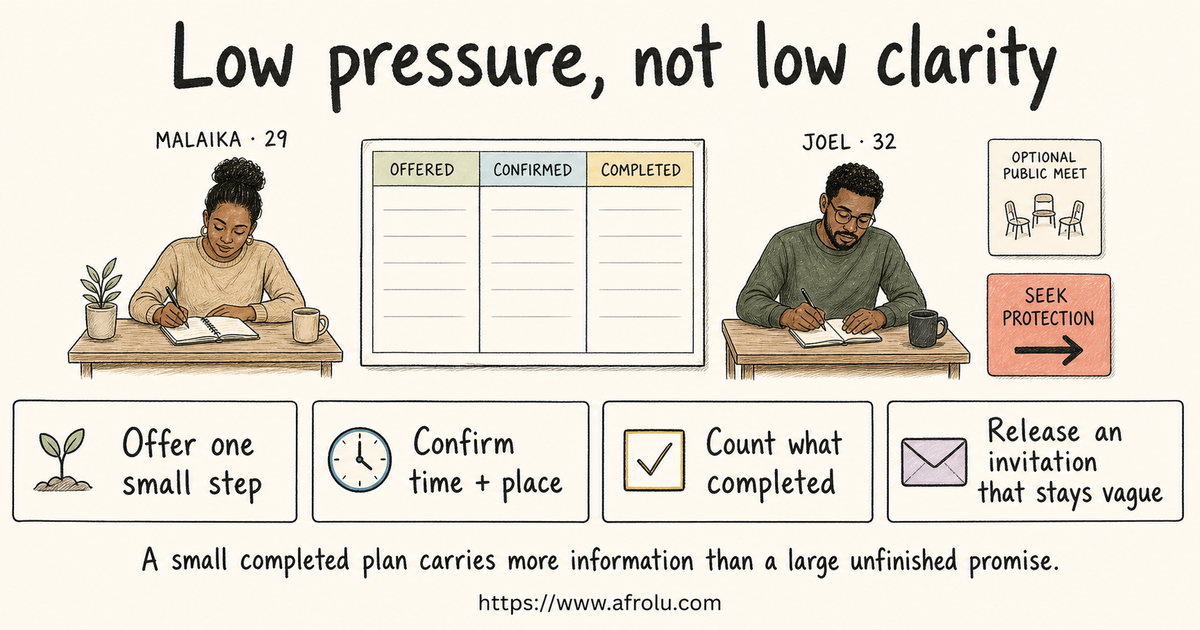
Low pressure keeps the step small; clarity makes the step real.
Written and edited by Grace Mutiso · Kenya Guides Editor
Use three marks: OFFERED, CONFIRMED and COMPLETED. Low pressure keeps the next step small; it does not make the answer permanently vague. Offer one bounded call or public meeting, welcome a specific counteroffer and protect study time, academic data, fare, phone and return. Continue, redesign, pause or close from present conduct without proving motive. Fraud, tracking, threats, coercion and defeated no bypass the planner.
Mixed signals · Students
How can an adult student aged 25 or older distinguish mutually low-pressure Nairobi dating from possible breadcrumbing without judging a busy timetable, monitoring another person or rushing the relationship?
Breadcrumbing is tentative, non-diagnostic shorthand for intermittent romantic attention that repeatedly renews possibility while useful progress remains unfinished. For adult students 25+ in Nairobi, compare the present scope, chosen quiet rhythm, answerable invitations, delivery, repair, study-time respect, privacy, money and exit. A busy module may explain availability; it does not require either adult to reserve an undefined future.
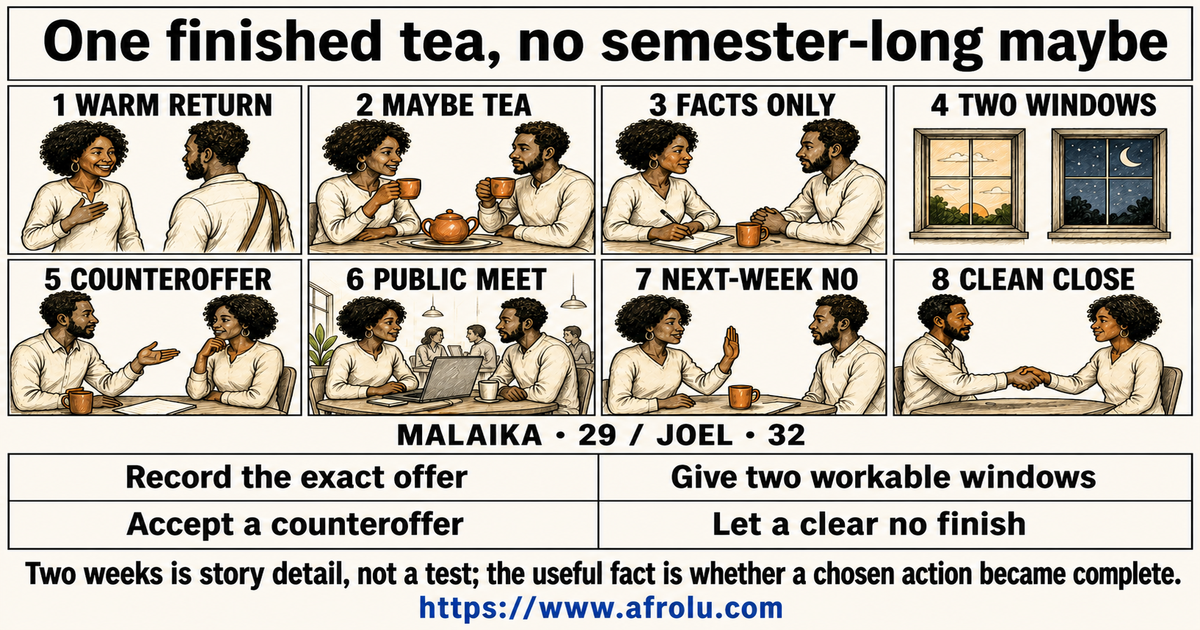
Malaika, 29, and Joel, 32, are fictional Black Kenyan adults combining paid work with adult study in Nairobi. Malaika turns two vague tea suggestions into one bounded invitation. Joel counters and they meet, then discover their preferred planning rhythms do not fit. When another open-ended suggestion arrives, Malaika closes the romantic route and returns the time to her life.
Grace's three-mark adult timetable studio
Keep the romance light and the next line on the planner honest
This route treats student as an adult 25+ responsibility, Nairobi as practical context and breadcrumbing as a limited description of unfinished conduct.
Separate offered, confirmed and completed; protect the study perimeter; plan a public independent return; and let no close cleanly.
Offered
Turn a warm idea into one small invitation or release it.
Confirmed
Name enough time and place detail for a free answer.
Completed
Credit the action that happened without inflating its meaning.
Protect the return
Keep fare, phone, location, consent and exit independently controlled.
Start by removing the school stereotype
This guide is for adult students aged 25 and older, not young people
Throughout this page, student means an adult aged 25 or older who may also work, care for relatives, run a home or change careers. It never means a child, a school pupil or someone whose choices belong to an institution. Nairobi supplies the setting, not a personality type. No course, campus, neighbourhood or qualification predicts how an adult dates.
Low-pressure dating means keeping romantic steps modest, voluntary and proportionate. It may be one short call, one public tea or one week without messaging during an assessment. It does not mean holding another person in a permanent maybe. Clarity can be gentle: an invitation has a time, a counteroffer changes something concrete, and a no is allowed to finish the route.
Breadcrumbing is a behaviour description used cautiously here. It may fit when intermittent romantic attention repeatedly restores hope while reasonable attempts to make the next small step answerable remain unfinished. One late reply, a cancelled plan, a demanding module or an irregular shift proves none of that. The word cannot reveal intent, attachment style, character, honesty or care.
An adult does not need the label to set a boundary. If the available rhythm consumes more attention than it returns, collides with study or work, or simply no longer feels worth carrying, the reader may redesign or leave. The goal is not to prosecute another adult's motives. It is to make the current offer visible enough that both people can choose freely.
Use three marks instead of a message count
Separate what was offered, what was confirmed and what actually happened
OFFERED records the smallest real proposal: tea on Saturday, a twenty-minute call after class, or a quiet week followed by a named check-in. A vague 'we should meet' belongs in a notes margin, not in the offered column. The point is not bureaucratic dating. It is to stop a warm possibility being remembered later as a plan nobody actually made.
CONFIRMED needs enough information for each adult to act: day, time, general public place, approximate duration and any accessibility or transport constraint that must be known. Confirmation remains voluntary and can change. A person with a full timetable may counter with a smaller window. A counteroffer is information; demanding a photograph of a class schedule or employer rota is intrusion.
COMPLETED means the agreed step happened close enough to its terms, or a change was communicated and repaired with another completed step. A beautiful apology is not completion. Equally, one completed tea is not proof of commitment, identity, compatibility or safety. Give each fact only the weight it can carry, then return attention to work, learning, sleep and existing relationships.
Use the planner briefly, perhaps for the decision currently troubling you, then put it away. Do not convert it into a secret score, loyalty exam or archive of response times. If a direct safety fact appears, including money pressure, tracking, threats, impersonation, coerced images or contact that defeats no, leave the ordinary planner and use protection suited to the location and urgency.
Malaika closes an invisible study reservation
A fictional Nairobi story shows why a completed no can be a good result
Malaika, 29, studies part-time and works in Nairobi. Joel, 32, combines a professional course with contract work. Both are fictional Black Kenyan adults, and neither represents a campus, profession or neighbourhood. They have met once. Joel returns warmly after quiet stretches and mentions tea, but Malaika notices that she keeps leaving Saturday afternoons half-open without a confirmed plan.
She writes three facts: Joel suggested tea twice; no day or place was confirmed; nothing was cancelled because nothing had been booked. She does not inspect his online status, question classmates or decide he is manipulating her. On Tuesday she says she enjoys their exchanges and offers Saturday at 14:00 or Sunday at 11:00 for forty-five minutes in a public place.
Joel cannot do either window. This time he counters with the following Wednesday at 18:00 near a location both can reach, and they meet. During tea he says his available dating rhythm is spontaneous contact when work loosens. Malaika wants one modest plan she can put down on a calendar. Their wishes are both legitimate, but the forms do not fit.
When Joel returns the next week with another open-ended tea message, Malaika does not reopen the Saturday reservation. She says the unplanned romantic rhythm does not fit and closes it. Joel accepts. The result is neither a punishment nor proof of breadcrumbing. One completed meeting revealed a pace mismatch, and one completed ending returned attention to the rest of adult life.
Read paired signals without grading a person
Look across scope, delivery, study time, privacy, money and exit
SCOPE works lightly when both adults use compatible words for the present connection and accept that either may decline. RHYTHM works when quiet periods and check-ins are chosen rather than guessed. The unresolved versions are not simply fewer messages; they appear when romantic warmth repeatedly reopens access while questions about the current offer keep sliding into 'sometime.'
INVITATION and DELIVERY deserve separate tabs. A specific invitation allows yes, counter or no. Delivery records what happens next. A missed plan can be ordinary; repair becomes useful when the effect is acknowledged, another feasible option is offered and that option later occurs. Repeated explanations may be sincere while still leaving an unusable form of dating.
STUDY TIME is respected when an adult can be offline without punishment and can state availability without proving a timetable. Privacy remains intact when class location, ID cards, assessment dates, employer details, live location, passwords and device access stay controlled. Affection creates no entitlement to notes, fees, M-PESA access, transport money or evidence of where someone spent an evening.
EXIT AND SAFETY work when pause, no and closure are accepted across channels. A match who dislikes the boundary may leave; disagreement alone is not abuse. Tracking, threats, impersonation, non-consensual image sharing, coercion, account access, financial deception or repeated contact after a clear stop changes the task. Secure what is exposed and use current Kenyan platform, support or emergency routes.

Study pressure explains context; it does not decide the pattern.
Give a Nairobi plan room to arrive and leave
Build city travel, public setting, privacy and an independent return into the invitation
Nairobi County continues to describe congestion as a mobility problem while major transit changes remain plans in progress. That official context supports a practical editorial choice, not a prediction: use a time window with a buffer, confirm on the day and avoid interpreting every delay as romantic evidence. Neither person should have to disclose a live route to earn patience.
For an early low-pressure meeting, choose a public place both adults independently recognise, during operating hours they have checked themselves. Each controls fare, phone, arrival and return. Share the plan with a trusted person if desired, but do not post it publicly. A campus library, workplace or home need not become the meeting site merely because one adult studies nearby.
Kenya's data-protection regulator explains rights involving information, access, objection, correction and deletion, alongside lawful, transparent, purpose-limited processing and data minimisation. That legal overview does not decide a dating dispute. Applied editorially, the plain rule is to share only what the present interaction needs. A student card, class schedule, photograph, identifier or live pin is not proof of romantic honesty.
If online conduct becomes doxing, cyberstalking, threats, image abuse, hacking or cross-platform harassment, the State Department's Digital Safe Space describes Kenyan reporting and support options. A university may also offer counselling; the University of Nairobi, for example, describes professional campus services, but each institution and eligibility rule differs. Immediate danger requires current local emergency help, not another clarity date.
Use words that fit between real responsibilities
Twelve scripts turn pressure, privacy, planning and closure into answerable choices
Start with scope and pace: 'I am open to light dating with plans we can actually confirm; does that fit you?' If the answer is yes, offer a bounded invitation. If the reply changes the subject, repeat once only if more information would genuinely help. A label debate is optional; the reader can decide that the available form does not fit.
Protect study time in ordinary language: 'I am offline while I study and will reply after 20:30 if I have capacity.' This is an availability statement, not permission for monitoring. A respectful date may accept, counter or decide the rhythm is too quiet. Nobody needs a screenshot of an assessment portal, a lecturer's message or an employer rota to justify a boundary.
For Nairobi plans, name a public setting, duration and independent return without publishing precise movement beyond the people who need it. Say, 'Saturday, 14:00–14:45, in a public place?' Confirmation does not bundle touch, images, sex, exclusivity, money, transport or a future date. Each remains a separate choice before, during and after the meeting.
Closure can stay factual: 'Open-ended contact does not fit me. I am closing it.' It does not require an accusation, final seminar or response. If closure is respected, stop carrying the file. If contact crosses channels, recruits classmates, exposes information or becomes threatening, preserve useful evidence where safe and move to protective support rather than another explanatory script.

A timetable is shared by consent, not extracted as proof.
Return the open hour to its owner
Choose one of eight equal outcomes from the strongest present fact
CONTINUE LIGHTLY fits a small mutual rhythm with clear scope and usable plans. SET ONE PLAN fits warm interest that has not yet had one answerable invitation. ACCEPT A COUNTER fits a specific alternative that genuinely works. None is a test, and a completed coffee does not promote anyone automatically toward exclusivity, home access or another date.
REDESIGN fits two adults who want contact but need a different channel, frequency or meeting length. REVIEW LATER fits a current no with no romantic place-holding; either person may be unavailable when later arrives. PAUSE protects capacity without demanding loyalty. CLOSE ends the route when the form, effort or interest no longer fits, even if no one behaved badly.
SEEK PROTECTION is not the red end of a romance scale. It is a separate response to money deception, threats, tracking, coerced images, hacking, impersonation, location exposure or contact that defeats a boundary. Secure accounts and devices, preserve useful evidence where safe, and use current platform, Kenyan support, legal or emergency options matched to what happened.
The adult-student lesson is deliberately modest. A full timetable does not make someone deceptive, and affectionate messages do not reserve another adult's free hours. Ask for one small action only when the answer would matter. Count what was offered, confirmed and completed. Then choose the route that protects study, work, city movement, privacy, consent and the right to stop.

Your course load can change the offer without cancelling your right to an answer.
Eight moments when a light invitation becomes clear, vague or unsafe
A warm message suggests tea but names no time
The adult keeps half a day emotionally reserved even though no actionable invitation exists.
Offer one bounded window or return Saturday to yourself.Replies become quieter during a known busy period
Reduced volume may fit the stated rhythm and does not prove a romantic pattern or hidden motive.
Use the agreed check-in, then judge the answer rather than the silence.Neither proposed time works
The other adult offers a different day, duration and public area they can genuinely reach.
Treat the counter as evidence for one step, not a character certificate.Every specific invitation becomes 'after things calm down'
Warm contact continues while no smaller alternative or release becomes available.
Stop holding time; ask once for a usable offer or close.A match requests class screenshots or live location
Ordinary coordination has turned into access to personal, academic and movement data.
Refuse the proof request and reduce or end access.Nairobi travel disrupts a confirmed meeting
Delay alone is ambiguous; notice, updated timing and a safe independent return are more useful facts.
Decide from communication and feasibility without tracking the route.Affection becomes tied to transport money or an account
The issue is financial access, not whether the message rhythm meets a breadcrumbing label.
Send nothing and use verified financial or reporting support if needed.Closure is followed by classmate contact and new accounts
A clear exit is being defeated through other people or channels.
Secure information, preserve useful evidence and seek local protection.Sixteen marks across scope, delivery, study time, Nairobi movement and exit
Both adults are explicitly 25 or older; student status never implies youth or dependence.
Present scope is named without turning low pressure into indefinite romantic access.
A quiet contact rhythm is mutually chosen rather than silently assigned.
Invitations include enough detail for yes, a counteroffer or no.
A counteroffer changes a time, place, duration or channel concretely.
Completed actions are credited only for what they establish.
Missed plans receive notice and a feasible repair rather than surveillance.
Study and work blocks can stay offline without punishment or loyalty tests.
Timetables, student IDs, portals and live locations remain private.
Nairobi travel buffers are planned without demanding route tracking.
Each adult controls meeting fare, phone, arrival and return.
A public meeting creates no automatic consent, exclusivity or second date.
Money, documents, codes and account access never become proof of interest.
Pause, no and closure are accepted across every contact channel.
One ordinary mismatch is not converted into a diagnosis or moral verdict.
Threats, tracking, image abuse, hacking or defeated no bypass ordinary review.
Ten planner questions without a motive grade
| Situation | What it may mean | What to do next |
|---|---|---|
| Is low pressure defined? | Fits: The next step is small and answerable. Needs review: One expectation remains assumed. Stop: Vagueness is treated as permanent access. | Name what a light but complete step means. |
| Is present scope shared? | Fits: Both use compatible words for the connection. Needs review: One consequence needs discussion. Stop: Romantic access expands without agreement. | Describe only the current relationship offer. |
| Was anything actually offered? | Fits: A bounded call or meeting exists. Needs review: A warm idea lacks one detail. Stop: Sometime is being carried like a booking. | Create one real invitation or release the time. |
| Can either adult counter? | Fits: A specific alternative is welcome. Needs review: Flexibility has no limits. Stop: Only compliance counts as interest. | Invite one feasible counteroffer without proof. |
| What became complete? | Fits: The agreed action happened or was repaired. Needs review: An apology has no replacement yet. Stop: Promises repeatedly replace delivery. | Give completed conduct its exact weight. |
| Is study time protected? | Fits: Offline blocks need no defence. Needs review: Reply expectations need redesign. Stop: Schedules or portals are demanded. | Share availability, not academic evidence. |
| Does the Nairobi plan preserve exit? | Fits: Public setting and independent return are workable. Needs review: One route detail needs checking. Stop: Live tracking or dependence removes choice. | Separate fare, movement, phone and return. |
| Are money and data controlled? | Fits: Each keeps accounts and identifiers private. Needs review: One disclosure is unnecessary. Stop: Fares, codes, IDs or access are requested. | Refuse and secure the exposed channel. |
| Can no finish? | Fits: Closure works across channels. Needs review: One expectation needs release. Stop: Friends, classmates or new accounts bypass no. | Stop discussion and move to protection if needed. |
| What is the strongest fact? | Fits: A mutual light route remains. Needs review: A mismatch needs choice. Stop: Fraud, coercion or danger is present. | Choose the route matched to that fact. |
Twelve adult lines for scope, study blocks, public plans, privacy and closure
“I want light dating with confirmable plans. Does that fit?”
“One short meeting every week or two is enough for me right now.”
“Saturday, 14:00–14:45, in a public place?”
“That window does not work; Tuesday from 18:00 to 18:30 does.”
“Let us each check the public venue and our own route before confirming.”
“If neither option fits, please offer one you can carry or say no.”
“I am offline to study; I may reply after 20:30.”
“A quiet week works only if we name when contact resumes.”
“The plan passed without notice; another invitation needs a time you can keep.”
“I do not share my timetable, student ID, portal, passwords or live location.”
“I control my fare, phone, arrival and return, and a meeting creates no further consent.”
“Open-ended contact does not fit me. I am closing it.”
Know the difference
Mutual low-pressure dating is quiet by agreement; breadcrumbing stays open by repetition
Scope, quiet periods and small invitations are named; counteroffers and no work; neither adult must keep time reserved.
Romantic warmth repeatedly revives a future while reasonable small steps, counters or release remain unfinished and one adult carries the waiting.
Compare the present agreement and delivered action, not message volume or a theory about intention.

Name the state only far enough to choose the next action.
Mutual low pressure, possible breadcrumbing and seven nearby states
| Type or dimension | What it describes | Best next question |
|---|---|---|
| Possible breadcrumbing pattern | Intermittent romantic re-entry repeatedly renews possibility while requested modest progress stays unfinished. | Ask once for an answerable step, then choose without proving motive. |
| Mutual low-pressure dating | Both adults choose a light rhythm, complete small plans and remain free to counter or leave. | Continue only while the modest form fits both. |
| Early exploration | Scope is still forming and neither person has repeatedly reserved the other's time. | Use one invitation to learn what is actually offered. |
| Real study constraint | A demanding period is named and paired with a realistic alternative or complete pause. | Respect the limit and decide whether the offered rhythm fits. |
| Pace mismatch | Both adults are clear, but one wants more planning or contact than the other can offer. | Redesign once or close without blame. |
| Friendship | Warm contact exists without an agreed romantic direction or romantic place-holding. | Name friendship only if both genuinely want it. |
| Respectful closure | One adult ends the route and contact stops without retaliation or a reserved future. | Let the completed ending stand. |
| Romance fraud | Affection or meeting language becomes a route to fares, fees, codes, documents or investments. | Do not fund or verify through the contact; use independent official channels. |
| Unsafe control | Tracking, threats, coercion, hacking, image abuse or defeated no changes the task. | Prioritise current local protection over another clarity talk. |
Mark offered, confirmed and completed before reserving another hour
Adult means 25+ here
Student is a workload context, never a cue to depict or address children.
Mark three different facts
Offered, confirmed and completed are not interchangeable stages of one promise.
Keep pressure low and answers usable
A small yes, specific counter or clean no can all complete the step.
Plan for Nairobi movement
Use current checks, a buffer, a public setting and independent return.
Protect the study perimeter
Share availability without portals, IDs, schedules, employer proof or live location.
Route harm separately
Fraud, threats, tracking, coercion and defeated closure are not low-pressure mismatches.
Questions to offer, confirm, protect and choose
Choose a few prompts that fit the moment. This is a reference library, not a list to complete.
Offer
Make low pressure concrete before protecting time for it.
- What are we exploring?
- What small step is real?
- What is not promised?
- Can either adult say no?
Confirm
Give one plan enough detail to act on safely.
- Which day and time?
- Which public setting?
- How long?
- What counter could work?
Protect
Keep adult study and Nairobi movement under personal control.
- Which data stays private?
- Who controls fare?
- How does each leave?
- Who knows the plan?
Choose
Use the strongest fact instead of a total score.
- Continue lightly?
- Redesign or pause?
- Close cleanly?
- Does safety bypass talk?
What breadcrumbing research and current Kenyan sources can support
A cross-country survey operationalises breadcrumbing and examines attachment associations
The study supports using breadcrumbing as a studied behaviour term while keeping association distinct from cause, intent or diagnosis.
Evidence limit: The online cross-sectional sample was 682 adults aged 18–40 in India and Spain; it cannot establish causality or describe Kenyan adult students as a group.
The County approved a Phase I rapid-transit implementation framework
The announcement supports allowing realistic city travel buffers and checking present transport facts before a meeting.
Evidence limit: It is a Nairobi County implementation announcement, not evidence that proposed infrastructure is complete or a prediction of any reader's route, cost or arrival time.
The University of Nairobi describes professional counselling and student-welfare services
The page supports checking one's own institution for confidential help when relationship strain affects study or daily life.
Evidence limit: It describes University of Nairobi services, not every Nairobi institution, eligibility outcome or clinical assessment; service details can change.
The regulator explains processing principles and data-subject rights
The guidance supports a general data-minimisation rule; applied editorially, that means avoiding unnecessary early disclosure of location, images, identifiers and schedules.
Evidence limit: It is a general Kenyan regulatory overview, not incident-specific legal advice, proof of a violation or a guarantee that a platform will act.
The State Department's Digital Safe Space covers technology-facilitated gender-based violence
The portal identifies conduct including doxing and cyberstalking and describes account security, evidence preservation, reporting and referral options.
Evidence limit: It is a Kenyan national support portal, not a promise of response, prosecution or safety; risks and appropriate routes depend on facts, identity and urgency.
eSafety separates privacy, meeting preparation and platform tools
The official resource supports data minimisation, a trusted-contact plan, public meetings, independent exit, blocking and reporting.
Evidence limit: Australian law, services, statistics and platform code arrangements differ from Kenya; these steps reduce selected risks but cannot verify identity or guarantee conduct.
Six ways a light route becomes a stereotype, surveillance task or safety problem
Treating student as young
It erases adult autonomy and complex work-study lives. Repair: state and depict everyone as 25+.
Calling sometime a plan
An idea reserves attention without an actionable offer. Repair: add details or release the time.
Counting replies as commitment
Volume replaces scope and delivery. Repair: ask what the present connection actually is.
Demanding schedule proof
Coordination becomes access to private academic data. Repair: accept availability, counter or leave.
Reading traffic as intention
A city delay becomes a character verdict. Repair: use notice, updated timing and repair as facts.
Keeping discussion open after danger
Ordinary ambiguity language hides direct harm. Repair: secure channels and seek protection.
Choose one light route that can become complete
Use the guide matched to the missing fact: the behaviour pattern, a mutual slow pace, or mixed words and delivery.
Explore the guide library
Show more related guides
Continue with Afrolu
Show more Afrolu guides
One bounded primary study and five current official sources
Afrolu reviewed these health, research, safety, or public guidance resources while editing this page. They support the behaviour and safety guidance; they do not diagnose any individual described by a reader.
Adult student questions about quiet contact, Nairobi plans and breadcrumbing
Does student mean university-age on this page?
No. Every student in this guide is explicitly an adult aged 25 or older. The term covers adults balancing later study with work, care, enterprise or a career change. It does not include school pupils, and it does not imply dependence, inexperience, a particular income or unlimited availability.
Is quiet contact automatically breadcrumbing?
No. A light rhythm can work when both adults choose it, make small answerable plans and remain free to counter or leave. Breadcrumbing may be useful shorthand only when romantic re-entry repeatedly renews possibility while reasonable progress remains unfinished. Message count cannot reveal intent or compatibility.
How long should I observe the pattern?
There is no universal period. The two-week story is fiction, not a threshold. Ask for one bounded action only if the answer would help, then choose from present facts and capacity. You may leave earlier, accept a slower mutual rhythm or close without ever using the breadcrumbing label.
Should I show my timetable to prove I am busy?
No. Offer the hours and notice you can give. A date can accept, counter or decline without seeing an assessment portal, student card, lecturer message, workplace rota or live location. Pressure for proof is a separate privacy issue, not a necessary step in low-pressure coordination.
What makes a Nairobi invitation usable?
Include a day, time, general public place, approximate duration and any access need that matters. Each adult should check current venue and transport facts, control fare and return, and be able to cancel. Avoid publishing live movement. A public setting reduces some risks but cannot guarantee safe conduct.
What if traffic makes one of us late?
Delay alone proves little. Look for timely notice where possible, an updated estimate, a safe plan for waiting or leaving, and proportionate repair. Do not demand route screenshots or tracking. Either adult may end the plan if the remaining time, transport or safety conditions no longer work.
Can a completed date prove the person is serious?
No. It shows one plan was completed. It does not verify every identity claim, define exclusivity, predict consistency or create consent for touch, images, sex, money, home access or another meeting. Return to present scope and the next separately chosen action rather than promoting someone through a hidden score.
What if they keep saying the semester is too busy?
Believe the stated constraint without investigating, then ask what offer is genuinely available: a smaller plan, a named pause, a later check chosen by both, or no romantic route. You may respect the explanation and still decline the available form. Sincerity and fit are separate questions.
Do I have to confront someone about breadcrumbing?
No. If one conversation would help, describe the observable pattern and your offer without claiming motive. You can also say the open-ended contact does not fit and stop. A boundary concerns your participation; it does not require a confession, diagnostic agreement or final response from the other adult.
When should I skip another clarity conversation?
Skip it when contact may increase danger or when money deception, tracking, threats, hacking, coerced images, impersonation, location exposure or persistence after no is present. Secure accounts and devices, preserve useful evidence where safe, and use current platform, Kenyan support, legal or emergency routes suited to the facts.
One thing to do now
Return every unconfirmed hour to the adult who owns it
Continue only while low pressure has present scope, a mutually workable rhythm, small invitations that can be answered, proportionate delivery and repair, protected adult-study time, controlled city logistics, separate money and consent, and a usable exit. Redesign or close without label agreement. Use current Kenyan protection for fraud, tracking, threats, hacking, image abuse, coercion or contact that defeats no.