A view is not an offer
Orbiting in Dating: Visibility Is Not Intention
Orbiting in dating explained with a visibility test, story-view limits, direct scripts, a seven-day feed reset, research, and clear next steps.
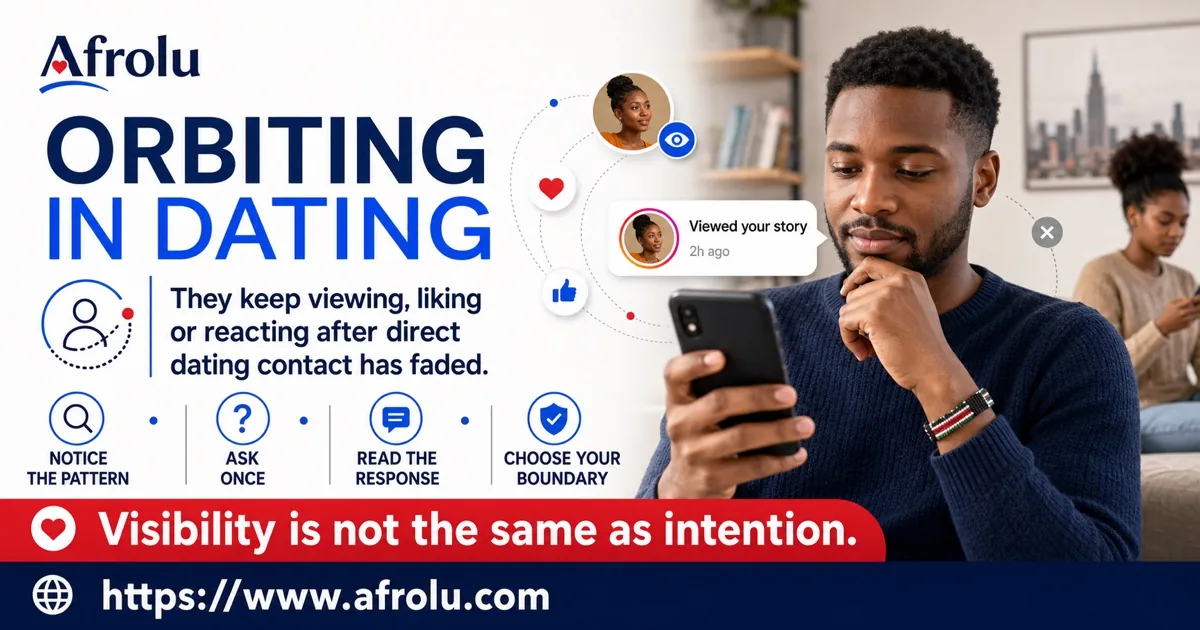
Separate passive views and likes from direct contact, clear intention, a specific next step, and follow-through. A view can show attention; only direct action makes an offer.
Written and edited by Clarisse Uwimana · Dating Culture Editor
Orbiting is a popular term for a person ending or withdrawing from direct romantic communication while remaining visibly present around someone's social-media activity. A story view or like can confirm exposure or attention; it cannot reveal motive, apology, readiness, or relationship intention. Read the sequence instead: direct contact, a named offer, a specific next step, and follow-through. Ask once if a real conversation would help, then choose from the reply and conduct. Mute, unfollow, restrict, remove, or block for your attention and safety when needed, not as a secret test designed to create pursuit.
Modern dating terms
Does this online visibility become direct contact, a clear intention, a specific next step, and follow-through, or does it only keep uncertainty emotionally active?
Orbiting in dating describes a digital pattern in which direct romantic communication has stopped or materially withdrawn, yet the disengaged person remains visibly present through story views, reactions, likes, follows, or other observable social-media activity. The term is everyday relationship language, not a diagnosis. Researchers have operationalised orbiting more narrowly as ghosting combined with continued visible following on social media; popular use is often broader, so the exact behaviour should be described before the label is used.
The conversation ended without a clear answer. Three days later, their name appears in the story-view list. A week later, an old photograph receives a like. Nothing is said, no repair is offered, and no plan appears, yet each small signal returns the relationship to the front of your mind. The visible action is real. Its meaning remains unknown. The useful question is not whether the view was accidental or strategic; it is whether any present offer exists that you can understand, consent to, and build around.
The visibility test
The action may be visible while the relationship offer remains absent
A viewer list creates an unusual kind of evidence. You can see that an account appeared, but not what the person felt, intended, noticed, or expected you to do. That gap invites the mind to write a complete relationship story from a very small digital trace. The visibility test keeps the trace in proportion without pretending it never affects you.
Use five columns. Visibility records the online action without interpretation. Contact asks whether the person communicated directly. Intention asks whether they named a present offer rather than a vague emotion. Next step asks whether something specific can happen. Follow-through checks whether conduct supports the words. A boundary then decides how much access this sequence receives to your attention, privacy, and life.
Record the smallest fact first
A story was viewed, a post was liked, or an account remained followed. Do not quietly upgrade exposure into apology, longing, readiness, or a request.
Look for words addressed to you
A direct message, call, or in-person approach creates a communication event. Even then, the content matters more than the mere arrival.
Ask what the person is offering now
Curiosity, friendship, accountability, casual contact, and renewed dating are different offers. A usable return names enough of the direction to let you choose.
Give sincerity somewhere practical to go
A call, apology conversation, date, or respectful closure should have a clear format and timeframe. “We should talk sometime” remains future atmosphere.
Let conduct update the interpretation
A specific return that happens can earn another conversation. Repeated viewing after a missed promise is more visibility, not evidence that the promise still stands.
Choose exposure for your wellbeing
Leave, mute, unfollow, remove, restrict, or block based on attention, privacy, unwanted contact, and safety. The control is for you, not a message you need decoded.
Visibility is the first column
Record the online trace without letting it write the relationship story
Start with the smallest sentence that can be verified: “this account viewed three stories,” “this person liked an older photograph,” or “we still follow one another.” That sentence may matter emotionally. It does not yet contain an apology, invitation, commitment, warning, or explanation. Digital platforms make exposure visible in ways ordinary life often does not, and the visibility can feel more intentional than the available evidence supports.
Create four additional columns before deciding what the trace means. Direct contact contains words addressed to you. Clear intention names what the person wants now. A specific next step gives the offer a time, place, or format. Follow-through shows whether the proposed action happens. A person can move from orbiting to accountable reconnection, but the evidence must move too. The viewer list is not a substitute for any of these columns.
This method is not a demand that every former date explain every click. It protects both people from mind-reading. The viewer is not automatically manipulative, obsessed, afraid, or secretly in love. The person being viewed is not foolish for noticing or feeling activated. The decision is narrower: what relationship offer exists now, and how much access should passive visibility receive to your attention and life?
Sequence before signal
Use direct contact, intention, specificity, and follow-through as the evidence route
A sequence prevents one digital moment from carrying the weight of a whole relationship. Begin with contact: did the person message, call, or approach you directly? Next ask whether the content named a present intention. “Hey” and a heart reaction are direct, but they may still leave the central offer unknown. “I would like to apologise and ask whether you are open to a call” creates a different kind of evidence.
Specificity gives sincerity a place to go. A call has a proposed time. A date has a day, place, and safety plan. A repair identifies the earlier conduct, its impact, and what will change. An ending names that the dating connection is closed. Follow-through then matters more than the elegance of the message. A promised call that repeatedly does not happen returns the sequence to visibility without usable movement.
Review the sequence once rather than after every new view. You might choose a private review point after one week, after the proposed call, or after a clearly stated boundary. The date is not an ultimatum and should not be used as a secret trap. It is the moment when you stop collecting more ambiguous traces and decide from the pattern already available.

A background view creates no conversation. A soft signal opens no clear next step. Direct contact names why the person reached out. Real repair adds accountability, a request, and consistent follow-through. Judge the channel, clarity, and conduct, not the notification alone.
Many meanings, one visible action
Let habit, curiosity, algorithms, nostalgia, and uncertainty remain possibilities
The same view can emerge from different routes. The person may tap through every story automatically. A platform may surface your account after a shared contact. They may miss you, feel curious, check whether you have moved on, or wonder whether to apologise. They may also want the comfort of access without the responsibility of direct communication. The screen does not identify which explanation is true.
Uncertainty about motive does not remove your agency. You can say, “I do not know why they watch, and this pattern keeps me checking,” then change the feed. You can say, “I would welcome one accountable conversation,” then ask once. You can decide, “even a sincere explanation would not make this relationship fit,” and leave the connection closed. A decision about impact does not require a successful investigation of intent.
Keep cultural and community context visible. Former partners may remain connected through family, faith, work, neighbourhood, diaspora networks, creative circles, or shared friends. Polite online overlap after a clear ending is not automatically a romantic strategy. The question is whether the current behaviour violates an agreement, interferes with recovery, creates ambiguity, exposes private information, or crosses into unwanted monitoring.

One story view may reflect automatic habit, curiosity without a plan, friendly social interest, or a test of whether access remains open. The view cannot identify which meaning is true. Direct words and follow-through carry more information.
Direct and proportionate
Ask once when an answer would help, then let the reply and conduct answer
A direct message is useful only when the connection had enough substance, a real answer could change your decision, and contact feels safe. Keep it shorter than the story your mind has been carrying: “I noticed we still see each other online. Do you want a real conversation, or should we leave the dating connection closed?” The goal is not to make the person confess every reason for watching. It is to reveal whether a present offer exists.
Read the content rather than rewarding arrival alone. An accountable return can name the earlier silence, recognise impact, state what is wanted now, accept that you may decline, and propose one specific next step. Nostalgic language without an offer may be sincere, but sincerity alone does not make the connection usable. Ask what would be different and let the answer reach the calendar before increasing emotional, sexual, or practical access.
One message is enough. No answer, an evasive answer, or another failed plan provides decision-grade information even if it does not provide satisfying closure. Do not keep sending explanations until the other person agrees with your interpretation. Do not message after a clear no-contact request, a brief match that never became a relationship, or conduct that makes contact unsafe. Closure can be a boundary you implement rather than a document both people sign.

Ask once whether a real conversation is wanted, state that story views are not a relationship signal, and require direct words for reconnection. Read the reply and follow-through; clarity does not require chasing.
Seven days of recovered attention
Choose the exposure setting, interrupt the checking loop, and review what actually changed
On day one, choose the smallest control that serves your real need. Mute when repeated incoming exposure is the problem. Unfollow or remove when continued connection no longer fits. Restrict or narrow privacy when access should decrease. Block and report when contact is unwanted, evasive, threatening, or unsafe. Platform controls change, so confirm their current effects rather than relying on a remembered label.
For days two through six, stop opening viewer lists and searching the account. Remove shortcuts and notifications that begin the loop. Return the saved minutes to sleep, work, exercise, faith, friends, family, creative life, and dates that involve direct reciprocal communication. Share only what you would still want to share if the silent person could not see it. Curiosity may return; noticing the urge without completing the ritual is part of the experiment.
On day seven, review three things: calm, clarity, and direct contact. Did attention become less fragmented? Is the present offer easier to describe? Did any message, accountable repair, or specific plan occur without being engineered through a jealousy post or boundary test? Keep, loosen, or strengthen the setting based on your wellbeing and safety. The reset does not prove what the other person felt; it reveals what less exposure does for you.

Mute or unfollow, stop checking the story-view list, archive the chat, tell one grounded friend, restore a displaced routine, separate facts from feelings and urges, then choose the boundary that protects your attention. Block and report unwanted, threatening, or unsafe contact.
The directness and movement map
Distinguish orbiting from ghosting, breadcrumbing, benching, and accountable reconnection
Ghosting names the unexplained end of direct communication. Orbiting adds continued visible online presence to that withdrawal. Breadcrumbing includes small direct messages that renew hope without enough movement. Benching keeps a person available through warm contact while plans, reciprocity, or progress remain withheld. The labels overlap in real life, but each directs attention to a different part of the sequence.
Accountable reconnection changes the evidence. The returning person communicates directly, names what they want, addresses relevant impact, proposes a specific next step, accepts your choice, and follows through. You can still decline. An apology does not restore former access, and a sincere meeting does not require immediate exclusivity, sex, forgiveness, or trust. The point is not to reward perfect wording; it is to make mutual choice possible again.
Use labels lightly and decisions firmly. Say what happened, identify what is being offered, and choose the boundary that fits. If the pattern includes new accounts after blocks, threats, impersonation, location tracking, repeated unwanted contact, or offline following, leave the dating vocabulary behind. Preserve evidence when safe, strengthen privacy and account access, involve trusted support, and use appropriate reporting or local services. Immediate danger requires urgent help, not one more clarity conversation.
Five online traces that should not receive the same interpretation
They stopped replying, yet their name appears after nearly every story
Two dates and several weeks of messages ended with a reply that never came. The person still watches public stories quickly and sometimes likes a photograph. No apology, question, or new plan arrives. You begin choosing posts partly for the reaction and checking the list before enjoying the moment you shared.
Name the observable pattern and decide whether one direct question would help. If not, mute, remove, restrict, or leave the account untouched while stopping the viewer-list ritual. Do not keep a dating slot open for a signal that has not become an offer.A former date appears once after months of silence
A single story view lands after neither person has communicated for a long time. The account may have appeared through ordinary browsing, a shared contact, search, habit, or deliberate curiosity. There is no other conduct and no present agreement to revisit.
Treat one view as one view. No response is required. If you genuinely want to reconnect, make that your own direct decision rather than using the view as permission or proof.They view, then send a direct message that owns the earlier ending
The message names the silence, apologises without demanding forgiveness, explains what has changed without turning the explanation into an excuse, and asks whether you would consider a short call. When you choose a time, the person confirms and shows up.
This has moved beyond orbiting into a proposed reconnection. You still decide whether repair is wanted and whether trust should rebuild slowly. Accountability earns a hearing, not automatic access, reunion, intimacy, or restored status.Online visibility continues because your lives still overlap
You attend the same faith community, creative circle, workplace network, or friend group. Public posts naturally cross both feeds, and polite reactions continue after a clear, mutually understood ending. Neither person uses the activity to reopen romantic ambiguity.
Do not force the orbiting label onto ordinary social overlap. Keep the ending and current boundary clear. Reduce exposure only if it disrupts recovery, privacy, work, or safety.New accounts and repeated contact continue after a boundary
You asked the person not to contact you and blocked an account. New profiles appear, friends are questioned about you, location details are mentioned, or offline encounters begin to feel engineered. The issue is no longer an ambiguous dating signal.
Treat repeated unwanted monitoring, threats, impersonation, or boundary evasion as a safety concern. Preserve evidence when safe, tighten account and location privacy, tell trusted people, use platform reporting, and seek appropriate local support. Do not send a clarity message when contact may increase risk.Six signs that online presence is carrying more meaning than direct conduct
Direct romantic communication has stopped while visible views, likes, or follows continue
Each online trace restarts interpretation even though no present offer has been made
You check viewer lists, profiles, or timestamps more often than direct conduct changes
A minimal reaction arrives, but intention, accountability, and the next step stay unnamed
Posting begins to function as an indirect message or test for the silent person
Feed exposure affects sleep, concentration, current dating, privacy, or emotional recovery
Choose a response for curiosity, contact, repair, unwanted monitoring, or danger
| Situation | What it may mean | What to do next |
|---|---|---|
| One story view appears after months of silence | Ordinary browsing, algorithmic exposure, curiosity, habit, nostalgia, or intentional checking. | No action is required. Treat one view as one view and return attention to your present life. |
| Views repeat, but no direct message arrives | Continued visibility with unknown motive and no usable relationship offer. | Stop reserving meaning or availability. Adjust feed access if the pattern keeps reopening uncertainty. |
| A like or emoji reaction arrives without words | A minimal direct signal that still may not state intention, accountability, or a next step. | Reply only if you want to. Do not perform the missing conversation for both people. |
| They send “thinking of you” after disappearing | Nostalgia, loneliness, apology preparation, renewed interest, or breadcrumbing without movement. | Ask what they want to discuss now. Require a specific and respectful next step before increasing access. |
| They apologise, name impact, and request a call | A possible accountable reconnection rather than passive orbiting. | Choose whether the call serves you. Rebuild trust slowly from conduct; an apology does not restore the former relationship automatically. |
| A clear former partner remains a normal online friend | Mutually understood post-relationship contact or shared-community overlap. | Keep or reduce the connection according to recovery and current agreements, not a universal no-contact rule. |
| You post mainly to see whether they react | The viewer-list loop is now organising your attention even without new direct conduct. | Run the seven-day feed reset. Share for your real audience and life, not as an indirect conversation. |
| New accounts appear after blocks or no-contact requests | Boundary evasion, unwanted monitoring, harassment, or a wider safety concern. | Preserve evidence when safe, tighten privacy and account security, involve support, report appropriately, and avoid a clarity confrontation if risk may rise. |
Words for clarification, reconnection, boundaries, closure, and unwanted contact
“I noticed we still see each other online. Do you want a real conversation, or should we leave the dating connection closed?”
“I am not using story views or likes as a relationship signal. If you want to speak with me, please contact me directly.”
“I hear that you have been thinking about me. What are you asking for now, and what would be different from before?”
“I am open to one call. I can speak Thursday at 7 p.m. If that does not work, please suggest another specific time.”
“Thank you for reaching out. I am not reopening the relationship, and I wish you well.”
“Continued online visibility is making it harder for me to move forward, so I am changing my feed and contact settings.”
“I am keeping contact with former romantic connections clear and limited. I will not continue private ambiguous exchanges.”
“Do not contact me or create new accounts to view or message me. I will not respond further.”
Know the difference
Orbiting and accountable reconnection can both begin with visibility, then sharply diverge
Online presence remains visible while direct contact, intention, a next step, or follow-through is absent.
A direct message names the return, respects your choice, proposes something specific, and follows through.
Do not decide from how closely someone circles. Decide from what they communicate, offer, and do.

Orbiting is visibility without direct contact or an offer. Ghosting ends direct contact whether online visibility remains or not. Breadcrumbing sends small direct messages without progress. Reconnection names the return and follows through.
Orbiting, ghosting, breadcrumbing, reconnection, or ordinary online overlap?
| Type or dimension | What it describes | Best next question |
|---|---|---|
| Orbiting | Direct romantic contact has stopped or withdrawn while visible social-media presence continues. | Treat visibility as visibility; require direct contact, an offer, and follow-through before reopening the relationship. |
| Ghosting | Direct communication ends without explanation. Online visibility may disappear or may continue. | Do not make online absence the defining test. Decide from the ended communication and any safety context. |
| Breadcrumbing | Messages, flirtation, or reassurance recur but do not become plans, clarity, or progress. | Ask for one usable next step and stop treating intermittent contact as sufficient movement. |
| Benching | Warm contact keeps a dating option available while plans, reciprocity, and progress remain withheld. | Compare contact with calendar movement, reciprocal effort, and the present offer. |
| Reconnection | A person communicates directly, names the return, addresses relevant impact, and proposes a specific next step. | Choose freely whether to engage, then let consistency and repair determine how much trust returns. |
| Shared online community | Views or reactions continue within a workplace, friendship, faith, family, or creative network after a clear ending. | Maintain or reduce exposure according to comfort, agreements, privacy, and recovery without inventing romantic intent. |
The visibility, contact, intention, next-step, and follow-through test
Write the visible fact
Record “viewed three stories this week” before adding any explanation about longing, regret, jealousy, or intent.
Separate contact from exposure
A name in a list is exposure. A message addressed to you is contact. Neither becomes a relationship agreement automatically.
Ask for a present offer
If clarification is useful and safe, ask whether the person wants a real conversation, friendship, reconnection, or no contact.
Require a usable next step
A call, date, apology conversation, or ending should be specific enough that both adults know what happens next.
Review conduct once
Notice whether the reply arrives and whether the promised action happens. Do not keep reopening the same trial after every view.
Choose your exposure
Manage the feed according to attention, recovery, privacy, and safety rather than the reaction you hope a control will provoke.
What orbiting describes, what research can support, and what a view cannot prove
Orbiting began as a name for silent online presence after communication stopped
Writer Anna Iovine describes coining the term in 2018 after someone stopped replying while continuing to watch her Instagram stories. The phrase was later used widely for similar digital ambiguity. That origin is useful context, but popular language changes as people apply it to ex-partners, old matches, near-dates, and intermittent admirers.
Evidence limit: Use the behaviour in the sentence, not only the label: “direct messages stopped, but story views continued” is more precise than “they are orbiting me.”
One study treated orbiting as ghosting with continued visible following
Pancani and colleagues compared recalled ghosting, orbiting, and direct rejection among 208 young adults. Their definition described orbiting as ghosting in which the disengager still visibly follows the former partner on social media. Qualitative reports included surprise, confusion, difficult emotions, repair attempts, and eventual acceptance.
Evidence limit: A recall study of young adults does not establish how every person responds, why a particular viewer watched, or which boundary will help one reader.
The platform can expose an action without exposing the reason
A view may be deliberate, habitual, accidental, algorithmically prompted, nostalgic, curious, friendly, ambivalent, or strategic. The same visible action can come from different internal states, and several can coexist. Repeated patterns may justify a boundary, but they still do not provide privileged access to another person's motive.
Evidence limit: Avoid diagnosing attachment style, narcissism, obsession, manipulation, or fear of commitment from viewer lists and likes.
Research links observing an ex online with harder recovery, but direction and context matter
A 2012 study of 464 participants associated Facebook surveillance of a former partner with greater current breakup distress, negative feelings, longing, and lower personal growth after accounting for several relationship and individual factors. Association does not prove that every exposure caused the distress; distressed people may also monitor more, and platform use has changed since the study.
Evidence limit: Use this evidence to justify experimenting with less exposure, not to claim that following an ex is universally unhealthy or that one week offline cures grief.
Active and passive observation can both keep breakup material emotionally available
A 2026 multi-study paper used longitudinal, experimental, and daily-diary methods to examine active and passive observation of ex-partners. Across its studies, observation was connected with breakup distress, negative affect, or jealousy in specific ways, with attachment anxiety sometimes amplifying associations. The work supports testing lower exposure when observation repeatedly destabilises recovery.
Evidence limit: The studies concern observation of ex-partners, not every early match or every person whose account appears in a viewer list. They cannot identify an orbiter's intention.
Checking can become the active half of an otherwise passive pattern
Orbiting is often described through what the other person does, but the reader's own checking can become a second system: post, wait, open the viewer list, notice the name, interpret, search the profile, and post again. The loop consumes attention even when no direct contact occurs. Interrupting it is not denial; it is a way to recover a more accurate measure of what the relationship currently offers.
Evidence limit: Do not shame ordinary curiosity. Change the routine when it repeatedly affects sleep, concentration, mood, safety, or your ability to engage with present life.
A proportionate question can create clarity without turning silence into a negotiation
If the relationship had enough substance and contact feels safe, one calm message can ask whether a real conversation or reconnection is wanted. Make the question answerable and avoid presenting a prosecution file of views. Then use the reply, specificity, and follow-through. Repeated messages after no answer do not create mutual communication.
Evidence limit: No message is owed after a brief match, a clear ending, a safety concern, or an explicit request for no contact. Silence can be information without being a respectful explanation.
Mute, unfollow, remove, restrict, and block solve different exposure problems
Platform labels and effects change, but the decision can remain simple. Mute when you want less incoming exposure. Unfollow or remove when continued connection no longer fits. Restrict or tighten privacy when access should narrow. Block and report when contact is unwanted, evasive, threatening, or unsafe. Confirm current behaviour in the platform's own help and settings before relying on a remembered feature.
Evidence limit: A control is not a guaranteed privacy shield, and changing it should not be used to test whether someone creates another account or chases harder.
Repeated monitoring after a clear boundary is a different problem from romantic ambiguity
New accounts after blocks, location references, impersonation, threats, pressure, password requests, intimate-image abuse, offline following, or recruitment of friends to collect information require safety-aware decisions. Reduce discoverable location detail, review account access, preserve relevant evidence when safe, involve trusted support, and use local reporting or specialist services appropriate to the situation.
Evidence limit: Do not confront a person or announce a safety plan when doing so may escalate risk. Immediate danger requires urgent local help rather than another relationship script.
Four ways passive visibility quietly becomes an active emotional system
Turning exposure into intention
A visible account can confirm that content was opened, not why it was opened or what relationship the viewer wants.
Posting as an indirect message
Strategic songs, captions, dates, or jealousy cues keep your life organised around a response you cannot control.
Using feed controls as a test
Muting, removing, or blocking to provoke pursuit turns a boundary into another monitoring experiment.
Calling safety concerns orbiting
New accounts, location monitoring, threats, impersonation, or repeated unwanted contact exceed ordinary dating ambiguity.
Use a reviewed resource that matches the decision
This guide focuses on the relationship decision, so it does not rank dating apps. Check current prices, safety tools, and local availability before choosing a service.
Explore the guide library
Show more related guides
Continue with Afrolu
Show more Afrolu guides
Orbiting experiences, breakup observation, online surveillance, and term history
Afrolu reviewed these health, research, safety, or public guidance resources while editing this page. They support the behaviour and safety guidance; they do not diagnose any individual described by a reader.
Orbiting in dating questions, answered without mind-reading
What does orbiting mean in dating?
Orbiting usually means direct romantic communication has stopped or substantially withdrawn while the person remains visibly present around your social-media activity through views, likes, reactions, follows, or similar traces. It is popular language, not a diagnosis, and people use it more broadly than some research definitions.
Why does someone orbit after ghosting?
A viewer list cannot answer why. Possibilities include habit, curiosity, algorithmic exposure, nostalgia, uncertainty, friendship, validation, or a wish to keep access. Several can coexist. You can decide from the present conduct without proving motive.
Does watching every story mean they still like me?
It may show repeated attention or exposure, but it does not establish romantic interest, readiness, apology, or intention. Look for direct contact, a named offer, a specific next step, and follow-through before assigning relationship meaning.
Should I message someone who keeps viewing my stories?
You may send one proportionate message if the connection had enough substance, a real answer would help, and contact feels safe. Ask whether they want a genuine conversation. Then use the reply and follow-through. You do not need to message after a brief match, a clear ending, a no-contact request, or a safety concern.
Should I block someone who is orbiting me?
Choose the setting that solves your actual problem. Muting may reduce incoming exposure; unfollowing or removing may close ordinary access; restricting can narrow interaction; blocking and reporting may fit unwanted or unsafe contact. Platform features change, so confirm current effects in the platform settings and help pages.
Is orbiting the same as breadcrumbing?
No. Orbiting centres on passive visible presence after direct communication stops or withdraws. Breadcrumbing uses small direct messages or flirtation that repeatedly renew hope without enough progress. A person can move between or combine the patterns, so describe the exact sequence.
Is orbiting the same as ghosting?
One research definition treats orbiting as ghosting plus continued visible following on social media. Ghosting itself is the unexplained withdrawal from communication; online visibility can disappear or remain. Orbiting names the remaining digital presence.
Can orbiting turn into genuine reconnection?
Yes, but the evidence changes. Genuine reconnection involves direct communication, a clear present intention, accountability where harm occurred, a specific next step, respect for your choice, and follow-through. A like alone has not completed that change.
How do I stop checking whether they viewed my story?
Try a seven-day feed reset: choose a boundary on day one; stop checking viewer lists and return attention to work, friends, rest, and real plans on days two through six; then review calm, clarity, and any direct contact on day seven. Adjust the setting again if the loop still disrupts daily life.
When does orbiting become a safety concern?
Treat it as more than dating ambiguity when new accounts appear after blocks, explicit no-contact boundaries are evaded, location details are monitored, friends are recruited for information, or contact includes threats, impersonation, coercion, or offline following. Preserve evidence when safe, tighten privacy, involve trusted support, report appropriately, and seek urgent local help for immediate danger.
One thing to do now
Let the next relationship signal be an action you can actually use
Treat passive visibility as visibility. Upgrade its meaning only when direct communication names an intention, proposes a specific next step, and earns trust through follow-through.