Two-weekend evidence walk · long-gap return
Read Breadcrumbing Clearly After a Long Dating Gap
An adult guide to breadcrumbing after years away: compare quiet weekend rhythm with vague re-entry, test one clear plan, and protect privacy and money.
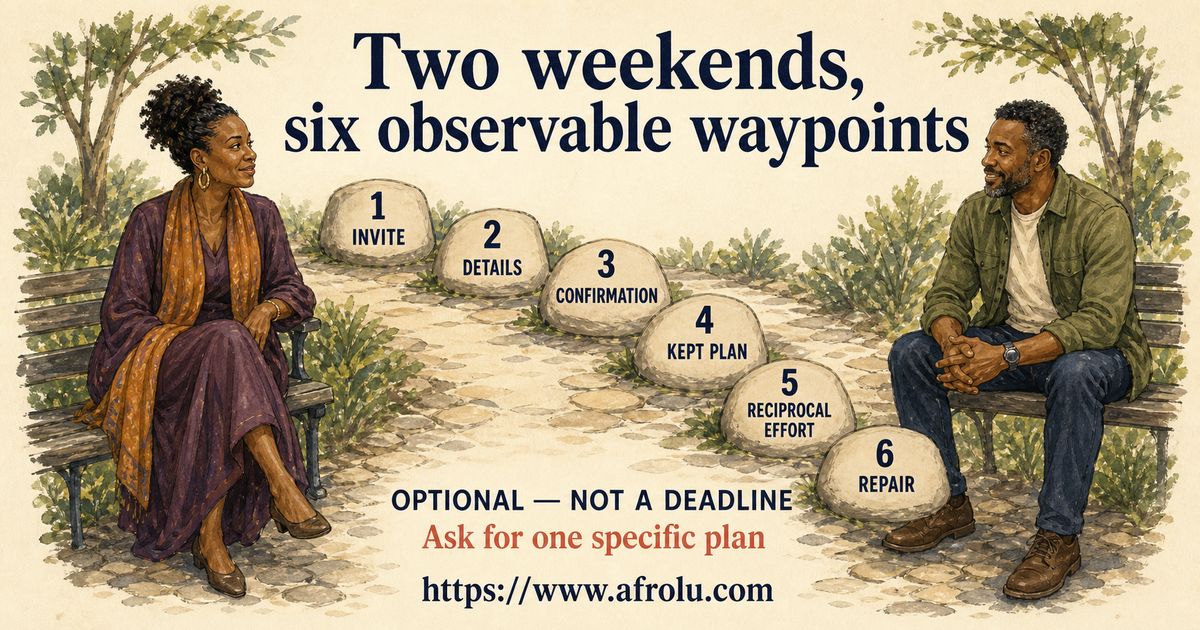
A long gap does not make every return precious; let one specific plan become observable.
Written and edited by Jean-Claude Mukendi · Relationship Guides Editor
Use an optional two-weekend evidence walk: INVITE, DETAILS, CONFIRMATION, KEPT PLAN, RECIPROCAL EFFORT and REPAIR. A mutually agreed low-frequency rhythm can be complete even with sparse messages. Repeated warmth that keeps those steps vague may fit breadcrumbing shorthand. Ask once, then continue quietly, counter, review later, pause or close. Money deception and direct danger bypass ordinary review.
Mixed signals · Late Entrants
How can an adult returning after years away assess intermittent weekend attention without treating late-comers as an age group, guessing motives or forcing a universal timeline?
Breadcrumbing is non-diagnostic shorthand for intermittent flirtatious or romantic attention that keeps possibility open while useful progress repeatedly remains unfinished. Here, late-comers means adults returning after a long dating gap, not an age class. Frequency alone is not the test: agreement, specificity, carried effort, repair and a usable exit distinguish nearby routes.
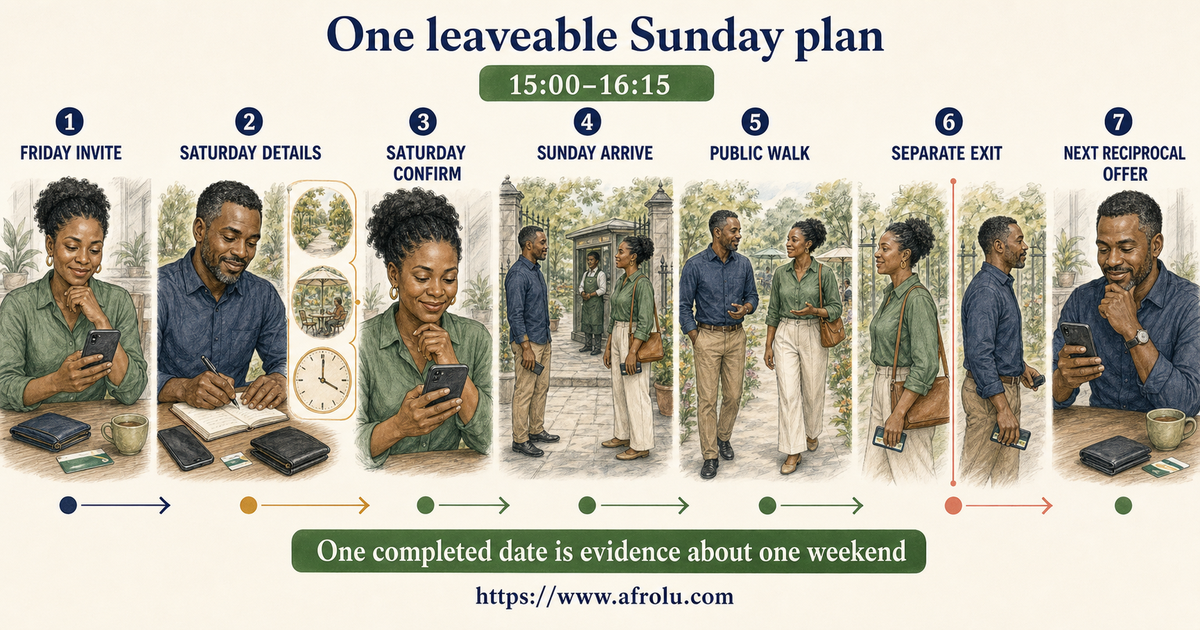
Amina, 39, returns after six years away from dating and asks Thabo, 42, to turn repeated Friday warmth into one public Sunday walk. He adds a place, confirms, keeps the 75-minute plan and later makes a reciprocal offer. Their sparse weekday contact fits because it is agreed. Both adults and every event are fictional.
Jean-Claude's optional two-weekend evidence walk
Give intermittent warmth six observable waypoints and no hidden-motive story
This route treats a long dating gap as context, a quiet rhythm as an agreement question and breadcrumbing as a limited behaviour label.
Ask for one specific plan, observe details through repair and follow privacy, money or safety facts directly.
Name the rhythm
Agree what low-frequency weekend contact means before scoring silence.
Make it answerable
Move from warm possibility to activity, place, time and confirmation.
Notice who carries
Reciprocal invitations and repair reveal more than repeated returns.
Protect essentials
Privacy, money, consent and exit never wait for another weekend.
Return without paying an urgency tax
Treat late-comers as adults returning after a long dating gap
Here, late-comers means adults who are dating again after a long personal gap. It does not identify an age group, generation, skill level or relationship value. Amina is 39 and Thabo is 42 only to make the fictional scenes unmistakably adult. Someone could return after years away at many adult ages and still choose any pace, structure or ending.
A long gap can make a bright message feel unusually important. The returning adult may wonder whether they forgot an unwritten rule, should tolerate uncertainty or must seize a rare opening. None of those feelings changes the evidence. Interest becomes answerable when it takes a specific form: an invitation, usable details, timely confirmation and effort that can be accepted or declined.
Breadcrumbing usually describes intermittent flirtatious or romantic attention that keeps possibility alive while meaningful progress requires little effort. One slow reply, a quiet week or a cancelled date does not establish it. The term is most useful when it points to repeated observable incompletion. It becomes less useful when used to diagnose attachment, claim manipulation or explain another person's private motive.
The practical aim is not to win consistent attention. It is to learn whether the available rhythm fits. An agreed low-frequency weekend connection can be caring and mutual when both adults know its shape and carry their part. Repeated vague re-entry is different: warmth returns, yet invite, details, confirmation, kept plan, reciprocal effort or repair repeatedly remains unfinished.
Walk only as far as useful evidence
Use an optional two-weekend review without turning it into a test
Start with INVITE. A useful invitation names an activity and a window: Sunday coffee between 14:00 and 15:15, for example. DETAILS add a public place and ordinary practical information. CONFIRMATION names when each person will know the plan stands. These three waypoints protect a weekend from being reserved by affectionate messages that never become answerable.
KEPT PLAN means each adult arrives or communicates a genuine change before the agreed point. RECIPROCAL EFFORT means planning does not permanently sit with one person; a counteroffer or later invitation can count. REPAIR follows a miss. It names what happened, acknowledges the effect, offers a realistic alternative and then changes conduct. Apology alone is not the only measure, but unchanged vagueness is useful information.
The two weekends are optional because some evidence arrives sooner and some mutually quiet rhythms need longer. A direct money request, threat, stalking, identity deception or blocked exit should end the ordinary walk immediately. Adults who explicitly choose one date every few weekends do not need to increase frequency merely to pass an outside standard. Their agreement is the reference point.
At the end of either weekend, choose the smallest next action supported by the facts: continue quietly, invite once, make a counteroffer, review later, pause or close. You do not need the other adult to agree with the breadcrumbing label. You need only decide whether the contact offered enough clarity, reciprocity and safety for the space it occupies in your life.
Amina asks for one complete Sunday
See how warmth, detail and reciprocal effort separate across two weekends
After a six-year break from dating, Amina exchanges occasional warm messages with Thabo. For three Fridays he has written that they should meet soon, but no plan follows. She enjoys the conversation and does not assume bad intent. On the fourth Friday she asks one narrow question: would a public Sunday walk from 15:00 to 16:15 work, or should they release the idea?
Thabo says yes, suggests a staffed garden entrance and agrees they will confirm by Saturday at 18:00. He confirms before that point. Both arrive independently, buy their own refreshments and keep home addresses, account details and live location history private. The walk ends at the chosen time. A pleasant meeting grants no touch, images, another date, financial help or explanation of Amina's dating gap.
During the following week, messages remain sparse. That fact alone does not turn the connection into breadcrumbing because they have discussed a weekend-only rhythm and both prefer it. On the second weekend, Thabo makes a specific invitation of his own. Amina cannot attend and provides one realistic alternative. The evidence now includes reciprocal planning rather than constant contact.
The story could end differently. If Thabo returned with compliments but ignored the plan, Amina could close without proving motive. If he cancelled and offered a workable repair, she could decide whether one more plan fits. If money pressure, threats, monitoring or persistence after no appeared, she would skip ordinary review and protect access through suitable local support.
Quiet does not always mean unfinished
Compare an agreed low-frequency rhythm with repeated vague re-entry
An agreed quiet rhythm has language around it. Both adults may say that they prefer weekend messages and one date every few weeks. Invitations are still specific, changes are communicated and either person may renegotiate or leave. Repeated vague re-entry sounds active but produces little that can be answered: we must meet returns after silence, while dates, details and confirmation keep evaporating.
A real constraint is not automatically breadcrumbing. Travel, care work, illness, faith commitments or an intense project can reduce availability. The relevant evidence is not whether the explanation sounds impressive. It is whether the adult states the limit, offers what is genuinely possible, accepts that the offer may not fit and avoids reserving another person's time with an indefinite promise.
New-connection uncertainty and pace mismatch also deserve ordinary names. Two adults may both be interested while one wants weekly contact and the other wants a monthly meeting. They can propose terms and discover a mismatch without making either person wrong. Friendship is another distinct route when romantic pursuit is clearly closed rather than kept warm as an unspoken possibility.
Fraud and unsafe control are not stronger forms of ambiguity. Requests for money, codes, documents or investments require independent verification and protective action. Threats, tracking, image abuse, coercion or contact that defeats a no require safety choices. Do not average those facts against a kept date, flattering message or plausible story; follow the most safety-relevant evidence first.

Count what was carried, not how convincing the return sounded.
Keep the route public and independently leaveable
Protect identity, money, movement and consent while re-learning dating
After a long dating gap, familiar safety habits may feel rusty and newer online routines unfamiliar. Keep profile details proportionate, use in-platform controls while useful and consider a live conversation before meeting. Do not send identity documents, passwords, verification codes, intimate images or workplace access as proof of trust. Independently check claims that affect money or physical safety.
For an early weekend meeting, choose a staffed public setting with a known beginning and ending. Arrange independent arrival and return, keep a home address private and tell a trusted person the plan when useful. A video call, public venue or successful date reduces some uncertainties but cannot certify identity, intent or future conduct. Leave whenever you want, even if the other adult paid.
Keep ordinary costs visible. Decide whether each adult pays their own way or how a modest bill will be handled before it becomes leverage. Do not send fares, emergency funds, customs fees, gift cards, cryptocurrency, investments, account access or recovery payments. Romance-scam guidance from U.S. agencies provides useful patterns, but reporting routes and financial protections vary by country.
Consent remains specific and reversible. Agreeing to a date does not decide images, touch, sex, contraception, testing, future exclusivity or another meeting. If pressure becomes threats, monitoring, impersonation, non-consensual image sharing or blocked movement, stop seeking clarity through the evidence walk. Preserve useful evidence where safe, secure accounts and use suitable platform, financial, legal, health or emergency channels.
Ask once without prosecuting the pattern
Use language that creates a usable answer and leaves room for no
You can name your context without apologising: I am returning after a long gap, so I prefer one clear plan at a time. For rhythm, say: Weekend contact works for me if we both know that is the agreement. Neither sentence asks the other adult to assess your experience. It turns private history into only the practical information needed now.
For an invitation, try: Would Sunday coffee from 14:00 to 15:15 work? Add: Let us confirm by Saturday at 18:00 or release the plan. If the window fails, a counteroffer can be simple: I cannot do Sunday; I can offer next Saturday morning. One adult need not repeatedly design both sides of a connection to prove patience.
For repair, focus on action: Yesterday's plan passed without confirmation. If you want another date, please make one specific offer. This avoids a motive debate and does not demand confession. A useful response might apologise, propose details and later follow through. Another vague compliment supplies different evidence. You remain free to close even when the repair is courteous.
Privacy, money and closure deserve complete lines: My address stays private; I do not send dating contacts money or codes; and this repeated vague rhythm does not fit me, so I am ending romantic contact. If closure is ignored, do not keep improving the sentence. Block, report, secure information or seek local help according to the conduct and immediate risk.

A direct question can release a weekend even when it does not create a date.
Let the weekend return to you
Choose a proportionate route without demanding certainty or a motive
CONTINUE QUIETLY fits an expressly agreed low-frequency rhythm with enough completed effort for both adults. INVITE ONCE fits warmth that has not yet received one answerable opportunity. COUNTER fits a real plan whose timing does not work. REVIEW LATER fits a mutually accepted slower cadence, not a private promise to wait indefinitely for possible attention.
PAUSE returns attention to rest, friendship, work or ordinary life without forecasting a return date. CLOSE fits repeated vague re-entry, a pace mismatch or simply a connection you no longer choose. Neither route requires the other adult to admit breadcrumbing. A boundary is a decision about your participation, not a court finding about their personality.
REPORT FRAUD fits romantic contact tied to money, credentials, documents or suspicious investment and recovery claims. Contact financial providers and reporting services through independently found details. SEEK SAFETY HELP fits threats, stalking, coercion, image abuse, impersonation or defeated exit. Services and law vary, so use current local support matched to facts and urgency.
A long dating gap does not make a weekend scarce property. You may enjoy the message, decline the rhythm, ask one question, accept a modest date or end the route. Keep the lesson narrow: invitations, details, confirmation, kept plans, reciprocal effort and repair provide more usable evidence than intermittent warmth, while privacy, money, consent and exit remain yours.

The evidence walk ends when you have enough information for your own next choice.
Eight weekend moments where rhythm, effort, money or exit changes the route
Warm contact reappears before each weekend
The message may be welcome, but repeated enthusiasm has not yet supplied an activity, place, time or confirmation point.
Ask for one specific plan or release it.Both adults choose weekend-only contact
Sparse weekday messages fit because the rhythm was named, dates are answerable and either adult may renegotiate without punishment.
Judge delivery against the agreement.Care work removes a proposed Sunday
The reason can be genuine while fit remains uncertain; a workable counteroffer gives more evidence than a detailed defence.
Use the alternative, not the biography.A compliment follows an unaddressed cancellation
Warmth resumes but the missed plan, its effect and any alternative remain untouched, leaving the same practical loop open.
Request repair once, then read conduct.One adult designs every meeting
Dates sometimes occur, yet invitation and follow-up permanently depend on the same person carrying the connection.
Ask for reciprocal effort and stop over-functioning.A match requests an address and identity document
Returning after a gap does not make sensitive access a reasonable price for reassurance or a first weekend plan.
Refuse, protect records and verify proportionately.Affection becomes urgent transport money
A weekend meeting is used to justify a transfer before identity, need or destination can be independently checked.
Send nothing and use fitting reporting routes.Contact continues through new accounts after no
The issue is no longer ordinary ambiguity because closure is being defeated across channels.
Secure access and seek appropriate safety help.Fifteen observable signs without an age label, motive claim or score
The long dating gap is described as context rather than an age identity.
A low-frequency weekend rhythm is discussed and freely agreed by both adults.
Warm interest develops into an activity, place and bounded time.
A confirmation point protects the weekend from indefinite reservation.
A changed plan carries a realistic counteroffer or a clean release.
Kept plans are treated as present evidence rather than a character certificate.
Invitations and follow-up do not permanently rely on one adult's labour.
Repair addresses the missed action and is followed by changed conduct.
A quiet week does not trigger monitoring, punishment or motive claims.
Home, workplace, documents, codes and live location remain private.
Each adult controls ordinary costs, accounts, gifts and transfers.
A date does not bundle images, touch, sex or another meeting.
Pause and closure are respected across every available channel.
Fraud indicators move directly to independent checks and reporting.
Threats, tracking, image abuse and blocked exit move directly to protection.
Ten questions for the optional two-weekend evidence walk
| Situation | What it may mean | What to do next |
|---|---|---|
| Is the rhythm agreed? | Fits: Both freely chose its frequency. Needs review: One assumption needs words. Stop: Silence is treated as consent. | Name the rhythm before judging it. |
| Is there a specific invite? | Fits: Activity and window are answerable. Needs review: One detail remains open. Stop: Someday language keeps returning. | Ask once for a complete offer. |
| Are details sufficient? | Fits: Public place and duration are clear. Needs review: One practical fact is missing. Stop: The weekend stays indefinitely reserved. | Set details or release the time. |
| Does confirmation work? | Fits: Both know when the plan stands. Needs review: The point needs agreement. Stop: Last-minute warmth replaces confirmation. | Choose a confirmation cut-off. |
| Was the plan carried? | Fits: It happened or changed responsibly. Needs review: One miss needs review. Stop: Plans repeatedly dissolve without repair. | Count conduct, not promises. |
| Is effort reciprocal? | Fits: Both initiate or counter realistically. Needs review: Planning is becoming one-sided. Stop: One adult carries every next step. | Stop filling the other side. |
| Did repair change anything? | Fits: Impact was addressed and conduct shifted. Needs review: An apology lacks a plan. Stop: Warm re-entry repeats the same loop. | Read the next action. |
| Are privacy and money controlled? | Fits: Access and costs remain independent. Needs review: One boundary needs tightening. Stop: Documents, codes or funds are requested. | Refuse and verify independently. |
| Does exit remain usable? | Fits: No and pause are respected. Needs review: One channel needs securing. Stop: Contact defeats closure or movement. | Protect access proportionately. |
| What is the strongest fact? | Fits: An ordinary fit choice remains. Needs review: Repeated ambiguity supports pause or close. Stop: Fraud or danger needs direct action. | Follow the highest-risk evidence. |
Twelve lines for long-gap context, quiet rhythm, plans, privacy and closure
“I am returning after a long dating gap, so I prefer one clear plan at a time.”
“Weekend-only contact can work for me if we both choose that rhythm.”
“Would Sunday coffee from 14:00 to 15:15 work for you?”
“I can meet at the staffed entrance and will arrange my own travel.”
“Let us confirm by Saturday at 18:00 or release the plan.”
“I cannot do this weekend; I can offer next Saturday morning.”
“I made the last two plans; please make the next specific offer if you want one.”
“My address, documents, workplace and live location stay private.”
“I do not send dating contacts fares, fees, codes or investments.”
“This date does not decide images, touch, sex or another meeting.”
“The last plan passed without confirmation; a new offer needs complete details.”
“This repeated vague rhythm does not fit me, so I am ending romantic contact.”
Know the difference
Agreed quiet weekends are not repeated vague re-entry
Both adults name the sparse contact, carry specific plans and remain free to review or leave.
Warm attention returns while invitations, details, confirmation, reciprocity or repair repeatedly stays unfinished.
Frequency alone proves neither care nor breadcrumbing; compare the agreement with completed effort.

Frequency alone is not the distinction; agreement, specificity and carried effort are.
Agreed quiet weekends, vague re-entry and seven nearby routes
| Type or dimension | What it describes | Best next question |
|---|---|---|
| Breadcrumbing pattern | Intermittent romantic attention repeatedly keeps possibility open without carrying a useful next step. | Ask once, then pause or close if the loop persists. |
| Agreed quiet rhythm | Sparse contact and occasional dates are explicitly mutual and reliably carried. | Continue while the agreement still fits. |
| Real constraint | Availability is limited, named and paired with a realistic offer or release. | Evaluate the offer rather than demanding details. |
| New-connection uncertainty | Both adults lack enough experience to promise more and do not imply otherwise. | Try one small plan or wait freely. |
| Pace mismatch | Interest exists but preferred frequency or planning style differs. | Counter once, redesign or close. |
| Friendship | Warm contact continues after the romantic route is clearly closed. | Keep the non-romantic agreement explicit. |
| Respectful closure | An adult directly ends or declines and does not keep romantic possibility active. | Accept the ending across channels. |
| Romance fraud | Affection is tied to money, documents, codes, fees or investment access. | Send nothing and report through fitting channels. |
| Unsafe control | Threats, tracking, coercion, image abuse or defeated exit changes the risk. | Protect access and seek current local help. |
Walk invite, details, confirmation, kept plan, reciprocity and repair
Remove the age label
Use late-comers only for adults returning after a long gap, never as a demographic category.
Name the quiet rhythm
Sparse weekend contact can be mutual when frequency and expectations are expressly agreed.
Walk six waypoints
Observe invite, details, confirmation, kept plan, reciprocal effort and repair independently.
Keep the review optional
Two weekends structure evidence but never become a universal timeline or forced test.
Protect essentials
Identity, home, work, money, movement, sexual choices and exit stay independently controlled.
Follow direct risk
Fraud and danger bypass ordinary dating interpretation and use fitting protective routes.
Questions for return, evidence, a leaveable weekend and the clearing
Choose a few prompts that fit the moment. This is a reference library, not a list to complete.
Return
Keep the long gap in proportion.
- What feels unfamiliar?
- What pace is chosen now?
- What stays private?
- What urgency can be refused?
Waypoints
Observe the six steps separately.
- Was there an invite?
- Were details usable?
- Was confirmation timely?
- Was the plan kept?
- Was effort reciprocal?
- Did repair change conduct?
Weekend
Build a leaveable public plan.
- Where is staffed?
- When does it end?
- How does each arrive?
- How does each leave?
- Who controls costs?
Clearing
Choose from present evidence.
- Continue quietly?
- Ask or counter once?
- Pause or close?
- Report fraud?
- Seek safety help?
What breadcrumbing research and official safety guidance can support
A cross-country study supplies one operational breadcrumbing definition
The paper describes flirtatious but non-committal messages used to keep romantic or sexual possibility open with little effort, which supports a cautious behaviour definition.
Evidence limit: It surveyed adults aged 18–40 in India and Spain cross-sectionally; association is not motive, diagnosis, causation or a universal description.
CFPB guidance describes romance-scam trust and money requests
The U.S. consumer page supports slowing down, refusing transfers and checking identities or financial stories outside the contact's supplied route.
Evidence limit: It cannot verify a match, guarantee recovery or replace local banks, police, law and reporting systems outside the United States.
eSafety covers profile privacy, public meetings and abuse response
Australian official guidance supports limiting personal details, using platform controls, checking claims proportionately, meeting publicly and preserving evidence where safe.
Evidence limit: Australian powers, statistics and reporting services differ elsewhere, and precautions cannot guarantee safety.
FTC guidance separates affection from urgent financial access
The official resource supports refusing travel money, emergencies, gift cards, cryptocurrency and investments, then contacting providers through independently found details.
Evidence limit: Its examples and reporting route are U.S.-specific and cannot determine whether a particular person committed fraud.
FBI guidance identifies common confidence-fraud approaches
The FBI page supports treating requests for money, banking data and sensitive information as a separate risk lane rather than proof of romantic commitment.
Evidence limit: It reflects U.S. federal reporting and cannot promise investigation, fund recovery or an outcome in another jurisdiction.
CDC offers general steps for emotional well-being and support
The page supports naming feelings, healthy coping, social connection, respectful communication and seeking counselling when distress interferes with everyday life.
Evidence limit: It does not diagnose anyone, explain another adult's conduct or prescribe when dating should start, continue or end.
Six ways scarcity, labels and curiosity can distort the evidence
Calling late an age group
Timing becomes demographic identity. Repair: describe the dating gap only.
Scoring message frequency
Quiet contact is judged without its agreement. Repair: compare terms and delivery.
Turning two weekends into law
A useful review becomes a deadline. Repair: stop as soon as evidence is sufficient.
Debating hidden motives
Attention stays on an unprovable explanation. Repair: ask for one observable next step.
Paying to preserve possibility
Urgency moves romance into financial access. Repair: send nothing and verify independently.
Testing danger with another date
Concrete risk is averaged against hope. Repair: bypass ordinary review and protect access.
Turn a warm return into a specific invitation, a counter-offer or closure
Returning after a long dating gap does not make every message scarce or valuable. Ask once for useful details, notice reciprocal effort and repair, and take privacy, money or safety concerns off the ordinary waiting path.
Explore the guide library
Show more related guides
Continue with Afrolu
Show more Afrolu guides
One limited operational study and five current official safety sources
Afrolu reviewed these health, research, safety, or public guidance resources while editing this page. They support the behaviour and safety guidance; they do not diagnose any individual described by a reader.
Long-gap dating questions about quiet rhythm, breadcrumbing and safer weekends
Does late-comers mean older adults?
No. On this page it means adults returning after a long gap from dating. Amina is 39 and Thabo is 42 only to keep the example adult-specific. The phrase sets no age boundary, skill ranking or deadline. Any adult returning after years away can choose a low-frequency rhythm, a faster pace, a pause or no dating at all.
Is one slow reply breadcrumbing?
No. Breadcrumbing is more useful as a description of repeated intermittent romantic attention paired with repeatedly unfinished progress. One delay, cancellation or quiet week has many possible explanations. Ask for one answerable next step if you want it, then judge the action and fit without claiming a motive, attachment style or diagnosis.
Can weekend-only dating be healthy and mutual?
Yes. Low frequency can fit when both adults explicitly choose it, invitations are specific, plans are confirmed, changes are communicated and either person may renegotiate or leave. Daily messages are not required. The key distinction is not volume but whether the rhythm is agreed and carried without indefinite reservations or punishment.
Must I wait exactly two weekends before deciding?
No. The two-weekend evidence walk is optional, not a minimum, maximum or universal timeline. You can decide after one message, one plan or a longer mutually quiet rhythm. Stop immediately when enough evidence exists for your choice. Fraud, threats, tracking, image abuse or a defeated exit bypass ordinary review altogether.
What counts as a specific invitation?
Name an activity, a bounded time and enough place information to answer safely. Add a confirmation point when needed. Sunday coffee from 14:00 to 15:15 at the staffed garden entrance, confirmed by Saturday at 18:00, permits yes, a counteroffer or no. A plan can stay simple without reserving a whole weekend.
Should I ask why someone keeps returning vaguely?
You may ask, but an explanation is not required for your decision and may not be verifiable. A narrower question is often more useful: would you like to make one specific plan? Read whether details, confirmation, reciprocal effort and repair follow. You can close because the rhythm does not fit, even if the other person disputes the label.
What if a real work or family constraint interrupts the plan?
Treat the constraint respectfully without demanding private proof. A realistic counteroffer or clean release provides usable evidence. You can believe the reason and still decide the available rhythm does not fit. Compatibility does not require proving dishonesty, and a sincere constraint does not require you to keep an indefinite weekend open.
Is a video call enough to verify a match?
No single check certifies identity, intentions or safety. A proportionate live call may reduce one uncertainty. Keep documents, codes, accounts, workplace details, home address and sensitive images private; meet in a staffed public place and retain independent travel. Verify financial or professional claims through channels you find independently.
What if the person asks for a fare or emergency payment?
Do not send money, gift cards, cryptocurrency, fees, codes or account access. Affection, a video call and a planned date cannot verify the need. Contact your financial provider and appropriate reporting services through independently found details if money moved. The relevant services and recovery options depend on your country.
When should I skip a clarity message?
Skip direct discussion when it may increase danger or when threats, stalking, tracking, impersonation, coercion, non-consensual image sharing or persistence after no is present. Preserve useful evidence where safe, secure devices, accounts, money and location information, and use suitable platform, financial, legal, health, advocacy or emergency support.
One thing to do now
Take back the weekend without solving another person's motive
Continue only while the low-frequency rhythm is genuinely mutual, invitations become answerable, confirmation protects time, effort is reciprocal, repair changes conduct and privacy, money, consent and exit stay controlled. Pause or close without proving motive. Refuse financial access, report suspected fraud and use current local safety help for threats, tracking, image abuse, coercion or defeated exit.