Benching in dating · adult students · low-pressure weekends
Keep weekend dating light without treating your time as spare
Study, chores and recovery all count. Suggest one simple weekend plan, set a natural end time and choose again when an invitation stays uncertain. Keep resting.

Rest is a valid choice; a date should fit the time you want to share.
Written and edited by Ruth Akinyi · Local Dating Editor
Low-pressure dating can be enjoyable and specific: choose one activity, a realistic time and a natural end point. It does not mean accepting an open invitation or hiding what you need. If a plan remains uncertain, make other weekend plans and decide again if it becomes concrete. Benching is an informal label that cannot explain motive; you can choose from the time and clarity actually offered.
Modern dating terms · Students
How can I keep a weekend date low-pressure without making study or rest seem less important?
A low-pressure weekend plan gives each adult room to accept, revise or decline without a large expense or implied promise. Students may need weekends for revision, paid work, care or recovery. This boundary is not a rejection of dating. It offers the time genuinely available and keeps the rest of the day for other parts of life.
Illustrative scenario: An adult student finishes a demanding assessment week and wants a quiet Saturday. Someone sends a warm but non-specific message about meeting. The student suggests a short garden walk on Sunday afternoon, then rests on Saturday. A date happens only if both adults confirm details; either can choose something else without accusation.
Redefine low pressure
Simple does not have to mean vague or one-sided
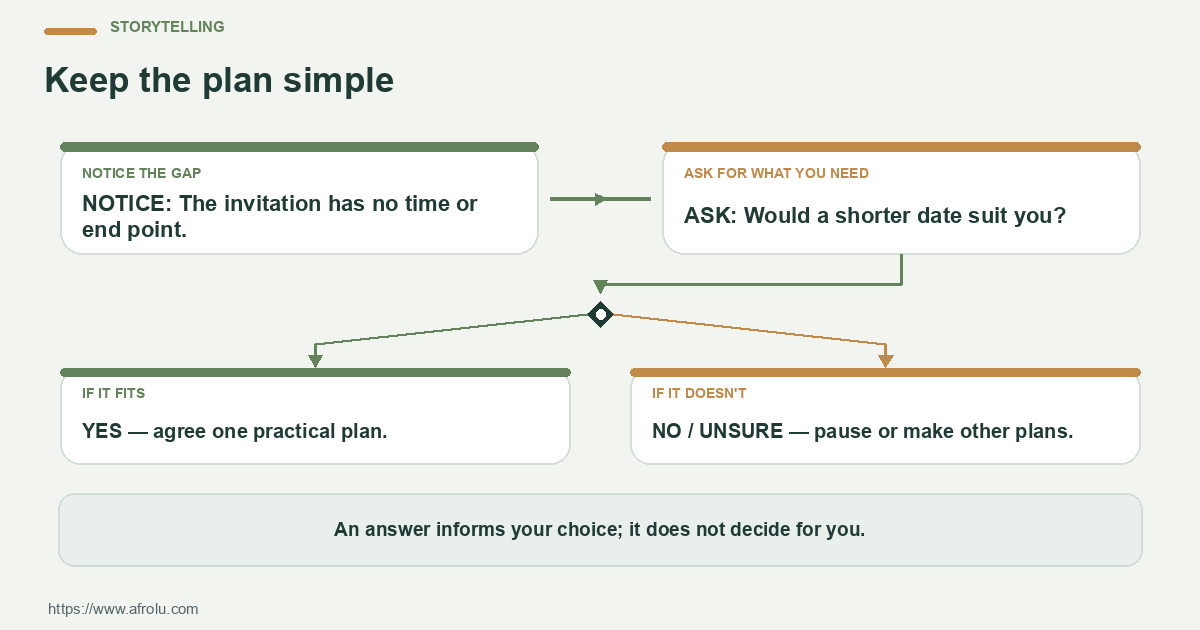
A short walk, free talk or hour at a public garden can be a meaningful date when both people want to go. The activity need not have an elaborate schedule, but the invitation should answer basic questions. Would you like to walk on Sunday at two near the garden entrance? is easier to accept or decline than maybe later.
Low pressure means less performance and obligation, not less respect. You may keep the meeting short, choose a place without a fee, or decide a quiet weekend suits you better. Tell the other person what you prefer instead of hoping they infer it. They can share their preference, and the plan can change if neither option works.
An informal benching label sometimes appears when contact continues without a shared next step. The word cannot tell whether an invitation is vague because someone is uncertain, busy or spontaneous. Rather than treating the label as a verdict, notice whether the plan available matches the kind of dating you want this weekend.
Make room for recovery
Rest is part of the weekend, even when you are dating
A student may move between lectures, commuting, shifts and deadlines, then arrive at Saturday with no spare energy. You can want connection and still prefer a slow morning or an afternoon without plans. Decide how you feel before agreeing, instead of treating every free hour as a chance you must take before someone loses interest.
A bounded activity can help: meet after lunch for a walk, then leave for a study group or go home to rest. If you want to stay longer, that remains your choice. An end time does not signal dislike. It tells both adults how much time is on offer and makes it easier to say yes honestly.
You need not justify your energy with a medical explanation or a list of completed assignments. I can meet for about an hour is enough. If the other person wants longer, choose another day or decline. Someone should be able to hear a time boundary, though one response cannot predict how the whole connection will develop.

Review observable details when deciding whether keeping a low-pressure weekend date compatible with study, spending and recovery fits.
Keep the plan manageable
An activity can be enjoyable without becoming a spending test
Weekend plans can involve transport, food, entry fees and opportunity cost. If you prefer not to spend much, suggest an activity that appeals to you instead of apologizing for a smaller budget. Another adult may have a different preference. Compare options and decide whether to choose something free, share a cost or plan a different day.
A low-cost date is not automatically more sincere, just as an expensive one is not proof of commitment. Avoid offering to pay for everything to seem generous or accepting a cost you cannot carry. You may ask an event's price before agreeing. You can say you would rather meet for a walk than go somewhere with an entry fee.
Keep money discussions tied to the decision. Tuition, family support, salary and account balances are private unless you choose to discuss them. If someone treats your budget boundary as an invitation to pressure you, repeat the limit and leave the plan. Neither adult needs to prove financial worthiness to deserve a respectful date.

Adapt one short question to discuss keeping a low-pressure weekend date compatible with study, spending and recovery.
Keep other plans visible
Making another plan does not make you unavailable
Your weekend may include group work, a shift, family visit or a task that keeps your week manageable. If an invitation arrives late, compare it with those commitments and decide whether you genuinely want to change them. You do not need to reply instantly or give a detailed account of why an hour is unavailable.
If you are open to meeting, offer a window that does not disrupt something important. If the person cannot make it, they can offer another time. You may keep the original plan because it matters more. Neither choice is a game. Respond to your priorities, not to make another adult anxious or jealous.
A maybe can remain a maybe without becoming a moral failure. Tell the other person when you need to make arrangements, then follow through. Choose a limit that matches your calendar rather than borrowing a fixed number of hours from online advice. Different weekends call for different choices.
Choose again after the date
You can enjoy a weekend together and still change pace
After you meet, take stock of your own experience rather than looking for a score. Did you feel comfortable? Was the activity manageable? Could you say when you wanted to leave? You may want to see the person again, keep it casual, ask a question or stop. A good time does not obligate you to continue.
If you want another meeting, share a concrete option. If you want more notice or a different pace, name it. If you do not want to continue, a concise ending is enough. You do not need to use the word benching to justify your choice; describing what you want now is clearer than arguing over a label.
This page's questions and diagrams are editorial reflection aids, not validated measures of attraction, safety or relationship quality. Keep study, friends, rest and other interests in view. If dating creates distress or someone ignores a stated limit, consider talking with a trusted person or qualified support available where you are. An article cannot assess individual risk.

Keep these choices nearby when keeping a low-pressure weekend date compatible with study, spending and recovery.
Common moments in keeping a low-pressure weekend date compatible with study, spending and recovery
An open invitation
For keeping a low-pressure weekend date compatible with study, spending and recovery: A date is mentioned without the detail this reader needs.
Ask for one concrete option and keep other plans until it is confirmed.A timetable changes
For keeping a low-pressure weekend date compatible with study, spending and recovery: Study, work, transport or family changes the time someone can offer.
Share an update and suggest another time only if it works.A clear invitation
For keeping a low-pressure weekend date compatible with study, spending and recovery: Someone offers a walk or community garden visit with a clear start and end with practical details.
Accept, decline or suggest a change freely.A delayed answer
For keeping a low-pressure weekend date compatible with study, spending and recovery: A response arrives after you have made another plan.
Decide whether the offer still suits you; do not treat timing as a score.An uncertain answer
For keeping a low-pressure weekend date compatible with study, spending and recovery: The other adult is unsure about the next step.
Ask what they want now and choose your own limit.A changed place
For keeping a low-pressure weekend date compatible with study, spending and recovery: The meeting point changes after an initial agreement.
Pause and decide whether the new details still work.Different expectations
For keeping a low-pressure weekend date compatible with study, spending and recovery: Both adults use the same dating term differently.
Clarify the part that affects your next choice.A boundary
For keeping a low-pressure weekend date compatible with study, spending and recovery: One person says a time, place or activity does not work.
Respect the limit without repeated pressure.Notice choices and actions, not imagined motives
The plan is simple but specific.
Rest remains a valid choice.
A time boundary is accepted.
The activity fits your energy.
Costs are discussed when relevant.
Other plans remain visible.
A maybe is not a promise.
An end time is not an insult.
Both adults can change their minds.
Study is not treated as rejection.
A later reply creates no debt.
Interest is not forced into performance.
Changes are discussed plainly.
You can choose again afterwards.
Choose a response that fits the moment
| Situation | What it may mean | What to do next |
|---|---|---|
| An open invitation | A date is mentioned without the detail this reader needs. | Ask for one concrete option and keep other plans until it is confirmed. |
| A timetable changes | Study, work, transport or family changes the time someone can offer. | Share an update and suggest another time only if it works. |
| A clear invitation | Someone offers a walk or community garden visit with a clear start and end with practical details. | Accept, decline or suggest a change freely. |
| A delayed answer | A response arrives after you have made another plan. | Decide whether the offer still suits you; do not treat timing as a score. |
| An uncertain answer | The other adult is unsure about the next step. | Ask what they want now and choose your own limit. |
| A changed place | The meeting point changes after an initial agreement. | Pause and decide whether the new details still work. |
| Different expectations | Both adults use the same dating term differently. | Clarify the part that affects your next choice. |
| A boundary | One person says a time, place or activity does not work. | Respect the limit without repeated pressure. |
| The answer is uncertain | The other adult may be unsure or prefer different terms; one answer does not establish motive. | Ask whether another conversation would help, then choose your own limit. |
| Your comfort changes | A changed feeling can be enough reason to revise or stop a plan. | Say what you want now and keep the next choice voluntary. |
Words you can adapt to your own voice
“I am interested in keeping a low-pressure weekend date compatible with study, spending and recovery, and I want to be clear about what works for me.”
“Would you like to plan a walk or community garden visit with a clear start and end?”
“Would you enjoy a short walk on Sunday, or would another time suit you better?”
“I can share one time you can share, not your whole weekend or private schedule, but I am keeping other details private.”
“Can we agree on a short weekend period that leaves time for rest or other commitments before I change my plans?”
“That time no longer works for me. I can suggest another option if I still want to meet.”
“It sounds as if we want different things right now. Have I understood you?”
“My feelings or availability have changed. Would you like to revisit what we agreed?”
“I am not comfortable with that plan, so I will not go ahead with it.”
“I can meet for about an hour, then I need to head home.”
“I want to think about that before I answer. I will get back to you if I decide to.”
“I have appreciated meeting you, but I do not want to continue dating.”
Know the difference
Compare a bounded invitation with an open-ended weekend
The activity, time and natural end point fit the day both adults choose.
The invitation remains vague, leaving study, rest and other plans unsettled.
Low pressure can be clear, enjoyable and easy to decline.

Compare a shared agreement with an assumption in keeping a low-pressure weekend date compatible with study, spending and recovery.
Compare a bounded invitation and an open-ended weekend
| Type or dimension | What it describes | Best next question |
|---|---|---|
| A feeling | Interest, uncertainty or disappointment describes an experience, not an agreement. | Notice it and choose whether to talk or wait. |
| A stated goal | Each person can explain a hope without guaranteeing an outcome. | Ask what the goal means in current choices. |
| A clear plan | A time, activity and practical details have been agreed. | Confirm the details and keep the choice voluntary. |
| A boundary | A person names what they will or will not do. | Respect it without asking repeatedly. |
| A changed plan | Someone's schedule, place or comfort has shifted. | Offer or accept an alternative only if it works. |
| An open possibility | A future idea has been mentioned but no present step is agreed. | Separate hope from what is available today. |
| A mismatch | Two adults want different terms, pace or contact. | Decide whether the actual offer suits you. |
| A repeated pattern | Several interactions show how plans or limits are handled. | Describe observations without diagnosing motive. |
| A new choice | Either adult wants to revise or end the arrangement. | State the change and let both adults respond freely. |
Six practical ideas to keep nearby
No universal movement score
A reflection prompt cannot measure intent, safety or relationship quality.
Messages are not terms
Contact and affection do not define exclusivity or commitment.
Small steps count
For keeping a low-pressure weekend date compatible with study, spending and recovery, one manageable action may give useful information.
Boundaries remain yours
You can protect time, privacy, money and comfort while dating.
Use observable details
Compare what was agreed with what happened without guessing motive.
Choose again
Continue, clarify, pause or stop as your needs change.
Questions for planning and reflection
Choose a few prompts that fit the moment. This is a reference library, not a list to complete.
Before a plan
Choose conditions that fit your real life.
- What do I want from this interaction?
- What detail or boundary matters?
- What is one step I actually want?
During the conversation
Ask the question that affects your next choice.
- What does this term mean to me?
- What does the other person want now?
- Can either of us say no freely?
Afterward
Notice your experience without turning it into a verdict.
- Could I be myself?
- Did the plan and boundary hold?
- Do I want another step?
If something changes
Revisit the plan without assigning motive.
- What changed?
- What do I want now?
- Would a pause or ending fit better?
What research and guidance can—and cannot—tell you
What a narrow survey can show
A Canadian survey of 647 emerging adults examined remote communication among people dating or in relationships.
Evidence limit: It cannot set a message quota or prove that more texting causes satisfaction.
Why schedules vary
U.S. time-use research examined work and family demands among established couples.
Evidence limit: It cannot prescribe a student dating schedule or explain one person's availability.
What direct questions can do
A two-wave study examined relationship-status conversations in a defined U.S. sample.
Evidence limit: It does not offer a universal timeline or represent every adult in Kenya.
Why an informal term is not a diagnosis
Words such as casual, serious and benching can mean different things to different adults.
Evidence limit: This guide does not diagnose attachment, motive or mental-health conditions.
Share personal information deliberately
Kenya's ODPC describes rights and consent involving personal-data processing.
Evidence limit: Data-protection guidance does not authenticate a profile or guarantee confidentiality.
Use planning choices without promises
Australian and U.S. resources offer general online-dating suggestions.
Evidence limit: They are not Kenyan legal advice, a safety guarantee or an individual risk assessment.
Common assumptions that add pressure
Treating benching as a diagnosis
The informal word cannot establish another person's motive.
Treating a date as a promise
One interaction does not define a future relationship.
Using a label as a contract
Adults can mean different things by the same dating term.
Explaining a boundary at length
A respectful no does not need a long defense.
Reading one delay as proof
Timing has many explanations; ask for what you need.
Giving up ordinary support
Friends, routine, rest and qualified support can remain part of life.
Offer a simple plan and protect your rest
These information links are clearly labelled, non-commercial and do not promise a relationship outcome.
Explore the guide library
Show more related guides
Continue with Afrolu
Show more Afrolu guides
Research and practical guidance used for this guide
Afrolu reviewed these health, research, safety, or public guidance resources while editing this page. They support the behaviour and safety guidance; they do not diagnose any individual described by a reader.
Questions about keeping a low-pressure weekend date compatible with study, spending and recovery
Does low pressure mean no planning?
No. A modest plan can still name the day, time and activity.
Can I protect a weekend for rest?
Yes. You can be interested in dating and still choose a quiet day.
Should I keep a day open for a vague invitation?
Only if you want to; ask for details and continue with other plans.
Does a short date seem uninterested?
Not necessarily. State the time you have and let the other adult choose.
Is a low-cost plan less thoughtful?
No. Cost does not determine care or commitment.
Can I say no after a good date?
Yes. A pleasant meeting does not obligate you to continue.
Does one cancellation prove benching?
No. Notice communication and alternatives over time without guessing motive.
Is this reflection check validated?
No. It is an editorial aid, not a research scale or predictor.
What if our planning styles differ?
Discuss the difference and decide whether the available arrangement works for you.
Do I owe an explanation for resting?
No. A simple boundary is enough.
One thing to do now
Choose the next step that fits your actual needs
Offer a simple plan you would enjoy, keep the rest of the weekend intact and decide from confirmed details rather than hope.